The thought of an interview can be nerve-wracking, but the right preparation can make all the difference. Explore this comprehensive guide to Radar System Maintenance interview questions and gain the confidence you need to showcase your abilities and secure the role.
Questions Asked in Radar System Maintenance Interview
Q 1. Explain the different types of radar systems.
Radar systems are categorized based on several factors, including their frequency, waveform, and application. Broadly, they can be classified into:
- Primary Radar: This type transmits a signal and directly receives the reflected signal from the target. Think of it like shouting and listening for an echo. It provides direct information about the target’s range, velocity, and angle.
- Secondary Radar: This system relies on transponders in the target (like aircraft) that respond to the transmitted signal. This is similar to using a two-way radio – you send a message, and the target sends a reply with additional information. This improves accuracy and provides identification.
- Pulse Radar: This classic type transmits short bursts (pulses) of energy and measures the time it takes for the echo to return. Most common types of weather and air traffic control radars are pulse radars.
- Continuous Wave (CW) Radar: This system transmits a continuous signal. It measures the Doppler shift – the change in frequency – to determine target velocity. Commonly used for speed guns and some weather detection.
- Frequency Modulated Continuous Wave (FMCW) Radar: This sophisticated system transmits a continuously varying frequency signal. It measures the difference between the transmitted and received frequencies to determine range and velocity very accurately. This type is found in advanced automotive applications and some high-precision industrial sensors.
- Doppler Radar: Any radar that specifically measures the Doppler shift to determine target velocity falls under this category. Both pulse and CW radars can employ Doppler techniques.
Each type has its own strengths and weaknesses, making it suitable for different applications. For instance, a weather radar might use pulse-Doppler technology to detect both the precipitation’s range and velocity, while a police radar often uses CW radar to measure vehicle speed precisely.
Q 2. Describe the process of troubleshooting a malfunctioning radar system.
Troubleshooting a malfunctioning radar system is a systematic process. It typically involves these steps:
- Safety First: Always ensure the system is powered down and locked out before commencing any work. Understand the potential hazards associated with high-power RF systems.
- Initial Assessment: Begin by identifying the symptoms. Is there no signal at all? Are there false targets? Is the range limited? Is the display erratic?
- Check the Obvious: Inspect for obvious physical damage, loose connections, or environmental factors like excessive heat or humidity. Sometimes the problem is simpler than it seems.
- Consult Documentation: Refer to the system’s technical manuals, schematics, and diagnostic procedures. This is crucial for understanding the specific system architecture and troubleshooting techniques.
- Signal Tracing: Using appropriate test equipment (spectrum analyzers, oscilloscopes, signal generators), trace the signal path from the transmitter to the receiver, checking for signal strength, noise levels, and any anomalies at each stage.
- Component Level Testing: If signal tracing points to a specific component (e.g., magnetron, modulator, receiver), isolate it and test its functionality using specialized test equipment. This might involve substituting known good components.
- Software Diagnostics: Many modern radar systems have built-in diagnostic routines that can help pinpoint the source of the problem. Access and analyze these diagnostics to determine error codes and relevant data.
- Calibration and Alignment: Once the faulty component is identified and repaired/replaced, the system may require recalibration and alignment to ensure optimal performance.
- System Testing: After repairs, thoroughly test the system to ensure it’s functioning correctly under various conditions. Document all findings and corrective actions.
Remember to meticulously document every step of the troubleshooting process, including observations, measurements, and actions taken. This is essential for future reference and for collaborating with other technicians.
Q 3. What are the common causes of radar system failures?
Radar system failures can stem from a multitude of sources:
- Component Failures: High-power components like magnetrons, klystrons, and traveling-wave tubes (TWTs) can fail due to aging, overheating, or voltage surges. Solid-state components (e.g., transistors, diodes) can also fail, often due to age or stress.
- Antenna Problems: Damage to the antenna, misalignment, or blockage (e.g., by birds’ nests, ice) can significantly affect performance. Poor connections or RF leaks in the antenna system are also common culprits.
- High Voltage Issues: Problems with the high-voltage power supplies that feed the transmitter can lead to system malfunctions. This can be due to faulty components within the power supply or insufficient filtering.
- Receiver Issues: A malfunctioning receiver can result in noise, poor sensitivity, or inaccurate signal processing. This can stem from defective components within the receiver chain or interference.
- Signal Processing Errors: Issues within the radar’s signal processing algorithms or the digital processing units (DPUs) can manifest as incorrect range, velocity, or angle measurements. Software bugs or corrupted data can be the cause.
- Environmental Factors: Extreme temperatures, humidity, or precipitation can affect the performance and reliability of the system. Lightning strikes can cause catastrophic damage.
Often, failures are not isolated events. For example, a magnetron failure might lead to other cascading failures in the high-voltage supply due to voltage spikes.
Q 4. How do you perform preventative maintenance on a radar system?
Preventative maintenance is crucial for maintaining radar system reliability and extending its lifespan. This includes:
- Regular Inspections: Conduct visual inspections of all components, cables, and connectors. Look for signs of wear and tear, loose connections, corrosion, or damage.
- Cleaning: Regularly clean the antenna to remove debris, bird droppings, or ice buildup. This is especially important in harsh environmental conditions.
- Calibration: Perform periodic calibration checks to ensure the accuracy of range, velocity, and angle measurements. This often involves using specialized calibration equipment.
- Component Testing: Test critical components like magnetrons, klystrons, and high-voltage power supplies using appropriate test equipment. Replace components showing signs of degradation or wear before they fail.
- Software Updates: Update the radar system’s software to the latest version whenever updates are available. This often includes bug fixes and performance improvements.
- Environmental Control: Maintain proper environmental conditions, such as temperature and humidity, within the recommended operating range. Consider using environmental controls like air conditioning and dehumidifiers.
- Documentation: Maintain thorough records of all maintenance activities, including inspection reports, calibration data, and component replacements.
A well-structured preventative maintenance program, tailored to the specific radar system and its operating environment, can significantly reduce downtime and extend the operational life of the equipment.
Q 5. What safety precautions do you take when working on radar systems?
Safety is paramount when working on radar systems. High-power RF signals, high voltages, and potentially hazardous mechanical components require stringent safety protocols:
- Lockout/Tagout (LOTO): Always follow LOTO procedures before working on any part of the system to prevent accidental energization.
- Personal Protective Equipment (PPE): Use appropriate PPE, including safety glasses, gloves, and hearing protection, as necessary.
- RF Safety: Understand the potential hazards of RF exposure and use appropriate RF shielding and protective measures. Never expose yourself to high-power RF radiation.
- High Voltage Safety: Use proper insulation and safety precautions when working with high-voltage circuits. Always ensure the system is fully discharged before working on it.
- Grounding: Ensure proper grounding of the system to prevent electrical shocks or static electricity damage.
- Emergency Procedures: Be familiar with emergency procedures in case of accidents or emergencies.
- Training: All personnel involved in radar maintenance should receive adequate training on safety procedures and the potential hazards associated with the specific system.
Ignoring safety precautions can lead to severe injury or death. Always prioritize safety above all else.
Q 6. Explain the principles of radar signal processing.
Radar signal processing is a complex subject but can be summarized as follows: The received signal, often weak and contaminated by noise and clutter, undergoes several stages to extract meaningful information.
- Reception and Amplification: The antenna receives the weak reflected signal, which is then amplified to a usable level. The initial signal is weak because much of the transmitted energy scatters in various directions; only a small fraction returns to the antenna.
- Noise Filtering: The amplified signal contains noise and clutter (e.g., reflections from the ground or weather). Filters are employed to remove or attenuate these unwanted signals, enhancing the target signal’s detectability.
- Signal Detection: A threshold is set to determine whether a received signal is a true target echo or just noise. This often involves comparing the received signal’s strength against the noise level.
- Pulse Compression: For pulse radars, pulse compression techniques are used to increase range resolution. This involves encoding the transmitted pulse in a specific manner and then decoding the received pulse to achieve improved resolution.
- Doppler Processing: Doppler processing is used to determine the target’s radial velocity (velocity along the radar line of sight). This involves analyzing the frequency shift of the received signal caused by the Doppler effect.
- Target Tracking: Once targets are detected, algorithms track their movement by combining data from multiple scans. This involves predicting future target positions and updating tracking data with each new scan.
- Clutter Rejection: Advanced techniques are employed to further reduce the effect of clutter. Examples include moving target indication (MTI), which eliminates stationary clutter, and space-time adaptive processing (STAP), which adapts to changing clutter conditions.
The output of the signal processing chain is a set of parameters for each detected target (e.g., range, velocity, angle, and possibly target size or type), which are then presented to the radar operator or integrated into a larger system.
Q 7. How do you interpret radar data?
Interpreting radar data involves understanding the information presented and converting it into meaningful insights.
- Range: The distance from the radar to the target. It’s determined by measuring the time it takes for the radar signal to travel to the target and back.
- Velocity: The target’s speed and direction relative to the radar. This is obtained using Doppler processing.
- Angle: The direction of the target relative to the radar (azimuth and elevation). This is determined using directional antennas or antenna arrays.
- Target Characteristics: In advanced radars, additional information about the target might be available, such as size, shape, and type. This is often accomplished using sophisticated signal processing techniques like polarization diversity or synthetic aperture radar (SAR).
- Weather Data: Weather radars provide information on precipitation type (rain, snow, hail), intensity, and movement.
The interpretation of radar data depends heavily on the type of radar and its application. For example, an air traffic controller interprets radar data to maintain safe separation between aircraft, while a meteorologist uses weather radar data to predict severe weather events. The data is typically presented on a display, which shows targets as blips or symbols with associated range, velocity, and angle information. The user’s understanding of the radar system and data representation is crucial for correct interpretation.
It’s essential to understand the limitations of radar data. Factors such as atmospheric conditions, clutter, and radar limitations can affect the accuracy and reliability of the information. Experienced radar operators understand these limitations and use their knowledge to interpret the data effectively.
Q 8. Describe your experience with radar calibration and alignment.
Radar calibration and alignment are crucial for ensuring accurate target detection and measurement. It involves adjusting the radar system’s parameters to match its specifications and environmental conditions. This process typically includes several steps.
- Phase Alignment: Ensuring the transmitter and receiver signals are synchronized. Misalignment leads to signal cancellation and reduced sensitivity. I’ve used sophisticated test equipment like network analyzers to precisely measure and adjust phase differences in various radar systems, including X-band and Ku-band.
- Gain Calibration: This step involves adjusting the amplifier gains to ensure uniform signal strength across the entire range and beamwidth. Inaccurate gain can result in inconsistent target detection. I’ve worked with various calibration standards and traceable methods to achieve the required accuracy, often using precision attenuators and power meters.
- Beam Alignment: This ensures the radar beam points precisely in the intended direction. Misalignment leads to inaccurate target location and reduced detection range. I have experience using specialized alignment tools, including theodolites and precise positioning systems, to ensure the antenna is correctly pointed.
- Range Calibration: This involves verifying the accuracy of range measurements by using known targets at precise distances. This often involves comparing the radar measurements with GPS-referenced targets.
For example, during maintenance on an airport surveillance radar, I once identified a subtle phase mismatch in the receiver chain. After careful adjustment using a vector network analyzer, we significantly improved the system’s sensitivity and reduced false alarms.
Q 9. What software and tools are you familiar with for radar system maintenance?
My experience encompasses a wide range of software and tools used in radar system maintenance. This includes both specialized radar test equipment and general-purpose software.
- Software: I’m proficient in using radar signal processing software packages like MATLAB and specialized radar simulation software for analyzing system performance and troubleshooting. I also have experience with database management systems to maintain radar performance records and historical data.
- Test Equipment: My expertise extends to using sophisticated instruments including vector network analyzers (VNAs), spectrum analyzers, oscilloscopes, signal generators, power meters, and time-domain reflectometers (TDRs) for various tests and calibrations. I’m also comfortable working with GPS receivers for accurate positioning and timing synchronization.
- Specialized Tools: I have experience with antenna alignment tools (e.g., theodolites), RF power sensors for high-power systems, and specialized diagnostic software provided by radar manufacturers.
For instance, using a VNA, I once isolated a faulty component in the transmitter chain of a weather radar by observing an unusual frequency response. This allowed us to pinpoint the problem and replace the component effectively.
Q 10. How do you diagnose and repair faulty radar components?
Diagnosing and repairing faulty radar components is a systematic process requiring a strong understanding of radar principles and troubleshooting techniques.
- Symptom Identification: The first step is to carefully identify the specific symptoms of the malfunction, such as reduced range, poor resolution, increased noise level, or erratic behavior.
- System Check: I then perform a thorough check of the entire system, starting from the antenna, down to the receiver and signal processor. This might involve visual inspection for any physical damage, checking connections, and testing power supplies.
- Component-Level Testing: Based on the initial assessment, I perform targeted tests on individual components using appropriate test equipment. For example, I might use a VNA to test the integrity of waveguide components, or an oscilloscope to check the waveforms in the receiver chain.
- Fault Isolation: Using the test results, I pinpoint the faulty component. This may involve comparing measured parameters against specifications or using signal tracing techniques.
- Repair or Replacement: Once the faulty component is identified, it is either repaired (if feasible) or replaced with a new one. After replacement, a thorough retest of the system is always performed.
For example, I once encountered a weather radar exhibiting significant noise. After a systematic check, I found a faulty high-voltage power supply. Replacing this component immediately restored the system to optimal performance.
Q 11. Explain your experience with different types of radar antennas.
My experience covers a variety of radar antenna types, each with its own unique characteristics and maintenance requirements.
- Parabolic Reflectors: These are common in many radar systems and require careful alignment and surface condition checks. I have experience with cleaning, repairing, and adjusting these antennas to ensure optimal performance. Surface imperfections or misalignment significantly affect beam shape and gain.
- Phased Arrays: These electronically steerable antennas offer great flexibility but require careful monitoring of individual element performance. I’m familiar with testing individual array elements and identifying and replacing faulty components within the array.
- Horn Antennas: These are simple and rugged antennas, but their performance can still be affected by environmental factors like moisture or damage. I have experience maintaining horn antennas used in various applications, from ground-based to airborne systems.
- Microstrip Antennas: These antennas are often used in compact radar systems. Their maintenance involves checking for damage to the antenna substrate and ensuring proper impedance matching.
During the maintenance of a shipborne radar system, I once identified corrosion on a parabolic reflector’s surface, causing reduced signal strength. We cleaned and restored the surface, regaining the system’s expected performance.
Q 12. Describe your experience with high-power RF systems.
Working with high-power RF systems demands meticulous safety precautions and specialized expertise. My experience includes working with systems operating at tens of kilowatts and even megawatts.
- Safety Procedures: Safety is paramount. I’m rigorously trained in RF safety procedures, including proper grounding, shielding, and the use of personal protective equipment (PPE), such as RF protective clothing and safety eyewear.
- High-Voltage Systems: High-power systems often involve high-voltage components and circuits. I have experience with high-voltage testing and diagnostics, ensuring the safety of both personnel and equipment.
- High-Power Amplifier Maintenance: I have expertise in maintaining and repairing high-power amplifiers, including cooling systems, power supplies, and RF components. These often involve specialized test equipment and procedures.
- Troubleshooting High-Power Issues: Diagnosing issues in high-power systems can be challenging due to the potential for damage from excessive RF power. I’m skilled in using specialized techniques and equipment to isolate faults without causing further damage.
For example, during the maintenance of a weather radar system using a high-power magnetron, I noticed signs of arcing in the waveguide. Using specialized tools and taking all necessary safety precautions, I identified and repaired the arcing before it could cause further damage.
Q 13. How do you handle complex radar system issues?
Handling complex radar system issues requires a systematic and methodical approach.
- Thorough Analysis: I begin by thoroughly analyzing the problem, gathering all available data and symptoms.
- Root Cause Identification: This is a crucial step, often involving a combination of testing, simulation, and analysis of the collected data. I use fault trees and other systematic methods to isolate the root cause and not just treat the symptoms.
- Documentation: I maintain detailed documentation of all tests, findings, and repairs. This is essential for traceability and future maintenance.
- Collaboration: For complex problems, I readily collaborate with other engineers and specialists to leverage expertise and brainstorm solutions.
- Verification and Validation: After implementing a solution, I thoroughly verify its effectiveness and validate that the system is performing as expected.
In one instance, a military radar system experienced intermittent failures. By systematically analyzing the data logs, I found a correlation between the failures and extreme temperature variations. Further investigation revealed a flaw in the thermal design of a critical component. Collaboration with a thermal engineer resulted in a redesign and eliminated the problem.
Q 14. What are the key performance indicators (KPIs) for a radar system?
Key Performance Indicators (KPIs) for a radar system are crucial metrics that assess its overall effectiveness. These KPIs vary depending on the radar’s specific application, but some common ones include:
- Detection Range: The maximum distance at which the radar can reliably detect a target. This is crucial for surveillance and early warning systems.
- Accuracy: The precision of target location, range, and velocity measurements. Inaccurate measurements can lead to poor decision-making.
- Sensitivity: The radar’s ability to detect weak signals from small or distant targets. A highly sensitive radar can detect more targets and provide more detailed information.
- False Alarm Rate: The frequency of false alarms, which are incorrect target detections. A high false alarm rate makes the system unreliable.
- Resolution: The ability to distinguish between closely spaced targets. Good resolution is essential for dense target environments.
- Mean Time Between Failures (MTBF): This indicates the system’s reliability and is a measure of time until the system needs maintenance.
- System Availability: Percentage of time the system is operational and available for its intended use. This metric includes time lost due to planned and unplanned maintenance.
Regular monitoring of these KPIs allows for proactive maintenance and ensures the radar system remains efficient and reliable.
Q 15. How do you ensure the accuracy and reliability of radar data?
Ensuring the accuracy and reliability of radar data is paramount. It involves a multi-faceted approach encompassing meticulous calibration, regular maintenance, and sophisticated signal processing techniques.
Calibration: We regularly calibrate the radar system using known targets or signal generators. This process verifies the accuracy of range, azimuth, elevation, and velocity measurements. For instance, we might use a precision-positioned target at a known distance to check for range errors. Any deviations are then corrected through adjustments to the system’s parameters.
Maintenance: Preventative maintenance is key. This includes checking antenna alignment, ensuring the integrity of the RF components, and verifying the health of the signal processing units. We use diagnostic tools to identify and address issues before they impact data accuracy. A simple example is regularly cleaning the radar’s antenna to prevent signal degradation from accumulated debris.
Signal Processing: Advanced signal processing algorithms help filter out noise and clutter. Clutter rejection techniques, like Moving Target Indication (MTI), are vital in distinguishing real targets from background interference like rain or ground reflections. Proper implementation of these algorithms is crucial for reliable data. We often use specialized software to fine-tune these algorithms for optimal performance in specific environmental conditions.
Career Expert Tips:
- Ace those interviews! Prepare effectively by reviewing the Top 50 Most Common Interview Questions on ResumeGemini.
- Navigate your job search with confidence! Explore a wide range of Career Tips on ResumeGemini. Learn about common challenges and recommendations to overcome them.
- Craft the perfect resume! Master the Art of Resume Writing with ResumeGemini’s guide. Showcase your unique qualifications and achievements effectively.
- Don’t miss out on holiday savings! Build your dream resume with ResumeGemini’s ATS optimized templates.
Q 16. Describe your experience with radar system documentation and reporting.
My experience with radar system documentation and reporting is extensive. I’ve created and maintained comprehensive system logs, fault reports, and maintenance records for a variety of radar systems. This includes meticulous record-keeping of all maintenance activities, calibration results, and any identified issues.
I utilize structured reporting templates to ensure consistency and clarity. Reports typically include details on the issue encountered, diagnostic steps taken, corrective actions performed, and the system’s subsequent performance. For instance, a detailed report might include graphs showing signal strength before and after a component replacement.
Furthermore, I’m proficient in creating visual aids, such as diagrams and schematics, to enhance the understanding of complex system issues. My documentation adheres to industry best practices to ensure traceability and ease of access for future reference.
Q 17. Explain your understanding of radar system testing procedures.
Radar system testing procedures are rigorous and depend heavily on the specific radar type and its intended application. However, several common elements exist across various testing methodologies.
- Functional Tests: These verify that all system components are operating as expected. This might involve checking the functionality of the transmitter, receiver, antenna, and signal processing units independently and as an integrated system.
- Performance Tests: This focuses on evaluating the radar’s key performance indicators (KPIs), such as range accuracy, angular accuracy, velocity accuracy, and detection sensitivity. We use calibrated targets and controlled environments to measure these parameters.
- Environmental Tests: This involves subjecting the radar to various environmental stresses like temperature extremes, humidity, and vibrations. This is crucial to ensure its reliability under real-world operating conditions.
- Acceptance Tests: These tests are performed after maintenance or upgrades to verify that the system is functioning according to its specifications and is ready for operational use. These often involve rigorous testing against pre-defined criteria.
Throughout testing, we meticulously document the results and any anomalies discovered. We use specialized testing equipment, such as signal generators and spectrum analyzers, to facilitate these procedures.
Q 18. How do you stay updated with the latest advancements in radar technology?
Staying updated on advancements in radar technology is crucial for my role. I accomplish this through a combination of methods.
- Professional Conferences and Workshops: Attending industry conferences allows me to learn about the latest research and developments directly from leading experts. I actively participate in discussions and workshops to expand my knowledge base.
- Industry Publications and Journals: I subscribe to leading publications and journals focusing on radar technology, reviewing articles on cutting-edge techniques and new system designs. This keeps me informed about the latest research and technological trends.
- Online Courses and Webinars: I frequently participate in online courses and webinars hosted by industry leaders and educational institutions to hone my skills in specific areas of radar technology.
- Manufacturer Training Programs: When working with specific radar systems, I participate in manufacturer-provided training programs to remain updated on the system’s operational capabilities and new features.
This proactive approach ensures I remain at the forefront of the field, enabling me to offer optimal maintenance and support.
Q 19. Describe your experience with radar system upgrades and modifications.
I have extensive experience with radar system upgrades and modifications. These can range from minor component replacements to major system overhauls.
Component Upgrades: This often involves replacing outdated components with more modern, efficient, and reliable alternatives. For example, replacing older signal processors with newer, faster processors can significantly improve system performance. This often requires careful planning and execution to ensure minimal downtime and seamless integration.
System Enhancements: We may add new capabilities to existing radar systems, such as improved clutter rejection algorithms or advanced signal processing techniques. This can involve integrating new software, hardware, or both. A common example is adding a digital beamforming capability to an existing phased array radar for improved target resolution and tracking.
Major Overhauls: These are more extensive projects that may involve complete system replacements or significant modifications to its architecture. This requires careful planning, coordination with stakeholders, and adherence to stringent safety protocols. A significant overhaul might involve migrating from an analog system to a fully digital system.
Throughout the upgrade and modification process, rigorous testing is performed to ensure the system functions correctly and meets the performance requirements. Documentation is meticulously updated to reflect all changes made.
Q 20. How do you manage multiple tasks and prioritize your workload in radar maintenance?
Managing multiple tasks and prioritizing workload in radar maintenance requires a structured and organized approach.
Prioritization Matrix: I employ a prioritization matrix that considers urgency and impact. Tasks with high urgency and high impact are addressed immediately. Tasks with low urgency and low impact are scheduled for later. This approach ensures that critical maintenance tasks are completed timely.
Task Scheduling Tools: I utilize task scheduling tools to plan and track my activities. This allows me to allocate sufficient time for each task, manage deadlines effectively, and ensure efficient resource utilization. I find Gantt charts particularly useful for visualizing task dependencies and timelines.
Regular Review and Adjustment: I regularly review my schedule and adjust priorities as needed. Unforeseen issues or urgent requests may necessitate changes to the initial plan. Flexibility is key to handling unexpected events effectively.
This systematic approach helps me maintain efficiency and ensures all tasks are completed within the appropriate timeframe.
Q 21. What is your experience with working in a team environment on radar system projects?
I have extensive experience collaborating in team environments on radar system projects. Effective teamwork is essential for successful radar maintenance and upgrades.
Communication and Collaboration: I strongly believe in clear and open communication. I actively participate in team meetings, contribute my expertise, and readily share information with my colleagues. I actively seek input and collaboration from other team members to leverage diverse perspectives.
Problem-Solving: When faced with complex issues, I collaborate with other team members to brainstorm solutions. We leverage each individual’s strengths and expertise to effectively resolve the problem.
Role Clarity and Responsibility: I am adept at working within a defined structure, understanding my role and responsibilities within the team. This ensures clarity and efficiency in task completion.
My experience demonstrates a consistent ability to work effectively within team dynamics, contributing positively to the overall success of our projects. For example, in a recent project involving a major radar upgrade, effective teamwork ensured the project was completed ahead of schedule and within budget.
Q 22. Describe your troubleshooting methodology for radar system problems.
My troubleshooting methodology for radar system problems follows a systematic approach, much like a detective solving a case. I begin with a thorough symptom analysis, carefully documenting the issue. Is the system completely down? Is there reduced range performance? Are there specific error codes displayed? This initial assessment guides the next steps.
Next, I move to data analysis. Radar systems generate a wealth of information; I examine logs, sensor readings, and performance metrics to identify any anomalies or patterns. For instance, a sudden drop in signal strength might indicate a problem with the antenna, while increased noise might point to interference. I utilize specialized diagnostic software to delve deeper into the system’s internal workings.
Then comes component testing. Based on the data analysis, I isolate potential faulty components. This might involve checking the transmitter, receiver, antenna, signal processor, or power supply. I use calibrated test equipment to verify the functionality of each component, ensuring accurate measurements. For example, I’d use a spectrum analyzer to verify the transmitter output power and frequency.
Finally, repair or replacement is performed, followed by comprehensive system testing to ensure the problem is resolved and the system is operating within specifications. Thorough documentation is crucial throughout the entire process, allowing for future troubleshooting and preventative maintenance.
Q 23. Explain the importance of regular maintenance for radar system longevity.
Regular maintenance is paramount for ensuring the longevity and optimal performance of a radar system. Think of it like servicing a car – regular checks prevent small problems from escalating into major, costly failures. Preventive maintenance extends the operational lifespan, reduces downtime, and improves the accuracy and reliability of the system.
Regular tasks include checking for loose connections, inspecting for corrosion, cleaning components (like antennas), verifying calibration, and performing software updates. These actions prevent degradation of components due to environmental factors or wear and tear. A well-maintained radar system is less likely to experience unexpected failures, leading to reduced operational costs and improved safety.
For instance, neglecting antenna maintenance can lead to signal degradation and inaccurate readings, while a faulty power supply can cause catastrophic system failure. Proactive maintenance minimizes such risks, leading to a more robust and dependable system.
Q 24. How do you handle emergency repairs on a radar system?
Emergency repairs require a swift, decisive response. My priority is to ensure safety first, then assess the urgency and impact of the failure. Is the system critical to safety or operations? I prioritize addressing the most critical issues immediately, often working with a team to ensure a coordinated effort.
My approach involves a rapid assessment using available tools and data. This often involves isolating the problem area, determining if a quick fix is possible, or if a component replacement is required. If a part is unavailable, I might employ temporary workarounds to restore partial functionality until a replacement can be sourced and installed. In a critical situation, I would consult with senior engineers or manufacturers for support.
For example, if a critical transmitter component fails, I might try to utilize a backup system (if available) while awaiting a replacement. Comprehensive documentation is crucial during emergency repairs, providing valuable insights for future maintenance and identifying potential weaknesses in the system.
Q 25. What are the common challenges faced in radar system maintenance?
Radar system maintenance presents several challenges. One common issue is the complexity of the systems themselves. These systems integrate numerous sophisticated components, requiring specialized knowledge and equipment for proper maintenance. The sheer number of potential failure points makes troubleshooting demanding.
Environmental factors also play a significant role. Exposure to harsh weather conditions (extreme temperatures, humidity, salt spray) can accelerate component degradation. This necessitates robust protective measures and regular inspections.
Another challenge is obtaining spare parts. Specialized components might have long lead times, potentially causing extended downtime. Effective inventory management and proactive sourcing strategies are crucial to mitigating this issue.
Finally, staying updated with the latest technologies and maintenance procedures is vital. Radar systems are constantly evolving, requiring ongoing professional development to ensure effective maintenance and troubleshooting.
Q 26. How do you ensure compliance with relevant safety regulations when working on radar systems?
Safety is my paramount concern. I strictly adhere to all relevant safety regulations, including those pertaining to high-voltage systems, RF radiation, and hazardous materials. Before starting any work, I perform a thorough risk assessment, identifying potential hazards and implementing appropriate safety measures.
This includes using appropriate personal protective equipment (PPE), such as safety glasses, gloves, and hearing protection, and utilizing lockout/tagout procedures to prevent accidental energization of equipment during maintenance. I maintain detailed records of all safety procedures followed and any incidents that occurred. Compliance with regulations ensures a safe working environment for myself and others, and prevents potential accidents or injuries.
Regular safety training and awareness programs are also crucial. Continuous learning helps keep my knowledge current and ensures adherence to the latest safety standards and best practices. I actively participate in these programs to enhance my safety awareness and competency.
Q 27. Describe your experience with different radar frequency bands and their applications.
I have extensive experience working with various radar frequency bands, each with its own specific applications. For example, L-band (1-2 GHz) is commonly used in weather radar, providing excellent penetration through clouds and precipitation. Its longer wavelength offers better performance in adverse weather conditions.
S-band (2-4 GHz) is frequently employed in air traffic control and weather radar due to its good range and resolution. X-band (8-12 GHz) is used in short-range applications like automotive radar and security systems, offering high resolution but with reduced range compared to lower frequencies.
Ku-band (12-18 GHz) and Ka-band (26.5-40 GHz) are utilized in high-resolution applications needing exceptional precision, such as satellite communication and advanced weather systems. Higher frequencies provide greater resolution but are more susceptible to atmospheric attenuation.
My experience spans across these bands, allowing me to tailor maintenance procedures to the specific requirements of each frequency and its application. Understanding the unique characteristics of each band is crucial for effective troubleshooting and performance optimization.
Q 28. Explain your understanding of the impact of environmental factors on radar system performance.
Environmental factors significantly influence radar system performance. Temperature variations affect component characteristics, leading to performance degradation or malfunctions. Extreme heat can cause overheating and damage to sensitive electronics, while extreme cold can affect signal propagation and component efficiency.
Humidity can cause corrosion and degradation of electrical connections and antenna components, leading to signal attenuation and performance issues. Precipitation (rain, snow, hail) can absorb and scatter radar signals, reducing range and accuracy.
Atmospheric conditions such as atmospheric pressure and refractive index also influence signal propagation. Salt spray in coastal environments is particularly corrosive to many radar components. Understanding these environmental effects is critical for proper system design, siting, and maintenance. Regular inspections, protective measures, and environmental monitoring are essential to mitigate their impact.
Key Topics to Learn for Radar System Maintenance Interview
- Radar System Fundamentals: Understanding the basic principles of radar operation, including signal transmission, reception, and processing. This includes familiarity with different radar types (e.g., pulsed, continuous wave).
- RF and Microwave Components: Knowledge of common components like waveguides, antennas, transmitters, receivers, and associated circuitry. Be prepared to discuss troubleshooting techniques for these components.
- Signal Processing Techniques: Understanding digital signal processing (DSP) as it applies to radar systems. This includes concepts like filtering, noise reduction, and target detection algorithms.
- System Diagnostics and Troubleshooting: Practical experience with diagnosing and resolving faults in radar systems. This involves using test equipment and interpreting diagnostic data.
- Maintenance Procedures and Documentation: Familiarity with standard maintenance practices, including preventative maintenance schedules, repair procedures, and accurate record-keeping.
- Safety Procedures and Regulations: Understanding and adhering to safety protocols when working with high-power RF systems. This includes proper grounding, shielding, and personal protective equipment (PPE).
- Test Equipment and Instrumentation: Proficiency in using various test equipment, such as spectrum analyzers, oscilloscopes, and network analyzers, to diagnose and repair radar systems.
- Data Analysis and Interpretation: Ability to interpret radar data to identify anomalies and performance issues. This includes understanding radar parameters and their significance.
Next Steps
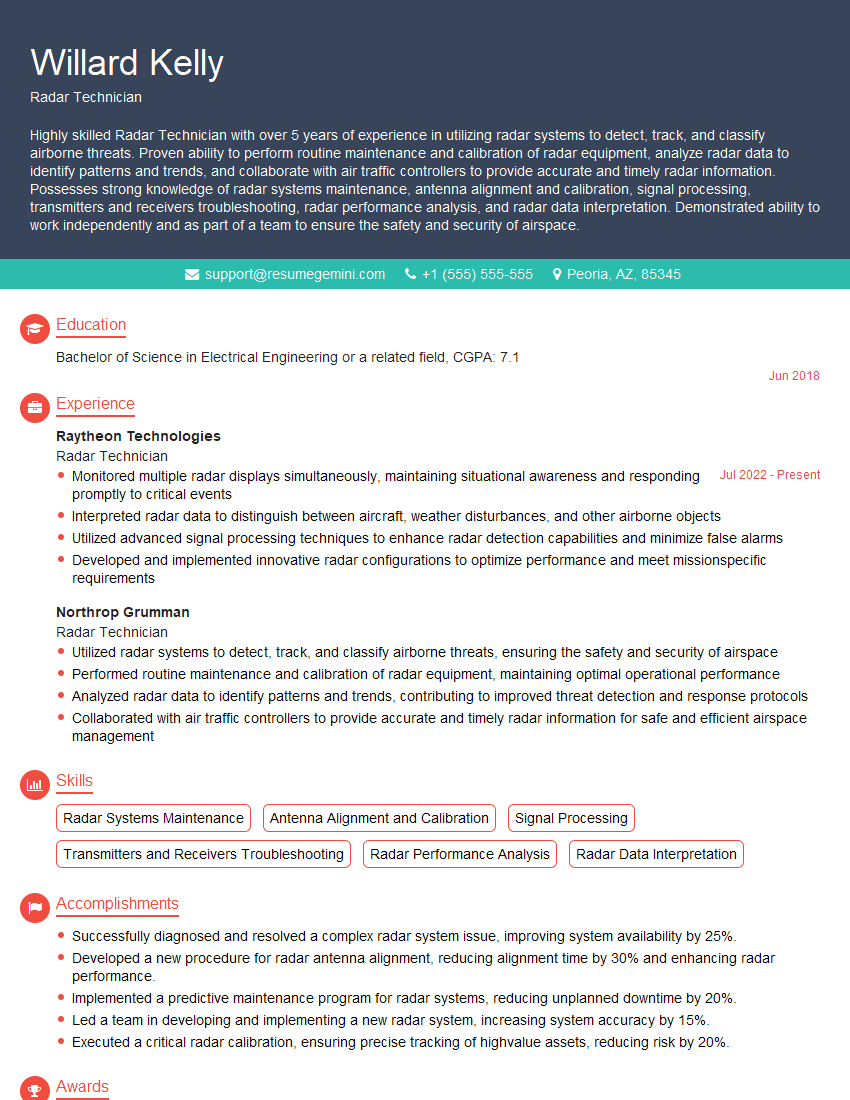
Mastering Radar System Maintenance opens doors to exciting career advancements, offering opportunities for specialization, leadership roles, and higher earning potential. To maximize your job prospects, it’s crucial to present your skills effectively. Crafting an ATS-friendly resume is key to getting your application noticed by recruiters. ResumeGemini is a trusted resource to help you build a professional and impactful resume that highlights your expertise in Radar System Maintenance. Examples of resumes tailored to this field are available to guide you through the process, ensuring your qualifications shine.
Explore more articles
Users Rating of Our Blogs
Share Your Experience
We value your feedback! Please rate our content and share your thoughts (optional).
What Readers Say About Our Blog
Very informative content, great job.
good