Are you ready to stand out in your next interview? Understanding and preparing for Radar System Troubleshooting and Diagnostics interview questions is a game-changer. In this blog, we’ve compiled key questions and expert advice to help you showcase your skills with confidence and precision. Let’s get started on your journey to acing the interview.
Questions Asked in Radar System Troubleshooting and Diagnostics Interview
Q 1. Explain the difference between pulsed and continuous wave radar.
The core difference between pulsed and continuous wave (CW) radar lies in how they transmit signals. Pulsed radar transmits short bursts of electromagnetic energy, pausing between each transmission to listen for echoes. Think of it like shouting and then listening for the echo. This allows it to measure distance (range) by timing the delay between transmission and reception. Continuous wave radar, on the other hand, transmits a continuous signal. It doesn’t pause. Instead, it determines range and velocity through techniques like frequency modulation (FM-CW) which involves changing the frequency of the transmitted signal over time. Imagine someone whistling a continuously rising tone – the change in frequency reveals information about the target’s movement and range.
Pulsed Radar: Better for measuring range and detecting multiple targets simultaneously because of the distinct transmission and reception periods. Examples include weather radar and air traffic control radar.
CW Radar: Excellent for measuring velocity (Doppler effect) and is often used in applications where precise velocity measurement is critical, such as speed guns or proximity sensors. It’s less effective at measuring range precisely than pulsed radar in many cases.
Q 2. Describe the common types of radar clutter and how to mitigate them.
Radar clutter refers to unwanted echoes that interfere with the detection of desired targets. Several types exist:
- Ground Clutter: Reflections from the ground, buildings, and terrain. This is usually the most significant type of clutter.
- Sea Clutter: Reflections from the sea surface, strongly affected by sea state (wave height and wind).
- Weather Clutter: Reflections from rain, snow, or hail. This can be particularly problematic for weather radar itself!
- Clutter from Birds or Insects: Insects and birds can create a large amount of small echoes that obscure the target.
Mitigating clutter involves various techniques:
- Moving Target Indication (MTI): This technique filters out stationary clutter by exploiting the Doppler shift. It only shows moving targets.
- Space-Time Adaptive Processing (STAP): This advanced technique uses multiple antennas and signal processing to adapt to the clutter environment.
- Clutter Rejection Filters: Digital filters designed to attenuate signals within the frequency range of the clutter.
- Polarization Diversity: Utilizing different polarizations of the transmitted signal can help differentiate between clutter and the target because of how clutter reflects signals differently.
- Antenna Design: Sidelobe suppression techniques in antenna design minimizes unwanted signal reception from off-axis directions, reducing clutter.
The choice of clutter mitigation technique depends on the specific application and the type of clutter encountered. For instance, MTI is simple and effective against slow-moving ground clutter, while STAP is more complex but offers superior performance in challenging environments.
Q 3. How do you troubleshoot a radar system with no output signal?
Troubleshooting a radar system with no output signal requires a systematic approach. Here’s a step-by-step process:
- Power Supply Check: Verify the power supply to the entire system, including the transmitter, receiver, and processing units. Is the power on? Are the voltages correct?
- High Voltage Check (if applicable): In high-power radar systems, check the high-voltage power supply for proper operation. This is often a high-risk area and should only be performed by qualified personnel.
- Transmitter Test: The transmitter is the heart of the system; confirm that the transmitter is generating the expected signal. This might involve checking the magnetron (in some systems) or other power amplifier components for proper output. Use specialized instruments (power meters, spectrum analyzers) to confirm signal presence and power level.
- Receiver Check: Examine the receiver for proper functionality. Check for signal amplification and any obvious issues like loose connections.
- Antenna Check: Ensure the antenna is connected correctly and is not damaged. A visual inspection and a check of the antenna’s impedance are crucial steps.
- Signal Path Tracing: Trace the signal path from the transmitter to the receiver, looking for any breaks in the connection or faulty components.
- Processing Unit Check: Check the signal processing unit. Are there any error messages? Is the software running correctly?
- Grounding and Shielding: Improper grounding or shielding can affect signal integrity. Ensure the system is grounded correctly and that shielding is effective.
Throughout this process, use appropriate test equipment to measure voltages, currents, and signal levels at different points in the system. Consult the system’s documentation for detailed specifications and troubleshooting guidance.
Q 4. Explain the process of calibrating a radar system.
Radar system calibration is a crucial process that ensures accurate measurements of range, velocity, and angle. It involves adjusting the system’s parameters to match known standards. The specific procedure varies depending on the radar type and application, but generally involves these steps:
- Range Calibration: This typically involves using a known target at a precise distance. The radar’s range measurement is then adjusted to match the known distance.
- Velocity (Doppler) Calibration: This involves using a target with a known velocity. The radar’s velocity measurement is adjusted to agree with the known velocity. A rotating target at a known speed or a moving reflector on a track might be used.
- Angle Calibration: This ensures the accuracy of the angle measurement. This often requires a precision positioning system to place a target at known angles relative to the radar.
- Gain Calibration: This ensures the radar’s receiver sensitivity is properly set. This often involves a known signal strength and adjusting the receiver gain to yield a specific response.
- System Alignment: This step, crucial for systems using multiple antennas or components, ensures that the different parts are properly aligned to work together effectively.
Calibration is often performed using specialized equipment, such as precision signal generators, positioners, and signal analyzers. The frequency of calibration depends on the application and the stability of the system. Regular calibration is essential to maintain the accuracy and reliability of the radar measurements.
Q 5. What are the common causes of radar range errors?
Radar range errors can stem from various sources:
- Errors in Time Measurement: Inaccurate timing circuits can directly affect the range measurement, as range is calculated from the time delay of the echo.
- Propagation Effects: Atmospheric conditions (temperature, pressure, humidity) can affect the speed of the electromagnetic wave, leading to range errors. Refraction can also bend the signal path.
- Multipath Propagation: Signals reflecting off multiple surfaces (e.g., ground and a target) can cause errors in range estimation due to interference and ghost targets.
- Receiver Noise: Noise in the receiver can lead to inaccurate detection of the signal’s leading edge, resulting in range errors. The signal-to-noise ratio is a critical factor.
- Transmitter Instability: Variations in the transmitted signal’s characteristics (e.g., pulse width) can introduce range errors.
- Calibration Errors: Inaccurate calibration of the radar system will directly impact range measurements.
Mitigating range errors often involves using advanced signal processing techniques, accurate calibration procedures, and compensation for atmospheric effects. Understanding the sources of error is crucial in implementing effective countermeasures.
Q 6. How do you diagnose a problem with a radar antenna?
Diagnosing a problem with a radar antenna is a crucial aspect of radar system troubleshooting. The approach depends on the nature of the suspected problem, but here are key steps:
- Visual Inspection: Begin with a thorough visual inspection of the antenna, checking for physical damage such as cracks, corrosion, or misalignment. Look for signs of debris buildup or damage to the radome (the protective cover).
- Antenna Impedance Measurement: Measure the antenna’s impedance using a network analyzer or impedance meter. Deviations from the specified impedance indicate a problem that could range from loose connections to internal damage within the antenna structure.
- Radiation Pattern Measurement: Use a specialized antenna range to measure the antenna’s radiation pattern. Deviations from the expected pattern indicate potential problems with the antenna’s elements or feed network.
- Return Loss Measurement: This measurement, related to impedance, assesses how effectively the antenna transmits and receives signals. High return loss suggests a mismatch causing signal reflection back toward the transmitter.
- Signal Strength Measurement: Check the signal strength received at the antenna input or output. A low signal strength could indicate issues with the antenna’s efficiency or connectivity.
- Mechanical Check: Check the antenna’s mechanical stability, including the rotating mechanism (if applicable), for issues like binding or malfunctions.
Specialized test equipment is usually needed for comprehensive antenna diagnostics. The detailed approach will depend on the antenna’s complexity and design.
Q 7. Describe different types of radar signal processing techniques.
Radar signal processing techniques are essential for extracting meaningful information from received signals. Here are some key techniques:
- Pulse Compression: This technique uses coded waveforms to improve range resolution without sacrificing transmitted power. It effectively increases the signal-to-noise ratio.
- Moving Target Indication (MTI): Filters out stationary clutter by using the Doppler shift to differentiate between moving and stationary targets.
- Doppler Processing: Used to measure the velocity of targets based on the frequency shift caused by their motion (Doppler effect).
- Clutter Filtering: Techniques aimed at reducing or eliminating unwanted echoes from clutter sources, as discussed earlier.
- Beamforming: This uses multiple antenna elements to shape the radar beam, improving angular resolution and reducing sidelobes.
- Space-Time Adaptive Processing (STAP): A sophisticated technique that combines spatial and temporal processing to adapt to the clutter environment.
- Constant False Alarm Rate (CFAR) Detection: A method to maintain a consistent false alarm rate regardless of the level of clutter or noise.
- Synthetic Aperture Radar (SAR) Processing: Combines signals received over time from a moving platform to create a high-resolution image of the target area.
These are just a few of the many signal processing techniques used in radar systems. The specific techniques employed depend on the application and the requirements for range resolution, velocity accuracy, and clutter rejection.
Q 8. Explain the concept of radar cross-section (RCS).
Radar Cross-Section (RCS) is a measure of how detectable an object is to radar. Think of it like how ‘shiny’ an object is to radar waves. A larger RCS means the object reflects more energy back to the radar, making it easier to detect. It’s measured in square meters (m²) and depends on several factors, including the object’s size, shape, material, and the radar’s frequency.
For example, a large, metallic aircraft will have a much larger RCS than a small, stealth-designed drone. The shape plays a crucial role; a flat surface reflects more energy than a curved surface. Materials like radar-absorbing materials (RAM) are specifically designed to reduce RCS by absorbing incident radar energy.
Understanding RCS is critical in designing stealth technology, optimizing radar detection capabilities, and interpreting radar returns. A low RCS object is harder to detect, while a high RCS object is easily spotted. In military applications, managing RCS is a key aspect of both offensive and defensive strategies.
Q 9. How do you troubleshoot a radar receiver with low sensitivity?
Troubleshooting a radar receiver with low sensitivity involves a systematic approach. We start by checking the obvious: is the receiver even powered on correctly? Are there any visible signs of damage?
Next, we move to more in-depth checks. We’d examine the receiver’s gain, which is how much it amplifies the weak radar signal. Low gain can directly cause low sensitivity. We’d use test equipment like a signal generator and a spectrum analyzer to measure the gain at various frequencies. If the gain is insufficient, the problem could be a faulty amplifier stage, requiring component-level diagnosis and potentially replacement.
Noise is another culprit. Excessive noise in the receiver can mask weak signals, effectively reducing sensitivity. We’d use the spectrum analyzer to identify the sources of noise, such as interference from other electronic devices or thermal noise within the receiver itself. If excessive noise is detected, the cause might be faulty filters, poor shielding, or degradation in components.
Finally, we’d inspect the intermediate frequency (IF) stages of the receiver. These stages process the received signal, and any malfunction here can significantly reduce sensitivity. This requires detailed understanding of the receiver’s internal architecture and might involve signal tracing and component testing.
Q 10. What are the safety precautions when working with radar systems?
Safety when working with radar systems is paramount. High-power radar systems emit electromagnetic radiation (EMR) that can be harmful to humans. The key safety precautions are:
- Eye Protection: Never look directly at the radar antenna while it’s transmitting. The high-power EMR can cause serious eye damage.
- Distance: Maintain a safe distance from the antenna during operation, as specified in the system’s safety manual. This distance reduces exposure to EMR.
- Radiation Warning Signs: Ensure proper warning signs are in place to alert others of the potential hazards.
- Personal Protective Equipment (PPE): Appropriate PPE such as safety glasses and possibly other EMR-shielding clothing may be necessary, especially for high-power systems.
- Lockout/Tagout Procedures: Follow strict lockout/tagout procedures to prevent accidental activation during maintenance or repair.
- Training: All personnel working with radar systems should receive comprehensive safety training.
Ignoring these precautions can lead to severe injury or death.
Q 11. Describe the use of spectrum analyzers in radar diagnostics.
Spectrum analyzers are essential tools for radar diagnostics. They allow us to visualize the frequency spectrum of the radar signals, which is crucial for identifying various issues.
For instance, a spectrum analyzer can help identify interference from other sources that might be masking the radar signals or causing false alarms. We can also use it to check the purity of the transmitted signal, looking for spurious emissions or unwanted harmonics that could affect performance.
Furthermore, the spectrum analyzer helps in analyzing the received signals to assess signal-to-noise ratio (SNR), which is a key indicator of radar sensitivity and performance. A low SNR could indicate problems with the receiver, antenna, or the environment. We can pinpoint the exact frequencies where the noise is concentrated, guiding our troubleshooting efforts.
In essence, the spectrum analyzer provides a comprehensive view of the frequency domain, helping to identify and diagnose a wide range of problems, from signal integrity issues to interference problems, and ultimately contributes to improved system performance.
Q 12. Explain the function of a radar transmitter.
The radar transmitter is the heart of a radar system. Its primary function is to generate and transmit high-frequency electromagnetic waves (radio waves). These waves are radiated by the antenna and travel outward. The transmitter’s design depends on the type of radar and its specific application. Common transmitter types include magnetrons, klystrons, and solid-state devices.
The transmitter’s key characteristics include its power output (measured in watts or kilowatts), its frequency, its pulse width (the duration of each transmitted pulse), and its pulse repetition frequency (PRF, the number of pulses transmitted per second). These parameters determine the radar’s range, resolution, and other key performance metrics.
For example, a high-power transmitter is needed for long-range radar applications, while a short pulse width is required for high-resolution imaging.
The transmitter also incorporates circuitry to control the timing and shape of the transmitted pulses, ensuring accurate operation and efficient power usage. Any issues within the transmitter, such as low power output or spurious emissions, can significantly impair the radar’s performance.
Q 13. How do you identify and fix false alarms in a radar system?
False alarms, where the radar indicates a target that isn’t actually there, are a major concern in radar systems. These can be caused by various factors such as clutter (reflections from ground, sea, rain, etc.), interference from other electronic devices, or malfunctioning internal components.
Identifying the cause requires careful analysis. We’d use signal processing techniques to examine the characteristics of the false alarms, looking for patterns or anomalies. For instance, clutter often has a specific Doppler signature that can be identified and filtered out. Interference often shows up as specific frequencies that can be blocked using filters.
Fixing the issue depends on its root cause. If it’s clutter, we might use advanced signal processing techniques like Moving Target Indication (MTI) or clutter rejection filters. If it’s interference, we’d try to identify the source and implement shielding or filters. Internal component failures might require hardware replacement or repair.
A well-designed system incorporates multiple layers of detection and verification to minimize false alarms. This might involve threshold adjustments, multiple-stage processing, and even using multiple radars in a coordinated fashion to confirm detections.
Q 14. What is the importance of maintaining accurate radar data logs?
Accurate radar data logs are crucial for several reasons. They provide a detailed record of the radar’s operation, including its performance metrics, detected targets, and any anomalies. This data is vital for troubleshooting, maintenance planning, and performance analysis.
For instance, if the radar’s performance degrades over time, the data logs can help pinpoint the exact moment the degradation started and potentially identify the cause. This allows for proactive maintenance and prevents unexpected outages.
Moreover, in safety-critical applications, data logs are essential for incident investigation. If there’s an incident related to the radar’s operation, the logs can provide valuable insights into the events leading up to the incident and help to determine the cause.
Finally, accurate data logs are also important for system calibration and verification. They allow us to ensure the radar is performing within its specified tolerances and to identify any discrepancies or calibration issues that require attention. Proper data logging helps maintain the integrity and reliability of the radar system, leading to enhanced operational efficiency and safety.
Q 15. Describe your experience with various radar types (e.g., Doppler, FMCW).
My experience encompasses a wide range of radar types, focusing primarily on pulsed Doppler and Frequency-Modulated Continuous Wave (FMCW) systems. Pulsed Doppler radars are excellent for measuring both range and velocity, using the Doppler shift of the reflected signal to determine target speed. I’ve worked extensively on systems using this technology for air traffic control and weather monitoring, troubleshooting issues related to signal processing and clutter rejection. FMCW radars, on the other hand, excel in high-precision range measurement, particularly at shorter ranges. My work with FMCW radars includes applications in automotive collision avoidance and industrial process monitoring. I’ve had the opportunity to compare and contrast the strengths and weaknesses of each type in various scenarios, understanding that the choice between them often hinges on the specific application requirements.
For example, in one project involving a weather radar system, we improved the accuracy of precipitation estimation by carefully calibrating the Doppler radar’s receiver and implementing advanced clutter filtering algorithms. In another project involving an automotive FMCW radar, I helped optimize the system’s performance in challenging environmental conditions, such as heavy rain and fog, by adjusting the signal processing parameters. This included implementing advanced signal processing algorithms to mitigate multipath effects.
Career Expert Tips:
- Ace those interviews! Prepare effectively by reviewing the Top 50 Most Common Interview Questions on ResumeGemini.
- Navigate your job search with confidence! Explore a wide range of Career Tips on ResumeGemini. Learn about common challenges and recommendations to overcome them.
- Craft the perfect resume! Master the Art of Resume Writing with ResumeGemini’s guide. Showcase your unique qualifications and achievements effectively.
- Don’t miss out on holiday savings! Build your dream resume with ResumeGemini’s ATS optimized templates.
Q 16. How do you troubleshoot a radar system experiencing high noise levels?
High noise levels in a radar system can stem from numerous sources, including internal receiver noise, external interference (e.g., jamming, other electronic devices), and clutter from the environment (e.g., ground reflections, rain). Troubleshooting begins with a systematic approach.
- Identify the noise source: Is the noise broadband or narrowband? Does it correlate with specific environmental conditions or operational modes? Analyzing the noise spectrum using a spectrum analyzer is crucial.
- Check the receiver: Examine the receiver chain for faulty components, such as damaged amplifiers, mixers, or filters. Look for signs of overheating or poor connections.
- Assess antenna integrity: A damaged or poorly positioned antenna can pick up significant amounts of unwanted signals. Inspect the antenna for physical damage and ensure proper grounding and shielding.
- Evaluate the signal processing: Incorrectly configured filters or gain settings in the signal processing chain can amplify noise. Check the processing algorithms and parameter settings.
- Investigate external interference: Use a spectrum analyzer to identify potential sources of external interference. Implementing appropriate shielding, filtering, or other countermeasures may be necessary.
For instance, I once encountered a case where a high noise floor in a Doppler radar was traced to a faulty amplifier in the receiver. Replacing the amplifier resolved the issue. In another case, we found that electromagnetic interference from a nearby industrial facility was causing spurious signals, which we mitigated by using a directional antenna and implementing a notch filter.
Q 17. Explain the concept of radar ambiguity resolution.
Radar ambiguity resolution addresses the issue of multiple possible ranges or velocities for a detected target. This arises when the pulse repetition frequency (PRF) is too low or the transmitted signal’s characteristics don’t allow for accurate determination of the true target parameters. Imagine trying to determine the speed of a car based on its position at two different points a long time apart. There’s a higher chance of misinterpreting the speed. Similarly, low PRF in radar can cause ambiguity.
Several techniques are employed to resolve this ambiguity. One common approach is to use multiple PRFs. By transmitting pulses at different PRFs, we obtain multiple range measurements, which can be compared to eliminate the ambiguous measurements. Another method involves using advanced signal processing techniques such as frequency-domain processing or waveform diversity. The choice of method depends on the specific radar system and the required accuracy.
A practical example is in air traffic control. A low PRF could lead to false interpretations of aircraft ranges due to the ambiguity. Using multiple PRFs or more sophisticated signal processing solves this issue, ensuring accurate tracking.
Q 18. How do you test and verify the performance of a repaired radar component?
Testing and verifying a repaired radar component involves a multi-step process ensuring both functionality and performance meet specifications. It usually involves a combination of bench testing and system-level testing.
- Bench testing: This involves testing the component in isolation using dedicated test equipment such as signal generators, oscilloscopes, and spectrum analyzers. The component’s parameters (gain, noise figure, etc.) are measured and compared against manufacturer specifications. For example, a high-power amplifier might be tested using a load and checking power output.
- System-level testing: After bench testing, the repaired component is integrated back into the radar system. This requires functional tests to ensure the component works correctly within the system. This involves using calibrated targets or simulated signals. Performance parameters, such as sensitivity, range accuracy, and velocity accuracy are then checked.
- Performance verification: This typically involves using specialized radar test software to measure key performance indicators (KPIs). The results are compared against system specifications and historical data to determine if the repair was successful and the system performance has been restored.
For example, after repairing a radar transmitter, I’d first bench test it to verify its output power and frequency characteristics. Then, I’d integrate it back into the system and conduct functional tests using a simulated target to check range and angle accuracy. Finally, I’d use radar test software to assess the system’s overall performance, ensuring it met all the requirements.
Q 19. What are the common causes of radar receiver saturation?
Radar receiver saturation occurs when the input signal is too strong for the receiver to process linearly. This leads to a loss of dynamic range and inaccurate measurements. Several factors can contribute to this.
- Strong clutter returns: Large amounts of unwanted reflections from the ground, sea, or weather can overwhelm the receiver.
- Jamming signals: Intentional interference from external sources can saturate the receiver.
- Incorrect gain settings: If the receiver gain is set too high, weak signals might be amplified excessively leading to saturation.
- Faulty receiver components: Components such as amplifiers or mixers may have lost their ability to handle high input power.
One instance involved a coastal radar system where strong sea clutter caused frequent receiver saturation. This was mitigated by implementing a more sophisticated clutter rejection algorithm. In another case, adjusting the receiver gain settings resolved the issue of saturation caused by accidental overamplification.
Q 20. Describe your experience with radar signal processing software.
My experience with radar signal processing software includes proficiency in MATLAB, Python (with libraries like NumPy and SciPy), and specialized radar signal processing toolkits. I’m comfortable working with both raw radar data and processed data, developing algorithms for tasks such as pulse compression, clutter rejection, target detection, and tracking.
In previous roles, I’ve used MATLAB extensively for developing and testing signal processing algorithms. I’ve created custom functions for implementing advanced filtering techniques, improving signal-to-noise ratio and reducing the impact of interference. My experience with Python involves leveraging its versatile libraries for data analysis, visualization, and algorithm implementation. This has been particularly useful for tasks like analyzing large radar datasets and building machine-learning models for target recognition.
A recent project involved using Python to develop a real-time signal processing pipeline for an FMCW radar system. This required working with streaming data, processing data efficiently, and developing algorithms for accurate distance and velocity measurements.
Q 21. Explain the principles of target detection and tracking in radar systems.
Target detection and tracking are fundamental aspects of radar systems. Detection involves identifying the presence of a target within the received radar signal, while tracking involves estimating the target’s position and velocity over time.
Target detection typically involves comparing the received signal strength to a threshold. If the signal exceeds the threshold, a target is detected. This threshold is carefully chosen to balance the probability of detection with the probability of false alarms. Advanced techniques like Constant False Alarm Rate (CFAR) detectors are used to adapt the threshold to varying noise levels.
Target tracking uses a series of detected target measurements to estimate the target’s trajectory. Common algorithms include Kalman filtering, which uses a probabilistic approach to estimate the target’s state (position, velocity, acceleration) based on noisy measurements. Other techniques such as alpha-beta filters offer simpler implementations but may be less accurate. The choice of algorithm depends on the application’s complexity and requirements.
For example, in an air traffic control radar, a CFAR detector is used to detect aircraft in the presence of clutter and noise. The detected targets’ positions are then used in a Kalman filter for precise and stable tracking of each aircraft, enabling accurate predictions of their paths.
Q 22. How do environmental factors affect radar performance?
Environmental factors significantly impact radar performance. Think of it like trying to shout across a crowded room – interference makes it harder to hear clearly. Similarly, atmospheric conditions, weather phenomena, and geographic features can all degrade a radar signal.
- Atmospheric Attenuation: Rain, snow, fog, and even dust particles absorb and scatter radar energy, reducing the signal’s strength and range. Heavy rainfall can significantly weaken signals, especially at higher frequencies. This is similar to how a thick fog makes it harder to see distant objects.
- Multipath Propagation: Reflections from the ground, buildings, or other objects can create multiple signal paths, leading to interference and distortion. This is like hearing an echo – the original sound and the echo can overlap and make it hard to understand the message.
- Refraction: Changes in atmospheric temperature and pressure can bend radar beams, causing inaccuracies in range and bearing measurements. This is like looking at a straw in a glass of water; the straw appears bent because light bends as it passes from water to air.
- Clutter: Ground clutter (reflections from the terrain) and weather clutter (reflections from rain, snow, or hail) can mask the desired target echoes. Imagine trying to spot a small bird in a flock of birds – the clutter makes it difficult to distinguish the individual bird.
Understanding these effects is critical for proper radar system design, calibration, and performance assessment. We often use signal processing techniques to mitigate these effects, like clutter rejection algorithms.
Q 23. What are the key performance indicators (KPIs) for a radar system?
Key Performance Indicators (KPIs) for a radar system are crucial for evaluating its effectiveness and ensuring it meets operational requirements. These KPIs can be grouped into several categories:
- Accuracy: This refers to how precisely the radar measures range, bearing, and velocity. It’s vital for applications like air traffic control where precise positioning is paramount. We often measure this in terms of root mean square error (RMSE).
- Range Resolution: This indicates the radar’s ability to distinguish between two closely spaced targets. A higher resolution allows for better target discrimination. We express it as the minimum distance between two targets that the radar can resolve.
- Sensitivity: This measures the radar’s ability to detect weak signals, which translates to longer detection ranges. Low sensitivity means missing potential threats.
- Clutter Rejection: This KPI assesses the radar’s capability to filter out unwanted signals from the ground or weather, allowing better detection of targets of interest. We might quantify this with a clutter-to-noise ratio.
- Reliability: This reflects the radar’s uptime and consistency of performance. High reliability ensures continuous operation, which is crucial for safety-critical applications. Mean time between failures (MTBF) is a common metric.
- Availability: The percentage of time the radar system is operational and ready for use. High availability minimizes disruptions and maximizes the operational time.
The specific KPIs prioritized will depend on the radar’s application. For example, a weather radar might emphasize range resolution and clutter rejection, while an air surveillance radar focuses on accuracy and sensitivity.
Q 24. How would you troubleshoot a radar system with intermittent failures?
Troubleshooting intermittent failures requires a systematic and methodical approach. It’s like diagnosing a car problem that only occurs occasionally – you need to be patient and thorough.
- Gather Information: Document the frequency, duration, and conditions under which the failures occur. Note down any error messages or unusual behaviors. This is critical for narrowing down potential causes.
- Check for Obvious Issues: Examine power supplies, connections, and external hardware for loose connections or faults. A simple loose cable can cause intermittent issues.
- Analyze System Logs: Many radar systems record operational data and error logs. Review these logs for patterns or anomalies that might indicate a specific component or process failing intermittently.
- Perform Signal Integrity Checks: Use test equipment like oscilloscopes and spectrum analyzers to examine the radar signals at various points in the system. Look for signal degradation, noise, or interference that appears intermittently.
- Isolate the Faulty Component: Through systematic testing and analysis, narrow down the likely source of the problem. This might involve swapping out suspect components or modules.
- Environmental Factors: Consider whether environmental conditions (temperature fluctuations, humidity, etc.) might be contributing to the intermittent failures.
- Software Diagnostics: If the radar system has embedded software, run diagnostic routines or perform software updates to address potential software bugs or glitches.
Intermittent failures can be challenging, often requiring a combination of hardware and software troubleshooting techniques. Patience and meticulous record-keeping are essential.
Q 25. Explain your experience with different types of radar modulation techniques.
My experience encompasses various radar modulation techniques, each with its strengths and weaknesses. The choice of modulation depends heavily on the specific radar application and its requirements.
- Pulse Modulation: This is the most common technique, where short pulses of radio waves are transmitted. It’s simple to implement and provides good range resolution. Variations include pulse compression techniques to improve range resolution and signal-to-noise ratio.
- Frequency Modulation (FM): This involves varying the frequency of the transmitted signal over time. FM-CW radar is particularly well-suited for short-range applications and velocity measurements. I’ve used it in automotive applications.
- Phase Modulation (PM): This technique changes the phase of the transmitted signal. Phase-coded waveforms are commonly used in modern radar systems to achieve high range resolution and clutter rejection. I have significant experience using this in advanced radar systems.
- Chirp Modulation: A type of frequency modulation that uses a linearly increasing or decreasing frequency over the pulse duration. It allows for high range resolution and good signal-to-noise ratio using pulse compression techniques. This is used extensively in modern airborne and ground-based radars.
I’ve worked with both analog and digital implementations of these techniques, and I understand the trade-offs between complexity, cost, and performance. The selection of the appropriate modulation scheme is a critical aspect of radar system design.
Q 26. Describe your proficiency with radar test equipment (e.g., oscilloscopes, network analyzers).
I am proficient in using a wide range of radar test equipment, including:
- Oscilloscopes: For analyzing waveforms, signal timing, and identifying anomalies in the radar signals. I routinely use oscilloscopes to check for signal integrity, pulse shape, and timing jitter.
- Spectrum Analyzers: To identify frequency components, measure signal power, and detect interference or unwanted signals. These are critical in diagnosing frequency-related issues and interference.
- Network Analyzers: Used for characterizing radar antennas, transmission lines, and waveguide components. This helps in identifying issues like impedance mismatches and antenna performance degradation.
- Signal Generators: Essential for testing and calibrating various components of the radar system. I use them to simulate radar signals and test the system’s response.
- Power Meters: To measure the power levels at different points in the radar system, ensuring proper operation and preventing damage from high power levels.
My experience extends to both bench-top and specialized radar test equipment. I understand how to select the appropriate equipment for a specific task and interpret the results to diagnose and resolve problems. For example, I once used a spectrum analyzer to identify a narrowband interference signal that was masking a target echo in a ground-based radar system.
Q 27. How do you handle a situation where a radar system is down during critical operations?
A radar system failure during critical operations requires immediate and decisive action. The priority is to restore service as quickly as possible while ensuring safety.
- Activate Emergency Procedures: Immediately follow established emergency protocols and alert relevant personnel. This often includes notifying supervisors and potentially activating backup systems.
- Initial Assessment: Quickly assess the extent of the failure, the affected components, and the potential impact on critical operations. This often involves looking at system status indicators, alarm logs, and other relevant data.
- Troubleshooting: Begin systematic troubleshooting to identify the root cause of the failure. The strategy will depend on the nature of the failure (e.g., software glitch, hardware failure, environmental issues).
- Prioritize Repairs: Focus on resolving the most critical aspects of the failure first, even if it requires temporary workarounds. Safety considerations always take precedence. For instance, we might prioritize a quick fix to restore basic functionality.
- Document Everything: Meticulously document all steps taken, including the sequence of events, troubleshooting actions, and any temporary solutions implemented. This information is vital for future analysis and preventing similar incidents.
- Post-Incident Analysis: After the system is restored, conduct a thorough post-incident analysis to identify the root cause, determine the impact, and identify any improvements to prevent recurrence.
Experience has taught me the importance of calm, methodical problem-solving under pressure, combined with a strong emphasis on safety and clear communication with all stakeholders.
Q 28. Describe your experience with radar system documentation and reporting.
Comprehensive documentation and reporting are essential for effective radar system maintenance and troubleshooting. I have extensive experience generating a variety of documentation:
- System Design Documents: Detailing the radar system’s architecture, components, and operational specifications. This includes block diagrams, schematics, and performance requirements.
- Maintenance Manuals: Providing step-by-step instructions for routine maintenance, troubleshooting, and repairs. These are crucial for technicians to understand how to maintain the system properly.
- Test Procedures: Defining the methods and procedures used for testing and calibrating the radar system, ensuring consistency and accuracy of measurements.
- Technical Reports: Summarizing the findings of investigations, troubleshooting efforts, and system performance assessments. These reports are crucial for tracking system health and identifying trends.
- Failure Reports: Documenting the details of any system failures, including the root cause, corrective actions taken, and preventive measures implemented. These are crucial for continuous improvement.
My documentation follows industry best practices and ensures clarity, accuracy, and completeness. I understand the importance of using clear diagrams, concise language, and a well-structured format. Good documentation is a cornerstone of maintaining the integrity and longevity of a radar system.
Key Topics to Learn for Radar System Troubleshooting and Diagnostics Interview
- Signal Processing Fundamentals: Understanding basic radar signal characteristics (pulse width, PRF, bandwidth), signal-to-noise ratio, and the effects of clutter and interference. Practical application: Analyzing received signals to identify sources of noise or distortion.
- Radar System Architecture: Familiarity with the components of a radar system (transmitter, receiver, antenna, signal processor, display) and their interdependencies. Practical application: Isolating faults by understanding the signal flow and data processing chain.
- Fault Isolation Techniques: Mastering systematic troubleshooting methodologies, including the use of schematics, test equipment (e.g., oscilloscopes, spectrum analyzers), and diagnostic software. Practical application: Efficiently diagnosing and resolving hardware and software issues.
- Antenna Theory and Diagnostics: Understanding antenna characteristics (gain, beamwidth, polarization), and common antenna problems (misalignment, damage, impedance mismatch). Practical application: Identifying and resolving antenna-related performance issues.
- Digital Signal Processing (DSP) in Radar: Knowledge of digital filtering, FFT algorithms, and their application in radar signal processing. Practical application: Interpreting processed data to identify targets and anomalies.
- Radar Calibration and Alignment: Understanding procedures for calibrating and aligning radar systems to ensure accurate performance. Practical application: Performing routine maintenance and calibrations to maintain system accuracy.
- Troubleshooting Common Radar System Failures: Identifying and resolving problems related to transmitter malfunctions, receiver sensitivity, data processing errors, and display issues. Practical application: Quickly identifying the root cause of failures and implementing effective solutions.
Next Steps
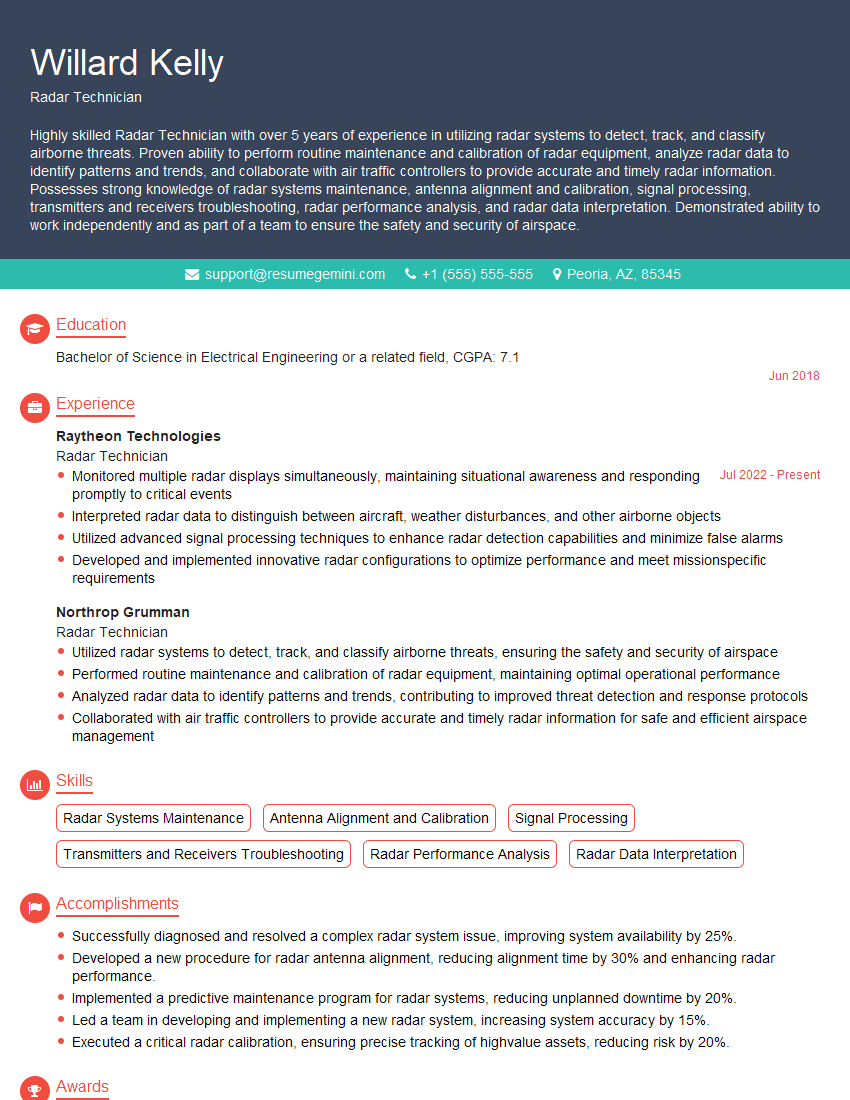
Mastering Radar System Troubleshooting and Diagnostics is crucial for advancing your career in this specialized field. A strong understanding of these concepts opens doors to higher-level roles with increased responsibility and earning potential. To maximize your job prospects, invest time in creating an ATS-friendly resume that highlights your skills and experience effectively. ResumeGemini is a trusted resource that can help you build a professional and compelling resume, showcasing your expertise in Radar System Troubleshooting and Diagnostics. Examples of resumes tailored to this specific field are available to further guide your preparation.
Explore more articles
Users Rating of Our Blogs
Share Your Experience
We value your feedback! Please rate our content and share your thoughts (optional).
What Readers Say About Our Blog
Very informative content, great job.
good