Unlock your full potential by mastering the most common Chain-Link Fence Installation interview questions. This blog offers a deep dive into the critical topics, ensuring you’re not only prepared to answer but to excel. With these insights, you’ll approach your interview with clarity and confidence.
Questions Asked in Chain-Link Fence Installation Interview
Q 1. What are the different types of chain-link fence fabric?
Chain-link fence fabric comes in various types, primarily differentiated by wire gauge and coating. The wire gauge refers to the thickness of the wire, with lower numbers indicating thicker, stronger wire. Thicker wire is more durable and resistant to damage. The coating protects the wire from rust and corrosion, extending its lifespan. Common coatings include galvanized (zinc), PVC (polyvinyl chloride), and vinyl-coated galvanized.
- Galvanized: Offers basic rust protection, relatively inexpensive.
- PVC-coated: Provides excellent corrosion resistance and comes in a variety of colors, enhancing aesthetics.
- Vinyl-coated galvanized: Combines the durability of galvanized wire with the aesthetic appeal and corrosion resistance of PVC.
For high-security applications or areas with harsh weather conditions, a heavier gauge wire with a durable coating like vinyl-coated galvanized is preferred. For less demanding applications, a lighter gauge galvanized wire might suffice, offering a more budget-friendly option. Choosing the right fabric depends on the project’s specific needs and budget.
Q 2. Explain the process of setting fence posts.
Setting fence posts is crucial for a stable and long-lasting fence. The process typically involves these steps:
- Site Preparation: Mark the post locations accurately, considering property lines and any obstacles. Clear the area of vegetation and debris.
- Digging Holes: Dig holes deep enough to accommodate the post, typically one-third to one-half of the post’s length below ground. The hole’s diameter should be slightly wider than the post.
- Setting Posts: Place the post in the hole, ensuring it’s plumb (perfectly vertical) using a level. You can use temporary supports to hold the post in place.
- Backfilling and Compaction: Fill the hole with gravel or crushed stone for drainage, followed by compacted soil. This provides a stable base and prevents settling.
- Post Anchors (optional): For added stability, especially in unstable soil, post anchors or concrete can be used. Concrete is poured into the hole around the post, ensuring it’s fully supported.
Remember to always use appropriate safety gear, such as gloves and safety glasses, when digging and handling posts.
Q 3. Describe the proper method for tensioning chain-link fabric.
Proper tensioning is vital for a secure and aesthetically pleasing chain-link fence. Improper tension can lead to sagging, which compromises the fence’s integrity and appearance. Tensioning is typically done using a tensioning tool, often a specialized wrench or ratchet.
The process involves gradually tightening the fabric by turning the tensioning tool while paying close attention to the fabric’s tightness. Too much tension can damage the fabric or cause posts to bend or pull out of the ground. Too little tension results in a sagging fence. A good rule of thumb is to achieve a level of tension that makes the fabric taut but not overly stretched.
Many installers use a ‘pull-test’ to ensure appropriate tension has been achieved. This involves pushing against the fabric across the face of the fence, with the expectation of only minimal give. If significant give is felt, more tensioning is needed.
The use of tension wires and their careful placement at the top and bottom of the fence are critical to maintain this tension over time.
Q 4. How do you determine the required number of fence posts for a given project?
Determining the number of posts depends on the fence’s length and the spacing between posts. Standard spacing is typically 6-8 feet apart for residential fences. To calculate the number of posts:
- Measure the total fence length.
- Divide the total length by the desired post spacing. For example, a 100-foot fence with 8-foot spacing requires 100/8 = 12.5 posts. Always round up to the nearest whole number.
- Add one post for each corner and each gate location.
For instance, a 100-foot fence with 8-foot spacing and two gates would need 12.5 + 2 +2 (two gates) rounded up to 17 posts.
Always account for gates and corners. They require additional posts for support and proper functionality.
Q 5. What safety measures do you follow when working with chain-link fence materials?
Safety is paramount in chain-link fence installation. Here are key safety measures:
- Wear appropriate personal protective equipment (PPE): This includes safety glasses, work gloves, steel-toed boots, and a hard hat, especially when working with heavy posts and digging tools.
- Use caution with digging tools: Be mindful of underground utilities before digging. Call your local utility companies to locate any underground lines before commencing work.
- Handle materials safely: Use proper lifting techniques to avoid injuries when handling heavy chain-link rolls and posts.
- Use caution with tensioning tools: Avoid placing hands or fingers near the tensioning mechanism and release the tool’s tension before adjusting it.
- Be aware of your surroundings: Maintain awareness of your surroundings and other workers on the site. Work slowly and methodically, as rushing can increase the risk of accidents.
Following these procedures is critical for reducing injuries and ensuring a safe working environment.
Q 6. What are the common types of gate hardware used in chain-link fence installation?
Various gate hardware options exist for chain-link fences, each offering different features and levels of security:
- Self-closing gates: These gates utilize springs or hinges to automatically close, enhancing security and convenience.
- Sliding gates: Ideal for wider openings, sliding gates move along a track, requiring less space than swing gates.
- Swing gates: Traditional swing gates open and close like a door, and are suitable for most applications.
- Latching mechanisms: Various latching mechanisms are available, ranging from simple spring latches to more secure keyed locks or combination locks.
- Gate hinges: These should be heavy-duty, corrosion-resistant, and sized appropriately for the gate’s weight.
Selecting the right hardware depends on the gate type, security requirements, and aesthetic preferences.
Q 7. How do you deal with uneven terrain during fence installation?
Uneven terrain presents challenges in chain-link fence installation, requiring adjustments to maintain a consistent fence height and stability. Here’s how to manage it:
- Grading: Prepare the ground by grading or leveling the terrain as much as possible before installing the fence. This helps create a consistent foundation.
- Varying Post Depth: Adjust the depth of each post to compensate for changes in elevation. Posts in lower areas need to be set deeper to ensure stability.
- Step-Down Posts: In areas with significant changes in elevation, step-down posts can be used to transition the fence smoothly over hills or inclines.
- Terracing: In some cases, terracing might be necessary to create a series of level platforms for the fence to run across.
- Post Anchors: Using post anchors or concrete can help improve stability on uneven terrain, especially in areas with loose or unstable soil.
Careful planning and attention to detail are key to overcoming these challenges and constructing a sturdy, level fence.
Q 8. How do you install a gate within a chain-link fence?
Installing a gate in a chain-link fence requires precision and attention to detail. Think of it like adding a door to a room – it needs to fit seamlessly and function correctly. The process involves several key steps:
- Determine Gate Location and Size: Carefully measure the desired gate opening. Consider factors like access needs and the surrounding landscape.
- Prepare the Gateposts: Set sturdy line posts on either side of the opening, ensuring they are plumb (perfectly vertical) and firmly embedded in the ground. These posts need to be strong enough to support the gate’s weight and withstand daily use. Concrete is your best friend here.
- Install Gate Hardware: Attach hinges and a latch mechanism to the gate and the gateposts. Ensure the hinges are securely fastened and the latch operates smoothly. You may need to use a self-closing spring gate mechanism.
- Hang the Gate: Carefully hang the gate on the hinges. It should swing freely and smoothly. Adjust the hinges if needed.
- Connect to Fence: Attach the gate to the existing fence fabric using tension wire and tension bars. This helps reinforce the gate and integrate it into the overall fence.
- Final Checks: Check that the gate opens and closes smoothly, the latch works, and the gate is properly aligned with the fence.
Remember, proper alignment and secure fastening are crucial for a long-lasting and functional gate. A poorly installed gate can become a safety hazard and an eyesore.
Q 9. What are the steps involved in repairing damaged chain-link fence?
Repairing damaged chain-link fence depends on the type and extent of damage. It’s like patching a hole in a sweater – you need the right tools and technique to create a lasting repair.
- Assess the Damage: Determine if you need to replace just a section of wire mesh, a single post, or a larger portion of the fence.
- Gather Supplies: Depending on the damage, you may need replacement wire mesh, tension wire, tools, and possibly new fence posts.
- Repairing Holes or Tears: For minor holes or tears, you can use wire mesh repair patches secured with sturdy wire ties. Ensure a secure overlap to avoid further damage.
- Replacing Sections: Larger sections may require replacement. This involves cutting out the damaged section and carefully splicing in a new piece, ensuring proper alignment and tension.
- Post Repair: If a post is damaged, it’ll need to be removed and replaced, ensuring the new post is set securely using concrete.
- Tightening Loose Wire: Use wire tensioners or a come-along to tighten the wire mesh and restore the fence to its original tension.
It’s always important to take safety precautions when making repairs, using appropriate safety glasses and gloves. A well-maintained fence is essential for security and aesthetics.
Q 10. How do you measure for and install a self-closing gate?
Measuring and installing a self-closing gate involves careful planning and accurate measurements. It’s akin to precisely measuring and hanging a picture frame – proper measurements are essential for a perfect fit.
- Measure the Opening: Accurately measure the width and height of the gate opening. Add a few extra inches on either side for a snug fit and to account for the gatepost width.
- Choose the Gate: Select a self-closing gate of the appropriate size and material. Self-closing mechanisms usually involve a spring or hydraulic damper.
- Install Posts: Set sturdy gateposts firmly in concrete on both sides of the opening. Ensure they are perfectly vertical and spaced to accommodate the gate’s width.
- Install Gate Hardware: Attach hinges and a self-closing mechanism to both the gate and the posts. Ensure the mechanism is installed according to the manufacturer’s instructions.
- Hang and Adjust: Carefully hang the gate, ensuring it swings freely and the self-closing mechanism operates smoothly. Adjust the hinges as needed to ensure proper alignment.
- Secure the Gate to the Fence: Connect the gate to the existing fence fabric using tension wire and tension bars for stability and a neat finish.
Careful attention to the self-closing mechanism is vital. Proper adjustment ensures effortless and automatic closing, enhancing security and preventing accidental openings.
Q 11. What tools and equipment are essential for chain-link fence installation?
Chain-link fence installation requires a range of specialized tools. This isn’t a project you tackle with just a hammer and nails! You’ll need:
- Post Hole Digger: For efficient and accurate digging of post holes.
- Shovel: For digging, backfilling, and leveling.
- Post Level: Ensures posts are perfectly vertical.
- Measuring Tape: Accurate measurement is critical for proper alignment.
- Wire Cutters: For cutting chain-link fabric and wire.
- Tension Wire: Used to maintain tension in the fence.
- Tension Bars: To help tighten and support the wire.
- Line Posts: Temporary posts to establish a straight line for the fence.
- Concrete Mixer (or wheelbarrow and shovel): For mixing concrete to set posts.
- Safety Glasses and Gloves: Protection from sharp wire and potential injuries.
- Come-Along or Wire Tensioner: To pull and tighten the wire.
Having the right tools significantly improves efficiency and the quality of the final installation. The investment in quality tools pays for itself with a better-looking and more durable fence.
Q 12. Describe your experience with different types of post hole diggers.
I’ve used a variety of post hole diggers throughout my career, each with its strengths and weaknesses. It’s like choosing the right tool for the job – a small screwdriver for tiny screws, and a wrench for larger bolts.
- Manual Diggers: These are good for smaller projects and softer soils. They are more labor-intensive.
- Auger Diggers (hand-cranked): These are efficient in moderately hard soil. They are less strenuous than manual diggers but still require physical effort.
- Power Augers: These are essential for larger projects and tougher soil conditions. They significantly reduce labor but require an power source.
- Post Hole Digger Attachments for Tractors or Skid Steers: These are the most efficient for large scale projects, offering speed and power but requiring larger machinery.
My choice of digger depends heavily on the project size, soil conditions, and available resources. A power auger is indispensable for a large project in hard clay, while a manual digger might suffice for a small residential fence in sandy soil.
Q 13. How do you calculate the amount of wire needed for a specific fence project?
Calculating the amount of wire needed for a chain-link fence project requires careful measurement and a little math. Think of it as creating a precise recipe – accurate measurements are crucial for the perfect outcome.
- Measure the Perimeter: Accurately measure the total length of the fence line. This is the base for your calculations.
- Determine the Height: Measure the height of the fence. This is crucial for calculating the vertical wire length.
- Calculate the Wire Length: Multiply the perimeter length by the height of the fence to obtain the total area in square feet (or meters). This will give you an estimated amount of wire needed.
- Account for Waste: Add extra wire (around 10-15%) to account for cuts, mistakes, and overlaps during installation.
- Check Manufacturer’s Specs: Consult the manufacturer’s specifications for their recommended roll sizes to ensure you order the correct amount of wire.
Remember that accurate measurements are key to avoiding costly mistakes and ensuring you have enough materials. Always overestimate slightly to account for unforeseen circumstances.
Q 14. Explain the importance of proper line tension in chain-link fence construction.
Proper line tension is absolutely critical for a durable and aesthetically pleasing chain-link fence. It’s like the tension in a guitar string – too tight or too loose, and it doesn’t sound right. The same applies to the fence.
- Strength and Stability: Adequate tension provides strength and stability, preventing sagging and making the fence more resistant to damage from wind and other external forces.
- Appearance: A properly tensioned fence looks neat and professional, with straight lines and consistent spacing between wires. Sagging detracts from its appearance.
- Security: A taut fence is more difficult to climb or penetrate, providing better security.
- Longevity: A properly tensioned fence is less likely to experience premature wear and tear, extending its lifespan.
Using a wire tensioner and consistently checking tension throughout the installation process are essential for achieving the correct line tension. Ignoring this step can lead to a weak, unsightly, and less secure fence.
Q 15. What is the difference between galvanized and vinyl-coated chain-link fabric?
The core difference between galvanized and vinyl-coated chain-link fabric lies in their corrosion resistance and aesthetic appeal. Galvanized chain link is made of steel wire that’s been coated with zinc through a process called galvanization. This zinc coating protects the steel from rusting, increasing its lifespan, especially in harsh weather conditions. Think of it like a protective shell for the metal.
Vinyl-coated chain link, on the other hand, takes this a step further. The galvanized wire is then coated with a layer of polyvinyl chloride (PVC). This adds another layer of protection against rust and also provides a wider array of color options, allowing for greater aesthetic customization. Imagine it as adding a colorful, durable outer layer on top of the zinc’s protection. The vinyl coating also offers slightly better resistance to scratches and dents compared to galvanized alone.
In a nutshell: Galvanized offers good rust protection and is generally more economical; vinyl-coated provides superior protection and enhanced visual appeal but comes at a higher cost.
Career Expert Tips:
- Ace those interviews! Prepare effectively by reviewing the Top 50 Most Common Interview Questions on ResumeGemini.
- Navigate your job search with confidence! Explore a wide range of Career Tips on ResumeGemini. Learn about common challenges and recommendations to overcome them.
- Craft the perfect resume! Master the Art of Resume Writing with ResumeGemini’s guide. Showcase your unique qualifications and achievements effectively.
- Don’t miss out on holiday savings! Build your dream resume with ResumeGemini’s ATS optimized templates.
Q 16. Describe your experience with working from blueprints or plans.
I’m highly proficient at interpreting and working from blueprints and site plans. My experience includes translating detailed drawings into accurate fence layouts, determining the quantity and types of materials required, and coordinating the installation process accordingly. I’ve worked on projects ranging from simple residential fences to complex commercial installations involving multiple gates, varying terrain, and precise measurements.
For example, on a recent project with a complex curved fence line, I carefully scaled the blueprint, transferred the measurements to the site, and utilized specialized tools like a string line and measuring tape to ensure the curve was perfectly replicated. I’m meticulous about verifying all measurements before beginning any excavation or post-setting, preventing costly errors down the line. My attention to detail is crucial to ensuring the final product matches the client’s vision and meets all safety standards.
Q 17. How do you handle conflicts or problems that arise during a job?
Conflict resolution is a key aspect of successful project management. When problems arise, my approach is always collaborative and focused on finding the best solution for all parties involved. I begin by clearly identifying the problem, gathering all relevant information, and then assessing the situation calmly and objectively.
For instance, if there’s a discrepancy between the provided blueprints and the existing site conditions (e.g., unforeseen underground utilities), I immediately consult with the client and any relevant contractors to discuss solutions. This might involve adjusting the fence line slightly, employing alternative techniques, or requesting amendments to the original plan. Open communication and a willingness to compromise are vital in resolving these issues efficiently and amicably.
If there are disagreements about materials or labor, I facilitate discussions to clarify expectations and reach a mutually acceptable agreement. My goal is always to maintain a positive working relationship while ensuring the project is completed to the highest standards.
Q 18. How do you maintain accurate records of materials used during a project?
Maintaining accurate records of materials is crucial for project budgeting, cost control, and avoiding discrepancies. I utilize a combination of methods to ensure meticulous tracking. This includes creating detailed material lists before starting the project, based on the blueprints and site assessment.
During the installation process, I meticulously document each item used, recording quantities, sizes, and any relevant specifications. I might use a combination of physical inventory sheets and digital spreadsheets to keep track. This allows for real-time monitoring of materials consumed and helps in preventing any shortages or overages. At the end of each day, I review my records to ensure accuracy and cross-reference them with purchase orders and receipts.
This comprehensive record-keeping system proves incredibly valuable when finalizing invoices, providing transparent cost breakdowns to clients, and even during future maintenance or repairs on the fence.
Q 19. Explain your experience with working at heights.
I have extensive experience working at heights, adhering strictly to safety regulations and best practices. This includes using appropriate safety equipment such as harnesses, fall arrest systems, and safety nets whenever working above ground level. Regular safety inspections of equipment are conducted before each use.
My training includes proper techniques for setting up and utilizing scaffolding, ladders, and other height-access equipment. I ensure the stability and secure placement of all equipment and never take shortcuts, prioritizing the safety of myself and my team above all else. For example, when installing a fence on a steep slope, we would use appropriate safety measures such as securing a lifeline and wearing harnesses to prevent falls.
I am well-versed in OSHA safety regulations regarding working at heights and can confidently assess risks and implement the necessary precautions.
Q 20. What are common problems encountered during chain-link fence installation?
Several common problems can arise during chain-link fence installation. One of the most frequent is encountering uneven ground or difficult terrain, requiring adjustments to post depths and potentially more extensive excavation.
Another issue is dealing with underground utilities. Unforeseen pipes, cables, or other infrastructure can cause delays and require careful planning and coordination with utility companies. Incorrect measurements or inaccurate planning during the initial stages can lead to material miscalculations and adjustments on site, which impact the project timeline and budget.
Poor weather conditions, like strong winds or heavy rain, can significantly disrupt the work schedule and create safety hazards. Finally, challenges can arise from improper handling or installation of gates, leading to misalignment or functional issues. Addressing these challenges proactively, with careful planning and meticulous execution, is key to a successful fence installation.
Q 21. How do you resolve issues with uneven ground or challenging terrain?
Uneven ground and challenging terrain require adaptable solutions. For instance, if the ground is significantly sloped, I would adjust post depths to ensure stability. This may involve digging deeper in some areas and shallower in others, while maintaining a consistent fence height. Precise leveling is crucial to prevent sagging or unevenness.
In rocky or hard soil, specialized equipment like augers or post-hole diggers might be necessary to create accurate and stable post holes. For very challenging terrain, I may need to consult with a civil engineer for recommendations or to alter the fence design to best fit the land. In some cases, this may necessitate the use of retaining walls to support the fence posts and maintain stability.
Careful site assessment before the installation begins is essential to anticipate and address these challenges effectively. Adaptability and problem-solving skills are critical for successfully navigating these obstacles and ensuring a structurally sound and aesthetically pleasing fence installation.
Q 22. Explain your understanding of local building codes and regulations related to fence installation.
Understanding local building codes and regulations is paramount for any fence installation project. These codes dictate everything from fence height and setbacks from property lines to materials allowed and required permits. For example, some jurisdictions might limit fence height in certain zones to maintain sightlines or preserve aesthetic harmony, while others might have strict rules about the type of posts allowed (e.g., requiring treated lumber to resist rot). Ignoring these regulations can lead to costly fines, delays, and even the need to remove and reinstall the fence.
My approach involves a thorough pre-installation site visit. I research the specific codes for that location online and at the local building department. This includes reviewing zoning maps to confirm allowable fence heights and setbacks based on the property’s location and its relationship with neighboring properties. I then incorporate these specifics into the project proposal and secure the necessary permits before starting any work. This proactive approach ensures compliance and mitigates potential risks.
For example, I once encountered a project where the client wanted a 10-foot tall fence, but the local code limited residential fences to 6 feet unless a specific variance was granted. By identifying this limitation early, I was able to discuss alternative solutions with the client and help them navigate the variance application process, saving them time and potential frustration.
Q 23. Describe your experience with working independently and as part of a team.
I’m comfortable working both independently and collaboratively. As a skilled chain-link fence installer, I can manage all aspects of a small project independently – from site preparation and material ordering to installation and cleanup. My experience includes managing solo projects efficiently and meeting tight deadlines.
However, I also thrive in team environments. Larger projects often require a coordinated effort. I’ve worked with crews of various sizes, demonstrating my ability to effectively communicate, share responsibilities, and contribute to a team’s overall success. For instance, on a recent large commercial project, I was the lead installer coordinating the work of three other crew members, ensuring that everyone understood the plans, and that we met our production goals while maintaining the highest standards of quality.
My ability to effectively collaborate stems from my strong communication skills, ability to follow instructions, willingness to learn from others, and proactive problem-solving approach. I believe a strong team dynamic is crucial for delivering a high-quality product in a timely manner.
Q 24. What are the key factors to consider when choosing the right chain-link fence for a given project?
Selecting the right chain-link fence depends heavily on the project’s specific requirements. Key factors to consider include:
- Purpose: Is it for residential security, commercial containment, or something else? Security needs might require heavier gauge wire and smaller mesh openings. Commercial projects often prioritize durability and longevity.
- Budget: Pricing varies based on the gauge of the wire, height, type of posts, and other accessories.
- Aesthetics: Chain link is available in various colors and styles. Matching the fence to the surrounding environment can enhance curb appeal.
- Climate: In areas with heavy snow or wind, a sturdier fence with larger posts and stronger tension wires will be necessary to withstand these elements.
- Site conditions: The terrain and soil type will influence post placement and the need for additional support.
For example, a residential project emphasizing privacy might use a smaller mesh opening (2” x 4”) and a galvanized wire for rust resistance, while a commercial fencing project enclosing a sports field might utilize a larger mesh opening and heavier gauge wire for enhanced durability and longevity.
Q 25. How do you ensure the longevity of a chain-link fence installation?
Ensuring the longevity of a chain-link fence installation involves meticulous attention to detail throughout the process. The first step is to use high-quality materials, selecting galvanized or vinyl-coated wire and treated wood posts to resist rust and rot. Proper installation techniques are equally crucial. Posts must be set to the correct depth and secured with concrete, ensuring stability and preventing sagging. Tension wires should be appropriately tensioned to avoid slack, which can lead to damage over time.
Additionally, preventative maintenance plays a significant role. Regular inspections, especially after severe weather events, can identify and address potential problems such as loose wires, damaged posts, or rust spots early on. Minor repairs are often less expensive and disruptive than major repairs or replacements. For example, yearly cleaning and spot treatment of rust can extend the life of a galvanized fence.
Finally, protecting the fence from damage is paramount. This can include planting vegetation at an appropriate distance away from the fence to prevent damage from roots, as well as informing the client of the importance of not stressing the structure in any way.
Q 26. How do you manage a project schedule effectively?
Effective project scheduling is essential for on-time and budget-conscious completion. My approach uses a combination of proven methods:
- Detailed Planning: Before starting any project, I create a detailed plan, outlining all tasks, necessary materials, and estimated timeframes. This includes allowances for potential delays due to weather or unexpected complications.
- Resource Allocation: I assess the project’s scope and allocate the necessary resources, including personnel, tools, and materials efficiently. Prioritizing tasks effectively can streamline the process and prevent bottlenecks.
- Regular Monitoring: Throughout the project, I monitor progress against the schedule. Any deviations are promptly identified, and adjustments are made. This might involve adjusting the schedule, reallocating resources, or finding creative solutions to overcome challenges. For instance, if bad weather delays the work, I may temporarily shift focus to other tasks or update the client proactively.
- Communication: Open communication with the client keeps them informed of the project’s status and addresses any concerns promptly.
I use project management software to track progress and communicate efficiently with my team and client. This provides a centralized overview, facilitates collaboration and keeps everyone on the same page.
Q 27. Describe your experience with customer communication and handling customer concerns.
Excellent customer communication is vital for project success. I prioritize clear and proactive communication, keeping clients informed every step of the way. This includes providing initial consultations, discussing project details and expectations, clarifying costs, securing all necessary permits, and updating them on the project’s progress.
I actively listen to customer concerns, and I aim to address them promptly and effectively. If unexpected issues arise, I keep the client informed and work collaboratively to find solutions that satisfy their needs and meet our agreement. I view customer satisfaction as the ultimate goal, and I believe building trust through open and honest communication is key.
For instance, I had a client who was anxious about potential damage to their landscaping during the installation. I worked with them to develop a plan that minimized disruption and mitigated their concerns. This involved discussing the installation method, coordinating the work around their specific plantings, and providing regular updates during the project. This proactive approach not only prevented unnecessary stress but also resulted in a strong positive client relationship.
Key Topics to Learn for Chain-Link Fence Installation Interview
- Site Preparation: Understanding land surveying, excavation techniques, and proper ground leveling for optimal fence placement. Practical application: Explaining how to handle uneven terrain and address drainage issues.
- Post Installation: Mastering techniques for setting concrete posts, using post hole diggers, and ensuring proper post depth and plumbness. Practical application: Describing different post types and their suitability for various soil conditions and project requirements.
- Fabric Installation: Understanding the proper tensioning and stretching of chain-link fabric to prevent sagging. Practical application: Explaining how to use tensioning tools and adjust fabric for optimal appearance and durability.
- Gate Installation: Knowing how to install various gate types (swing, sliding), ensuring proper alignment and functionality. Practical application: Describing the process of adjusting hinges, latches, and ensuring smooth gate operation.
- Safety Procedures: Demonstrating knowledge of OSHA regulations and safe work practices related to excavation, heavy machinery use, and working at heights. Practical application: Explaining how to mitigate risks and maintain a safe work environment.
- Tools and Equipment: Familiarity with various hand tools, power tools, and specialized equipment used in chain-link fence installation. Practical application: Identifying the appropriate tools for specific tasks and explaining their proper use.
- Material Selection: Understanding different types of chain-link fabric, post materials (steel, vinyl), and hardware. Practical application: Explaining the pros and cons of various materials based on project needs and budget.
- Problem-Solving: Demonstrating the ability to identify and troubleshoot common installation issues, such as uneven terrain, fabric tension problems, and gate malfunctions. Practical application: Describing your approach to resolving challenges encountered during a typical installation.
Next Steps
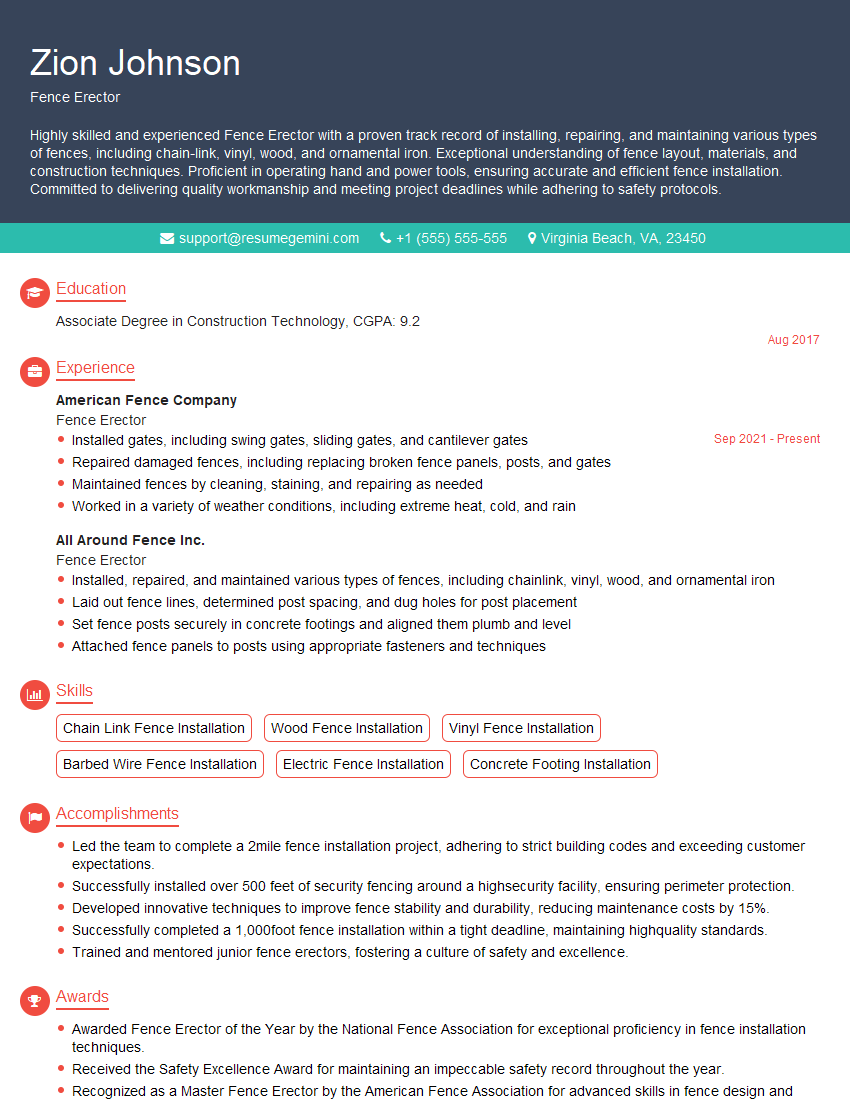
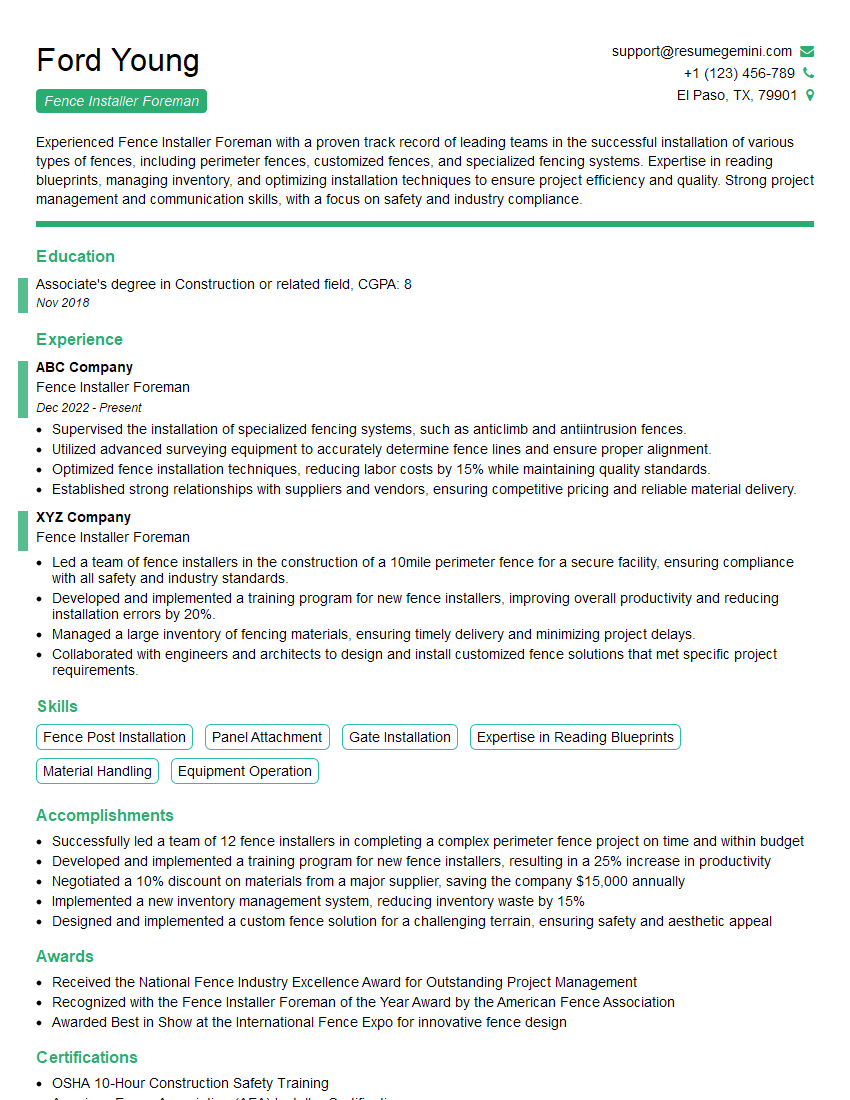
Mastering chain-link fence installation opens doors to a rewarding career with opportunities for advancement and specialization. To increase your job prospects, focus on crafting an ATS-friendly resume that showcases your skills and experience effectively. ResumeGemini is a trusted resource to help you build a professional and impactful resume. Examples of resumes tailored to chain-link fence installation are available to help you get started.
Explore more articles
Users Rating of Our Blogs
Share Your Experience
We value your feedback! Please rate our content and share your thoughts (optional).
What Readers Say About Our Blog
Very informative content, great job.
good