Are you ready to stand out in your next interview? Understanding and preparing for Radar Systems Operation and Maintenance interview questions is a game-changer. In this blog, we’ve compiled key questions and expert advice to help you showcase your skills with confidence and precision. Let’s get started on your journey to acing the interview.
Questions Asked in Radar Systems Operation and Maintenance Interview
Q 1. Explain the difference between pulsed and continuous wave radar.
The core difference between pulsed and continuous wave (CW) radar lies in how they transmit signals. Pulsed radar transmits short bursts of electromagnetic energy, pausing between each burst to listen for echoes. Think of it like shouting and then listening for a reply. This allows for range measurement because the time delay between transmission and echo reception is directly proportional to the target’s distance. Continuous wave radar, on the other hand, transmits a continuous signal. It’s like constantly talking, needing a different method to determine distance and velocity.
- Pulsed Radar: Offers range and velocity measurement. Excellent for detecting objects at various ranges. Used in weather radar, air traffic control, and many military applications.
- Continuous Wave Radar: Primarily measures velocity using the Doppler effect – the change in frequency of the reflected wave due to the target’s motion. Often used in police speed guns and some advanced automotive radar systems where precise velocity is crucial.
Imagine a police officer using a radar gun – that’s CW radar, measuring the speed of cars. In contrast, an air traffic controller’s radar system is pulsed, determining the distance and altitude of aircraft.
Q 2. Describe the function of a radar transmitter and receiver.
The radar transmitter and receiver are the heart of any radar system, working in tandem to detect and measure targets.
- Transmitter: Generates and transmits electromagnetic waves. The power and frequency of these waves are crucial for the radar’s performance. A high-power transmitter is needed to detect distant targets, while frequency selection depends on the application and the properties of the target material (some materials reflect certain frequencies better than others).
- Receiver: Detects the weak reflected signals (echoes) from targets. It’s incredibly sensitive, capable of amplifying tiny signals from miles away. The receiver also processes the received signal, extracting information about the target’s range, velocity, and other characteristics. This often includes filtering out noise and clutter.
Consider this analogy: the transmitter is like a powerful spotlight, illuminating the area, and the receiver is like a very sensitive camera, capturing the faint reflections from objects in the dark.
Q 3. What are the common types of radar antennas and their characteristics?
Radar antennas play a vital role in directing the transmitted energy and collecting the received echoes. Several types exist, each with distinct characteristics:
- Parabolic Reflector Antennas: These are dish-shaped antennas that focus the electromagnetic energy into a narrow beam, enhancing the signal strength and improving range resolution. They’re commonly used in long-range radar systems.
- Horn Antennas: Simpler in design than parabolic reflectors, horn antennas provide a relatively narrow beamwidth. They are often used as feed antennas for larger reflector systems.
- Array Antennas: These consist of multiple radiating elements arranged in a specific configuration (e.g., linear, planar). They can electronically steer the beam without physically moving the antenna, enabling fast scanning and tracking of multiple targets. Phased array antennas are a prime example, used extensively in modern radar systems.
- Microstrip Antennas: Compact and lightweight, these antennas are often integrated into smaller radar systems, such as those found in vehicles or handheld devices. They are often printed on a circuit board.
The choice of antenna depends on the specific application’s requirements for beamwidth, gain, size, and weight. For example, a weather radar uses a large parabolic antenna for its wide coverage, while a missile guidance system might utilize a small, agile array antenna for precise target tracking.
Q 4. Explain the concept of radar cross-section (RCS).
Radar Cross-Section (RCS) quantifies how much electromagnetic energy a target reflects towards the radar. It’s expressed in square meters (m²) and represents the ‘effective’ size of the target as seen by the radar. A large RCS means a strong reflection, making the target easily detectable, while a small RCS implies a weak reflection and makes the target harder to detect.
Several factors influence RCS, including the target’s size, shape, material composition, and orientation relative to the radar. A flat plate reflects more energy than a sphere of the same size. Stealth technology focuses on minimizing a target’s RCS to reduce its detectability.
For instance, a large metal aircraft has a much higher RCS than a small, wooden boat. Stealth aircraft employ special designs and materials to minimize their RCS.
Q 5. How does clutter affect radar performance, and how is it mitigated?
Clutter refers to unwanted radar echoes from objects other than the target of interest. These echoes can be from ground, sea, weather phenomena (rain, snow, birds), or other interfering objects. Clutter can mask the target’s signal, making detection difficult or impossible.
Clutter mitigation techniques involve:
- Moving Target Indication (MTI): This technique exploits the Doppler effect to separate moving targets from stationary clutter. Moving targets have a Doppler shift in their return signal, while stationary clutter does not.
- Space-Time Adaptive Processing (STAP): A more advanced technique, STAP uses multiple antennas and multiple pulses to create a spatial and temporal filter that adapts to the clutter environment. This allows for superior clutter rejection, particularly in complex clutter scenarios.
- Clutter Mapping: Building a map of the clutter environment and subtracting it from the received signal. This is effective for stationary clutter.
- Polarization Filtering: Using different polarizations of electromagnetic waves to discriminate between the target and clutter.
Imagine trying to spot a small boat on a stormy sea – the waves (clutter) obscure the boat’s visibility. Clutter mitigation techniques are akin to using sophisticated image processing techniques to filter out the waves and make the boat visible.
Q 6. Describe different types of radar signal processing techniques.
Radar signal processing is crucial for extracting meaningful information from the received echoes. Several techniques are employed:
- Pulse Compression: This technique improves range resolution by transmitting long pulses with specific codes and then compressing them at the receiver. It’s like sending a long, coded message and then decoding it to reveal finer detail.
- Doppler Processing: This technique utilizes the Doppler shift to measure the radial velocity of targets. It’s essential for separating moving targets from stationary clutter and determining target speed.
- Matched Filtering: This technique optimizes signal-to-noise ratio by correlating the received signal with a replica of the transmitted signal. It enhances the desired signal while suppressing noise.
- Digital Beamforming: This technique uses digital signal processing to electronically steer the radar beam, forming multiple beams simultaneously. This allows for simultaneous tracking of multiple targets.
These techniques are applied in various stages, from raw signal processing to target detection and tracking. The specific choice of technique depends on the radar system’s capabilities and the application’s needs.
Q 7. Explain the principles of frequency modulation continuous wave (FMCW) radar.
Frequency Modulated Continuous Wave (FMCW) radar transmits a continuous wave whose frequency changes linearly with time (a frequency chirp). The difference between the transmitted and received frequencies is directly proportional to the target’s range. Since it’s continuous, there’s no need to wait between transmissions for echoes.
It works by mixing the transmitted signal with the received echo. This generates an intermediate frequency (IF) signal whose frequency is directly proportional to the target’s range. The higher the frequency difference, the farther the target.
FMCW radar is particularly useful for short-range applications because it provides high range resolution with relatively low power. It’s used extensively in automotive radar (adaptive cruise control, collision avoidance systems), industrial process control, and some weather radar applications. Its precise range measurements make it well-suited for close-proximity sensing and short-range obstacle detection.
Q 8. What are the common types of radar failures and troubleshooting steps?
Radar failures can stem from various sources, ranging from simple component malfunctions to complex system-wide issues. Common failures include:
- Transmitter Problems: Magnetron failure (in older systems), klystron issues (similarly less common now), high-voltage supply malfunctions, and modulator problems often lead to reduced power output or complete transmitter failure. Troubleshooting involves checking high voltage levels, magnetron/klystron performance (via specialized equipment), and inspecting the modulator circuitry for faults.
- Receiver Issues: Low-noise amplifier (LNA) failures, mixer problems, intermediate frequency (IF) amplifier malfunctions, and faulty detectors can significantly impact signal reception sensitivity and quality. Troubleshooting entails checking signal strength at various points in the receiver chain using spectrum analyzers and signal generators, isolating faulty components through signal tracing.
- Antenna Problems: Misalignment, damage to the antenna structure, waveguide leaks, or faulty rotary joints can severely degrade performance. Troubleshooting includes visual inspection for physical damage, alignment checks using precision surveying equipment, and leakage detection with specialized waveguide sensors.
- Processor/Display Issues: Software glitches, computer hardware malfunctions, and display unit problems can lead to incorrect data processing or presentation. Troubleshooting involves checking system logs, running diagnostics software, and inspecting the hardware for any visible damage or loose connections.
- Power Supply Issues: Inadequate power to any radar subsystem can lead to unpredictable behavior. Troubleshooting necessitates checking power levels at various points in the system using multimeters and identifying any voltage drops or fluctuations.
Troubleshooting follows a systematic approach: First, identify the symptom, then isolate the affected subsystem using built-in test equipment or external diagnostic tools. Finally, repair or replace the faulty component, ensuring thorough testing before returning the system to operation.
Q 9. How do you perform radar calibration and alignment?
Radar calibration and alignment are crucial for accurate measurements. Calibration ensures the system’s internal parameters (e.g., gain, timing) are accurate, while alignment ensures the antenna points precisely in the desired direction.
Calibration typically involves using known signal sources (e.g., calibrated test signals) to adjust internal parameters to match expected values. This often involves specialized software and equipment specific to the radar system’s design. For instance, we might use a precision attenuator to fine-tune the receiver gain, ensuring proper signal level handling across the entire dynamic range.
Alignment involves physically adjusting the antenna’s orientation to its intended azimuth and elevation angles. This process usually involves high-precision surveying equipment, such as theodolites, to measure the antenna’s position and make the necessary adjustments. Modern systems often have automated alignment routines that assist in this process. For example, using a known reference point (like a mountain peak or geodetic marker), we can measure the antenna’s pointing accuracy and make adjustments until we achieve the required precision.
Both calibration and alignment often require detailed documentation and adherence to manufacturer’s specifications to ensure accuracy and safety.
Q 10. Describe the safety procedures for working with high-power radar systems.
Safety is paramount when working with high-power radar systems. The primary hazards include high-voltage electricity, high-power microwave radiation, and potentially dangerous mechanical components. Safety procedures must be strictly followed.
- High-Voltage Precautions: Always use appropriate lockout/tagout procedures before working on any high-voltage circuits. Proper personal protective equipment (PPE), including insulated gloves and safety glasses, is mandatory. Only qualified personnel should work on these systems.
- Microwave Radiation Safety: Never operate the radar transmitter without adequate shielding and safety interlocks. Access to the radiation hazard area should be strictly controlled, and personnel must use appropriate personal protective equipment, such as microwave-absorbing garments and specialized safety goggles, if any access is necessary while the system is operating. Radiation levels must be regularly monitored using survey meters.
- Mechanical Safety: Rotating antenna components pose a significant risk. Ensure all safety interlocks and guards are in place and functioning correctly before operating the antenna. Never attempt repairs or maintenance on moving parts while the system is powered on.
- Emergency Procedures: Establish clear emergency procedures, including communication protocols, access to emergency power shutoff, and first aid provision, and conduct regular training and drills.
Remember that safety is not just a set of rules, but a culture that emphasizes careful planning, risk assessment, and adherence to established protocols at every stage of operation and maintenance.
Q 11. Explain the importance of radar maintenance and preventative measures.
Radar maintenance is essential to ensure system reliability, accuracy, and longevity. Preventative maintenance minimizes unexpected downtime and avoids costly repairs. It also extends the lifespan of the equipment and improves its overall performance.
Importance: Regular maintenance ensures that the radar system operates at its peak performance, delivering accurate and reliable data. Neglecting maintenance can lead to decreased accuracy, increased downtime, and potentially dangerous malfunctions.
Preventative Measures: A well-defined preventative maintenance schedule should include:
- Regular Inspections: Visual inspections for signs of physical damage, corrosion, and loose connections.
- Component Testing: Regular testing of critical components like the transmitter, receiver, and antenna using specialized test equipment.
- Software Updates: Implementing software updates to address bugs and improve functionality.
- Environmental Control: Maintaining a controlled environment to minimize the impact of dust, moisture, and extreme temperatures.
- Calibration and Alignment: Performing periodic calibration and alignment to maintain accuracy.
- Documentation: Maintaining detailed maintenance logs and records.
A proactive approach to maintenance dramatically reduces the likelihood of unexpected failures and ensures the radar system remains operational and provides accurate data for its intended purpose.
Q 12. How do you interpret radar data and identify anomalies?
Interpreting radar data involves understanding the displayed information and identifying any anomalies that may indicate a problem. This requires a strong understanding of the radar system’s operational parameters and characteristics.
Data Interpretation: Radar data is typically displayed as a range-azimuth plot, showing the detected targets’ range and bearing. Additional information, such as Doppler velocity and target strength, may also be displayed. Understanding the radar’s specific parameters (e.g., range resolution, beamwidth, pulse repetition frequency) is crucial for accurate interpretation.
Identifying Anomalies: Anomalies can include:
- Unexpected Target Appearance: Detection of targets outside the expected operational range or area.
- False Targets: Targets that do not correspond to real objects (e.g., ground clutter, multipath reflections).
- Missing Targets: Failure to detect expected targets.
- Inconsistent Target Characteristics: Variations in target strength or Doppler velocity that are not consistent with the expected target behavior.
- Data Glitches: Abrupt changes or discontinuities in the radar data.
Identifying anomalies requires a combination of technical expertise, familiarity with the specific radar system, and an understanding of the surrounding environment. For example, unexpectedly high clutter levels might indicate antenna misalignment or interference from other sources.
Q 13. What are the different types of radar displays and their interpretations?
Radar displays vary depending on the radar system’s capabilities and intended application. Common types include:
- A-Scope (Amplitude vs. Time): A simple display showing the received signal amplitude as a function of time. Useful for simple range detection but lacks bearing information.
- B-Scope (Range vs. Bearing): Displays target range and bearing relative to the radar’s position. Targets appear as dots on a map-like display.
- PPI (Plan Position Indicator): A circular display that shows the detected targets’ range and bearing in a polar coordinate system. Often used in weather radar and air traffic control.
- RHI (Range Height Indicator): Displays targets’ range and height. Useful for profiling atmospheric conditions or terrain features.
- Digital Displays: Modern systems often use digital displays that provide a more comprehensive and flexible presentation of radar data. This allows for the simultaneous display of range, bearing, velocity, and other parameters in various formats, possibly including 3D representations.
Interpretations: The interpretation of each display depends on the specific radar system and its parameters. Understanding the system’s characteristics—such as range resolution, beamwidth, and pulse repetition frequency—is essential for accurate interpretation. For instance, a cluttered PPI display could indicate ground clutter or interference, requiring adjustments to the radar parameters or signal processing techniques to mitigate the effect. A B-scope might show clusters of dots corresponding to a flock of birds, while isolated dots might represent aircraft.
Q 14. Describe your experience with radar system testing and validation.
My experience with radar system testing and validation spans various projects and system types, including both legacy and modern systems. This has involved a range of activities aimed at ensuring system performance meets specified requirements and complies with safety regulations.
Testing methodologies have included:
- Component-level testing: Individual components, such as the transmitter, receiver, and antenna, are tested to verify their performance parameters.
- System-level testing: The entire system is tested as an integrated unit to ensure that all components work together correctly.
- Environmental testing: The radar system is subjected to various environmental conditions (temperature, humidity, vibration) to verify its robustness and reliability.
- Performance testing: The radar’s performance characteristics (range, accuracy, resolution) are measured and compared to the specified requirements.
- Functional testing: The system’s functionality is tested to ensure it performs as intended.
- Acceptance testing: This final stage verifies that the system meets all requirements before deployment.
In one specific instance, I was involved in testing a new weather radar system. We used a range of techniques, including comparisons to ground truth data from meteorological stations, simulations with known weather patterns, and testing under various environmental conditions. This rigorous testing process ensured the system’s accuracy and reliability before deployment to a critical operational site.
Q 15. Explain the role of signal processing in improving radar accuracy.
Signal processing is the backbone of accurate radar operation. Raw radar signals are noisy and often contain unwanted information. Signal processing techniques filter out this noise and extract the relevant information, improving the accuracy of target detection, range, velocity, and angle measurements.
For example, consider matched filtering. This technique uses a filter designed to match the expected radar signal shape. This improves the signal-to-noise ratio (SNR) by maximizing the signal’s strength relative to the background noise, allowing us to better distinguish real targets from clutter.
Another example is Moving Target Indication (MTI), crucial for ground-based radars. MTI processes the radar returns to remove stationary objects (clutter) like trees and buildings, leaving only moving targets. This significantly improves the detection of aircraft or vehicles in cluttered environments. This involves techniques like subtracting successive returns to cancel stationary echoes and detecting Doppler shifts related to target movement. Advanced algorithms employ digital filtering techniques and frequency domain processing to enhance the accuracy of MTI.
In short, signal processing is essential for cleaning up raw radar data, enhancing target detection, and improving the overall precision of range, velocity and angular measurements, enabling accurate tracking and identification.
Career Expert Tips:
- Ace those interviews! Prepare effectively by reviewing the Top 50 Most Common Interview Questions on ResumeGemini.
- Navigate your job search with confidence! Explore a wide range of Career Tips on ResumeGemini. Learn about common challenges and recommendations to overcome them.
- Craft the perfect resume! Master the Art of Resume Writing with ResumeGemini’s guide. Showcase your unique qualifications and achievements effectively.
- Don’t miss out on holiday savings! Build your dream resume with ResumeGemini’s ATS optimized templates.
Q 16. How do you ensure the reliability and availability of a radar system?
Ensuring radar system reliability and availability involves a multifaceted approach encompassing preventive maintenance, proactive monitoring, and robust design.
- Preventive Maintenance: Regular scheduled maintenance, following manufacturer guidelines, is crucial. This includes checks of critical components like the transmitter, receiver, antenna, and signal processors. Replacing aging or worn parts before failure prevents costly downtime. We perform detailed inspections, calibration and testing at regular intervals.
- Redundancy: Employing redundant components is paramount. Having backup systems for critical components like power supplies and transmitters ensures that the radar remains operational even if one component fails. This is particularly vital in mission-critical applications.
- Proactive Monitoring: Real-time monitoring of key performance indicators (KPIs) allows for early detection of potential problems. This might involve monitoring power levels, signal strength, temperature, and system error logs. Early warning systems facilitate timely repairs, reducing downtime.
- Environmental Protection: Protecting the radar from harsh environmental conditions is key. This involves proper shelter, climate control, and shielding from elements like rain, dust, and extreme temperatures. Regular cleaning is vital to prevent performance degradation.
- Software Updates: Keeping the radar’s software up-to-date is essential. Updates often include bug fixes, performance improvements, and new features that enhance reliability and security.
By combining these strategies, we can significantly enhance the reliability and operational availability of the radar system, ensuring consistent performance and minimizing disruption.
Q 17. What are the environmental factors that affect radar performance?
Various environmental factors significantly impact radar performance. These can broadly be categorized into atmospheric effects, geographic features, and weather conditions.
- Atmospheric Attenuation: Rain, snow, fog, and atmospheric gases (water vapor, oxygen) absorb and scatter radar signals, reducing their range and strength. The degree of attenuation depends on the frequency, weather conditions, and the distance the signal travels.
- Multipath Propagation: Reflections of the radar signal from the ground, sea surface, or other objects create multiple signal paths. This can lead to ghost targets or distortions in the radar returns, particularly at low elevations and in areas with complex terrain.
- Refraction: Changes in atmospheric temperature and pressure can refract (bend) the radar beam, causing inaccuracies in range and elevation measurements. This effect is more pronounced at low altitudes and over long ranges.
- Clutter: Ground clutter, sea clutter, and weather clutter can mask or obscure real targets. Clutter is caused by reflections from stationary objects or atmospheric phenomena.
- Geographic Features: Mountains, hills, and buildings can block or scatter the radar beam, creating blind spots and degrading performance. The topography significantly influences propagation.
Understanding and compensating for these environmental effects, through signal processing techniques and accurate environmental modeling, is vital for reliable radar operation.
Q 18. Describe your experience with radar system upgrades and modifications.
I have extensive experience in radar system upgrades and modifications, covering various aspects from hardware replacements to software enhancements. One notable project involved upgrading an aging pulse Doppler radar with a new digital signal processor (DSP). This involved careful planning, rigorous testing, and meticulous integration.
The project began with a thorough assessment of the existing system’s capabilities and limitations, identifying areas where improvements were needed. This included analyzing the existing DSP’s performance bottlenecks and evaluating potential replacements. We selected a higher-performance DSP capable of processing larger amounts of data, improving target detection, tracking, and classification. The installation involved careful removal of the old DSP, installation of the new one, and thorough testing to ensure seamless integration with existing hardware and software. We also implemented improved signal processing algorithms which considerably enhanced the accuracy of target parameters estimation.
Another project focused on enhancing the radar’s operational range by replacing the existing antenna with a higher-gain antenna. This involved careful alignment and calibration to maintain accurate beam pointing and minimize side lobe levels. Comprehensive testing was carried out to confirm the improved range performance and to ensure there were no unforeseen effects on other system parameters.
In all upgrade projects, careful consideration of system compatibility, safety, and regulatory compliance were paramount. We followed strict protocols and documentation procedures to ensure the success of each upgrade.
Q 19. Explain your experience with different radar technologies (e.g., phased array, pulse Doppler).
My experience spans various radar technologies, including phased array and pulse Doppler radars. Phased array radars offer significant advantages in terms of electronic beam steering, allowing for rapid scanning and multi-target tracking. I’ve worked on several projects involving the maintenance and optimization of phased array radars, focusing on calibration procedures, phase shifter adjustments, and beamforming algorithms. Maintaining phase coherence across numerous antenna elements is a critical aspect of their operation, and I’m experienced in diagnosing and resolving issues related to phase errors and amplitude imbalances.
Pulse Doppler radar is another key technology in my expertise. I’ve been involved in the maintenance, repair, and troubleshooting of various pulse Doppler systems. Understanding the intricacies of Doppler processing, including clutter rejection techniques like MTI and digital filtering is critical for accurate velocity measurement. I’m proficient in analyzing the radar’s Doppler spectra to identify moving targets and separate them from clutter.
Beyond these, I have experience with other radar modalities, including frequency-modulated continuous wave (FMCW) radar, which is commonly used in short-range applications such as automotive radar. My expertise includes understanding and troubleshooting different radar waveforms, signal processing techniques tailored to specific radar types, and evaluating the performance characteristics of each technology in diverse applications.
Q 20. How do you diagnose and resolve problems with radar signal propagation?
Diagnosing and resolving problems with radar signal propagation requires a systematic approach combining theoretical understanding and practical troubleshooting skills.
The initial step involves analyzing the received signal strength and quality. A significant reduction in signal strength could indicate atmospheric attenuation, multipath propagation, or obstructions. We use propagation models to predict signal strength, taking into account environmental conditions and geographic factors. If the predicted strength differs from the measured strength, we investigate the possible causes.
Systematic Troubleshooting:
- Check for Obstructions: Examine the radar’s line of sight for any potential obstructions like trees, buildings, or terrain features that could block or scatter the radar signal.
- Analyze Weather Data: Assess meteorological conditions like rain, snow, fog, and atmospheric pressure to evaluate their potential impact on signal propagation.
- Examine Antenna Alignment: Verify the antenna’s alignment and ensure there is no misalignment that might affect the beam’s direction.
- Evaluate Signal Processing: Analyze the received signal for anomalies. Clutter, multipath effects, or noise might indicate a problem in signal processing. We can adjust processing parameters to mitigate these issues.
- Conduct Signal Strength Measurements: Use calibrated equipment to measure signal strength at different points along the radar’s coverage area to identify any propagation anomalies.
- Employ Propagation Models: Use propagation models to predict signal strength and compare it to measured values. Discrepancies suggest further investigation.
Often, multiple factors contribute to propagation problems. The resolution strategy involves addressing each identified issue, implementing appropriate mitigation techniques, and performing comprehensive testing to verify improvements.
Q 21. What are the key performance indicators (KPIs) for a radar system?
Key Performance Indicators (KPIs) for a radar system vary depending on the specific application, but some common metrics include:
- Detection Range: The maximum distance at which the radar can reliably detect targets of a given size and radar cross-section.
- Accuracy: The precision of range, bearing, velocity and other target parameter measurements. Accuracy is often expressed as a standard deviation or mean error.
- False Alarm Rate: The number of false alarms (detections of non-existent targets) per unit time. A lower rate indicates better performance.
- Probability of Detection (Pd): The probability that the radar will detect a target given its size, range, and other characteristics.
- Clutter Rejection Capability: The radar’s ability to discriminate between targets and clutter (ground, sea, or weather echoes).
- System Availability: The percentage of time the radar system is operational and available for use.
- Mean Time Between Failures (MTBF): The average time between successive failures of the radar system.
- Mean Time To Repair (MTTR): The average time taken to repair a failed component or system.
Monitoring these KPIs provides valuable insights into the radar system’s performance and helps identify areas needing improvement or maintenance. Regular performance evaluations, comparing KPIs against established thresholds, are crucial for ensuring the radar’s reliability and effectiveness.
Q 22. Describe your experience with radar data acquisition and analysis.
Radar data acquisition and analysis involves collecting raw radar signals, processing them to extract meaningful information, and interpreting the results. This process starts with the radar transmitting signals and receiving echoes from targets. The raw data, typically in the form of complex time series, needs careful handling.
My experience includes working with various radar types – from simple pulsed Doppler systems to advanced phased array radars. I’m proficient in using signal processing techniques like Fast Fourier Transforms (FFTs) to convert the time-domain signals into the frequency domain, enabling the identification of target velocities and range. I’ve used tools like MATLAB and specialized radar signal processing software to perform tasks such as clutter rejection, target detection, and tracking. For example, I worked on a project where we analyzed weather radar data to predict severe weather events. This required implementing advanced algorithms to filter out ground clutter and accurately estimate rainfall rates. Another example involves using range-Doppler processing of SAR (Synthetic Aperture Radar) data to create high-resolution images of terrain.
Data analysis is crucial. I have experience in statistical analysis of radar data to validate system performance and assess the reliability of the detected targets. This involves calculating key metrics such as signal-to-noise ratio (SNR), probability of detection (Pd), and probability of false alarm (Pfa).
Q 23. Explain your experience working with different radar software and hardware platforms.
My experience spans a broad range of radar software and hardware platforms. On the hardware side, I’ve worked with various radar types, including pulsed Doppler radars, FMCW (Frequency-Modulated Continuous Wave) radars, and phased array radars from different manufacturers. This experience includes familiarity with the associated hardware components like antennas, transmitters, receivers, and signal processors. I’ve been involved in the installation, configuration, and testing of these systems.
In terms of software, I’m proficient in using various radar signal processing software packages, including MATLAB, Python with libraries like SciPy and NumPy, and specialized radar software like CASS (Computer Aided Software System) and other proprietary solutions. I’ve also worked with data acquisition and control systems using LabVIEW and other similar platforms. I’m familiar with databases for storing and managing large volumes of radar data, such as relational databases and NoSQL databases. For instance, I once had to integrate data from an older legacy radar system into a modern, networked system. This involved developing custom software to handle data conversion and format compatibility issues.
Q 24. How do you ensure the security of a radar system?
Radar system security is paramount. It involves protecting the system from unauthorized access, use, disclosure, disruption, modification, or destruction. This requires a multi-layered approach.
- Physical Security: This includes securing the radar site with fences, access control systems, and surveillance cameras. Regular physical inspections are vital.
- Network Security: If the radar is part of a network, robust firewalls, intrusion detection systems (IDS), and intrusion prevention systems (IPS) are essential. Regular security audits and penetration testing are crucial.
- Data Security: This includes encrypting sensitive radar data both in transit and at rest. Access control mechanisms should restrict data access based on user roles and responsibilities. Regular data backups are also critical.
- Software Security: Regular software updates and patching are essential to address vulnerabilities. Secure coding practices and regular vulnerability assessments are critical.
- Personnel Security: Thorough background checks and security training for personnel are necessary to prevent insider threats.
For example, in a previous role, I implemented a multi-factor authentication system for accessing the radar control software, significantly enhancing security. We also implemented encryption for all data transmitted over the network.
Q 25. Describe your troubleshooting methodology for complex radar issues.
My troubleshooting methodology for complex radar issues is systematic and follows a structured approach. It begins with clearly identifying the problem and gathering all relevant information. I then use a combination of techniques:
- Symptom Analysis: Carefully examining the observed symptoms and documenting them thoroughly.
- Data Analysis: Analyzing radar data to pinpoint the source of the problem. This might involve examining signal quality, power levels, and other relevant parameters.
- Hardware Checks: Inspecting hardware components, checking for physical damage, loose connections, or faulty components. This may involve using specialized test equipment.
- Software Checks: Reviewing software logs, configurations, and code for errors or inconsistencies. This could involve debugging code or reinstalling software.
- System Tests: Performing various system tests to verify functionality. This might involve running diagnostics or using simulated targets.
- Root Cause Analysis: Identifying the root cause of the problem and developing a solution to prevent recurrence.
For instance, I once encountered a situation where a radar system was experiencing intermittent signal dropouts. Through systematic investigation, I discovered a faulty connection in the antenna cable. The problem was resolved by replacing the faulty cable.
Q 26. What is your experience with radar system documentation and reporting?
Comprehensive documentation and reporting are vital for radar systems. My experience includes creating and maintaining various types of documentation, including:
- System Design Documents: Detailed documentation of the radar system’s architecture, components, and functionalities.
- Operational Manuals: Step-by-step instructions for operating the system, including safety procedures.
- Maintenance Manuals: Detailed instructions for performing routine maintenance tasks and troubleshooting common issues.
- Test Reports: Comprehensive reports documenting the results of system tests and calibrations.
- Performance Reports: Regular reports summarizing system performance, including key metrics like signal-to-noise ratio (SNR) and probability of detection (Pd).
I ensure that all documentation is clear, concise, and readily accessible. I also use various software tools to manage and version control the documentation, ensuring its accuracy and consistency. For example, I’ve used tools like Confluence and SharePoint to manage documentation related to a large air surveillance radar project.
Q 27. Describe your experience with radar system integration with other systems.
Radar system integration with other systems is often crucial. My experience includes integrating radar systems with various other systems, such as:
- Air Traffic Control Systems: Integrating radar data into air traffic control systems to provide real-time tracking of aircraft.
- Command and Control Systems: Providing radar data to command and control centers for situational awareness.
- Surveillance Systems: Combining radar data with other sensor data (e.g., video, acoustic) for enhanced situational awareness.
- Data Processing and Analysis Systems: Transferring radar data to data processing systems for further analysis and interpretation.
This involves understanding the communication protocols, data formats, and interfaces of different systems. I have experience with various integration techniques, including custom software development, utilizing standard communication protocols like TCP/IP, and using middleware solutions. A specific example was integrating a weather radar into a hydrological forecasting system. This involved developing custom software to translate radar data into rainfall estimates that the hydrological model could utilize.
Q 28. Explain your understanding of radar regulations and compliance standards.
A strong understanding of radar regulations and compliance standards is critical. These vary depending on the type of radar system, its application, and the geographic location. My knowledge encompasses:
- Frequency Allocation: Understanding the radio frequency spectrum allocation regulations and obtaining the necessary licenses to operate the radar system within the allocated frequency bands.
- Emission Standards: Adhering to international and national standards for radar emissions to minimize interference with other systems and protect the environment.
- Safety Regulations: Compliance with safety regulations for operating and maintaining radar systems, including radiation safety guidelines.
- Data Privacy Regulations: Compliance with data privacy regulations, particularly if the radar system collects personal data.
- Security Regulations: Adherence to cybersecurity regulations to protect the radar system from cyber threats.
I am familiar with various regulatory bodies such as the FCC (Federal Communications Commission) in the US and similar agencies internationally. I ensure all projects comply with the relevant regulations throughout the system’s lifecycle, from design and development to deployment and operation. For instance, I have been actively involved in obtaining the necessary licenses and permits for operating radars in different countries, ensuring that all required paperwork is compliant with their specific regulations.
Key Topics to Learn for Radar Systems Operation and Maintenance Interview
- Radar Principles: Understanding fundamental concepts like wave propagation, signal processing, and target detection is crucial. This forms the bedrock of your knowledge.
- System Architecture: Familiarize yourself with the different components of a radar system (transmitter, receiver, antenna, processor) and how they interact. Be prepared to discuss their functions and potential points of failure.
- Signal Processing Techniques: Mastering techniques like pulse compression, clutter rejection, and moving target indication (MTI) is vital for interpreting radar data effectively. Consider practical scenarios where these techniques are applied.
- Maintenance Procedures: Understand preventative maintenance schedules, troubleshooting techniques, and the importance of following safety protocols. Be prepared to discuss practical examples of maintenance tasks and problem-solving scenarios.
- Troubleshooting and Diagnostics: Develop a systematic approach to identifying and resolving faults within the radar system. Practice diagnosing issues based on error codes or observed system behavior.
- Data Interpretation and Analysis: Learn how to interpret radar data displays and extract meaningful information. Be ready to discuss different types of radar displays and their interpretations.
- Calibration and Alignment: Understanding the procedures for calibrating and aligning radar systems to ensure accurate performance is key. This showcases attention to detail and precision.
- Safety Regulations and Procedures: Demonstrate a strong understanding of relevant safety regulations and procedures pertaining to radar systems operation and maintenance. This is paramount in this field.
- Specific Radar Technologies: Research the specific types of radar systems (e.g., weather radar, air traffic control radar, search radar) relevant to the job description and prepare to discuss their unique characteristics and operational considerations.
Next Steps
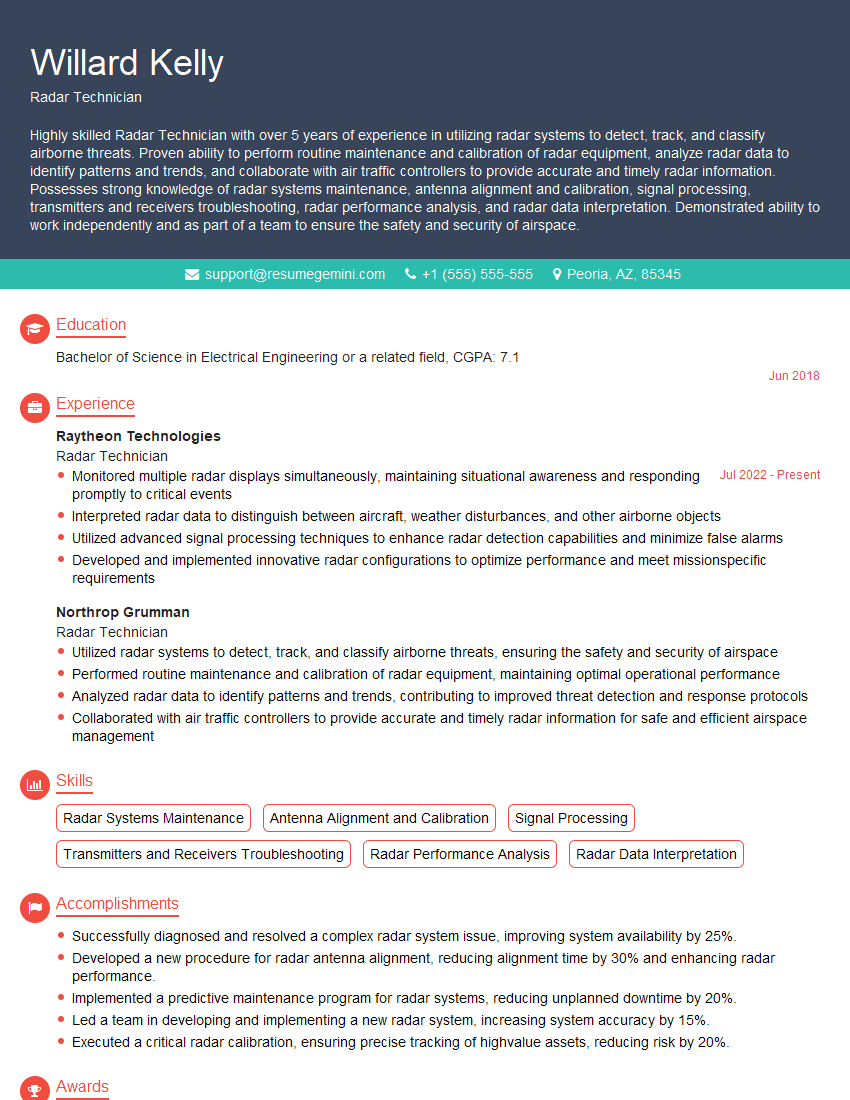
Mastering Radar Systems Operation and Maintenance opens doors to exciting career opportunities in a dynamic and crucial field. To maximize your chances of landing your dream job, a well-crafted resume is essential. An ATS-friendly resume ensures your application gets noticed by recruiters. ResumeGemini is a trusted resource to help you build a professional and impactful resume that highlights your skills and experience effectively. Examples of resumes tailored to Radar Systems Operation and Maintenance are available to further assist you in crafting your perfect application.
Explore more articles
Users Rating of Our Blogs
Share Your Experience
We value your feedback! Please rate our content and share your thoughts (optional).
What Readers Say About Our Blog
Very informative content, great job.
good