Feeling uncertain about what to expect in your upcoming interview? We’ve got you covered! This blog highlights the most important Repairing Farm Equipment interview questions and provides actionable advice to help you stand out as the ideal candidate. Let’s pave the way for your success.
Questions Asked in Repairing Farm Equipment Interview
Q 1. Describe your experience diagnosing engine malfunctions in farm equipment.
Diagnosing engine malfunctions in farm equipment requires a systematic approach. It’s like being a detective, piecing together clues to find the culprit. I start by listening carefully – unusual noises like knocking, ticking, or whining can pinpoint the problem area. Next, I check the basics: oil level, coolant level, and fuel supply. Low levels or contamination are often the first indicators. Then, I use diagnostic tools such as compression testers to measure cylinder pressure (low compression suggests worn rings or valves), and scan tools to read engine codes (these codes provide a digital roadmap to potential issues). For example, a recurring code related to the oxygen sensor might point to a faulty sensor or an air intake leak. If mechanical issues are suspected, I might conduct further inspections, such as checking for fuel injector malfunctions, examining the timing chain or belt for wear, or looking for cracks in the engine block. Experience allows me to rapidly identify the most probable causes based on the symptoms and then systematically rule them out through testing and inspection. I’ve worked on everything from small tractor engines to the powerful diesels in combine harvesters, and each requires a different level of expertise.
Q 2. Explain the process of repairing a hydraulic system leak in a tractor.
Repairing a hydraulic system leak in a tractor involves several crucial steps. Safety is paramount – always ensure the tractor is turned off and the hydraulic system is depressurized before beginning. First, I locate the source of the leak. This often involves carefully inspecting all hydraulic lines, hoses, fittings, and the hydraulic pump itself for any visible leaks or damage. Think of it like finding a leak in a garden hose; sometimes it’s obvious, sometimes you need to follow the trail of oil to find the culprit. Once identified, I determine the severity of the leak. A small leak in a hose might only require replacing a hose clamp, whereas a larger leak in a hydraulic cylinder might require more extensive repairs, potentially involving seal replacements or even cylinder rebuilding. For example, if a high-pressure line is leaking, it requires careful attention as high-pressure hydraulic fluid is dangerous. The faulty component is replaced or repaired, and the system is thoroughly flushed to remove any debris resulting from the leak. Finally, I test the repaired system under operating conditions, checking for any further leaks and verifying proper hydraulic function. Proper torque specification for fittings is crucial to prevent leaks after repair.
Q 3. How do you troubleshoot electrical problems in farm machinery?
Troubleshooting electrical problems in farm machinery involves a combination of systematic testing and careful observation. I begin by visually inspecting wiring harnesses, connectors, and components for any signs of damage, corrosion, or loose connections. This often involves tracing wires, checking for shorts or breaks, and making sure all connections are tight and clean. Think of it like following a circuit; you need to trace each connection to find where the problem lies. Then, I use a multimeter to test voltages, current, and continuity in different parts of the electrical system. For example, I might test the voltage at the battery, then trace it through the wiring harness to see if it’s reaching the component in question. I might also use a circuit tester to identify short circuits. Once the problem is identified (a blown fuse, a faulty switch, a shorted wire, etc.), I make the necessary repairs or replacements. Proper documentation and diagrams are essential when working with complex electrical systems, and I always double-check my work to prevent further damage.
Q 4. What are the common causes of overheating in farm equipment engines?
Overheating in farm equipment engines is a common problem with several potential causes. The most frequent culprits include low coolant levels, a faulty thermostat (preventing proper coolant flow), a clogged radiator (restricting airflow), a malfunctioning cooling fan (inadequate air circulation), and a leaking head gasket (allowing coolant to escape). In addition, problems like a clogged air filter, low oil pressure, or a failing water pump can all contribute to overheating. Imagine the engine as a furnace; you need the right combination of fuel, air, and cooling to function properly. If any part of that system fails, the engine will overheat. Diagnosing the cause requires a systematic approach. I usually start by checking coolant levels and inspecting the radiator for blockages. Then I would verify fan operation, assess the thermostat function, and check for coolant leaks. Addressing the root cause, rather than just adding coolant, is crucial to prevent further damage and maintain engine health.
Q 5. How do you perform preventative maintenance on a combine harvester?
Preventative maintenance on a combine harvester is vital for optimal performance and longevity. It’s like regular check-ups for a person; preventing small issues before they become big problems. My approach typically involves a pre-harvest inspection covering all major components: thorough cleaning of the machine, removing accumulated debris from the header, rotor, and cleaning system; lubrication of all bearings, chains, and moving parts according to the manufacturer’s recommendations; checking and tightening all bolts and connections to prevent vibration-related damage; inspection and cleaning of the air filters to ensure efficient engine operation; and finally, inspecting the fuel and hydraulic systems for leaks or contamination. During the harvest season, I prioritize daily checks on critical components like the rotor, cleaning system, and feeder house for blockages or damage. I also carefully monitor oil levels, coolant levels, and hydraulic fluid levels daily, adjusting as needed. Regular maintenance intervals, scheduled according to the manufacturer’s manual, are essential. This approach ensures the machine remains in top operating condition, reduces the risk of breakdowns during the crucial harvest season, and extends the lifespan of the equipment.
Q 6. Describe your experience working with different types of farm equipment.
My experience spans a wide range of farm equipment. I’ve worked extensively on tractors – from compact utility tractors to large four-wheel-drive models – diagnosing and repairing issues with their engines, transmissions, hydraulic systems, and electrical components. I’m also proficient with harvesting machinery, including combines, balers, and forage harvesters. I am familiar with the specific requirements and maintenance procedures for each machine. For example, I understand the intricacies of the combine’s threshing mechanism and the importance of careful adjustment for optimal grain separation. I’ve also worked on tillage equipment, planters, sprayers, and other implements, providing comprehensive maintenance and repair services. My experience isn’t limited to a single brand or type of equipment, I’ve worked on various makes and models, developing a broad understanding of the common issues and repair techniques across different manufacturers.
Q 7. What is your experience with welding and fabrication in farm equipment repair?
Welding and fabrication are essential skills in farm equipment repair. I am proficient in various welding techniques, including MIG, TIG, and stick welding. I frequently use these skills to repair broken or damaged components, such as repairing cracked engine blocks, mending broken cultivator tines, or fabricating custom parts. For example, I’ve fabricated replacement brackets for attachments, custom hitches, and repaired damaged structural components on implements. I also use fabrication skills to create custom solutions to address specific problems. When a part is unavailable or prohibitively expensive, creating a replacement part allows me to get the equipment back in operation quickly and cost-effectively. My fabrication skills extend beyond welding. I can use cutting, bending, and shaping techniques to ensure a proper fit and function. Safety is always the top priority. I always adhere to safety protocols when working with welding equipment and follow appropriate precautions when dealing with potentially hazardous materials.
Q 8. How familiar are you with different types of farm equipment transmissions?
Farm equipment transmissions are crucial for power transfer. I’m very familiar with several types, including manual transmissions, which are simpler and require more operator skill; automated manual transmissions (AMTs), offering a blend of manual control and automated shifting; and continuously variable transmissions (CVTs), providing infinitely variable speed ratios for optimal efficiency. I’ve worked extensively with all three. For example, I recently repaired a John Deere tractor with a failing AMT system, tracing the problem to a faulty clutch actuator. Understanding the specific type of transmission is vital for accurate diagnosis and repair because the troubleshooting process varies greatly. A manual transmission might need a clutch adjustment or gear synchronizer repair, while an AMT problem could originate from the electronic control unit or hydraulic actuators. CVTs often require specialized tools and knowledge of their complex internal components such as belts and hydraulic pumps.
Q 9. Explain your experience with diagnosing and repairing PTO systems.
Power Take-Off (PTO) systems are vital for operating implements like balers and mowers. Diagnosing PTO issues often involves checking the PTO shaft for damage (bent or worn splines), inspecting the PTO clutch for proper engagement and wear, and verifying the correct operation of the associated hydraulics if the system is hydraulically activated. I’ve tackled various PTO problems, from simple lubrication issues to complete clutch replacements. One memorable case involved a farmer whose PTO shaft sheared. Through careful examination, we found the shear pin had been improperly installed, causing excessive stress on the shaft. A thorough inspection of the whole system revealed that wear and tear from repeated overloads was also a contributing factor. A simple preventative measure of regular lubrication and inspection could have averted the costly repair. In short, thorough examination of each component, starting with the simplest potential causes and progressively investigating more complex issues, is key to effective PTO diagnosis.
Q 10. How do you handle emergency repairs in the field?
Emergency repairs in the field require quick thinking and resourcefulness. My approach prioritizes safety, then focuses on identifying the critical failure. I always start with a thorough safety assessment of the situation, ensuring the equipment is secured and the environment is safe. Next, I assess the problem, often using a combination of visual inspection, listening for unusual sounds, and utilizing basic diagnostic tools if available. The goal is to create a temporary fix that allows the farmer to continue operating, even if it means reduced capacity. For example, if a hydraulic hose bursts, I can utilize a temporary repair kit or a combination of clamps and sealant to get the farmer back in operation. However, it is important to advise the farmer that a proper repair is necessary as soon as possible to avoid further damage.
Q 11. What safety procedures do you follow when repairing farm equipment?
Safety is paramount. Before starting any repair, I always disconnect the power source – battery, PTO, etc. – and use lockout/tagout procedures to prevent accidental activation. I also wear appropriate personal protective equipment (PPE), including safety glasses, gloves, hearing protection, and steel-toed boots. Working with hydraulic systems requires extra caution to avoid high-pressure fluid leaks. I thoroughly inspect any tools for damage before using them, ensuring they are in good working condition. I make sure to follow the manufacturer’s safety guidelines for the specific piece of equipment being repaired. Any task involving heavy lifting or potentially dangerous operations necessitates the use of appropriate lifting equipment and assistance from a colleague if needed. A detailed safety checklist before any repair task is fundamental to my workflow.
Q 12. What diagnostic tools and equipment are you proficient in using?
I’m proficient with a variety of diagnostic tools, including multimeters for electrical checks, pressure gauges for hydraulic systems, compression testers for engines, and diagnostic scanners for electronic control units (ECUs). I can also use specialized tools like a borescope for inspecting hard-to-reach areas and a leak detection kit for hydraulic systems. My experience also includes using manufacturer-specific diagnostic software for advanced troubleshooting. I regularly update my knowledge on the latest diagnostic tools and techniques, understanding that technology is constantly evolving in agricultural equipment repair.
Q 13. Describe your experience with hydraulic systems and their components.
Hydraulic systems are central to many farm machines. I have extensive experience with their various components, including pumps, valves, cylinders, and hoses. I can diagnose problems like leaks, low pressure, and system failures, often using pressure gauges and flow meters to pinpoint the source of the issue. A recent example involved a malfunctioning hydraulic lift on a combine harvester. Using pressure gauges, I traced a pressure drop to a faulty relief valve, necessitating its replacement. Understanding the various types of hydraulic systems, from open-center to closed-center, is crucial for effective troubleshooting and repair. I also understand the importance of maintaining proper fluid levels and cleanliness, preventing problems before they arise.
Q 14. How do you interpret technical manuals and schematics?
Interpreting technical manuals and schematics is essential for accurate repairs. I approach them methodically, starting with the overall system overview before focusing on specific components. I utilize the diagrams to trace electrical circuits, hydraulic pathways, and mechanical linkages. The use of diagrams and manuals allows for pinpointing the location of components, identifying their function, and understanding their relationship within the system as a whole. When dealing with complex systems, I often use a combination of the manual and my experience to understand what’s happening practically, using schematics and diagrams to connect the theoretical with the practical. For example, recently I had to troubleshoot an electrical fault on a tractor. The wiring diagram allowed me to trace the circuit and identify a faulty relay. The schematic illustrations and component descriptions found in the manual are indispensable for efficient and accurate equipment repair.
Q 15. What is your experience with engine rebuilding and overhaul?
Engine rebuilding and overhaul is a core competency for me. It involves completely disassembling an engine, inspecting every component for wear and tear, replacing or repairing damaged parts, and reassembling it to factory specifications. This is a meticulous process requiring precision and a deep understanding of internal combustion engines. I’ve worked on a wide range of engines, from small diesel engines in compact tractors to large gasoline engines in combines, and I’m proficient in diagnosing various engine issues, such as low compression, oil leaks, and overheating. For instance, I once completely overhauled a John Deere 4045 engine that was suffering from significant wear in the piston rings. This involved carefully measuring the cylinder walls for wear, honing them to restore their surface finish, installing new rings, and meticulously reassembling the engine. The tractor is now back in operation and performing flawlessly.
My experience includes working with various engine types like inline, V-type, and horizontally opposed engines, as well as different cooling systems, like liquid-cooled and air-cooled. I’m adept at using specialized tools like engine bore gauges, dial indicators, and torque wrenches to ensure accuracy throughout the process.
Career Expert Tips:
- Ace those interviews! Prepare effectively by reviewing the Top 50 Most Common Interview Questions on ResumeGemini.
- Navigate your job search with confidence! Explore a wide range of Career Tips on ResumeGemini. Learn about common challenges and recommendations to overcome them.
- Craft the perfect resume! Master the Art of Resume Writing with ResumeGemini’s guide. Showcase your unique qualifications and achievements effectively.
- Don’t miss out on holiday savings! Build your dream resume with ResumeGemini’s ATS optimized templates.
Q 16. Describe your experience with repairing fuel systems in farm equipment.
Repairing fuel systems in farm equipment requires a thorough understanding of both mechanical and electronic fuel injection systems. I have experience troubleshooting and repairing issues such as fuel leaks, clogged injectors, malfunctioning fuel pumps, and problems with the fuel delivery system itself. This involves using diagnostic tools to identify the root cause of the problem, which can range from a simple blockage to a more complex electronic malfunction. For example, I recently diagnosed and repaired a fuel injector problem in a Case IH tractor using a specialized diagnostic scanner to pinpoint the faulty injector and replace it. This returned the tractor to full functionality.
My work encompasses various fuel system components like fuel filters, fuel lines, fuel injectors, fuel pumps, and fuel injection control units (ECU). I’m skilled in cleaning and testing fuel injectors, replacing fuel pumps, and diagnosing electronic control issues. I understand the importance of maintaining proper fuel pressure and flow for optimal engine performance and fuel efficiency, and I can work on both older mechanical systems and the newer, more complex electronic systems found in modern farm equipment.
Q 17. How do you stay updated on the latest technologies and advancements in farm equipment repair?
Staying updated in this field is crucial for effective repair. I utilize several methods to keep my knowledge current. I regularly attend workshops and training sessions offered by manufacturers like John Deere, Case IH, and New Holland. These sessions cover the latest technologies, diagnostic techniques, and repair procedures. I also subscribe to industry-specific journals and online resources that provide articles and updates on new equipment and repair techniques. Additionally, I actively participate in online forums and communities where mechanics share their experiences and troubleshooting tips. This constant learning ensures I’m always prepared to tackle the challenges presented by increasingly sophisticated farm equipment.
Q 18. How do you prioritize multiple repair tasks effectively?
Prioritizing multiple repair tasks requires a systematic approach. I typically start by assessing the urgency and impact of each task. For example, a broken-down combine harvester during harvest is a higher priority than a minor repair on a tractor used for less time-sensitive operations. I create a prioritized list based on factors like the severity of the problem, the impact on farm operations, and the availability of parts. I also consider the required time for each repair, ensuring realistic timeframes. Effective time management and clear communication with clients are essential to smoothly handle multiple tasks and meet deadlines effectively.
Q 19. Describe your experience working independently and as part of a team.
I’m comfortable working both independently and as part of a team. Independent work often involves diagnosing and repairing equipment with minimal supervision, requiring strong problem-solving skills and self-reliance. This is essential for field service calls. Teamwork, on the other hand, enhances efficiency and allows us to leverage the expertise of other mechanics for complex repairs. I’ve been part of teams that worked on large-scale repairs, such as overhauling engine systems in large harvesters, where collaboration was key to a successful outcome. I value effective communication and collaboration when working in a team environment, contributing ideas, and sharing knowledge.
Q 20. What is your experience with repairing different types of tractors?
My experience with tractor repair spans a wide range of makes and models, including John Deere, Case IH, Massey Ferguson, and Ford. I’m familiar with different tractor types, such as wheel tractors, crawler tractors, and articulated tractors. This experience extends to various sizes and horsepower ratings, from small utility tractors to large agricultural tractors. I understand the unique mechanical and electronic systems of each brand and model, allowing me to diagnose and repair problems effectively. My knowledge extends to both older mechanical systems and newer electronically controlled systems that are prevalent in today’s tractors.
For instance, I’ve successfully repaired hydraulic systems in older Massey Ferguson tractors and diagnosed and fixed electronic issues in modern John Deere tractors using diagnostic software. This broad experience enables me to efficiently troubleshoot and repair a variety of tractors regardless of brand or model.
Q 21. What is your understanding of different types of engine fuel injection systems?
My understanding of engine fuel injection systems includes both mechanical and electronic systems. Mechanical systems use a pump and injectors to deliver fuel under pressure, while electronic systems rely on electronic control units (ECUs) to precisely control fuel delivery. I’m familiar with various types of injectors, including common rail, unit injectors, and individual pump systems. I can diagnose and repair problems related to fuel pressure, injector performance, and electronic control systems. Understanding the nuances of these systems, from fuel pressure regulation to precise metering, is critical for effective troubleshooting and repair. For example, I’ve repaired common rail systems by replacing faulty injectors or diagnosing wiring and sensor issues using diagnostic tools. My understanding includes the calibration and programming aspects, essential for ensuring optimal engine performance and emissions compliance.
Q 22. How do you troubleshoot and repair problems with electrical wiring harnesses?
Troubleshooting electrical wiring harnesses in farm equipment requires a systematic approach. It’s like detective work – you need to find the culprit causing the malfunction. I begin by visually inspecting the entire harness for obvious damage like broken wires, loose connections, or chafing against metal parts. I then use a multimeter to check for continuity and voltage at various points along the harness, comparing my readings to the equipment’s wiring diagram. This diagram acts as a roadmap, showing me the path the electrical current should take.
For instance, if a tractor’s headlights aren’t working, I’d start by checking the fuse. If that’s fine, I’d trace the wiring from the battery, through the switch, to the headlights themselves, testing voltage at each point. If I find a break in the circuit, I carefully repair the wire using appropriate connectors and heat-shrink tubing, ensuring a proper seal against moisture. Sometimes, the problem isn’t a simple break but a short circuit – a connection where electricity flows unexpectedly. I use a specialized wire tracer to pinpoint these shorts, then carefully repair the damaged section. Finally, thorough testing is critical to confirm the repair and prevent future issues.
- Visual inspection for damage
- Multimeter checks for continuity and voltage
- Using wiring diagrams
- Repairing breaks and short circuits
- Thorough testing
Q 23. What is your experience with engine performance tuning and optimization?
Engine performance tuning and optimization is about getting the most out of your engine while maintaining its longevity. Think of it like fine-tuning a musical instrument – you need to make small adjustments to achieve the perfect harmony. My experience includes using both mechanical and electronic methods to optimize engine performance. Mechanically, this involves things like adjusting valve clearances, ensuring proper fuel delivery, and checking air intake restrictions. Electronically, I work with engine control modules (ECMs) using diagnostic software to adjust parameters such as fuel injection timing, air-fuel ratios, and ignition advance.
For example, I once worked on a combine harvester that was experiencing poor fuel efficiency. After using diagnostic software and analyzing sensor data, I identified that the air-fuel mixture was too rich. By making precise adjustments to the ECM using specialized software, I was able to lean out the mixture, resulting in a significant improvement in fuel economy and power output. It’s crucial to remember that optimization isn’t just about increasing power; it’s also about extending the life of the engine by reducing wear and tear. This often involves finding the right balance between power and efficiency.
Q 24. Explain your understanding of different types of lubrication systems in farm equipment.
Farm equipment utilizes several types of lubrication systems, each with its own strengths and weaknesses. The most common is the pressure lubrication system, which uses a pump to circulate oil under pressure to various engine components, ensuring consistent lubrication even under heavy loads. Think of it like your body’s circulatory system – constantly delivering essential fluids where they are needed. Then there are splash lubrication systems, which rely on the oil splashing around to lubricate components. This is simpler and cheaper but less effective at delivering oil to all components, particularly under high loads.
Some systems use a combination of both methods. Grease lubrication is another essential aspect, used for bearings, joints, and other moving parts. Different greases have different properties, some better suited for high temperatures or high loads. Understanding these systems and choosing the right lubricant for each component is critical to preventing premature wear and equipment failure. Ignoring lubrication can lead to catastrophic engine failure, so regular checks and maintenance are vital.
Q 25. Describe your experience with computerized diagnostic systems.
My experience with computerized diagnostic systems is extensive. Modern farm equipment is heavily reliant on electronics, and these systems are essential for accurate and efficient troubleshooting. I’m proficient in using various diagnostic tools and software to retrieve diagnostic trouble codes (DTCs), monitor sensor data in real-time, and perform various tests on different systems. This is similar to a doctor using medical imaging to diagnose a patient – the data provides crucial clues about the problem.
For instance, I recently used a diagnostic scanner on a tractor experiencing intermittent power loss. The scanner indicated several DTCs pointing to problems with the fuel injection system. By analyzing the sensor data and performing further tests, I was able to pinpoint a faulty injector. These systems don’t just identify problems; they often guide you through the repair process, suggesting likely causes and providing step-by-step troubleshooting procedures. Proper interpretation and use of this data significantly reduce diagnostic time and improve repair efficiency.
Q 26. How do you handle difficult or challenging repair situations?
Difficult repair situations require a methodical approach. My first step is to thoroughly document the problem, gather as much information as possible, and analyze available data. I often start by reviewing service manuals, consulting with colleagues, or searching online forums for similar issues. This is like researching a complex scientific problem—you need to gather all the relevant information before attempting a solution.
For example, I once encountered a complex electrical fault in a self-propelled sprayer that stumped several other mechanics. After systematically testing all components and analyzing the wiring diagrams, I discovered a faulty relay hidden deep within the control panel. In such cases, patience, persistence, and a willingness to explore unconventional solutions are crucial. Sometimes, the solution may involve improvising using readily available materials, or even fabricating a custom part. If all else fails, seeking advice from experienced colleagues or manufacturers is always a viable option. The goal is to always find a safe and effective solution while adhering to best practices and safety standards.
Q 27. How do you maintain accurate records and documentation of repairs?
Maintaining accurate records is essential for efficient management and traceability. I use a combination of digital and paper-based systems to record all repairs. For each repair, I document the equipment’s identification number, the date, the problem, the steps taken to diagnose the issue, the parts used (including part numbers and suppliers), the labor time involved, and the final outcome. This information is crucial for warranty claims, future troubleshooting, and overall equipment management.
For digital records, I use specialized software that allows me to generate detailed reports, track parts inventory, and analyze repair trends. Paper-based records are maintained as a backup and for situations where digital access may be limited. Clear and concise documentation prevents confusion and helps to ensure that future repairs on the same piece of equipment are efficient and effective. It’s a crucial aspect of professional responsibility and helps to ensure repeatability and efficiency in problem-solving.
Q 28. What is your experience with repairing and maintaining irrigation systems?
My experience with irrigation systems covers a wide range of tasks, from routine maintenance to complex repairs. I’m familiar with various irrigation types, including center pivot, drip, and sprinkler systems. Maintaining these systems involves regular checks for leaks, blockages, and wear and tear on pumps, pipes, and valves. Repairs can range from simple tasks like replacing a leaky pipe fitting to more complex jobs involving pump repairs or controller programming.
For instance, I once had to troubleshoot a center pivot system that wasn’t irrigating correctly. Through systematic checks, I found a broken drive motor causing the pivot arm to stop rotating. This required not only replacing the motor but also checking the power supply, wiring, and control system to prevent future failures. Irrigation system repair requires a combination of mechanical and electrical skills, along with a good understanding of hydraulics. Effective troubleshooting relies on understanding water pressure, flow rates, and the overall system design.
Key Topics to Learn for Repairing Farm Equipment Interview
- Diesel Engine Systems: Understanding diesel engine operation, troubleshooting common issues (fuel delivery, starting problems, lubrication), and preventative maintenance procedures.
- Hydraulic Systems: Diagnosing and repairing hydraulic leaks, understanding hydraulic components (pumps, valves, cylinders), and troubleshooting hydraulic failures in farm machinery.
- Electrical Systems: Working knowledge of farm equipment wiring diagrams, troubleshooting electrical faults, and repairing components like alternators, starters, and sensors.
- Transmission and Drivetrain Systems: Understanding different transmission types (manual, automatic, hydrostatic), diagnosing drivetrain problems (clutches, axles, differentials), and performing necessary repairs.
- Welding and Fabrication: Practical skills in welding and metal fabrication for repairing damaged equipment components. This includes understanding different welding techniques and materials.
- Safety Procedures: Demonstrating a comprehensive understanding of safety regulations and practices related to farm equipment repair, including lockout/tagout procedures and personal protective equipment (PPE) usage.
- Troubleshooting and Diagnostic Techniques: Applying systematic approaches to identifying and resolving equipment malfunctions, utilizing diagnostic tools and manuals effectively.
- Common Farm Equipment Components: Familiarity with the components and workings of various farm equipment, such as tractors, harvesters, planters, and balers.
- Preventive Maintenance: Understanding the importance of regular maintenance schedules and procedures to prevent breakdowns and prolong the lifespan of farm equipment.
Next Steps
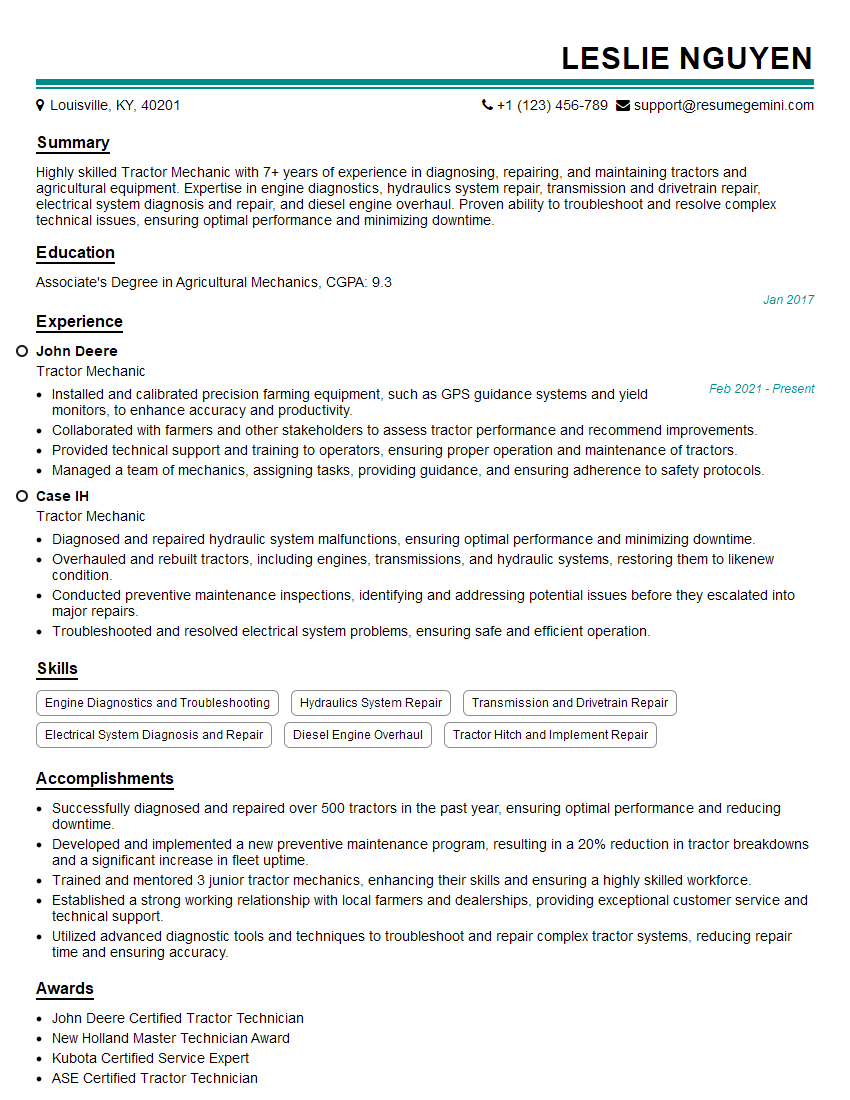
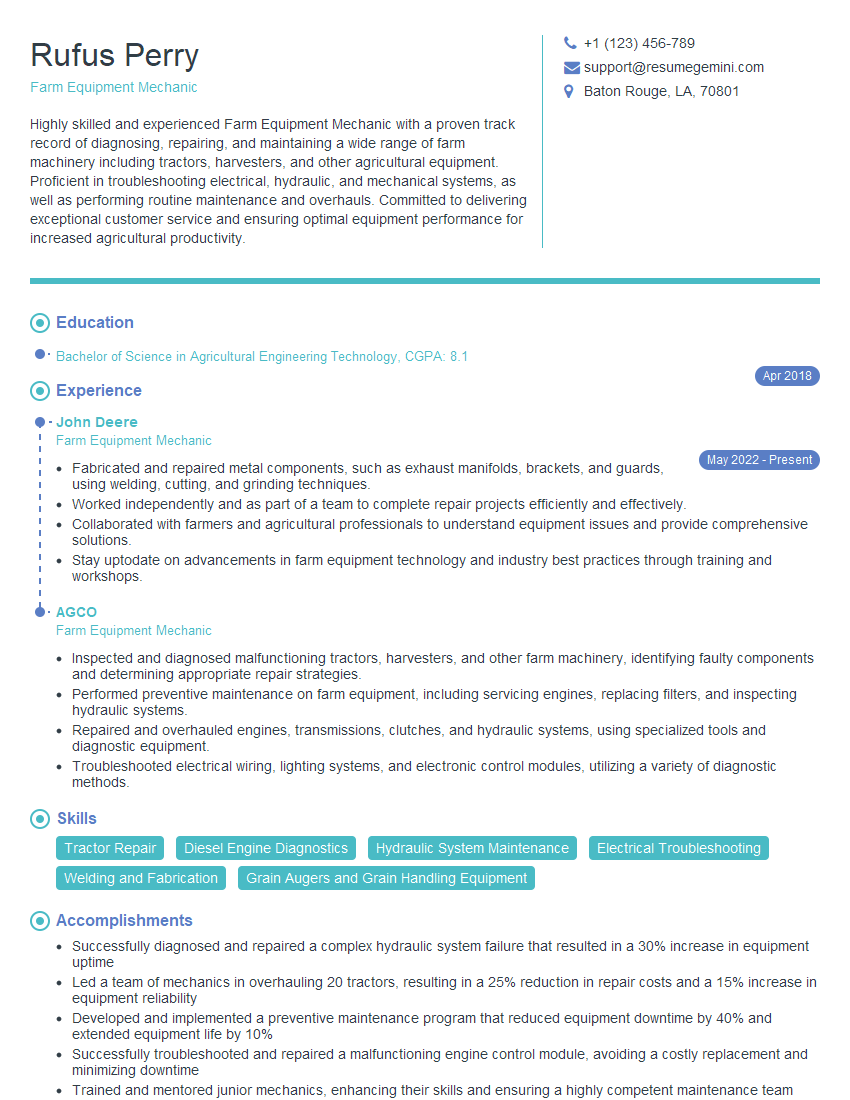
Mastering the repair of farm equipment opens doors to a rewarding career with excellent growth potential. Demand for skilled technicians is consistently high, offering opportunities for specialization and advancement within the agricultural industry. To maximize your job prospects, it’s crucial to present your qualifications effectively. Creating an ATS-friendly resume is vital in getting your application noticed. ResumeGemini is a trusted resource that can significantly enhance your resume-building experience. They provide tools and resources, including examples of resumes tailored to Repairing Farm Equipment, to help you craft a compelling application that highlights your skills and experience.


Explore more articles
Users Rating of Our Blogs
Share Your Experience
We value your feedback! Please rate our content and share your thoughts (optional).
What Readers Say About Our Blog
Very informative content, great job.
good