Unlock your full potential by mastering the most common Residential Fence Installation interview questions. This blog offers a deep dive into the critical topics, ensuring you’re not only prepared to answer but to excel. With these insights, you’ll approach your interview with clarity and confidence.
Questions Asked in Residential Fence Installation Interview
Q 1. What types of residential fences are you familiar with installing (e.g., wood, vinyl, chain link)?
I’m experienced in installing a wide variety of residential fences. My expertise covers the most popular choices: wood, vinyl, and chain link. Each has its own unique characteristics and installation methods. Wood fences offer a classic, natural look, requiring regular maintenance. Vinyl fences are low-maintenance and durable, coming in a variety of styles and colors. Chain link fences are economical and provide good visibility, ideal for perimeter security. I’m also familiar with composite and wrought iron fences, although these are less common in residential settings.
- Wood: Offers aesthetic versatility; requires regular staining or sealing.
- Vinyl: Durable, low maintenance; can be less aesthetically flexible than wood.
- Chain Link: Cost-effective, strong; less aesthetically pleasing than wood or vinyl.
Q 2. Describe your experience with post-hole digging and setting.
Post-hole digging and setting is fundamental to any successful fence installation. The depth and stability of the posts directly impact the fence’s longevity and structural integrity. I utilize both manual post hole diggers and power augers, selecting the appropriate tool based on soil conditions and project scale. For smaller projects, a manual digger might suffice, while larger projects benefit from the efficiency of a power auger. After digging, I ensure the hole is deep enough – generally at least 1/3 the height of the post – and wide enough to accommodate the post and concrete. The post is then set plumb (perfectly vertical) using a level and braced with temporary supports until the concrete sets. Proper compaction of the soil around the post is crucial for preventing settling.
I’ve encountered everything from loose sandy soil to dense clay. In challenging soil conditions, I might use techniques like adding gravel to the bottom of the hole to improve drainage and prevent settling.
Q 3. Explain the process of leveling fence posts.
Leveling fence posts is crucial for a straight, aesthetically pleasing, and structurally sound fence. I use a combination of tools for precise leveling. A level is essential for checking verticality, while a line level helps ensure consistent height along the fence line. Before setting the post in concrete, I carefully adjust its position using shims (small pieces of wood) or by slightly adjusting the amount of soil or gravel around the base until it’s perfectly plumb and level. Once satisfied, I fill the hole with concrete, ensuring it fully surrounds the post. I always double-check my work with the level before the concrete fully sets.
Imagine trying to build a wall with uneven bricks – it wouldn’t stand! The same principle applies to fence posts. Careful leveling ensures the entire fence structure is stable and won’t sag over time.
Q 4. What are the common problems encountered during fence installation, and how do you address them?
Common problems during fence installation include uneven terrain, improperly set posts, incorrect measurements, and hidden underground utilities. Uneven terrain requires careful planning and potentially additional excavation or modifications to post depths to maintain consistent height. Improperly set posts can lead to sagging or leaning, which I address by carefully resetting the posts before the concrete cures. Incorrect measurements can result in gaps or misaligned sections, which I rectify through careful re-measurement and readjustment. Discovering hidden utilities requires immediate action to ensure safety and prevent damage. I always call 811 before starting any excavation to locate underground utilities.
Problem-solving is a core aspect of my work. I use a systematic approach to diagnose and correct issues, and prioritize safety above all else.
Q 5. What safety measures do you follow during fence installation?
Safety is my top priority. I always wear appropriate personal protective equipment (PPE), including safety glasses, work gloves, and steel-toed boots. When using power tools, I ensure proper training and adherence to manufacturer guidelines. I use caution when operating machinery near power lines, and I’m fully aware of the potential hazards of working with sharp objects and heavy materials. I frequently inspect my tools and equipment to ensure they are in good working order. For larger jobs, I utilize spotters and communicate clearly with my team to avoid accidents. I always make sure the work area is free from obstructions and properly secured to prevent trips and falls.
Safety is not just a checklist; it’s a mindset integrated into every step of the process.
Q 6. How do you ensure accurate measurements and alignment during fence construction?
Accurate measurements and alignment are paramount for a professional-looking and structurally sound fence. I begin by establishing a straight baseline using string lines and stakes. I then use a measuring tape to accurately determine the spacing between posts and the overall length of the fence. A level is continuously used to ensure the posts are perfectly vertical and aligned. Throughout the installation, I regularly check my measurements against my initial plan to maintain accuracy. For curves or angles, I use specialized tools and techniques to ensure precise alignment.
Think of it like building with LEGOs – each piece needs to fit perfectly for a strong and attractive final product.
Q 7. What tools and equipment are essential for residential fence installation?
The essential tools and equipment for residential fence installation vary depending on the fence type, but some staples include:
- Post hole digger (manual or power auger)
- Shovel
- Measuring tape
- Level (both standard and line level)
- String line and stakes
- Concrete mixer
- Post-hole tampers
- Safety glasses
- Work gloves
- Steel-toed boots
- Various hand tools (hammers, saws, etc.)
- Power tools (depending on the fence type, e.g., sawzall for wood)
Having the right tools significantly impacts efficiency and quality.
Q 8. Describe your experience with different fence materials and their properties.
My experience spans a wide range of fence materials, each with unique properties impacting durability, aesthetics, and cost. Let’s look at some popular choices:
- Wood: Classic, aesthetically pleasing, and relatively affordable. However, it requires regular maintenance (staining, sealing) to prevent rot and insect damage. Different wood types offer varying levels of durability; cedar and redwood are naturally resistant to rot, while pressure-treated pine is a more economical but less naturally durable option.
- Vinyl: Low-maintenance, durable, and comes in a variety of colors and styles. It’s resistant to rot, insects, and fading, but can be more expensive upfront than wood. It’s also less forgiving of impacts compared to wood, potentially cracking under significant force.
- Metal (Chain Link, Aluminum, Wrought Iron): Chain link is the most budget-friendly, requiring minimal maintenance but offering less privacy. Aluminum is lightweight, rust-resistant, and relatively easy to install, while wrought iron offers superior strength and elegance, but is considerably more expensive and requires regular painting to prevent rust.
- Composite: A blend of wood and plastic, offering a wood-like appearance with increased durability and lower maintenance than traditional wood. It tends to be more expensive than wood but less expensive than vinyl.
Choosing the right material depends heavily on the client’s budget, aesthetic preferences, and the specific site conditions (e.g., exposure to harsh weather). I always discuss these factors with the client before making a recommendation.
Q 9. How do you handle challenging terrain during fence installation?
Challenging terrain requires careful planning and execution. I’ve encountered slopes, rocky areas, and uneven ground, all demanding unique solutions. Here’s my approach:
- Site Assessment: Thoroughly evaluating the terrain before starting any work is crucial. This includes identifying potential obstacles, measuring slopes, and determining the most suitable fence line.
- Grading and Leveling: For significant slopes, I may need to create level sections using retaining walls or steps to ensure a stable and straight fence line. This may involve excavating and backfilling, potentially requiring heavy machinery.
- Post Placement: On uneven ground, posts need to be set at consistent depths to ensure stability. I use post hole diggers and sometimes augers for rocky areas. In some cases, concrete footings are necessary for extra stability, especially on slopes.
- Adaptive Techniques: I adjust my installation techniques as needed; this may involve using longer posts on slopes or employing specialized anchoring systems in rocky areas.
Safety is paramount. I always use appropriate safety equipment and ensure the work area is properly secured, especially when working on slopes or near potential hazards.
Q 10. What is your experience with using various types of fasteners (nails, screws, staples)?
My experience with fasteners is extensive, and the choice depends heavily on the fence material and specific application.
- Nails: Primarily used for wood fences, providing a quick and relatively inexpensive fastening method. The size and type of nail (galvanized, coated) are crucial for durability and corrosion resistance. I use a nail gun for efficiency and consistency.
- Screws: Offer superior holding power and are less likely to pull out than nails, especially in denser wood. They are also easier to remove if adjustments are needed. I use various screw types, from deck screws to lag bolts, depending on the post size and wood type.
- Staples: Primarily used with chain link fences to secure the fabric to the posts. Heavy-duty galvanized staples are essential to ensure long-term durability. A staple gun significantly speeds up this process.
I always select fasteners appropriate for the material and environmental conditions to ensure a secure and long-lasting fence.
Q 11. How do you manage a fence installation project’s timeline and budget?
Managing project timelines and budgets requires careful planning and proactive communication.
- Detailed Estimates: I provide clients with detailed estimates that include all materials, labor, and potential unforeseen costs. This includes a breakdown of each phase of the project, facilitating transparent cost management.
- Project Scheduling: I create a realistic schedule, considering potential weather delays and material availability. This schedule is shared with the client, allowing for open communication and adjustments as needed.
- Regular Updates: I provide regular updates to the client on progress, potential challenges, and any necessary budget adjustments. This proactive communication helps prevent surprises and ensures the project stays on track.
- Efficient Work Practices: I use efficient methods, including the use of power tools and optimized workflows, to minimize labor costs and complete projects on time.
Unexpected issues can always arise. My experience enables me to quickly assess problems, propose cost-effective solutions, and communicate these transparently to the client.
Q 12. Explain your understanding of local building codes and regulations related to fence installation.
Understanding local building codes and regulations is critical for legal and safe fence installation. These regulations often cover:
- Height Restrictions: Maximum fence height varies by location, often impacting visibility and property lines.
- Setback Requirements: Regulations define the minimum distance a fence must be from property lines, streets, and easements.
- Materials and Construction: Specific requirements might dictate material types, post spacing, and construction methods to ensure safety and structural integrity.
- Permitting: Many areas require permits for fence installation, especially for taller or more complex projects. I am always up-to-date on local regulations and will obtain the necessary permits on behalf of the client.
Ignoring building codes can lead to fines, project delays, or even the need for costly renovations. I make it a point to stay informed and compliant to avoid these issues.
Q 13. How do you calculate the amount of materials needed for a specific fence project?
Accurately calculating material quantities is crucial for cost-effective project management. My process involves:
- Precise Measurements: I take detailed measurements of the perimeter and any gates to determine the exact fence length. Slopes and uneven terrain require careful consideration and potentially adding extra material for adjustments.
- Material Specifications: I determine the required material quantities based on chosen material (wood, vinyl, metal), post spacing, and other design elements. This includes posts, rails, boards, wire mesh, etc.
- Waste Factor: I always include a waste factor in my calculations to account for cuts, imperfections, and potential damage. This factor varies depending on the material and project complexity.
- Software and Tools: I utilize software tools and online calculators to aid in material estimations, especially for complex designs. This ensures accuracy and minimizes the risk of material shortages.
Accurate calculations are essential to prevent delays due to material shortages and unnecessary expenses due to over-ordering.
Q 14. Describe your experience with working from blueprints or sketches.
Working from blueprints or sketches is a standard part of my process. I can interpret various representations to create a precisely built fence.
- Blueprint Interpretation: I carefully review blueprints, noting fence line, dimensions, material specifications, gate locations, and any special features. I verify the accuracy of measurements and identify potential conflicts or discrepancies.
- Sketch Interpretation: Sketches, even hand-drawn ones, can provide valuable information. I can interpret dimensions, design elements, and material choices. Clear communication with the client ensures any ambiguities are clarified before starting the project.
- Collaboration: For complex designs, I’ll often collaborate with the client and potentially other contractors to ensure complete understanding and a successful outcome.
- On-site Adjustments: Even with detailed plans, on-site adjustments might be necessary due to unexpected terrain or site conditions. I have the experience to make informed adjustments while adhering to the overall design intent.
Accurate interpretation of plans and efficient adaptation to on-site realities is essential to delivering a high-quality project that meets the client’s expectations.
Q 15. What is your experience with gate installation and adjustment?
Gate installation and adjustment are crucial for a fence’s functionality and aesthetics. My experience encompasses all aspects, from initial planning and precise measurements to the final adjustments ensuring smooth operation. This includes various gate types – swing gates (both single and double), sliding gates, and even automated gates. I’m proficient in installing hinges, latches, and self-closing mechanisms, paying close attention to proper alignment and leveling to prevent binding or sagging. Adjustments often involve fine-tuning hinges, replacing worn parts, or addressing settling issues that can occur over time. For example, a recent project involved a double swing gate that was sticking due to uneven settling. I carefully adjusted the hinges and added shims to level the gate, restoring its smooth operation. This meticulous attention to detail ensures longevity and ease of use.
Career Expert Tips:
- Ace those interviews! Prepare effectively by reviewing the Top 50 Most Common Interview Questions on ResumeGemini.
- Navigate your job search with confidence! Explore a wide range of Career Tips on ResumeGemini. Learn about common challenges and recommendations to overcome them.
- Craft the perfect resume! Master the Art of Resume Writing with ResumeGemini’s guide. Showcase your unique qualifications and achievements effectively.
- Don’t miss out on holiday savings! Build your dream resume with ResumeGemini’s ATS optimized templates.
Q 16. How do you deal with customer complaints or unexpected issues during installation?
Handling customer complaints and unexpected issues is a crucial part of this job. My approach emphasizes open communication and proactive problem-solving. I always listen carefully to the customer’s concerns and thoroughly investigate the issue. For example, if a section of the fence is damaged during installation, I will immediately assess the situation, explain the cause (perhaps unforeseen rocky soil or a faulty material), discuss possible solutions (repair or replacement), and work with the customer to find a mutually acceptable resolution, often providing options at different price points. I believe transparency is key; I explain the steps involved in rectifying the problem and keep the customer informed throughout the process. I always prioritize maintaining a positive relationship, even when dealing with challenging situations, to ensure customer satisfaction.
Q 17. Describe your experience with different types of fence gates (swing, sliding, etc.).
I have extensive experience with various fence gate types. Swing gates, both single and double, are common and relatively straightforward. The key is proper hinge placement and ensuring the gate swings freely without dragging. Sliding gates require more precision, involving track installation, rollers, and a sturdy support system. I’ve worked with both manual and automated sliding gates, understanding the nuances of each. Automated gates involve additional complexities such as motor installation, wiring, and safety sensors. I’ve also installed specialty gates, including those with custom designs and features. Understanding the unique challenges and installation requirements of each type is essential for a successful outcome. Each type needs a different approach; for instance, sliding gates necessitate careful grading and consistent track support, while swing gates demand precise hinge placement and robust latch systems.
Q 18. How do you maintain the quality and efficiency of your work?
Maintaining quality and efficiency requires a multifaceted approach. Firstly, I meticulously plan each project, carefully measuring and designing the fence layout to minimize waste and maximize efficiency. I use high-quality materials from reputable suppliers, ensuring durability and longevity. Secondly, I employ skilled and reliable crew members who understand the importance of precision and safety. Regular training and tool maintenance are critical. We leverage efficient tools and techniques. For example, using a post hole digger instead of manual digging significantly speeds up the process without compromising quality. Finally, consistent quality checks at each stage of the project prevent errors and rework, saving time and resources. We follow a checklist for each step to maintain consistency.
Q 19. What are your preferred methods for repairing damaged fence sections?
Repairing damaged fence sections depends on the extent of the damage. Minor repairs, such as replacing damaged boards or fixing loose posts, are relatively straightforward. I typically replace damaged boards, ensuring proper alignment and securing them with appropriate fasteners. For more significant damage, it might be necessary to replace entire sections or posts. I carefully assess the damage to determine the best course of action. For example, if a post has rotted at the base, I’ll dig it out, replace it with a treated lumber post, and ensure proper setting and backfilling. Safety is always a priority; damaged sections are carefully stabilized before repairs begin to prevent further damage or injury.
Q 20. Describe your experience with trenching and backfilling.
Trenching and backfilling are essential aspects of fence installation. I utilize various methods, selecting the most appropriate based on the soil conditions and project requirements. For smaller projects, a manual post hole digger is sufficient, while larger projects often require power augers or trenchers for efficiency. Proper trench depth is critical for post stability, and I always ensure the correct depth based on the post height and soil type. Backfilling involves carefully replacing the excavated soil around the posts, compacting it to ensure stability and prevent settling. I often use a combination of native soil and gravel for improved drainage and support. Careful backfilling prevents future problems like leaning posts or gate misalignment.
Q 21. How do you ensure proper drainage around the fence line?
Ensuring proper drainage around the fence line is critical for longevity and prevents issues like rot and instability. I create a slight grade away from the fence line during backfilling to direct water away from the posts and fence panels. This prevents water pooling around the fence base. In areas with poor drainage, I may incorporate gravel or drainage fabric around the base of the posts to facilitate water runoff. Proper drainage also minimizes the risk of frost heave during winter, protecting the fence’s structural integrity. For example, in clay soil, I would add gravel to improve drainage, ensuring the water doesn’t damage the fence’s foundation. This preventative measure significantly extends the life of the fence.
Q 22. What is your understanding of different fence post materials and their durability?
Choosing the right fence post material is crucial for longevity and aesthetics. Durability depends on factors like climate, soil conditions, and the fence’s intended purpose. Let’s explore some common options:
- Wood: A classic choice, offering a natural look. Pressure-treated lumber is essential for ground contact, extending its life by resisting rot and insect damage. However, wood requires regular maintenance like staining or sealing to prevent weathering. Cedar and redwood are naturally rot-resistant and require less maintenance but are more expensive.
- Metal: Steel and aluminum are popular choices. Steel posts are incredibly strong but susceptible to rust unless galvanized or powder-coated. Aluminum is lightweight, rust-resistant, and low-maintenance, making it ideal for coastal areas or regions with high humidity. However, it can be more expensive than steel.
- Vinyl: A low-maintenance option that resists rot, insects, and fading. It’s a good choice for areas with harsh weather conditions. However, vinyl posts can be brittle in extreme cold and may not be as strong as metal or pressure-treated wood.
- Concrete: Offers exceptional strength and durability, particularly in high-traffic areas or areas prone to strong winds. However, they are heavy, require specialized equipment for installation, and aren’t as aesthetically versatile as other materials.
The best material depends on your specific needs and budget. For example, in a coastal area with high salinity, aluminum or vinyl would be preferable to steel. In a heavily wooded area prone to termites, pressure-treated wood may be the most cost-effective option.
Q 23. How do you prepare the ground before fence installation?
Proper ground preparation is paramount for a stable and long-lasting fence. Neglecting this step can lead to leaning posts, sagging fences, and premature failure. Here’s my approach:
- Clear the area: Remove all vegetation, rocks, and debris from the fence line. This ensures a level and solid base for the posts.
- Survey the land: Mark the locations of the posts precisely, ensuring straight lines and proper spacing. This is crucial for achieving a visually appealing and structurally sound fence.
- Dig the holes: The depth and diameter of the holes depend on the post material, soil conditions, and local building codes. I typically use a post hole digger, but for larger projects, I might employ a power auger. The holes need to be deep enough to accommodate the post and the foundation, ensuring at least one-third of the post is buried.
- Level the ground: Before setting the posts, ensure the ground at the bottom of each hole is level. This can be achieved using a level and shovel.
I often advise clients to consider the impact of future landscaping on the fence line. For instance, ensuring adequate space around the posts for potential tree growth will prevent root damage.
Q 24. What are the different types of fence foundations?
The type of foundation needed for fence posts depends on the soil conditions, the height and type of fence, and local regulations. Common types include:
- Set-in-ground posts: The simplest method, where posts are directly set into holes and backfilled with soil. This is suitable for less demanding fences and stable soil. I always ensure the post is plumb (perfectly vertical) before backfilling.
- Gravel foundation: A layer of gravel is placed at the bottom of the hole before setting the post. This improves drainage and provides better stability in loose or clay soils. It’s a cost-effective method to improve stability.
- Concrete foundation: Provides the strongest and most durable foundation. The post is set into a concrete footing poured into the hole. This is ideal for taller fences, windy areas, or areas with poor soil conditions. I use quick-setting concrete for faster installation and often reinforce the footing with rebar for added strength.
Choosing the right foundation is crucial for the fence’s lifespan. In areas prone to frost heave (soil expansion due to freezing and thawing), a deeper foundation, perhaps including gravel, is necessary to prevent post movement.
Q 25. How do you deal with uneven ground during fence installation?
Uneven ground is a common challenge in fence installation. Ignoring it leads to a visually unappealing and structurally weak fence. My strategy involves:
- Assess the unevenness: Carefully survey the entire fence line to determine the extent of the unevenness. Identify high and low points.
- Adjust post depths: For minor unevenness, adjust the depth of the post holes to compensate. Deeper holes in low areas ensure the fence top remains level. This requires careful measurement and leveling at each post.
- Use shims and fill material: For more significant unevenness, I use shims (small pieces of wood) to level the posts within the holes before setting the concrete or backfilling with soil. This ensures the posts are plumb and the fence is level.
- Step-wise installation: Instead of trying to force posts into uneven ground, I work in sections, achieving a level line for each segment. This approach helps to manage the challenge incrementally.
- Consider grading: In cases of severe unevenness, I may recommend grading the land beforehand to create a level base for the fence. This is more time-consuming and costly but ensures the best results.
Remember to always prioritize the structural integrity of the fence. A visually appealing fence is useless if it’s unstable.
Q 26. Describe your experience with concrete work related to fence installation.
Concrete work is a vital part of professional fence installation, particularly for ensuring post stability and longevity. My experience encompasses various aspects, from mixing and pouring to ensuring proper curing:
- Mixing concrete: I’m proficient in using both ready-mix concrete and mixing my own from dry ingredients, ensuring the correct water-cement ratio for optimal strength and workability. I utilize a wheelbarrow and shovel for smaller projects and a concrete mixer for larger jobs.
- Pouring and setting posts: I carefully place the posts in the holes, ensuring they are plumb and at the correct depth before pouring the concrete. I use a level and a plumb bob to ensure accuracy. I use a post-setting tool to help hold the posts in place while the concrete cures.
- Curing and finishing: I understand the importance of proper concrete curing. I keep the concrete moist by covering it with plastic sheeting or burlap to prevent cracking and ensure sufficient strength development. I ensure the concrete sets properly, allowing enough time before backfilling the surrounding area.
I’ve encountered situations where soil conditions required specific concrete mixes—for instance, using a quick-setting mix in wet conditions to minimize delays. Experienced concrete work is essential for minimizing project time, avoiding re-work, and increasing structural strength.
Q 27. What steps do you take to ensure a finished fence is aesthetically pleasing and structurally sound?
A structurally sound and aesthetically pleasing fence is the result of careful planning and execution. Here’s how I approach it:
- Post Alignment: Precise alignment of posts is paramount. I utilize string lines and levels to ensure straight lines and proper spacing between posts. This is crucial for the fence’s visual appeal and structural integrity.
- Proper bracing: I use diagonal bracing and corner bracing to reinforce the fence’s structure, especially in areas prone to high winds or where stability is critical. This adds strength and prevents sagging over time.
- Consistent Railing: Consistent spacing and alignment of rails contribute greatly to the overall look. I use measuring tools and clamps to ensure accuracy.
- Careful finishing: Once the fence is constructed, I take the time to clean up any debris and ensure a neat and professional finish. This includes properly sealing or painting wooden fences.
- Matching materials: When working with multiple materials, I pay attention to the integration and cohesiveness of the materials to ensure a unified aesthetic look.
I always emphasize the importance of choosing materials that complement the house and landscape. For example, a rustic wooden fence might be appropriate for a rural setting, while a sleek metal fence might suit a modern home.
Q 28. How do you handle difficult clients or demanding projects?
Handling difficult clients or demanding projects requires patience, clear communication, and professional expertise. My approach is multi-faceted:
- Active listening: I carefully listen to the client’s concerns and address them directly. This shows respect and builds trust, even if the client’s expectations are challenging.
- Clear communication: I maintain open and transparent communication throughout the project. I provide regular updates, address concerns promptly, and explain technical details clearly. I avoid jargon and opt for simple, understandable language.
- Problem-solving: I actively work with the client to find solutions. If challenges arise, I present options, outlining the pros and cons of each approach, and encourage collaborative decision-making. This avoids unilateral actions that could disappoint the client.
- Setting realistic expectations: I help clients to set realistic expectations concerning timelines and budget. This avoids misunderstandings and ensures the client’s satisfaction.
- Maintaining professionalism: Even under pressure, I maintain a professional demeanor and focus on delivering high-quality work. This is crucial for preserving my reputation and client relationships.
I remember a project where the client had unrealistic expectations about the timeline. By engaging in open communication, offering alternative solutions, and meticulously explaining the steps involved, I managed to meet their expectations partially, while maintaining a positive relationship. My focus is always on collaboration and finding win-win solutions.
Key Topics to Learn for Residential Fence Installation Interview
- Site Assessment and Planning: Understanding property lines, soil conditions, and client requirements to create accurate project plans. Practical application: Describing your process for measuring a property and identifying potential obstacles like underground utilities or uneven terrain.
- Material Selection and Estimation: Choosing appropriate fence materials (wood, vinyl, metal) based on budget, durability, and aesthetic preferences. Practical application: Calculating material quantities needed for a project of a given size and explaining your approach to minimizing waste.
- Post Installation Techniques: Proper methods for setting fence posts, ensuring stability and longevity. Practical application: Explaining different post-setting methods (e.g., using concrete, sonotubes) and their advantages/disadvantages.
- Fence Construction Methods: Understanding different fence styles (e.g., picket, privacy, chain link) and their construction techniques. Practical application: Describing your experience building different fence types and highlighting any specialized skills.
- Safety Regulations and Best Practices: Adhering to OSHA standards and local building codes for safe and compliant installations. Practical application: Discussing your experience with safety protocols on job sites and your approach to risk mitigation.
- Problem-Solving and Troubleshooting: Identifying and resolving issues that may arise during installation (e.g., uneven ground, damaged materials). Practical application: Describing a challenging project and how you overcame obstacles to deliver a successful outcome.
- Client Communication and Project Management: Effectively communicating with clients, managing expectations, and ensuring timely project completion. Practical application: Detailing your approach to client interaction and project scheduling.
Next Steps
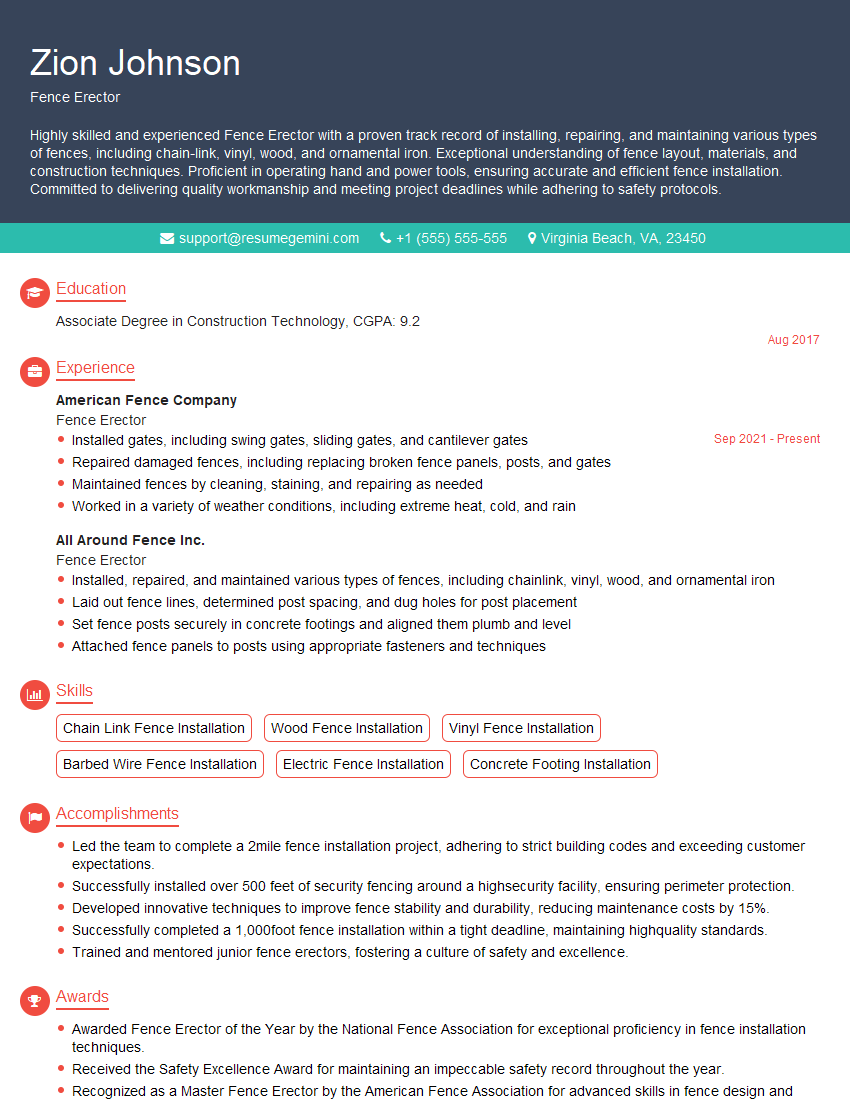
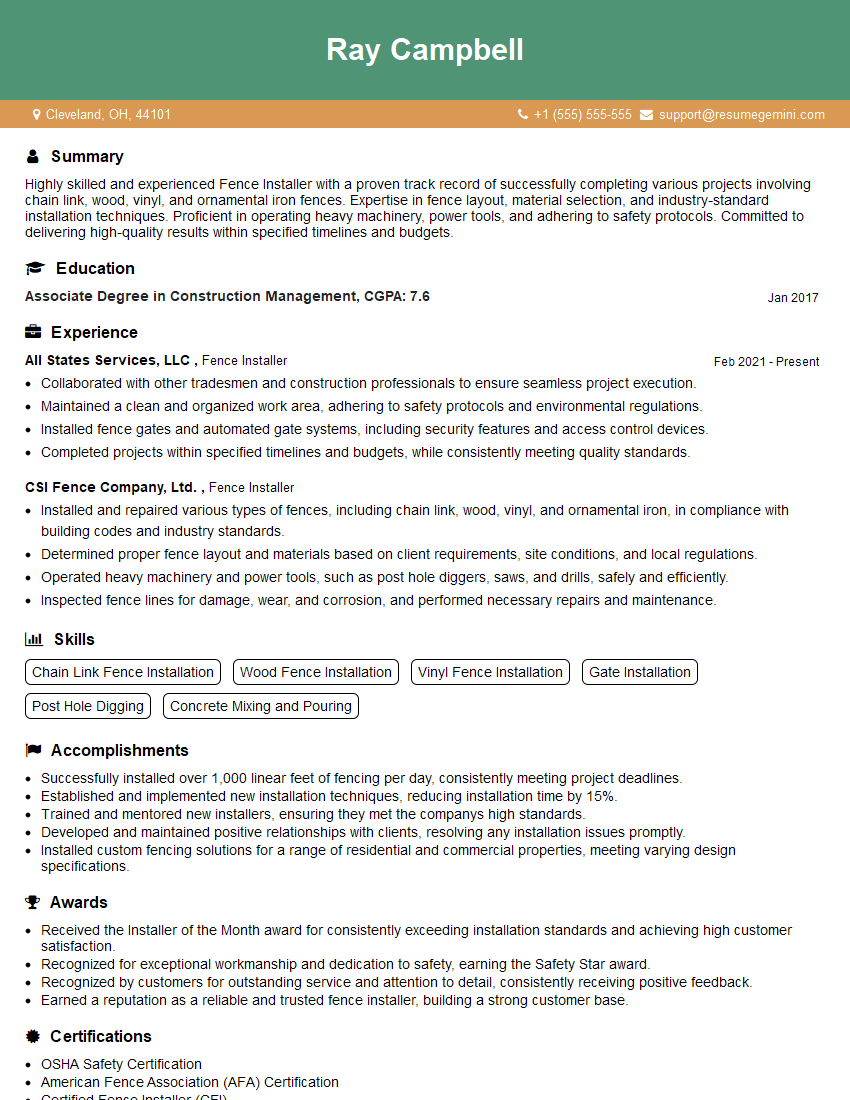
Mastering residential fence installation opens doors to a rewarding career with opportunities for advancement and specialization. Building a strong, ATS-friendly resume is crucial for showcasing your skills and experience to potential employers. ResumeGemini is a trusted resource to help you craft a professional and impactful resume that highlights your qualifications effectively. Examples of resumes tailored to Residential Fence Installation are available to guide you in creating yours.
Explore more articles
Users Rating of Our Blogs
Share Your Experience
We value your feedback! Please rate our content and share your thoughts (optional).
What Readers Say About Our Blog
Attention music lovers!
Wow, All the best Sax Summer music !!!
Spotify: https://open.spotify.com/artist/6ShcdIT7rPVVaFEpgZQbUk
Apple Music: https://music.apple.com/fr/artist/jimmy-sax-black/1530501936
YouTube: https://music.youtube.com/browse/VLOLAK5uy_noClmC7abM6YpZsnySxRqt3LoalPf88No
Other Platforms and Free Downloads : https://fanlink.tv/jimmysaxblack
on google : https://www.google.com/search?q=22+AND+22+AND+22
on ChatGPT : https://chat.openai.com?q=who20jlJimmy20Black20Sax20Producer
Get back into the groove with Jimmy sax Black
Best regards,
Jimmy sax Black
www.jimmysaxblack.com
Hi I am a troller at The aquatic interview center and I suddenly went so fast in Roblox and it was gone when I reset.
Hi,
Business owners spend hours every week worrying about their website—or avoiding it because it feels overwhelming.
We’d like to take that off your plate:
$69/month. Everything handled.
Our team will:
Design a custom website—or completely overhaul your current one
Take care of hosting as an option
Handle edits and improvements—up to 60 minutes of work included every month
No setup fees, no annual commitments. Just a site that makes a strong first impression.
Find out if it’s right for you:
https://websolutionsgenius.com/awardwinningwebsites
Hello,
we currently offer a complimentary backlink and URL indexing test for search engine optimization professionals.
You can get complimentary indexing credits to test how link discovery works in practice.
No credit card is required and there is no recurring fee.
You can find details here:
https://wikipedia-backlinks.com/indexing/
Regards
NICE RESPONSE TO Q & A
hi
The aim of this message is regarding an unclaimed deposit of a deceased nationale that bears the same name as you. You are not relate to him as there are millions of people answering the names across around the world. But i will use my position to influence the release of the deposit to you for our mutual benefit.
Respond for full details and how to claim the deposit. This is 100% risk free. Send hello to my email id: lukachachibaialuka@gmail.com
Luka Chachibaialuka
Hey interviewgemini.com, just wanted to follow up on my last email.
We just launched Call the Monster, an parenting app that lets you summon friendly ‘monsters’ kids actually listen to.
We’re also running a giveaway for everyone who downloads the app. Since it’s brand new, there aren’t many users yet, which means you’ve got a much better chance of winning some great prizes.
You can check it out here: https://bit.ly/callamonsterapp
Or follow us on Instagram: https://www.instagram.com/callamonsterapp
Thanks,
Ryan
CEO – Call the Monster App
Hey interviewgemini.com, I saw your website and love your approach.
I just want this to look like spam email, but want to share something important to you. We just launched Call the Monster, a parenting app that lets you summon friendly ‘monsters’ kids actually listen to.
Parents are loving it for calming chaos before bedtime. Thought you might want to try it: https://bit.ly/callamonsterapp or just follow our fun monster lore on Instagram: https://www.instagram.com/callamonsterapp
Thanks,
Ryan
CEO – Call A Monster APP
To the interviewgemini.com Owner.
Dear interviewgemini.com Webmaster!
Hi interviewgemini.com Webmaster!
Dear interviewgemini.com Webmaster!
excellent
Hello,
We found issues with your domain’s email setup that may be sending your messages to spam or blocking them completely. InboxShield Mini shows you how to fix it in minutes — no tech skills required.
Scan your domain now for details: https://inboxshield-mini.com/
— Adam @ InboxShield Mini
support@inboxshield-mini.com
Reply STOP to unsubscribe
Hi, are you owner of interviewgemini.com? What if I told you I could help you find extra time in your schedule, reconnect with leads you didn’t even realize you missed, and bring in more “I want to work with you” conversations, without increasing your ad spend or hiring a full-time employee?
All with a flexible, budget-friendly service that could easily pay for itself. Sounds good?
Would it be nice to jump on a quick 10-minute call so I can show you exactly how we make this work?
Best,
Hapei
Marketing Director
Hey, I know you’re the owner of interviewgemini.com. I’ll be quick.
Fundraising for your business is tough and time-consuming. We make it easier by guaranteeing two private investor meetings each month, for six months. No demos, no pitch events – just direct introductions to active investors matched to your startup.
If youR17;re raising, this could help you build real momentum. Want me to send more info?
Hi, I represent an SEO company that specialises in getting you AI citations and higher rankings on Google. I’d like to offer you a 100% free SEO audit for your website. Would you be interested?
Hi, I represent an SEO company that specialises in getting you AI citations and higher rankings on Google. I’d like to offer you a 100% free SEO audit for your website. Would you be interested?