Are you ready to stand out in your next interview? Understanding and preparing for RF and Wireless Communication interview questions is a game-changer. In this blog, we’ve compiled key questions and expert advice to help you showcase your skills with confidence and precision. Let’s get started on your journey to acing the interview.
Questions Asked in RF and Wireless Communication Interview
Q 1. Explain the concept of impedance matching and its importance in RF systems.
Impedance matching is the practice of designing a circuit such that the impedance of a source matches the impedance of a load. Think of it like trying to fit a square peg into a square hole – maximum power transfer happens only when the impedances align. In RF systems, the source is typically a transmitter, and the load is the antenna or a receiving circuit. Mismatched impedances lead to signal reflections, power loss, and signal distortion.
Importance: Efficient power transfer is crucial in RF systems. If the impedance isn’t matched, a significant portion of the transmitted power is reflected back to the source, reducing the signal strength at the receiver. This is especially critical in applications like long-range communication, where every bit of power counts. Imagine trying to send a radio signal across a vast distance with a significant portion of the signal bouncing back – your message would be weak and unreliable.
Techniques: Impedance matching is achieved using various components such as matching networks (LC networks, transmission lines), baluns (to match balanced and unbalanced impedances), and attenuators (to reduce mismatches). The specific technique depends on the frequency and the impedances involved.
Example: A common scenario is connecting a 50-ohm transmitter to a 50-ohm antenna. If there’s a mismatch, say due to a damaged cable, the signal quality would degrade, leading to weaker reception or even complete signal loss. Proper impedance matching ensures maximum power reaches the antenna for efficient transmission.
Q 2. Describe different types of antennas and their radiation patterns.
Antennas are devices that radiate and receive electromagnetic waves. They come in various shapes and sizes, each with unique radiation patterns depending on their design and application.
- Dipole Antenna: A simple, widely used antenna consisting of two conductors of equal length. It has a figure-eight radiation pattern, radiating most strongly perpendicular to its axis.
- Monopole Antenna: A single conductor, often grounded, commonly used in applications where one side is grounded, such as AM radio broadcast. It has a unidirectional pattern.
- Yagi-Uda Antenna: A directional antenna comprising a driven element and parasitic elements (reflectors and directors) for increased gain and directivity. Its radiation pattern is highly directional.
- Patch Antenna: A planar antenna etched on a substrate, commonly used in mobile devices and satellite communication. Its pattern can be omnidirectional or directional depending on design.
- Horn Antenna: A waveguide antenna with a flared opening, providing high gain and directivity, suitable for high-frequency applications.
Radiation Patterns: The radiation pattern of an antenna describes how the signal strength varies with direction. It’s typically represented graphically in polar or Cartesian coordinates. Patterns can be omnidirectional (radiating equally in all directions), unidirectional (radiating primarily in one direction), or bidirectional (radiating strongly in two opposite directions).
Example: A Wi-Fi router typically uses an omnidirectional antenna to cover a wide area. Conversely, a satellite dish utilizes a highly directional antenna to focus the signal towards the satellite, improving signal strength and reducing interference.
Q 3. What are the key performance indicators (KPIs) for a wireless communication system?
Key Performance Indicators (KPIs) for a wireless communication system vary based on the application but generally include:
- Throughput: The amount of data transmitted per unit of time (e.g., Mbps).
- Latency: The delay experienced by data packets from transmission to reception (e.g., milliseconds).
- Bit Error Rate (BER): The number of errors in data transmission.
- Signal-to-Noise Ratio (SNR): The ratio of signal power to noise power, indicating signal quality.
- Coverage Area: The geographical region where the system provides reliable communication.
- Power Consumption: The amount of energy consumed by the system.
- Availability: The percentage of time the system is operational.
Example: In a cellular network, KPIs like throughput, latency, and coverage area are critical for providing a seamless user experience. A high throughput allows for fast data download and upload speeds, low latency reduces delays in applications like online gaming, and wide coverage ensures connectivity across a larger area.
Q 4. How does MIMO technology improve wireless communication performance?
Multiple-Input and Multiple-Output (MIMO) technology enhances wireless communication by using multiple antennas at both the transmitter and receiver. This allows for spatial multiplexing, where multiple data streams are transmitted simultaneously over the same frequency band, effectively increasing the data rate.
Improvements: MIMO offers several advantages:
- Increased Data Rate: By transmitting multiple data streams simultaneously, MIMO significantly boosts the overall data throughput.
- Improved Reliability: Using multiple antennas and paths provides diversity gain, mitigating the effects of fading and interference.
- Extended Range: In some scenarios, MIMO can extend the communication range due to the spatial diversity.
- Enhanced Signal Quality: Through spatial multiplexing and beamforming, MIMO can improve the signal-to-noise ratio.
Example: MIMO is widely used in modern Wi-Fi (802.11n, 802.11ac, and 802.11ax) and cellular (4G LTE and 5G) technologies. A smartphone with MIMO can achieve significantly faster download speeds compared to one with a single antenna, especially in congested environments.
Q 5. Explain the difference between frequency modulation (FM) and amplitude modulation (AM).
Both Frequency Modulation (FM) and Amplitude Modulation (AM) are techniques for superimposing an information signal onto a carrier wave for transmission. However, they differ in how this is achieved:
- Amplitude Modulation (AM): In AM, the amplitude (strength) of the carrier wave is varied proportionally to the instantaneous amplitude of the information signal. The frequency of the carrier remains constant.
- Frequency Modulation (FM): In FM, the frequency of the carrier wave is varied proportionally to the instantaneous amplitude of the information signal. The amplitude of the carrier remains constant.
Key Differences and Applications:
- Noise Immunity: FM is significantly more resistant to noise than AM. Noise affects the amplitude of a signal, thus AM is highly susceptible. In contrast, FM’s information is encoded in the frequency shifts, making it less vulnerable.
- Bandwidth: FM typically requires a wider bandwidth than AM for the same quality of transmission.
- Applications: AM is commonly used for long-distance radio broadcasts because of its simpler implementation and ability to travel longer distances via ground waves. FM is preferred for high-fidelity audio broadcasting (radio) due to its superior noise immunity.
Example: AM radio broadcasts often suffer from static noise, especially in poor reception conditions. FM radio generally provides a clearer and more noise-free audio experience.
Q 6. What is the Nyquist sampling theorem and its relevance to signal processing in wireless systems?
The Nyquist-Shannon sampling theorem states that to accurately reconstruct a continuous-time signal from its discrete-time samples, the sampling frequency (fs) must be at least twice the highest frequency component (fmax) present in the signal. Mathematically, this is expressed as:
fs ≥ 2fmax
Relevance to Wireless Systems: In wireless communication, signals are often analog and need to be converted into digital form for processing and transmission. The Nyquist theorem dictates the minimum sampling rate required to avoid aliasing – a phenomenon where high-frequency components are mistakenly represented as low-frequency components, leading to signal distortion.
Example: If you’re designing a system to receive a signal with a maximum frequency of 10 kHz, you’ll need a sampling frequency of at least 20 kHz to avoid aliasing. If you sample at a lower rate, the reconstructed signal will be corrupted. An anti-aliasing filter (low-pass filter) is typically used prior to sampling to eliminate frequencies above fmax, ensuring accurate signal representation.
Q 7. Describe different types of wireless communication protocols (e.g., Wi-Fi, Bluetooth, Zigbee).
Various wireless communication protocols cater to different needs regarding data rate, range, power consumption, and complexity.
- Wi-Fi (IEEE 802.11): A widely used standard for local area networks (LANs), offering high data rates and relatively wide coverage. It’s ideal for connecting devices within a home or office.
- Bluetooth (IEEE 802.15.1): A short-range wireless technology suitable for connecting personal devices like smartphones, keyboards, and mice. It prioritizes low power consumption and ease of use.
- Zigbee (IEEE 802.15.4): A low-power, low-data-rate wireless protocol often used in sensor networks and home automation systems. It’s optimized for battery-powered devices and focuses on reliable communication over long periods.
- Cellular (e.g., 4G LTE, 5G): A wide-area network (WAN) technology providing mobile broadband access. It offers high data rates and extensive coverage but typically consumes more power than short-range protocols.
- NFC (Near Field Communication): Enables short-range communication between devices by bringing them very close together. Commonly used for contactless payments and data transfer.
Choosing the Right Protocol: The choice of protocol depends heavily on the application’s requirements. For instance, a real-time sensor network might opt for Zigbee’s low power and reliability, while high-bandwidth streaming applications would prefer Wi-Fi or cellular technologies.
Q 8. Explain the concept of path loss and its impact on wireless signal strength.
Path loss refers to the reduction in power density of an electromagnetic wave as it propagates through space. Think of it like a light bulb: the further you get, the dimmer it appears. In wireless communication, this means the signal weakens as it travels from the transmitter to the receiver. Several factors contribute to path loss, including distance, frequency, and the environment. The most significant is usually distance, often following an inverse square law (power decreases proportionally to the square of the distance). This means doubling the distance results in a fourfold reduction in signal strength. The environment also plays a huge role; obstacles like buildings, trees, and even rain can significantly attenuate the signal, leading to increased path loss. This impacts signal strength drastically, potentially leading to unreliable communication, dropped calls, or slow data speeds. For example, a cellular signal might be strong near a cell tower but drastically weaken several kilometers away due to path loss.
Q 9. What are the challenges of designing RF circuits for high-frequency applications?
Designing RF circuits for high-frequency applications presents unique challenges. At higher frequencies, parasitic effects – unintended capacitances and inductances – become much more pronounced. These parasitic elements can significantly alter the circuit’s performance, leading to unexpected impedance mismatches, signal attenuation, and noise. Another major challenge is the increasing difficulty in fabricating miniature components with precise tolerances. The physical dimensions of components become comparable to the signal wavelength, leading to significant radiation losses and difficulties in controlling the electromagnetic field. For example, trace inductance on a PCB becomes a serious consideration at GHz frequencies, requiring careful design and potentially the use of specialized materials and manufacturing techniques. Moreover, the availability of suitable components at high frequencies can be limited, and their cost often significantly higher. Finally, testing and characterizing high-frequency circuits require sophisticated equipment and expertise. Dealing effectively with these challenges necessitates a deep understanding of electromagnetic theory and advanced circuit design techniques.
Q 10. How do you perform RF signal analysis and troubleshooting?
RF signal analysis and troubleshooting involve a systematic approach. It starts with understanding the system’s specifications and expected performance. Next, I’d use specialized instruments like spectrum analyzers, network analyzers, and oscilloscopes to measure various parameters like signal strength, frequency response, noise floor, and impedance. A spectrum analyzer helps visualize the frequency components of the signal, revealing unwanted signals or interference. A network analyzer measures the scattering parameters (S-parameters) to characterize the impedance matching and transmission characteristics of components and circuits. An oscilloscope visualizes the signal’s time-domain waveform, enabling detection of signal distortion or anomalies. If there’s a problem, I would systematically isolate the source using signal tracing and comparison against expected values. For instance, if the signal strength is low, I might check for cable losses, antenna misalignment, or interference. Documentation and careful record-keeping are crucial to track progress and identify the root cause efficiently. Troubleshooting frequently involves iterative testing and refinement until the problem is resolved and performance meets specifications.
Q 11. Explain different modulation techniques used in wireless communication.
Numerous modulation techniques exist for wireless communication, each offering trade-offs in terms of bandwidth efficiency, power efficiency, and robustness against noise.
- Amplitude Shift Keying (ASK): Transmits information by changing the amplitude of a carrier wave.
- Frequency Shift Keying (FSK): Transmits information by changing the frequency of a carrier wave.
- Phase Shift Keying (PSK): Transmits information by changing the phase of a carrier wave. Different variations include Binary PSK (BPSK), Quadrature PSK (QPSK), and others.
- Quadrature Amplitude Modulation (QAM): Combines amplitude and phase modulation, offering high spectral efficiency.
- Orthogonal Frequency-Division Multiplexing (OFDM): Divides a high-bandwidth signal into multiple orthogonal lower-bandwidth subcarriers, offering robustness against multipath fading.
Q 12. What are the key considerations for antenna placement and design?
Antenna placement and design are crucial for effective wireless communication. Key considerations include:
- Radiation Pattern: The antenna’s radiation pattern dictates where the signal is strongest and weakest. Choosing an antenna with a suitable pattern for the coverage area is crucial. A directional antenna focuses the signal in a particular direction, while an omnidirectional antenna radiates equally in all directions.
- Gain: Antenna gain represents the antenna’s ability to focus power in a specific direction. Higher gain antennas concentrate power, resulting in a stronger signal at the receiver, but this comes at the cost of a narrower beamwidth.
- Polarization: The orientation of the electric field of the radio wave. Antennas should have matching polarizations for optimal signal reception. Vertical and horizontal polarizations are common.
- Environmental Factors: Obstacles, reflections, and multipath propagation can significantly impact antenna performance. The antenna location should minimize these effects.
- Frequency: Antennas are designed to operate at specific frequencies, and their efficiency decreases outside this range.
Q 13. What is the role of a filter in an RF system?
Filters are essential in RF systems to select desired frequencies while rejecting unwanted ones. They act like sieves, allowing specific frequency ranges to pass while attenuating others. This is crucial for minimizing interference, noise, and unwanted signals. Different filter types exist, each with its characteristics:
- Bandpass filters allow a specific range of frequencies to pass.
- Bandstop filters (notch filters) block a specific range of frequencies.
- Low-pass filters allow frequencies below a cutoff frequency to pass.
- High-pass filters allow frequencies above a cutoff frequency to pass.
Q 14. How do you measure RF power and signal strength?
Measuring RF power and signal strength requires specialized instruments.
- Power meters directly measure the power level of an RF signal in units like dBm or watts.
- Spectrum analyzers measure both the power and frequency of an RF signal, providing a visual representation of the signal’s spectrum.
- Signal generators, along with a power meter, can be used to calibrate measurement systems.
- Field strength meters measure the strength of an RF signal in a specific location, often expressed in dBµV/m or dBm.
Q 15. Explain the concept of noise figure and its importance.
The noise figure (NF) quantifies how much noise a component or system adds to a signal. Think of it like this: you’re trying to hear a whisper (your signal) in a noisy room (noise). The noise figure tells you how much louder the room’s noise becomes because of your amplifier, making it harder to hear the whisper. A lower noise figure is better, indicating less added noise.
It’s expressed in decibels (dB) and is crucial in RF systems because noise limits the sensitivity and dynamic range. In satellite communication, for example, a high noise figure means you might need a significantly more powerful transmitter to overcome the additional noise introduced by the receiver, increasing costs and power consumption. A low noise figure is essential for systems receiving weak signals, like those from deep-space probes.
Mathematically, the noise factor (F) is the ratio of the total noise power at the output to the noise power due solely to the input termination (at standard temperature) and the noise figure (NF) is simply 10log10(F) in dB.
Career Expert Tips:
- Ace those interviews! Prepare effectively by reviewing the Top 50 Most Common Interview Questions on ResumeGemini.
- Navigate your job search with confidence! Explore a wide range of Career Tips on ResumeGemini. Learn about common challenges and recommendations to overcome them.
- Craft the perfect resume! Master the Art of Resume Writing with ResumeGemini’s guide. Showcase your unique qualifications and achievements effectively.
- Don’t miss out on holiday savings! Build your dream resume with ResumeGemini’s ATS optimized templates.
Q 16. Describe different types of RF amplifiers and their characteristics.
RF amplifiers boost the power of radio frequency signals. Several types exist, each with its strengths and weaknesses:
- High-Electron Mobility Transistor (HEMT) Amplifiers: Known for high gain, low noise, and high frequency operation. They are commonly used in satellite communications and radar systems, where low noise is paramount.
- Field-Effect Transistor (FET) Amplifiers: A common and versatile type, offering good linearity and wide bandwidth, making them suitable for a range of applications, from cellular base stations to cable television.
- Bipolar Junction Transistor (BJT) Amplifiers: Offer high power output capabilities but generally have higher noise figures than FETs at higher frequencies. They are often chosen for applications requiring significant power amplification, such as broadcasting transmitters.
- Operational Transconductance Amplifier (OTA): These amplifiers often provide better efficiency at very low voltages. They are widely used in integrated circuits, especially in mobile devices.
The choice of amplifier depends heavily on the specific application requirements, such as frequency range, required power output, gain, noise figure, linearity, and power consumption. For instance, a low-noise amplifier (LNA) at the front-end of a receiver is crucial for maximizing sensitivity, while a high-power amplifier (HPA) at the transmitter ensures sufficient signal coverage.
Q 17. What are the advantages and disadvantages of different types of wireless communication technologies?
Various wireless technologies exist, each with advantages and disadvantages:
- Wi-Fi (IEEE 802.11): Offers relatively high data rates within a limited range, making it suitable for home and office networking. However, it can be susceptible to interference and has security concerns.
- Bluetooth: Low power consumption and short range, ideal for connecting peripherals. Data rates are lower than Wi-Fi, and range is limited.
- Cellular (4G/5G): High data rates and wide coverage, but requires infrastructure and can be expensive. High frequencies used in 5G provide high bandwidth but have a shorter range and higher signal attenuation.
- Zigbee: Low power, long range, suitable for IoT applications. Data rates are low compared to Wi-Fi or cellular.
- Satellite: Very long range, but high latency and susceptibility to atmospheric conditions. Very expensive infrastructure requirements.
The choice depends on factors such as required data rate, range, power consumption, cost, security, and infrastructure availability. A smart home might utilize a combination of Wi-Fi, Bluetooth, and Zigbee, while a global communication network relies on satellite and cellular technologies.
Q 18. How does interference affect wireless communication performance?
Interference degrades wireless communication by adding unwanted signals to the desired signal. This ‘noise’ can mask the intended data, leading to errors or a complete loss of communication. Sources include other wireless devices operating on the same or adjacent frequencies (co-channel interference), nearby electrical equipment (EMI), and natural phenomena like atmospheric noise.
Imagine trying to have a conversation in a crowded, noisy room. Other people talking (co-channel interference) make it hard to understand your conversation partner. The impact of interference depends on its power relative to the desired signal, its frequency characteristics, and the type of modulation scheme used. Mitigation techniques include frequency planning, using better antennas with higher gain and directivity, and employing error correction codes.
Q 19. Explain the concept of signal fading and its mitigation techniques.
Signal fading refers to the fluctuation of signal strength at the receiver due to changes in the propagation environment. It’s like trying to see a light source through a fog – the fog (propagation environment) makes the light’s intensity (signal strength) appear to fluctuate.
Several types of fading exist, including Rayleigh fading (non-line-of-sight propagation) and Rician fading (with a line-of-sight component). Mitigation techniques include:
- Diversity techniques: Using multiple antennas (spatial diversity), different frequencies (frequency diversity), or different time slots (temporal diversity) to combat fading.
- Error correction codes: Adding redundancy to the transmitted data to allow the receiver to correct errors caused by fading.
- Adaptive modulation and coding: Adjusting the modulation scheme and coding rate to match the channel conditions.
- Power control: Adjusting the transmit power based on the channel conditions.
These techniques help to improve the reliability and robustness of wireless communication systems in challenging environments.
Q 20. Describe different methods for RF shielding and grounding.
RF shielding and grounding are crucial for minimizing electromagnetic interference (EMI) and ensuring the integrity of RF systems. Shielding involves enclosing sensitive components within a conductive material (like copper or aluminum) to block electromagnetic fields. Grounding connects conductive parts to earth ground, providing a low-impedance path for unwanted currents, preventing the build-up of static charges and reducing interference.
Methods for RF shielding include:
- Enclosure shielding: Using a metal enclosure to house sensitive equipment.
- Conductive coatings: Applying conductive paints or coatings to surfaces.
- Shielding gaskets: Using conductive gaskets to seal gaps in enclosures.
Grounding methods involve connecting equipment to earth ground using conductive wires, grounding planes, and grounding straps. Proper shielding and grounding are essential in critical applications like medical imaging, scientific instrumentation, and military communications where interference can have serious consequences.
Q 21. Explain the concept of channel equalization in wireless communication.
Channel equalization is a technique used to compensate for the distortion introduced by the wireless channel. The wireless channel isn’t a perfect, clean medium; it distorts the transmitted signal due to multipath propagation, attenuation, and other factors. Imagine throwing a pebble into a pond – the ripples (multipath) distort the pebble’s initial trajectory.
Channel equalization aims to reverse this distortion. It does so by estimating the channel’s impulse response and then designing a filter (the equalizer) to compensate for its effects. Equalizers can be implemented in various ways, including linear equalizers (like Zero-Forcing and Minimum Mean Square Error) and decision feedback equalizers. The choice depends on the channel characteristics and complexity constraints. Equalization is critical in high-speed data transmission over wireless channels, as it allows for reliable data reception despite channel impairments.
Q 22. What are the key challenges in designing for 5G wireless communication?
Designing for 5G presents numerous challenges, primarily stemming from its ambitious goal of providing significantly higher data rates, lower latency, and massive device connectivity compared to previous generations. Let’s break down some key hurdles:
- High Frequency Challenges: 5G utilizes millimeter-wave (mmWave) frequencies (above 30 GHz), which offer wider bandwidths but suffer from higher path loss and susceptibility to atmospheric attenuation and blockage by obstacles like buildings and trees. This necessitates denser network deployments and sophisticated beamforming techniques to compensate for signal degradation.
- Network Complexity: Managing the massive number of connected devices (IoT) and diverse quality of service (QoS) requirements across various applications (e.g., autonomous driving, remote surgery) adds significant complexity to network management and optimization. Efficient resource allocation and interference mitigation become crucial.
- Power Efficiency: Balancing the need for high data rates with power constraints in mobile devices is a critical design challenge. Efficient power amplifiers, intelligent sleep modes, and advanced power management techniques are essential.
- Interference Management: The higher density of 5G base stations and the wider bandwidths used can increase the risk of interference from other systems, necessitating sophisticated interference cancellation and coordination mechanisms.
- Standardization and Interoperability: Ensuring seamless interoperability between equipment from different vendors is crucial for the success of 5G. Adherence to international standards and rigorous testing are paramount.
- Security: The large number of connected devices and the sensitive nature of the data they transmit necessitate strong security mechanisms to protect against cyberattacks and unauthorized access.
For example, in a recent project, we tackled the challenge of beamforming in a mmWave 5G base station by using advanced algorithms to dynamically steer the beam towards the user equipment, improving the signal-to-noise ratio and overcoming the severe path loss at these high frequencies. This involved extensive simulation and real-world testing.
Q 23. Explain the different types of spread spectrum techniques.
Spread spectrum techniques are used to transmit signals over a wider bandwidth than the minimum required for data transmission. This provides several advantages, primarily in terms of interference rejection and security. The two main types are:
- Direct Sequence Spread Spectrum (DSSS): In DSSS, the data signal is multiplied by a pseudorandom noise (PN) sequence with a much higher chip rate than the data rate. This spreads the signal across a wider bandwidth. The receiver then correlates the received signal with the same PN sequence to recover the original data. This is resistant to narrowband interference because the interference is spread over a wider bandwidth, thereby reducing its impact. Example: Bluetooth uses DSSS.
- Frequency Hopping Spread Spectrum (FHSS): In FHSS, the carrier frequency hops pseudorandomly among many different frequencies during transmission. This makes it difficult for an interferer to consistently jam the signal, as it would need to simultaneously jam many different frequencies. Example: Some older cordless phones used FHSS.
There are also variations like hybrid spread spectrum techniques that combine aspects of both DSSS and FHSS. The choice of technique depends on the specific application requirements, considering factors such as bandwidth availability, interference environment, and complexity.
Q 24. What are the security considerations in wireless communication systems?
Security in wireless communication systems is paramount, given the inherent broadcast nature of wireless transmissions. Several key considerations need to be addressed:
- Confidentiality: Protecting data from unauthorized access using encryption techniques like AES (Advanced Encryption Standard) is essential. This ensures that only authorized parties can decrypt and access the transmitted information.
- Integrity: Ensuring that data hasn’t been tampered with during transmission is crucial. This can be achieved using message authentication codes (MACs) or digital signatures, verifying the data’s authenticity and integrity.
- Authentication: Verifying the identity of communicating parties to prevent unauthorized access and impersonation. This can be achieved through various authentication protocols, such as WPA2/3 for Wi-Fi networks.
- Availability: Ensuring continuous and reliable communication service by protecting against denial-of-service (DoS) attacks that aim to disrupt network operation.
- Access Control: Restricting access to the network and its resources to authorized users and devices using methods such as firewalls and access control lists.
For instance, securing an IoT network requires careful consideration of device authentication, data encryption, and over-the-air (OTA) firmware updates to prevent vulnerabilities. We commonly employ security protocols like TLS/SSL to secure data transmission in our systems.
Q 25. How do you troubleshoot problems in a wireless network?
Troubleshooting wireless network problems involves a systematic approach. My process typically follows these steps:
- Gather Information: Start by collecting information about the problem. This includes the type of network (Wi-Fi, cellular, etc.), the symptoms experienced (slow speeds, dropped connections, intermittent connectivity), and the devices affected. Speak to users to get a clear understanding of the issue.
- Check the Obvious: Ensure the basics are correct: router is powered on, cables are connected, Wi-Fi is enabled on devices, and network settings are correctly configured. Look for obvious physical obstructions affecting signal propagation.
- Signal Strength and Interference: Use a wireless analyzer or smartphone app to check signal strength and identify potential sources of interference (other Wi-Fi networks, microwaves, Bluetooth devices). Consider adjusting the router’s location or channel to optimize signal quality.
- Check Network Configuration: Verify the router’s settings, including SSID, password, security protocols (WPA2/3), and channel. Check for outdated firmware and update if necessary. Ensure DHCP is properly configured for IP address assignment.
- Check Device Drivers and Software: Ensure all devices have the latest drivers and software updates. Outdated drivers can cause connectivity issues.
- Network Diagnostics Tools: Utilize network diagnostic tools (ping, traceroute, netstat) to identify specific bottlenecks or problems within the network. These tools provide more detailed information than visual signal strength indicators.
- Contact the ISP (if applicable): If the problem seems to be outside your local network, contact your internet service provider (ISP) to check for problems on their end.
For example, when troubleshooting slow Wi-Fi, I once discovered the issue was caused by a poorly configured router channel that was overlapping with several neighboring Wi-Fi networks. By switching to a less congested channel, the performance was significantly improved.
Q 26. Explain the concept of link budget analysis.
Link budget analysis is a crucial process in wireless system design, quantifying the signal power available at the receiver relative to the minimum required power for reliable communication. It essentially determines whether a wireless link will work effectively.
It involves calculating the power transmitted by the transmitter, the various losses encountered during propagation (path loss, antenna gains, atmospheric attenuation, cable losses, etc.), and the minimum receiver sensitivity. A positive link budget implies sufficient received power for reliable communication, while a negative budget indicates insufficient power and potential communication failure.
The equation can be expressed as:
Received Power (dBm) = Transmitted Power (dBm) + Gains (dB) - Losses (dB)Where:
- Transmitted Power: Power output of the transmitter.
- Gains: Antenna gain, amplifier gains.
- Losses: Path loss, cable loss, atmospheric loss, other losses.
A practical example is in cellular network planning, where the link budget determines the required transmitter power and the necessary density of base stations to provide acceptable coverage. I regularly use link budget calculations to assess the feasibility of wireless communication links in various projects, ensuring sufficient signal strength for reliable performance.
Q 27. What are your experiences with RF simulation tools (e.g., ADS, HFSS)?
I have extensive experience using RF simulation tools like Advanced Design System (ADS) and High-Frequency Structure Simulator (HFSS). ADS is my preferred choice for circuit-level design and system-level simulations, while HFSS excels in electromagnetic simulations for antennas and complex structures.
In ADS, I’ve used its capabilities for simulating various RF components like mixers, amplifiers, and filters, performing noise analysis, and optimizing circuit performance. I’ve also used ADS for system-level simulations to model entire communication systems, evaluating their performance under different conditions.
With HFSS, I’ve designed and simulated various antennas, including microstrip patches, horn antennas, and phased arrays, analyzing their radiation patterns, gain, and impedance characteristics. The results from these simulations inform the design and optimization of the RF components and antenna systems, reducing the need for extensive and costly prototyping.
For example, in a recent project involving a mmWave antenna array, I used HFSS to optimize the antenna element design and the array configuration to achieve optimal beamforming capabilities, resulting in significant improvements in signal coverage and data rates.
Q 28. Describe your experience with different RF test equipment.
My experience with RF test equipment is broad, encompassing a wide range of instruments used in the design, development, and testing of wireless communication systems. This includes:
- Network Analyzers (VNA): For characterizing the performance of RF components and antennas, measuring S-parameters, and identifying impedance mismatches.
- Signal Generators: To generate various RF signals with specified frequencies, amplitudes, and modulation schemes.
- Spectrum Analyzers: To analyze the frequency spectrum of signals, identifying unwanted interference and spurious emissions.
- Power Meters: To accurately measure the power levels of RF signals.
- Oscilloscope: To visualize and analyze time-domain waveforms of RF signals.
- Channel Emulators: To simulate real-world wireless channels, including multipath fading and interference effects.
In my previous role, I extensively used VNAs to measure the performance of high-frequency amplifiers, optimizing their gain, noise figure, and linearity. I also used spectrum analyzers to ensure the compliance of our devices with regulatory standards for spurious emissions. My familiarity with these instruments allows for accurate and efficient testing and troubleshooting of RF systems.
Key Topics to Learn for RF and Wireless Communication Interview
- Fundamental RF Concepts: Understanding signal propagation, attenuation, reflection, refraction, and diffraction. Practical application: Analyzing signal strength in different environments and optimizing antenna placement.
- Antenna Theory and Design: Gain, directivity, polarization, impedance matching. Practical application: Selecting appropriate antennas for specific applications (e.g., cellular base stations, satellite communication).
- Wireless Communication Systems: Familiarize yourself with various modulation techniques (e.g., ASK, FSK, PSK, QAM), multiple access schemes (e.g., TDMA, FDMA, CDMA, OFDMA), and error correction codes. Practical application: Evaluating the performance of different communication systems in terms of data rate, reliability, and power efficiency.
- RF Circuit Design: Understanding active and passive components used in RF circuits (e.g., amplifiers, mixers, filters, oscillators). Practical application: Designing and analyzing RF circuits for specific applications, such as transceivers or signal processing units.
- Wireless Standards and Protocols: Deep dive into standards like Wi-Fi (802.11), Bluetooth, LTE, 5G, and satellite communication protocols. Practical application: Troubleshooting and optimizing wireless network performance.
- Signal Processing Techniques: Familiarize yourself with concepts like filtering, equalization, and channel estimation. Practical application: Improving the quality of received signals and mitigating the effects of noise and interference.
- RF Measurements and Testing: Understanding various RF measurement techniques and equipment (e.g., spectrum analyzers, network analyzers). Practical application: Verifying the performance of RF systems and identifying potential issues.
- Electromagnetic Compatibility (EMC): Understanding the principles of EMC and techniques for mitigating RF interference. Practical application: Ensuring that RF systems comply with regulatory standards and do not interfere with other electronic devices.
Next Steps
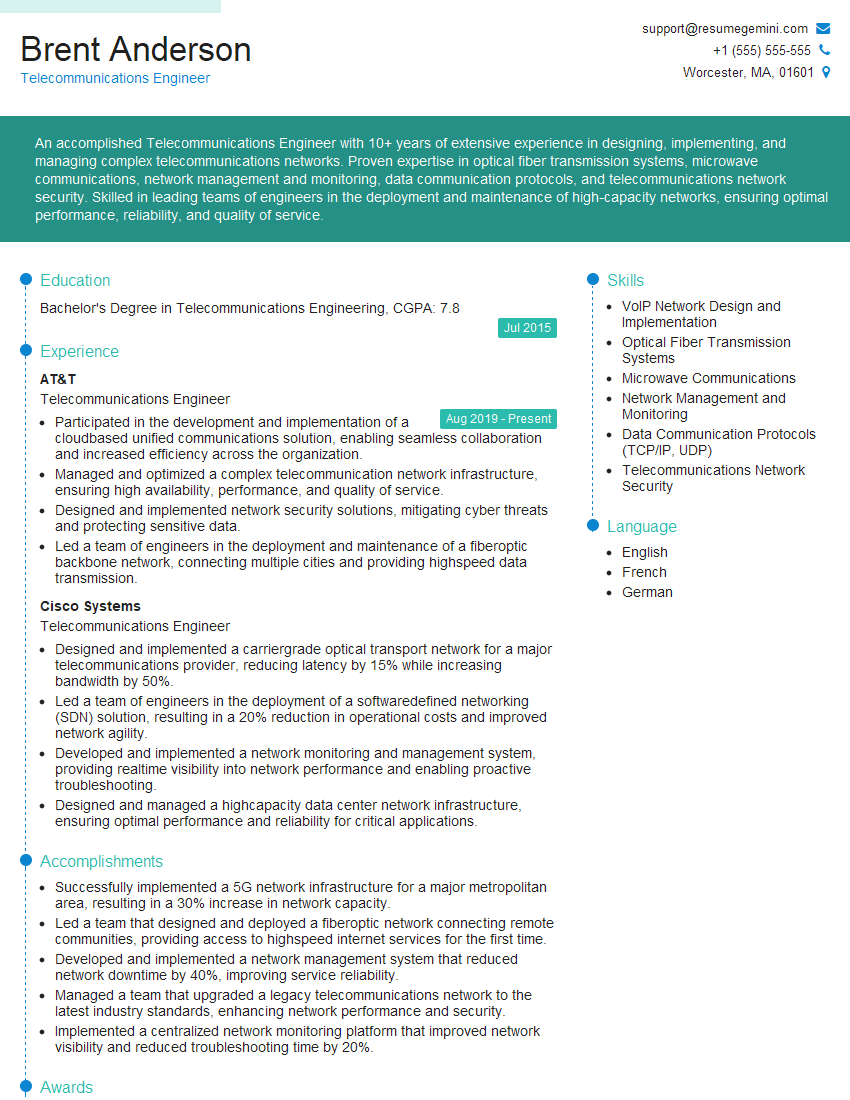
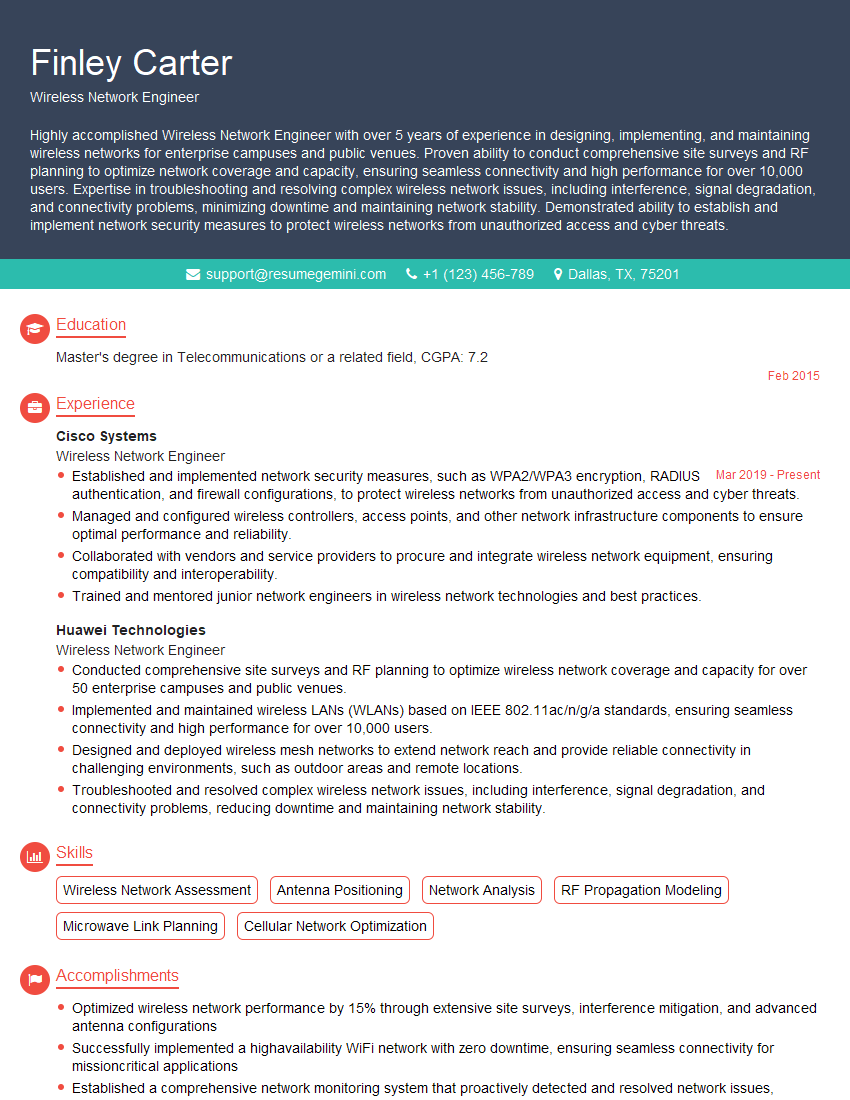
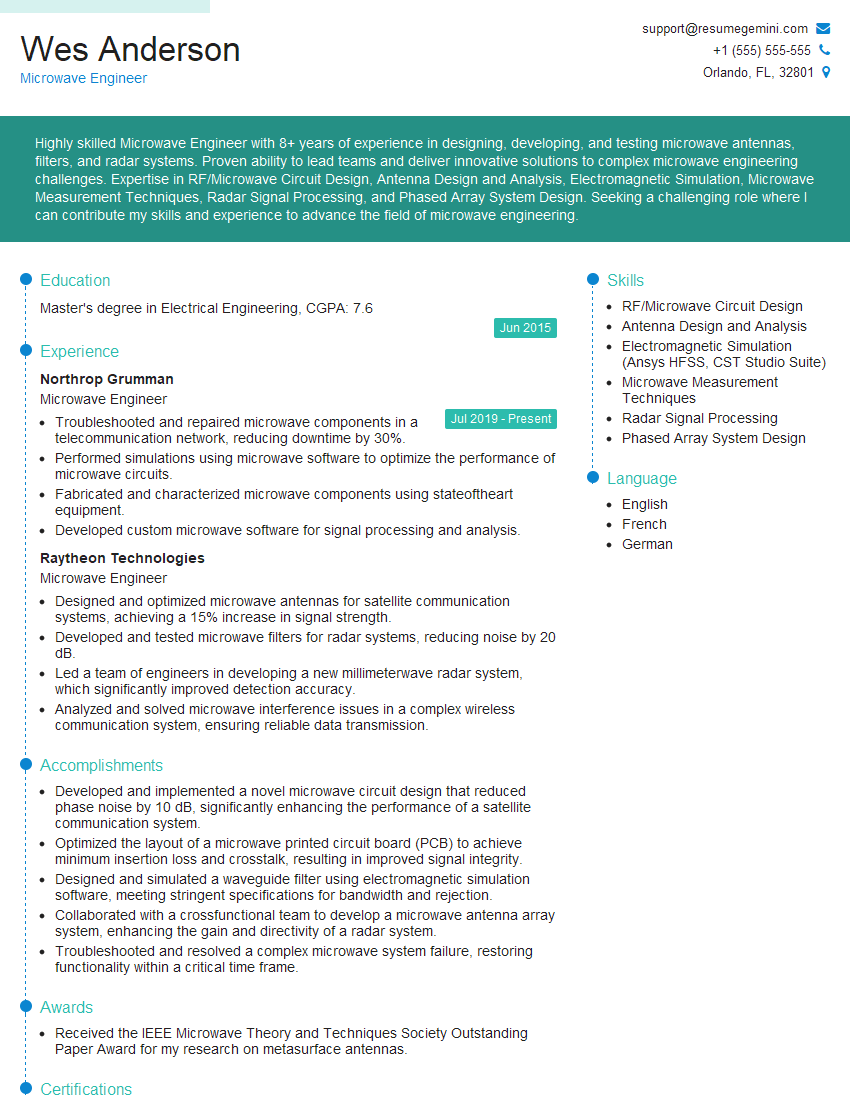
Mastering RF and Wireless Communication opens doors to exciting and rewarding careers in a rapidly growing field. To maximize your job prospects, it’s crucial to present your skills effectively. An ATS-friendly resume is key to getting your application noticed by recruiters and hiring managers. We encourage you to leverage ResumeGemini, a trusted resource for crafting professional and impactful resumes. ResumeGemini offers examples of resumes tailored to the RF and Wireless Communication field, helping you showcase your expertise convincingly. Invest time in crafting a compelling resume – it’s your first impression!
Explore more articles
Users Rating of Our Blogs
Share Your Experience
We value your feedback! Please rate our content and share your thoughts (optional).
What Readers Say About Our Blog
Very informative content, great job.
good