Feeling uncertain about what to expect in your upcoming interview? We’ve got you covered! This blog highlights the most important RF Shielding interview questions and provides actionable advice to help you stand out as the ideal candidate. Let’s pave the way for your success.
Questions Asked in RF Shielding Interview
Q 1. Explain the difference between EMI and RFI.
Both EMI (Electromagnetic Interference) and RFI (Radio Frequency Interference) refer to unwanted electromagnetic energy that disrupts the operation of electronic devices, but they differ in their frequency ranges. EMI encompasses a broader spectrum, including both low-frequency and high-frequency electromagnetic disturbances. RFI, on the other hand, specifically refers to interference within the radio frequency (RF) spectrum, typically ranging from 3 kHz to 300 GHz. Think of it like this: RFI is a subset of EMI. A faulty power supply might create EMI in the low-frequency range, while a nearby radio transmitter could cause RFI in the high-frequency range. Both can corrupt signals and lead to malfunctioning devices.
Q 2. What are the common materials used for RF shielding?
The choice of material for RF shielding depends heavily on the frequency range of the interference, the required attenuation level, and cost considerations. Common materials include:
- Metals: Copper, aluminum, and steel are frequently used due to their excellent conductivity. Copper offers superior shielding performance but is more expensive. Aluminum provides a good balance of performance and cost. Steel is often chosen for its mechanical strength, though its shielding effectiveness might be slightly lower at higher frequencies.
- Conductive Coatings: These are applied to other substrates like plastics or composites to provide shielding properties. Common examples include nickel, silver, and conductive polymers. They offer flexibility and lighter weight than solid metal sheets but may exhibit lower shielding effectiveness at certain frequencies.
- Magnetic Materials: Materials like mu-metal and ferrite are effective at attenuating magnetic fields, especially at lower frequencies. They’re crucial in applications where magnetic fields are a primary concern, such as shielding sensitive electronic components from external magnetic interference.
- Composite Materials: These combine various materials to achieve a balance of shielding effectiveness, weight, and other mechanical properties. For example, a composite might incorporate conductive fibers woven into a polymer matrix.
The selection process often involves trade-offs. For instance, a lightweight, flexible shield might be preferred for portable devices, even if it offers slightly less shielding than a heavier metal enclosure.
Q 3. Describe different RF shielding techniques.
Several techniques are employed for RF shielding, often used in combination for optimal performance:
- Enclosure Shielding: This involves completely surrounding the sensitive equipment with a conductive enclosure, forming a Faraday cage. This is a highly effective method for broadband shielding.
- Gaskets and Seals: Conductive gaskets are used to maintain the integrity of the enclosure by filling gaps and seams, preventing electromagnetic leakage. These are especially critical at higher frequencies where even small openings can significantly degrade shielding effectiveness.
- Coating and Painting: Applying conductive coatings or paints to the surface of components or enclosures provides an additional layer of shielding. This is often used to supplement enclosure shielding or protect individual components.
- Conductive Fabrics and Tapes: These are used for applications requiring flexibility or for localized shielding. They’re often employed to shield cables or connectors.
- Waveguide Attenuation: This technique exploits the properties of waveguides to attenuate electromagnetic waves propagating through them. It is commonly used in high-frequency applications and specialized shielding scenarios.
The choice of technique depends on the specific application. A server rack, for instance, might use enclosure shielding with conductive gaskets, while shielding cables in a high-frequency environment might involve using conductive tape and ferrites.
Q 4. How do you measure the effectiveness of RF shielding?
The effectiveness of RF shielding is typically measured in decibels (dB), representing the attenuation of electromagnetic fields. This is commonly referred to as shielding effectiveness (SE). Measurement involves using specialized equipment like:
- Near-field probes: These measure the electromagnetic fields in close proximity to the shielded object.
- Anechoic chambers: These are specialized environments designed to minimize reflections and provide accurate measurements.
- Network analyzers: These instruments are used to measure the transmission and reflection coefficients of electromagnetic waves through the shield.
Measurements are often conducted across a range of frequencies to characterize the shield’s performance across the spectrum. The obtained data provides the shielding effectiveness (SE) at different frequencies. A higher dB value indicates better shielding.
For example, a measurement might show an SE of 60 dB at 1 GHz, meaning the shield reduces the electromagnetic field intensity by a factor of 1 million at that frequency.
Q 5. What are the challenges in designing effective RF shielding for high-frequency applications?
Designing effective RF shielding for high-frequency applications presents several challenges:
- Increased Skin Depth: At higher frequencies, the skin depth (the depth to which electromagnetic waves penetrate a conductor) decreases significantly. This necessitates using thicker materials or more complex designs to achieve the required shielding effectiveness.
- Aperture Coupling: Even small openings or seams in the shield become significant pathways for electromagnetic leakage at high frequencies. Careful design and sealing are crucial.
- Mode Conversion: At high frequencies, electromagnetic waves can convert between different modes, making it more difficult to predict and control shielding performance.
- Material Limitations: Certain materials might exhibit reduced conductivity or increased losses at high frequencies, impacting their shielding capabilities.
- Cost and Complexity: Implementing effective shielding at high frequencies often requires specialized materials, complex designs, and rigorous testing, leading to higher costs and complexities.
Addressing these challenges often involves using specialized techniques like multi-layer shielding, carefully designed gaskets, and advanced material selection.
Q 6. Explain the concept of shielding effectiveness.
Shielding effectiveness (SE) quantifies the reduction in electromagnetic field intensity provided by a shield. It’s usually expressed in decibels (dB) and represents the ratio of the electromagnetic field intensity without the shield (Ein) to the field intensity with the shield (Eout):
SE (dB) = 20 * log10(Ein / Eout)
A higher SE value indicates better shielding performance. For example, an SE of 40 dB means the shield reduces the field intensity by a factor of 10,000. The SE is frequency-dependent; a shield might provide excellent shielding at one frequency but less so at another.
Q 7. How do you design for grounding and bonding in RF shielding?
Proper grounding and bonding are essential for effective RF shielding. They ensure a low-impedance path for conducted interference currents, preventing them from entering the shielded area. Key considerations include:
- Single-Point Grounding: All grounding wires should be connected to a single point to avoid ground loops and potential interference currents circulating between different ground points.
- Low-Impedance Paths: The grounding connections must offer minimal impedance to effectively divert interference currents. This requires using large cross-sectional area wires and minimizing connection resistance.
- Conductive Bonding: Conductive bonding straps or paints are used to connect different parts of the shield to create a continuous, electrically conductive path, minimizing gaps and potential leakage points.
- Ground Plane Design: In electronic circuits, a ground plane is a large area of conductive material used to reduce the impedance between components and ground. This is critical in high-frequency applications.
- Shielded Cables and Connectors: Cables entering and leaving the shielded area should be shielded and properly grounded to prevent interference from being conducted along the cables.
Neglecting proper grounding and bonding can significantly compromise the effectiveness of even the most well-designed RF shield. Imagine a perfectly sealed enclosure but with poor grounding; interference can still find its way in through conducted paths.
Q 8. What are the different types of electromagnetic interference?
Electromagnetic interference (EMI) encompasses any unwanted electromagnetic energy that disrupts the performance of electronic devices or systems. It’s like unwanted noise interfering with a conversation – you can’t hear the message clearly. EMI can be categorized into two main types: Conducted EMI and Radiated EMI.
Conducted EMI: This occurs when unwanted electromagnetic energy travels along electrical conductors, such as power lines or signal cables. Think of it as a noisy telephone line – the interference travels directly through the wire.
Radiated EMI: This happens when electromagnetic energy propagates through space, typically as electromagnetic waves. Imagine a radio station broadcasting – the signal travels through the air and can be picked up by any receiver within range.
Further classification can include sources like switching power supplies creating high frequency noise, harmonics from power grids, and unintentional radiation from antennas.
Q 9. What are the regulatory standards related to RF shielding?
Regulatory standards for RF shielding vary depending on the application and geographic location. These standards define acceptable emission limits and susceptibility levels for electronic equipment. Key standards include:
FCC (Federal Communications Commission) Part 15: Governs unintentional radiators in the United States. It sets limits on emissions from various devices to prevent interference with other electronic equipment and radio services.
CISPR (International Special Committee on Radio Interference): Develops international standards for limits and measurement methods for electromagnetic disturbances. These are often adopted nationally.
MIL-STD (Military Standard): The US military employs stringent standards for EMI/EMC in their equipment, often exceeding civilian standards due to the critical nature of their operations.
CE Marking (Conformité Européenne): Indicates compliance with EU health, safety, and environmental protection legislation, including EMC directives.
Specific standards will depend on the frequency range and the type of equipment involved. For example, medical devices have significantly stricter standards compared to consumer electronics.
Q 10. Describe your experience with different shielding enclosure designs.
My experience includes designing and testing a wide range of shielding enclosures, from small, custom-designed boxes for sensitive instrumentation to large, rack-mounted systems for industrial applications. These designs incorporate various approaches:
Single-layer enclosures: Made from conductive sheet metal (aluminum, copper, steel), offering a basic level of shielding effectiveness. These are cost-effective but might not provide high levels of attenuation.
Multi-layer enclosures: Using multiple layers of conductive material, often with different materials or absorbing materials between layers, to improve shielding effectiveness. This is like adding multiple layers of insulation to a house – each layer adds to the overall protection.
Conductive coatings: Applying conductive paints or films to non-metallic structures, providing a lightweight and flexible shielding option. This approach is useful when shielding needs to be integrated into complex shapes.
EMI gaskets and conductive seals: Essential for sealing seams and openings in the enclosure, preventing RF leakage. We use a variety of gasket materials such as conductive foam, silicone, and beryllium copper, selecting materials to match the application’s requirements.
I’ve also worked with specialized designs for specific frequency ranges, such as anechoic chambers for precise electromagnetic measurements.
Q 11. How do you address RF leakage in a shielded enclosure?
RF leakage in a shielded enclosure is addressed through a multi-pronged approach focusing on meticulous design and construction. Leakage can occur through seams, openings (like ventilation holes), and even through the enclosure material itself if it’s not sufficiently conductive. Strategies include:
Proper seam design and construction: Overlapping seams, conductive welding, or the use of conductive gaskets are crucial for eliminating gaps.
Filtering of ventilation openings: Using specialized EMI filters that allow air flow while attenuating RF signals. These filters are carefully selected based on the required frequency range and airflow needs.
Shielded cables and connectors: Using shielded cables with proper grounding and connectors with EMI shielding to prevent leakage through input/output points.
Testing and remediation: Thorough testing using specialized equipment (e.g., near-field scanners) to identify and address leakage points. This often involves adding additional shielding material or modifying existing designs.
Addressing leakage requires a combination of careful planning, proper construction techniques, and rigorous testing. It’s an iterative process, often refining the design based on the results of testing.
Q 12. What are the limitations of using conductive coatings for RF shielding?
While conductive coatings offer a lightweight and flexible alternative to solid conductive enclosures, they have limitations:
Lower shielding effectiveness: Compared to solid metal sheets, conductive coatings generally offer lower shielding effectiveness, particularly at higher frequencies. The thickness and conductivity of the coating greatly influence its performance.
Surface imperfections: Any imperfections in the coating, such as pinholes or inconsistencies in thickness, can significantly reduce shielding effectiveness, creating pathways for RF leakage.
Environmental factors: Conductive coatings can degrade over time due to environmental factors such as humidity, temperature, and UV exposure, reducing their effectiveness.
Durability: They may be more susceptible to damage compared to solid metal sheets, requiring careful handling and potentially compromising their integrity.
Conductive coatings are best suited for applications where weight and flexibility are critical but extremely high shielding effectiveness is not paramount.
Q 13. Explain the concept of absorption in RF shielding.
Absorption in RF shielding refers to the process where electromagnetic energy is converted into heat within a material. This is different from reflection, where the energy bounces off the surface. Think of a sponge absorbing water – it converts the kinetic energy of the water into potential energy, and similarly, absorbent materials convert electromagnetic energy into heat.
Absorbent materials typically contain magnetic or dielectric materials that have high loss tangents. These materials effectively dissipate the energy as heat. Common absorbent materials include:
Magnetic absorbers: These materials contain ferromagnetic materials that are lossy at specific frequencies. They are effective at absorbing electromagnetic energy by converting the energy into heat through hysteresis losses.
Dielectric absorbers: These materials are characterized by high dielectric losses. They absorb energy by converting it into heat through dielectric polarization mechanisms.
Absorbers are often used in conjunction with reflective materials in multi-layer shielding to maximize shielding effectiveness. The absorbent material reduces the energy that is reflected back into the shielded enclosure, further reducing the level of interference.
Q 14. How do you select appropriate shielding materials for a specific application?
Selecting appropriate shielding materials requires careful consideration of several factors:
Frequency range: Different materials exhibit different shielding effectiveness at various frequencies. Copper is often favored at higher frequencies, while steel might be more cost-effective at lower frequencies.
Shielding effectiveness requirements: The level of attenuation required will dictate the choice of material and its thickness. A high-security application will need much higher shielding than a standard consumer product.
Weight and size constraints: Lightweight materials like aluminum are preferred for portable devices, while heavier materials like steel may be necessary for robust industrial equipment.
Cost: The cost of the material is a significant factor, with different materials offering different cost-effectiveness.
Environmental considerations: Factors like corrosion resistance and temperature tolerance should be considered, especially in harsh environments.
Magnetic properties: In applications near sensitive magnetic sensors, non-magnetic materials such as aluminum or copper must be used.
Often, a combination of materials will be needed to optimize performance. For instance, a multi-layer shield might combine a reflective outer layer (e.g., aluminum) with an absorbing inner layer to minimize both reflection and transmission of electromagnetic waves. This is often an iterative process involving testing and refinement to achieve optimal results.
Q 15. How do you test for electromagnetic compatibility?
Electromagnetic Compatibility (EMC) testing verifies that a device or system doesn’t emit excessive electromagnetic interference (EMI) and is not unduly susceptible to EMI from other sources. Think of it like making sure your radio doesn’t blast static into your neighbor’s TV, and vice versa. We use specialized equipment to measure both radiated and conducted emissions and immunity.
Radiated emissions testing involves measuring the electromagnetic fields a device radiates into free space. This is often done in a shielded chamber (anechoic chamber) to eliminate external noise. We use antennas to capture the emitted signals and measure their strength across a range of frequencies.
Conducted emissions testing involves measuring EMI conducted along power lines and signal cables. We use a Line Impedance Stabilization Network (LISN) to accurately measure these emissions. A LISN acts as a precisely controlled impedance match so that the signals are not reflected and the measurements are accurate.
Immunity testing assesses a device’s resilience to external electromagnetic fields. We expose the device to controlled levels of electromagnetic fields (radiated or conducted) and observe its performance. This ensures the device will continue working properly even under the influence of EMI.
The entire process is guided by standards like CISPR (International Special Committee on Radio Interference) and other relevant industry-specific norms.
Career Expert Tips:
- Ace those interviews! Prepare effectively by reviewing the Top 50 Most Common Interview Questions on ResumeGemini.
- Navigate your job search with confidence! Explore a wide range of Career Tips on ResumeGemini. Learn about common challenges and recommendations to overcome them.
- Craft the perfect resume! Master the Art of Resume Writing with ResumeGemini’s guide. Showcase your unique qualifications and achievements effectively.
- Don’t miss out on holiday savings! Build your dream resume with ResumeGemini’s ATS optimized templates.
Q 16. Describe your experience with simulation tools for RF shielding design.
My experience with simulation tools for RF shielding design is extensive. I’ve used industry-standard software such as CST Microwave Studio, ANSYS HFSS, and COMSOL Multiphysics extensively. These tools allow for accurate prediction of shielding effectiveness across a wide frequency range, considering various material properties and geometric complexities.
For instance, in a recent project involving a high-speed data acquisition system, we utilized CST Microwave Studio to model the enclosure and optimize the shielding material and thickness to achieve a minimum of 80dB attenuation from 10MHz to 18GHz. The simulation allowed us to identify potential weaknesses in the design, such as apertures or seams, before physical prototyping, saving time and resources. This significantly reduced the number of costly iterations required during the physical prototyping stage. Example code (Python scripting within CST): #Get the shielding effectiveness parameter from the simulation result
Beyond predicting shielding effectiveness, these tools are also invaluable for analyzing the impact of different grounding strategies, identifying potential resonance frequencies, and optimizing the placement of absorbing materials.
Q 17. Explain the importance of gaskets and seals in RF shielding.
Gaskets and seals are crucial for maintaining the integrity of RF shielding enclosures. They compensate for imperfections in the enclosure’s construction and provide a conductive path to prevent electromagnetic leakage through seams and joints. Imagine a dam; even a small crack can cause catastrophic failure. Similarly, gaps in shielding can allow EMI to penetrate.
The choice of gasket material is critical. Common materials include conductive elastomers (like silicone or EPDM with conductive fillers), conductive foams, and beryllium copper for high-performance applications. The selection depends on factors such as frequency range, temperature requirements, and environmental conditions. For example, a high-temperature application might necessitate a specialized ceramic-filled silicone gasket.
Proper gasket compression is essential. Insufficient compression can lead to gaps that compromise shielding effectiveness, while excessive compression can damage the gasket or the enclosure itself. We often utilize specialized compression testing equipment to ensure the gasket provides the necessary electrical contact across the interface.
Q 18. What are the considerations for RF shielding in high-temperature environments?
High-temperature environments present unique challenges for RF shielding. Many common shielding materials experience degradation in their electrical conductivity or mechanical properties at elevated temperatures. For example, certain polymers lose their flexibility and effectiveness above a certain threshold.
Material selection is paramount in high-temperature applications. High-temperature resistant materials, such as certain ceramics, specialized conductive polymers with high glass transition temperatures, or even precious metals, become necessary. For example, ceramic-filled silicone is frequently used at operating temperatures up to 200°C. However, material selection needs to also consider thermal expansion mismatch between the shield and the gasket materials. For extremely high temperatures, specialized solutions involving active cooling systems may also be required.
Additionally, the design must account for thermal expansion and contraction of the shielding materials to prevent gaps from forming during temperature cycling. This could involve using flexible materials or incorporating expansion joints into the design. Thorough thermal testing is essential to verify the integrity of the shielding across the entire operating temperature range.
Q 19. How do you troubleshoot RF shielding problems?
Troubleshooting RF shielding problems is a systematic process. It starts with accurately measuring the shielding effectiveness using techniques described earlier, identifying the frequency range of the problem, and pinpointing the location of leakage. This could involve systematic measurements across different parts of the shield.
Tools like near-field probes help to locate leakage points by mapping the electromagnetic field around the enclosure. Spectroscopy analysis can help pinpoint the frequency range of the problematic emissions. If there is a weak point in the shielding this will often show up as a ‘notch’ in the attenuation spectrum. A notch indicates poor attenuation at a specific frequency.
Once the problem area is identified, potential causes include insufficient gasket compression, gaps or apertures in the enclosure, inadequate grounding, or the use of inappropriate materials. Addressing these issues might involve improving gasket design, adding conductive fillers, reinforcing structural integrity, or replacing inadequate shielding materials. Once modifications have been made the measurements should be repeated to ensure the fix was successful.
Q 20. Explain the impact of apertures on shielding effectiveness.
Apertures, or openings, in an RF shield significantly reduce its effectiveness. Even small openings can drastically degrade shielding performance, particularly at higher frequencies. Think of it like poking holes in a blanket; the more holes, the less warmth it provides. Similarly, apertures allow electromagnetic waves to pass through, negating the protective effect of the shield.
The impact of apertures depends on their size, shape, and location relative to the wavelength of the electromagnetic radiation. Generally, larger apertures and higher frequencies result in greater leakage. For instance, a 1cm aperture may have negligible effect at low frequencies but significantly compromise shielding at microwave frequencies. The effect of an aperture is usually more complex than simply the aperture size and geometry; it is influenced by the surrounding structures in the shield enclosure. A simple slot of some width and length may behave like an antenna in certain conditions.
Minimizing apertures is paramount in good shielding design. When apertures are unavoidable (e.g., for cable or connector penetrations), they should be carefully managed using techniques such as waveguides, filters, or shielded feedthroughs to mitigate leakage. These specialized components are designed to minimize the transmission of unwanted electromagnetic energy while allowing signals to pass through.
Q 21. What is the role of ferrites in RF shielding?
Ferrites are materials with high magnetic permeability and are frequently used in RF shielding applications, especially for suppressing conducted EMI. They function by absorbing electromagnetic energy, essentially converting it into heat. Imagine a sponge absorbing water; ferrites absorb electromagnetic energy.
Ferrites are commonly incorporated into common-mode chokes, which are used to suppress noise on power and signal lines. These chokes consist of ferrite beads or cores around a wire, effectively creating a high impedance path for high-frequency noise. This prevents high-frequency noise from entering or exiting sensitive circuitry. They are commonly used with power supplies and data lines to improve EMC performance.
The choice of ferrite material depends on the frequency range of the interference being suppressed. Different ferrite compositions exhibit varying permeability characteristics across different frequencies. They are also used in conjunction with filters to improve noise attenuation over a broad band of frequencies.
Q 22. Describe your experience with different types of shielding enclosures (e.g., conductive, magnetic).
My experience encompasses a wide range of shielding enclosure types, focusing primarily on conductive and magnetic shielding. Conductive shielding utilizes materials like copper, aluminum, or nickel-plated steel to reflect electromagnetic waves. The effectiveness depends on the material’s conductivity and thickness. For instance, a copper enclosure is highly effective across a broad frequency range. Magnetic shielding, on the other hand, uses high-permeability materials like mu-metal or ferrite to divert magnetic fields. These are crucial for protecting sensitive equipment from strong magnetic interference. I’ve worked with both solid enclosures and enclosures with conductive gaskets to maintain seamless shielding. I also have experience in designing enclosures using hybrid approaches, combining conductive and magnetic shielding materials for optimal performance in specific frequency bands.
For example, in one project, we used a copper enclosure lined with mu-metal to shield a sensitive magnetic sensor from both electric and magnetic fields, achieving over 100dB of shielding effectiveness across a wide frequency range. Another project involved designing an aluminum enclosure with conductive gaskets for a medical device requiring significant RFI protection.
Q 23. How do you account for the effects of seams and joints in shielding design?
Seams and joints are critical weak points in shielding enclosures. Their presence can significantly degrade shielding effectiveness, creating pathways for electromagnetic interference to penetrate. To mitigate this, several strategies are employed. Firstly, meticulous design ensures seams are minimized and strategically placed. Secondly, conductive gaskets or meshes are used to fill gaps and maintain electrical continuity between the enclosure’s components. These gaskets are often made from materials with high conductivity and resilience. Thirdly, techniques like overlapping seams, conductive welding, and specialized fasteners are utilized to ensure a secure and electrically continuous seal. Finally, simulations using tools like ANSYS HFSS can model the electromagnetic field behavior near seams and joints, helping optimize the design for maximum effectiveness.
For example, when shielding a high-frequency application, using a conductive gasket with a high conductivity and low contact resistance is critical. The choice of gasket material is frequency dependent. A conductive adhesive is sometimes added to enhance the electrical connection between the shielding surfaces.
Q 24. What are the considerations for EMI/RFI shielding in PCB design?
EMI/RFI shielding in PCB design requires a multi-pronged approach focusing on minimizing emissions and preventing susceptibility. Key considerations include: proper grounding techniques, using shielded cables and connectors, incorporating conductive planes, strategic placement of components to minimize loop areas, and using EMI/RFI filters. Grounding is crucial – a single, well-defined ground plane is essential. Shielded cables prevent radiation from traces on the PCB. Conductive planes act as shields, reducing electromagnetic fields. Minimizing loop areas reduces radiated emissions. Finally, EMI/RFI filters suppress unwanted signals entering or leaving the PCB.
For example, in high-speed digital designs, it’s common to incorporate a ground plane and use ferrite beads on power lines to suppress high-frequency noise. Careful trace routing, avoiding long unshielded traces, is also essential.
Q 25. How does the frequency of the electromagnetic field impact shielding effectiveness?
The frequency of the electromagnetic field significantly impacts shielding effectiveness. At lower frequencies, magnetic fields are more dominant, and shielding effectiveness depends heavily on the permeability of the shielding material. High-permeability materials like mu-metal are effective here. At higher frequencies, electric fields become more significant, and the conductivity and skin depth of the material become crucial. Conductive materials like copper and aluminum perform better at these frequencies. The shielding effectiveness typically decreases with increasing frequency due to skin effect. The skin depth, the depth to which an electromagnetic wave penetrates a conductor, becomes smaller at higher frequencies.
Think of it like this: at low frequencies, the magnetic field can easily penetrate a poor conductor, while at high frequencies, the electric field is primarily reflected by the conductor’s surface.
Q 26. Explain your experience with different types of EMI/RFI filters.
My experience includes various EMI/RFI filter types, including common-mode chokes, differential-mode chokes, LC filters, and Pi filters. Common-mode chokes suppress noise currents flowing in the same direction on two conductors, often found in power lines. Differential-mode chokes filter noise currents flowing in opposite directions on two conductors. LC filters utilize inductors and capacitors to create a high impedance path for unwanted frequencies. Pi filters extend this by adding another capacitor, enhancing attenuation, especially at higher frequencies. The selection depends on the application and frequency range of the noise. Factors like impedance matching, insertion loss, and attenuation characteristics need to be carefully considered.
For instance, in a medical device project requiring stringent EMI compliance, we employed a combination of LC filters and common-mode chokes to effectively suppress a wide range of frequencies.
Q 27. Describe a situation where you had to overcome a challenging RF shielding problem.
I once encountered a challenging situation where a high-power RF transmitter was causing significant interference with a nearby sensitive measurement instrument. The initial shielding attempts were inadequate, leading to unacceptable levels of interference. After careful analysis using near-field probes and spectrum analyzers, we identified several areas for improvement. The first was the inadequate grounding of the transmitter and the shielding enclosure. We implemented a comprehensive grounding strategy, ensuring low-impedance paths to earth. Secondly, we improved the shielding enclosure’s design, focusing on minimizing seams and adding specialized conductive gaskets to enhance the seal. Thirdly, we added RF absorbing material inside the enclosure to attenuate reflected signals. These combined efforts significantly reduced interference, bringing it down to acceptable levels.
Q 28. How would you approach designing a shielded room for a sensitive application?
Designing a shielded room for a sensitive application requires a holistic approach. Firstly, the shielding material selection depends on the frequency range and intensity of the interference. Materials like copper or aluminum are common choices. The room’s construction is critical—seamless construction is essential to minimize entry points for electromagnetic interference. Conductive gaskets or welds are employed at seams and joints. Multiple layers of shielding may be necessary for high-level protection. Grounding is paramount; the entire structure needs to be effectively grounded to earth. Furthermore, RF absorbing materials (RAM) are often installed inside to minimize internal reflections and improve attenuation. Finally, thorough testing and verification using specialized equipment like a reverberation chamber are needed to ensure the room meets the specified requirements.
The design must account for the specific needs of the application – this includes factors like the dimensions of the room, access points, environmental conditions, and the types of equipment inside.
Key Topics to Learn for RF Shielding Interview
- Fundamentals of Electromagnetic Fields and Waves: Understanding wave propagation, reflection, absorption, and transmission is crucial. Consider exploring different frequency ranges and their impact on shielding effectiveness.
- Shielding Materials and Their Properties: Learn about the characteristics of various materials used in RF shielding, such as conductive metals, conductive polymers, and magnetic materials. Analyze their permeability, conductivity, and shielding effectiveness.
- Shielding Design Principles and Techniques: Explore different shielding techniques, including enclosures, gaskets, coatings, and apertures. Understand how to optimize shielding effectiveness based on frequency, material selection, and geometry.
- Practical Applications and Case Studies: Review real-world applications of RF shielding, such as in telecommunications, medical imaging, and aerospace. Studying specific examples will help you understand the practical challenges and solutions involved.
- Measurement and Testing Techniques: Familiarize yourself with methods for measuring and testing the effectiveness of RF shielding, including near-field and far-field measurements. Understand the importance of accurate testing and compliance with industry standards.
- EMI/EMC Compliance and Regulations: Gain an understanding of relevant electromagnetic interference (EMI) and electromagnetic compatibility (EMC) regulations and standards. Knowing how to design and test for compliance is vital.
- Troubleshooting and Problem-Solving: Prepare to discuss common problems encountered in RF shielding design and implementation. Develop your ability to analyze issues, identify root causes, and propose effective solutions.
Next Steps
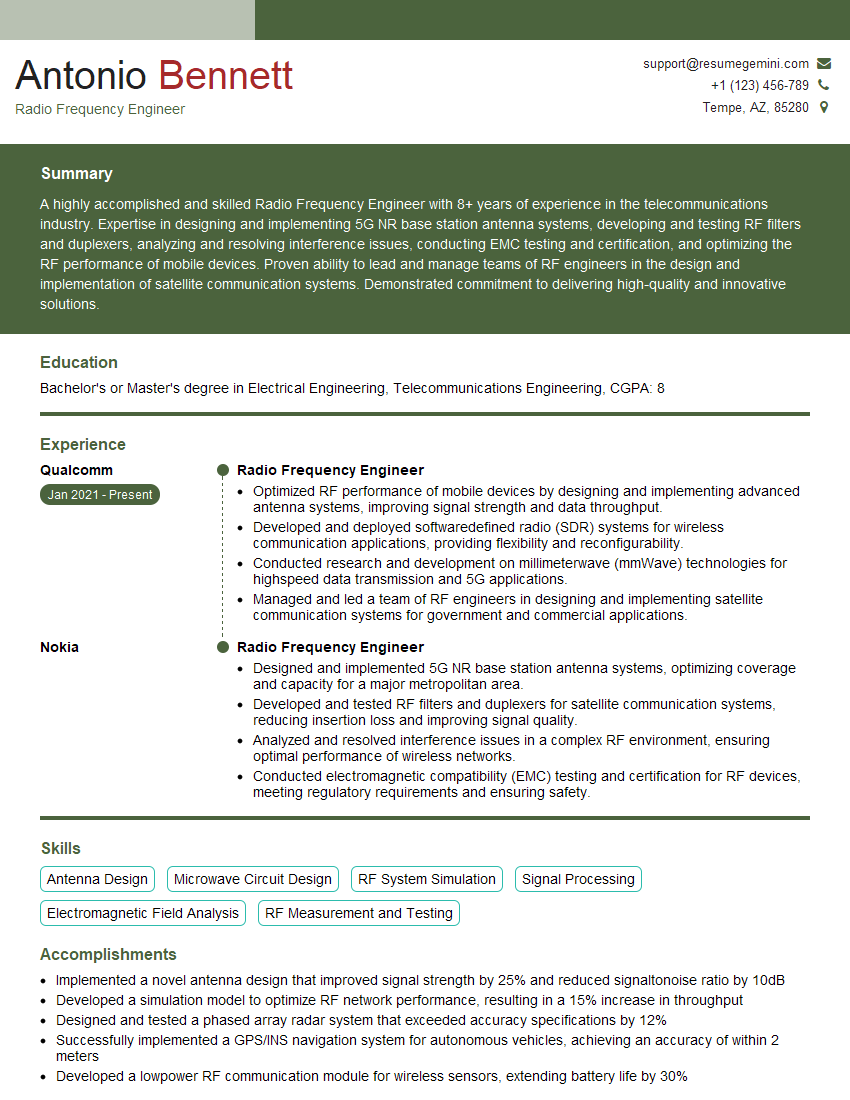
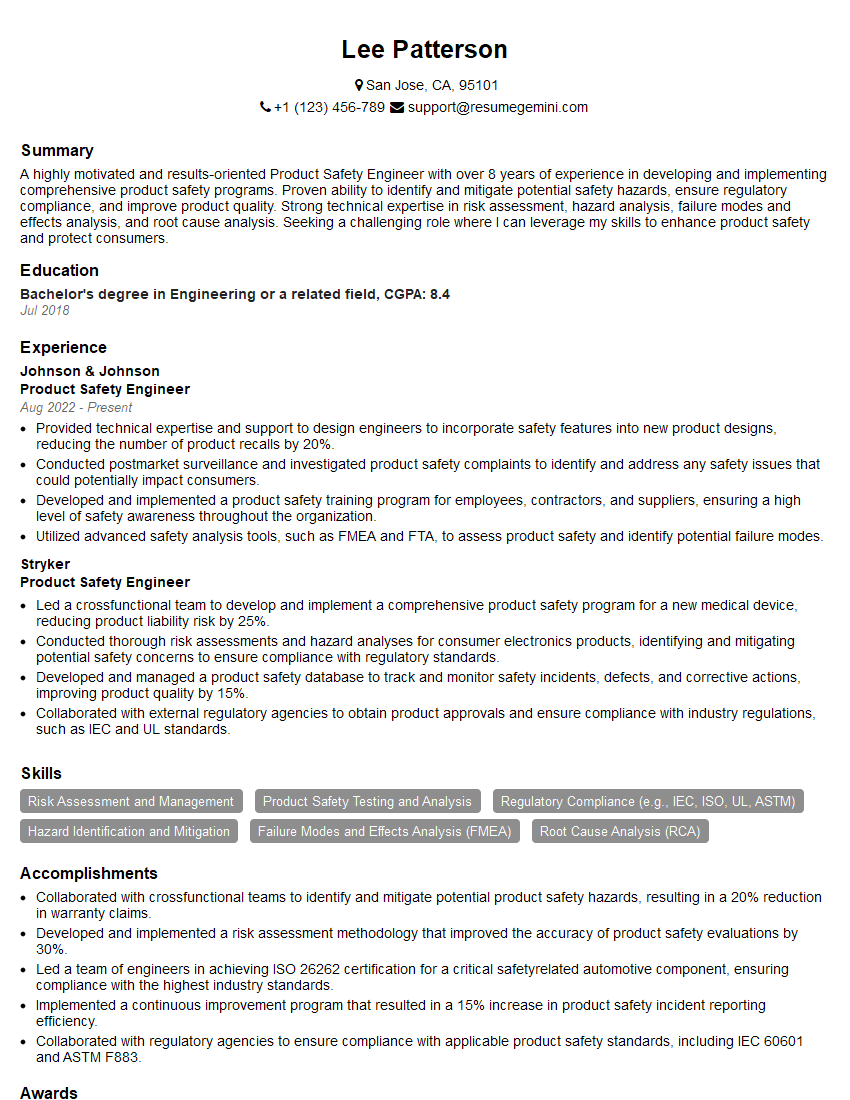
Mastering RF shielding opens doors to exciting career opportunities in diverse and innovative industries. A strong understanding of these concepts is highly valued by employers. To maximize your chances of landing your dream role, creating a compelling and ATS-friendly resume is essential. ResumeGemini is a trusted resource to help you build a professional resume that showcases your skills and experience effectively. Examples of resumes tailored to the RF Shielding field are available to guide you, ensuring your application stands out from the competition.
Explore more articles
Users Rating of Our Blogs
Share Your Experience
We value your feedback! Please rate our content and share your thoughts (optional).
What Readers Say About Our Blog
Very informative content, great job.
good