Interviews are opportunities to demonstrate your expertise, and this guide is here to help you shine. Explore the essential Robotic Manipulation interview questions that employers frequently ask, paired with strategies for crafting responses that set you apart from the competition.
Questions Asked in Robotic Manipulation Interview
Q 1. Explain the Jacobian matrix and its role in robotic manipulation.
The Jacobian matrix is a fundamental tool in robotics that describes the relationship between the joint velocities of a robot and the resulting end-effector velocity. Imagine you’re controlling a robotic arm. The Jacobian lets you translate small changes in the angles of each joint into the resulting speed and direction of the hand at the end. It’s essentially a mathematical representation of this transformation.
Specifically, it’s a matrix of partial derivatives. Each element represents how much the end-effector’s velocity in a particular direction (x, y, z, and rotation about each axis) changes with a small change in a specific joint angle. A 6xN Jacobian (6 for 3D position and 3D orientation, N for the number of joints) is common for robotic arms.
Example: Consider a simple 2-joint robot arm. The Jacobian would be a 2×2 matrix. A change in joint 1’s angle might affect both the x and y position of the end-effector, while a change in joint 2’s angle might have a different effect on x and y. The Jacobian quantifies these effects.
Role in Manipulation: The Jacobian is crucial for:
- Inverse Kinematics: Calculating joint angles needed to reach a desired end-effector pose.
- Motion Control: Precisely controlling the end-effector’s velocity and trajectory.
- Singularity Analysis: Identifying configurations where the robot loses degrees of freedom.
- Force Control: Translating forces at the end-effector to required joint torques.
Q 2. Describe different robot hand designs and their applications.
Robot hand designs, or end-effectors, vary widely depending on the task. They range from simple grippers to complex multi-fingered hands. The choice of design hinges on factors such as the object’s shape, size, weight, and fragility, as well as the required dexterity and manipulation precision.
- Two-fingered grippers: These are the simplest and most common, typically using parallel jaws to grasp objects. They are robust, inexpensive, and suitable for picking up many cylindrical or block-like objects. Example: A simple parallel-jaw gripper on an industrial robot arm used for picking and placing parts on an assembly line.
- Three-fingered grippers: Offer increased dexterity compared to two-fingered grippers, enabling a wider range of grasps and better object manipulation. They are suitable for objects with more complex shapes.
- Multi-fingered hands (anthropomorphic): These hands mimic human hands with multiple fingers and opposable thumbs, offering the highest dexterity. However, they are more complex to design, control, and are considerably more expensive. Examples include research robots like the Shadow Hand, used for tasks requiring fine manipulation, like assembling small electronics.
- Vacuum grippers: Use suction to grasp objects. They are ideal for smooth, flat surfaces and are commonly used in automated warehousing and manufacturing for handling boxes and similar items. The simplicity, speed, and reliability make them popular for high-throughput applications.
- Magnetic grippers: Use magnets to handle ferromagnetic materials. They are fast and simple, but limited to specific materials.
Q 3. What are the challenges of grasping and manipulating deformable objects?
Grasping and manipulating deformable objects (like cloth, ropes, or food) poses significant challenges because their shape and properties change under external forces. This makes it difficult to predict their behavior and design robust control strategies.
- Shape Uncertainty: The object’s shape is constantly changing, making it hard to model accurately for grasp planning.
- Contact Uncertainty: The contact points between the gripper and object are unpredictable due to deformation.
- Internal Forces: Deformable objects exhibit internal forces and stresses that affect their overall response to external manipulation.
- Slippage: Maintaining a stable grasp is difficult due to potential slippage at contact points. This requires sophisticated control algorithms that can adjust grip force based on real-time sensor feedback.
Addressing these challenges requires advanced sensing techniques (e.g., tactile sensors, vision systems), soft robotics (using compliant materials to conform to the object’s shape), and control algorithms that can handle uncertainty and adapt to changes in the object’s shape. For example, vision-guided adaptive grasp control systems that monitor the object’s deformation and adjust the grip accordingly are being actively developed.
Q 4. Explain the concept of workspace and its importance in robotic manipulation.
The workspace of a robot manipulator refers to the set of all possible positions and orientations its end-effector can reach. Think of it as the robot’s ‘reachable space’. It’s a crucial aspect because it dictates what tasks the robot can perform.
Importance:
- Task Planning: Knowing the workspace helps determine whether a given task is even feasible for the robot. If the required position lies outside the workspace, the task is impossible.
- Workcell Design: The workspace guides the design of the robot’s work environment. Objects to be manipulated must be positioned within reach of the robot.
- Collision Avoidance: Path planning algorithms need to ensure the robot remains within its workspace and avoids obstacles within that space.
- Redundancy Resolution: For robots with more joints than necessary to achieve a task (redundant robots), the workspace analysis can be used to find the optimal joint configuration.
Example: A robotic arm mounted on a wall has a limited workspace – a hemisphere-like volume in front of the wall. If you want to use the robot to place objects on a shelf behind the wall, it won’t be possible because that location is outside its workspace.
Q 5. How do you address singularities in robot manipulators?
Singularities in robot manipulators are configurations where the robot loses one or more degrees of freedom. Imagine a robotic arm extending fully straight – it might lose the ability to move in certain directions. This is a singularity.
Mathematically, it happens when the Jacobian matrix becomes singular (non-invertible). This means there’s no unique solution for joint velocities to achieve a desired end-effector velocity. Several strategies can address singularities:
- Singularity Avoidance: Path planning algorithms are designed to avoid trajectories that pass through or near singularities. This is often achieved by adding constraints or penalty functions to the optimization problem during path planning.
- Redundancy Resolution: For redundant robots, the extra degrees of freedom can be used to move away from a singularity while still achieving the desired task. This might involve using optimization techniques to find a joint configuration that avoids the singularity.
- Singularity Robust Control: Advanced control schemes are developed to handle singularities gracefully. These methods might involve using pseudo-inverses of the Jacobian or other techniques that provide a solution even when the Jacobian is singular.
- Mechanical Redesign: In some cases, the robot’s mechanical design can be modified to reduce the likelihood of encountering singularities. For example, adding additional joints or changing the link lengths might help.
Example: A common singularity is the ‘elbow singularity’ in a robotic arm where the elbow is fully extended or fully folded.
Q 6. Discuss different path planning algorithms used in robotics.
Path planning algorithms find collision-free paths for robots to move from a starting point to a goal point while respecting constraints such as joint limits and obstacles. Many algorithms exist; some of the most popular include:
- A* (A-star): A graph search algorithm that finds the shortest path by evaluating a heuristic function estimating the distance to the goal. It’s computationally efficient for relatively simple environments.
- RRT (Rapidly-exploring Random Trees): Builds a tree by randomly sampling the configuration space and connecting the samples if they are collision-free. It’s good for high-dimensional spaces and complex environments.
- PRM (Probabilistic Roadmaps): Generates a roadmap of collision-free configurations before planning the path. This method is effective for complex environments and can find paths efficiently once the roadmap is constructed.
- Potential Field Methods: Treat the goal as an attractive force and obstacles as repulsive forces. The robot follows the resulting potential field to reach the goal. It’s simple but can get stuck in local minima.
- Hybrid Approaches: Many modern algorithms combine aspects of different techniques to achieve better performance. For example, they might use RRT for global path planning and then refine the path locally using A* or other local planners.
The choice of algorithm depends on the complexity of the environment, the robot’s dynamics, and the required path properties (e.g., shortest path, smoothness).
Q 7. Explain the difference between forward and inverse kinematics.
Forward and inverse kinematics are fundamental concepts in robotics that describe the relationship between the joint angles of a robot and the position and orientation of its end-effector.
Forward Kinematics: Given the joint angles, determine the position and orientation of the end-effector. This is relatively straightforward; it involves applying successive transformations (rotations and translations) based on the robot’s geometry. It’s like knowing the angles of each joint of your arm and calculating where your hand ends up.
Inverse Kinematics: Given the desired position and orientation of the end-effector, determine the required joint angles. This is significantly more challenging and often requires iterative numerical methods because it involves solving a system of non-linear equations. It’s like knowing where you want your hand to be and figuring out how to move each joint to get there.
Example: Consider a robotic arm. Forward kinematics would take the joint angles as input (e.g., shoulder angle = 30°, elbow angle = 90°) and calculate the (x, y, z) coordinates of the hand. Inverse kinematics would take the desired (x, y, z) coordinates of the hand as input and calculate the required joint angles to reach that location.
In Summary: Forward kinematics is a direct calculation; inverse kinematics is an optimization problem often solved using iterative algorithms.
Q 8. How do you handle sensor noise and uncertainty in robotic manipulation?
Sensor noise and uncertainty are unavoidable in robotic manipulation. Think of it like trying to build a tower of blocks blindfolded – you have an idea of where the blocks are, but you’re not perfectly sure. We tackle this using several strategies. First, we employ sensor fusion, combining data from multiple sensors (e.g., a camera and a force/torque sensor) to get a more robust estimate of the robot’s state. This is like having multiple people guide you while building the tower, each providing slightly different perspectives.
Second, we utilize Kalman filtering or similar probabilistic techniques. These algorithms predict the robot’s future state and update that prediction based on incoming sensor readings, effectively smoothing out noisy data. Imagine the algorithm constantly refining its understanding of the tower’s stability based on each block placed.
Third, we design robust control algorithms that are less sensitive to small errors. Instead of aiming for precise movements, we design controllers that tolerate a certain level of uncertainty. This is analogous to building the tower with a slightly larger margin for error, ensuring it doesn’t collapse easily.
Finally, we use statistical methods to characterize and model sensor noise and uncertainty. This allows us to quantify the reliability of our sensor data and make informed decisions about how to use it in our control algorithms. This is like understanding the limitations of the blindfold and adjusting your strategy accordingly.
Q 9. Describe different methods for force control in robotic manipulation.
Force control in robotic manipulation is about regulating the interaction forces between the robot and its environment. Several methods exist, each with its strengths and weaknesses:
- Position-based control with force limits: This is a simple approach where we control the robot’s position, but we also set limits on the allowable forces. If the robot encounters a force exceeding the limit, it stops. Think of a robot carefully placing a delicate object – it stops if it encounters unexpected resistance.
- Hybrid force/position control: This method allows us to control force along certain directions and position along others. For example, a robot might be instructed to maintain a constant force against a surface while simultaneously controlling its position along a specific axis. Imagine a robot polishing a table, maintaining a constant contact force while following a pre-defined path.
- Impedance control (discussed in detail in the next question): This method allows the robot to respond to external forces in a compliant manner, behaving like a spring-damper system.
- Adaptive force control: This sophisticated approach uses machine learning to adapt the control strategy to changing environmental conditions and uncertainties. This is like having the robot automatically adjust its grip strength based on the object’s weight and slipperiness.
Q 10. Explain the concept of impedance control.
Impedance control is a powerful technique that allows a robot to interact with its environment in a compliant and adaptable way. Instead of precisely specifying the desired position or force, we define the desired impedance – a relationship between force and position (or velocity).
Imagine a spring-damper system. The stiffness of the spring dictates how much force is needed to change the position, and the damping coefficient determines how quickly the system settles to its equilibrium. Impedance control essentially makes the robot behave like a programmable spring-damper system.
The advantages are numerous: it allows the robot to adapt to unexpected forces or disturbances, prevents damage from collisions, and enables smoother and more natural interaction with the environment. Think of a robot assembling a complex part – impedance control allows it to adapt to slight variations in part alignment without causing damage.
The control law usually involves specifying a desired impedance matrix, which relates the desired force to the position or velocity error. The control algorithm then actively regulates the robot’s behavior to match this desired impedance, ensuring a smooth and safe interaction. The implementation often involves complex matrix calculations and requires careful tuning of the impedance parameters.
Q 11. What are the advantages and disadvantages of using different robot actuators (e.g., hydraulic, pneumatic, electric)?
The choice of actuator significantly impacts a robot’s capabilities and design. Let’s compare hydraulic, pneumatic, and electric actuators:
- Hydraulic actuators: Offer high power-to-weight ratios and can generate significant forces. They are well-suited for heavy-duty applications, such as construction robots or heavy machinery. However, they are often bulky, require a complex hydraulic system, and can leak fluids.
- Pneumatic actuators: Lightweight and inexpensive, they provide simple and fast control, making them suitable for simpler tasks. However, their force and precision are limited compared to hydraulic or electric actuators. They are often used in assembly lines or simple pick-and-place tasks.
- Electric actuators: Highly precise, clean, and easy to control, electric actuators are becoming increasingly popular. They offer good repeatability and are well-suited for complex manipulation tasks. However, they may not be as powerful as hydraulic actuators for heavy-duty applications. They are commonly found in collaborative robots and precision assembly systems.
The best choice depends on the specific application. For example, a surgical robot would benefit from the precision of electric actuators, whereas a heavy-lift robot might require the power of hydraulic actuators.
Q 12. How do you calibrate a robotic manipulator?
Calibrating a robotic manipulator is crucial for accurate and reliable operation. It involves determining the relationship between the robot’s joint angles and its end-effector position and orientation. This process typically involves several steps:
- Geometric calibration: This determines the physical parameters of the robot’s links and joints (lengths, offsets, etc.). This often involves using precise measurement tools and techniques.
- Kinematic calibration: This establishes the relationship between joint angles and end-effector pose. Techniques like the Denavit-Hartenberg (DH) parameters are commonly used to model this relationship. Calibration often involves moving the robot to various poses and measuring its end-effector position using external sensors.
- Dynamic calibration: This determines the robot’s dynamic parameters (mass, inertia, friction, etc.). It is more complex and involves measuring the robot’s response to known forces and torques. Techniques often involve applying controlled forces and measuring the resulting acceleration.
Calibration often requires specialized software and equipment, and the process can be time-consuming. Regular calibration is essential to maintain the robot’s accuracy and prevent errors in its operation.
Q 13. Describe your experience with different robotic programming languages (e.g., ROS, MATLAB).
I have extensive experience with both ROS (Robot Operating System) and MATLAB. ROS is my primary tool for developing complex robotic systems. Its modular architecture and extensive libraries for robot control, perception, and communication are invaluable. I have used it to develop everything from simple pick-and-place routines to sophisticated manipulation tasks using force control and computer vision. For example, in a previous project I used ROS to coordinate a multi-robot system for warehouse automation.
MATLAB is excellent for prototyping and simulation, particularly for control algorithm development and analysis. Its rich set of mathematical functions and visualization tools allow for quick experimentation and evaluation. I’ve used MATLAB to simulate various robotic systems and develop control strategies before deploying them on the physical robot. In one project, I used MATLAB to simulate and optimize the trajectory planning for a robot arm manipulating a flexible object.
Q 14. Explain your experience with various robot sensors (e.g., force/torque sensors, cameras).
My experience with robot sensors is broad. I’ve worked extensively with force/torque sensors for precise force control applications, such as robotic surgery or delicate assembly tasks. These sensors provide crucial feedback about the interaction forces between the robot and the environment, enabling compliant and safe manipulation.
Cameras are integral to many of my projects, particularly when dealing with visual servoing and object recognition. I’ve used both 2D and 3D cameras, along with various computer vision techniques, to enable robots to locate, identify, and manipulate objects in their environment. For instance, in one project, I developed a system using a depth camera and image processing to enable a robot arm to autonomously grasp and place objects of varying shapes and sizes.
Beyond force/torque sensors and cameras, I’ve also worked with other sensor modalities like laser range finders and IMUs (Inertial Measurement Units). The choice of sensor always depends on the specific application and the level of precision required. I have a deep understanding of the limitations and capabilities of different sensors and how to effectively integrate them into robotic systems.
Q 15. How do you design a robotic gripper for a specific task?
Designing a robotic gripper begins with a thorough understanding of the task. It’s not a one-size-fits-all solution; the gripper must be tailored to the object’s shape, size, weight, material properties, and the environment. Think of it like choosing the right tool for a job – you wouldn’t use a screwdriver to hammer a nail.
- Object Analysis: First, we meticulously analyze the object’s characteristics. Is it fragile? Does it have a unique shape? Is it heavy? This dictates the gripper’s design parameters, such as force, dexterity, and end-effector type.
- Gripper Type Selection: Based on the object analysis, we select the appropriate gripper type. Common types include parallel grippers (two fingers moving in parallel), three-fingered grippers, and specialized grippers like vacuum cups (for flat, smooth objects) or magnetic grippers (for ferromagnetic objects). For delicate objects, soft robotic grippers made from flexible materials are often preferred.
- Material Selection: The gripper material is crucial. We consider factors like durability, weight, grip, and resistance to the environment. For example, a gripper handling hot objects needs heat-resistant materials.
- Actuation: The gripper needs an actuation mechanism, such as pneumatic actuators (using compressed air), electric motors (offering precise control), or even shape memory alloys (for more compliant gripping).
- Sensing: Often, we incorporate sensors like tactile sensors or force/torque sensors to provide feedback to the robot, ensuring a safe and reliable grasp. This allows for adaptive gripping, adjusting to slight variations in object position or shape.
For example, in a delicate assembly task involving circuit boards, a soft robotic gripper with integrated tactile sensors would be ideal to prevent damage. Conversely, for lifting heavy parts in a manufacturing setting, a robust parallel gripper with high gripping force would be more suitable.
Career Expert Tips:
- Ace those interviews! Prepare effectively by reviewing the Top 50 Most Common Interview Questions on ResumeGemini.
- Navigate your job search with confidence! Explore a wide range of Career Tips on ResumeGemini. Learn about common challenges and recommendations to overcome them.
- Craft the perfect resume! Master the Art of Resume Writing with ResumeGemini’s guide. Showcase your unique qualifications and achievements effectively.
- Don’t miss out on holiday savings! Build your dream resume with ResumeGemini’s ATS optimized templates.
Q 16. Describe your experience with robot simulation software (e.g., Gazebo, V-REP).
I have extensive experience with both Gazebo and V-REP, using them for robotic simulation and development. These platforms allow for rapid prototyping and testing of manipulation strategies without the need for expensive physical hardware. This significantly reduces development time and costs, enabling early detection of potential issues.
In Gazebo, I’ve worked extensively on creating accurate robot models, including both the physical and kinematic properties. I’ve used its physics engine to simulate realistic interactions between the robot, objects, and the environment. This includes simulating complex scenarios like grasping objects, navigating cluttered environments, and detecting collisions.
Similarly, V-REP has been used for detailed simulations, particularly in scenarios requiring precise control and sensor modelling. I’ve incorporated various sensor models, such as cameras and force sensors, within V-REP to evaluate the performance of the robot control algorithms under realistic conditions.
One project involved simulating a robotic arm picking and placing objects in a warehouse setting using Gazebo. We modeled different scenarios, including unexpected obstacles and variations in object placement to ensure the robot’s robustness. This simulation helped us refine the robot’s control algorithms and avoid costly mistakes during real-world implementation.
Q 17. How do you deal with collision avoidance in robotic manipulation?
Collision avoidance is paramount in robotic manipulation, preventing damage to the robot, the environment, or the objects being handled. Effective collision avoidance relies on a combination of planning and reactive control.
- Motion Planning: Algorithms like Rapidly-exploring Random Trees (RRT) and A* are used to generate collision-free paths for the robot. These algorithms search the configuration space of the robot to find a path that avoids obstacles. RRT excels in high-dimensional spaces and complex environments, while A* is efficient for finding optimal paths in known environments.
- Sensor Integration: Real-time sensor data, such as from laser scanners, cameras, or proximity sensors, provides critical information about the robot’s surroundings. This data is processed to identify potential collisions and trigger reactive responses.
- Reactive Control: When unexpected obstacles or errors occur, reactive control mechanisms take over to quickly adjust the robot’s motion. This often involves techniques like potential fields, where obstacles repel the robot, guiding it towards safe trajectories.
- Safety Mechanisms: In addition to software-based collision avoidance, physical safety mechanisms like emergency stops and force/torque limits are incorporated to ensure safety.
For example, consider a robotic arm operating in a cluttered workspace. The robot might use a 3D camera to build a map of its surroundings and then employ an RRT algorithm to plan a path to reach its goal while avoiding collisions with obstacles. If an unexpected object appears during execution, the reactive control system based on proximity sensors would adjust the arm’s movement, preventing a collision.
Q 18. Explain your approach to troubleshooting robotic manipulation systems.
Troubleshooting robotic manipulation systems requires a systematic approach. I typically follow a structured process to isolate and resolve issues:
- Identify the Problem: Begin by precisely defining the problem. Is the robot not moving correctly? Is it dropping objects? Are there sensor errors? Accurate problem definition is the first step towards effective troubleshooting.
- Gather Data: Collect relevant data, including sensor readings, error logs, and video recordings. This data helps pinpoint the source of the problem. Analyzing logs and sensor data often reveals subtle clues.
- Check the Obvious: Start by checking the most basic aspects: power supply, connections, and software configurations. Often, simple issues are overlooked.
- Isolating the Problem: Systematically test individual components (sensors, actuators, controllers) to isolate the faulty element. This may involve replacing components or running diagnostic tests.
- Simulation: If the problem is not easily identified, using simulation software can help recreate the scenario and identify potential causes that might not be apparent in the real world.
- Root Cause Analysis: Once the faulty component or software issue is identified, a root cause analysis is performed to prevent similar issues in the future.
For instance, if a robot consistently misses its target, I would first check sensor calibration, then investigate the motion planning algorithm, followed by verifying actuator performance and finally, inspecting the gripper’s design for possible flaws. The systematic approach ensures efficiency and avoids overlooking the simple problems.
Q 19. Describe your experience with different types of robot manipulators (e.g., serial, parallel).
My experience encompasses both serial and parallel manipulators, each possessing distinct advantages and disadvantages.
- Serial Manipulators: These manipulators have links connected in a series, like a chain. They are characterized by a large workspace and relatively simple control, making them suitable for many applications. However, they can suffer from accumulated errors and reduced accuracy, especially at the end of the arm.
- Parallel Manipulators: These manipulators have multiple kinematic chains connecting the base to the end-effector. They offer high stiffness, precision, and payload capacity, making them ideal for applications requiring high accuracy, like assembly tasks. However, their workspace is usually smaller and more complex to control.
In one project, we used a serial manipulator for a pick-and-place task in a large warehouse. Its large workspace and relative simplicity were key advantages. In another project, a parallel manipulator was chosen for a high-precision micro-assembly task due to its accuracy and stiffness. The choice depends heavily on the specific application’s demands.
Q 20. How do you ensure the safety of robotic manipulation systems?
Ensuring the safety of robotic manipulation systems is critical. A layered approach is essential, combining hardware and software safety measures:
- Risk Assessment: A comprehensive risk assessment identifies potential hazards, such as collisions, crushing, or electric shock. This helps prioritize safety measures.
- Hardware Safety: Physical safety mechanisms include emergency stops, limit switches, and protective enclosures. Force/torque sensors limit the robot’s force to prevent damage in case of unexpected collisions.
- Software Safety: Software-based safety measures include collision avoidance algorithms, software-based emergency stops, and safety-rated controllers. These ensure safe robot operation and limit risks.
- Redundancy: Implementing redundant systems ensures that if one system fails, another can take over. For example, multiple sensors providing data enhance robustness against failures.
- Regular Maintenance: Regular maintenance checks on hardware and software are essential to prevent malfunctions and ensure continued safe operation.
For example, in a collaborative robot (cobot) setting, safety is paramount. Cobots utilize force sensors and advanced algorithms to prevent injury to humans working alongside them. Emergency stops and speed limits further enhance the safety profile of collaborative robots.
Q 21. Explain your experience with different motion planning algorithms (e.g., RRT, A*).
Motion planning algorithms are central to robotic manipulation, enabling the robot to move efficiently and safely from one position to another. My experience includes using several key algorithms.
- RRT (Rapidly-exploring Random Trees): RRT is particularly well-suited for high-dimensional configuration spaces and complex environments with obstacles. It efficiently explores the search space by randomly sampling configurations and connecting them to form a tree structure. It’s robust to unforeseen obstacles.
- A* (A-star): A* is a graph search algorithm that finds optimal paths in known environments. It uses a heuristic function to estimate the cost of reaching the goal from a given node, making it efficient in finding the shortest path. It requires a map of the environment.
- Other Algorithms: Beyond RRT and A*, I’ve also worked with other motion planning algorithms, including PRM (Probabilistic Roadmaps), which is effective in handling high-dimensional spaces, and potential field methods, often used for reactive collision avoidance.
The choice of algorithm depends heavily on the specific application and environment. For a robot navigating in a known, structured environment, A* might be suitable, while in a dynamic and uncertain environment, an algorithm like RRT is more appropriate. I’ve often combined multiple algorithms to leverage their individual strengths.
Q 22. Describe your experience with visual servoing.
Visual servoing is a powerful technique that allows robots to control their movements based on visual feedback from a camera. Instead of relying solely on pre-programmed paths, the robot uses image processing to track features in its environment and adjust its actions accordingly. This is crucial for tasks requiring precision and adaptability, especially when dealing with objects whose exact position or orientation isn’t precisely known beforehand.
My experience encompasses both position-based and image-based visual servoing. In position-based visual servoing, we estimate the robot’s pose relative to the object of interest from the image and then use a control law to minimize the error between the desired and current pose. Image-based visual servoing, on the other hand, directly uses image features like points, lines, or contours to control the robot’s movement. I’ve worked extensively with both methods, implementing them in various robotic systems for tasks such as grasping objects, following trajectories in unstructured environments, and performing intricate assembly operations. For instance, in one project, we used image-based visual servoing to enable a robot to autonomously thread a needle, a task demanding high precision and robustness to small variations in needle position and lighting conditions.
A key challenge in visual servoing is dealing with uncertainties like camera calibration errors, lighting variations, and occlusions. I’ve addressed these by employing robust control strategies, incorporating sensor fusion techniques, and developing adaptive control algorithms capable of learning and compensating for uncertainties online.
Q 23. How do you handle dynamic environments in robotic manipulation?
Handling dynamic environments in robotic manipulation requires a combination of robust perception, planning, and control strategies. Imagine a robot operating in a warehouse where other robots or humans are moving around – unpredictable events are the norm. Predictive models and reactive control are key here.
Firstly, robust perception is vital. This involves using sensors like lidar, radar, or stereo cameras to build a real-time understanding of the robot’s surroundings. Algorithms for object detection, tracking, and motion prediction become essential. This allows the robot to anticipate potential collisions or changes in the environment.
Secondly, the planning algorithm needs to be adaptable. Instead of relying on static pre-computed paths, techniques like Model Predictive Control (MPC) or dynamic window approach (DWA) are often used. MPC predicts the future state of the robot and environment, optimizing its trajectory to avoid collisions and achieve the task objective while considering the dynamic constraints. DWA evaluates possible trajectories within a small time window, selecting the safest and most efficient one.
Finally, reactive control mechanisms are crucial for handling unexpected events. For instance, an emergency stop system should be integrated to halt the robot immediately if a critical situation arises. Furthermore, path replanning capabilities are essential to enable the robot to adapt to unforeseen changes in its environment while ensuring it can still complete the intended task.
Q 24. What are some common failure modes of robotic manipulators?
Robotic manipulators can fail in numerous ways, broadly categorized into hardware and software failures. Hardware failures include things like actuator malfunctions (motor failures, gear wear), sensor errors (noisy readings, sensor drift), and mechanical issues (linkage damage, joint misalignment). Software failures can be due to poor control algorithms (instability, oscillations), unexpected inputs or disturbances, and software bugs.
Let’s consider some examples. An actuator malfunction could lead to inaccurate positioning or inability to reach a desired pose. Sensor noise might result in erratic movements, while mechanical issues could cause collisions or limit the robot’s range of motion. On the software side, a poorly tuned PID controller might cause the robot to oscillate around the target position, failing to accurately perform the task. Incorrect trajectory planning could cause collisions with obstacles. Finally, software bugs can lead to unpredictable behavior and system crashes.
To mitigate these, we employ redundant sensors for cross-checking, robust control algorithms that tolerate some sensor noise and uncertainty, and thorough testing procedures including simulations and real-world experiments. Regular maintenance and calibration are also critical for minimizing hardware-related failures.
Q 25. How do you optimize the trajectory of a robot manipulator for a specific task?
Optimizing a robot manipulator’s trajectory for a specific task involves finding the best path that balances speed, accuracy, and smoothness while respecting the robot’s physical constraints. This optimization often involves several considerations.
First, we need to define an objective function. This function quantifies the aspects we want to optimize, such as minimizing time, minimizing energy consumption, or maximizing smoothness. The objective function might look something like this: Minimize: ∫(t_f)0 (a^2 + b*v^2) dt, where ‘a’ is acceleration and ‘v’ is velocity, and ‘b’ is a weighting factor determining the relative importance of velocity versus acceleration.
Next, we need to consider the constraints. These include joint limits (how far each joint can rotate), velocity limits, acceleration limits, obstacle avoidance, and possibly torque limits to ensure safe operation and prevent damage.
Optimization algorithms such as gradient descent, nonlinear programming, or more advanced techniques like Rapidly-exploring Random Trees (RRT) are used to find the optimal trajectory. RRTs are particularly powerful in high-dimensional spaces and for dealing with complex constraints. This process often requires iterative refinement and careful tuning of parameters.
The resulting optimized trajectory can be represented as a sequence of waypoints or as a continuous function of time. This trajectory can then be fed into the robot’s controller to execute the task.
Q 26. Explain your experience with real-time control systems in robotics.
Real-time control systems are crucial for robotic manipulation because they require immediate responses to sensor inputs and timely execution of commands. The controller must respond within a predefined time window to ensure stability and avoid undesirable behavior. Delays can lead to oscillations, collisions, and inaccuracies.
My experience spans several real-time control architectures. I’ve worked with both low-level control using embedded systems (microcontrollers, FPGAs) as well as higher-level control using real-time operating systems (RTOS) like VxWorks or ROS (Robot Operating System). These RTOS provide tools for task scheduling and priority management crucial for maintaining the real-time constraints of the system. For instance, using ROS, we’ve implemented complex control algorithms that incorporate sensor fusion and advanced motion planning techniques all within a real-time framework.
Ensuring deterministic timing is a core challenge. We frequently use techniques such as rate monotonic scheduling and earliest deadline first scheduling for efficient task management. Additionally, proper hardware selection and code optimization are key to minimizing latency and jitter within the system. Careful consideration of communication protocols and data transfer rates is also critical for ensuring real-time performance.
Q 27. Describe your experience with integrating robotic manipulators with other systems.
Integrating robotic manipulators with other systems is a common and essential aspect of robotics. This involves connecting the robot to sensors, computers, and other robotic systems for a larger, more complex task. Effective integration requires careful consideration of communication protocols, data formats, and synchronization.
I have extensive experience integrating robotic manipulators with various systems. For example, I’ve integrated robotic arms with vision systems to perform tasks like bin picking, where a camera identifies objects in a bin, and the robot arm picks them up. I’ve also integrated robots with force/torque sensors to enable force control and compliant manipulation, crucial for delicate tasks like assembly. Moreover, I’ve been involved in projects where multiple robots collaborated, using a distributed control system to coordinate their actions for tasks requiring joint effort. This often includes ROS communication, where robots can share information and coordinate their tasks via topics and services.
A key aspect of integration is choosing the right communication protocols. Common choices include Ethernet, CAN bus, and serial communication, each with its trade-offs concerning speed, reliability, and complexity. Data standardization is also important to ensure seamless data exchange between different systems. Finally, robust error handling and fail-safe mechanisms are crucial to maintain the stability and safety of the integrated system.
Key Topics to Learn for Robotic Manipulation Interview
- Kinematics and Dynamics: Understanding forward and inverse kinematics, Jacobian matrices, dynamics modeling (Lagrangian/Newton-Euler), and trajectory planning are fundamental. Consider exploring different robot arm configurations and their implications.
- Control Systems: Mastering PID control, adaptive control, force/torque control, and impedance control is crucial. Think about how these control strategies are applied in real-world manipulation tasks.
- Grasp Planning and Manipulation: Explore different grasp strategies (e.g., power grasp, precision grasp), grasp stability analysis, and methods for object manipulation (e.g., pick-and-place, assembly). Consider the role of sensors in grasp planning.
- Perception and Sensing: Familiarize yourself with various sensor technologies (e.g., cameras, force/torque sensors, lidar) and their application in robotic manipulation. Understanding image processing, point cloud processing, and sensor fusion is vital.
- Path Planning and Motion Planning: Learn about different path planning algorithms (e.g., A*, RRT) and motion planning techniques for collision avoidance and efficient manipulation. Consider the complexities of moving in cluttered environments.
- Programming and Software: Demonstrate proficiency in relevant programming languages (e.g., Python, C++) and robotics software packages (e.g., ROS, MoveIt!). Highlight your experience with simulation environments.
- Robotics Hardware: Understanding different robotic manipulators (e.g., serial, parallel), actuators, and end-effectors is important. Be ready to discuss the trade-offs between different hardware choices.
- Advanced Topics (Optional): Depending on the role, you might explore areas like learning-based control, reinforcement learning for manipulation, human-robot interaction, or soft robotics.
Next Steps
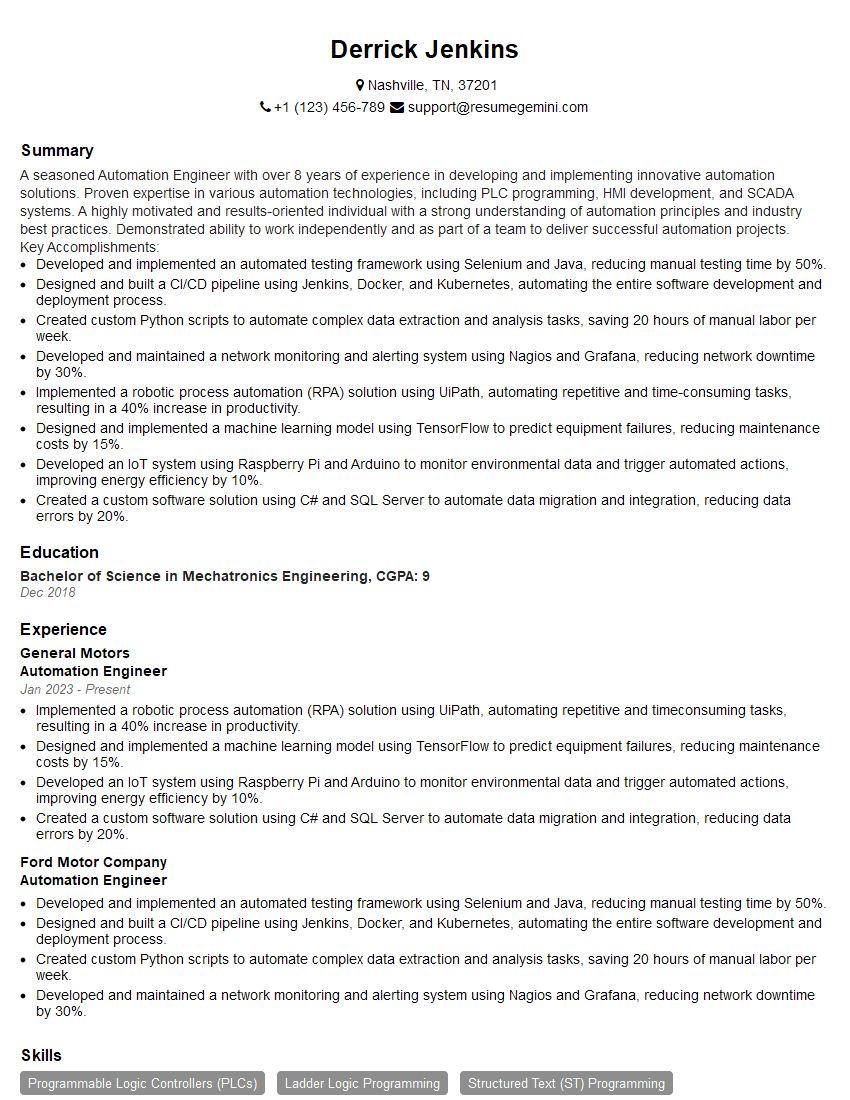
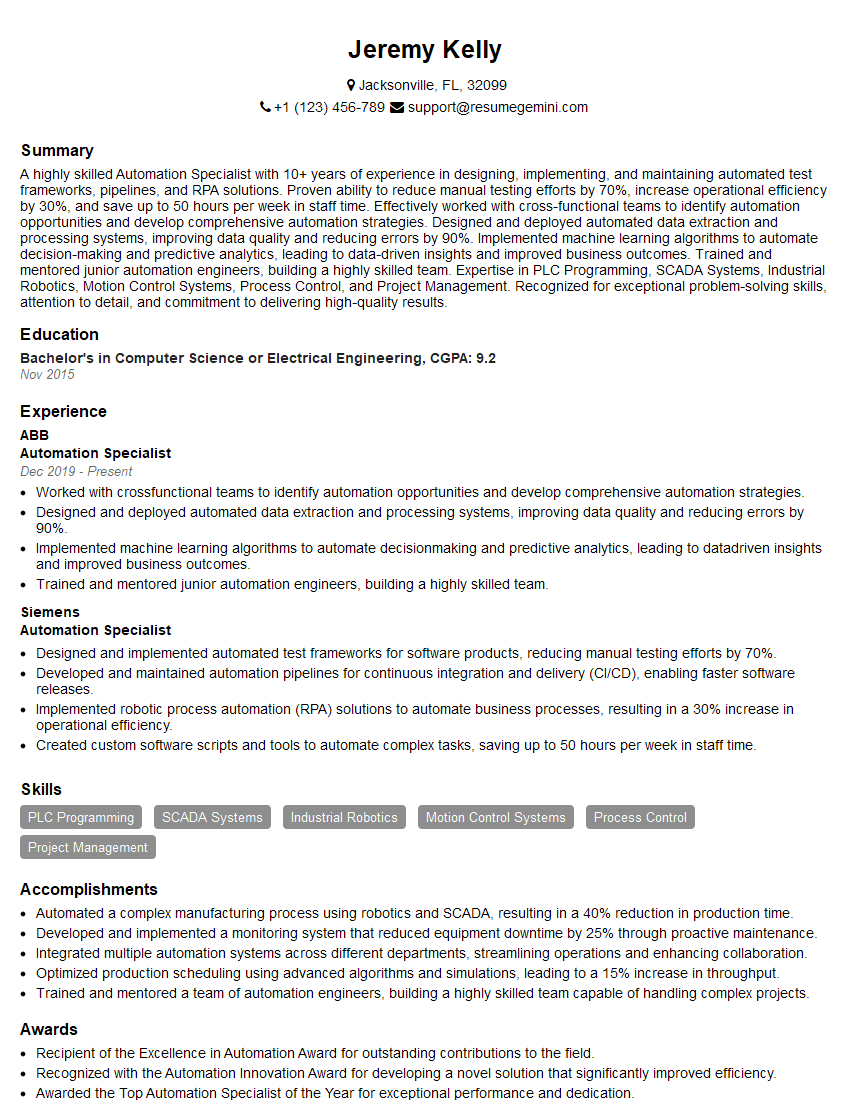
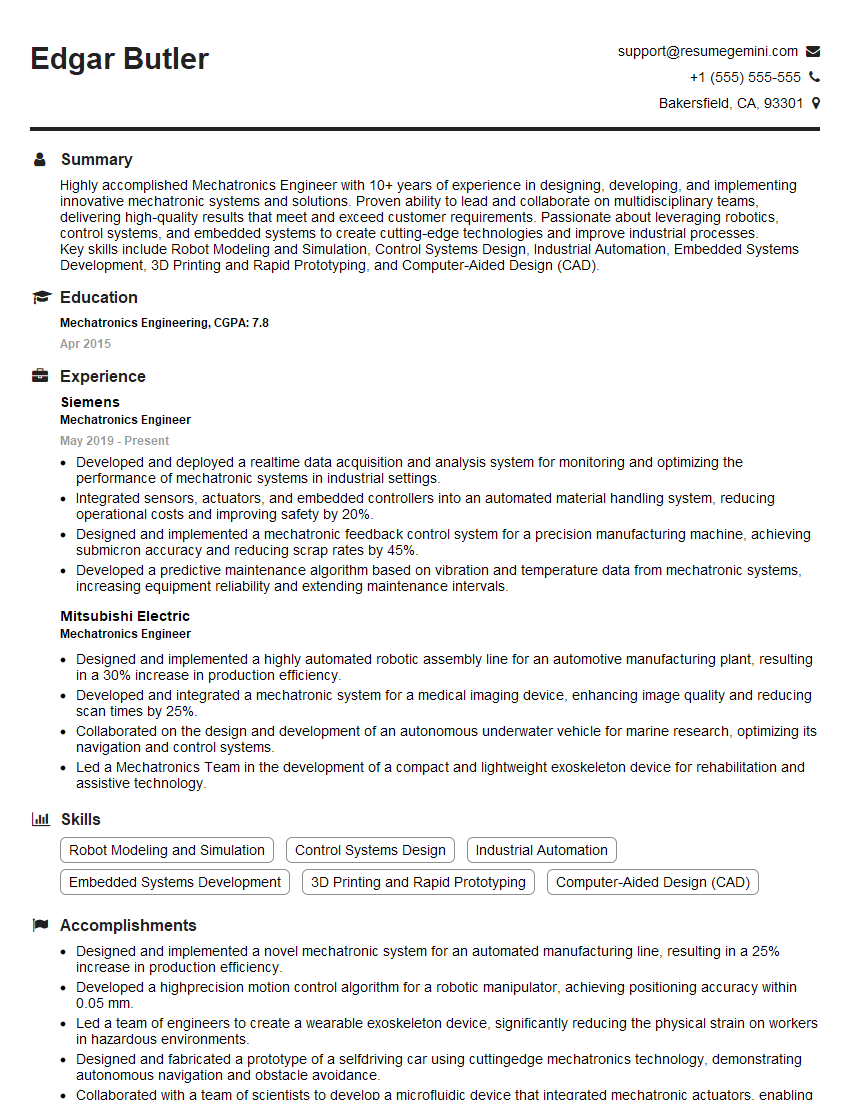
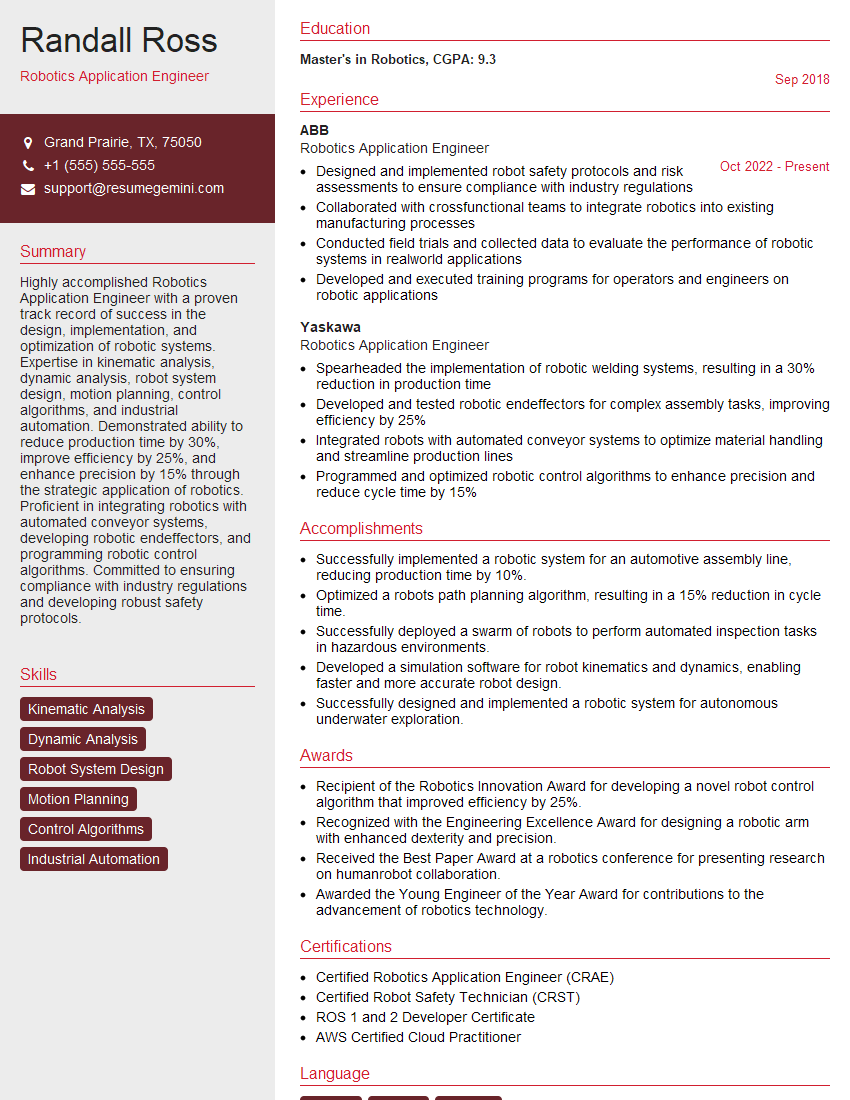
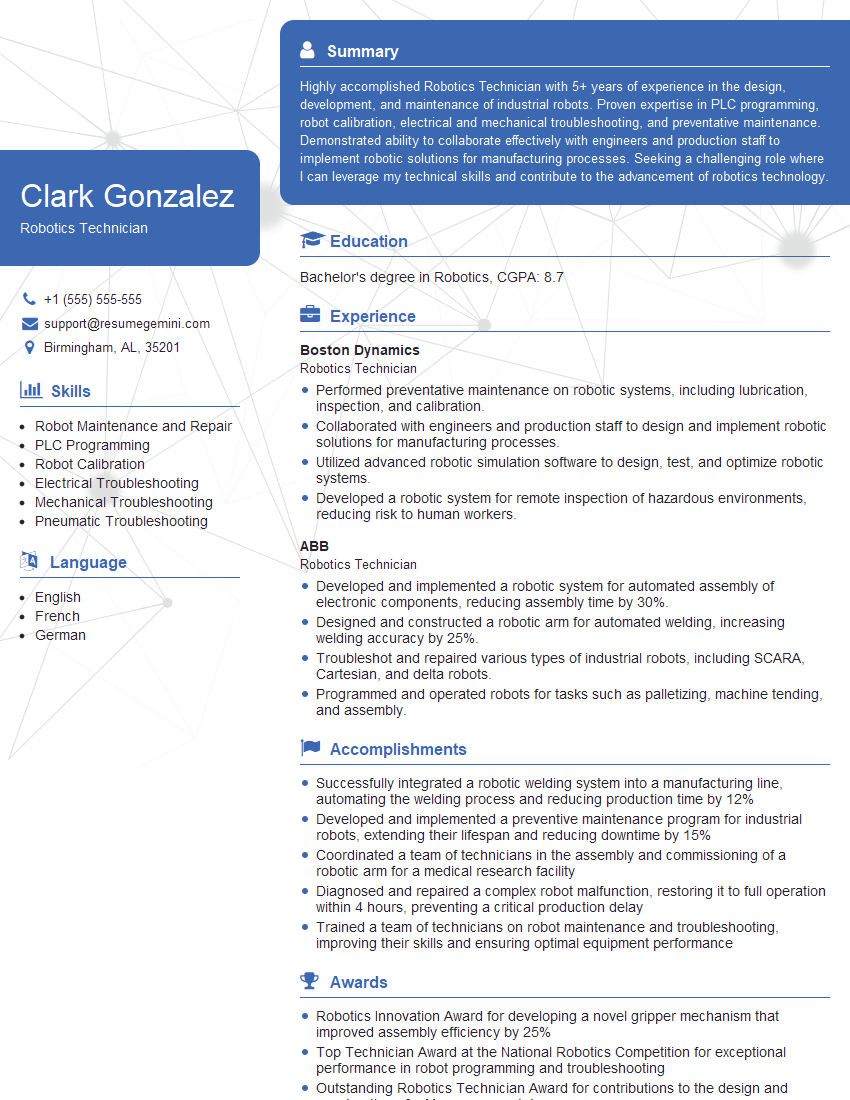
Mastering robotic manipulation opens doors to exciting careers in cutting-edge fields like automation, manufacturing, healthcare, and research. To maximize your job prospects, creating a strong, ATS-friendly resume is crucial. ResumeGemini is a trusted resource to help you build a professional and impactful resume that highlights your skills and experience effectively. Examples of resumes tailored to robotic manipulation are available to help you craft the perfect application.


Explore more articles
Users Rating of Our Blogs
Share Your Experience
We value your feedback! Please rate our content and share your thoughts (optional).
What Readers Say About Our Blog
Very informative content, great job.
good