The right preparation can turn an interview into an opportunity to showcase your expertise. This guide to Roll Setting and Calibration interview questions is your ultimate resource, providing key insights and tips to help you ace your responses and stand out as a top candidate.
Questions Asked in Roll Setting and Calibration Interview
Q 1. Explain the process of roll setting in detail.
Roll setting is the precise adjustment of rolls in machinery, like in paper mills, printing presses, or metal rolling mills, to achieve the desired product quality and dimensions. It’s a crucial step involving meticulous control of roll position, gap, and alignment. The process generally begins with a thorough inspection of the rolls for wear, damage, or debris. Then, the rolls are positioned according to pre-determined specifications, often guided by detailed engineering drawings or established procedures. This involves using various adjustment mechanisms, like shims, wedges, or hydraulic systems, to fine-tune the roll’s position both horizontally and vertically. Once the rough placement is done, precise adjustments are made to control the roll gap (the distance between the rolls) and ensure proper alignment. This is usually done iteratively, making small adjustments and checking the results until the desired parameters are achieved. For example, in a paper mill, the roll gap will determine the thickness of the final paper sheet. Incorrect settings will lead to inconsistent thickness, surface irregularities, and potentially product defects.
The entire process requires careful attention to detail and precision instrumentation. Operators must be highly skilled and experienced to perform the task correctly.
Q 2. Describe different methods for roll alignment.
Roll alignment is crucial for consistent product quality and to prevent damage to the rolls and machinery. Several methods are employed for achieving precise roll alignment, including:
- Laser Alignment: This is a highly accurate method using laser beams to measure the relative positions of the roll axes. Laser alignment systems provide real-time feedback, guiding the operator to make adjustments until perfect alignment is achieved. They are particularly useful for large rolls and critical applications where high precision is paramount.
- Dial Indicators: These are simpler and less expensive than laser systems, but still provide reliable measurements. Dial indicators are manually placed on the rolls at various points to check the gap and parallelism. The operator then uses the readings to guide adjustments.
- Optical Alignment: Using specialized optical tools, this method checks for parallelism and gap consistency by observing reflected light or using image processing techniques. It offers good precision and can be useful for various roll sizes and configurations.
- Mechanical Alignment: This involves using precision measuring tools and mechanical gauges to check the parallelism and position of the rolls. While less sophisticated than other methods, it’s still valuable for basic alignment checks.
The choice of method depends on the application’s precision requirements, budget, and available resources. In high-precision settings like semiconductor manufacturing, laser alignment is preferred. In less demanding applications, dial indicators might suffice.
Q 3. How do you ensure precise roll gap control?
Precise roll gap control is essential for consistent product quality. Several techniques and technologies contribute to this control:
- Hydraulic or Pneumatic Systems: Many modern machines use hydraulic or pneumatic systems to precisely adjust the roll gap. These systems offer fine control, allowing for extremely small adjustments. They are often automated, providing feedback loops for maintaining a consistent gap.
- Screw Adjustments: Simpler machines might rely on screw adjustments, where turning a screw moves the roll closer or further from its counterpart. While less precise than hydraulic systems, screw adjustments are still effective for many applications.
- Roll Gap Sensors: Electronic sensors are used to continuously monitor the roll gap, providing feedback to the control system. This ensures that the gap remains constant even under changing operating conditions.
- Automated Control Systems: Advanced systems integrate sensors and actuators with control algorithms to automatically maintain the desired roll gap. These systems can compensate for variations in material properties or other factors affecting the gap.
Regular calibration of these systems is essential for maintaining their accuracy and ensuring consistent roll gap control. For example, a paper mill might use a micro-gauge to regularly verify the accuracy of the gap sensor and adjustment mechanisms.
Q 4. What are the common causes of roll misalignment?
Roll misalignment can stem from various factors:
- Wear and Tear: Over time, rolls can wear unevenly, leading to misalignment. This is especially true for rolls subjected to significant stress or abrasion.
- Improper Installation: Incorrect installation of the rolls or supporting structures can result in misalignment from the outset.
- Mechanical Damage: Impacts or other forms of mechanical damage can deform the rolls or their mounting components, leading to misalignment.
- Thermal Expansion: Differential thermal expansion of the rolls or their supporting structures can cause misalignment, particularly in high-temperature applications.
- Foundation Issues: If the machine’s foundation is not properly leveled or stable, it can contribute to roll misalignment.
- Vibration: Excessive vibration during operation can induce roll misalignment over time.
Regular inspection and maintenance are vital to identify and address these issues before they cause significant problems. A thorough preventive maintenance program is crucial to minimise these risks.
Q 5. How do you troubleshoot roll setting issues?
Troubleshooting roll setting issues requires a systematic approach. Here’s a suggested procedure:
- Visual Inspection: Begin by visually inspecting the rolls and their supporting structures for any obvious signs of damage, wear, or misalignment.
- Measurement: Use appropriate tools (dial indicators, laser alignment systems, etc.) to precisely measure the roll gap and alignment.
- Data Analysis: Analyze the measurement data to identify the nature and extent of the misalignment.
- Identify the Root Cause: Based on the data analysis, pinpoint the root cause of the misalignment (e.g., worn rolls, loose mounting bolts, foundation issues).
- Corrective Action: Implement the necessary corrective actions to address the identified root cause. This might involve replacing worn components, tightening bolts, adjusting the foundation, or recalibrating control systems.
- Verification: After implementing corrective actions, re-measure the roll gap and alignment to verify that the problem has been resolved.
Careful record-keeping during troubleshooting is important for future reference and to track the effectiveness of corrective measures. A well-documented history of maintenance and repair can be invaluable for preventative actions.
Q 6. Explain the importance of calibration in roll setting.
Calibration is the process of ensuring that the measuring instruments and control systems used in roll setting are accurate and reliable. Accurate calibration is crucial for several reasons:
- Consistent Product Quality: Accurate calibration ensures that the roll gap and alignment are precisely controlled, leading to consistent product dimensions and quality. Inconsistent calibration leads to inconsistent product output.
- Reduced Waste: Precise roll setting minimizes material waste and reduces the production of defective products. This is especially important in industries where materials are expensive or difficult to source.
- Improved Efficiency: Well-calibrated systems operate efficiently, minimizing downtime and maximizing production output.
- Safety: Accurate roll settings contribute to safe operation by reducing the risk of roll jams or other mechanical failures.
For instance, imagine a printing press: improperly calibrated roll gap controls could result in smeared ink, wasted paper, and customer dissatisfaction. Regular calibration ensures the press consistently produces high-quality prints.
Q 7. What calibration tools and equipment are you familiar with?
My experience encompasses a wide range of calibration tools and equipment, including:
- Laser Alignment Systems: Various models from leading manufacturers, providing high-precision measurements of roll parallelism and alignment.
- Dial Indicators: Mechanical dial indicators of different ranges and accuracies for measuring roll gap and position.
- Micrometers and Calipers: Precision measuring tools for verifying roll dimensions and clearances.
- Optical Alignment Tools: Specialized optical instruments for verifying roll straightness and parallelism.
- Roll Gap Sensors: Electronic sensors for real-time monitoring of the roll gap, including those with digital output for integration with control systems.
- Calibration Standards: Traceable calibration standards for verifying the accuracy of measuring instruments.
- Data Acquisition Systems: Systems for collecting and analyzing data from multiple sensors, providing comprehensive information on roll alignment and gap control.
Proficiency with these tools and the knowledge of their application ensures accurate and reliable calibration, which is paramount to the success of any roll-setting operation.
Q 8. How do you perform a calibration check?
A calibration check verifies the accuracy and precision of the roll setting against a known standard. It’s like checking your kitchen scale against known weights to ensure it’s measuring accurately. We use precision measuring instruments, like micrometers or dial indicators, to compare the actual roll gap (the distance between rolls) to the setpoint. This process typically involves:
- Establishing a Baseline: First, we select a reference point or known dimension. This could be a precisely machined gauge block or a calibrated master roll.
- Measurement: Next, we use a micrometer or dial indicator to measure the gap between the rolls at multiple points across the roll face. This accounts for variations across the entire roll.
- Comparison: We compare our measurements to the target gap setting. Any deviation beyond a predetermined tolerance requires adjustment.
- Documentation: All measurements and adjustments are meticulously documented, including date, time, and the person performing the calibration.
For instance, if we’re setting rolls for a paper machine to produce a specific thickness, a calibration check ensures that the rolls are actually creating paper at that thickness and not thicker or thinner, leading to waste or off-spec product.
Q 9. What are the safety precautions involved in roll setting and calibration?
Safety is paramount in roll setting and calibration. These are heavy pieces of equipment, and even small errors can have significant consequences. Key precautions include:
- Lockout/Tagout (LOTO): Always ensure that the machinery is properly locked out and tagged out before commencing any work. This prevents accidental startup.
- Personal Protective Equipment (PPE): Wearing appropriate PPE is mandatory, including safety glasses, gloves, and steel-toed boots. Depending on the specific application, hearing protection might also be necessary.
- Safe Lifting Techniques: Heavy rolls require proper lifting techniques to avoid injuries. Cranes and other lifting equipment must be used appropriately and inspected before use.
- Awareness of Moving Parts: Be acutely aware of moving parts during the calibration process, including rotating shafts and hydraulic systems. Never place hands or body parts near moving elements.
- Emergency Procedures: Thorough understanding of emergency procedures, including how to stop the machinery in case of an accident, is essential.
Ignoring these safety precautions can lead to serious accidents ranging from minor injuries to fatalities. We prioritize a culture of safety and rigorous adherence to these protocols.
Q 10. Describe your experience with different types of rolls (e.g., rubber, steel).
My experience encompasses a wide range of roll types, each with its own unique properties and challenges.
- Steel Rolls: These rolls are robust and offer excellent wear resistance. They’re common in heavy-duty applications such as metal rolling mills, but require precise alignment to prevent product defects. Setting these involves carefully measuring and adjusting the roll gap with specialized tools, often using shims for fine-tuning.
- Rubber Rolls: Rubber rolls, often used in paper, textile, and plastic processing, offer a softer, more yielding surface. Their calibration is often simpler than steel, but they are susceptible to wear and tear, requiring more frequent checks and adjustments. The challenge lies in maintaining consistent pressure and surface condition across the entire roll to avoid inconsistencies in the final product. I’ve worked with various rubber compounds, each with varying degrees of hardness and resilience.
- Chilled Iron Rolls: These offer a balance between hardness and abrasion resistance. Their calibration involves similar techniques to steel rolls, but the focus is often on maintaining precise surface finish and hardness to ensure consistent product quality.
My experience allows me to adapt my techniques and procedures to match the specific characteristics of each roll type.
Q 11. How do you handle roll wear and tear?
Roll wear and tear is inevitable, and effective management is crucial to maintain consistent product quality and prevent costly downtime. We tackle this through a multi-pronged approach:
- Regular Inspections: Visual inspections for wear, scratches, or damage are performed regularly. Microscopic examination might also be used to assess surface irregularities.
- Predictive Maintenance: Monitoring key parameters like roll temperature, vibration, and power consumption can provide early warnings of impending wear.
- Grinding and Reprofiling: When wear becomes significant, rolls are often sent for grinding and reprofiling to restore their original dimensions and surface finish. This process requires very precise measurements and techniques to ensure the rolls remain within tolerance.
- Roll Replacement: In cases of severe damage or excessive wear, roll replacement becomes necessary. This requires careful planning and coordination to minimize downtime.
We maintain detailed records of roll wear, which informs our maintenance schedule and helps us predict future needs. For example, if we observe accelerated wear on a certain type of roll, we might investigate the root cause (e.g., incorrect processing parameters) to prevent future problems.
Q 12. Explain your experience with automated roll setting systems.
I have extensive experience with automated roll setting systems, which significantly improve efficiency and precision compared to manual methods. These systems typically employ sensors and actuators to precisely control the roll gap, often with closed-loop feedback systems for enhanced accuracy.
These systems often integrate with the overall process control system, allowing for real-time monitoring and adjustment. This is particularly beneficial in high-speed production environments where manual adjustments are impractical and prone to errors. I’m proficient in troubleshooting and maintaining these automated systems, including calibration of the sensors and actuators. In one past role, we implemented a new automated roll setting system that reduced our setup times by 50% and improved product consistency significantly. The system’s software allows for easy data logging and analysis, providing valuable insights into roll wear and overall equipment effectiveness.
Q 13. What are the key performance indicators (KPIs) you monitor during roll setting?
Key Performance Indicators (KPIs) monitored during roll setting and calibration are crucial for ensuring consistent product quality and optimizing the process. The specific KPIs vary depending on the application, but some common ones include:
- Roll Gap Consistency: This measures the uniformity of the gap between the rolls across their entire surface. Inconsistencies can lead to variations in product thickness or quality.
- Product Thickness/Diameter: This is a direct measure of the final product’s dimensions and is crucial for meeting specifications.
- Surface Finish: This assesses the smoothness and quality of the product’s surface, which can be affected by roll imperfections or misalignment.
- Roll Wear Rate: Monitoring the rate of roll wear helps in predicting maintenance needs and optimizing roll life.
- Production Downtime: Minimizing downtime due to roll setting adjustments or maintenance is crucial for overall productivity.
- Defect Rate: The number of defective products produced, directly influenced by the accuracy of roll settings.
We use statistical process control (SPC) techniques to monitor these KPIs and identify any trends or deviations that require attention. This proactive approach helps to prevent problems and maintain consistent, high-quality output.
Q 14. How do you document your roll setting and calibration procedures?
Documentation is a critical part of roll setting and calibration. We maintain comprehensive records, ensuring traceability and facilitating troubleshooting and continuous improvement.
Our documentation includes:
- Calibration Logs: Detailed records of each calibration event, including date, time, person performing the calibration, measured values, adjustments made, and any deviations from the target.
- Roll Setting Procedures: Step-by-step instructions for setting and calibrating various roll types.
- Maintenance Records: Detailed logs of roll maintenance activities, such as grinding, reprofiling, or replacement.
- Inspection Reports: Reports detailing the results of visual inspections for wear and tear.
- Digital Images/Videos: Images or videos can be helpful in documenting roll condition and calibration procedures.
All this documentation is stored securely and is readily accessible to authorized personnel. This ensures that the procedures are consistently followed, improving product consistency and simplifying troubleshooting when issues arise.
Q 15. What are the different types of calibration standards used?
Calibration standards are crucial for ensuring the accuracy of our roll setting measurements. They serve as benchmarks against which our measuring instruments are compared. Different types exist depending on the precision needed and the nature of the rolls being calibrated.
- Traceable Standards: These are the highest level of accuracy, directly linked to national or international standards organizations like NIST (National Institute of Standards and Technology). They’re often used to calibrate master gauges. Think of them as the ‘gold standard’ in our field.
- Working Standards: These are calibrated against traceable standards and used daily to check the accuracy of our everyday measuring instruments. They’re like the ‘reliable assistant’ that ensures consistent accuracy on the shop floor.
- Reference Standards: These are high-precision standards used for specific applications or to calibrate working standards. They fall between the traceability of national standards and the daily use of working standards.
The choice of standard depends on the required level of accuracy. For critical applications, traceable standards are mandatory. For routine checks, working standards are sufficient.
Career Expert Tips:
- Ace those interviews! Prepare effectively by reviewing the Top 50 Most Common Interview Questions on ResumeGemini.
- Navigate your job search with confidence! Explore a wide range of Career Tips on ResumeGemini. Learn about common challenges and recommendations to overcome them.
- Craft the perfect resume! Master the Art of Resume Writing with ResumeGemini’s guide. Showcase your unique qualifications and achievements effectively.
- Don’t miss out on holiday savings! Build your dream resume with ResumeGemini’s ATS optimized templates.
Q 16. Explain your understanding of tolerance limits and specifications in roll setting.
Tolerance limits and specifications define the acceptable range of variation in roll settings. They are essential for ensuring product quality and consistency. Think of them as the ‘goalposts’ we aim for.
Tolerance limits specify the maximum permissible deviation from a nominal value. For example, a roll might need to have a diameter of 100mm ± 0.1mm. This means the acceptable range is between 99.9mm and 100.1mm. Exceeding these limits indicates a problem requiring adjustment.
Specifications define the overall requirements for the roll setting, including tolerance limits, but also other factors like surface finish, material properties, and concentricity. These are comprehensive requirements that must be met for the roll to be deemed acceptable.
Understanding both is crucial for effective roll setting. Tolerances guarantee dimensional accuracy, while specifications ensure overall quality.
Q 17. How do you maintain accurate records of calibration results?
Maintaining accurate records is paramount for traceability and compliance. We use a combination of digital and paper-based systems.
Our digital system is a database containing detailed calibration reports, including:
- Instrument ID: Unique identifier for each measuring instrument.
- Calibration date: Date of the calibration.
- Calibration standard used: Identification of the standard used for the calibration.
- Measurement results: Detailed data of all measurements taken.
- Tolerance limits: Specified tolerance limits for each measurement.
- Calibration technician: Identification of the technician who performed the calibration.
- Certificate of calibration: A generated report confirming the calibration results.
Paper-based records (hard copies) are kept for archival purposes and in case of digital system failure. This dual approach ensures record integrity and availability.
Q 18. How do you manage discrepancies between measured and expected values?
Discrepancies between measured and expected values require immediate investigation. The first step is to verify the accuracy of the measuring instrument itself by recalibrating it against a known standard. If the instrument is faulty, it needs repair or replacement.
If the instrument is accurate, then we examine the roll setting process:
- Re-measure: We re-measure the roll several times to rule out human error in measurement.
- Check the process: We review the roll setting process to identify potential sources of error, such as machine malfunction, incorrect setup parameters, or environmental factors.
- Document findings: Thorough documentation of the investigation, including corrective actions taken and subsequent verification measurements, is essential.
- Root cause analysis: We conduct a root cause analysis to understand the reason behind the discrepancies and prevent their recurrence.
In some cases, a minor adjustment to the roll may be necessary to bring it within tolerance limits. However, significant discrepancies might require rework or rejection of the roll.
Q 19. Describe your experience with different types of measuring instruments (e.g., micrometers, dial indicators).
I have extensive experience with various measuring instruments. My expertise includes:
- Micrometers: I’m proficient in using both outside and inside micrometers for precise linear measurements of roll diameters and other dimensions. I know how to identify and compensate for zero error and understand the importance of proper handling to avoid damage and maintain accuracy.
- Dial Indicators: These are used for checking surface irregularities, run-out, and concentricity. I can expertly set up and use dial indicators to measure small deviations with high precision. I am well-versed in understanding their limitations and how to optimize their use for different applications.
- Optical Comparators: I’m familiar with optical comparators for detailed inspection of roll profiles and detecting minute imperfections. I understand how to interpret the projected images and assess conformity to specifications.
Regular calibration and proper handling are crucial for maintaining the accuracy of all these instruments.
Q 20. How do you ensure the accuracy and reliability of your calibration processes?
Accuracy and reliability are maintained through a robust system of quality control:
- Regular Calibration: All measuring instruments are calibrated at scheduled intervals according to their specifications and usage frequency.
- Traceability: A clear chain of traceability from our working standards back to national standards is maintained. This ensures the accuracy and reliability of our measurements.
- Environmental Control: We maintain a controlled environment for calibration to minimize the influence of temperature, humidity, and other factors.
- Operator Training: Operators receive comprehensive training on the proper use and maintenance of measuring instruments, following documented procedures.
- Preventive Maintenance: Regular preventative maintenance of measuring instruments is conducted to extend their lifespan and maintain accuracy.
- Statistical Process Control: We use statistical methods to monitor the consistency of our calibration processes and identify potential problems early.
This multi-faceted approach ensures high confidence in the accuracy and reliability of our calibration processes.
Q 21. How do you interpret calibration certificates and reports?
Calibration certificates and reports are crucial documents that provide evidence of the accuracy of our measuring instruments. I’m proficient at interpreting them, focusing on key aspects:
- Instrument Identification: Verifying the instrument’s identification number matches the instrument being used.
- Calibration Date: Confirming the calibration date is within the acceptable timeframe.
- Calibration Standard: Checking the traceability of the calibration standard used.
- Measurement Results: Examining the measured values and comparing them to the tolerance limits.
- Uncertainty of Measurement: Understanding the associated uncertainty in the measurements.
- Accreditation: Verifying the accreditation of the calibration laboratory.
I understand that inconsistencies or out-of-tolerance values necessitate immediate action, triggering an investigation of the instrument or the calibration process itself.
Q 22. How do you troubleshoot inaccurate calibration results?
Troubleshooting inaccurate calibration results begins with a systematic approach. Think of it like diagnosing a car problem – you wouldn’t start replacing parts randomly. First, we verify the calibration equipment itself. Is it properly calibrated and functioning within its specified tolerances? We use known standards to check its accuracy. Next, we examine the process. Were the initial measurements taken correctly? Were environmental factors like temperature and humidity within acceptable ranges? These factors can significantly affect the precision of roll settings. Environmental control is paramount. For example, variations of just a few degrees Celsius can impact the accuracy of measurements in some applications. Then we analyze the roll itself. Is there any wear and tear? Are there imperfections on the roll surface that might affect its calibration? Finally, we look at the software or control system. Are there any errors or glitches in the code? Is the data being logged and interpreted correctly? We meticulously check every step of the process. Often, the issue isn’t a major malfunction but a small error in one of these steps. A detailed log of each calibration step is essential for effective troubleshooting.
Q 23. Describe your experience with preventative maintenance of roll setting equipment.
Preventative maintenance is key to ensuring the longevity and accuracy of roll setting equipment. It’s like regular check-ups for your car – better to prevent problems than to fix them later. My approach involves a structured schedule of inspections and cleaning. This includes regularly inspecting the bearings for wear and tear, lubricating moving parts according to the manufacturer’s recommendations, and cleaning the equipment to remove any dust, debris, or adhesive residue that might build up. I also carefully check the sensors and calibration tools for any signs of damage or drift. Additionally, I maintain detailed logs of all maintenance activities, including dates, procedures performed, and any observations or findings. These logs are critical for tracking equipment performance and identifying potential problems early on. For example, I might notice a gradual increase in measurement error over time, indicating a need for more frequent calibration or replacement of a specific component. A proactive approach to preventative maintenance ensures accurate and reliable roll settings, reducing downtime and enhancing overall productivity.
Q 24. What are the effects of improper roll setting on the final product?
Improper roll setting has cascading effects on the final product. Imagine trying to bake a cake with an inaccurate oven temperature – the result wouldn’t be right. Similarly, in manufacturing processes, improper roll setting can lead to several defects. Inconsistent thickness is a common problem; if the rolls aren’t set correctly, the material passing through them might be too thick in some areas and too thin in others. This can affect the product’s quality and even its functionality. Furthermore, improper settings might cause wrinkles or creases in the final product. It might also result in a lower quality of surface finish, a problem that’s critical for industries requiring visual appeal. In extreme cases, inaccurate roll settings could lead to catastrophic failure, like a complete tear or breakage of the material. In short, paying close attention to roll setting is critical for achieving the desired product quality and consistency.
Q 25. How do you communicate technical information effectively to non-technical personnel?
Communicating technical information to non-technical personnel requires a different approach than talking to engineers. My strategy involves simplifying complex concepts using analogies and avoiding jargon. For instance, instead of discussing ‘roll eccentricity,’ I might explain it as the ‘wobble in the roll,’ illustrating it with a simple diagram. I also use visual aids like charts and graphs to convey information more effectively. It’s about explaining the ‘why’ behind the technical details – what impact does this setting have on the final product? How will a change affect the production process? Finally, I always encourage questions and ensure the audience understands the information before moving on. Clear and concise communication helps prevent misunderstandings and ensures everyone is on the same page. It’s important to build rapport, make the discussion interactive, and tailor my approach to the specific audience.
Q 26. How do you prioritize tasks during a busy production run?
During busy production runs, prioritization is critical. I use a combination of methods to manage tasks effectively. First, I assess the urgency and impact of each task. Which tasks are time-sensitive and will significantly affect production if delayed? These are my top priorities. Next, I consider the dependencies between tasks. Are some tasks prerequisites for others? I prioritize those upstream tasks to avoid bottlenecks. Finally, I break down large tasks into smaller, more manageable steps. This makes the overall process less daunting and allows for better tracking of progress. I also use visual tools, like Kanban boards, to keep track of tasks and their status. Effective task management is essential to minimize downtime and maximize output during a busy period. It requires flexibility and the ability to adapt to unexpected events.
Q 27. Describe a time you had to solve a complex roll setting problem.
I once faced a complex issue where the final product exhibited significant inconsistencies in thickness, despite repeated calibrations. After thoroughly checking the equipment and process, we discovered a subtle vibration in the roll stand itself. This vibration, barely perceptible to the naked eye, was causing inconsistencies in the material’s compression during processing. We investigated and found a problem with the foundation of the roll stand. The solution involved extensive modifications to dampen the vibrations, including installing vibration-damping pads and reinforcing the stand’s foundation. This required collaboration with engineers, maintenance personnel, and production managers. The successful resolution improved product quality dramatically, proving the importance of considering every aspect of the system, even seemingly insignificant details. This situation underscores that often the root cause is not always apparent at first glance.
Q 28. How do you stay updated on the latest advancements in roll setting and calibration technology?
Staying updated in this field is crucial. I regularly attend industry conferences and workshops, which provide opportunities to learn about the latest technologies and best practices. I subscribe to relevant industry journals and publications to keep abreast of new developments in roll setting and calibration technology. I also actively participate in online forums and professional communities, engaging with other experts and sharing knowledge. Moreover, I actively seek out training opportunities offered by equipment manufacturers. They provide insights into the latest advancements and practical tips for optimizing equipment usage. Continuous learning is essential to ensure I remain at the forefront of this ever-evolving field. This proactive approach helps me maintain my expertise and provide the best solutions for my clients.
Key Topics to Learn for Roll Setting and Calibration Interview
- Understanding Roll Geometry: Mastering concepts like crown, deflection, and roll gap control is fundamental. Consider how these affect product quality and process efficiency.
- Calibration Techniques: Explore various calibration methods, including manual adjustments and automated systems. Understand the precision required for different applications and materials.
- Process Optimization: Learn how roll setting impacts overall process parameters like speed, tension, and product dimensions. Think about how adjustments affect the final product.
- Troubleshooting and Diagnostics: Develop your ability to identify and solve common issues related to inaccurate roll settings, such as surface defects or dimensional inconsistencies. Consider root cause analysis techniques.
- Safety Procedures: Familiarize yourself with all relevant safety protocols and best practices for working with heavy machinery and potentially hazardous materials.
- Material Science Fundamentals: Understand how different materials behave under pressure and how this impacts roll setting and calibration choices. Consider the implications of material properties on the process.
- Data Analysis and Interpretation: Practice interpreting data from various sources (e.g., gauges, sensors) to identify trends and make informed adjustments to roll settings.
- Preventive Maintenance: Discuss your knowledge of preventative maintenance procedures for roll setting equipment to ensure optimal performance and minimize downtime.
Next Steps
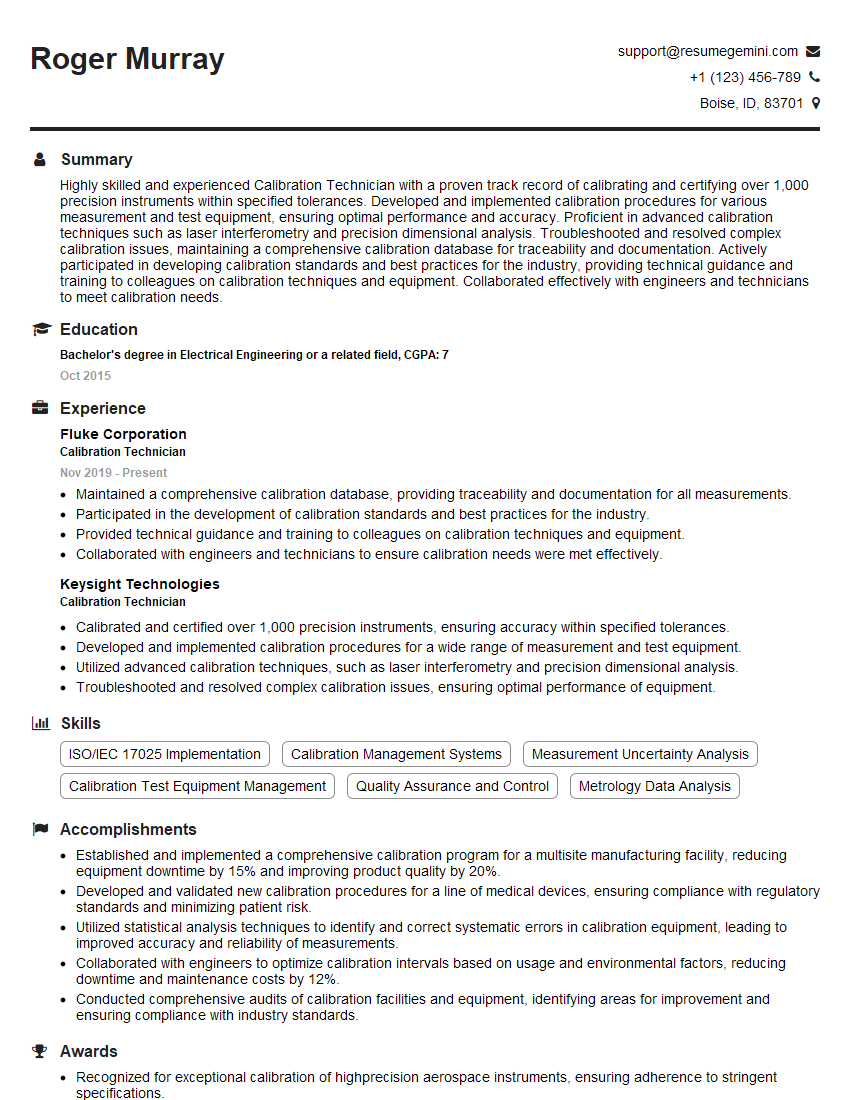
Mastering Roll Setting and Calibration opens doors to exciting opportunities for career advancement within manufacturing and related industries. It demonstrates a valuable skill set highly sought after by employers. To increase your chances of landing your dream role, create a compelling and ATS-friendly resume that highlights your expertise. ResumeGemini is a trusted resource that can help you build a professional resume that showcases your skills effectively. We provide examples of resumes tailored to Roll Setting and Calibration to guide you through the process. Invest in your future – craft a resume that gets noticed!
Explore more articles
Users Rating of Our Blogs
Share Your Experience
We value your feedback! Please rate our content and share your thoughts (optional).
What Readers Say About Our Blog
Very informative content, great job.
good