Every successful interview starts with knowing what to expect. In this blog, we’ll take you through the top Roping and Wrestling interview questions, breaking them down with expert tips to help you deliver impactful answers. Step into your next interview fully prepared and ready to succeed.
Questions Asked in Roping and Wrestling Interview
Q 1. Describe the different types of roping techniques.
Roping techniques are diverse, categorized primarily by the type of livestock being roped and the style of competition. The fundamental techniques, however, share common elements. We have:
- Heeling: This involves roping the hind legs of a steer. Precision and timing are crucial, as a well-placed heel rope prevents the steer from kicking and ensures a secure hold. The rider must coordinate their horse’s movement with the steer’s to maintain control.
- Heading: This focuses on roping the horns or the neck of a steer, aiming to stop its forward momentum. This requires a quick, accurate throw and often a strong pull to bring the steer down. It’s the starting point in team roping.
- Dallying: This is a key technique used in both heeling and heading. It involves wrapping the rope around the saddle horn to create leverage and control over the steer. This adds another level of skill requiring precise handwork and coordination with the horse.
- Roping from the ground (or ‘ground roping’): This technique is more about precision and control, requiring a good understanding of rope physics and how to throw to maximize accuracy. It’s a common starting point for many ropers before moving to horseback.
Variations exist within these main categories, depending on the specific event and individual roper’s style.
Q 2. Explain the importance of proper horsemanship in roping.
Proper horsemanship is paramount in roping. Your horse is an integral part of the team, and its responsiveness and training directly impact your success. A well-trained roping horse understands commands, anticipates the steer’s movements, and responds smoothly to the rider’s cues.
Think of it like this: the horse is the roper’s extension. If the horse is hesitant or unresponsive, the roper loses valuable time and compromises their chances. Key aspects include:
- Responsiveness to cues: The horse needs to be instantly responsive to subtle commands. This takes consistent training and a strong bond between horse and rider.
- Agility and speed: The horse should be agile enough to maneuver quickly and accurately around a moving steer.
- Understanding of timing: The horse should understand the timing of the rope throw and move accordingly to assist with the catch.
- Calm temperament: A calm horse is essential for safe and effective roping.
Without proper horsemanship, even the most skilled roper will struggle.
Q 3. What are the key components of a successful roping run?
A successful roping run is a seamless blend of skill, timing, and horsemanship. The key components are:
- Accurate rope throw: The rope must land precisely on the target. This requires practice and a deep understanding of rope physics.
- Quick and efficient delivery: The loop must be delivered quickly to avoid the steer from getting too far.
- Proper dallying technique: The rope must be wrapped securely around the saddle horn to prevent the steer from escaping.
- Horse control: The rider must maintain complete control of the horse throughout the run.
- Calm demeanor: Staying calm under pressure ensures a clean run and reduces the chances of mistakes.
Think of it like a perfectly choreographed dance. Every step, every movement must be synchronized and precise.
Q 4. How do you maintain your roping equipment?
Maintaining roping equipment is crucial for safety and performance. Neglecting this can lead to broken ropes, damaged equipment, and potential injuries. The process includes:
- Rope care: Regularly inspect the rope for wear and tear. Clean it after each use to remove dirt and debris. Store it properly to prevent damage. Consider treating it with conditioners to extend its life.
- Saddle and tack maintenance: Regularly check the saddle, cinch, and bridle for wear and tear. Keep the leather clean and conditioned. Tighten loose screws and replace worn parts as needed.
- Gear inspection: Before every roping session, always check all your gear is working correctly and in good condition.
Proper equipment maintenance is a crucial aspect of roping, ensuring both safety and optimal performance.
Q 5. Describe your experience with different types of ropes.
My experience spans various types of ropes, each with its strengths and weaknesses. I’ve worked with:
- Manila rope: A traditional choice, known for its durability but can be heavier and stiffer than other options.
- Synthetic ropes (polyester, nylon, etc.): Lighter and stronger than manila, often preferred for their superior performance and flexibility. Different synthetic materials offer varying characteristics like stretch and durability.
- Braided ropes: Offer superior strength, smoother throws and less chance of kinks.
Choosing the right rope depends on personal preference, competition rules, and the type of roping being performed.
Q 6. What are the common injuries associated with roping, and how can they be prevented?
Roping carries inherent risks. Common injuries include:
- Rope burns: These can be prevented by wearing protective clothing, such as long sleeves and gloves.
- Muscle strains and sprains: Proper warm-up and stretching routines, along with maintaining good form, minimize the risk.
- Back injuries: Maintaining good posture and using proper lifting techniques are critical. This includes good core strength.
- Head injuries (from being hit by a steer): Wearing a helmet is an absolute necessity.
- Injuries from falls: A properly fitted helmet, appropriate protective gear, and careful riding practices are essential.
Prevention is key. Proper training, safety gear, and a focus on safe practices significantly reduce the likelihood of injury.
Q 7. Explain the different wrestling holds and takedowns.
Wrestling holds and takedowns are extremely varied, categorized by the body part targeted and the execution. Here are a few examples:
- Single-leg takedown: A common technique involving shooting for one leg to unbalance and take down the opponent.
- Double-leg takedown: Similar to the single-leg, but targeting both legs for a more powerful takedown.
- Headlock takedowns: Using a headlock to control the opponent’s head and take them to the ground.
- Clinch takedowns: Using a body lock or clinch position to control the opponent’s center of gravity and take them down. Different types of clinches target different areas for better control.
- Throws (such as hip throws, judo throws): These utilize leverage and momentum to throw the opponent to the ground.
Each takedown requires specific techniques, timing, and leverage. Understanding these concepts, paired with proper training, is crucial for success in wrestling.
Q 8. Describe your experience in various wrestling styles.
My wrestling experience spans several styles, primarily focusing on Freestyle and Greco-Roman. In Freestyle, I competed at a collegiate level, emphasizing takedowns, leg attacks, and fast-paced scoring. The focus on quick points and aggressive attacks is what I loved about this style. My Greco-Roman experience was more focused on upper body control and throws, developing a strong sense of balance and leverage. This style demands incredible core strength and technique. I’ve also dabbled in folkstyle wrestling, which is more common in high school and college in the US and has a greater emphasis on pinning your opponent. Each style offers unique challenges and rewards, requiring adaptable strategic thinking and physical conditioning.
Q 9. What are the key strategies for offensive and defensive wrestling?
Offensive wrestling hinges on creating opportunities and capitalizing on them. Key strategies include analyzing your opponent’s weaknesses, using effective takedowns (like single-leg, double-leg, or high crotch in freestyle), and maintaining control once you secure a position. For example, a well-timed single-leg takedown followed by a quick transition to a dominant position can quickly earn points. Defensive wrestling is just as important. It focuses on preventing takedowns, using sprawls, whizzers, and defending your legs and hips effectively. Maintaining proper posture and balance is crucial; a strong base is the foundation of a solid defense. A good example of a defensive maneuver is using a deep half-nelson to control your opponent and prevent him from scoring.
Q 10. How do you maintain physical fitness for wrestling?
Maintaining peak physical condition for wrestling requires a multifaceted approach. My training regime centers around strength and conditioning, incorporating weight training to build muscle mass and power, especially focusing on core strength, legs, and upper body. Plyometrics are crucial for explosiveness. High-intensity interval training (HIIT) enhances cardiovascular endurance, crucial for the high-energy demands of wrestling matches. Flexibility and mobility exercises, like yoga or dynamic stretching, are essential for injury prevention and performance optimization. Adequate rest and recovery are also vital, to avoid overtraining and allow the body to repair and rebuild muscle tissue. Hydration and a balanced diet are also key components, providing the energy needed for intense training.
Q 11. Describe your experience in coaching or mentoring wrestlers.
My coaching experience includes working with youth and high school wrestlers. I’ve mentored athletes across various skill levels, from beginners to seasoned competitors. My coaching philosophy emphasizes not only technical skills but also mental fortitude and sportsmanship. I focus on building a strong team atmosphere and creating an environment where wrestlers feel supported and encouraged. I teach not just the physical aspects but also strategic thinking, teaching them to analyze opponents and adapt their game plans accordingly. I believe in individualized training plans, tailoring each program to suit an athlete’s unique strengths and weaknesses. One success story involved a young wrestler who lacked confidence. Through individualized attention and consistent encouragement, I helped him overcome his self-doubt, leading to significant improvement in his performance and an increased sense of self-belief.
Q 12. What are the common injuries associated with wrestling, and how are they treated?
Wrestling is a physically demanding sport with a range of potential injuries. Common injuries include sprains and strains (ankles, knees, shoulders, hamstrings), concussions, and skin infections (mat burn, ringworm). Proper warm-up and cool-down routines are crucial preventative measures. Treatment depends on the severity of the injury. Minor sprains often respond well to RICE (rest, ice, compression, elevation) therapy. More serious injuries like concussions necessitate medical attention, often requiring rest and observation to monitor for complications. Skin infections are treated with topical creams or ointments. Prevention through proper hygiene and sanitation is also extremely important.
Q 13. Explain the rules and regulations of a specific wrestling style.
Let’s examine the rules of Freestyle Wrestling. Matches are typically three periods of two minutes each. Points are awarded for takedowns, near falls (exposing your opponent’s back for a brief period), reversals, escapes, and penalties assessed to the opponent. The wrestler with the most points at the end of the match wins. A pin (keeping your opponent’s shoulders to the mat for a sustained period) results in an immediate win. Illegal holds and actions, such as grabbing the opponent’s headgear, can lead to penalties. Referees enforce the rules, ensuring fair play. The emphasis is on attacking, scoring points, and achieving a pin – a dramatic end to any match. A crucial element is the neutral position – after a takedown, wrestlers return to their feet to start again, making the pace quick and dynamic.
Q 14. How do you develop a training plan for a wrestler?
Developing a training plan for a wrestler is a personalized process. It begins with a thorough assessment of the athlete’s current fitness level, strengths, weaknesses, and specific goals. The plan needs to address all aspects of wrestling fitness, including strength training, conditioning, technical drills, and tactical strategies. A well-structured plan incorporates periodization, cycling the intensity and volume of training over different phases. This might include a base-building phase focused on general conditioning, a strength phase emphasizing weight training, and a peaking phase focusing on high-intensity workouts. Regular assessment and adjustments are necessary throughout the training process. Furthermore, incorporating flexibility and recovery strategies is paramount to prevent injuries and enhance long-term performance. A sample weekly plan may include 3 days of strength training, 2 days of high-intensity interval training, 1 day of technical wrestling drills, and 1 day of rest. This, however, should be adapted based on the wrestler’s level, goals, and any existing injuries.
Q 15. What are the ethical considerations in coaching wrestling?
Ethical coaching in wrestling prioritizes the athlete’s well-being above all else. It’s about fostering a positive and supportive environment that encourages fair play, respect, and personal growth, not just winning. This involves several key considerations:
- Athlete Safety: Coaches must prioritize the physical and mental health of their wrestlers. This includes proper training techniques, adequate rest and recovery, and addressing potential injuries promptly and responsibly. For example, a coach shouldn’t push an injured athlete to compete, risking further harm.
- Fair Play and Sportsmanship: Coaches should instill ethical conduct in their athletes. This includes teaching respect for opponents, officials, and the rules of the sport. Encouraging good sportsmanship, whether winning or losing, is crucial.
- Equal Opportunity: Coaches must treat all athletes fairly, regardless of skill level, background, or personal characteristics. Providing equal opportunities for training, competition, and support is essential for fostering a truly inclusive team environment.
- Transparency and Honesty: Maintaining open and honest communication with athletes, parents, and officials is critical. This includes being transparent about training methods, expectations, and any potential conflicts of interest.
- Respect for Rules and Regulations: Coaches need to be knowledgeable about and abide by all governing rules and regulations. This includes the rules of the sport itself, as well as any organizational policies or codes of conduct.
Ethical lapses can range from pressuring injured athletes to compete to employing illegal tactics during matches. A coach who consistently prioritizes the well-being and development of their wrestlers above winning is demonstrating ethical coaching.
Career Expert Tips:
- Ace those interviews! Prepare effectively by reviewing the Top 50 Most Common Interview Questions on ResumeGemini.
- Navigate your job search with confidence! Explore a wide range of Career Tips on ResumeGemini. Learn about common challenges and recommendations to overcome them.
- Craft the perfect resume! Master the Art of Resume Writing with ResumeGemini’s guide. Showcase your unique qualifications and achievements effectively.
- Don’t miss out on holiday savings! Build your dream resume with ResumeGemini’s ATS optimized templates.
Q 16. Describe your experience with judging roping competitions.
I’ve been judging roping competitions for over 15 years, ranging from local rodeos to larger state-level events. My experience encompasses judging various roping styles, including team roping, tie-down roping, and steer roping. I’ve worked with both amateur and professional ropers, witnessing a wide spectrum of skill levels and techniques. This broad exposure has sharpened my ability to identify and score subtle nuances in performance, ensuring fair and accurate judging.
One memorable experience involved a close contest in team roping. Both teams executed near-perfect runs, and the final scores were very tight. Careful observation of the timing and accuracy of the roping, the horse handling, and the overall efficiency of the team’s performance, allowed me to make a fair decision that was well-received by the contestants.
Q 17. What are the key criteria for judging a roping event?
Judging a roping event involves several crucial criteria, all contributing to a fair and accurate score. These include:
- Time: The speed at which the roper completes the roping process is a major factor. Faster times generally receive higher scores, provided the roping is executed correctly.
- Accuracy: The precision of the roping is critical. This involves the accuracy of the throw, the skill in securing the animal without injury or penalty, and the efficiency of the overall technique. A missed throw or a poorly executed catch significantly impacts the score.
- Style and Technique: While speed and accuracy are paramount, the roper’s style and technique are also considered. A smooth, efficient, and controlled approach generally scores better than a rough or clumsy one. This encompasses horsemanship, roping mechanics and overall presentation.
- Animal Welfare: The well-being of the animal is paramount. Ropers who display respect for the animal and execute the roping without causing undue stress or injury will score higher.
- Rules Adherence: The roper must follow all rules and regulations of the competition, including any specific stipulations related to equipment, procedures, and conduct. Penalties are often applied for rule infractions.
Each of these criteria is usually weighted, with time often being the most heavily weighted factor, but a perfect, quick roping is still worthless if the animal is injured or the roper breaks a crucial rule.
Q 18. How do you handle disputes or disagreements during a roping competition?
Disputes in roping competitions, though rare with experienced judges, are handled through a process designed to ensure fairness and transparency.
- Review the Footage: If a dispute arises, we often review video footage of the run to carefully examine any aspects of the performance that are under question. This is particularly helpful in identifying close calls or potential rule infractions.
- Consult with Other Judges (if applicable): In larger competitions with multiple judges, we will discuss any contested calls among the judging panel to reach a consensus. A majority vote often resolves the dispute.
- Explain the Decision Clearly: After reviewing all evidence and consulting with other judges as needed, I explain the decision to the contestants, clearly outlining the reasons for the ruling. The explanation is presented in a professional, respectful manner.
- Maintain Objectivity: Throughout the process, maintaining objectivity and professionalism is vital. This includes avoiding personal biases and basing all decisions on the established rules and judging criteria. The goal is not to win an argument, but to render a just and equitable decision.
Open communication and respect for the process are essential in resolving disputes amicably.
Q 19. Describe your experience with officiating wrestling matches.
My experience officiating wrestling matches spans various levels, from youth leagues to high school and even some collegiate competitions. I’ve worked with a range of wrestlers, from beginners to highly skilled athletes. This varied experience has provided me with a thorough understanding of the rules, techniques, and dynamics of the sport, crucial for effective officiating. I’ve officiated in both freestyle and Greco-Roman styles, adding to my expertise and versatility.
One of the most challenging matches I officiated involved a close, highly competitive bout that went down to the wire. Maintaining focus, precise observation of the action, and swift application of the rules were crucial to ensure fairness and accuracy.
Q 20. What are the key aspects of officiating a wrestling match fairly?
Fair officiating in wrestling hinges on several key aspects:
- Thorough Knowledge of the Rules: An official must have an in-depth understanding of the rules governing the specific style of wrestling being competed. This includes rules about legal holds, illegal moves, penalties, and scoring.
- Impartiality and Objectivity: The official must remain neutral and unbiased throughout the match, ensuring fairness to both wrestlers. Any personal preference or bias must be set aside in favor of applying the rules objectively.
- Attentive Observation: The official must constantly pay attention to the action, tracking every move and positioning of the wrestlers. They should be able to identify infractions and maintain an accurate score throughout the competition. This demands excellent visual acuity and concentration.
- Accurate Scoring: Timely and accurate recording of points and penalties is essential. This directly affects the final outcome of the match, demanding concentration and precision.
- Effective Communication: Clear and effective communication with the wrestlers and coaches is crucial. This includes explanations of penalties, announcements of scores, and overall management of the match dynamics. The ability to communicate clearly and concisely is very important.
- Maintaining Control: The official must be able to maintain order and control the match effectively. This includes addressing any disputes or conflicts that may arise between wrestlers or coaches, managing time, and ensuring the match proceeds smoothly.
Maintaining fairness requires not just knowledge of the rules but also a dedicated commitment to their impartial application.
Q 21. How do you handle disagreements between wrestlers or coaches?
Disagreements between wrestlers or coaches are a potential challenge in wrestling, requiring skillful conflict resolution:
- Listen to All Sides: The first step is to listen attentively to both wrestlers and their coaches, understanding each perspective on the issue. This involves creating a safe and respectful environment for communication.
- Apply the Rules Objectively: After hearing both sides, the official should re-examine the situation and apply the rules objectively. This might involve reviewing any disputed points or actions.
- Explain the Decision Clearly: The official should clearly explain the decision and the reasoning behind it to all involved parties, ensuring that they understand how the rules were applied. This enhances transparency and reduces misunderstandings.
- Enforce Consequences (if applicable): If a rules violation occurred, penalties must be enforced fairly and consistently, regardless of which wrestler or coach is involved. This is crucial to uphold the integrity of the match.
- De-escalate Tensions: When faced with emotional outbursts or conflicts, it is crucial for the official to keep calm and de-escalate the situation, focusing on restoring order and respect.
Maintaining control, remaining impartial, and applying the rules consistently are key to resolving these conflicts effectively and fairly. Escalation is rarely the solution; professional communication is much more effective.
Q 22. Explain your understanding of animal welfare in roping.
Animal welfare in roping is paramount. It’s not just about the skill of the roper, but about responsible handling of livestock. This means prioritizing the animal’s safety and minimizing stress at every stage. We must ensure quick, clean roping techniques to avoid injury, and handle the animal with respect and calmness. This includes using appropriately sized ropes, correctly placing the rope, and avoiding harsh or unnecessary movements. A well-trained roper understands that a calm, confident approach leads to a safer and more successful outcome for both the animal and the roper.
For example, a poorly executed roping technique could result in a panicked animal, potentially leading to injury for both the animal and the roper. Conversely, a skilled roper knows how to use subtle cues to guide the animal, minimizing stress and ensuring a smooth and safe capture. We also need to consider the animal’s breed, age, and temperament, adjusting techniques as needed.
Q 23. Describe your experience working with livestock in a roping context.
My experience with livestock in a roping context spans over two decades. I’ve worked extensively with cattle of various breeds, including Herefords, Angus, and Longhorns, each requiring a slightly different approach. I’ve participated in numerous rodeos, ranch work, and livestock handling events. This experience has provided me with a deep understanding of animal behavior, allowing me to anticipate their reactions and adjust my roping technique accordingly. I emphasize a gentle yet firm approach, focusing on control and minimizing the animal’s discomfort. I’ve developed a keen sense for reading an animal’s body language – a crucial skill for ensuring its safety and well-being during the roping process.
For instance, I’ve learned to recognize signs of stress in cattle, such as rapid breathing, wide eyes, or a lowered head. Recognizing these signals allows me to modify my approach to keep the animal calm. This includes taking extra care to use a loose loop when possible and avoiding sudden jerking motions of the rope.
Q 24. What safety measures do you take while roping?
Safety is always my top priority while roping. I never compromise on safety measures, both for myself and the animal. This includes wearing appropriate protective gear like a helmet, chaps, and gloves. I meticulously inspect my rope before each use, checking for any fraying or weaknesses. I always maintain a safe distance from the animal, especially during the roping and handling phases, and I am keenly aware of my surroundings to avoid any potential obstacles. I also work with experienced partners whenever possible, ensuring that someone is there to assist if needed. Further, I constantly assess the environment for potential hazards, such as uneven terrain or sharp objects.
For instance, before each roping, I carefully check the ground for any hazards that could cause me to fall or trip. I also ensure that there is sufficient space to work safely and avoid any collisions.
Q 25. How do you adapt your roping technique to different livestock?
Adapting my roping technique to different livestock is essential for success and animal welfare. Cattle, for example, are larger and stronger than calves, necessitating a more controlled and forceful approach, while still ensuring a smooth and safe capture. Conversely, working with calves requires a more delicate touch, with a lighter rope and gentler movements to avoid injury. I also consider the temperament of the individual animal. A nervous animal needs a different approach than a calm one. A skilled roper observes the animal’s behavior, anticipating its movements and adjusting their technique to ensure a safe and efficient roping.
For example, when roping a large, mature bull, I use a stronger rope and a more controlled swing. However, when roping a young calf, I use a lighter rope and a softer swing to minimize the risk of injury. I’ve also adapted my technique for working with sheep and goats, understanding that their smaller size and different builds require a gentler approach compared to working with cattle.
Q 26. Explain your understanding of the different weight classes in wrestling.
Weight classes in wrestling are crucial for creating fair competition. They categorize wrestlers based on their body weight, ensuring that athletes of similar size and strength compete against each other. This system prevents larger, heavier wrestlers from dominating smaller opponents, promoting a more balanced and exciting competitive environment. Common weight classes are defined by organizations like the NCAA, USA Wrestling and international federations; these may vary slightly, but the underlying principle of weight divisions remains consistent, promoting balanced competition.
For example, the NCAA may have weight classes ranging from 125 pounds to 285 pounds, with each division featuring athletes within a specific weight range. This system ensures that wrestlers are not pitted against opponents with a significant weight advantage.
Q 27. How do you assess a wrestler’s strengths and weaknesses?
Assessing a wrestler’s strengths and weaknesses requires a multifaceted approach. I observe their technique during practice and competition, analyzing their offensive and defensive moves. I look for specific strengths like takedowns, escapes, top control, or a strong, fast, powerful style. Weaknesses could include poor defensive posture, predictable offensive moves, or a lack of stamina. I also consider their physical attributes – speed, strength, flexibility – and their mental game, including their aggression, focus, and resilience under pressure. A comprehensive evaluation considers not just their technical skills but also their mental fortitude and overall athleticism.
For example, a wrestler might excel in takedowns but struggle with maintaining top control. Another wrestler might be incredibly strong but lack the speed and agility to avoid being taken down. Identifying these specific strengths and weaknesses is vital for developing a personalized training plan.
Q 28. Describe your experience with developing a wrestler’s skills.
Developing a wrestler’s skills is a rewarding process that involves a combination of technical instruction, physical training, and mental conditioning. I begin by assessing their current skill level and identifying areas needing improvement. I then tailor a training program to address these specific needs, focusing on fundamental techniques such as stance, footwork, takedowns, escapes, and pins. I emphasize proper form and technique, ensuring that they execute moves correctly and efficiently. I also incorporate strength and conditioning exercises to improve their overall physical capabilities. Finally, I focus on their mental conditioning, teaching them strategies for managing pressure and maintaining focus during competition.
For example, if a wrestler struggles with takedowns, I might spend extra time drilling specific takedown techniques, providing feedback and corrections. If they lack stamina, we incorporate high-intensity interval training into their workouts. I might also use visualization techniques to help them improve focus and mental toughness.
Key Topics to Learn for Roping and Wrestling Interview
- Roping Techniques: Mastering various roping styles (e.g., heeling, dallying, hog tying), understanding the physics of rope throws, and analyzing different livestock behaviors.
- Wrestling Holds and Takedowns: Knowledge of various wrestling holds, escapes, and takedowns relevant to the specific discipline (e.g., freestyle, Greco-Roman, rodeo wrestling). Practical application includes demonstrating proper form and safety procedures.
- Livestock Handling and Safety: Safe and effective handling practices for different animals, understanding animal behavior and temperament, and implementing safety protocols to minimize risk of injury to both animals and handlers.
- Equipment Knowledge and Maintenance: Familiarity with various roping equipment (ropes, saddles, spurs), their proper use and maintenance, and troubleshooting common equipment issues.
- Competition Strategies and Rules: Understanding the rules and regulations of various roping and wrestling competitions, developing effective competition strategies, and analyzing performance to identify areas for improvement.
- Physical Fitness and Conditioning: Discussing the importance of strength, stamina, agility, and flexibility for success in both roping and wrestling. Explaining training regimens and injury prevention strategies.
- Teamwork and Communication: Highlighting the collaborative nature of many roping and wrestling events, emphasizing effective communication with teammates and understanding various team roles.
- Problem-solving in high-pressure situations: Demonstrating the ability to think critically and solve problems quickly and effectively under pressure, drawing on practical examples from past experiences.
Next Steps
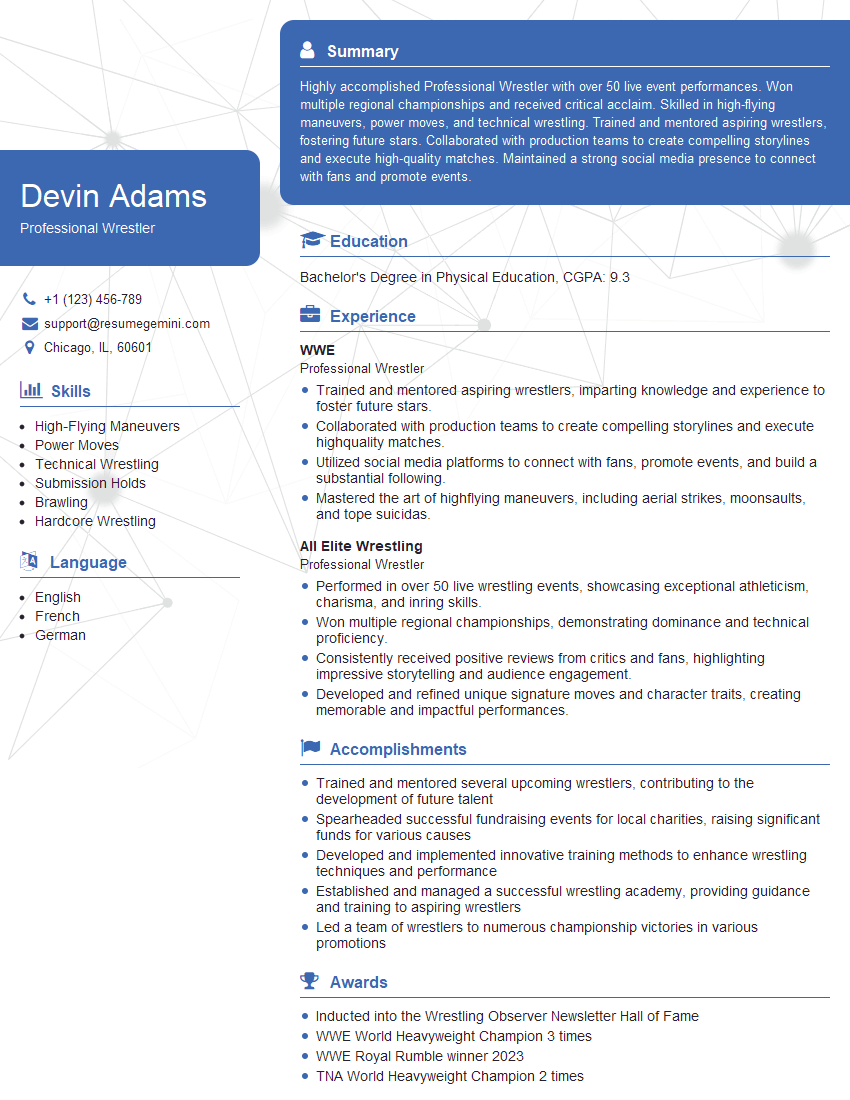
Mastering roping and wrestling skills opens doors to exciting careers in rodeos, ranching, livestock management, and related fields. To maximize your job prospects, create an ATS-friendly resume that highlights your achievements and skills effectively. ResumeGemini is a trusted resource that can help you build a professional and impactful resume, ensuring your qualifications stand out. Examples of resumes tailored to Roping and Wrestling are available to guide you. Invest the time to craft a compelling resume – it’s your first impression on potential employers.
Explore more articles
Users Rating of Our Blogs
Share Your Experience
We value your feedback! Please rate our content and share your thoughts (optional).
What Readers Say About Our Blog
Very informative content, great job.
good