Interviews are opportunities to demonstrate your expertise, and this guide is here to help you shine. Explore the essential Rotating Disc Electrode interview questions that employers frequently ask, paired with strategies for crafting responses that set you apart from the competition.
Questions Asked in Rotating Disc Electrode Interview
Q 1. Explain the principle of operation of a Rotating Disc Electrode (RDE).
The Rotating Disc Electrode (RDE) is a powerful electrochemical technique that allows for precise control and measurement of mass transport to an electrode surface. It works by spinning a small disc-shaped electrode at a controlled speed within an electrolyte solution. This rotation generates a well-defined hydrodynamic flow profile, creating a laminar flow of the solution towards the electrode. This laminar flow ensures a consistent and predictable mass transport rate, crucial for accurate electrochemical measurements.
Imagine a spinning plate in a bowl of soup. The soup (electrolyte) flows towards the center (electrode) in a predictable manner. This controlled flow allows us to study electrochemical reactions without the complicating factors of unpredictable diffusion seen in stationary electrodes.
Q 2. What is the Levich equation and how is it used in RDE experiments?
The Levich equation is a cornerstone of RDE theory. It mathematically describes the relationship between the limiting current (iL), the kinematic viscosity of the solution (ν), the diffusion coefficient of the electroactive species (D), the angular velocity of the electrode (ω), and the number of electrons transferred (n):
iL = 0.62nFAD2/3ω1/2ν-1/6where:
iLis the limiting current (A)nis the number of electrons transferredFis the Faraday constant (C/mol)Ais the electrode area (cm2)Dis the diffusion coefficient (cm2/s)ωis the angular velocity (rad/s)νis the kinematic viscosity (cm2/s)
In RDE experiments, the Levich equation is used to determine the diffusion coefficient (D) of the electroactive species. By measuring the limiting current at different rotation speeds, a plot of iL vs. ω1/2 can be constructed. The slope of this plot is directly proportional to D, allowing for its calculation. This information is vital for understanding the kinetics of the electrochemical reaction.
Q 3. Describe the limitations of the RDE technique.
While the RDE is a powerful technique, it does have limitations. One key limitation is the assumption of a perfectly smooth electrode surface and perfectly laminar flow. Surface roughness or turbulent flow can disrupt the well-defined hydrodynamic profile and lead to inaccuracies in measurements. The technique is also sensitive to edge effects, where the flow near the edge of the electrode can deviate from the ideal model. Furthermore, the RDE is generally best suited for studying relatively fast electrochemical reactions, as slower reactions may be masked by other processes.
For instance, studying highly viscous solutions can be challenging due to the difficulty in achieving sufficient laminar flow. Similarly, studying reactions with complex intermediates may present challenges in interpreting the results. Careful experimental design and consideration of these limitations are crucial for obtaining reliable and accurate data.
Q 4. How does the rotation speed affect the mass transport to the electrode surface?
The rotation speed of the electrode directly affects the rate of mass transport to the electrode surface. Increasing the rotation speed enhances the convective mass transport, leading to a thinner diffusion layer and a higher limiting current. This is because the faster rotation generates a stronger hydrodynamic flow, efficiently bringing fresh electroactive species to the electrode surface.
Consider again the soup analogy: spinning the plate faster brings the soup to the plate much quicker. The same applies to the electroactive species in the RDE: faster rotation brings more reactants to the electrode surface for reaction, thus increasing the current.
Q 5. Explain the concept of the limiting current in RDE voltammetry.
In RDE voltammetry, the limiting current is the plateau current observed at high overpotentials (large applied potentials). At this point, the rate of the electrochemical reaction is entirely controlled by the rate of mass transport of the electroactive species to the electrode surface. Essentially, the electrode is consuming the reactant as fast as it arrives, and further increases in potential do not increase the current further.
The limiting current provides valuable information about the diffusion coefficient and concentration of the electroactive species, as demonstrated by the Levich equation. Reaching a limiting current signifies that the electrochemical reaction is under diffusion control and mass transport is the limiting factor.
Q 6. What are the different types of RDE experiments and what information do they provide?
Several types of RDE experiments exist, each providing unique information:
- Rotating Disc Voltammetry (RDV): This is the most common type, where the potential is swept linearly while the rotation speed is held constant. It yields voltammograms showing the current response as a function of potential, providing information about the kinetics and thermodynamics of the electrochemical reaction.
- Rotating Ring-Disc Electrode (RRDE): This advanced technique uses a ring electrode surrounding the disc electrode. It allows for the detection of intermediates or products formed during the electrochemical reaction at the disc, giving insights into reaction mechanisms.
- Chronoamperometry and Chronocoulometry: These techniques involve maintaining a constant potential at the rotating disc electrode and measuring the current (amperometry) or charge (coulometry) as a function of time. They can provide information about the reaction kinetics and the adsorption/desorption of species on the electrode surface.
The choice of experiment depends on the specific information sought about the electrochemical reaction.
Q 7. How do you determine the number of electrons transferred in an electrochemical reaction using RDE?
Determining the number of electrons transferred (n) in an electrochemical reaction using RDE involves combining the Levich equation with experimental data. By measuring the limiting current (iL) at a known rotation speed (ω), known diffusion coefficient (D), known electrode area (A), and knowing the Faraday constant (F), one can rearrange the Levich equation to solve for ‘n’:
n = iL / (0.62FAD2/3ω1/2ν-1/6)However, accurately determining ‘n’ often requires independent determination of the diffusion coefficient (D) which can be challenging. This often involves methods like using a known electrochemical reaction with a known number of electrons to calibrate the system under the same experimental conditions.
It’s important to note that while the Levich equation provides a straightforward route to estimate ‘n’, the accuracy depends on the precision of the measured parameters and the validity of the assumptions underlying the Levich equation. In practice, corroborating the value of ‘n’ through independent techniques is recommended for enhanced reliability.
Q 8. Describe the effect of electrode material on RDE measurements.
The electrode material significantly impacts RDE measurements because it influences several crucial aspects of the electrochemical process. The most important factors are its electrochemical properties (e.g., potential window, catalytic activity, and surface roughness) and its chemical stability in the electrolyte.
- Potential Window: The electrode material’s potential window dictates the range of potentials where it remains electrochemically inert. Exceeding this window can lead to electrode dissolution or other side reactions, corrupting the data. For instance, using a platinum electrode in a highly oxidizing environment might cause the platinum to oxidize, altering the current response of the analyte.
- Catalytic Activity: If the electrode material catalyzes the reaction of interest, it can significantly accelerate the reaction rate, obscuring the intrinsic kinetics. Conversely, an inert electrode surface will provide more accurate measurements of the analyte’s intrinsic behavior. Gold is often used due to its inertness in a wide range of systems.
- Surface Roughness: A rough surface can lead to increased capacitance and non-uniform current distribution, complicating data interpretation. A highly polished surface minimizes these effects.
- Chemical Stability: The electrode material needs to be stable in the electrolyte solution. Corrosion or other chemical changes will alter the surface area and introduce artifacts into the measured current.
For example, studying oxygen reduction reactions might use a platinum RDE due to its well-known catalytic activity towards oxygen reduction. However, studying a less active process may call for a glassy carbon electrode to minimize catalytic effects. Choosing the appropriate electrode material is therefore crucial for obtaining accurate and reliable RDE measurements.
Q 9. How do you calibrate an RDE setup?
Calibrating an RDE setup is essential to ensure accurate and reliable data. It usually involves two main steps: calibrating the rotation speed and calibrating the electrochemical setup.
- Rotation Speed Calibration: This ensures that the rotation speed displayed by the rotator matches the actual rotation speed of the electrode. Many RDE setups allow for this check using a strobe light or a high-speed camera and comparing to a known frequency. Discrepancies could originate from sensor drift or mechanical wear and need addressing before running experiments.
- Electrochemical Calibration: This typically involves using a well-characterized redox couple (e.g., ferricyanide/ferrocyanide) with known diffusion coefficient to validate the electrochemical signal response. This step often entails measuring the limiting current and comparing to theory using the Levich equation (
iL = 0.62nFAD2/3ω1/2ν-1/6C), where iL is the limiting current, n is the number of electrons transferred, F is Faraday’s constant, A is the electrode area, D is the diffusion coefficient, ω is the angular velocity, ν is the kinematic viscosity, and C is the concentration. Deviations from the expected behavior might suggest issues with the electrode surface, the reference electrode, or the electrolyte.
A proper calibration procedure is critical to ensuring reliable measurements and minimizing systematic errors. Failure to calibrate can lead to incorrect kinetic parameters and potentially flawed conclusions.
Q 10. What are the common sources of error in RDE experiments?
Several sources of error can affect the accuracy of RDE experiments. These errors can be broadly classified into:
- Electrode Contamination: The electrode surface can be contaminated by impurities in the electrolyte solution or from the atmosphere. This leads to inconsistent surface area and catalytic activity, affecting the observed currents. Proper cleaning procedures are vital.
- Solution Contamination: Impurities or dissolved oxygen in the electrolyte can interfere with the electrochemical reaction of interest. Degassing techniques (using inert gas such as Argon) and stringent electrolyte preparation are necessary.
- Unstable Rotation Speed: Fluctuations in the rotation speed can introduce significant errors, especially at higher rotation rates, since the Levich equation is sensitive to the square root of the angular velocity.
- Non-uniform Current Distribution: The current distribution might not be uniform across the electrode surface, particularly at higher rotation speeds, leading to inaccurate measurements of the limiting current. This can be influenced by the electrode geometry and solution conductivity.
- Reference Electrode Issues: A poorly maintained or inappropriately chosen reference electrode can introduce significant potential errors.
- IR Drop: The ohmic drop (IR drop) in the solution can cause a significant deviation from the true electrode potential, particularly at high current densities. Compensation techniques can mitigate this.
Careful experimental design and rigorous attention to detail are essential for minimizing errors and achieving accurate RDE measurements. A good experimental protocol includes detailed procedures for cleaning, degassing, and calibration to ensure reproducibility.
Q 11. How do you troubleshoot problems such as unstable rotation speed or noisy current readings?
Troubleshooting unstable rotation speed or noisy current readings requires a systematic approach.
- Unstable Rotation Speed: Check the rotator’s motor for proper functioning. Look for mechanical issues (e.g., loose parts, bearing wear) or electronic problems (e.g., faulty wiring, power supply issues). Calibration should be checked and repeated if necessary. Verify the electrode shaft is securely mounted.
- Noisy Current Readings: Noisy currents can stem from various sources. Start by checking for issues with the electrochemical cell (e.g., poor connection, faulty electrodes), the potentiostat (e.g., faulty electronics, insufficient grounding), or the electrolyte solution (e.g., high resistance, presence of bubbles). Make sure the wiring is tight and the solution is free from any contamination. Also, a higher sampling rate on your potentiostat may reduce the noise in the current data.
Addressing these issues requires a methodical approach that checks both the mechanical and electronic components of the RDE setup. Recording the experimental conditions and potential problems is critical to troubleshooting and preventing similar errors in future experiments.
Q 12. Explain the concept of diffusion layer thickness and its relationship to rotation speed.
The diffusion layer is a thin layer of solution adjacent to the electrode surface where the concentration gradient of the electroactive species is significant. Its thickness (δ) is determined by the balance between convective transport (driven by electrode rotation) and diffusion.
The relationship between the diffusion layer thickness and rotation speed is inverse. As the rotation speed (ω) increases, the convective transport of the electroactive species to the electrode surface increases, thus decreasing the thickness of the diffusion layer. This is quantified by the Levich equation, which includes the term ω-1/2, demonstrating this inverse relationship. A faster rotation rate effectively ‘sweeps’ the depleted layer away, maintaining a thinner diffusion layer and increasing the limiting current.
Imagine stirring a cup of tea: gentle stirring creates a thicker layer of unmixed tea near the bottom of the cup, while vigorous stirring greatly reduces this layer. Similarly, increasing the rotation speed in an RDE experiment makes the diffusion layer thinner, leading to enhanced mass transport and a higher current.
Q 13. How do you determine the kinetic parameters of an electrochemical reaction using RDE?
Determining kinetic parameters of an electrochemical reaction using RDE relies on analyzing the voltammograms (current vs. potential plots) obtained at various rotation speeds. The Koutecky-Levich equation is central to this process.
The Koutecky-Levich equation combines the contributions of mass transport (diffusion) and the electrochemical reaction kinetics:
1/i = 1/ik + 1/iL
where:
iis the measured currentikis the kinetic current (related to the reaction rate)iLis the limiting current (determined by mass transport)
By plotting 1/i vs ω-1/2 (at a constant potential), a straight line is obtained, with the intercept yielding 1/ik and the slope relating to the diffusion coefficient and other parameters. From ik, the rate constant (k) and other kinetic parameters such as the transfer coefficient (α) can be extracted using the Butler-Volmer equation. Different potential values can then be investigated to obtain complete kinetic data across the voltage range.
For example, we can determine the standard rate constant and the transfer coefficient for a specific redox reaction by fitting the Koutecky-Levich plots obtained at different potentials.
Q 14. What is the difference between hydrodynamic voltammetry and stationary voltammetry?
Hydrodynamic voltammetry, as employed in RDE experiments, differs significantly from stationary voltammetry.
- Hydrodynamic Voltammetry (RDE): This technique uses a rotating disc electrode to induce forced convection, creating a well-defined and predictable mass transport regime. The rotating disc ensures a uniform flow profile and simplifies the mathematical description of mass transport. The limiting current is directly proportional to the concentration and the square root of the rotation speed.
- Stationary Voltammetry: In this technique, the electrode is stationary, and mass transport is primarily governed by diffusion. The current response is time-dependent and often involves complex diffusion profiles, making it more challenging to analyze. The limiting current in this case has a more complex relationship with concentration and requires detailed understanding of diffusion effects.
The key difference is the controlled mass transport. RDE creates a steady-state condition due to forced convection, which makes it easier to interpret the results and separate kinetic and mass transport effects. Conversely, stationary voltammetry often involves transient currents complicating kinetic parameter extraction. In short, RDE provides a more controlled and easily-analyzed environment for studying electrochemical kinetics.
Q 15. Explain the concept of mass transfer coefficient and how it is affected by RDE rotation speed.
The mass transfer coefficient (km) quantifies the rate at which a species moves from the bulk solution to the electrode surface. Think of it like this: imagine trying to stir sugar into your coffee. km represents how quickly the sugar dissolves and mixes with the coffee. In RDE experiments, this is crucial because electrochemical reactions only happen at the electrode surface; the faster the mass transfer, the faster the reaction.
The RDE’s rotation creates a forced convection, significantly impacting km. Increasing the rotation speed (ω) generates a higher hydrodynamic shear stress near the electrode, effectively sweeping away the reaction products and bringing fresh reactants to the surface. This directly increases km. The relationship is often described by the Levich equation:
km = 0.62 D2/3 ν-1/6 ω1/2where D is the diffusion coefficient of the species, and ν is the kinematic viscosity of the solution. This equation clearly shows the direct proportionality between km and the square root of the rotation speed (ω1/2).
For example, if you double the rotation speed, you don’t quite double km, but you increase it by a factor of approximately 1.41 (√2). This precise control over mass transfer is a major advantage of the RDE.
Career Expert Tips:
- Ace those interviews! Prepare effectively by reviewing the Top 50 Most Common Interview Questions on ResumeGemini.
- Navigate your job search with confidence! Explore a wide range of Career Tips on ResumeGemini. Learn about common challenges and recommendations to overcome them.
- Craft the perfect resume! Master the Art of Resume Writing with ResumeGemini’s guide. Showcase your unique qualifications and achievements effectively.
- Don’t miss out on holiday savings! Build your dream resume with ResumeGemini’s ATS optimized templates.
Q 16. Describe the Koutecky-Levich plot and its significance.
A Koutecky-Levich plot is a graphical representation of the inverse of the current (1/i) versus the inverse of the square root of the rotation speed (ω-1/2). It’s a powerful tool for analyzing the kinetics of electrode reactions and separating the effects of mass transfer and charge transfer.
The plot typically yields a straight line at higher rotation speeds, where mass transfer is the limiting factor. The slope of this line is directly related to the diffusion coefficient (D) and the concentration of the electroactive species, allowing for the determination of these important parameters. The y-intercept provides information about the kinetics of the electron transfer process, specifically the charge transfer resistance. By extrapolating the linear portion to the y-axis (ω-1/2 = 0, representing infinite rotation speed and thus no mass transfer limitations), we obtain the current due to charge transfer alone (ik).
Its significance lies in its ability to distinguish between kinetic and mass-transport controlled reactions. This is invaluable in understanding the reaction mechanism and determining rate constants, making it an essential tool in electrocatalysis research.
Q 17. How do you choose the appropriate rotation speed for an RDE experiment?
Choosing the appropriate rotation speed is crucial for obtaining reliable RDE data. It’s a balance between ensuring mass transport limitations and avoiding excessive hydrodynamic shear or electrode damage.
The selection depends on several factors:
- Nature of the reaction: Fast reactions might require higher rotation speeds to minimize mass transfer limitations, while slower reactions might benefit from lower speeds to focus on kinetic aspects.
- Diffusion coefficient of the electroactive species: Species with low diffusion coefficients will need higher rotation speeds to ensure adequate mass transport.
- Electrode material and geometry: The electrode material’s susceptibility to wear and tear should guide the rotation speed selection. Also, the size and shape of the electrode influence the hydrodynamic profile.
A common approach involves performing experiments at a range of rotation speeds, then constructing a Koutecky-Levich plot. If the plot shows a linear relationship at higher rotation speeds (the Levich region), mass transport is adequately controlled, and the chosen speed is suitable. If there’s significant deviation from linearity, the rotation speed might need to be adjusted.
It’s usually a good practice to start with lower rotation speeds and gradually increase them to observe trends and ensure the stability of the electrode-electrolyte interface.
Q 18. What are the advantages and disadvantages of using an RDE compared to other electrochemical techniques?
RDEs offer significant advantages but also come with certain limitations compared to other electrochemical techniques like cyclic voltammetry (CV) or chronoamperometry.
Advantages:
- Precise control over mass transport: RDEs allow for precise control of mass transport to the electrode surface through rotation speed, facilitating the separation of kinetic and mass transfer effects.
- Quantitative analysis: The Levich equation and Koutecky-Levich plots enable quantitative analysis of reaction kinetics and diffusion coefficients.
- Steady-state measurements: RDE measurements are often performed under steady-state conditions, simplifying data analysis and interpretation.
Disadvantages:
- Limited applicability to some systems: RDEs might not be suitable for studying highly viscous solutions or systems with fragile electrode surfaces. Also, the rotation might influence the electrode-solution interface differently than other techniques.
- Complex experimental setup: Compared to simpler techniques like CV, RDE setups involve more sophisticated instrumentation and require careful calibration.
- Potential for edge effects: At high rotation speeds, edge effects can become important and could lead to some inaccuracy.
Q 19. How do you prepare the electrode surface for RDE experiments?
Proper electrode surface preparation is crucial for obtaining reproducible and reliable RDE results. A contaminated or rough surface can significantly alter the electrochemical response.
The preparation procedure typically involves several steps:
- Mechanical polishing: This is often the first step, using progressively finer abrasive materials (e.g., diamond pastes or alumina suspensions) to achieve a mirror-like finish. The goal is to remove any scratches, oxide layers, or contaminants from the surface. Careful rinsing with deionized water is critical between each polishing step.
- Ultrasonic cleaning: After mechanical polishing, the electrode is typically cleaned ultrasonically in solvents such as ethanol or isopropanol to remove residual polishing materials.
- Electrochemical cleaning: In some cases, further cleaning using electrochemical methods (e.g., cyclic voltammetry in a suitable electrolyte) can be performed to remove any remaining surface contaminants.
- Drying: Finally, the electrode should be carefully dried under a stream of nitrogen or argon gas, avoiding contamination.
The specific steps and materials used will depend on the electrode material and the nature of the experiment. The surface morphology can be checked with techniques like optical microscopy or scanning electron microscopy (SEM) to ensure the desired level of cleanliness and smoothness.
Q 20. What types of electrochemical cells are commonly used with RDEs?
Several types of electrochemical cells are compatible with RDEs, depending on the specific application and experimental requirements.
Common types include:
- Conventional three-electrode cells: These cells typically consist of the RDE (working electrode), a reference electrode (e.g., Ag/AgCl or saturated calomel electrode), and a counter electrode (e.g., platinum wire or mesh). The design is optimized for efficient mass transport due to the rotating electrode and allows for precise potential control.
- Sealed cells: Sealed cells are designed to prevent evaporation of the electrolyte and minimize contamination, which is particularly important for long-duration experiments or studies requiring specific atmospheric conditions.
- Flow cells: For certain applications, a flow cell is used to continuously flow fresh electrolyte over the electrode surface, further enhancing mass transport and reducing concentration polarization effects.
The choice of the cell depends on factors such as the volatility of the electrolyte, the need for precise control of the environment, and the duration of the experiment. The cell material needs to be chemically inert with respect to the electrolyte and the electroactive species.
Q 21. Discuss the role of the reference electrode in RDE experiments.
The reference electrode in RDE experiments plays a critical role in maintaining a stable and well-defined potential at the working electrode (RDE). It provides a constant potential against which the potential of the RDE is measured.
Without a stable reference, accurate electrochemical measurements are impossible. The potential applied to the RDE is relative to the reference electrode’s potential, which remains constant throughout the experiment. This ensures that any changes in the current are due to the electrochemical processes at the RDE and not variations in the applied potential.
Common reference electrodes used with RDEs include Ag/AgCl (silver/silver chloride) and saturated calomel electrodes (SCE). The choice depends on the electrolyte and the potential range of the experiment. The reference electrode’s potential must be stable and well-defined under the experimental conditions to ensure accurate measurements and data interpretation.
It is crucial to maintain the liquid junction between the reference electrode and the working solution to minimize junction potential and to properly calibrate the reference electrode before each experiment to ensure accuracy.
Q 22. Explain the importance of proper grounding in RDE measurements.
Proper grounding in Rotating Disc Electrode (RDE) measurements is paramount for accurate and safe operation. It prevents electrical noise and ensures the electrochemical reactions are only occurring at the working electrode, minimizing interference from stray currents. Think of it like grounding a power tool – it prevents electrical shocks and ensures the tool functions correctly. Improper grounding can lead to inaccurate voltammograms, distorted kinetic data, and even equipment damage. The RDE setup typically involves grounding the counter electrode (often a platinum wire) and the reference electrode (e.g., Ag/AgCl) to the potentiostat’s ground. The cell itself should also be electrically isolated to prevent unwanted current paths.
Q 23. Describe the different types of RDE materials available and their applications.
RDEs are available in a variety of materials, each with specific advantages and disadvantages depending on the application. Common materials include:
- Glassy Carbon: A popular choice due to its wide electrochemical window, chemical inertness, and relatively low cost. Ideal for many organic and inorganic systems.
- Platinum: Excellent for reactions involving oxidation, particularly oxygen reduction reactions (ORRs) and hydrogen evolution reactions (HERs), but can be susceptible to poisoning by certain species.
- Gold: Often used in studies involving thiols and other sulfur-containing compounds due to its strong affinity for sulfur. Also useful for oxidation reactions.
- Boron-doped Diamond: Offers an exceptionally wide electrochemical window and excellent resistance to corrosion and fouling. Pricier but extremely robust for harsh environments.
The choice of material depends entirely on the specific electrochemical reaction being studied and the analyte’s properties. For instance, studying the oxidation of a highly reactive species might require the use of a highly inert electrode like boron-doped diamond, while the reduction of oxygen would often involve a platinum electrode.
Q 24. How do you analyze the data obtained from an RDE experiment?
Analyzing RDE data involves several key steps. The raw data typically consists of current (I) as a function of potential (E) and rotation rate (ω). First, we usually correct for background currents by subtracting a blank voltammogram obtained in the absence of the analyte. The next critical step is to use the Koutecky-Levich equation to extract kinetic parameters. This equation relates the current to the rotation rate and the inherent reaction kinetics:
1/I = 1/Ik + 1/(Bω1/2)where Ik is the kinetic current, B is the Levich constant, and ω is the rotation rate. By plotting 1/I versus 1/ω1/2 (Levich plot), we can determine Ik from the y-intercept and extract the number of electrons transferred (n) and the diffusion coefficient (D) from the slope (B). Finally, electrochemical parameters like the electron transfer coefficient (α) and the heterogeneous rate constant (k0) can be derived from Ik at different potentials, often by using Tafel analysis.
Q 25. Describe different software packages used for analyzing RDE data.
Several software packages are used to analyze RDE data. Many electrochemists utilize the software provided by their potentiostat manufacturer (e.g., Gamry, BioLogic, Autolab). These often have built-in features for Koutecky-Levich analysis and other electrochemical data processing. Beyond manufacturer-specific software, general-purpose data analysis packages like Origin, MATLAB, and Python (with libraries like SciPy and NumPy) offer powerful tools for data manipulation, plotting, and curve fitting. The choice depends on familiarity, the complexity of the data analysis, and the specific needs of the research. Python, for instance, provides flexibility and extensive community support for developing custom analysis scripts.
Q 26. What are the safety precautions you should take when working with an RDE?
Safety is paramount when working with an RDE. Here are some key precautions:
- Always wear appropriate personal protective equipment (PPE): This includes safety glasses, lab coats, and gloves to protect against chemical spills and electrode fragments.
- Ensure proper grounding of the equipment: As mentioned previously, this is critical to prevent electrical hazards.
- Handle electrodes carefully: Avoid scratching or damaging the electrode surface, as this can affect its performance.
- Work in a well-ventilated area: Electrochemical reactions can sometimes generate hazardous gases.
- Dispose of chemicals properly: Follow appropriate safety protocols for handling and disposing of electrochemical solutions.
- Regularly inspect equipment for damage: Before each experiment, carefully inspect the RDE shaft, the rotating assembly, and the cell for any signs of wear or damage.
Following these guidelines will minimize the risk of accidents and ensure the safety of the researcher and their surroundings.
Q 27. Explain the concept of electrochemical impedance spectroscopy (EIS) and its application in conjunction with RDE.
Electrochemical Impedance Spectroscopy (EIS) is a powerful technique used to characterize the interfacial properties of electrochemical systems. It involves applying a small amplitude AC voltage to the electrode and measuring the resulting current response over a range of frequencies. The resulting impedance spectrum provides information about the various processes occurring at the electrode-electrolyte interface, such as charge transfer, diffusion, and adsorption. By combining EIS with RDE, we gain insights into the kinetics and mass transport processes that affect the overall reaction rate. For example, we can determine the charge transfer resistance (Rct), which reflects the speed of the electron transfer reaction. The change in Rct with rotation rate provides valuable information about the contribution of mass transport limitations to the overall reaction rate. In essence, EIS helps decouple kinetic and mass transport contributions to overall reaction performance when used in conjunction with RDE.
Q 28. How would you diagnose and resolve issues related to electrode fouling in RDE experiments?
Electrode fouling is a common issue in RDE experiments, where the electrode surface becomes covered with adsorbed species, thereby hindering the electrochemical reaction. Diagnosing fouling is typically done by observing changes in the voltammograms – a decrease in current, peak broadening, and/or a shift in peak potentials over time. Resolving fouling involves several strategies:
- Electrochemical cleaning: Applying potential cycles in a suitable electrolyte (e.g., repeated potential sweeps between +1.5 V and -0.5 V in 0.1 M H2SO4 for Pt electrodes) to oxidatively or reductively remove adsorbed species.
- Mechanical cleaning: Carefully polishing the electrode surface with polishing alumina suspensions of decreasing particle size, followed by thorough rinsing.
- Chemical cleaning: Using chemical solvents to remove specific adsorbed species. This requires knowledge of the fouling species to select an appropriate solvent. However, this method should be applied cautiously to avoid damage to the electrode.
- Using a different electrode material: If fouling is persistent, consider using a more resistant electrode material, such as boron-doped diamond.
The best approach to tackle electrode fouling depends on the nature of the fouling species and the electrode material. Often, a combination of these methods is necessary to achieve a clean and reproducible electrode surface. Preventing fouling is just as important and can involve carefully purifying the electrolyte and/or controlling experimental parameters.
Key Topics to Learn for Rotating Disc Electrode Interview
- Hydrodynamics of the Rotating Disc Electrode (RDE): Understanding the laminar flow profile and its impact on mass transport.
- Mass Transport Theory: Grasping the Levich equation and its application in determining diffusion coefficients and kinetic parameters.
- Electrochemical Kinetics: Familiarizing yourself with the Butler-Volmer equation and its relevance to RDE experiments.
- Experimental Techniques: Mastering the practical aspects of using an RDE, including electrode preparation, potential control, and data acquisition.
- Data Analysis: Knowing how to analyze voltammograms obtained from RDE experiments, including determining kinetic parameters and identifying reaction mechanisms.
- Applications of RDE: Exploring the diverse applications of RDE in various fields, such as corrosion studies, electrocatalysis, and material science.
- Limitations of RDE: Understanding the inherent limitations and potential sources of error associated with RDE measurements.
- Advanced Techniques: Exploring more advanced techniques like RRDE (Rotating Ring-Disc Electrode) and its applications.
- Troubleshooting common issues: Being prepared to discuss solutions to potential problems encountered during RDE experiments.
Next Steps
Mastering Rotating Disc Electrode techniques significantly enhances your prospects in electrochemistry and related fields, opening doors to exciting research and development opportunities. A strong resume is crucial for showcasing your skills effectively to potential employers. To maximize your chances, create an ATS-friendly resume that highlights your expertise in RDE. ResumeGemini is a trusted resource for building professional, impactful resumes. Take advantage of their tools and resources – examples of resumes tailored to Rotating Disc Electrode expertise are available to help guide you.

Laboratory Manager Resume Sample

Project Manager Resume Sample

Senior Research Scientist Resume Sample

Process Engineer Resume Sample

Research Scientist Resume Sample

Technical Specialist Resume Sample

Chemical Engineer Resume Sample

Instrumentation Engineer Resume Sample

Quality Control Specialist Resume Sample
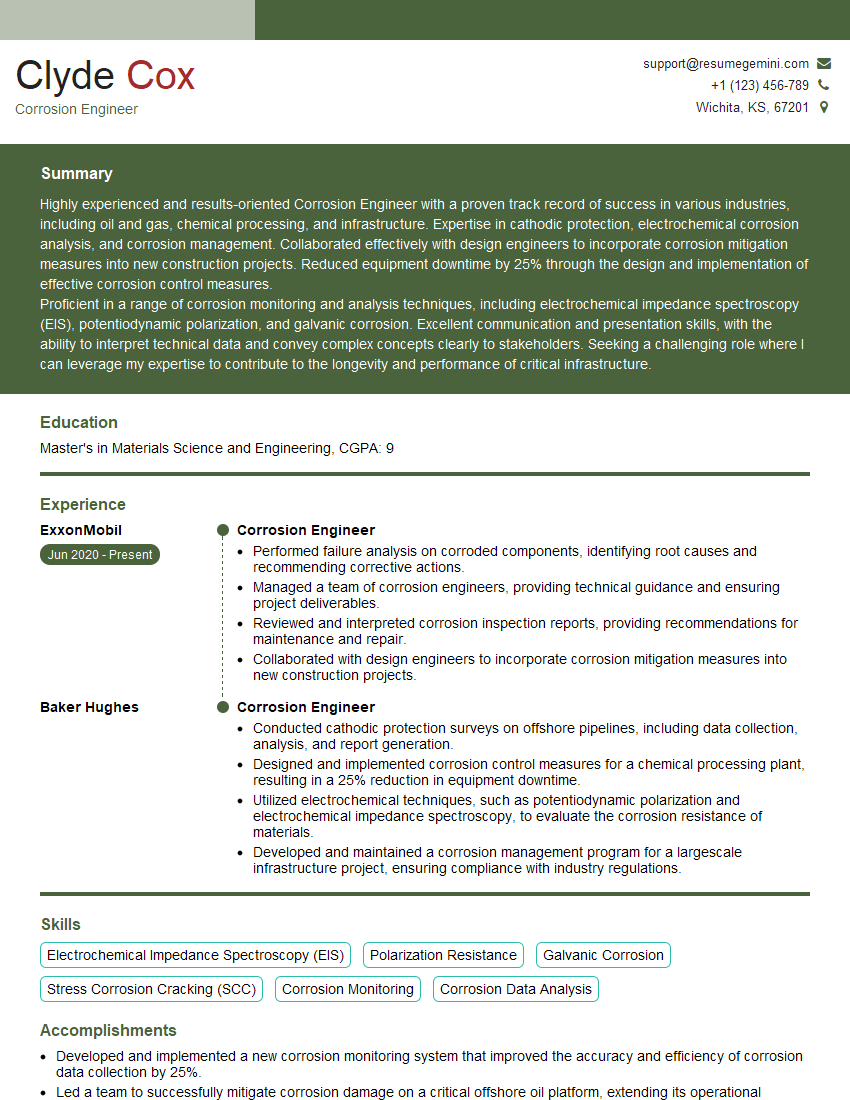
Corrosion Engineer Resume Sample

Fuel Cell Engineer Resume Sample

Analytical Chemist Resume Sample
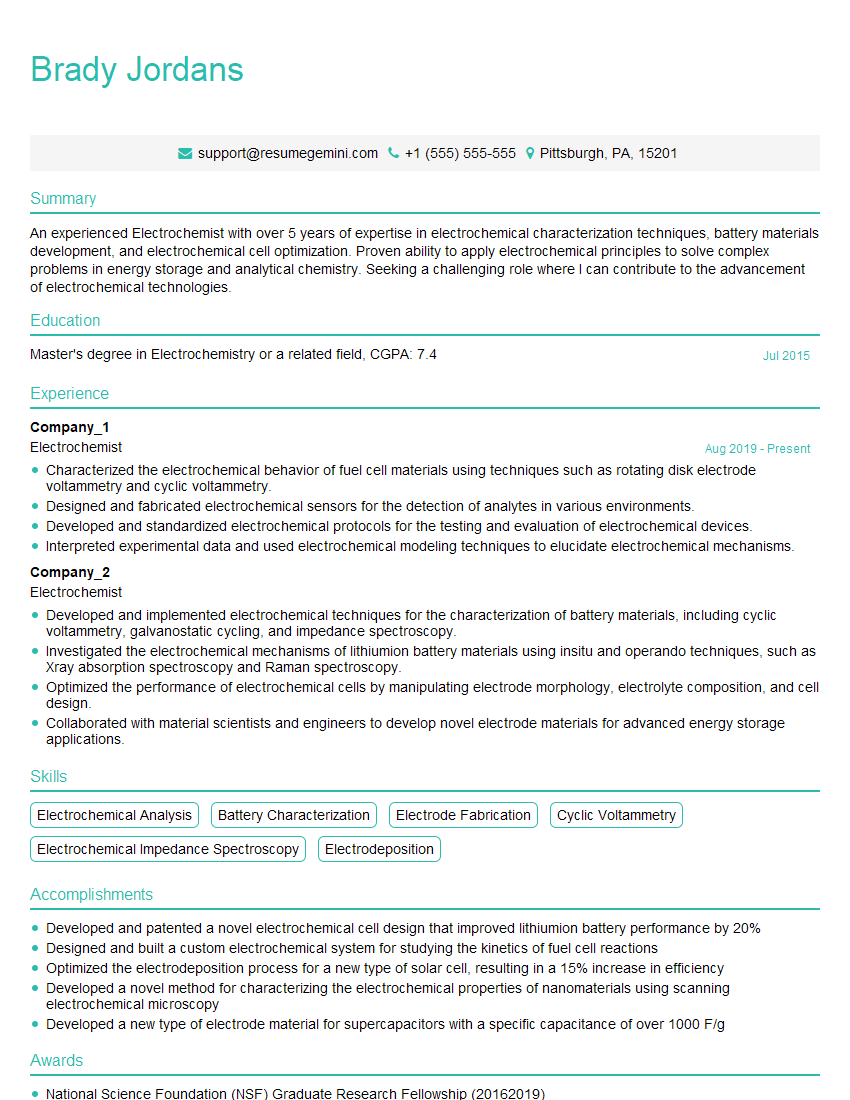
Electrochemist Resume Sample

Physical Chemist Resume Sample

Materials Scientist Resume Sample
Explore more articles
Users Rating of Our Blogs
Share Your Experience
We value your feedback! Please rate our content and share your thoughts (optional).
What Readers Say About Our Blog
Very informative content, great job.
good