The right preparation can turn an interview into an opportunity to showcase your expertise. This guide to Scales and Arpeggios interview questions is your ultimate resource, providing key insights and tips to help you ace your responses and stand out as a top candidate.
Questions Asked in Scales and Arpeggios Interview
Q 1. Name the major scales and their corresponding key signatures.
The major scales are built on a specific pattern of intervals. Each scale has a corresponding key signature indicating the sharps or flats required to play it in that key. Here’s a list:
- C Major: No sharps or flats (Key Signature: None)
- G Major: One sharp (F#)
- D Major: Two sharps (F#, C#)
- A Major: Three sharps (F#, C#, G#)
- E Major: Four sharps (F#, C#, G#, D#)
- B Major: Five sharps (F#, C#, G#, D#, A#)
- F# Major: Six sharps (F#, C#, G#, D#, A#, E#)
- C# Major: Seven sharps (F#, C#, G#, D#, A#, E#, B#)
- F Major: One flat (Bb)
- Bb Major: Two flats (Bb, Eb)
- Eb Major: Three flats (Bb, Eb, Ab)
- Ab Major: Four flats (Bb, Eb, Ab, Db)
- Db Major: Five flats (Bb, Eb, Ab, Db, Gb)
- Gb Major: Six flats (Bb, Eb, Ab, Db, Gb, Cb)
- Cb Major: Seven flats (Bb, Eb, Ab, Db, Gb, Cb, Fb)
Remember that enharmonic equivalents exist (e.g., F# is enharmonically equivalent to Gb). The choice depends on the context of the music.
Q 2. Explain the construction of a major scale.
A major scale is constructed using a specific intervallic formula: W-W-H-W-W-W-H, where ‘W’ represents a whole step (two semitones) and ‘H’ represents a half step (one semitone). Let’s break it down:
Imagine starting on the root note (the tonic). You then ascend through the scale by following this formula:
- Root
- Whole step
- Whole step
- Half step
- Whole step
- Whole step
- Whole step
- Half step (back to the octave)
Example: In C Major (CDEFGAB), the intervals are: C-D (W), D-E (W), E-F (H), F-G (W), G-A (W), A-B (W), B-C (H).
Understanding this formula allows you to construct any major scale, regardless of the root note. For instance, to build G Major, start on G and follow the W-W-H-W-W-W-H pattern.
Q 3. Describe the construction of a natural minor scale.
The natural minor scale follows a different intervallic formula: W-H-W-W-H-W-W. It’s essentially a minor counterpart to the major scale, creating a darker, more melancholic sound.
To construct it, start on the root and proceed as follows:
- Root
- Whole step
- Half step
- Whole step
- Whole step
- Half step
- Whole step
- Whole step (back to the octave)
Example: The A natural minor scale is A-B-C-D-E-F-G-A. Notice the characteristic minor third interval (C-E) that distinguishes it from the A major scale.
Q 4. How do you construct a harmonic minor scale?
The harmonic minor scale modifies the natural minor scale by raising the 7th degree by a half step. This creates a characteristic leading tone that strongly pulls towards the tonic, adding tension and resolution. The intervallic formula becomes: W-H-W-W-H-W-1 1/2
This alteration makes the harmonic minor scale more suitable for certain melodic and harmonic progressions, especially in compositions that require a strong sense of resolution.
Example: The A harmonic minor scale is A-B-C-D-E-F-G#-A. The raised 7th (G#) is the key difference from the natural minor scale.
Q 5. How do you construct a melodic minor scale?
The melodic minor scale addresses some of the perceived awkwardness of the harmonic minor scale by also raising the 6th degree in the ascending form. The intervallic formula in the ascending form is W-W-H-W-W-W-H, which is the same as the major scale. The descending form reverts to the natural minor scale W-H-W-W-H-W-W.
This makes the melodic minor scale smoother to ascend and descend, making it a more fluid melodic option.
Example: The A melodic minor scale ascending is A-B-C-D-E-F#-G#-A, and descending is A-G-F-E-D-C-B-A.
Q 6. What are the characteristics of a pentatonic scale?
Pentatonic scales are five-note scales that are widely used across many musical traditions. Their simplicity and inherent melodic quality make them particularly appealing. The most common pentatonic scales are major and minor pentatonic scales.
Characteristics:
- Five notes only: This creates a simple yet expressive melodic framework.
- Absence of specific intervals: They omit certain intervals found in diatonic scales, producing a characteristic sound.
- Easy to improvise over: Their simplicity allows for quick and fluid improvisation.
- Culturally diverse: Found in various musical traditions around the world.
Example: The C major pentatonic scale is C-D-E-G-A. Notice the absence of F and B.
Q 7. Explain the difference between diatonic and chromatic scales.
Diatonic and chromatic scales represent two contrasting approaches to organizing musical notes. The difference lies primarily in their intervallic structure.
Diatonic scales (like major and minor scales) are built using a specific sequence of whole and half steps. They are seven-note scales with a characteristic tonal center (tonic) and a defined melodic direction.
Chromatic scales, on the other hand, consist of all twelve notes of the octave, proceeding in a continuous sequence of half steps. They lack a defined tonal center, providing a more ambiguous and even unsettling sound often used for color.
In essence, diatonic scales are organized, creating a sense of tonality, while chromatic scales are unorganized and non-tonal in their pure form. This distinction is fundamental in understanding harmony, melody, and musical expression.
Q 8. How are arpeggios constructed from scales?
Arpeggios are essentially broken-down chords. They’re constructed by playing the notes of a chord in sequence, rather than simultaneously. To create an arpeggio from a scale, you first identify the chord tones within the scale. For example, a C major scale (C-D-E-F-G-A-B-C) contains the notes of a C major chord (C-E-G). Playing these notes C-E-G in succession creates a C major arpeggio. You can do this with any chord built from the scale. Think of it like taking a chord and ‘sprinkling’ its notes across time instead of playing them at once.
Let’s consider another example. The same C major scale also contains the notes of a G major chord (G-B-D). Playing G-B-D sequentially gives you a G major arpeggio. The selection of which chord to arpeggiate is dependent on the musical context.
Q 9. Explain the difference between major and minor arpeggios.
The difference between major and minor arpeggios lies in the intervals between their notes. A major arpeggio is built using major thirds (four semitones) and a minor third (three semitones), resulting in a bright, uplifting sound. For instance, a C major arpeggio (C-E-G) has a major third (C-E) and a minor third (E-G). A minor arpeggio, on the other hand, uses a minor third followed by a major third, creating a darker, more melancholic feel. A C minor arpeggio (C-Eb-G) features a minor third (C-Eb) and a major third (Eb-G).
Imagine the major arpeggio as a sunny day and the minor arpeggio as a quiet evening; the intervals create distinct moods.
Q 10. Describe the construction of a seventh chord arpeggio.
A seventh chord arpeggio extends the basic triad (three-note chord) by adding a seventh. The seventh can be major or minor, leading to different sounds. Let’s take a C major seventh chord (C-E-G-B) as an example. The arpeggio would be C-E-G-B played sequentially. The intervals are a major third (C-E), a minor third (E-G), and a major third (G-B). If we consider a C minor seventh chord (C-Eb-G-Bb), the arpeggio is C-Eb-G-Bb, with intervals of a minor third (C-Eb), a major third (Eb-G), and a minor third (G-Bb). Adding the seventh introduces a richer harmonic complexity to the arpeggio.
Q 11. What are the inversions of a triad?
Triads (three-note chords) have three inversions. An inversion is a rearrangement of the chord’s notes, keeping the same intervals but changing the bass note. The root position is the fundamental form; the other inversions are:
- First Inversion: The third of the chord is in the bass.
- Second Inversion: The fifth of the chord is in the bass.
For a C major triad (C-E-G), the inversions are:
- Root Position: C-E-G
- First Inversion: E-G-C
- Second Inversion: G-C-E
Inversions alter the bass line and the overall harmonic character, providing variety and interest in a musical piece.
Q 12. How do you identify the key of a given melody?
Identifying the key of a melody involves analyzing the prevailing notes and chords. The key is usually determined by the tonic, which is the central note around which the melody revolves. Look for:
- Frequent use of a single note: This note is likely the tonic.
- Cadences: Musical phrases often end on the tonic, creating a sense of resolution.
- Chord progressions: The predominant chords are usually built from the scale of the key.
For example, if a melody frequently uses C and ends its phrases on C, and the chords used are predominantly C major, G major, and F major, it is highly likely to be in the key of C major. Analyzing the overall harmonic and melodic tendencies will guide you to the key.
Q 13. Explain the concept of modulation.
Modulation is the process of smoothly changing from one key to another within a musical piece. It involves a gradual shift in the harmonic center, often using transitional chords that connect the old and new keys. These transitions can be subtle or dramatic, depending on the composer’s intent. Successful modulation creates a sense of harmonic movement and emotional progression. For instance, a piece might modulate from C major to G major, using chords common to both keys to ease the transition.
Think of modulation like shifting gears in a car—a smooth transition to a different harmonic ‘speed’.
Q 14. How are scales and arpeggios used in improvisation?
Scales and arpeggios are fundamental tools for improvisation. Scales provide a framework of notes within a specific key, allowing the improviser to create melodic lines that sound coherent and in harmony. Arpeggios provide rhythmic and harmonic interest, often outlining chords and adding movement. Improvisers use scales to choose notes and arpeggios to create chordal movement and rhythmic interest.
Imagine scales as a roadmap and arpeggios as scenic routes within that map; both help to guide and enhance the journey of improvisation. Experienced improvisers often creatively combine scales and arpeggios to craft sophisticated and unique melodic and harmonic passages.
Q 15. Describe the use of scales and arpeggios in composition.
Scales and arpeggios are the foundational building blocks of melody and harmony in music composition. Scales provide a framework of notes within a specific key, dictating the melodic possibilities. Arpeggios, derived from chords built on those scales, add harmonic interest and movement. Think of a scale as the alphabet of a musical language, and arpeggios as specific words or phrases within that language.
For example, a composer might use the C major scale (C-D-E-F-G-A-B-C) to create a bright, cheerful melody. They could then incorporate C major arpeggios (C-E-G) to reinforce the C major tonality and add harmonic depth. Varying the rhythm and voicing of both the scale and arpeggio provides further compositional texture and interest. A skilled composer might use scale fragments to create unique melodic lines, and arpeggiated figures to create harmonic movement or punctuate phrases.
Career Expert Tips:
- Ace those interviews! Prepare effectively by reviewing the Top 50 Most Common Interview Questions on ResumeGemini.
- Navigate your job search with confidence! Explore a wide range of Career Tips on ResumeGemini. Learn about common challenges and recommendations to overcome them.
- Craft the perfect resume! Master the Art of Resume Writing with ResumeGemini’s guide. Showcase your unique qualifications and achievements effectively.
- Don’t miss out on holiday savings! Build your dream resume with ResumeGemini’s ATS optimized templates.
Q 16. Explain the relationship between scales and chords.
Scales and chords are intrinsically linked. A chord is a simultaneous combination of notes, and the notes within a chord are typically derived from a specific scale. The scale provides the harmonic context for the chord. For instance, a C major chord (C-E-G) is built from the C major scale (C-D-E-F-G-A-B-C). Every note of the C major chord is found within the C major scale.
The scale dictates which chords are considered consonant (harmonious) and dissonant (creating tension) within a particular key. Understanding this relationship allows composers to create harmonic progressions that are both pleasing and interesting to the listener. The specific scale determines the available chords and their functions within the piece.
Q 17. How do you analyze the harmonic function of a chord within a scale?
Analyzing the harmonic function of a chord within a scale involves understanding its role within the overall harmonic progression. We look at its relationship to the tonic (the home chord), dominant (the V chord, creating a sense of pull towards the tonic), and subdominant (the IV chord, often creating a sense of rest or preparation).
For example, in the key of C major, the C major chord (I) is the tonic, the G major chord (V) is the dominant, and the F major chord (IV) is the subdominant. The G major chord, as the dominant, creates a strong pull towards the C major chord. The F major chord acts as a more stable and less intense preparation for the return to the tonic. The function of a chord can change based on the surrounding chords in a progression. A thorough understanding of Roman numeral analysis and functional harmony is crucial for this kind of analysis.
Q 18. Explain the concept of parallel and relative keys.
Parallel keys share the same tonic (root note) but different modes (major or minor). For example, C major and C minor are parallel keys, sharing the same tonic, C, but one being major and the other minor. They have different harmonic characters because of the different scale degrees they utilize.
Relative keys share the same key signature but different tonics. For instance, C major and A minor are relative keys because they share the same key signature (no sharps or flats) but their tonic notes are different (C and A respectively). They are closely related harmonically because they share many of the same notes.
Q 19. Name three common scale patterns used in jazz improvisation.
Three common scale patterns used in jazz improvisation are:
- The blues scale: A pentatonic scale with a characteristic ‘blue’ note (a flatted 3rd or 5th). It adds a soulful and expressive quality to improvisations.
- The major pentatonic scale: A five-note scale with a bright and uplifting sound, commonly used for solos.
- The bebop scale: An altered scale with an added note (typically a major 7th) above the major scale that creates a characteristic jazzy sound.
These scales provide a framework for creating melodic lines that fit within the harmonic context of a jazz tune. The addition of chromatic approaches and passing tones further enhances the improvisational expression.
Q 20. What are some common techniques for practicing scales and arpeggios?
Effective practice of scales and arpeggios involves a multifaceted approach:
- Systematic approach: Practicing scales and arpeggios in different octaves, positions, and rhythms.
- Hanon-like exercises: Using scales and arpeggios to develop finger dexterity and technique, including scales in different articulations.
- Improvisation: Using scales and arpeggios as a basis for improvisation over chord progressions.
- Ear training: Developing the ability to recognize and sing scales and arpeggios. This is essential for internalization.
- Metronome use: Ensuring accuracy and developing rhythmic precision. Gradually increasing the tempo builds speed and control.
Combining these techniques ensures comprehensive development and mastery.
Q 21. How do you apply scales and arpeggios to different musical genres?
The application of scales and arpeggios varies significantly across musical genres. In classical music, scales might be used to create elegant melodies and arpeggios to underpin harmonic progressions. In jazz, altered scales and blues scales become central to improvisation. In rock, pentatonic scales are frequently used for creating memorable riffs and solos. In pop music, simpler diatonic scales are more prevalent.
Understanding the typical scales and harmonic progressions associated with a genre is vital. For example, while a classical piece may heavily feature major and minor scales and their associated chords, a flamenco piece will heavily rely on the Phrygian mode, reflecting the unique character of that style.
Q 22. Explain the concept of enharmonic equivalence.
Enharmonic equivalence refers to the phenomenon where two or more notes have the same pitch but are spelled differently. This difference in spelling arises from the different ways we can name notes within our system of sharps and flats. Think of it like different routes to the same destination. For instance, C# and Db sound exactly the same but are written differently. This can significantly impact the analysis of a piece of music, particularly in terms of key signatures and chord progressions.
Understanding enharmonic equivalence is crucial for navigating complex harmonies and modulations. For example, a chord progression might move from a C major chord to a Db major chord. Although it sounds like a simple change, understanding the enharmonic relationship between C# and Db allows us to recognize the underlying chromatic alteration that drives the harmonic progression.
A common example in practice is the use of enharmonic spelling in resolving chromatic leading tones. A leading tone typically resolves upwards by a half step to the tonic. If you’re in the key of C major and encounter a B#, we can understand that its enharmonic equivalent is C, explaining its resolution to the tonic.
Q 23. Describe the difference between a major and minor key.
The difference between a major and minor key lies primarily in the intervallic structure of their scales. Both scales contain seven notes, but the arrangement of whole and half steps differs significantly, which creates distinct moods and characteristics.
A major scale is built using the formula: W-W-H-W-W-W-H (where W represents a whole step and H represents a half step). This intervallic structure gives major keys a bright, joyful, and stable feeling. The C major scale, for example, is C-D-E-F-G-A-B-C.
A natural minor scale uses a different formula: W-H-W-W-H-W-W. This results in a darker, more melancholic sound. The A natural minor scale is A-B-C-D-E-F-G-A. The minor scale has three variations: natural, harmonic, and melodic, each with its own characteristic intervallic structure and harmonic implications.
Q 24. How do you construct a diminished scale?
A diminished scale is built entirely of minor thirds. This means every note is separated from the next by an interval of three half steps. The resulting scale is symmetrical and has a characteristically exotic, mysterious, or even unsettling sound.
To construct a diminished scale, you can start on any note and proceed by stacking minor thirds. For example, starting on C, the whole-half diminished scale would be C-Eb-F#-A-B-D-E.
Diminished scales are highly chromatic and contain multiple enharmonic equivalents. This makes them a favorite tool for composers and improvisers looking to create tension and unexpected harmonic turns. Their symmetrical nature allows them to be used in various keys, making them incredibly versatile.
Q 25. How do you construct an augmented scale?
An augmented scale, unlike major and minor scales, isn’t based on a single tonic. It’s constructed by stacking augmented seconds (three half steps) which creates a striking and unstable sound, often used to create tension and exotic color.
There are several types of augmented scales, and their construction varies slightly. A common variation is the whole-tone scale, which consists entirely of whole steps. Another version stacks augmented seconds, resulting in a six-note scale. For example, starting on C, a common augmented scale would be C-D#-F#-A-B-D.
The augmented scale’s inherent instability and lack of a clearly defined tonic make it an ideal tool for creating atmospheric or dissonant effects. Its unique intervals are quite challenging for beginners but are very much part of the harmonic palette in modern and avant-garde compositions.
Q 26. What are the modes of the major scale?
The modes of the major scale are also known as the Greek modes or church modes. They represent the seven different scales that can be derived from a major scale, each starting on a different degree of the scale.
- Ionian: Major scale (e.g., C-D-E-F-G-A-B-C)
- Dorian: Minor scale with a major 6th (e.g., D-E-F-G-A-B-C-D)
- Phrygian: Minor scale with a flat 2nd (e.g., E-F-G-A-B-C-D-E)
- Lydian: Major scale with a #4th (e.g., F-G-A-B-C#-D-E-F)
- Mixolydian: Major scale with a flat 7th (e.g., G-A-B-C-D-E-F-G)
- Aeolian: Natural minor scale (e.g., A-B-C-D-E-F-G-A)
- Locrian: Diminished scale (e.g., B-C-D-E-F-G-A-B)
Each mode possesses a unique character and harmonic possibilities. They were prominently used in medieval and Renaissance music, and while less prevalent in modern tonal music, they still offer a rich source of melodic and harmonic ideas.
Q 27. How do you identify the mode of a given melody?
Identifying the mode of a melody involves analyzing the intervals between its notes relative to a tonic or home note. It is a process of careful observation and recognition of characteristic intervallic patterns.
Begin by determining the melody’s tonic (the note that feels like the ‘home’ note). Once you’ve established the tonic, examine the intervals between the notes to determine the scale degrees. Compare these intervals against the characteristic intervallic patterns of each mode (as shown in the previous answer). Does the melody have a major 6th from the tonic, suggesting Dorian? Does it have a flat 2nd, suggesting Phrygian? Does it sound like a major scale, which would indicate Ionian?
For example, if a melody centers around C, and it includes a major 6th (A), as well as a characteristic minor feel, it likely follows the Dorian mode. However, be mindful of passing tones, chromatic notes, and other melodic elements that may momentarily deviate from the modal character.
Q 28. Describe the use of scales and arpeggios in different musical styles.
Scales and arpeggios are fundamental building blocks in nearly every musical style, providing the melodic and harmonic frameworks for musical expression. Their application, however, varies greatly depending on the style.
In classical music, major and minor scales, along with their modes, form the core of harmonic language. Arpeggios are used extensively in accompaniment and melodic development. In Baroque music, counterpoint often uses scales as a foundation for the melodic lines.
Jazz improvisation heavily relies on scales, particularly altered scales and blues scales, providing a foundation for improvisational solos. Arpeggios are frequently used to create rhythmic and harmonic interest in accompaniment.
In popular music, major and minor pentatonic scales are prevalent, owing to their simplicity and versatility. Simple arpeggiated chords and scale-based progressions are common. In contemporary classical and experimental music, scales may be disregarded, or unconventional scales and microtonal systems become common.
In short, the application of scales and arpeggios is style-specific, reflecting the harmonic vocabulary and aesthetics of each genre. Understanding these applications is key to composing or performing effectively in various musical contexts.
Key Topics to Learn for Scales and Arpeggios Interview
- Major and Minor Scales: Understanding construction, characteristics, and modes (e.g., Dorian, Phrygian).
- Harmonic and Melodic Minor Scales: Distinguishing features and their application in different musical contexts.
- Pentatonic Scales: Identifying patterns, applications in improvisation and composition.
- Arpeggio Construction: Building arpeggios from major, minor, and diminished chords.
- Inversions and Voicings: Understanding different arpeggio voicings and their effect on sound.
- Scale and Arpeggio Relationships: Connecting scales to their corresponding arpeggios and chord progressions.
- Practical Application: Demonstrating proficiency in playing scales and arpeggios smoothly and accurately in different keys and tempos.
- Improvisation Techniques: Utilizing scales and arpeggios to create melodic and harmonic ideas.
- Ear Training: Identifying scales and arpeggios by ear.
- Theoretical Understanding: Explaining the theoretical underpinnings of scales and arpeggios, including intervallic relationships and chord construction.
- Problem-solving: Analyzing unfamiliar musical passages and identifying the underlying scales and arpeggios.
Next Steps
Mastering scales and arpeggios is fundamental for any serious musician, significantly enhancing your musical proficiency and opening doors to a wider range of opportunities. A strong foundation in these areas will demonstrate your musical depth and technical skill to potential employers. To maximize your chances of landing your dream role, create a compelling and ATS-friendly resume that highlights your abilities. ResumeGemini is a trusted resource that can help you build a professional resume showcasing your skills effectively. Examples of resumes tailored to highlight Scales and Arpeggios expertise are available using ResumeGemini.

Band Director Resume Sample
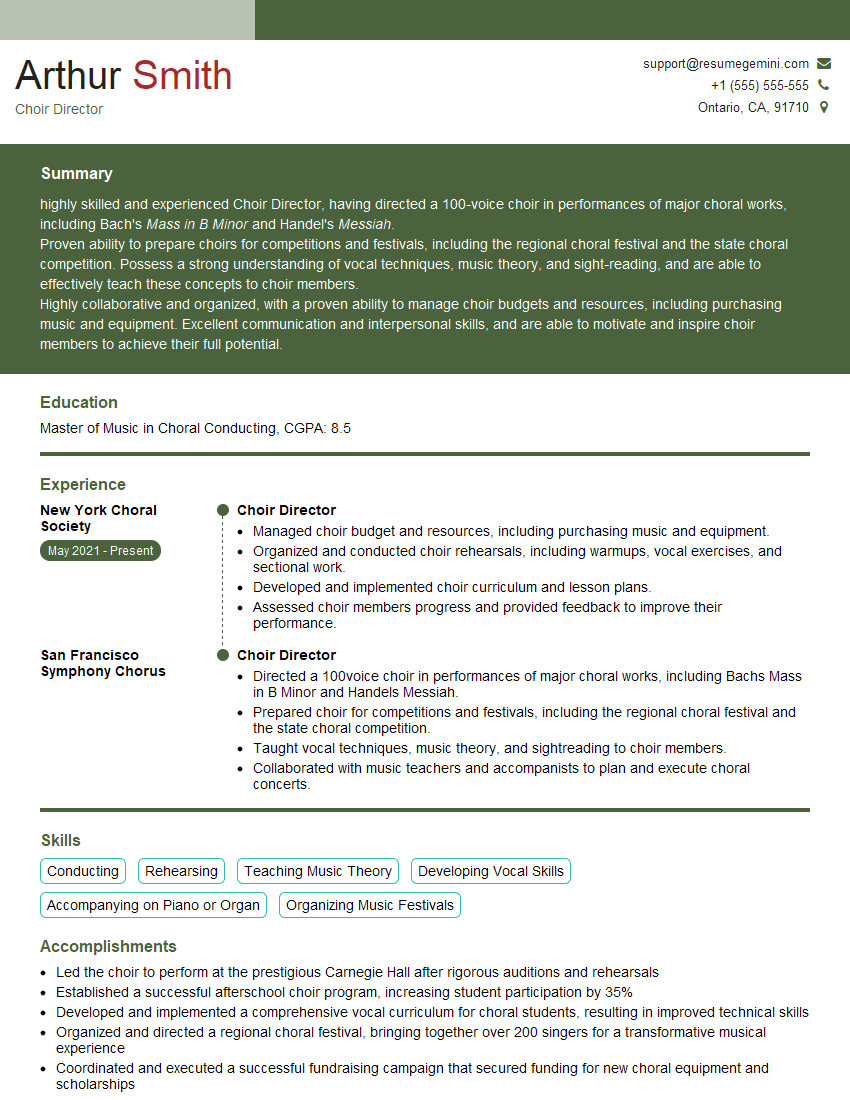
Choir Director Resume Sample

Guitar Teacher Resume Sample
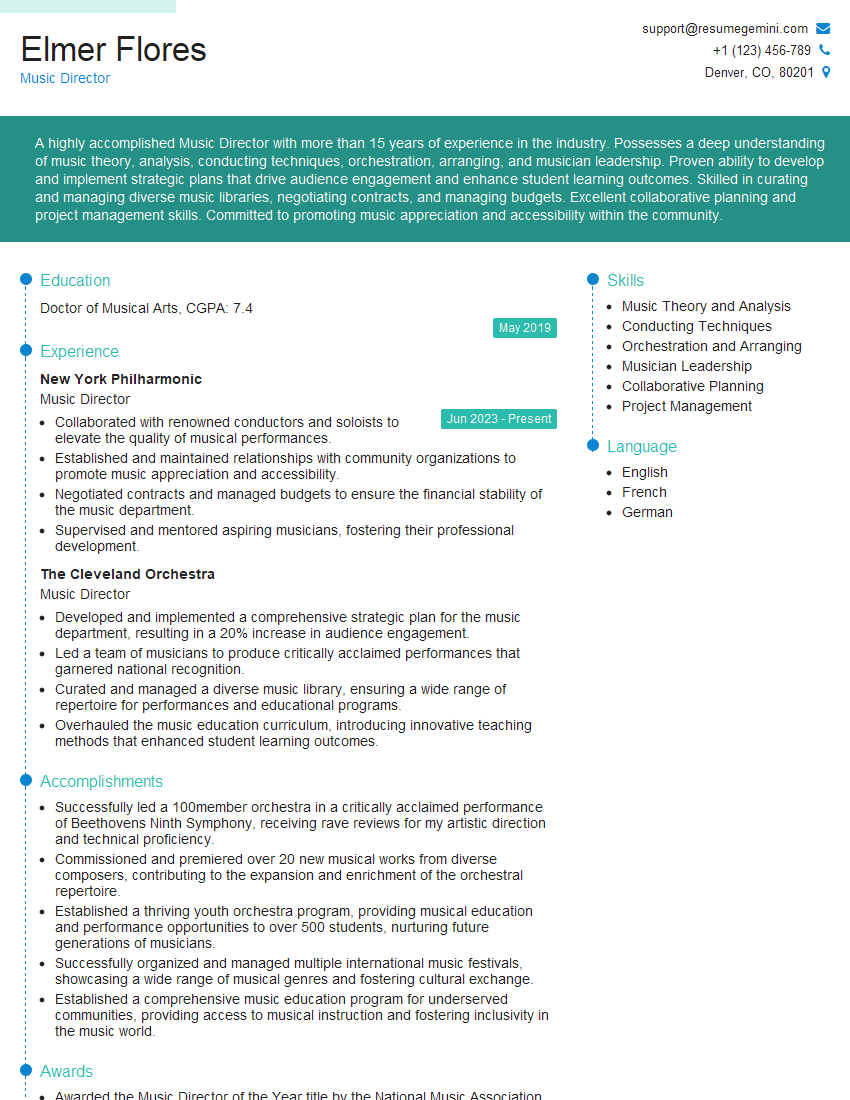
Music Director Resume Sample

Music Instructor Resume Sample

Piano Teacher Resume Sample

Music Teacher Resume Sample
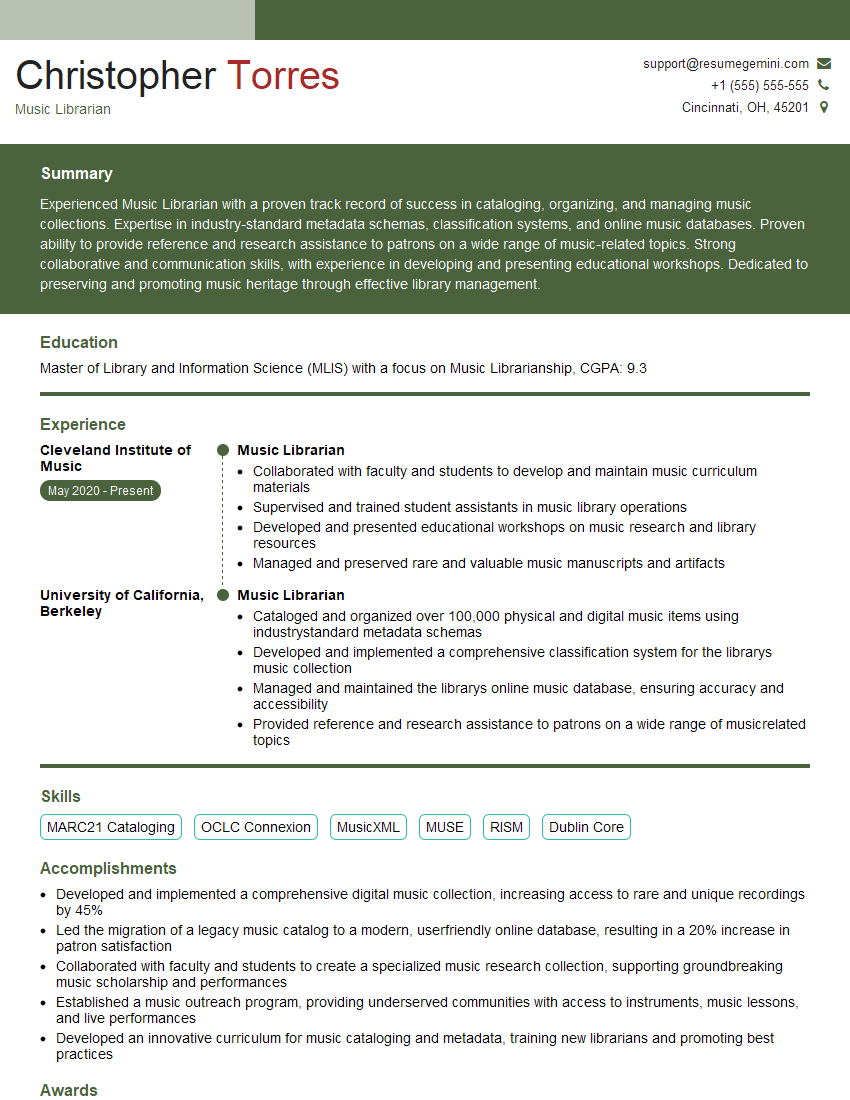
Music Librarian Resume Sample

Music Producer Resume Sample
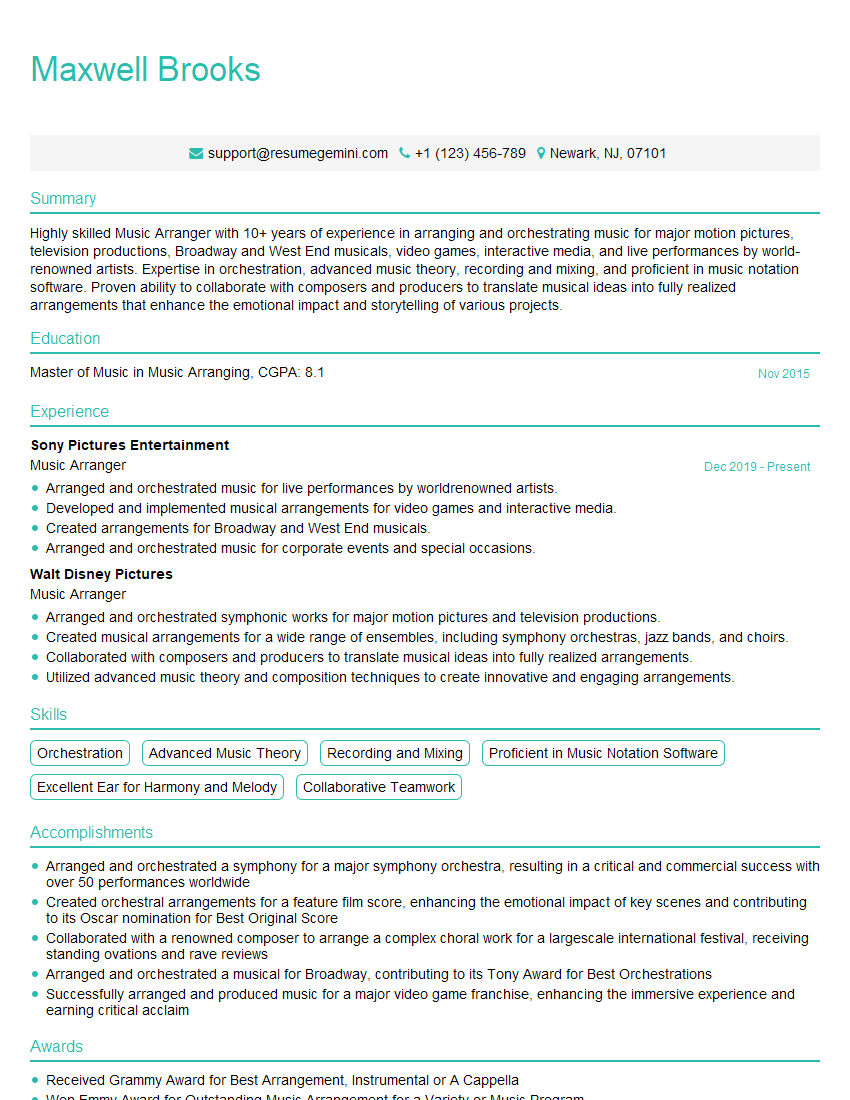
Music Arranger Resume Sample

Orchestrator Resume Sample
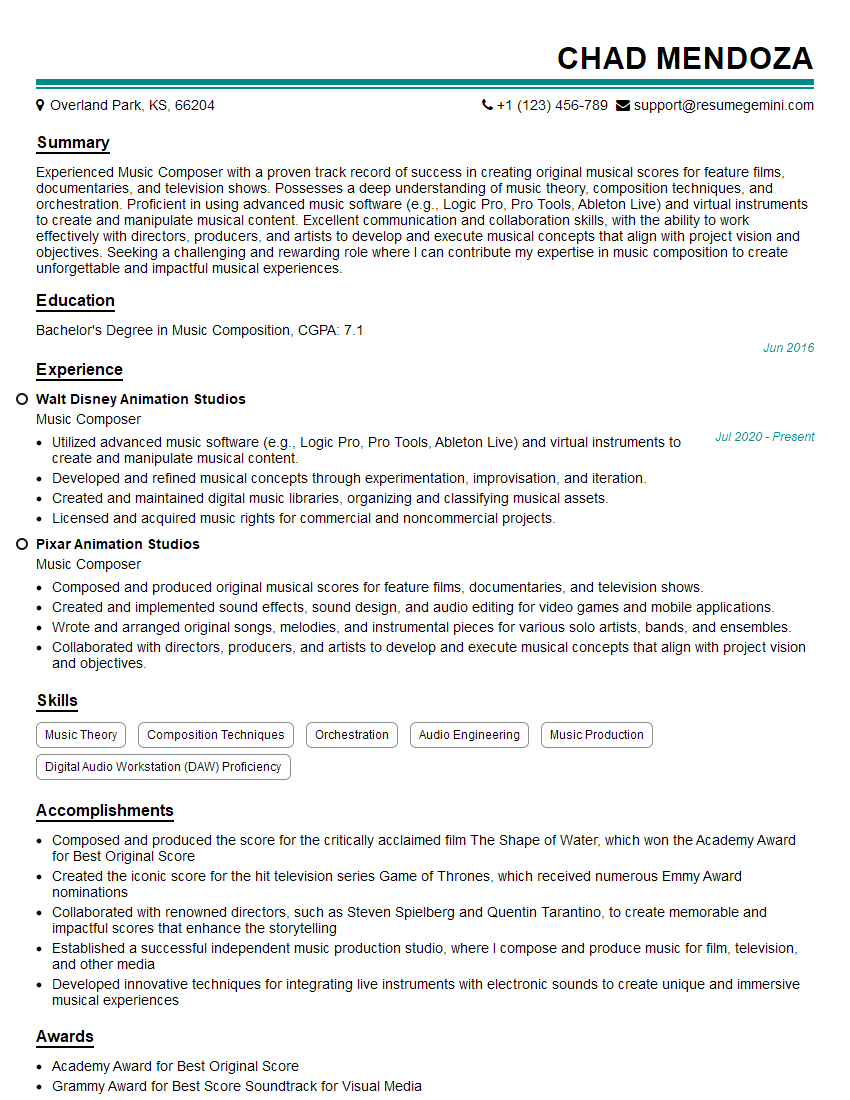
Music Composer Resume Sample
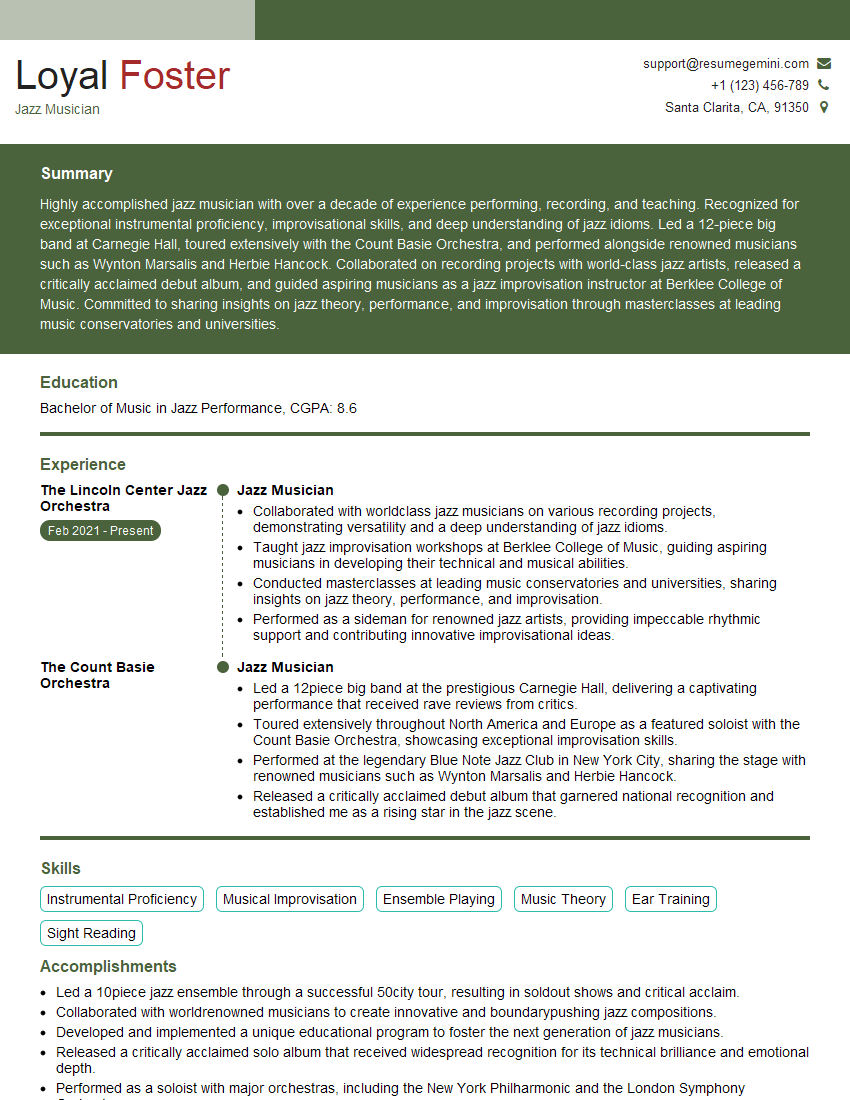
Jazz Musician Resume Sample

Audio Engineer Resume Sample

Music Therapist Resume Sample
Explore more articles
Users Rating of Our Blogs
Share Your Experience
We value your feedback! Please rate our content and share your thoughts (optional).
What Readers Say About Our Blog
Very informative content, great job.
good