Are you ready to stand out in your next interview? Understanding and preparing for Upholstery Assembly interview questions is a game-changer. In this blog, we’ve compiled key questions and expert advice to help you showcase your skills with confidence and precision. Let’s get started on your journey to acing the interview.
Questions Asked in Upholstery Assembly Interview
Q 1. Describe your experience with different upholstery techniques.
My upholstery experience encompasses a wide range of techniques, from traditional hand-sewing methods to the use of advanced power tools. I’m proficient in various styles, including channel tufting, button tufting, loose-cushion construction, and tight-seat construction. For example, I’ve worked extensively on restoring antique chairs using traditional hand-sewing techniques, requiring meticulous attention to detail and the use of specialized needles and thread. Conversely, I’ve also assembled modern sofas using pneumatic staple guns and power tools, prioritizing speed and efficiency while maintaining high quality. My understanding of these different approaches allows me to tailor my technique to the specific project requirements and the desired aesthetic.
- Traditional Hand-sewing: This method requires precise stitching and offers a unique, handcrafted look, ideal for bespoke pieces and restorations.
- Machine Stitching: Using industrial sewing machines increases efficiency and allows for consistent stitching, beneficial for mass production or projects requiring straight lines.
- Staple Gun Techniques: Essential for fastening fabric to frames efficiently, requiring knowledge of appropriate staple placement to avoid damage and ensure a taut finish.
Q 2. What types of upholstery materials are you familiar with?
I’m familiar with a vast array of upholstery materials, including various fabrics, leathers, and synthetics. My experience includes working with:
- Fabrics: Cotton, linen, velvet, silk, microfiber, chenille, and various blends. Each fabric has unique properties affecting its drape, durability, and maintenance.
- Leathers: Full-grain, top-grain, and genuine leather, each offering different levels of durability, texture, and price. Understanding the characteristics of different leather types is crucial for selecting the appropriate material for a project.
- Synthetics: Polyester, nylon, and other synthetic materials offer durability and stain resistance, often used for high-traffic areas or when affordability is a concern. These require different techniques to handle their specific properties.
- Foam: High-resilience foam, memory foam, and other types, impacting the comfort and longevity of the upholstery.
Choosing the right material is crucial. For example, a durable fabric like linen might be perfect for a dining chair, while a soft velvet would be more suitable for a living room sofa. I consider factors like the furniture’s intended use, the client’s budget, and the desired aesthetic when selecting materials.
Q 3. How do you ensure the proper fit and tension of upholstery fabric?
Achieving proper fit and tension is paramount to high-quality upholstery. It’s a balance of precision and skill. I start by ensuring the fabric is correctly measured and cut, leaving adequate seam allowances. Then, I use techniques like ‘pulling’ the fabric taut while stapling it to the frame, ensuring even tension across the surface. This prevents wrinkles, sagging, and ensures a professional, finished look. For curved surfaces, I may employ techniques like easing or pleating to manage the fabric’s flow. Tools such as a staple gun, tack strips, and specialized pliers are essential for this stage. I always double-check my work to guarantee evenness and avoid pulling the fabric too tightly, which could lead to puckering or damage.
Think of it like stretching a canvas for a painting: too loose, and it sags; too tight, and it wrinkles. The goal is a smooth, taut finish that enhances the furniture’s form and elegance.
Q 4. Explain your process for cutting and preparing upholstery fabric.
Cutting and preparing upholstery fabric requires precision and attention to detail. I begin by accurately measuring the piece of furniture to create a precise pattern. I then use sharp shears or an electric rotary cutter to cut the fabric according to the pattern, ensuring straight lines and precise angles. Any imperfections in the cut can compromise the final product. I always pre-treat the fabric, cleaning and addressing any existing flaws. This might involve steam cleaning, stain removal, or gentle washing, depending on the fabric type. Next, I lay out the fabric according to the grain to ensure consistency in the texture and appearance. Before assembling, I ensure all edges are neatly finished, using serging or binding to prevent fraying and enhance durability.
Think of this stage as preparing the ingredients for a complex recipe – the better the preparation, the better the outcome.
Q 5. Describe your experience with using various upholstery tools and machinery.
My proficiency extends to a wide range of upholstery tools and machinery. I’m adept at using:
- Hand tools: Needles, thread, seam rippers, upholstery shears, pliers, tack hammers, and various types of screwdrivers.
- Power tools: Pneumatic staple guns, electric sewing machines, and rotary cutters. Each requires specific safety procedures and techniques to operate effectively.
- Specialized tools: Cushion stuffing tools, webbing stretchers, and specialized pliers.
For instance, using a pneumatic staple gun efficiently and safely requires understanding its air pressure settings and proper staple placement to prevent damage to the fabric or the underlying frame. My familiarity with each tool allows me to select the most efficient and appropriate option for every step of the upholstery process.
Q 6. How do you handle challenges such as fabric imperfections or inconsistencies?
Fabric imperfections are an inevitable part of working with natural materials. When faced with imperfections, I assess the nature and extent of the defect. Minor flaws, like small holes or inconsistencies in color, can often be worked around by strategic placement of the fabric. For more significant imperfections, I may need to cut out the flawed section and carefully patch it with matching fabric, ensuring a seamless repair. This requires skills in pattern matching and meticulous stitching to ensure the repair is invisible. In extreme cases, if the imperfection cannot be successfully concealed or repaired, I would discuss the issue with the client to find the best solution, possibly suggesting a replacement piece of fabric if necessary.
Problem-solving is key. My experience allows me to creatively overcome these challenges while maintaining the high quality of my work.
Q 7. What safety precautions do you take when working with upholstery tools and materials?
Safety is my utmost priority. When working with upholstery tools and materials, I adhere to strict safety protocols. This includes:
- Proper use of personal protective equipment (PPE): Always wearing safety glasses, gloves, and dust masks when using power tools or working with potentially hazardous materials.
- Safe handling of power tools: Using power tools according to manufacturer’s instructions, ensuring they are properly maintained and serviced regularly.
- Careful handling of sharp objects: Using sharp objects like needles, shears, and staple guns with caution, keeping them away from exposed skin and properly storing them when not in use.
- Maintaining a clean and organized workspace: Minimizing tripping hazards and ensuring proper ventilation to prevent dust inhalation.
I regularly review safety procedures to ensure my continued compliance and understanding of best practices. This proactive approach helps prevent accidents and ensures a safe working environment.
Q 8. Explain your understanding of different types of foam and their applications in upholstery.
Understanding foam types is crucial for successful upholstery. Different foams offer varying degrees of firmness, resilience, and durability, impacting both comfort and the lifespan of the upholstered piece.
- Polyurethane foam: This is the most common type, available in various densities (measured in pounds per cubic foot or lb/ft³). Higher density foams are firmer and more durable, ideal for high-traffic areas like seating. Lower density foams are softer and more pliable, suitable for cushions and backrests requiring more give. For example, a high-density foam might be used for a sofa seat cushion, while a lower-density foam might be used for a decorative pillow.
- Memory foam: Known for its ability to conform to the body’s shape, memory foam provides excellent pressure relief and is often used in high-end furniture. However, it can be more expensive and less durable than polyurethane foam.
- Latex foam: A natural, durable option that offers excellent support and breathability. It’s more expensive than polyurethane but provides superior longevity and comfort. Often used in high-end, luxury upholstery.
- High-Resilience (HR) foam: A type of polyurethane foam known for its superior resilience and ability to spring back to its original shape after compression. Excellent for high-traffic areas.
The choice of foam depends on the specific application, budget, and desired level of comfort and durability. A skilled upholsterer understands these nuances to select the optimal foam for each project.
Q 9. How do you measure and cut foam for upholstery projects?
Accurate foam cutting is critical for a professional finish. I use a combination of precise measuring techniques and sharp tools.
- Measure twice, cut once: I always double-check my measurements against the existing frame or pattern before cutting. This prevents costly mistakes.
- Utilize proper tools: I use a sharp electric knife for straight cuts and a serrated knife for curved cuts. A ruler and measuring tape are essential for accuracy.
- Consider seam allowance: I always add extra foam to account for seams and potential shrinkage during the upholstery process. The amount depends on the fabric and foam type.
- Cutting techniques: For straight cuts, I use a long, straight edge as a guide for the knife. For curved cuts, I use templates or carefully freehand the cut, making sure to maintain consistency.
For instance, when upholstering a chair seat, I carefully measure the seat frame’s dimensions, add a seam allowance, transfer those measurements to the foam, and then proceed to cut it with precision. Any inaccuracies here will result in a poorly fitting seat cushion.
Q 10. Describe your experience with stapling, tacking, and other fastening techniques.
Fastening techniques are crucial for secure and aesthetically pleasing results. My experience encompasses various methods, each with its strengths and limitations.
- Stapling: This is the most common method, used for attaching fabric to the frame. I use an electric staple gun for efficiency and consistent penetration. The staple placement must be consistent and hidden as much as possible.
- Tacking: Tacking involves using upholstery tacks to secure fabric. This offers a more refined finish and is particularly useful in decorative applications or where a clean seam is desired. Tacking requires skill and precision to avoid damaging the fabric.
- Other fastening techniques: I’m also proficient in using glue (appropriate for foam and certain fabrics), Velcro (for removable or easily replaceable components), and even sewing (for custom details or repairs).
For example, when upholstering a curved surface, I might use a combination of stapling and tacking to ensure a snug and neat fit. In areas where the fabric needs to be particularly secure, I might reinforce with additional glue or stitching.
Q 11. How do you handle difficult-to-reach areas during the upholstery process?
Difficult-to-reach areas require strategic planning and specialized tools. I use a combination of techniques to ensure proper fabric placement and secure fastening.
- Extension tools: Long-reach staplers are invaluable for reaching deep into crevices. I also use specialized pliers to place tacks in tight spots.
- Flexible materials: Choosing pliable fabrics and foams helps navigate tight corners and curves more easily.
- Strategic cutting: I cut fabric in multiple smaller pieces, rather than one large piece, to facilitate easier maneuvering and secure placement in confined spaces.
- Patience and precision: These areas demand a meticulous approach. Rushing can lead to wrinkles, puckering, and loose fastenings.
For instance, when upholstering the arms of an armchair, I might use a long-reach stapler to secure the fabric to the underside of the arm, then carefully tuck and tack the fabric to create a smooth finish on the visible surface.
Q 12. What is your experience with different types of upholstery patterns?
I have experience with various upholstery patterns and their application. Understanding pattern placement is crucial for achieving a symmetrical and visually appealing result.
- Solid colors: These are simple to work with but require attention to detail to ensure consistent tension and a smooth finish.
- Stripes and checks: These patterns demand careful matching to ensure a seamless look. Precise cutting and measuring are essential.
- Floral and other intricate patterns: These patterns may require more complex cutting and placement techniques, as I need to consider pattern flow and orientation to achieve a professional outcome. Sometimes, special consideration must be given to the direction of the nap of the fabric.
- Damask and brocade: These rich, textured fabrics present their own challenges in terms of managing their weight and drape while maintaining even tension.
My experience allows me to adapt to different pattern complexities and to always achieve the desired aesthetic while maintaining structural integrity.
Q 13. How do you ensure consistent quality in your upholstery work?
Consistent quality is my top priority. I achieve this through a combination of skilled techniques, attention to detail, and quality materials.
- Preparation is key: I always start with a thorough assessment of the piece, ensuring all measurements are accurate and the frame is structurally sound.
- Proper material selection: Using high-quality fabrics and foams guarantees durability and longevity.
- Careful execution: I pay close attention to every step of the process, from cutting and measuring to stapling and finishing. I double-check my work regularly.
- Quality control: Before delivery, I conduct a thorough inspection, checking for any imperfections in the finish, seams, or firmness of the upholstery.
For example, I never skip steps and I’m meticulous about neat stapling. Even small details, like consistent tension on the fabric, contribute to the overall quality and professional appearance of the finished product.
Q 14. Describe your experience working with different types of frames and their construction.
Understanding frame construction is fundamental to upholstery. Different frame materials and construction methods impact the piece’s stability, durability, and suitability for various upholstery styles.
- Hardwood frames: These are the most durable and ideal for long-lasting pieces. Common hardwoods include oak, maple, and beech. The joints should be securely joined, often using dowels, glue, and screws for extra strength.
- Softwood frames: These are less durable but more affordable. Pine and fir are common examples. These require reinforcement in high-stress areas.
- Metal frames: These are becoming more common, often made of steel or aluminum. They provide good support and are less susceptible to warping. However, they can be heavier.
My experience allows me to assess the structural integrity of a frame, identify any weaknesses, and recommend appropriate solutions – like reinforcing joints – to ensure the longevity of the upholstered piece. For instance, I can easily recognize a poorly constructed frame prone to sagging by analyzing its joints and wood quality.
Q 15. How do you identify and address common upholstery problems?
Identifying and addressing upholstery problems requires a keen eye for detail and a systematic approach. I begin by carefully inspecting the piece, noting any inconsistencies in fabric tension, seams, filling, or framework. Common problems include sagging cushions, ripped seams, worn fabric, and loose buttons.
- Sagging Cushions: This often indicates a problem with the inner cushion filling (foam, feathers, etc.) or the stitching that holds the cushion cover in place. I’d assess the filling, potentially replacing it if necessary, and reinforce the stitching.
- Ripped Seams: These are repaired using appropriate stitching techniques, matching the original stitch type and thread as closely as possible. Strong, durable thread is crucial for long-lasting repairs.
- Worn Fabric: Depending on the extent of the wear, I might patch the fabric, using a similar material to minimize visibility, or recommend replacement, particularly for high-traffic areas.
- Loose Buttons: I would check the button’s shank and the underlying fabric. Often, a simple re-sewing or adding a button reinforcing patch will solve the issue.
Addressing these issues requires a combination of careful examination, appropriate repair techniques, and the right tools. I always prioritize preserving the original integrity and aesthetic appeal of the piece whenever possible.
Career Expert Tips:
- Ace those interviews! Prepare effectively by reviewing the Top 50 Most Common Interview Questions on ResumeGemini.
- Navigate your job search with confidence! Explore a wide range of Career Tips on ResumeGemini. Learn about common challenges and recommendations to overcome them.
- Craft the perfect resume! Master the Art of Resume Writing with ResumeGemini’s guide. Showcase your unique qualifications and achievements effectively.
- Don’t miss out on holiday savings! Build your dream resume with ResumeGemini’s ATS optimized templates.
Q 16. What are some of the common mistakes to avoid in upholstery assembly?
Several common mistakes can significantly impact the quality and longevity of an upholstered piece. Avoiding these is key to successful upholstery assembly:
- Incorrect Fabric Measurement and Cutting: Accurate measurements are paramount. A miscalculation can lead to insufficient fabric or awkwardly fitted covers. I always double-check measurements and add seam allowances.
- Improper Seam Construction: Using incorrect stitch types or insufficient stitching can lead to weak seams that easily unravel. Understanding stitch types and their applications is crucial (discussed further in Question 5).
- Neglecting to Pre-shrink Fabric: Some fabrics shrink after washing or exposure to moisture. Pre-shrinking prevents distortions and maintains the final product’s shape and size.
- Poor Staple Gun Technique: Stapling is essential for attaching fabric to the frame; uneven stapling can create puckers, folds, or tear the fabric. I always use the appropriate staple size and spacing for the specific fabric and frame material.
- Ignoring Proper Cushion Construction: Incorrect filling or poorly constructed cushions can lead to sagging and an uncomfortable piece. Using the right filling material and ensuring proper density is essential.
Careful planning, attention to detail, and the use of appropriate techniques are essential to prevent these common errors.
Q 17. Explain your experience with using sewing machines for upholstery applications.
My experience with sewing machines for upholstery extends over [Number] years. I’m proficient with both industrial and domestic machines, understanding their capabilities and limitations. I’ve worked with various models, each suited for specific tasks. Industrial machines, for example, are built for heavier-duty work, handling thicker fabrics and stitching longer seams with greater speed and precision than domestic machines. Domestic machines are great for smaller projects or delicate fabrics.
Selecting the right machine is crucial. For heavy-duty upholstery, I use industrial-grade walking foot machines, which help to feed multiple layers of fabric evenly. For intricate detailing or lighter fabrics, I use a high-quality domestic sewing machine with an appropriate needle and thread. Regular maintenance, including cleaning, oiling, and replacing needles, is critical for ensuring smooth operation and achieving high-quality stitching.
I’m familiar with various sewing machine attachments such as zipper feet, buttonhole feet, and different presser feet which are vital for efficient and accurate results.
Q 18. How do you maintain and clean your upholstery tools and equipment?
Maintaining and cleaning upholstery tools and equipment is crucial for both their longevity and the quality of my work. After each project, I meticulously clean my sewing machine, removing lint and debris from the bobbin case, feed dogs, and other areas. I lubricate moving parts with appropriate sewing machine oil. My staple gun is cleaned regularly to ensure smooth operation and prevent jams.
My other tools, such as scissors, seam rippers, measuring tapes, and hand needles, are also cleaned and stored appropriately. I always keep my workspace organized and clean to prevent accidents and maintain efficiency. Regular sharpening of my scissors and other cutting tools ensures precision. I follow the manufacturer’s recommendations for cleaning and maintenance of each tool.
Q 19. Describe your understanding of different types of sewing stitches and their applications in upholstery.
Understanding different sewing stitches and their applications is fundamental to successful upholstery. Several stitches are commonly used:
- Straight Stitch: A basic stitch used for seams, joining fabric pieces, and attaching decorative elements. It’s strong and versatile.
- Zigzag Stitch: Used for finishing raw edges to prevent fraying, adding flexibility to seams, and attaching elastic or other stretchy materials.
- Blind Stitch: Creates a nearly invisible seam, perfect for joining fabric edges neatly.
- Saddle Stitch: A strong hand stitch, often used for attaching buttons or creating decorative seams. It’s durable and aesthetically pleasing.
- Running Stitch: A simple hand stitch used for basting or gathering fabric. It’s easy to execute but less durable than other stitches.
The choice of stitch depends on the fabric, the project’s requirements, and the desired aesthetic. For example, a durable straight stitch might be used for a sofa seam, while a blind stitch might be preferred for a cushion cover. I select the appropriate stitch based on my detailed understanding of its strength and visual impact.
Q 20. How do you manage your time effectively when working on multiple upholstery projects?
Managing time effectively when working on multiple upholstery projects involves careful planning and organization. I utilize project management techniques, such as creating detailed timelines for each project, breaking down larger tasks into smaller, manageable steps, and prioritizing tasks based on deadlines and client needs. I maintain a detailed inventory of my materials and tools to avoid delays.
I also use a scheduling system, such as a digital calendar or planner, to allocate specific time blocks for each task. This helps me stay focused and prevents multitasking, which can decrease efficiency. Regularly reviewing my schedule and adjusting priorities as needed ensures that I complete all projects on time and to the highest standard.
Q 21. How do you prioritize tasks and meet deadlines in a fast-paced environment?
In a fast-paced environment, prioritizing tasks and meeting deadlines requires a combination of planning, efficient workflow, and effective communication. I utilize a prioritization matrix, such as the Eisenhower Matrix (urgent/important), to categorize tasks and allocate my time accordingly. Urgent and important tasks receive immediate attention, while less urgent tasks are scheduled strategically.
I communicate regularly with clients, providing updates on progress and addressing any concerns promptly. Proactive communication helps to manage expectations and prevent delays. I also build in buffer time for unexpected issues or delays, allowing for flexibility in my schedule. This ensures that even with unforeseen circumstances, I can still meet my deadlines.
Q 22. What is your experience with working from blueprints or sketches?
Working from blueprints or sketches is fundamental in upholstery assembly. My experience encompasses interpreting various design representations, from detailed technical drawings to freehand sketches. I’m proficient in understanding scale, dimensions, material specifications, and construction techniques indicated in these documents. For instance, I’ve worked with blueprints detailing complex curved sofa designs, accurately translating the 2D representations into the 3D reality of the finished piece. I’m adept at identifying potential discrepancies or ambiguities and seeking clarification before commencing work to ensure accuracy and avoid costly mistakes. I also understand how to effectively utilize measurements and annotations provided to build accurate patterns and cut fabric accordingly.
Q 23. How do you adapt to changes in designs or instructions during a project?
Adaptability is crucial in upholstery. I approach design changes methodically. First, I carefully review the modifications, clarifying any uncertainties with the designer or supervisor. Next, I assess the impact of the changes on the existing structure and materials. This might involve recalculating fabric needs, adjusting cutting patterns, or modifying assembly steps. For example, a recent project involved a last-minute change to the armrest design of a chair. Instead of panicking, I calmly assessed the alterations, adjusted the cutting pattern, and seamlessly integrated the new design into the assembly process without compromising the overall quality or timeline. My experience allows me to anticipate potential challenges and plan accordingly, ensuring a smooth workflow.
Q 24. Describe your experience with quality control procedures in upholstery assembly.
Quality control is integrated into every stage of my upholstery process. It begins with inspecting the materials—checking for fabric defects, foam density, and the structural integrity of the frame. During assembly, I meticulously follow each step, ensuring proper stitching, consistent tension, and accurate placement of components. I regularly conduct self-inspections, cross-checking my work against the design specifications. After completion, I conduct a final quality check, evaluating the overall aesthetic appeal, comfort, and structural soundness. Any minor imperfections are immediately addressed. I’m also familiar with industry-standard quality control checklists and documentation procedures, and I maintain detailed records of my work. I believe that proactive quality control minimizes rework, reduces waste, and ensures customer satisfaction.
Q 25. How do you handle customer complaints or issues with your work?
Handling customer complaints requires a professional and empathetic approach. I start by actively listening to the customer, understanding their concerns, and acknowledging their frustration. I then thoroughly investigate the issue, examining the piece to identify the source of the problem. This could involve anything from a loose stitch to a larger structural flaw. Based on my findings, I offer a solution, whether it’s a minor repair, a replacement part, or a more comprehensive rework. My aim is to resolve the issue efficiently and to the customer’s satisfaction, restoring their confidence in my workmanship. I believe clear communication and a proactive attitude are key to building trust and turning a negative experience into a positive one. I have always prioritized restoring the customer’s trust and upholding the shop’s reputation.
Q 26. What are your strengths and weaknesses as an upholstery assembler?
My strengths include meticulous attention to detail, a strong work ethic, and the ability to adapt quickly to new challenges. I am efficient, consistently meeting deadlines, and I take pride in delivering high-quality work. My experience with a wide range of upholstery techniques, from traditional to contemporary styles, makes me a versatile asset. A weakness I’m actively working on is delegation. While I’m comfortable handling all aspects of a project myself, I recognize the benefits of teamwork and am actively seeking opportunities to improve my leadership and delegation skills in a team environment.
Q 27. What are your salary expectations for this position?
My salary expectations are commensurate with my experience and skills, and I am open to discussing a competitive compensation package based on the specifics of this position and the company’s salary range. I am confident that my contributions will quickly exceed the investment in my compensation.
Q 28. Why are you interested in this upholstery assembly position?
I am interested in this upholstery assembly position because of [Company Name]’s reputation for high-quality craftsmanship and its commitment to customer satisfaction. I’m excited about the opportunity to contribute my skills and experience to a company that values precision and attention to detail. The opportunity to work on challenging projects and to learn from experienced professionals is particularly appealing. Furthermore, I’m impressed by [Company Name]’s commitment to [mention a specific company value or initiative that resonates with you]. I believe my work ethic and skills are a strong match for your team’s needs and I’m eager to contribute to your continued success.
Key Topics to Learn for Upholstery Assembly Interview
- Understanding Upholstery Materials: Learn the properties of different fabrics, foams, and fillings. Know their strengths, weaknesses, and appropriate applications in various furniture pieces.
- Cutting and Preparation Techniques: Master accurate fabric cutting, pattern matching, and preparation of materials for efficient assembly. This includes understanding fabric grain and nap.
- Frame Construction and Preparation: Familiarize yourself with different types of furniture frames and their assembly. Understand how to identify and address potential frame issues before upholstery begins.
- Staple Gun Operation and Techniques: Develop proficiency in using a staple gun safely and effectively. Understand different staple types and their applications for various materials and thicknesses.
- Sewing and Stitching Techniques (if applicable): If your role involves sewing, demonstrate knowledge of relevant stitches, seam finishes, and appropriate thread selection for durability and aesthetic appeal.
- Quality Control and Inspection: Understand the importance of quality checks throughout the assembly process to identify and rectify defects before completion. This involves understanding industry standards and expectations.
- Problem-Solving and Troubleshooting: Be prepared to discuss how you approach challenges during assembly, such as material inconsistencies, fitting issues, or mechanical malfunctions. Highlight your ability to find solutions efficiently.
- Safety Procedures and Practices: Demonstrate knowledge of relevant safety regulations and practices related to power tools, sharp objects, and handling of materials.
- Teamwork and Collaboration: Upholstery assembly often involves teamwork. Be ready to discuss your experience working collaboratively and contributing to a team’s success.
Next Steps
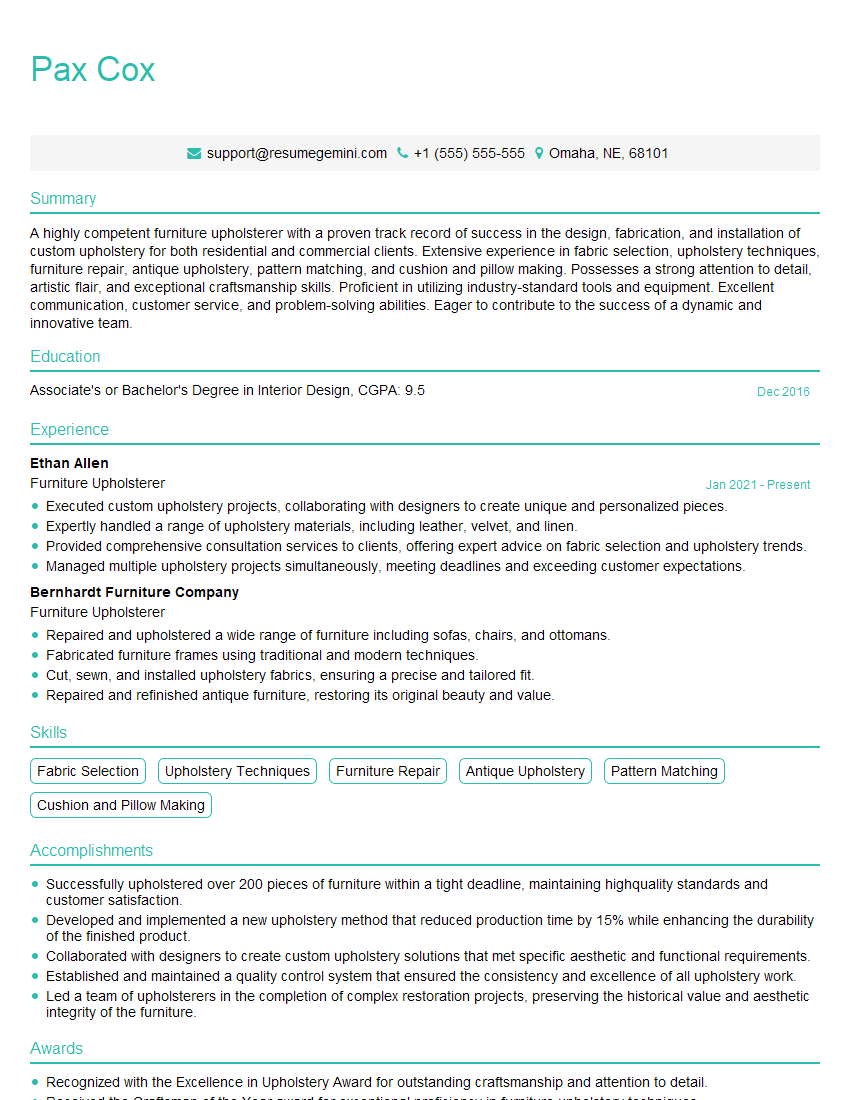
Mastering Upholstery Assembly opens doors to a rewarding career with opportunities for advancement and specialization. To increase your chances of landing your dream job, creating a strong, ATS-friendly resume is crucial. ResumeGemini is a trusted resource that can help you build a professional and impactful resume that highlights your skills and experience. Examples of resumes tailored to Upholstery Assembly are provided to help guide you. Take the next step towards your career success today!
Explore more articles
Users Rating of Our Blogs
Share Your Experience
We value your feedback! Please rate our content and share your thoughts (optional).
What Readers Say About Our Blog
Very informative content, great job.
good