Interviews are opportunities to demonstrate your expertise, and this guide is here to help you shine. Explore the essential Scanography interview questions that employers frequently ask, paired with strategies for crafting responses that set you apart from the competition.
Questions Asked in Scanography Interview
Q 1. Explain the differences between various scanning technologies (e.g., flatbed, sheetfed, rotary).
Scanning technologies differ significantly in their speed, capacity, and suitability for various document types. Let’s compare three common types: flatbed, sheetfed, and rotary scanners.
- Flatbed Scanners: These are the most common type for home use and smaller offices. They work like a copy machine, where you place the document face down on a glass platen. A light source illuminates the document, and the scanner captures the image. They’re great for single-page documents, books (using a book cradle), and fragile items because there’s no mechanical feed. However, they’re slow for large volumes.
- Sheetfed Scanners: These use a mechanism to automatically feed multiple sheets of paper through the scanner. They’re faster than flatbeds and ideal for high-volume scanning of documents like invoices or receipts. However, they can jam with certain paper types or damaged documents, and usually cannot handle thicker items like books.
- Rotary Scanners: These are high-speed, high-volume scanners typically used in large organizations for archival purposes. Documents are fed onto a rotating drum, and the image is captured by a sensor as it spins. They’re very efficient but expensive, complex, and typically require specialized training to operate.
The choice depends on the volume, types of documents, and budget. A small office might use a flatbed for occasional scanning, while a large archive would need rotary scanners for efficiency.
Q 2. Describe your experience with different image file formats (e.g., TIFF, JPEG, PDF).
My experience encompasses a wide range of image file formats, each with its own strengths and weaknesses. Here are a few key ones:
- TIFF (Tagged Image File Format): TIFF is a lossless format, meaning no image data is lost during compression. It’s excellent for archiving and preserving image quality, especially crucial for legal or historical documents. Its large file sizes are the main drawback.
- JPEG (Joint Photographic Experts Group): JPEG uses lossy compression, resulting in smaller file sizes. It’s ideal for images intended for web use or display where small file size is prioritized over absolute image fidelity. It’s not suitable for archival purposes as repeated saving will degrade the image quality.
- PDF (Portable Document Format): PDF is a versatile format capable of representing both images and text. It’s great for preserving document layout and is widely compatible across different platforms. The ability to embed searchable text within a scanned document (OCR) is key for efficient retrieval.
My workflow often involves scanning to TIFF for archival purposes and creating optimized JPEGs or PDFs for dissemination. The choice depends entirely on the intended use and storage limitations.
Q 3. How do you ensure the quality and accuracy of scanned images?
Ensuring quality and accuracy involves a multi-step process starting with the preparation stage and extends to post-processing:
- Pre-Scanning Preparation: This includes cleaning the scanner glass, ensuring proper lighting, and correctly orienting documents to minimize skew. Damaged documents need to be carefully handled to prevent further damage.
- Scanner Settings Optimization: Setting the correct resolution (DPI) is crucial. Higher resolution (e.g., 300 DPI or higher) provides better detail for text and images, but results in larger file sizes. Choosing the appropriate color mode (grayscale for text-heavy documents, color for photos) is essential.
- Post-Scanning Quality Control: I thoroughly review each scanned image for clarity, skew, dust, and other imperfections. I utilize image editing software to correct any identified issues.
- Regular Calibration: Regular calibration of the scanner using standardized test charts ensures consistent color reproduction and accuracy.
For instance, when scanning historical documents, I prioritize preserving the integrity of the original material and use specialized lighting and handling techniques to minimize damage. For large volume projects, implementing automated quality checks using software is vital.
Q 4. What are the best practices for managing large volumes of scanned documents?
Managing large volumes of scanned documents requires a structured approach focusing on organization, storage, and retrieval. This involves:
- File Naming Conventions: Implementing consistent and descriptive file naming conventions (e.g., YYYYMMDD_DocumentName_PageNum) is crucial for easy organization and retrieval.
- Metadata Tagging: Adding metadata (date, document type, keywords) to each file enables efficient searching and filtering. Software like Adobe Acrobat Pro can facilitate this.
- Optical Character Recognition (OCR): Applying OCR converts scanned images into searchable text, making it easy to find specific information within the documents.
- Efficient Storage Solutions: Utilizing network-attached storage (NAS) or cloud-based storage solutions ensures accessibility and redundancy. Cloud services often offer robust search and collaboration features.
- Version Control: Implementing a version control system to keep track of revisions helps prevent accidental overwriting of important files.
Regular backups are also crucial to prevent data loss. I often use a combination of local backups and cloud storage for enhanced security.
Q 5. Explain your experience with image enhancement and restoration techniques.
Image enhancement and restoration are critical for improving the quality of older or damaged documents. I use a range of techniques depending on the specific problem:
- Dust and Scratch Removal: Software like Adobe Photoshop provides tools to effectively remove dust and scratches without significantly affecting the image content.
- Color Correction: Adjusting brightness, contrast, and color balance can improve the readability and visual appeal of faded or discolored documents.
- Noise Reduction: Techniques like Gaussian blur can smooth out noise and graininess in older scanned images, improving clarity.
- Perspective Correction: This corrects skew and distortion, making the scanned image more visually appealing and easier to read.
- Image Interpolation: This technique can be used to increase the resolution of a low-resolution image, but care must be taken to avoid introducing artifacts.
For example, when restoring a faded photograph, I carefully adjust the color balance and contrast to bring out the details while avoiding over-processing. The goal is to improve the image without altering the historical accuracy.
Q 6. Describe your workflow for scanning and processing various document types.
My workflow is adaptable to different document types, but generally follows these steps:
- Assessment and Preparation: I assess the condition of the documents and plan accordingly, selecting the appropriate scanning equipment and settings.
- Scanning: I utilize the best scanning technology for the job (flatbed for delicate items, sheetfed for high volume). I meticulously adjust settings for optimal quality.
- Quality Control: I carefully review each scan for quality issues and correct them using image editing software.
- OCR (if applicable): I perform OCR to make the text searchable if necessary.
- File Management and Archiving: I organize the files using a consistent naming convention, add metadata, and store the final files in the appropriate location.
For example, when scanning books, I use a book cradle on a flatbed scanner to avoid damaging the spine. When dealing with large blueprints, I might use a large-format scanner. The key is adaptability and understanding the limitations of each type of document.
Q 7. How do you handle errors or inconsistencies during the scanning process?
Errors and inconsistencies can occur at various stages. My approach focuses on proactive prevention and reactive problem-solving:
- Proactive Measures: Regular maintenance of equipment, proper document handling, and consistent quality checks minimize errors. Testing the scanner settings on sample documents helps identify potential problems early.
- Reactive Solutions: If errors occur during scanning, I identify the cause (e.g., paper jams, skewed scans, OCR errors). I then rescan the affected documents or use image editing software to correct the issues. For significant errors, I may need to repeat the entire process for that batch.
- Documentation and Tracking: I keep detailed logs of the scanning process, including any errors or inconsistencies encountered and the steps taken to resolve them. This is invaluable for troubleshooting and process improvement.
For example, a paper jam might necessitate cleaning the scanner’s feed mechanism. OCR errors often require manual correction. A rigorous record-keeping system allows me to address issues promptly and learn from mistakes.
Q 8. What are the key considerations for selecting appropriate scanning resolutions and settings?
Selecting the right scanning resolution and settings is crucial for achieving optimal image quality and file size. It’s a balancing act; higher resolution means more detail but significantly larger file sizes, while lower resolution sacrifices detail for smaller files.
The optimal resolution depends entirely on the material being scanned and its intended use. For example:
- Archival purposes or high-resolution printing: A resolution of 600 dpi (dots per inch) or even higher might be necessary to capture fine details and textures. Think of scanning a valuable historical document or a highly detailed artwork.
- Web use or general document sharing: A resolution of 150-300 dpi is often sufficient. This offers a good balance between image clarity and file size, ideal for scanning documents for online distribution or everyday use.
Beyond resolution, settings like color depth (e.g., 24-bit color for vibrant images, grayscale for text-heavy documents), file format (TIFF for archival quality, JPEG for smaller file sizes), and the type of scan (color, grayscale, black and white) all play a significant role. Experimenting with different settings on test scans is crucial to finding the optimal balance for each specific scanning task. I always advise starting with a higher resolution than initially anticipated and then working downwards if file sizes become problematic.
Q 9. What experience do you have with color calibration and image profiling?
Color calibration and image profiling are essential for ensuring consistent and accurate color reproduction across different scans and devices. I’ve extensive experience using colorimeters and spectrophotometers to measure and profile scanners and monitors, creating ICC profiles that correct for variations in color response.
For example, I recently worked on a project involving scanning antique maps. The original colors were faded and inconsistent due to age and exposure. By creating a custom ICC profile for the scanner and the target output device (a high-quality inkjet printer), I was able to achieve highly accurate color reproduction in the final printed maps. Without proper calibration, the printed maps would have appeared significantly different from the originals and wouldn’t have been historically accurate.
My experience also extends to software-based color correction tools, where I use image editing software to refine scans and match color consistency across batches. I regularly perform test scans with color charts to verify accuracy and adjust settings as needed. This ensures that my final outputs are as true to the originals as technically possible.
Q 10. Explain your knowledge of metadata and its importance in scanography.
Metadata is crucial in scanography as it provides essential information about the scanned image, improving organization, searchability, and the long-term preservation of the digital assets. Think of metadata as the digital equivalent of the information you’d write on the back of a photograph – who, what, when, and where.
Key metadata elements include:
- Date and time of scan: Tracks when the scan was created.
- Scanner model and settings used: Documents the hardware and software used.
- Description of the scanned item: Provides contextual information about the original document or object.
- Keywords: Facilitates searching and retrieval of scans.
- Copyright information: Protects intellectual property rights.
Implementing robust metadata management ensures that scanned materials are easily discoverable and maintain their context over time. I always embed metadata directly into the image files using industry-standard formats like IPTC or XMP, ensuring the information travels with the image regardless of where it is stored or accessed.
Q 11. How do you ensure the security and integrity of scanned data?
Ensuring the security and integrity of scanned data is paramount. My approach involves a multi-layered strategy:
- Access control: Restricting access to scanned data through password protection, secure storage locations, and permissions systems. I avoid storing sensitive data in easily accessible public cloud services without proper encryption.
- Data backup and redundancy: Regularly backing up scanned data to multiple locations, using both local and cloud storage, to prevent data loss due to hardware failure or other unforeseen events. I utilize RAID systems where appropriate for critical data.
- Digital signatures: To verify the authenticity and integrity of the scanned data. I use digital signatures when necessary to guarantee that files haven’t been altered or tampered with since the original scan.
- Data encryption: Employing encryption to protect sensitive data during storage and transmission. This safeguards the information from unauthorized access.
Following these practices, I ensure that the integrity of the scanned materials remains intact and they are protected from loss or unauthorized access. This is particularly crucial when dealing with confidential or historically significant documents.
Q 12. Describe your experience with different scanning software and hardware.
My experience encompasses a wide range of scanning hardware and software. I am proficient with high-end flatbed scanners from manufacturers like Epson, Canon, and HP, as well as production-level document scanners such as those from Kodak and Fujitsu. I have also worked with various specialized scanners for large-format documents, books, and film negatives.
On the software side, I’m experienced with Adobe Photoshop, Lightroom, and Capture One for image editing and processing. I’m also proficient with various document management systems, including those used for archiving large collections of scanned materials. I am adept at adapting my workflows to suit various hardware and software combinations to maximize efficiency and quality. For example, I often use specialized software to stitch together images from multiple scans of large documents, creating a single high-resolution digital file.
Q 13. How do you handle large or fragile documents during the scanning process?
Handling large or fragile documents requires careful planning and specialized techniques. My approach depends on the nature of the material:
- Book scanning: I use a book cradle or scanner designed to prevent damage to the binding. This allows for scanning open pages without stress to the spine. If the pages are extremely delicate, I may choose to scan one page at a time, carefully supporting each page with archival-quality materials.
- Large-format documents: These might require the use of a large-format scanner or a combination of smaller scans that are later stitched together using image editing software. I always use appropriate backing and support materials to prevent damage.
- Fragile documents: These require extra care, often involving the use of archival-quality gloves and supports to minimize handling and prevent damage during the scanning process. Sometimes, non-contact scanning methods are necessary.
In all cases, I prioritize preservation and minimizing risk to the original documents. Before starting any scan, I conduct a thorough assessment of the document’s condition and choose the most appropriate scanning method and equipment to protect it.
Q 14. Explain your understanding of image compression techniques and their impact on file size and quality.
Image compression techniques are used to reduce the file size of scanned images. However, this often involves a trade-off between file size and image quality. There are two main types of compression: lossy and lossless.
- Lossy compression: (e.g., JPEG) discards some image data during compression, resulting in smaller file sizes but potentially some loss of image quality. This is acceptable for images where slight quality loss is acceptable, such as web images.
- Lossless compression: (e.g., TIFF, PNG) retains all image data, resulting in larger file sizes but no loss of quality. This is ideal for archival purposes or when high image fidelity is essential.
The choice of compression technique depends on the intended use of the scanned image. For archival purposes or when maximum image quality is required, lossless compression is preferable, even if it leads to larger file sizes. For web use or situations where file size is more of a concern, lossy compression may be a more practical choice, but it’s crucial to carefully balance compression level with acceptable image quality loss. I frequently use different compression methods depending on the needs of the project.
Q 15. How do you prioritize tasks and manage your time effectively during a high-volume scanning project?
Prioritizing tasks and managing time effectively during a high-volume scanning project is crucial for meeting deadlines and maintaining quality. I employ a multi-pronged approach. First, I meticulously analyze the project scope, identifying the total volume, document types, required processing (e.g., OCR, indexing), and deadlines. This allows me to create a realistic timeline and break down the project into manageable chunks.
Next, I utilize project management tools, such as Trello or Asana, to visualize tasks, assign priorities (e.g., using the MoSCoW method – Must have, Should have, Could have, Won’t have), and track progress. This helps me stay organized and identify potential bottlenecks early on. For example, if I’m scanning a large number of fragile documents, I might prioritize those first to minimize the risk of damage. Simultaneously, I’ll schedule tasks that can be done concurrently, like prepping documents while a batch is being scanned.
Finally, I regularly review my progress, adapt my schedule as needed, and communicate openly with stakeholders to manage expectations and ensure alignment. Regular breaks are also key to maintaining focus and avoiding burnout, a crucial element often overlooked in high-pressure situations.
Career Expert Tips:
- Ace those interviews! Prepare effectively by reviewing the Top 50 Most Common Interview Questions on ResumeGemini.
- Navigate your job search with confidence! Explore a wide range of Career Tips on ResumeGemini. Learn about common challenges and recommendations to overcome them.
- Craft the perfect resume! Master the Art of Resume Writing with ResumeGemini’s guide. Showcase your unique qualifications and achievements effectively.
- Don’t miss out on holiday savings! Build your dream resume with ResumeGemini’s ATS optimized templates.
Q 16. Describe your experience working with Optical Character Recognition (OCR) software.
My experience with Optical Character Recognition (OCR) software is extensive. I’m proficient in using several leading OCR programs, including ABBYY FineReader, Adobe Acrobat Pro, and Tesseract OCR. My expertise goes beyond simply running the software; I understand the nuances of OCR technology, including its limitations and how to optimize its accuracy. For instance, I know that the quality of the scanned image directly impacts OCR accuracy. Therefore, I always prioritize proper scanning settings to ensure high-resolution images with minimal noise or distortion.
I often need to fine-tune OCR settings depending on the document type. For example, documents with unusual fonts or layouts may require specific adjustments to the OCR engine’s language settings, character recognition parameters, or zone editing. Furthermore, post-processing OCR output is essential. I routinely review and correct any errors that the software might have made, ensuring the highest possible accuracy for data extraction. This can include manually correcting misread words, resolving layout issues, and verifying the accuracy of extracted data against the original document. For example, in a financial document, verifying numerical accuracy is paramount.
Q 17. How do you troubleshoot common scanning problems?
Troubleshooting scanning problems requires a systematic approach. I start by identifying the nature of the problem – is it a hardware issue, a software glitch, or a problem with the document itself? A common issue is jammed paper, which I address by carefully checking the feeder and clearing the jam. Poor image quality, often manifested as blurry or faded text, can be due to incorrect scanner settings (resolution, contrast, brightness), dirty scanner glass, or damaged documents. In such cases, I’d adjust the settings, clean the scanner glass, or, if necessary, use specialized techniques to handle damaged documents, such as using a book cradle for fragile materials.
Software-related problems can range from driver issues to software conflicts. I’ll try restarting the scanner, reinstalling drivers, or checking for software updates. If the problem persists, I might try a different scanning software or seek assistance from technical support. Furthermore, understanding the limitations of the scanner is crucial. For example, attempting to scan extremely thick books might result in poor image quality, necessitating the use of a book scanner or alternative methods like photographing individual pages.
Q 18. What are your skills in using image editing software for post-processing?
I’m highly proficient in using several image editing software packages, including Adobe Photoshop and GIMP. My skills extend beyond basic image manipulation; I can perform advanced tasks such as image restoration, color correction, noise reduction, and the removal of blemishes, creases, or stains often found on older documents. This is critical for ensuring the quality of the scanned documents, especially when dealing with aged or damaged materials.
For example, using Photoshop’s tools, I can intelligently remove watermarks, restore faded text using appropriate filters, and seamlessly patch damaged areas using content-aware fill techniques. I’m also adept at adjusting brightness, contrast, and sharpness to optimize readability and visual clarity. My expertise in image editing ensures that the final scanned documents are visually appealing and easily readable, maximizing their usability and archival value.
Q 19. Describe your experience with different document handling systems.
My experience encompasses a wide range of document handling systems, including both physical and digital solutions. I’ve worked with various document management systems (DMS) like SharePoint, M-Files, and Laserfiche. This experience includes tasks such as indexing, metadata tagging, and version control. My understanding extends to the practical considerations of document workflows, such as routing documents for approval, managing access control, and ensuring document integrity.
Beyond DMS, I’m familiar with various physical document handling systems, including different filing cabinets and shelving units suitable for various storage requirements (e.g., climate-controlled for archival materials). I understand the importance of proper organization and labeling in both digital and physical environments. For example, using a consistent file naming convention and employing a logical filing structure (e.g., by date, client, project) within the DMS ensures efficient retrieval and reduces search times significantly. This is especially critical for large-scale projects with extensive documentation.
Q 20. What is your experience with archiving and long-term storage of scanned documents?
Archiving and long-term storage of scanned documents require a comprehensive approach that considers several factors, including media longevity, data security, and accessibility. I’m experienced in using various archiving methods, including creating image backups on different storage mediums (e.g., external hard drives, cloud storage, optical media). I’m aware of the need for redundancy and data mirroring to protect against data loss. For example, I would never rely on a single storage location, instead implementing a multi-location strategy.
Moreover, I understand the importance of using metadata to facilitate retrieval. I ensure documents are properly indexed and tagged with descriptive metadata to improve searchability and organization. Selecting appropriate file formats (e.g., TIFF for archival purposes) is crucial for long-term preservation. I’m also familiar with different storage formats such as cloud storage (with appropriate security measures), and optical media (with the understanding of its technological limitations), and considerations for disaster recovery and data migration strategies for future proofing.
Q 21. How do you ensure compliance with data privacy regulations when scanning sensitive information?
Ensuring compliance with data privacy regulations is paramount when handling sensitive information. My approach incorporates several key strategies. First, I adhere strictly to all relevant regulations, such as GDPR, HIPAA, and CCPA. This means understanding the specific requirements of these regulations and implementing appropriate procedures throughout the scanning process. This includes obtaining consent for data processing, securing access to sensitive documents, and implementing appropriate data protection measures.
Secondly, I employ secure handling procedures, including controlled access to scanning equipment, secure disposal of original documents after scanning (often through shredding services), and the use of encrypted storage for sensitive data both during and after processing. Regular audits of security protocols and access logs are critical. Finally, I understand the importance of data anonymization techniques where applicable, to ensure that sensitive data is protected to the highest degree possible. For example, I might redact Personally Identifiable Information (PII) before scanning if the project requirements permit it. This multi-layered approach ensures that sensitive information is handled responsibly and legally.
Q 22. Explain your familiarity with different color spaces (e.g., RGB, CMYK).
Understanding color spaces is fundamental in scanography. Different spaces represent color differently, impacting how we see and manipulate images. RGB (Red, Green, Blue) is the additive color model used for screens and digital displays; mixing all three at maximum intensity produces white. CMYK (Cyan, Magenta, Yellow, Key/Black) is the subtractive model used in printing; inks absorb light, and combining all four results in black.
In scanography, I’m comfortable working with both. For example, when scanning for web use, I’d work in RGB to ensure accurate on-screen color representation. For archival purposes or print production, I’d utilize a color profile tailored to the specific printer and paper using CMYK, accounting for potential color shifts during the printing process. My experience includes managing color profiles, performing color corrections, and ensuring consistency across different output mediums.
Q 23. What is your experience with automated scanning workflows?
I’m highly proficient in automated scanning workflows, leveraging software like VueScan, SilverFast, and dedicated document management systems. My experience encompasses building and optimizing automated processes for high-volume scanning projects, incorporating features like batch processing, color correction profiles, and metadata tagging. For instance, I recently automated the scanning of thousands of historical documents for a museum archive. This involved creating a custom workflow that included automatic deskewing, dust and scratch removal, and OCR (Optical Character Recognition) for searchable text, significantly reducing processing time and manual intervention.
Q 24. Describe your proficiency in using different types of scanners (e.g., book scanners, large format scanners).
My experience with scanners extends across various types, including flatbed scanners, high-resolution book scanners, and large-format scanners. I’m skilled in operating different models from manufacturers such as Epson, Canon, and Heidelberg. This includes understanding the specific capabilities and limitations of each, such as optimal resolution settings for different document types and media, and choosing the best scanner type for specific tasks. For instance, fragile books benefit from the gentle handling of a book scanner, while large architectural plans require a large-format scanner.
I’m familiar with the nuances of adjusting settings for optimal scan quality, including bit depth, DPI, and file formats, adapting my approach based on the source material and the intended use of the scanned images.
Q 25. How do you maintain the quality and calibration of your scanning equipment?
Maintaining scan quality and calibration is crucial. I follow a rigorous procedure involving regular cleaning, IT8 target calibration, and performance checks. Regular cleaning of scanner glass and rollers prevents dust and scratches from affecting the scans. IT8 targets are used to calibrate color accuracy, ensuring consistent results. I use specialized software to create and apply color profiles based on these targets, accounting for variations in lighting and scanner performance over time. Periodic testing against known standards ensures the accuracy and consistency of the scanning process.
Q 26. Explain your understanding of digital asset management systems and best practices.
I understand digital asset management (DAM) systems and best practices profoundly. I am experienced with systems like Adobe Experience Manager, Canto, and Bynder. My approach emphasizes a structured metadata tagging system that includes keywords, descriptions, copyright information, and other relevant data to ensure accurate retrieval and organization of digital assets. This metadata ensures efficient searching and retrieval, critical for large collections. I also utilize file naming conventions that adhere to industry standards, promoting easy organization and long-term accessibility. Data backup and disaster recovery planning are also incorporated into my workflows to guarantee data integrity.
Q 27. Describe a time you had to solve a complex scanning problem. What was the solution?
During a project involving the scanning of extremely brittle and faded historical maps, I encountered a significant challenge. Standard scanning techniques led to blurry images and loss of detail. The solution involved a multi-step process: First, I used a high-resolution book scanner with specialized lighting to minimize damage. Second, I employed image stacking software to combine multiple scans of the same area, thereby improving clarity and reducing noise. Finally, I applied advanced image processing techniques to enhance contrast and restore faded colors. This resulted in high-quality digital reproductions preserving the historical integrity of the maps.
Q 28. What are your salary expectations for this Scanography position?
My salary expectations for this Scanography position are in the range of $X to $Y annually, commensurate with my experience and skills. This range takes into account my expertise in automated workflows, color management, digital asset management, and my ability to resolve complex scanning challenges.
Key Topics to Learn for Scanography Interview
- Image Acquisition Techniques: Understanding various scanning methods, sensor technologies (CCD, CMOS), and their impact on image quality and resolution.
- Image Processing and Enhancement: Familiarize yourself with techniques like noise reduction, contrast adjustment, sharpening, and artifact removal specific to scanned images.
- Color Management and Calibration: Mastering color profiles, ICC profiles, and the importance of accurate color reproduction in scanography workflows.
- File Formats and Compression: Understanding the strengths and weaknesses of different file formats (TIFF, JPEG, PNG) and appropriate compression techniques for various applications.
- Digital Asset Management (DAM): Learn about organizing, storing, and retrieving scanned images efficiently, including metadata management and archiving strategies.
- Scanning Hardware and Software: Gain practical knowledge of different scanner types (flatbed, drum, film scanners), their functionalities, and relevant software applications.
- Troubleshooting and Problem Solving: Develop skills in identifying and resolving common issues encountered during the scanning process, such as banding, dust, and color inconsistencies.
- Advanced Scanography Techniques: Explore specialized techniques like multispectral scanning, 3D scanning, and high-resolution scanning for specific applications.
Next Steps
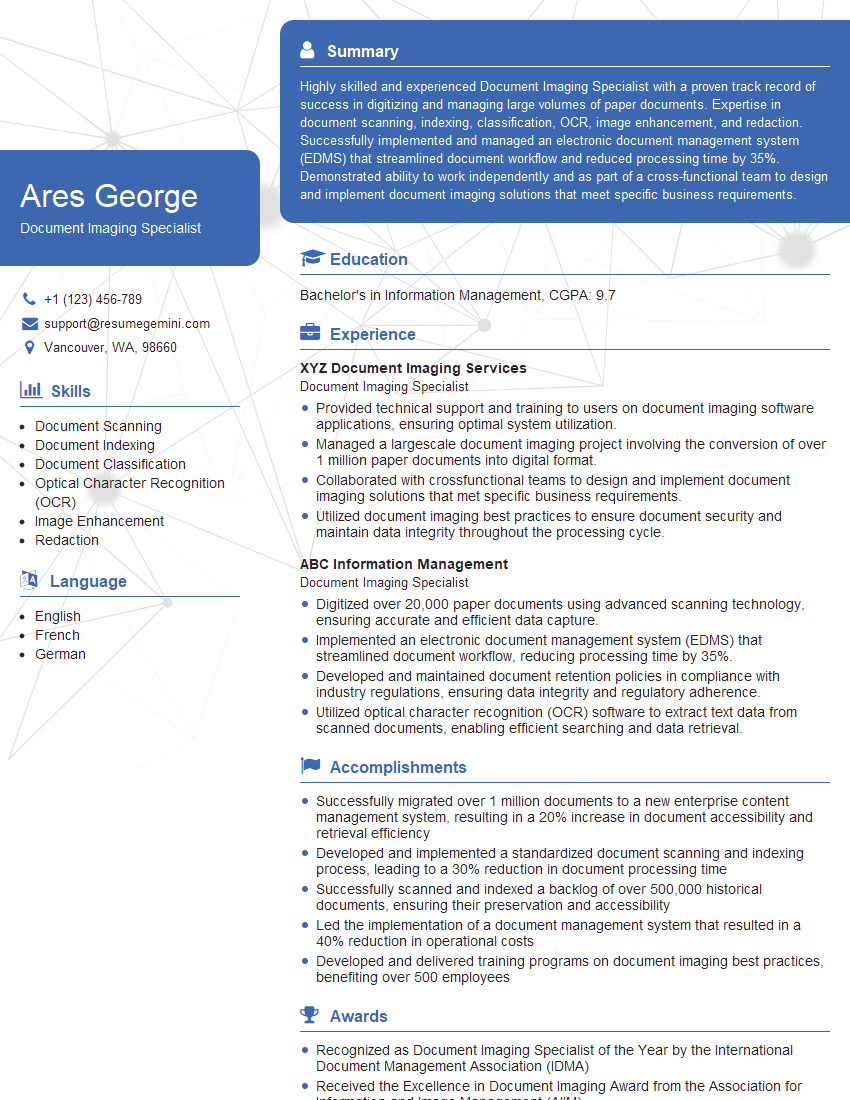
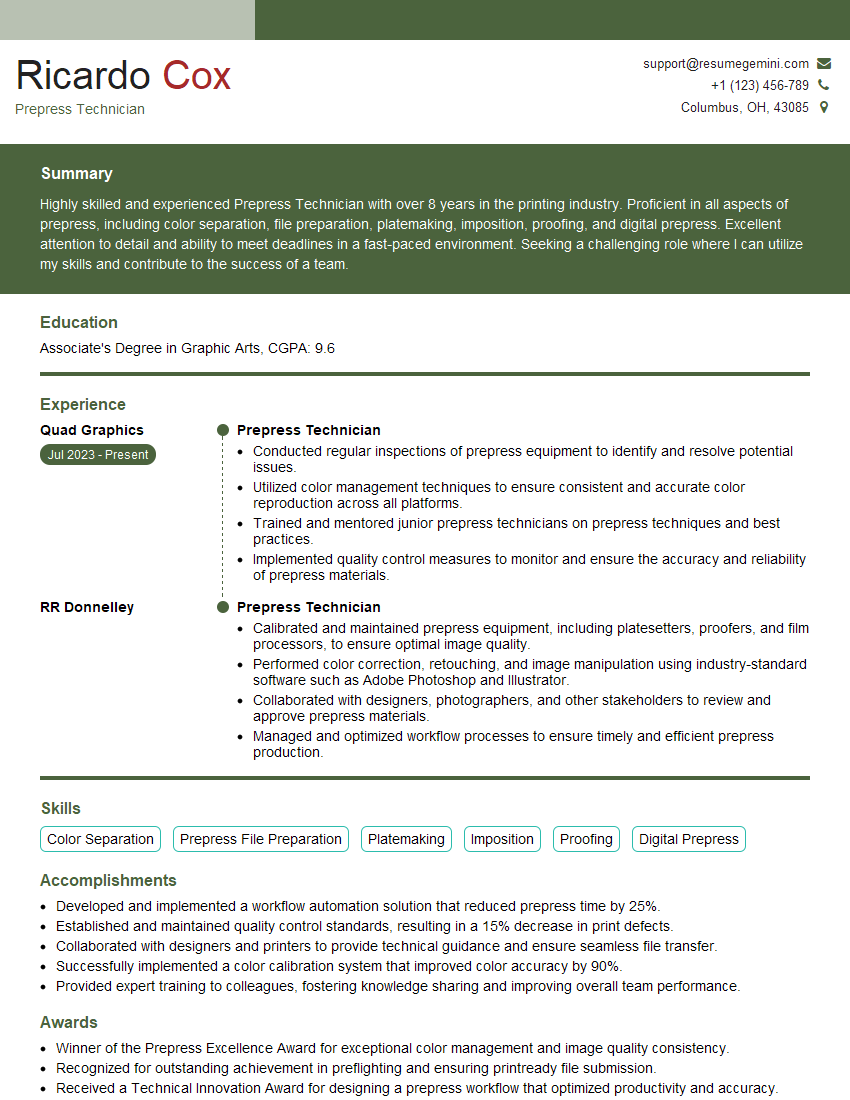
Mastering Scanography opens doors to exciting career opportunities in fields like archiving, digital preservation, publishing, and art restoration. To maximize your job prospects, creating a strong, ATS-friendly resume is crucial. ResumeGemini is a trusted resource that can help you build a professional resume that highlights your skills and experience effectively. We offer examples of resumes tailored to Scanography to help you get started. Invest time in crafting a compelling resume – it’s your first impression on potential employers.
Explore more articles
Users Rating of Our Blogs
Share Your Experience
We value your feedback! Please rate our content and share your thoughts (optional).
What Readers Say About Our Blog
Very informative content, great job.
good