Cracking a skill-specific interview, like one for Servomechanism Design, requires understanding the nuances of the role. In this blog, we present the questions you’re most likely to encounter, along with insights into how to answer them effectively. Let’s ensure you’re ready to make a strong impression.
Questions Asked in Servomechanism Design Interview
Q 1. Explain the basic principles of a closed-loop servomechanism.
A closed-loop servomechanism, at its core, is a control system that uses feedback to achieve precise control of a system’s output. Imagine you’re trying to park a car perfectly: you look at the distance from the curb (feedback), adjust the steering wheel (control action), and constantly check the distance again. This continuous feedback-adjustment cycle is the essence of a closed-loop system. It ensures the output (car position) matches the desired input (parking spot) accurately, correcting for any errors along the way.
Technically, it involves a feedback loop where the output is constantly compared to the desired input (setpoint). Any difference (error) between these two is used to generate a control signal that drives the system to minimize this error. This continuous comparison and correction is what distinguishes closed-loop systems from open-loop systems (explained below).
Q 2. Describe the difference between open-loop and closed-loop control systems.
The key difference lies in the presence or absence of feedback. An open-loop system operates without feedback; it simply executes a command without monitoring the actual output. Think of a simple toaster: you set the time, and it runs for that duration regardless of whether the bread is actually toasted. There’s no mechanism to check if the toast is done; it relies solely on the pre-programmed input.
In contrast, a closed-loop system (like our servomechanism) uses feedback to monitor the actual output and adjust the control signal accordingly. The same toaster but with a sensor measuring the bread’s temperature: it would stop toasting only when the set temperature is reached, irrespective of the timer’s value. This self-correcting behavior leads to higher accuracy and robustness against disturbances.
Q 3. What are the key components of a typical servomechanism?
A typical servomechanism consists of several essential components:
- Setpoint/Reference Input: This is the desired output value that the system aims to achieve.
- Controller: The ‘brain’ of the system, processing the error signal and generating the control signal. This often involves a proportional-integral-derivative (PID) controller.
- Actuator: The device that actually moves or controls the system, such as a servo motor, hydraulic cylinder, or solenoid.
- Plant/Process: The system being controlled. This could be a robotic arm, a machine tool, or any other mechanical system.
- Feedback Sensor: Measures the actual output of the plant and feeds it back to the controller.
- Comparator: Compares the setpoint to the feedback signal, generating the error signal.
These components work in a coordinated manner to achieve precise and accurate control. For example, a robotic arm’s position could be controlled using a setpoint defining its desired coordinates, an encoder as feedback sensor, and a motor as the actuator.
Q 4. Explain the role of feedback in a servomechanism.
Feedback is crucial because it enables the servomechanism to self-correct. Without feedback, any disturbances or uncertainties in the system would accumulate and lead to significant deviations from the desired output. Think of it as trying to hit a target with a bow and arrow without looking – highly inaccurate! Feedback allows the system to continuously monitor its performance and compensate for any errors or external disturbances.
The feedback signal is compared to the setpoint; the difference (error) is then used by the controller to adjust the actuator’s output, striving to reduce the error to zero. This closed-loop nature ensures higher accuracy, stability, and robustness in the face of uncertainties.
Q 5. What are some common types of feedback sensors used in servomechanisms?
Various sensors provide feedback depending on the application. Common types include:
- Potentiometers: Measure angular position by sensing the resistance change across a rotating wiper.
- Encoders (Incremental and Absolute): Provide precise position information using optical or magnetic techniques. Incremental encoders count pulses, while absolute encoders provide an absolute position value.
- Tachometers: Measure angular velocity.
- Linear Variable Differential Transformers (LVDTs): Measure linear displacement through magnetic coupling.
- Strain Gauges: Measure force or strain.
The choice of sensor depends on factors such as required accuracy, resolution, cost, and the nature of the measured variable.
Q 6. Describe different types of servo motors and their applications.
Several servo motor types exist, each with its own strengths and weaknesses:
- DC Servo Motors: Widely used due to their simple control and good speed regulation. Applications include robotics and industrial automation.
- AC Servo Motors (Induction and Synchronous): Offer higher power density and efficiency compared to DC motors. Synchronous motors have better precision. Used in high-performance applications like CNC machines and machine tools.
- Brushless DC Servo Motors: Combine the advantages of DC and AC motors, offering high efficiency, long lifespan, and precise control. Common in robotics, aerospace, and high-end industrial applications.
- Stepper Motors: Produce precise angular movements in steps. Suitable for applications requiring precise positioning, like 3D printers and CNC machines.
Selecting the appropriate servo motor involves considering factors like torque requirements, speed range, precision, cost, and environmental conditions.
Q 7. Explain the concept of transfer functions in control systems.
In control systems, a transfer function mathematically represents the relationship between the input and output of a system in the Laplace domain (a mathematical tool for analyzing systems). It describes how the system responds to different input signals. For example, a simple first-order system might have a transfer function of the form:
G(s) = K / (τs + 1)where:
G(s)is the transfer functionKis the system gainτis the time constantsis the complex frequency variable in the Laplace domain
Transfer functions are crucial for analyzing system stability, designing controllers (like PID controllers), and predicting system behavior. They allow engineers to simulate and optimize the system’s response before physical implementation, saving time and resources.
Q 8. How do you analyze the stability of a control system?
Analyzing the stability of a control system is crucial to ensure its proper functioning and prevent unwanted oscillations or runaway behavior. We primarily use tools from frequency-domain analysis and time-domain analysis. In the frequency domain, we look at the system’s response to sinusoidal inputs of varying frequencies. Techniques like Bode plots and Nyquist plots are invaluable here. In the time domain, we look at the system’s response to step or impulse inputs, analyzing the transient response for characteristics like overshoot, settling time, and rise time. A stable system will exhibit a bounded output for any bounded input. Unstable systems show unbounded outputs, indicating a potential for failure.
For example, imagine a temperature control system for an oven. An unstable system might lead to the oven overheating uncontrollably, posing a safety risk. Stability analysis helps us design a control system that keeps the temperature within the desired range, safely and reliably.
Q 9. What are Bode plots and Nyquist plots, and how are they used in control system design?
Bode plots and Nyquist plots are graphical representations of a control system’s frequency response. A Bode plot consists of two subplots: a magnitude plot (showing the gain in dB versus frequency in logarithmic scale) and a phase plot (showing the phase shift in degrees versus frequency). A Nyquist plot shows the system’s frequency response in the complex plane, plotting the real and imaginary parts of the transfer function for varying frequencies.
These plots are incredibly useful in assessing stability and designing controllers. By examining the gain and phase margins from the Bode plot or encirclements of the -1 point on the Nyquist plot, we can directly assess the system’s stability. Furthermore, they guide us in choosing appropriate compensators (like lead-lag networks) to improve system performance, enhancing stability and response characteristics.
For instance, a low phase margin indicates the system is close to instability and might experience oscillations. By adjusting controller gains or adding a compensator, we can improve the phase margin, making the system more robust.
Q 10. Explain the concept of gain margin and phase margin.
Gain margin and phase margin are crucial stability indicators derived from Bode plots. Gain margin is the amount of gain increase (in dB) that can be applied to the system before it becomes unstable. It’s determined by finding the frequency at which the phase crosses -180 degrees and then looking at the magnitude at that frequency. A larger gain margin indicates a greater tolerance to gain variations. Phase margin is the amount of additional phase lag that can be introduced before instability occurs. It’s determined by finding the frequency at which the magnitude is 0dB (unity gain) and then examining the phase at that frequency. A larger phase margin usually signifies less overshoot and faster settling time.
Think of a self-balancing robot: A large gain margin ensures that even if there are unexpected disturbances or slight changes in the motor gains, the robot won’t fall over. A large phase margin reduces oscillations during balancing, ensuring smoother movement.
Q 11. What are PID controllers, and how do you tune them?
PID controllers (Proportional-Integral-Derivative) are ubiquitous in control systems due to their effectiveness in achieving precise control. They consist of three terms:
- Proportional (P): The output is proportional to the error (difference between desired and actual value). It provides immediate response to errors but leaves a steady-state error.
- Integral (I): The output is proportional to the integral of the error over time. It eliminates steady-state errors but can cause overshoot or oscillations if not tuned carefully.
- Derivative (D): The output is proportional to the rate of change of the error. It anticipates future errors, reducing overshoot and improving settling time but can amplify noise.
Tuning a PID controller involves finding the optimal values for the proportional gain (Kp), integral gain (Ki), and derivative gain (Kd) to achieve the desired performance. This often involves a trial-and-error process, utilizing techniques like Ziegler-Nichols or iterative adjustments based on observing the system’s response.
For example, imagine controlling the speed of a motor. Kp provides quick response to changes in speed setpoint. Ki eliminates any persistent speed error. Kd dampens oscillations and ensures the motor settles at the desired speed quickly and smoothly.
Q 12. Describe different tuning methods for PID controllers (e.g., Ziegler-Nichols).
Several methods exist for tuning PID controllers. The Ziegler-Nichols method is a popular empirical approach. It involves two main steps:
- Ultimate Gain Method: Set the integral and derivative gains to zero (Ki = Kd = 0) and increase the proportional gain (Kp) until the system starts to exhibit sustained oscillations (limit cycle). Record the ultimate gain (Ku) and the period of oscillations (Pu).
- PID Gain Calculation: Based on Ku and Pu, calculate the PID gains using the following formulas (these are for the Ziegler-Nichols ‘P’ settings):
Kp = 0.6 * KuKi = 1.2 * Ku / PuKd = 0.075 * Ku * Pu
Other methods include the Cohen-Coon method, which offers slightly different formulas, or more advanced techniques involving optimization algorithms that search for optimal PID parameters based on a specific performance index (e.g., minimizing integral of squared error).
The choice of tuning method depends on factors like the system’s complexity, the available information, and the desired performance characteristics. Each approach represents a trade-off between simplicity and optimality.
Q 13. What is the purpose of a compensator in a control system?
A compensator is a device or algorithm inserted into a control system to modify its behavior in a desired way. Its main purpose is to improve the system’s performance, particularly stability and transient response characteristics. By carefully designing the compensator, we can modify the system’s frequency response, shaping its gain and phase characteristics to achieve better stability margins, faster response times, reduced overshoot, or improved robustness against disturbances.
Different types of compensators exist, including lead compensators (improve phase margin and speed up response), lag compensators (reduce steady-state error), and lead-lag compensators (a combination of both). The choice of compensator depends on the specific needs of the system. For instance, a lead compensator might be used to improve the speed of response in a robotic arm, while a lag compensator might be suitable for a temperature control system requiring precise steady-state accuracy.
Q 14. Explain the concept of state-space representation of a control system.
State-space representation offers a powerful mathematical framework for modeling and analyzing dynamic systems, including control systems. It describes the system’s behavior using a set of first-order differential equations. These equations relate the system’s state variables (internal variables that describe the system’s condition at any time) to the system’s inputs and outputs.
The general form is:
ẋ = Ax + Bu(state equation)y = Cx + Du(output equation)
where:
xis the state vectoruis the input vectoryis the output vectorAis the state matrixBis the input matrixCis the output matrixDis the direct transmission matrix
State-space representation is particularly useful for systems with multiple inputs and outputs, and for systems that are difficult to model using transfer functions. It allows for advanced control design techniques such as optimal control, state feedback control, and observer design. For instance, consider modeling the dynamics of a multi-joint robotic arm; the state-space model can efficiently capture the complex interactions between joints.
Q 15. How do you design a controller for a given system using state-space methods?
Designing a controller using state-space methods involves representing the system’s dynamics in state-space form, then designing a controller to achieve desired performance. This involves several steps:
- System Modeling: Represent the system using state-space equations:
ẋ = Ax + Buandy = Cx + Du, wherexis the state vector,uis the input vector,yis the output vector, and A, B, C, and D are system matrices. This often involves linearizing a non-linear system around an operating point. - Controller Design: Choose a controller type (e.g., state feedback, observer-based controller, LQR). For state feedback, we design a gain matrix
Ksuch that the closed-loop systemẋ = (A - BK)xhas desirable characteristics (e.g., stability, fast response, low overshoot). The Linear Quadratic Regulator (LQR) method allows us to find an optimalKby minimizing a quadratic cost function that weighs the states and control effort. - Observer Design (if needed): If not all states are measurable, we design an observer to estimate the unmeasurable states. This involves a gain matrix
L, often designed using pole placement or Kalman filtering techniques. - Simulation and Tuning: Simulate the closed-loop system using software like MATLAB/Simulink to evaluate performance. Tune the controller gains (
KandL) to meet performance specifications.
Example: Consider a simple mass-spring-damper system. We can model it in state-space form and design an LQR controller to minimize oscillations and settle quickly to a desired position.
In practice, we iterate through steps 2-4, refining the controller design based on simulation results. Robustness analysis and considerations for noise and disturbances are crucial aspects of this iterative process.
Career Expert Tips:
- Ace those interviews! Prepare effectively by reviewing the Top 50 Most Common Interview Questions on ResumeGemini.
- Navigate your job search with confidence! Explore a wide range of Career Tips on ResumeGemini. Learn about common challenges and recommendations to overcome them.
- Craft the perfect resume! Master the Art of Resume Writing with ResumeGemini’s guide. Showcase your unique qualifications and achievements effectively.
- Don’t miss out on holiday savings! Build your dream resume with ResumeGemini’s ATS optimized templates.
Q 16. What are some common challenges in servomechanism design?
Servomechanism design faces numerous challenges. Some common ones include:
- Nonlinearities: Real-world systems often exhibit nonlinearities (friction, saturation, backlash) that complicate controller design and can lead to unexpected behavior.
- Uncertainties and Disturbances: System parameters might be uncertain, and external disturbances (noise, vibrations) can affect performance. This necessitates robust control design techniques.
- Performance Specifications: Balancing conflicting requirements like speed of response, overshoot, steady-state error, and robustness is challenging.
- Actuator and Sensor Limitations: Actuators have limited force/torque capabilities, and sensors have noise and limited bandwidth. These constraints must be considered during design.
- Cost and Complexity: Implementing complex control algorithms can be expensive and require sophisticated hardware. A balance between performance and cost is crucial.
For instance, designing a precise robotic arm requires addressing nonlinearities in the joints (friction, backlash), handling uncertainties in arm mass and payload, and ensuring the controller is robust enough to deal with external disturbances.
Q 17. How do you handle nonlinearities in a control system?
Handling nonlinearities is a key aspect of servomechanism design. Several approaches exist:
- Linearization: Approximate the nonlinear system with a linear model around an operating point. This simplifies controller design, but accuracy depends on the operating range.
- Feedback Linearization: Transform the nonlinear system into a linear form through a nonlinear coordinate transformation and feedback. This allows the use of linear control techniques.
- Gain Scheduling: Design multiple linear controllers for different operating points and switch between them based on system state. This handles variations in nonlinearity.
- Nonlinear Control Techniques: Use nonlinear control methods like sliding mode control, adaptive control, or fuzzy logic control, which explicitly handle nonlinearities. These are often more complex to design and implement.
Example: In a robotic manipulator, joint friction is a significant nonlinearity. Feedback linearization can be used to compensate for it, while gain scheduling might be employed to account for changes in friction due to temperature or speed variations.
The choice of method depends on the nature and severity of the nonlinearities, the desired performance, and the complexity that can be tolerated.
Q 18. Explain the concept of robustness in control system design.
Robustness in control system design refers to the ability of the system to maintain performance despite uncertainties and disturbances. A robust controller ensures stability and acceptable performance even when there are variations in system parameters, unmodeled dynamics, or external disturbances.
Achieving robustness involves:
- Robust Control Techniques: Employing methods like H-infinity control, μ-synthesis, or L1 adaptive control that explicitly account for uncertainties.
- Sensitivity Analysis: Studying how the system’s performance changes with variations in parameters. This helps identify the most sensitive parameters and guide design choices.
- Margin Analysis: Assessing gain and phase margins to ensure sufficient stability robustness. These margins provide a measure of how much parameter variations the system can tolerate before becoming unstable.
- Modeling Uncertainties: Incorporating uncertainties into the system model using techniques like parametric uncertainty modeling. This allows for a more realistic assessment of robustness.
Example: A flight control system must be robust to changes in air density, wind gusts, and variations in aircraft mass. Robust control techniques ensure stability and acceptable handling qualities under these varying conditions.
Q 19. What are some common troubleshooting techniques for servomechanism issues?
Troubleshooting servomechanism issues requires a systematic approach. Here are common techniques:
- Check Sensor Readings: Verify that sensor readings are accurate and within the expected range. Inspect for noise or drift.
- Examine Actuator Performance: Confirm that actuators are functioning properly and are not saturated or exhibiting any mechanical issues.
- Analyze Control Signals: Inspect controller outputs and feedback signals to identify any abnormalities or unexpected behavior.
- System Identification: If the problem is difficult to diagnose, perform system identification to obtain a more accurate model of the system and identify potential sources of error.
- Simulation and Testing: Use simulation tools to replicate the problem and test different control strategies. This helps isolate the issue and design corrective actions.
- Step-by-step Debugging: If the problem is software-related, use debugging tools to step through the code, examine variables, and pinpoint the source of the error.
For example, if a robotic arm exhibits unexpected oscillations, the troubleshooting process might involve checking encoder readings, verifying actuator health, examining controller gains and feedback signals, and simulating the system to determine if a model mismatch or parameter uncertainty is the culprit.
Q 20. Describe your experience with simulation tools for control system design (e.g., MATLAB/Simulink).
I have extensive experience using MATLAB/Simulink for control system design and simulation. I’ve utilized it for:
- System Modeling: Creating state-space models, transfer function models, and block diagrams of various systems.
- Controller Design: Designing and tuning PID controllers, LQR controllers, and other advanced control algorithms.
- Simulation and Analysis: Simulating system responses to various inputs, analyzing stability and performance characteristics, and generating plots and reports.
- Verification and Validation: Verifying controller performance through simulation and validating against experimental data.
- Hardware-in-the-loop (HIL) Simulation: Integrating simulated controllers with real-time hardware components for realistic testing and validation.
I’m proficient in using Simulink’s various toolboxes, such as the Control System Toolbox and the Stateflow toolbox for state machine modeling and implementation. A recent project involved developing a complex motion control system for a robotic platform where Simulink’s real-time capabilities were essential for validating controller performance before deployment.
Q 21. Explain your experience with different programming languages used in control systems (e.g., C, C++, Python).
My experience with programming languages in control systems spans several languages:
- C/C++: I’ve used C/C++ extensively for developing real-time control applications requiring high performance and low-level hardware interaction. This involves working with microcontrollers and embedded systems.
- Python: Python is my primary language for prototyping, data analysis, and creating simulations and visualization tools. Its libraries like NumPy, SciPy, and Matplotlib are invaluable for control system design and analysis.
I’ve used C++ in projects involving direct control of robotic actuators, where precise timing and efficient code execution are critical. Python, on the other hand, has been extensively used for system identification, algorithm development, and creating custom simulation environments for complex systems.
Choosing the appropriate language depends greatly on the application. Real-time embedded systems demand the efficiency of C/C++, while rapid prototyping and analysis benefit from the versatility of Python.
Q 22. How do you ensure the safety and reliability of a servomechanism?
Ensuring safety and reliability in a servomechanism design is paramount. It involves a multi-faceted approach encompassing robust hardware selection, sophisticated software design, and rigorous testing procedures.
Firstly, we must select components – actuators, sensors, and controllers – with inherent safety features. For instance, choosing actuators with built-in current limiters prevents overloads and potential damage. Similarly, selecting sensors with redundancy and self-diagnostic capabilities allows for fault detection and graceful degradation.
Secondly, the control software itself needs to be designed with safety in mind. This includes implementing fail-safe mechanisms, such as watchdog timers that trigger emergency stops if the system malfunctions. Adding software features like saturation limits on control signals and incorporating checks for physically impossible states prevents unintended actions.
Finally, rigorous testing is crucial. This involves simulating various fault conditions, including sensor failures, actuator malfunctions, and power loss, to ensure the system responds safely. Both simulations and real-world testing on a scaled-down prototype are important to build confidence in system resilience.
Imagine a robotic arm used in a manufacturing setting. Safety features like emergency stops, speed limiting, and collision detection are critical to prevent accidents. The software needs to account for potential errors and trigger safe states to prevent damage to equipment or injury to personnel. The entire design must undergo thorough testing to verify its reliability and safety under various operating conditions.
Q 23. Describe your experience with different types of actuators used in servomechanisms.
My experience spans a wide range of actuators, each suited for different applications based on factors such as speed, torque, precision, and cost.
- DC Servomotors: These are widely used for their precise control and relatively simple implementation. I’ve worked extensively with brushed and brushless DC servomotors in robotics and precision positioning systems. The choice between brushed and brushless often depends on the required lifespan and maintenance needs. Brushless motors offer higher efficiency and longer lifespans.
- Stepper Motors: Ideal for applications demanding precise, incremental movements, I’ve employed stepper motors in printer mechanisms and CNC machining systems. Their open-loop control is simpler, but closed-loop control can significantly enhance accuracy.
- Hydraulic and Pneumatic Actuators: For high force applications, hydraulic and pneumatic actuators are invaluable. I’ve designed systems utilizing these in heavy machinery and industrial automation, where their power density is unmatched. However, accurate control and maintaining leak-free operation require meticulous design and maintenance.
- Piezoelectric Actuators: In applications demanding extremely fine positioning, such as nanoscale manipulation, piezoelectric actuators are essential. Their sub-nanometer resolution is unmatched, but they generally exhibit lower force capabilities.
Selecting the right actuator is crucial. The choice depends heavily on the application’s specific requirements, balancing cost, performance, and maintainability.
Q 24. Explain your understanding of different control system architectures (e.g., decentralized, hierarchical).
Control system architectures greatly impact a system’s performance, scalability, and robustness.
- Centralized Architecture: This involves a single controller responsible for managing the entire system. While simple to implement, it becomes a bottleneck as system complexity increases and suffers from single points of failure.
- Decentralized Architecture: This distributes control among multiple controllers, each responsible for a specific part of the system. This enhances robustness as failure in one controller doesn’t cripple the entire system. However, coordination between controllers needs careful consideration.
- Hierarchical Architecture: This combines centralized and decentralized approaches. High-level controllers oversee overall system behavior, while lower-level controllers manage specific sub-systems. This is particularly useful in large, complex systems, such as industrial robots or autonomous vehicles.
The choice of architecture depends on the application’s scale and complexity. A simple robot arm might use a centralized architecture, while a complex automated factory would benefit from a hierarchical structure. Careful consideration of fault tolerance, maintainability, and scalability is essential in choosing the optimal architecture.
Q 25. How do you handle disturbances in a control system?
Disturbances are unavoidable in any real-world control system. They can stem from various sources, such as external forces, sensor noise, or unmodeled dynamics. Robust control strategies are essential to mitigate their effects.
Feedforward Control: This method anticipates disturbances and compensates for them before they affect the system. For instance, in a robotic arm, predicting the effect of gravity on the arm’s movement and preemptively adjusting the control signal can effectively counter gravity’s influence.
Feedback Control: This uses sensors to measure the actual system output and compares it to the desired output. The difference, or error, is used to adjust the control signal, effectively minimizing the impact of disturbances. PID (Proportional-Integral-Derivative) controllers are a common and effective example of feedback control.
Adaptive Control: This approach dynamically adjusts the controller parameters based on the observed system behavior and disturbance characteristics. It’s particularly useful when the system dynamics are uncertain or change over time.
The selection of the optimal disturbance handling technique is context-dependent and often involves a combination of these methods. A well-designed control system anticipates potential disturbances and includes multiple layers of compensation to ensure stability and performance.
Q 26. Describe your experience with real-time control systems.
Real-time control systems demand precise timing and rapid responses. I have extensive experience developing and implementing real-time control systems, predominantly using embedded systems and real-time operating systems (RTOS).
My work has involved developing software for systems requiring deterministic timing behavior, such as industrial robots and autonomous vehicles. I am proficient in programming languages like C and C++, and have worked with various RTOS, including FreeRTOS and VxWorks.
A critical aspect of real-time control is ensuring that tasks are completed within their designated deadlines. This involves careful scheduling, efficient algorithm design, and thorough testing to verify timing constraints. Missing deadlines can result in system instability or unsafe operation. Techniques like rate-monotonic scheduling and priority inheritance are used to manage real-time tasks and ensure predictability.
In one project, I developed a real-time control system for a precision positioning stage used in semiconductor manufacturing. Meeting the stringent timing requirements and ensuring reliable operation under high-precision conditions demanded rigorous testing and optimization.
Q 27. What are some advanced control techniques you are familiar with (e.g., adaptive control, predictive control)?
Beyond traditional PID control, I’m familiar with advanced techniques offering enhanced performance and adaptability.
- Adaptive Control: This automatically adjusts controller parameters to compensate for changes in the system dynamics or disturbances. For example, in a robot arm operating in varying temperatures, adaptive control can adjust its gains to maintain performance despite changes in the arm’s stiffness.
- Predictive Control (MPC): This predicts future system behavior and optimizes control actions to achieve desired performance over a prediction horizon. This is invaluable in systems with significant delays or complex dynamics, such as chemical processes or aircraft flight control.
- Fuzzy Logic Control: This uses fuzzy sets and rules to handle imprecise or uncertain information, making it suitable for systems with difficult-to-model dynamics. It’s particularly useful in situations where precise mathematical models are unavailable.
- Model Predictive Control (MPC): MPC uses a model of the system to predict its future behavior and optimizes the control actions over a defined horizon to minimize a cost function. This is useful for systems with constraints and delays.
The choice of advanced control technique depends on the specific application’s requirements and the available system information. Advanced control techniques often require more computational resources and careful tuning, but they can deliver significant improvements in performance and robustness compared to simpler methods.
Q 28. Describe a challenging servomechanism design project you worked on and the solutions you implemented.
One challenging project involved designing a servomechanism for a high-speed, high-precision laser scanning system used in medical imaging. The challenge was to achieve extremely rapid and accurate beam positioning while minimizing vibrations and thermal drift.
The initial design struggled with significant resonant frequencies that caused oscillations and image blurring. My solution involved a multi-pronged approach. Firstly, we conducted a detailed modal analysis to identify the system’s resonant frequencies. Secondly, we incorporated a feedforward control strategy to preemptively compensate for known disturbances, such as vibrations from the surrounding environment. Thirdly, we implemented an adaptive control algorithm that continuously adjusted the controller parameters to counteract the effects of temperature variations and other unpredictable disturbances.
Finally, we optimized the mechanical design to dampen vibrations. This involved careful selection of materials and implementing vibration isolation techniques. Through this combined approach of mechanical design improvements and sophisticated control algorithms, we successfully achieved the required speed and accuracy, resulting in a significantly improved image quality.
Key Topics to Learn for Servomechanism Design Interview
- System Modeling and Analysis: Understand techniques like block diagrams, transfer functions, and state-space representations to model servomechanism systems. Practice analyzing system stability and performance.
- Control System Design: Familiarize yourself with various control strategies (PID, lead-lag compensators, etc.) and their applications in achieving desired system responses (e.g., minimizing overshoot, settling time). Be prepared to discuss the trade-offs between different control strategies.
- Sensor and Actuator Selection: Develop a strong understanding of different sensor types (e.g., potentiometers, encoders, accelerometers) and actuators (e.g., DC motors, stepper motors, hydraulic actuators) used in servomechanisms. Know their characteristics and limitations.
- Feedback Control Systems: Master the concepts of negative feedback, error signals, and closed-loop control. Be prepared to discuss the benefits and challenges of feedback control in servomechanism design.
- Nonlinear Control Techniques (if applicable): Depending on the role’s requirements, prepare for questions about nonlinear control techniques relevant to servomechanism design, such as sliding mode control or fuzzy logic control.
- Practical Applications: Be ready to discuss real-world examples of servomechanism applications, such as robotics, industrial automation, aerospace systems, and precision motion control. Highlighting personal projects or relevant coursework can be advantageous.
- Troubleshooting and Problem-Solving: Practice identifying and resolving common issues in servomechanism systems, such as instability, oscillations, and inaccuracies. Be prepared to discuss your approach to troubleshooting.
Next Steps
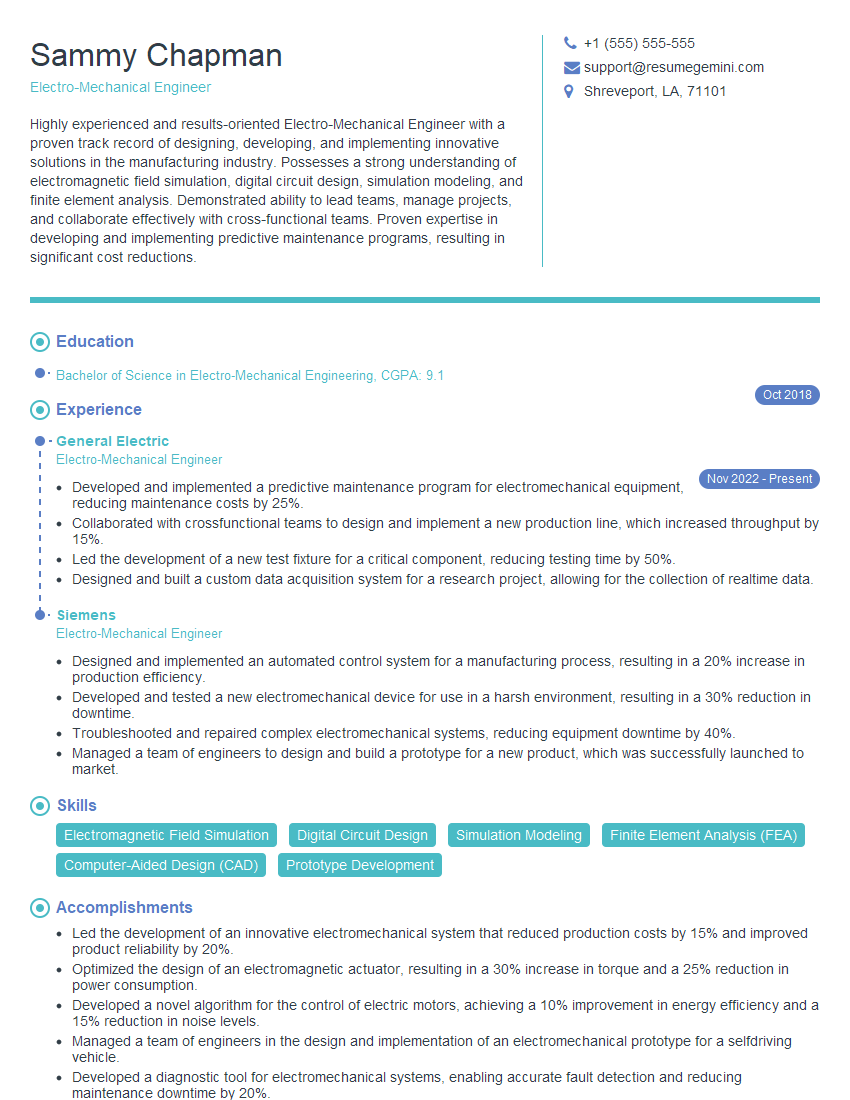
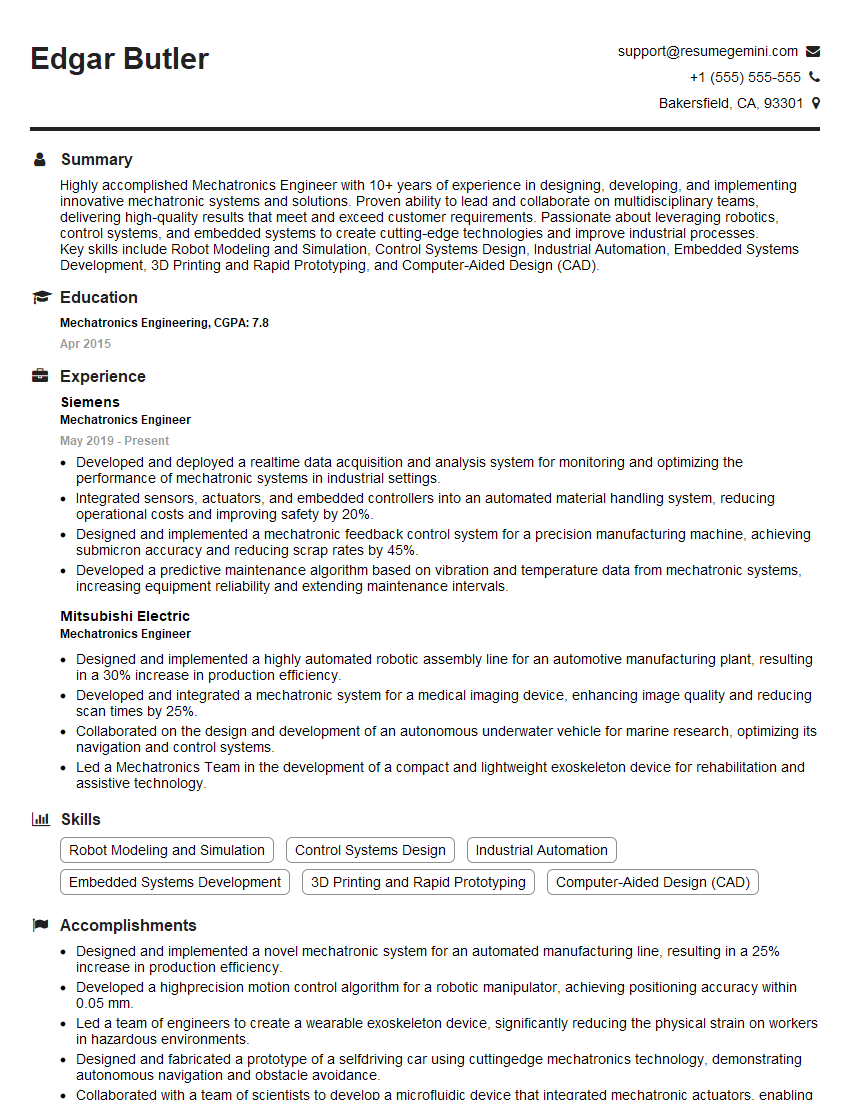
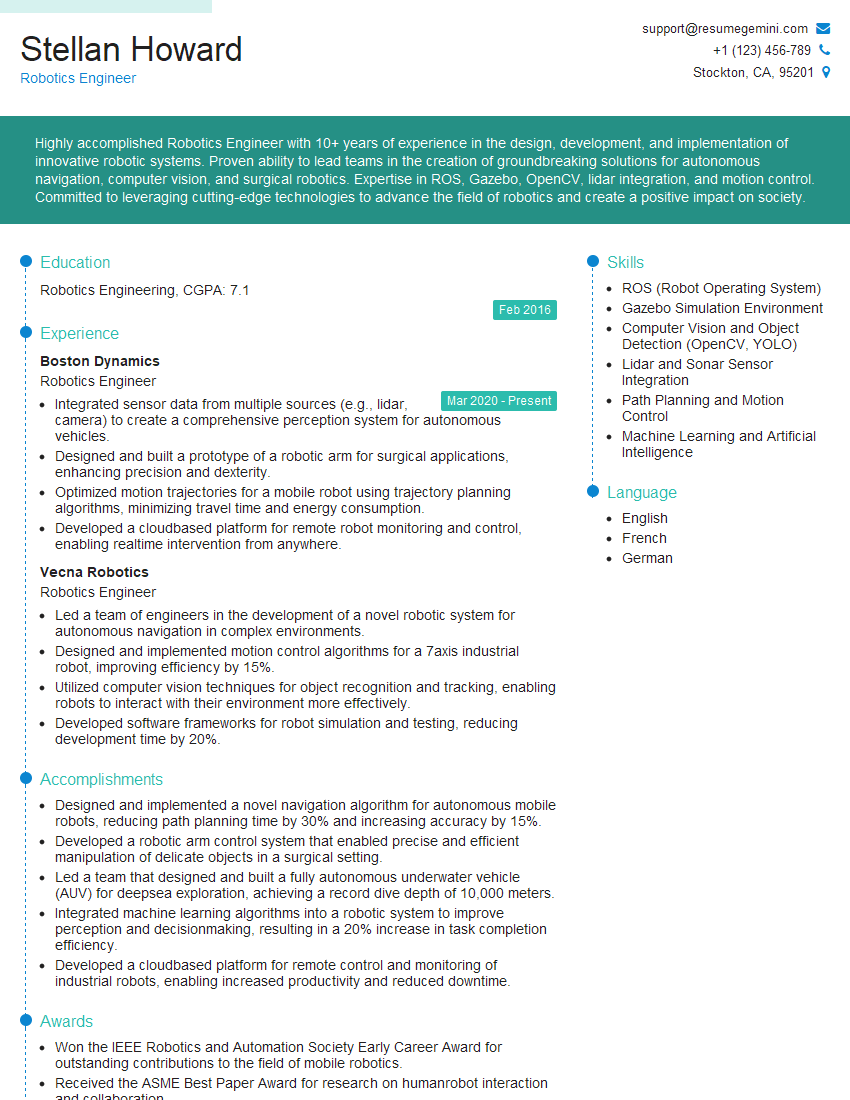
Mastering servomechanism design opens doors to exciting career opportunities in various high-tech industries. To maximize your job prospects, it’s crucial to present your skills effectively. An ATS-friendly resume is key to getting your application noticed by recruiters. We highly recommend using ResumeGemini to build a professional and impactful resume that highlights your expertise in servomechanism design. ResumeGemini offers a streamlined process and provides examples of resumes tailored to this specific field, giving you a significant advantage in your job search.
Explore more articles
Users Rating of Our Blogs
Share Your Experience
We value your feedback! Please rate our content and share your thoughts (optional).
What Readers Say About Our Blog
Very informative content, great job.
good