Cracking a skill-specific interview, like one for Parachute System Deployment, requires understanding the nuances of the role. In this blog, we present the questions you’re most likely to encounter, along with insights into how to answer them effectively. Let’s ensure you’re ready to make a strong impression.
Questions Asked in Parachute System Deployment Interview
Q 1. Explain the different types of parachute deployment systems.
Parachute deployment systems are categorized based on their activation mechanism and the type of parachute they deploy. Think of it like choosing the right tool for the job – each system is designed for specific needs and environments.
- Manual Deployment Systems: These require the user to initiate deployment, offering maximum control but demanding precise timing and technique. Examples include the ripcord systems used in skydiving, where the jumper pulls a cord to release the parachute. A more complex example would be a military cargo parachute system with multiple releases for controlled descent.
- Automatic Activation Devices (AADs): These are life-saving backups designed to deploy a reserve parachute if certain pre-programmed conditions are met (e.g., excessive descent rate or altitude loss). Imagine them as a final safety net, providing automatic deployment if something goes wrong during a main parachute deployment. They are commonly found in skydiving and some specialized military applications.
- Static Line Systems: These systems automatically deploy the main parachute upon exiting the aircraft. Think of it like a simple, reliable setup – the parachute is attached to a line that releases as you jump, immediately deploying the canopy. This system is commonly used for military training jumps and cargo drops.
- Pilot Chute Systems: A small pilot parachute is deployed first, which then pulls out the main parachute. It’s like using a smaller parachute to help deploy a larger one, creating a smoother and more controlled deployment sequence. Most modern parachute systems use this type of deployment.
The choice of system depends on the application. Skydivers might use manual systems with AADs for flexibility and safety. Military cargo drops often employ static line systems for quick and reliable deployment.
Q 2. Describe the process of parachute packing and inspection.
Parachute packing and inspection are critical processes directly impacting safety. A poorly packed parachute is a serious risk. Imagine packing a gift – you need to ensure everything is organized and secure to prevent damage or malfunction. It’s the same with a parachute.
The process typically begins with carefully laying out the parachute canopy and inspecting it for any rips, tears, or damage. Then, the canopy is meticulously folded following specific techniques to prevent tangling and ensure smooth inflation. Next, the canopy is placed into the parachute container, which includes the suspension lines, harness, and deployment mechanisms. Each step requires precision, often involving careful attention to detail and established procedures. After packing, a thorough inspection of the packed parachute is performed to ensure correct packing procedures have been followed and that the parachute is ready for use.
This detailed process includes visually checking for any irregularities and checking the functionality of all deployment mechanisms. Documentation of the packing and inspection is vital, usually involving a date and signature to certify it’s airworthy.
Strict adherence to established packing procedures and regular inspections are vital to ensure parachute safety and reliability.
Q 3. What are the key safety considerations in parachute system deployment?
Safety is paramount in parachute deployment. Think of it as a life-or-death situation – every precaution must be taken. Key considerations include:
- Proper Packing and Inspection: As previously discussed, ensuring the parachute is correctly packed and free from defects is foundational.
- Environmental Conditions: Strong winds, low temperatures, and high altitudes can significantly impact deployment. Careful consideration of weather conditions is essential, often leading to delays or cancellations.
- Emergency Procedures: Knowing how to handle malfunctions (e.g., cutaway procedures to deploy a reserve parachute) is critical training.
- Equipment Maintenance: Regular inspections and maintenance of all parachute components are vital. This includes the canopy, harness, and deployment system.
- User Training and Proficiency: Competent training is essential to ensure individuals understand how to use the equipment safely.
- Reserve Parachute: The presence of a secondary parachute system for emergencies provides an essential safety backup.
Failure to address these factors can lead to catastrophic consequences. Every step, from initial planning to post-deployment checks, needs to be meticulously managed to prioritize safety.
Q 4. How do you troubleshoot malfunctions in a parachute system?
Troubleshooting parachute malfunctions requires a systematic approach. Think of it like diagnosing a car problem – you need to identify the issue before you can fix it. Common troubleshooting steps:
- Identify the Malfunction: Is the main parachute not deploying? Is the canopy partially deployed? This initial assessment is crucial.
- Check Deployment System: Ensure the ripcord, pilot chute, or other deployment mechanisms are functioning correctly.
- Inspect the Canopy: Look for any entanglement, damage, or obstructions in the main parachute canopy.
- Assess Environmental Factors: Consider if strong winds or other environmental factors might be affecting deployment.
- Initiate Emergency Procedures: If the main parachute malfunctions, initiate the cutaway procedure to deploy the reserve parachute. This is a critical skill learned during training.
Troubleshooting often necessitates a combination of theoretical knowledge and practical skill. Proper training is critical to ensure that individuals can handle malfunctions effectively and safely.
Q 5. Explain the concept of parachute system redundancy.
Parachute system redundancy means incorporating backup systems to increase safety. It’s like having a spare tire in your car – you hope you never need it, but it’s invaluable if you do. In parachute systems, this typically takes the form of a reserve parachute.
Redundancy ensures that even if the primary system fails, there’s a backup to mitigate risks. For example, many skydivers use an Automatic Activation Device (AAD) as a redundant system, automatically deploying a reserve parachute if the main parachute fails to open correctly. This layered approach significantly reduces the chance of a catastrophic outcome.
The level of redundancy depends on the application. High-risk scenarios might employ multiple layers of redundancy. The design philosophy centers around mitigating the potential for single points of failure.
Q 6. What are the different types of parachute canopies and their applications?
Parachute canopies come in various designs, each with specific applications. Think of them like different types of clothing – each is suitable for a different situation.
- Round Parachutes: These are simple, reliable, and easy to pack, but have a relatively high descent rate. Often used in early designs and some specialized applications.
- Square Parachutes: These offer better maneuverability and lower descent rates than round parachutes, making them popular for skydiving and cargo operations.
- Ram-Air Parachutes: These canopies are designed with vents to allow airflow for improved control and steerability, making them well-suited for precision landings and high-performance applications.
- Parafoils: These flexible wings combine the advantages of a parachute and a glider, providing high maneuverability and precise landings. They’re commonly used in cargo systems and certain specialized sports.
The choice of canopy depends on the specific needs. Skydivers favor designs that offer good maneuverability and control. Cargo systems might prioritize reliability and high payload capacity.
Q 7. How do environmental factors (wind, temperature, altitude) affect parachute deployment?
Environmental factors significantly impact parachute deployment. Imagine trying to fly a kite in a hurricane – it would be extremely challenging. Similarly, various environmental conditions affect parachute performance.
- Wind: Strong winds can cause significant drift during descent and can hinder proper canopy inflation. High winds can even prevent safe landing.
- Temperature: Extremely low temperatures can affect material properties, potentially compromising the canopy’s structural integrity. High temperatures can also impact canopy performance.
- Altitude: Higher altitudes have thinner air, potentially affecting the parachute’s inflation characteristics. The thinner air makes it harder for the parachute to catch the wind and inflate properly.
Parachute deployment calculations often include detailed environmental data. Strong winds may lead to deployment delays or cancellations. Extreme temperatures can necessitate material selection modifications. Careful consideration of these factors is vital for safe and successful parachute operations.
Q 8. Describe your experience with parachute system testing and certification.
My experience in parachute system testing and certification spans over 15 years, encompassing various roles from design engineer to lead test engineer. I’ve been involved in the full lifecycle, from initial design reviews and analysis to final certification testing. This includes extensive work with both static and dynamic testing methodologies. Static testing involves rigorous material property assessments, load testing of individual components, and stress analysis using FEA (Finite Element Analysis). Dynamic testing is where we actually deploy the parachutes under controlled conditions, meticulously measuring deployment times, peak loads, and stability throughout descent. We utilize high-speed cameras, accelerometers, and other sophisticated instrumentation to gather critical data. This data is then analyzed to ensure compliance with relevant industry standards and regulatory requirements, leading to the final certification of the parachute system for its intended application. I’ve personally overseen the certification of dozens of parachute systems for various applications, including cargo delivery, human-rated systems, and even specialized systems for scientific payloads.
For example, on a recent project involving a heavy-lift cargo parachute, we conducted extensive drop tests from different altitudes and wind conditions. Through careful analysis of the collected data, we identified and addressed minor design flaws that enhanced the system’s reliability and performance. This highlights the iterative nature of testing and the importance of rigorous data analysis in achieving certification.
Q 9. What are the common failure modes of parachute systems and their causes?
Parachute system failures, while thankfully rare due to rigorous design and testing, can stem from various sources. Common failure modes include:
- Line breakage or entanglement: This can be caused by manufacturing defects, impact damage during deployment, or excessive wear and tear. Imagine a single weak strand in the suspension lines; under load, it could easily snap, resulting in a partial or total system failure.
- Canopy malfunction: This encompasses issues like rips, tears, or improper inflation. Strong winds or collisions can lead to canopy damage. A partial canopy collapse could result in an uncontrolled descent.
- Deployment system failures: This covers malfunctions in the mechanism initiating the deployment sequence. Issues with pyrotechnic initiators, bridle release mechanisms, or the deployment bag itself can prevent the parachute from deploying correctly.
- Environmental factors: Extreme temperatures, high winds, or precipitation can negatively impact parachute performance. For example, extremely low temperatures can embrittle materials, making them more susceptible to failure.
The root causes of these failures can often be traced to design flaws, manufacturing defects, improper maintenance, or even operational errors. Rigorous quality control at every stage, from material selection to final assembly, is crucial in mitigating these risks.
Q 10. Explain the role of drogue parachutes in deployment.
Drogue parachutes play a crucial role in stabilizing the descent of a payload and preventing undesirable orientations before the main parachute deploys. Think of it as a smaller, stabilizing parachute deployed first. Their primary functions include:
- Reducing descent rate: Drogue chutes slow down the initial, high-speed descent of the payload, reducing the dynamic forces acting on the main parachute during deployment.
- Stabilizing the payload orientation: They help align the payload in a suitable orientation for main parachute deployment, preventing tumbling or uncontrolled spins which could lead to entanglement or damage.
- Reducing deployment shock: By decelerating the payload before the main parachute deploys, drogue chutes lessen the impact forces on the main parachute system, minimizing the risk of damage.
For example, in high-altitude drops, the drogue chute is essential to safely slow the descent before deploying the main parachute. Without a drogue chute, the immense forces could damage or destroy the main parachute.
Q 11. How do you calculate the required parachute size for a given payload?
Calculating the required parachute size for a given payload isn’t a simple formula; it’s a complex process involving several factors. The primary equation involves balancing the payload weight (W) with the drag force (D) generated by the parachute at a safe descent rate (V). Simplified, we can relate these factors as follows: W = D
However, the drag force (D) is dependent on the parachute’s projected area (A), air density (ρ), and the descent velocity (V), along with a drag coefficient (Cd) specific to the parachute shape: D = 0.5 * ρ * V² * Cd * A
Therefore, to find the required area (A), we must consider:
- Payload weight (W): This is a straightforward measurement.
- Desired descent rate (V): This is determined by safety considerations and operational requirements.
- Air density (ρ): This varies with altitude and temperature.
- Drag coefficient (Cd): This depends on the parachute shape and design; it’s typically obtained through wind tunnel testing or computational fluid dynamics (CFD) simulations.
In practice, we use sophisticated software and simulations incorporating these factors, as well as additional considerations like wind gusts and parachute inflation dynamics. It’s not a simple calculation, but rather an iterative process guided by extensive experience and testing.
Q 12. What are the regulations and standards governing parachute system design and deployment?
The design and deployment of parachute systems are strictly governed by national and international regulations and standards. These regulations vary depending on the application (human-rated vs. cargo) and the geographical location. Key standards and regulations include:
- TCCA (Transportation Canada Civil Aviation): For parachutes used in Canada.
- FAA (Federal Aviation Administration): For parachutes used in the United States.
- EASA (European Union Aviation Safety Agency): For parachutes used within the European Union.
- MIL-STD (Military Standards): These standards govern the design and testing of military parachute systems.
These regulations typically cover aspects like design requirements, material specifications, testing procedures, certification processes, and maintenance protocols. Compliance with these standards is crucial for ensuring the safety and reliability of parachute systems.
Q 13. Describe your experience with parachute system simulation and modeling.
Parachute system simulation and modeling are integral to the design and development process. We extensively use computational tools like ANSYS, LS-DYNA, and specialized parachute simulation software to model the complex aerodynamic and mechanical behavior of parachute systems. These simulations help us:
- Predict parachute performance: Simulations allow us to estimate deployment times, descent rates, and stability under various conditions.
- Optimize parachute design: We can explore different design options and parameters (shape, material properties, size) to improve performance and reliability.
- Identify potential failure modes: Simulations can help us identify potential weaknesses in the design before physical prototyping and testing, reducing development time and costs.
- Analyze the effects of environmental factors: We can simulate the impact of wind gusts, turbulence, and other environmental conditions on parachute performance.
For example, we recently used CFD simulations to optimize the vent design on a new high-altitude research parachute, significantly improving its stability and reducing oscillations during descent. This allowed us to minimize the need for extensive and costly physical testing.
Q 14. Explain the different types of parachute deployment mechanisms.
Various mechanisms are used to deploy parachutes, each suited to different applications and payload characteristics. Common deployment mechanisms include:
- Pyrotechnic deployment: This is a common method for military and high-performance applications, using small explosive charges to quickly release the parachute. It’s reliable but requires careful handling and safety protocols.
- Mechanical deployment: This often involves springs or other mechanical devices to extract the parachute from its container. It’s generally simpler and less expensive than pyrotechnic methods but may not be as fast or reliable in extreme conditions.
- Air deployment: This uses airflow to inflate and deploy the parachute, often coupled with a small drogue parachute for stability. It’s advantageous for certain types of cargo and lighter payloads.
- Parachute extraction systems: More complex systems use a combination of the above mechanisms to ensure reliable deployment, often including features like redundant deployment systems or automated monitoring.
The choice of deployment mechanism depends on factors such as the payload size and weight, the environmental conditions, the required deployment speed, and the level of reliability needed. For instance, a simple cargo parachute might use a mechanical system, while a human-rated parachute requires a highly reliable and tested pyrotechnic system with backups.
Q 15. How do you ensure the proper functioning of a parachute system during high-speed deployment?
Ensuring proper parachute system functioning during high-speed deployment hinges on several critical factors. The primary concern is managing the immense forces generated during rapid deceleration. This involves careful consideration of the parachute’s design, materials, and deployment sequence.
- Controlled Deployment: We utilize deployment systems like rockets or pyrotechnic charges to initiate the deployment process smoothly and consistently. These systems are carefully calibrated to provide the necessary force for proper inflation while minimizing shock loads on the parachute and payload. For example, in a cargo delivery system, the initial deployment might involve a drogue chute to stabilize the payload before the main parachute deploys.
- Robust Construction: The parachute itself must be made of high-strength, lightweight materials capable of withstanding the stresses of rapid inflation and high-speed descent. We meticulously inspect all seams and components before deployment, ensuring there are no weak points.
- Aerodynamic Design: The parachute’s shape and size are crucial. A well-designed parachute will efficiently slow the payload without excessive oscillations or instability. Computational fluid dynamics (CFD) modeling is often employed to optimize the design before deployment testing begins.
- Redundancy Systems: Many high-speed parachute systems incorporate redundancy measures, such as multiple smaller parachutes or a reserve parachute system in case of a primary malfunction. These safety features are critical for minimizing risk.
For instance, in my experience working on high-altitude balloon launches, we used a complex staged deployment system with a pilot chute, a drogue chute, and finally the main parachute to safely bring down heavy scientific payloads. Each stage was precisely timed to ensure a stable and safe landing.
Career Expert Tips:
- Ace those interviews! Prepare effectively by reviewing the Top 50 Most Common Interview Questions on ResumeGemini.
- Navigate your job search with confidence! Explore a wide range of Career Tips on ResumeGemini. Learn about common challenges and recommendations to overcome them.
- Craft the perfect resume! Master the Art of Resume Writing with ResumeGemini’s guide. Showcase your unique qualifications and achievements effectively.
- Don’t miss out on holiday savings! Build your dream resume with ResumeGemini’s ATS optimized templates.
Q 16. What is your experience with different parachute materials and their properties?
My experience encompasses a wide range of parachute materials, each with its unique properties and applications. The choice of material depends heavily on the specific requirements of the parachute system, such as the payload weight, deployment speed, and environmental conditions.
- Nylon: A common choice due to its high strength-to-weight ratio, durability, and resistance to abrasion. Various types of nylon are available, each tailored for specific needs. Ripstop nylon, for example, is particularly useful for preventing the propagation of tears.
- Polyester: Offers good strength and resistance to stretching, often preferred in high-performance parachutes where dimensional stability is crucial. It is also more resistant to UV degradation than nylon.
- Kevlar: A high-strength, high-modulus fiber known for its exceptional tensile strength and resistance to cutting. It is frequently used in specialized applications where extreme durability is required, such as military parachutes or those used for heavy loads.
- Spectra/Dyneema: Ultra-high-molecular-weight polyethylene (UHMWPE) fibers provide exceptional strength and low weight, making them ideal for very high-performance applications where minimizing weight is paramount.
In one project, we compared nylon and polyester canopies for a precision-landing application. Polyester provided slightly better dimensional stability in strong winds, ultimately making it the preferred material.
Q 17. How do you handle parachute system malfunctions during deployment?
Handling parachute system malfunctions during deployment is a critical aspect of my expertise and requires immediate and decisive action. The response depends heavily on the nature of the malfunction and the context of the deployment.
- Immediate Assessment: The first step is to quickly assess the situation. What type of malfunction occurred? Is the primary parachute deployed properly? What is the current altitude and velocity?
- Activation of Backup Systems: If the primary parachute fails to deploy or malfunctions, activating any backup or reserve parachute systems is crucial. This often involves initiating a sequence that is clearly defined during training.
- Emergency Procedures: Specific emergency procedures are established based on the type of parachute and its intended use. These procedures might involve deploying an alternate braking system, adjusting the payload orientation, or taking other actions to mitigate the consequences of the malfunction.
- Post-Incident Analysis: After the incident, a thorough investigation is conducted to determine the root cause of the malfunction. This analysis guides improvements in future designs and operational procedures.
In one instance, a pilot chute failed to deploy properly. We had a backup pilot chute that successfully initiated the deployment of the main parachute, but the incident highlighted the need for enhanced design and inspection procedures.
Q 18. Describe your experience with parachute system maintenance and repair.
Parachute system maintenance and repair are crucial for ensuring safety and reliability. My experience covers a wide spectrum of tasks, from routine inspections to complex repairs.
- Regular Inspections: This includes thorough visual examinations for wear and tear, damage, and any signs of degradation in the materials. We follow strict checklists and documented procedures to ensure no detail is overlooked.
- Seam Repairs: Minor tears or damaged seams can often be repaired using specialized techniques and materials. Strength testing is performed on the repaired area to ensure its integrity.
- Component Replacement: Damaged components like lines, risers, or hardware must be replaced with certified components meeting the original specifications.
- Rigging and Packing: Correct packing of the parachute is critical for proper deployment. We follow precise procedures to minimize the risk of entanglement or improper inflation.
- Documentation: Detailed records are kept for all maintenance and repair activities, including the date, type of work performed, and the condition of the parachute.
For example, I once repaired a heavily worn parachute canopy by replacing a section of damaged material and meticulously reinforcing the seams. Post-repair testing confirmed its structural integrity before its return to service.
Q 19. Explain your understanding of parachute system design principles.
Parachute system design principles focus on balancing several key aspects: safety, reliability, and performance. A well-designed system achieves its intended function while minimizing risks.
- Aerodynamics: The shape and size of the canopy are crucial for achieving the desired drag and stability characteristics. Computational fluid dynamics (CFD) is frequently used to optimize the design.
- Structural Integrity: The system must withstand the forces generated during deployment and descent. This requires careful selection of materials and robust construction techniques.
- Deployment Mechanism: The deployment system must reliably and consistently initiate the inflation of the parachute under various conditions.
- Payload Considerations: The design must account for the weight, shape, and aerodynamic properties of the payload to ensure safe and controlled descent.
- Safety Factors: Design engineers incorporate substantial safety margins to account for uncertainties and potential variations in operating conditions.
Think of designing a parachute like designing a bridge; you need to account for many forces and stresses to make sure it holds and functions correctly under a wide range of conditions. We often use simulations and wind tunnel testing to refine our designs.
Q 20. How do you ensure the compatibility of parachute systems with different platforms?
Ensuring compatibility of parachute systems with different platforms involves careful consideration of several factors. A parachute system must be integrated seamlessly with the platform from which it is launched.
- Integration Points: The system must be designed to fit properly with the platform’s attachment points, taking into account the platform’s structure, dimensions, and strength.
- Deployment Sequence: The deployment sequence must be coordinated with the platform’s operational characteristics and any other systems that might be operating simultaneously.
- Environmental Factors: The parachute system must be capable of withstanding the environmental conditions anticipated for the launch platform (e.g., temperature, altitude, wind speed).
- Safety Systems: Interface with existing platform safety systems (e.g., emergency release mechanisms) needs to be considered.
- Testing and Certification: Rigorous testing is required to ensure the parachute system performs as designed when integrated with the specific platform.
For example, when working on integrating a parachute system onto a new drone platform, we conducted numerous simulated deployments and physical tests to verify its compatibility and safe deployment from the drone’s specific release mechanism.
Q 21. What is your experience with parachute recovery systems?
Parachute recovery systems are crucial for reusable parachutes, minimizing costs and environmental impact. My experience involves various approaches to efficient and reliable recovery.
- Tracking Systems: GPS trackers or other tracking technologies help locate the parachute after deployment for easier retrieval.
- Locator Beacons: Radio beacons aid in locating the parachute, particularly in challenging terrain or over large areas.
- Retrievable Systems: Systems utilizing tethers or specialized mechanisms allow for a more controlled retrieval. This might involve a winch system or a deployment of a smaller retrieval parachute.
- Parachute Design: The parachute’s design can be optimized for easier recovery, such as incorporating features to reduce entanglement or damage during landing.
- Post-Recovery Inspection: Once recovered, a thorough inspection is conducted to assess the condition of the parachute and plan for any necessary maintenance or repair before its reuse.
In one project, we developed a recovery system that used a small, lightweight drone to locate and retrieve a test parachute in a remote area. This improved efficiency and reduced the manpower needed for recovery.
Q 22. Explain the process of parachute system qualification and certification.
Parachute system qualification and certification is a rigorous process ensuring safety and reliability. It involves a series of tests and analyses designed to validate the system’s performance under various conditions. This process typically starts with design reviews, where engineers meticulously examine every aspect of the system’s design. Then comes the testing phase, which involves numerous tests such as drop tests (with various payloads and altitudes), material testing (to assess strength and durability), and deployment tests under various environmental conditions (temperature, humidity, wind). These tests generate vast amounts of data used to demonstrate compliance with relevant standards. Finally, independent certification bodies, such as those affiliated with national aviation authorities, review all the data and testing results to issue a certification, allowing the parachute system to be used for its intended purpose.
For example, a new cargo parachute system intended for high-altitude drops would need to undergo extensive testing to verify its ability to reliably deploy and safely deliver the payload, even with heavy winds or extreme temperatures. The certification process would involve demonstrating the system’s performance across the entire range of expected operational parameters. This ensures that the parachute will function safely and effectively.
Q 23. Describe your understanding of parachute system performance analysis.
Parachute system performance analysis involves evaluating how well the system performs against its design specifications and safety requirements. This is a critical process because it helps identify potential weaknesses or areas for improvement. We use various methods to analyze the performance data, including computational fluid dynamics (CFD) simulations to model air flow and parachute inflation, and statistical analysis of experimental data from drop tests. Key performance indicators (KPIs) include deployment time, descent rate, stability during descent, and the overall structural integrity of the parachute system. We’ll often use high-speed cameras, GPS trackers, and other sensors to acquire accurate data during testing, enabling in-depth analysis to assess system performance.
For instance, analyzing the descent rate data after a test drop can reveal whether the parachute is providing the correct drag and maintaining a stable descent profile. Deviations from the expected descent rate can highlight problems that might need to be addressed, such as parachute shape irregularities or aerodynamic issues.
Q 24. How do you manage risks associated with parachute system deployment?
Risk management in parachute system deployment is paramount. We employ a multi-layered approach. Firstly, we conduct thorough hazard identification and risk assessment (HIRA) during the design phase, identifying potential hazards throughout the system’s lifecycle, from manufacturing to deployment. Then we implement mitigation strategies which can be engineering controls (e.g., redundant systems, improved material selection), administrative controls (e.g., rigorous training protocols, improved maintenance procedures), or personal protective equipment (PPE) such as specialized suits or helmets. We rigorously document these risks and controls, continuously evaluating and updating them based on testing data, operational experience, and lessons learned from incidents (if any).
Imagine a situation where the parachute might experience a line entanglement. Our risk mitigation strategy could involve using a riser design that’s less prone to entanglement, coupled with training for personnel to correctly pack the parachute and identify potential entanglement risks before deployment.
Q 25. What are the ethical considerations in parachute system design and deployment?
Ethical considerations in parachute system design and deployment are crucial. Our primary concern is the safety and well-being of the users and anyone potentially affected. This means prioritizing reliability and functionality above cost-cutting measures that might compromise safety. We are also obligated to provide clear and accurate information to users regarding the system’s capabilities, limitations, and safety protocols. Intellectual property rights must also be respected and any design decisions must adhere to industry best practices and all relevant regulations.
For example, we would never knowingly release a system with known design flaws, even under pressure to meet deadlines or production targets. The ethical obligation to protect users’ lives overrides any other considerations.
Q 26. Explain your experience with parachute system data acquisition and analysis.
My experience with parachute system data acquisition and analysis is extensive. I have used various data acquisition systems, ranging from simple accelerometers and GPS trackers to more sophisticated systems incorporating high-speed cameras, pressure sensors, and strain gauges. Data analysis involves using software tools to process the raw data, identifying key performance indicators, and creating visual representations like graphs and charts. This allows us to visualize trends, identify outliers, and draw meaningful conclusions about the system’s performance. We use statistical methods to assess uncertainty and quantify the reliability of our findings. This analysis feeds directly into design improvements and risk mitigation strategies.
For instance, I’ve worked on projects where we’ve analyzed high-speed video footage to study the inflation dynamics of a parachute, identifying areas of instability that needed to be corrected through design modifications. This involved careful frame-by-frame analysis to observe parachute behavior and its impact on the overall system performance.
Q 27. Describe your experience with different parachute deployment control systems.
I’ve worked with a variety of parachute deployment control systems, including simple static lines, pyrotechnic systems, and more sophisticated electronically controlled systems. Static line systems rely on a simple cable to pull the ripcord, while pyrotechnic systems use explosive charges for rapid deployment. Electronically controlled systems provide greater precision and allow for conditional deployments based on factors like altitude or airspeed. The choice of system depends heavily on the specific application. For example, a cargo parachute system designed for precision drops might utilize an electronically controlled system that adjusts the deployment sequence based on environmental conditions. A simpler system like a static line might suffice for recreational parachuting applications.
Each system has its own advantages and disadvantages, which need to be carefully considered during the design process. Factors such as reliability, safety, cost, complexity, and operational constraints inform the selection.
Q 28. How do you ensure the long-term reliability and maintainability of a parachute system?
Ensuring long-term reliability and maintainability of a parachute system requires a proactive approach. This starts with robust design practices, using high-quality materials and manufacturing processes. A detailed maintenance plan is crucial, outlining regular inspections, repairs, and replacements of components. This plan includes specific procedures, frequency of inspections, and acceptance criteria. We also employ non-destructive testing techniques (NDT) to detect potential defects without damaging the system. Proper storage and handling procedures also play a critical role in prolonging the system’s lifespan. Finally, using feedback from field operations and implementing lessons learned from any incidents helps in continuous improvement and enhances the overall reliability and maintainability of the system.
Think of it like maintaining an aircraft – regular inspections, component replacements, and adherence to stringent protocols are all vital in ensuring the system’s continued airworthiness. The same principle applies to parachute systems, where safety is paramount.
Key Topics to Learn for Parachute System Deployment Interview
- Aerodynamics and Parachute Dynamics: Understanding drag, lift, and the factors influencing parachute descent rate and stability. This includes theoretical models and their practical limitations.
- Deployment Sequencing and Timing: Analyzing the critical steps in the deployment process, from ripcord activation to full canopy inflation. Consider the impact of environmental factors and potential malfunctions.
- Parachute System Components and their Function: Detailed knowledge of the parachute canopy, suspension lines, bridle, risers, container, and deployment mechanisms. Be prepared to discuss maintenance and inspection procedures.
- Emergency Procedures and Malfunction Handling: Understanding how to identify and react to various system malfunctions during deployment. Discuss problem-solving strategies and decision-making under pressure.
- Materials Science and Parachute Construction: Knowledge of the materials used in parachute construction, their properties, and how they affect performance and lifespan. This could include discussions on wear and tear and material degradation.
- Safety Regulations and Standards: Familiarity with relevant safety regulations and industry standards governing parachute design, testing, and operation. Understanding certification processes is crucial.
- Data Acquisition and Analysis: Understanding how to collect and analyze data from parachute deployments, such as using telemetry to assess performance and identify areas for improvement.
- Computational Fluid Dynamics (CFD) and Simulation: If applicable to your experience, be prepared to discuss your understanding of using CFD to model parachute behavior and predict performance.
Next Steps
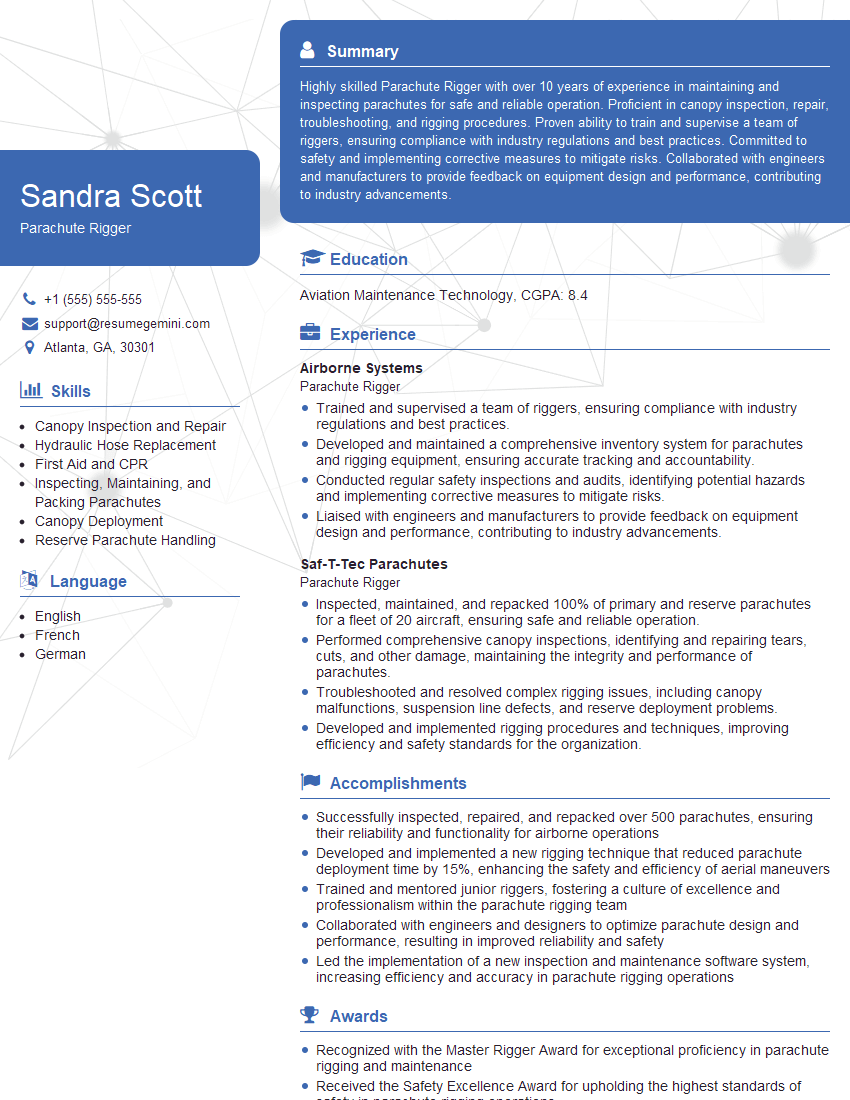
Mastering Parachute System Deployment opens doors to exciting and rewarding careers in aerospace, defense, and related industries. A strong understanding of these principles is essential for success. To maximize your job prospects, focus on crafting an ATS-friendly resume that highlights your skills and experience effectively. ResumeGemini is a trusted resource for building professional resumes that stand out. They provide examples of resumes tailored to Parachute System Deployment to help you showcase your qualifications. Take advantage of these resources to elevate your job search and land your dream role.

Explore more articles
Users Rating of Our Blogs
Share Your Experience
We value your feedback! Please rate our content and share your thoughts (optional).
What Readers Say About Our Blog
Very informative content, great job.
good