The thought of an interview can be nerve-wracking, but the right preparation can make all the difference. Explore this comprehensive guide to Sewer Troubleshooting interview questions and gain the confidence you need to showcase your abilities and secure the role.
Questions Asked in Sewer Troubleshooting Interview
Q 1. Explain the process of using a sewer camera for diagnostics.
Sewer camera diagnostics, also known as CCTV sewer inspection, uses a small, waterproof camera attached to a flexible rod to visually inspect the interior of sewer lines. This allows us to pinpoint the exact location and nature of problems without the need for extensive excavation.
The process typically involves inserting the camera into the sewer line through a cleanout or access point. The camera is equipped with lights and may have features like zoom and rotation for optimal viewing. The images are transmitted to a monitor, allowing the technician to assess the condition of the pipes and identify issues such as blockages, cracks, root intrusion, or pipe collapses. The recording can then be saved for later review and shared with clients to demonstrate the findings.
For example, I once used a sewer camera to locate a collapsed section of pipe buried under a newly paved driveway. The video clearly showed the extent of the damage, enabling us to plan the most efficient repair strategy – minimizing disruption to the client’s property.
Q 2. Describe different methods for sewer line cleaning.
Several methods exist for cleaning sewer lines, each appropriate for different types of blockages and pipe conditions. The choice depends on factors such as the severity of the blockage, the type of pipe material, and the accessibility of the line.
- Cable rodding: This involves using a long, flexible cable with a cutting head to break up and remove clogs. It’s effective for removing tree roots, grease build-up, and other solid obstructions.
- Hydro-jetting: A high-pressure water jet blasts away debris clinging to the pipe walls, effectively cleaning the entire line and removing buildup. This is particularly useful for removing grease, sediment, and root intrusion.
- Augering: Similar to cable rodding, but typically uses a larger diameter auger for tougher blockages. This is often used to clear larger obstructions or break up more substantial clogs.
- Vacuum trucks: These trucks use powerful suction to remove large amounts of debris from the sewer line, often used in conjunction with other methods.
Imagine a clogged kitchen sink. Cable rodding might be sufficient for a simple clog, while a more stubborn blockage might require hydro-jetting to remove the built-up grease. A major blockage could require a combination of techniques.
Q 3. How do you identify the source of a sewer blockage?
Identifying the source of a sewer blockage requires a systematic approach. Often, it’s a process of elimination and careful observation.
- Visual Inspection: Start by checking for obvious blockages in easily accessible areas like sinks, toilets, and floor drains. Is there a noticeable slow drain?
- Sewer Camera Inspection: As discussed earlier, a sewer camera is invaluable for pinpointing the location and cause of the blockage within the sewer line.
- Check for Water Backups: Note whether the backup is affecting multiple fixtures or only one, indicating a localized problem versus a more widespread issue. The direction of the backup can provide clues as well.
- Pressure Testing: In some cases, a pressure test can be conducted to help determine the location of a blockage by measuring the pressure drop across different sections of the line.
- History of the Problem: Talking to the homeowner to understand when and how the blockage started can help narrow down the possibilities. Has there been recent construction or tree root growth?
For instance, if a blockage is only affecting one bathroom, the problem is likely localized to that drain line, whereas a backup affecting multiple fixtures or the entire house points towards a more significant main-line blockage.
Q 4. What are the common causes of sewer backups?
Sewer backups are typically caused by a combination of factors. These factors can be broadly classified as:
- Blockages: Grease buildup, hair, foreign objects (like toys or sanitary products), tree roots penetrating the pipes, and sediment are common culprits.
- Pipe Damage: Cracks, collapses, or offsets in the sewer line can restrict flow and cause backups. This is more likely in older pipes or those affected by ground movement or root intrusion.
- Improper Installation: Poorly installed pipes, with improper slope or incorrect sizing, can lead to slow drainage and eventual backups.
- High Water Volume: Heavy rainfall or multiple fixtures being used simultaneously can overwhelm the system’s capacity, especially if there’s an existing restriction in the line.
- Bellied Pipes: These sections of pipe where the slope dips slightly, can cause solid waste and other materials to settle and build up.
Think of it like a river – if there’s a dam (blockage) or a narrowing in the channel (pipe damage), the water (wastewater) will back up.
Q 5. Explain the differences between hydro-jetting and cable rodding.
Both hydro-jetting and cable rodding are common methods for sewer line cleaning, but they differ significantly in their approach and effectiveness.
- Cable rodding uses a rotating cable with a cutting head to physically break up and remove blockages. It’s effective for tackling solid obstructions like tree roots and clogs, but it’s less effective at cleaning the entire pipe’s interior surface.
- Hydro-jetting uses high-pressure water jets to blast away debris from the pipe walls, effectively cleaning the entire line and removing buildup. It’s excellent for cleaning grease, sediment, and biofilm, improving the overall flow capacity of the sewer line.
Imagine a clogged artery. Cable rodding is like using a stent to open a blockage, while hydro-jetting is like using a high-pressure cleaning system to clear out the plaque buildup across the whole artery.
Q 6. How do you determine the appropriate repair method for a damaged sewer pipe?
Determining the appropriate repair method for a damaged sewer pipe depends on several factors, including the severity and location of the damage, the pipe material, and the accessibility of the pipe. A thorough sewer inspection, often using a camera, is critical for making an informed decision.
- Spot Repair: For minor cracks or holes, a spot repair, using epoxy or other patching materials, may be sufficient. This is often a cost-effective solution for small areas of damage.
- Pipe Lining (CIPP): This trenchless method involves inserting a resin-soaked liner into the damaged pipe and curing it in place. This creates a new pipe within the old one, restoring the structural integrity and extending the life of the sewer line. It’s suitable for many types of damage and avoids the need for extensive excavation.
- Pipe Bursting: A new pipe is pulled through the existing pipe, splitting the old pipe as it goes. This is a trenchless technique for replacing a damaged section of pipe. It’s good for lines that are beyond repair.
- Traditional Excavation and Replacement: For extensive damage, or when other methods are not feasible, the most reliable solution is excavation and replacement of the entire damaged section of the sewer line. This is more disruptive and expensive, but ensures a long-lasting solution.
The choice often involves balancing cost, disruption, and the long-term integrity of the sewer system. For example, a small crack in a readily accessible pipe might be cost-effectively repaired with epoxy, whereas extensive root intrusion across a long section of pipe might require pipe lining or even replacement.
Q 7. What safety precautions are necessary when working in a sewer environment?
Working in a sewer environment presents significant safety hazards. Proper safety precautions are paramount to prevent accidents and protect the health of workers.
- Personal Protective Equipment (PPE): This is non-negotiable and includes respirators to filter out harmful gases, rubber boots and gloves for protection against contact with wastewater and potentially harmful chemicals, hard hats, and safety glasses.
- Confined Space Entry Procedures: Sewer lines are confined spaces, meaning there’s a risk of oxygen deficiency, toxic gas buildup, and entrapment. Proper confined space entry procedures, including atmospheric testing before entry and the use of safety harnesses and communication systems, must be followed.
- Emergency Response Plan: Having a well-defined emergency response plan is crucial. Workers must know how to respond to emergencies such as gas leaks, collapses, or injuries.
- Training and Competence: All workers should be properly trained in sewer safety procedures, including the use of PPE, confined space entry techniques, and hazard recognition.
- Permit-required confined space entry: When working in a sewer line, especially a deep one, it’s essential to have proper permits from the appropriate authorities, and to follow all safety procedures, and documentation.
Ignoring safety protocols can have severe consequences, ranging from minor injuries to fatalities. Safety is not optional when working in these environments.
Q 8. Describe your experience with sewer line rehabilitation techniques.
Sewer line rehabilitation is crucial for extending the lifespan of aging infrastructure and preventing costly repairs. My experience encompasses a wide range of techniques, prioritizing minimally invasive methods whenever feasible. This includes:
- Cured-in-Place Pipe (CIPP): This involves inserting a resin-saturated liner into the existing pipe, inflating it to conform to the pipe walls, and curing it in place to create a new, structurally sound pipe within the old one. It’s minimally disruptive, requiring only access points at each end. I’ve successfully used CIPP on several projects, including a residential situation where a cracked clay pipe was causing recurring backups – the CIPP liner restored functionality quickly and efficiently.
- Pipe bursting: A newer technique where a new pipe is pulled through the existing pipe while the old pipe is simultaneously fractured and pushed into the surrounding soil. This method is ideal for situations with limited access or where the existing pipe is beyond repair. For instance, I utilized pipe bursting to replace a severely corroded section of metal pipe under a busy roadway, minimizing disruption to traffic.
- Spot Repairs: For localized damage, spot repairs using epoxy resins or other patching compounds are effective and economical. I frequently use this approach for dealing with small cracks or pinhole leaks. A recent case involved a small hole in a concrete pipe detected during a CCTV inspection – a spot repair saved the need for a full pipe replacement.
- Grouting: Grouting involves filling gaps and cracks in pipe joints to seal leaks and prevent infiltration. This is a useful technique for addressing issues in older systems with deteriorated joints. I’ve employed grouting successfully in several projects to address inflow/infiltration problems, substantially reducing stormwater entering the sewer system.
My approach always prioritizes selecting the most appropriate technique based on the specific circumstances, considering factors like pipe material, extent of damage, accessibility, and budget.
Q 9. How do you interpret sewer inspection reports?
Interpreting sewer inspection reports requires a keen eye for detail and a solid understanding of sewer system components. I begin by reviewing the overall summary and noting any critical findings. Then, I systematically analyze the visual data – usually video footage from a CCTV inspection – alongside the accompanying report. Key elements I focus on include:
- Pipe Condition: Identifying defects like cracks, root intrusion, corrosion, joint displacement, blockages, or sagging. I analyze the severity and location of these defects to determine their impact on sewer flow.
- Inflow/Infiltration (I/I): I evaluate evidence of groundwater or stormwater entering the sewer system, noting the sources and volume. High I/I can overload the system, leading to backups and environmental concerns. Pinpointing the source is crucial for effective repair.
- Pipe Alignment and Slope: Proper slope is essential for gravity flow. Deviations can lead to blockages. I verify the pipe’s alignment and grade against design specifications.
- Material Type: Knowing the pipe material (e.g., clay, PVC, concrete) helps to predict its potential for deterioration and informs the best repair strategy.
Finally, I correlate the inspection findings with the reported problems, such as slow drainage or recurring backups. This holistic approach allows for an accurate diagnosis and the development of a well-informed repair plan. I always treat the reports as a guide, confirming findings with additional investigations if needed.
Q 10. What are the signs of a collapsed sewer pipe?
A collapsed sewer pipe is a serious issue, often requiring immediate attention. The signs can be subtle initially, but become increasingly obvious as the collapse progresses. Key indicators include:
- Recurring Sewage Backups: This is the most common and significant symptom. Backups may be intermittent initially, but will become more frequent and severe as the collapse worsens.
- Slow Draining Plumbing Fixtures: Drains in sinks, toilets, and showers might drain much slower than usual.
- Gurgling Sounds from Drains: Air trying to escape a partially blocked line can cause gurgling noises.
- Sinks or Toilets Bubbling: This can occur when there’s a significant blockage and pressure buildup in the sewer line.
- Ground Subsidence: A visible depression or sinkhole above the collapsed section might appear, though this isn’t always the case.
- Sewer Odors: Strong sewer gas odors emanating from drains or the ground nearby indicate a problem with the sewer line.
If any of these symptoms are observed, it’s critical to contact a professional immediately for inspection and repair. Delaying action can exacerbate the problem and lead to extensive damage and costly repairs.
Q 11. How do you locate underground sewer lines?
Locating underground sewer lines accurately is crucial for preventing accidental damage during excavation. Several methods exist, each with its strengths and weaknesses:
- Existing Plans and Records: Reviewing existing property surveys and sewer system maps is the first step. However, these records may be inaccurate or incomplete.
- Ground Penetrating Radar (GPR): GPR uses electromagnetic waves to image subsurface features, including pipes. It’s a non-destructive method but can be affected by ground conditions.
- Pipe and Cable Locators: These devices emit signals that are detected by probes along the line to help pinpoint the location of metal or plastic pipes. They are reliable but less effective for non-metallic pipes or pipes buried at great depths.
- Traditional Digging and Tracing: In some instances, a carefully controlled excavation may be necessary to locate the pipe visually, especially for older systems without clear records. This should only be performed by experienced professionals, following safety protocols.
- Utility Locating Services: Professionals specializing in utility location are best equipped to utilize a combination of technologies and techniques. They often use a combination of the above methods to ensure accurate location.
A combination of methods is often employed for optimal accuracy. Prior to any excavation, it’s crucial to contact local utility companies to obtain exact pipe locations to avoid damaging other underground services.
Q 12. Explain the importance of proper sewer ventilation.
Proper sewer ventilation is essential for maintaining a functional and safe sewer system. Without adequate ventilation, several problems can arise:
- Sewer Gas Buildup: Sewer gas contains harmful gases like hydrogen sulfide, which is toxic and flammable. Inadequate ventilation leads to a buildup of these gases, posing risks to both public health and safety. This can manifest as foul odors or even explosions in extreme cases.
- Backups: Pressure imbalances caused by poor ventilation can lead to sewer backups in plumbing fixtures.
- Increased Corrosion: The presence of hydrogen sulfide contributes to the corrosion of sewer pipes, especially metal ones, shortening their lifespan. The buildup of moisture also encourages corrosion.
- Pest Infestation: Poor ventilation can create a favorable environment for insects and rodents.
Proper ventilation, typically achieved through vent stacks that extend above the roofline, ensures a constant flow of air through the sewer system. This helps to prevent gas buildup, maintain pressure balance, and generally keeps the system healthy.
Q 13. How do you handle hazardous materials encountered during sewer work?
Handling hazardous materials encountered during sewer work requires strict adherence to safety protocols and regulations. These materials can range from sewage itself, which contains bacteria and pathogens, to chemical spills and industrial waste. My approach involves:
- Proper Personal Protective Equipment (PPE): This includes respirators, gloves, protective suits, and eye protection. The choice of PPE is tailored to the specific hazard.
- Safe Work Practices: We always follow strict safety procedures such as confined space entry protocols and lockout/tagout procedures when working with equipment. The worksite is secured and designated personnel are present at all times.
- Emergency Response Planning: We have pre-planned emergency procedures, including emergency contact information and plans for evacuation, in case of unforeseen circumstances.
- Waste Disposal: All hazardous waste is handled according to local, state, and federal regulations. We utilize licensed hazardous waste disposal companies.
- Sampling and Analysis: If the presence of hazardous materials is suspected, we perform environmental sampling and analysis to accurately identify and quantify the risk.
I personally stress the importance of thorough training and ongoing education regarding hazardous materials and safety procedures. The safety and well-being of my team is my top priority.
Q 14. What are the different types of sewer pipe materials and their strengths/weaknesses?
Sewer pipes are manufactured from various materials, each with its own set of strengths and weaknesses. The selection of material depends on factors such as soil conditions, chemical environment, expected lifespan, and budget.
- Vitrified Clay Pipe (VCP): A traditional material known for its durability and resistance to corrosion. However, it’s brittle and susceptible to root intrusion. It is also less flexible compared to modern materials.
- Polyvinyl Chloride (PVC): A widely used plastic pipe known for its lightweight nature, corrosion resistance, and ease of installation. It is suitable for many applications, but can be damaged by strong impacts or extreme temperatures. The strength of the pipe varies depending on the schedule.
- High-Density Polyethylene (HDPE): A very strong and flexible plastic pipe, resistant to corrosion and root intrusion. It is ideal for difficult ground conditions and can be easily jointed. Its flexibility makes it ideal for situations with ground movement.
- Concrete Pipe: A strong material, resistant to crushing and impact. It can be more expensive and heavier than other options, and its permeability can be a concern if not properly sealed.
- Ductile Iron Pipe: Offers excellent strength and durability, making it suitable for high-pressure applications. However, it’s susceptible to corrosion without proper coatings. Cost is generally higher than many plastic materials.
The choice of pipe material is a critical decision that significantly impacts the longevity and maintenance requirements of the sewer system. I always consider the long-term implications of the material selection during the design and implementation phases.
Q 15. Describe your experience with trenchless sewer repair methods.
Trenchless sewer repair is a game-changer in the industry, minimizing disruption and saving time and money. My experience encompasses a wide range of these techniques, including pipe bursting, cured-in-place pipe (CIPP) lining, and lateral line relining. Pipe bursting involves using a bursting head to break up the old pipe while simultaneously pulling in a new one. CIPP involves inserting a resin-soaked liner into the existing pipe, inflating it to conform to the pipe walls, and curing it in place, creating a new, smooth pipe within the old one. Lateral line relining focuses on repairing individual branch lines without excavating the main line. I’ve successfully utilized these methods on projects ranging from residential repairs to large-scale municipal projects, consistently achieving excellent results with minimal environmental impact.
For example, I recently completed a CIPP lining project on a severely deteriorated 6-inch sewer line beneath a busy city street. Traditional excavation would have been incredibly disruptive and expensive. Using CIPP, we completed the repair quickly and efficiently, with minimal disruption to traffic and surrounding businesses. The homeowner was thrilled with the results and the significantly reduced cost compared to a traditional dig-and-replace method.
Career Expert Tips:
- Ace those interviews! Prepare effectively by reviewing the Top 50 Most Common Interview Questions on ResumeGemini.
- Navigate your job search with confidence! Explore a wide range of Career Tips on ResumeGemini. Learn about common challenges and recommendations to overcome them.
- Craft the perfect resume! Master the Art of Resume Writing with ResumeGemini’s guide. Showcase your unique qualifications and achievements effectively.
- Don’t miss out on holiday savings! Build your dream resume with ResumeGemini’s ATS optimized templates.
Q 16. How do you troubleshoot a slow-draining sewer line?
Troubleshooting a slow-draining sewer line requires a systematic approach. First, I’d check for obvious blockages, such as hair or grease buildup in visible pipes. Then, I’d use a plumbing snake (also known as a drain auger) to attempt to dislodge any blockages further down the line. If that’s unsuccessful, a sewer camera inspection is the next step. This allows for a visual inspection of the pipe’s interior, revealing any blockages, cracks, or root intrusions. The camera’s footage provides crucial information to determine the exact cause and location of the problem. Based on the camera inspection findings, we can then determine the appropriate solution, which might involve hydro-jetting (high-pressure water jetting to clear debris), snaking, or more extensive repairs.
For instance, I once encountered a slow drain that initially seemed like a simple clog. However, the sewer camera revealed a significant amount of root intrusion causing a partial blockage. This necessitated a more involved repair using targeted root removal techniques followed by a section of pipe lining to prevent future root intrusion.
Q 17. What are the legal and regulatory requirements for sewer repair work?
Sewer repair work is heavily regulated, varying by location. It typically involves obtaining the necessary permits and following local codes and regulations, including those related to excavation, backfilling, and environmental protection. These regulations often require specific qualifications and licensing for contractors to ensure proper safety and environmental protection measures are followed. I always make sure to stay current on all relevant regulations and ensure our work complies with all applicable laws. This includes adhering to OSHA standards for worker safety, as well as protecting the environment during and after the project is completed.
For example, in some areas, there are strict rules regarding the disposal of excavated materials, requiring specific handling and transportation to designated disposal sites to protect water quality and prevent pollution. We always carefully follow these regulations to avoid any potential fines or legal issues.
Q 18. Explain your experience with different types of sewer cleaning equipment.
My experience spans a wide range of sewer cleaning equipment, from basic hand tools to advanced mechanical and hydro-jetting systems. I’m proficient in using plumbing snakes of various sizes and configurations for clearing clogs. I have extensive experience with hydro-jetting equipment, which utilizes high-pressure water jets to effectively remove grease, debris, and root intrusions from sewer lines. Beyond these, I’m also familiar with using sewer cameras for inspections, and specialized equipment for specific tasks like root cutting and pipe lining installations. Regular maintenance and calibration of all equipment is crucial for ensuring its optimal performance and longevity, which is something I prioritize.
In one instance, a particularly stubborn blockage required the use of both a powerful hydro-jet and a specialized root cutter. The hydro-jet initially cleared some debris, but the camera revealed persistent root intrusion. Using the root cutter, we were able to effectively remove the roots before clearing the remaining debris.
Q 19. How do you handle customer complaints regarding sewer issues?
Handling customer complaints involves a combination of empathy, effective communication, and problem-solving. I always start by actively listening to the customer’s concerns, validating their frustrations, and expressing my sincere apologies for any inconvenience caused. Next, I explain the steps I will take to resolve the problem clearly and concisely. Then, I promptly schedule a time to assess the situation in person, carrying out the necessary troubleshooting and repair work. Once the problem is resolved, I follow up with the customer to confirm their satisfaction and ensure the issue does not recur. Open communication and a proactive approach are key to maintaining customer trust and satisfaction.
One example involved a customer who had experienced a sewage backup. Although the issue was ultimately resolved quickly, the emotional distress caused by the situation needed careful handling. Following the repair, I personally checked in with them several times, demonstrating that their concerns were heard and addressed with genuine care.
Q 20. What is your experience with root intrusion in sewer lines?
Root intrusion is a very common problem in sewer lines. Tree roots seeking moisture and nutrients can penetrate pipe joints and cracks, causing blockages and significant damage over time. My experience involves identifying root intrusion through sewer camera inspections, then employing various methods for removal, including mechanical removal with root cutters, chemical root control, and in some cases, pipe replacement or lining to prevent future issues. Preventive measures such as regular cleaning and inspection, and even the strategic planting of trees away from sewer lines, can also significantly help prevent root intrusion.
I once worked on a case where extensive root intrusion had caused a complete sewer line blockage. Using a combination of hydro-jetting and a specialized root cutter, we successfully removed the roots. However, the pipe itself was damaged, so we also performed CIPP lining to create a new, root-resistant sewer line.
Q 21. How do you prevent sewer backups during heavy rainfall?
Preventing sewer backups during heavy rainfall requires a multi-pronged approach. Regular maintenance of sewer lines is crucial to prevent blockages that can exacerbate the effects of heavy rainfall. This includes cleaning drains, clearing debris, and conducting routine inspections to identify any potential problems. Proper grading around the house can help direct water away from the foundation and prevent infiltration into the sewer system. Furthermore, ensuring that downspouts and sump pumps are properly directed away from the foundation helps reduce the load on the sewer system during periods of intense rainfall. For older homes, upgrading to a larger-capacity sewer line can significantly improve the system’s ability to handle increased water flow.
In one instance, a client’s basement repeatedly flooded during heavy rainfall. A thorough inspection revealed improperly directed downspouts contributing to basement flooding. After rerouting these to ensure water flowed away from the foundation, the flooding problem was eliminated.
Q 22. Describe your troubleshooting experience with sewer manholes.
My experience with sewer manholes spans over a decade, encompassing routine inspections, emergency repairs, and complex troubleshooting. I’ve encountered everything from simple blockages caused by tree roots to major structural issues requiring extensive repairs. For instance, I once investigated a manhole exhibiting significant inflow/outflow discrepancies. Through careful observation and flow measurements, I identified a collapsed section of the lateral sewer line leading to the manhole, which was subsequently repaired using cured-in-place pipe (CIPP) technology.
A typical troubleshooting process for me involves:
- Visual Inspection: Assessing the manhole’s condition for cracks, leaks, debris, and unusual water levels.
- Flow Measurement: Using flow meters to determine inflow and outflow rates, identifying potential blockages or leaks.
- CCTV Inspection: Employing closed-circuit television cameras to inspect the sewer line connecting to the manhole, identifying the source of any problems.
- Odor Detection: Identifying unusual odors that can indicate the presence of sewer gases or decaying organic matter.
- Hydrostatic Testing: In some cases, conducting hydrostatic tests to assess the structural integrity of the manhole and its connecting pipes.
The key is systematic investigation, combining different methods to accurately diagnose the issue and recommend the appropriate solution.
Q 23. What is your experience with sewer system maintenance and preventative measures?
Sewer system maintenance is crucial for preventing costly repairs and ensuring public health. My experience includes developing and implementing comprehensive maintenance plans, encompassing regular inspections, cleaning, and preventative measures. I’ve worked on projects involving everything from small residential systems to large municipal networks.
Preventive measures I frequently employ include:
- Regular Cleaning: Scheduling routine cleaning of sewer lines using high-pressure water jets or other appropriate methods to remove accumulated debris and prevent blockages.
- Root Control: Implementing strategies to prevent tree roots from intruding into sewer lines, such as root barriers or chemical treatments.
- Grease Trap Maintenance: Ensuring regular maintenance and cleaning of grease traps in commercial establishments to prevent fat, oil, and grease (FOG) buildup.
- Infiltration/Inflow (I/I) Reduction: Identifying and repairing sources of infiltration (groundwater entering the sewer system) and inflow (surface water entering the sewer system), which can overload the system.
- Manhole Inspections: Regularly inspecting manholes for structural damage, corrosion, and leaks.
A proactive approach to maintenance is far more cost-effective than reactive emergency repairs. Imagine preventing a major sewer collapse by addressing a minor crack early on – that’s the value of preventative maintenance.
Q 24. Explain the process of repairing a cracked sewer pipe.
Repairing a cracked sewer pipe depends heavily on the severity and location of the crack, as well as the pipe material. Minor cracks in accessible pipes might be repaired with epoxy resin or patching compounds. For more significant damage, or when the pipe is inaccessible, trenchless methods are often preferred.
Here’s a breakdown of common repair methods:
- Patching: For small cracks in accessible pipes, cleaning the area and applying a durable epoxy patch is a quick and effective solution.
- Point Repair: A more substantial repair involving excavation to expose the damaged section. The cracked section is then cut out and replaced with a new pipe section.
- Cured-in-Place Pipe (CIPP): A trenchless method involving inserting a resin-saturated liner into the damaged pipe. The liner is then cured, creating a new pipe within the old one.
- Pipe Bursting: Another trenchless technique where a new pipe is pulled through the existing pipe, breaking up the old pipe in the process.
Choosing the right repair method involves careful assessment of factors like pipe material, location, accessibility, and budget constraints. Safety is paramount during any sewer repair work, requiring adherence to strict safety protocols and the use of appropriate personal protective equipment (PPE).
Q 25. How familiar are you with different types of sewer gases and their dangers?
Sewer gases are a significant hazard, posing serious risks to workers. I’m familiar with various gases, including methane, hydrogen sulfide, and carbon dioxide. Hydrogen sulfide (H2S), in particular, is extremely dangerous, even at low concentrations, and can cause respiratory problems, unconsciousness, and even death. Methane is explosive, requiring careful ventilation procedures.
My experience includes:
- Gas Detection: Using specialized gas detection equipment to monitor gas levels in manholes and confined spaces before entering.
- Ventilation: Implementing appropriate ventilation techniques to ensure safe working conditions, including using blowers to displace dangerous gases.
- Safety Procedures: Following strict safety protocols, including wearing appropriate respiratory protection and harnesses with safety lines.
- Emergency Response: Knowing how to respond to gas leaks or exposure incidents.
It’s critical to understand that sewer gas exposure can have immediate and long-term health implications. Proper training, safety measures, and the use of appropriate monitoring equipment are vital for minimizing these risks.
Q 26. Describe your experience with using GPS and GIS for sewer line mapping.
I have extensive experience using GPS and GIS for sewer line mapping. This includes using GPS receivers to accurately locate manholes and other sewer infrastructure components in the field, and then integrating this data into a GIS system to create detailed maps of the sewer network. This technology is essential for planning maintenance, repairs, and new construction projects.
The benefits of using GIS for sewer line mapping are numerous:
- Accurate Mapping: Provides accurate locations of sewer lines, manholes, and other assets.
- Data Management: Allows for efficient storage and management of sewer system data.
- Spatial Analysis: Facilitates spatial analysis to identify patterns, trends, and potential problem areas.
- Project Planning: Supports planning and scheduling of maintenance, repair, and construction projects.
- Improved Efficiency: Reduces time and cost associated with locating and accessing sewer infrastructure.
For instance, I used GIS to identify areas within a municipality’s sewer network that were prone to flooding during heavy rainfall, allowing for targeted improvements to the system’s capacity and efficiency.
Q 27. What is your experience with different types of sewer flow meters?
My experience encompasses various sewer flow meters, including:
- Magnetic Flow Meters: These meters measure the flow rate based on the magnetic field induced by the flow of conductive liquid (wastewater). They are non-invasive and accurate for a wide range of flows.
- Ultrasonic Flow Meters: These meters use ultrasonic waves to measure the flow velocity. They’re suitable for a variety of pipe materials and sizes.
- Venturi Meters: These meters use a constriction in the pipe to create a pressure difference that is proportional to the flow rate. They’re relatively simple but can be less accurate than other types.
- Open Channel Flow Meters: These meters are used in open channels or partially filled pipes, often utilizing techniques like weirs or flumes to measure flow.
The selection of an appropriate flow meter depends on several factors, including the pipe size, material, flow rate range, and the level of accuracy required. Data from flow meters is essential for assessing the capacity and performance of the sewer system and identifying potential problems.
Q 28. Explain your knowledge of different sewer materials (clay, PVC, concrete, etc.)
I possess extensive knowledge of various sewer materials, each with its own strengths and weaknesses:
- Clay Pipes: Traditional material, relatively brittle and susceptible to root intrusion and cracking. Often found in older sewer systems.
- PVC Pipes: A widely used material, offering excellent corrosion resistance and relatively low cost. However, UV exposure can degrade it over time.
- Concrete Pipes: Durable and strong, but can be susceptible to cracking and corrosion in certain environments. Often used for large-diameter pipes.
- High-Density Polyethylene (HDPE) Pipes: Flexible and resistant to corrosion, making them suitable for challenging installations. They are also more resistant to root intrusion compared to other materials.
- Ductile Iron Pipes: Highly durable and resistant to corrosion, making them a good choice for high-pressure applications. They are typically used in areas where structural strength is paramount.
The choice of material depends on factors such as soil conditions, pipe diameter, flow rate, and budget. Understanding the properties of each material is essential for selecting the most appropriate option for a particular application. For example, in areas prone to ground movement, HDPE pipes are a good choice due to their flexibility. In areas with highly corrosive soils, ductile iron pipes offer superior corrosion resistance.
Key Topics to Learn for Sewer Troubleshooting Interview
- Sewer System Fundamentals: Understanding gravity sewers, force mains, lift stations, and their components. This includes knowledge of pipe materials, sizes, and flow dynamics.
- Troubleshooting Techniques: Practical application of diagnostic tools like CCTV cameras, flow meters, and pressure gauges to pinpoint blockages, leaks, and other issues. This also encompasses understanding root cause analysis methodologies.
- Common Sewer Problems: Identifying and addressing issues like root intrusion, grease build-up, pipe collapses, and infiltration/inflow. This requires understanding the impact of various factors on sewer system performance.
- Safety Procedures: Understanding and adhering to all relevant safety regulations and protocols when working in confined spaces and around potentially hazardous materials. This includes proper use of personal protective equipment (PPE).
- Repair and Maintenance Strategies: Knowledge of various repair techniques, including trenchless technologies, and routine maintenance procedures to prevent future problems. Understanding preventative maintenance schedules and their importance.
- Regulations and Compliance: Familiarity with local, state, and federal regulations pertaining to wastewater management and disposal. This includes understanding permit requirements and environmental considerations.
- Emergency Response: Understanding procedures for responding to sewer emergencies, including sewage backups and overflows. This includes knowing how to assess the situation, implement control measures, and initiate repairs.
Next Steps
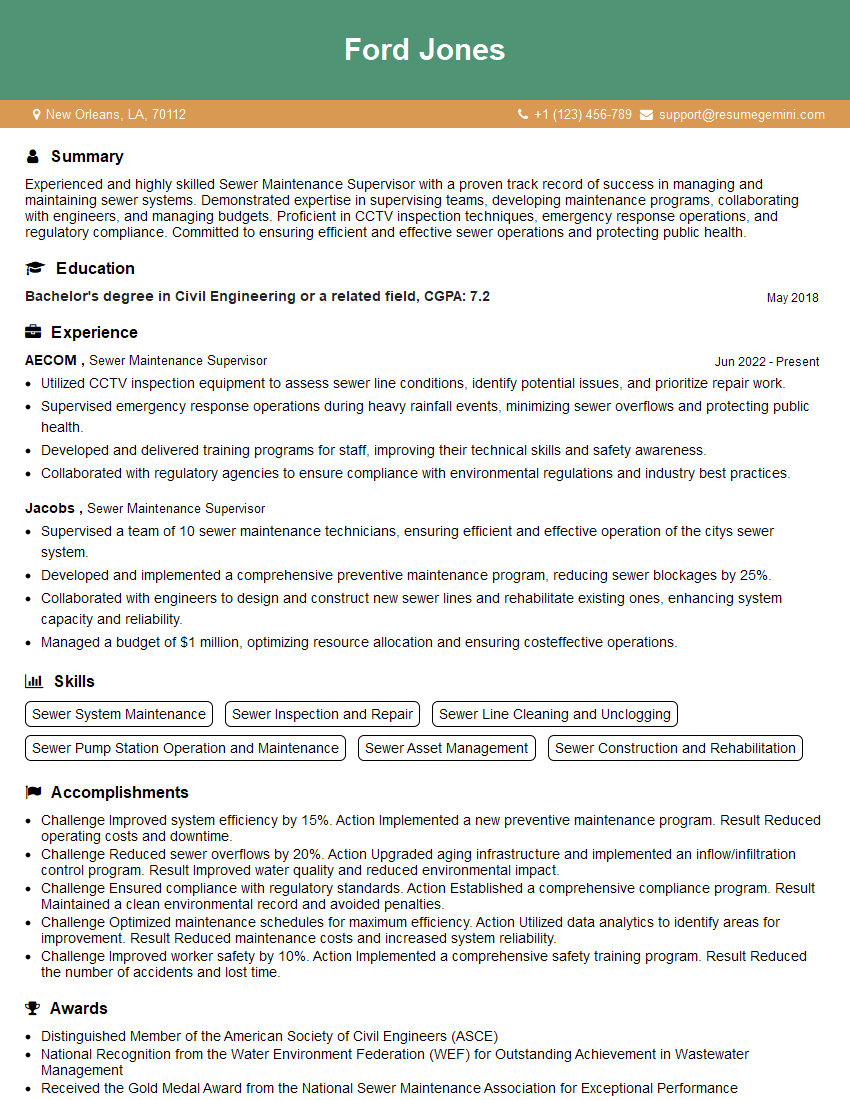
Mastering sewer troubleshooting opens doors to rewarding and stable careers in a vital infrastructure sector. Your expertise is highly valuable to municipalities and private companies alike. To maximize your job prospects, creating an ATS-friendly resume is crucial. ResumeGemini is a trusted resource to help you build a professional and impactful resume that showcases your skills and experience effectively. We provide examples of resumes tailored specifically to sewer troubleshooting roles to give you a head start.
Explore more articles
Users Rating of Our Blogs
Share Your Experience
We value your feedback! Please rate our content and share your thoughts (optional).
What Readers Say About Our Blog
Very informative content, great job.
good