Every successful interview starts with knowing what to expect. In this blog, we’ll take you through the top Sewing Pattern Reading interview questions, breaking them down with expert tips to help you deliver impactful answers. Step into your next interview fully prepared and ready to succeed.
Questions Asked in Sewing Pattern Reading Interview
Q 1. Explain the difference between a sloper and a block.
Both slopers and blocks are foundational pattern pieces, essentially personalized base patterns, but they differ significantly in their purpose and creation method. A sloper is a truly basic, close-fitting pattern based on your individual body measurements. Think of it as a blank canvas – it’s a highly personalized foundation onto which you’ll add design elements. It’s drafted directly from your measurements, creating a form-fitting shell that reflects your unique body shape. A block, on the other hand, is a more standardized base pattern, often commercially available in various sizes. While it aims for a good fit, it’s not as precisely tailored to your specific body contours as a sloper. You might find yourself making adjustments to a block to achieve a perfect fit, whereas a well-drafted sloper already accounts for much of your individual shape.
Think of it like this: a sloper is like a bespoke suit tailored to your exact measurements, while a block is like a well-fitting off-the-rack suit that may need some alterations.
Q 2. Describe the process of grading a sewing pattern.
Grading a sewing pattern involves scaling the pattern pieces up or down to create different sizes. This process is crucial for producing garments in a range of sizes without re-drafting the entire pattern each time. It’s usually done using specialized software or by hand, expanding or reducing specific pattern measurements based on industry standard grading rules. The process is quite technical, demanding precise measurements and consistent scaling across all pattern pieces to ensure the garment proportions remain accurate and balanced across different sizes. Incorrect grading can lead to ill-fitting garments and significant alterations later on.
The most common method involves establishing a set of grading rules – specifying, for example, how much larger the chest, waist and hip measurements should be for each size increase. These rules are systematically applied to the original pattern to create new pattern pieces for the larger sizes. Maintaining seam allowances and other critical design elements throughout the process is crucial for a successful grading.
Q 3. How do you identify and correct pattern fitting issues?
Identifying and correcting pattern fitting issues requires a keen eye and methodical approach. The first step involves assessing the garment on the body, carefully observing areas of tightness, looseness, or pulling. Common issues include:
- Shoulder seams too high or low: Adjust the shoulder slope on the pattern.
- Tightness across the bust or waist: Expand the pattern in those areas.
- Gaping at the neckline or armholes: Reduce the pattern in those areas.
- Pulling across the back: Consider adjusting the back width or shoulder blades.
Once the problem area(s) are identified, making small, incremental adjustments to the pattern is key. It’s often better to make multiple small adjustments than one large one. After each adjustment, test the fit on a muslin (a test garment made from inexpensive fabric) before committing to the final fabric. This iterative process ensures accurate fit adjustments until the garment fits properly.
Q 4. What are the common types of pattern adjustments?
Common pattern adjustments address a wide range of fitting issues. Some examples include:
- Full Bust Adjustment (FBA): Adds extra width to the bust area of the pattern, improving fit for larger busts.
- Shoulder Adjustments: Altering the slope and length of the shoulder seam to accommodate different shoulder structures.
- Waist Adjustments: Adjusting the waistline to create a better fit for various body shapes.
- Hip Adjustments: Adjustments to the hip area to ensure a comfortable fit.
- Length Adjustments: Modifying the length of the garment to suit individual height.
- Ease Adjustments: Adding or removing ease (extra fabric for comfort and movement) in different areas of the pattern.
The specific type of adjustment required will depend on the individual’s body shape and the fit issues identified during the fitting process. Accurate measurements are essential for successful adjustments.
Q 5. Explain how to use a seam allowance.
Seam allowance refers to the extra fabric added to the raw edges of pattern pieces before sewing. It provides space for seam construction and helps prevent the finished garment from being too small. Seam allowances vary depending on the garment and the type of fabric. Common seam allowances range from 1/4 inch (6 mm) to 5/8 inch (15mm). The pattern usually specifies the required seam allowance. It’s critical to consistently adhere to the specified allowance throughout the construction process to ensure all garment pieces fit together correctly.
Before cutting fabric, it’s crucial to add the seam allowance to each pattern piece. Many patterns have the seam allowance already included; however, others might show only the finished garment measurements, requiring you to add it manually. After cutting, accurately sewing along the seam line ensures the finished garment is well-proportioned and fits as designed.
Q 6. What are the different types of sewing pattern markings?
Sewing patterns utilize various markings to guide the sewing process. These are often tiny symbols or notches. Common markings include:
- Notches: Small triangular markings used for matching seams accurately. These are essential for aligning different pattern pieces correctly.
- Grainlines: Indicate the direction the fabric should be cut to ensure the garment hangs properly.
- Center Front (CF) and Center Back (CB): These markings indicate the center of the front and back panels.
- Seam Lines: These lines indicate where seams should be sewn.
- Dart Lines: These lines indicate the location of darts – shaped folds of fabric used for shaping the garment.
- Button and Buttonhole markings: Show the placement for buttons and buttonholes.
- Pocket placement markings: Indicate the placement for pockets.
Understanding these markings is crucial to accurate garment construction. Ignoring them can lead to ill-fitting or poorly constructed garments.
Q 7. How do you interpret pattern instructions?
Interpreting pattern instructions requires careful reading and a methodical approach. Begin by reviewing the entire instruction sheet before starting to sew. Pay close attention to the sequence of steps and the illustrations accompanying the text. Each step should be clearly understood before proceeding to the next. If you encounter unfamiliar terms or techniques, refer to a sewing dictionary or online resources for clarification. Take your time, work methodically and don’t hesitate to refer back to the instructions when needed.
Many patterns include diagrams and illustrations. Use these visual aids alongside the written instructions to visualize each step. Before cutting into your chosen fabric, create a muslin test garment to check the fit and construction. This ensures that the final garment will fit perfectly before committing your good fabric to the project.
Q 8. Describe your experience with different types of fabrics and their impact on pattern design.
Understanding fabric properties is paramount in pattern design. Different fabrics drape, stretch, and behave differently when sewn. For example, a lightweight silk will require a more delicate pattern with looser fitting and minimal seams to avoid distortion, unlike a sturdy denim which needs more robust construction and can tolerate more structured designs.
- Lightweight fabrics like silk, chiffon, and georgette require patterns with minimal ease and gentle curves to avoid pulling or distortion. They often need more support or lining.
- Medium-weight fabrics like cotton, linen, and crepe offer more versatility, allowing for a wider range of designs and ease.
- Heavyweight fabrics such as wool, denim, and brocade require sturdy patterns with strong seams, potentially incorporating interfacing for structure and shape retention. Seams need to be carefully considered to avoid bulkiness.
My experience spans working with a wide variety of fabrics, from delicate lace to heavy leather, influencing my design choices and construction methods accordingly. A tailored wool coat pattern would necessitate totally different considerations than a flowing silk maxi dress.
Q 9. How do you adjust a pattern for different body types?
Adjusting patterns for different body types involves a keen understanding of body measurements and how they relate to the pattern’s design. This process isn’t about just increasing or decreasing sizes uniformly but rather making strategic alterations based on individual needs. A common approach uses ‘full-bust’ or ‘high-bust’ adjustments for dresses, for instance, that accounts for the difference between the highest part of your bust to the fuller part of your bust.
- Bust adjustments: Adding or subtracting width at the bust point, adjusting the shoulder slope and dart placement.
- Waist adjustments: Raising or lowering the waistline, adjusting the side seams to accommodate different waist measurements.
- Hip adjustments: Adding or subtracting width at the hipline, adjusting the skirt’s flare or fullness.
- Length adjustments: Extending or shortening the pattern pieces to match desired garment length.
I use a combination of techniques including adding or removing wedges, shifting darts, and altering seam lines to precisely tailor the pattern to a specific body shape. I often create personalized grading charts, meticulously noting adjustments to ensure consistency in future projects. For example, someone with a fuller bust might need a ‘full bust adjustment’ which adds fabric at the bust point. Someone with broad shoulders might need a broader shoulder slope.
Q 10. What software are you proficient in for pattern making (e.g., Gerber, Optitex)?
While I am proficient with paper pattern making, I also have extensive experience with digital pattern-making software. My expertise includes using both Gerber Accumark and Optitex. These programs facilitate precision and efficiency in pattern design, grading, and marker making.
- Gerber Accumark: I’m highly skilled in using Accumark for creating complex patterns, grading for various sizes, and generating efficient marker layouts for optimal fabric utilization. I regularly leverage its features to simulate fabric drape and adjust patterns according to fabric behavior.
- Optitex: My experience with Optitex includes 3D visualization capabilities, allowing me to preview designs before physical creation. This is particularly useful for identifying potential problems or aesthetic tweaks early in the design process, significantly saving time and resources.
Digital pattern-making streamlines many of my design processes such as grading, and offers advantages like easy pattern storage and collaborative capabilities.
Q 11. Explain your process for creating a pattern from a sketch.
Transforming a sketch into a functional pattern involves several steps. It’s a bit like translating an artistic vision into a technical blueprint.
- Measurements and Design Specifications: Based on the sketch and desired garment style, I determine essential measurements (length, width, sleeve circumference etc.) and design features (e.g., darts, pleats, pockets).
- Drafting Basic Blocks: I then begin by drafting the essential blocks like bodice, sleeve, and skirt blocks, using industry standard techniques. These serve as foundations for the final pattern.
- Adding Design Details: I incorporate design elements from the sketch, such as neckline shape, sleeve style, and other specific features, gradually shaping the basic block into the desired form.
- Testing and Refinements: I create a muslin (test garment) to evaluate the fit and make any necessary adjustments. This iterative process is critical in refining the pattern until it meets the design goals.
Each step demands meticulous attention to detail, ensuring that the final pattern accurately reflects the design intention. Accuracy is vital for a successful final garment.
Q 12. How do you ensure accuracy in pattern making?
Accuracy in pattern making is paramount and I employ several techniques to ensure precision.
- Precise Measurements: Accurate measurements are fundamental. I always double-check my measurements, and I use professional measuring tools.
- Accurate Drafting Techniques: I use standardized drafting methods and always follow a structured workflow.
- Regular Checks: I frequently check my work for errors, ensuring all angles and measurements are correct.
- Test Garments: Muslin prototypes are essential. This allows for identifying and correcting fit problems early in the process.
- Grading Consistency: When grading patterns, I utilize software to maintain consistent proportional adjustments across sizes.
By consistently employing these methods, I minimize errors and ensure the final pattern is accurate, leading to well-fitting and well-constructed garments. A small error in the pattern can lead to large issues in the final garment, which is why these steps are critical.
Q 13. Describe your experience with different types of pattern pieces.
My experience includes working with various pattern pieces. Each piece contributes to the overall garment design and requires specific attention.
- Bodice pieces: Front and back bodice patterns, often including darts and shaping for a flattering fit.
- Sleeve pieces: Different types, such as set-in, raglan, kimono, and dolman sleeves. Each requires unique construction methods and adjustments.
- Skirt pieces: A-line, gathered, pleated, or fitted skirts, each with their own characteristics.
- Collar pieces: Standing, notched, or shawl collars, varying in complexity and construction.
- Pocket pieces: Patch, welt, or inseam pockets, each demanding accurate placement and execution.
Understanding the function and interaction of each piece is key to successful garment construction. For example, the interaction between the bodice and the sleeve needs precision to ensure a smooth fit, particularly in areas like armholes and shoulder seams.
Q 14. What is your process for troubleshooting pattern problems?
Troubleshooting pattern problems requires a systematic approach. It’s like detective work, examining clues to identify the root cause.
- Identify the Problem: Pinpoint the specific issue – is it a fit problem (too tight, too loose, pulling, gaping), or a construction problem (uneven seams, puckering)?
- Analyze the Pattern: Carefully examine the pattern pieces, checking for measurement errors, incorrect grainlines, or design flaws.
- Review Construction: Assess the sewing process. Were the instructions followed correctly? Was the right fabric used? Were seams finished appropriately?
- Make Adjustments: Based on the analysis, make appropriate adjustments to the pattern or the sewing process.
- Test Again: Create a new test garment or make a modification to the existing garment to verify the solution.
A methodical approach is essential. For example, a gaping neckline might indicate a need for a broader neckline pattern piece, or perhaps more ease added around the neck. Trial and error, combined with a critical eye, leads to the most successful outcomes.
Q 15. How do you create a muslin and use it to assess pattern fit?
A muslin is a test garment made from inexpensive fabric, like muslin or cotton, used to check the fit of a sewing pattern before cutting into your final fabric. It’s like a ‘dress rehearsal’ for your garment. Creating a muslin involves cutting out the pattern pieces in your chosen inexpensive fabric, sewing them together as instructed, and then trying it on.
Assessing Fit: Once the muslin is on, you critically examine the fit. Look for areas that are too tight, too loose, or need adjustments in length or width. Common areas to check include the shoulders, bust, waist, hips, and armholes. You may need to make markings on the muslin to indicate where alterations are needed. After removing the muslin, carefully unpick the seams and make your adjustments directly on the pattern pieces. You then re-cut your muslin or move on to your good fabric.
Example: If the shoulder seams are pulling, it means the pattern needs to be adjusted to add width to the shoulder area. You would add this width to the pattern pieces and recut.
Career Expert Tips:
- Ace those interviews! Prepare effectively by reviewing the Top 50 Most Common Interview Questions on ResumeGemini.
- Navigate your job search with confidence! Explore a wide range of Career Tips on ResumeGemini. Learn about common challenges and recommendations to overcome them.
- Craft the perfect resume! Master the Art of Resume Writing with ResumeGemini’s guide. Showcase your unique qualifications and achievements effectively.
- Don’t miss out on holiday savings! Build your dream resume with ResumeGemini’s ATS optimized templates.
Q 16. What are your preferred methods for transferring markings onto fabric?
Transferring markings accurately is crucial for a well-made garment. I employ several methods, choosing the best based on the fabric and markings.
- Tracing Wheel and Carbon Paper: This is great for transferring seam allowances and darts. I place carbon paper between the pattern and the fabric, then roll the tracing wheel along the pattern markings. The pressure creates a visible line on the fabric.
- Tailor’s Chalk: This is ideal for delicate fabrics, allowing for light markings that can be easily brushed away. I use a chalk pencil or tailor’s tacks to make temporary markings directly onto the fabric.
- Water-soluble Pens or Markers: These are useful for making specific markings, as they disappear when washed. They’re good for detailed instructions.
- Pins: Using pins is especially useful for transferring notches, which indicate matching points on different pattern pieces. I use a small pin to directly mark the notch point.
I always test the method on a scrap piece of fabric first to ensure it works well with the material and doesn’t cause unwanted damage or marks.
Q 17. Explain your understanding of grainlines and their importance.
Grainline refers to the direction of the warp (lengthwise) and weft (crosswise) yarns in woven fabrics. Understanding grainlines is fundamental to garment construction. Cutting a garment piece on the wrong grain will affect its drape, fit, and overall appearance.
- Straight Grain (Warp): This is the lengthwise yarn in the fabric, usually the strongest and least stretchy direction. Most pattern pieces are cut along the straight grain to ensure the garment hangs properly and retains its shape.
- Cross Grain (Weft): This is the crosswise yarn, usually softer and more flexible than the warp. It’s sometimes used for specific design elements but should be used sparingly for main parts of garments.
- Bias: This is a diagonal line at 45 degrees to both the warp and weft. Fabric cut on the bias drapes beautifully but tends to stretch more than fabric cut on the straight grain.
Importance: Cutting off-grain can lead to distortion, causing the garment to hang unevenly, twist, or lose its shape. For example, a skirt cut with the pattern on the bias instead of the straight grain could end up being too short in some areas and too long in others.
Q 18. How do you handle pattern alterations for plus sizes?
Pattern alterations for plus sizes often involve adding width to the pattern pieces. This can’t just be done by simply adding the difference between sizes. One shouldn’t just add inches all around. A more thoughtful approach is necessary to maintain correct proportions and aesthetics.
Methods:
- Full Bust Adjustment (FBA): This is a common alteration addressing the difference between the high bust and full bust measurements. It involves adding width to the bust area while maintaining a smooth, balanced fit.
- Adding Width to Other Areas: Depending on the body shape and the pattern, adjustments might also be needed at the waist, hips, or back. These adjustments should be done proportionally.
- Using Plus Size Patterns: When available, using patterns specifically designed for plus sizes is highly recommended. These are often drafted for more appropriate body proportions.
- Slanting Seams: To ensure a comfortable fit, sometimes seams need to be slanted or curved to account for the body’s shape. I often use this approach to create a better fit around the curves.
It’s vital to check the fit after each alteration by making muslins and fitting them to the body before committing to final fabric.
Q 19. Describe your experience with different types of closures (zippers, buttons, hooks).
I’m proficient with various closures and know that the choice depends on the garment’s style and construction.
- Zippers: I can install center-back, invisible, separating, and side zippers with proficiency. The technique varies depending on the type of zipper and garment.
- Buttons: I’m skilled in various button attachment methods, from hand-sewing to machine stitching. I carefully consider the size, material, and weight of buttons to ensure durability and aesthetic appeal.
- Hooks and Eyes: These are ideal for delicate or tailored garments. I know how to hand-sew them securely and neatly, ensuring they lie flat and provide secure closure.
- Snaps and Hooks and Bars: These are useful for closures that don’t require as much strength or visibility, such as on pockets or underclothing.
Proper installation of closures is critical for garment functionality and appearance. A well-placed and properly installed zipper or button enhances the garment’s overall quality.
Q 20. Explain your understanding of ease and how it affects pattern design.
Ease refers to the extra fabric added to a pattern to allow for comfort, movement, and body shape. It’s the difference between the body’s measurement and the finished garment measurement. Without enough ease, the garment will be too tight and restrictive. Too much ease will result in a baggy, ill-fitting garment.
Types of Ease:
- Sewing Ease: This accounts for the ease of sewing. It ensures the seams lie flat and don’t pull on the fabric. Small amounts of extra fabric.
- Design Ease: This is extra fabric added to create a specific look or style, such as a loose or flowing silhouette.
- Fitting Ease: This is extra fabric to accommodate the curves of the body, allowing for comfortable movement and a flattering fit. Most important for good fit.
Impact on Pattern Design: The amount of ease incorporated into a pattern is a critical design element. It directly affects the garment’s final fit, appearance, and comfort.
Q 21. How do you work with different types of pattern layouts?
Sewing patterns come in various layouts, and understanding them is key to successful garment making.
- Nested Pattern Pieces: These patterns have multiple pieces arranged efficiently to minimize fabric waste. It’s crucial to identify the correct pattern pieces and understand how they’re arranged.
- Separate Pattern Sheets: Some patterns come on several sheets, and you’ll need to tape or glue them together correctly, aligning the markings to maintain accuracy.
- Print-at-Home Patterns: These require careful printing and assembling using specific settings to ensure the pattern pieces are the correct size and scale. Following the provided instructions is essential.
- Layered Pattern Pieces: These patterns might have different sizes or views layered on top of each other. You select the size or view you need by carefully following the given instructions and cut carefully.
Regardless of the layout, careful attention to detail in cutting and assembling the pattern pieces is paramount to achieve accurate results.
Q 22. How do you identify and correct pattern distortions?
Identifying and correcting pattern distortions is crucial for achieving a well-fitting garment. Distortions can arise from various factors, including inaccurate cutting, stretching of fabric during cutting, or even errors in the original pattern design. Identifying them requires a keen eye for detail and a thorough understanding of garment construction.
Visual Inspection: Lay the cut pattern pieces flat and carefully examine them for any unevenness, puckering, or stretching. Compare them to the original pattern to highlight discrepancies.
Grainlines: Ensure that the grainline markings (usually indicated by arrows on the pattern piece) are straight and parallel. Incorrect grainlines will lead to distorted shaping.
Seam Allowances: Double-check that seam allowances are consistent throughout the pattern pieces. Inconsistent seam allowances can cause fit issues.
Test Garment: A test garment (muslin) is invaluable. Constructing a test garment from a inexpensive fabric allows you to identify and correct fit problems *before* cutting your expensive fabric. This helps catch distortions early.
Correcting distortions involves understanding the *cause* of the distortion. For example, if the fabric is stretched, you might need to carefully redraft the pattern piece, making it slightly smaller to compensate. If the distortion is due to a cutting error, the piece might need to be recut.
For example, if a sleeve cap is too high at the shoulder, it’s likely due to stretching during cutting. To correct this, I might reduce the length of the sleeve cap slightly in the next iteration.
Q 23. What is your experience with industrial sewing machines?
My experience with industrial sewing machines is extensive. I’m proficient in operating various types, including single-needle, double-needle, and overlock machines. I understand their specific functionalities, maintenance requirements, and the appropriate needle and stitch settings for different fabrics and projects.
In my previous role at [Previous Company Name], I regularly used industrial machines to produce high volumes of consistent and high-quality garments. This included setting up the machines for specific projects, troubleshooting malfunctions, and maintaining the machines to ensure optimal performance. I am comfortable with both basic and more advanced industrial sewing machine operations, such as blind hems, topstitching, and complex decorative stitching. I also have experience with programmable industrial machines, enabling efficient large-scale production.
Q 24. Describe your experience using different cutting tools.
I have extensive experience using a variety of cutting tools, each suited to different fabrics and cutting tasks. This includes:
Rotary Cutter: Ideal for cutting large quantities of fabric quickly and accurately, especially for straight lines. I’m adept at using a rotary cutter with a cutting mat to create precise cuts, reducing fabric waste.
Shears: I’m proficient with both dressmaking shears (for smooth, precise cuts on delicate fabrics) and pinking shears (for finishing raw edges). The selection depends greatly on the fabric weight and desired finish.
Electric Scissors: These are particularly useful for cutting multiple layers of heavier fabrics or for bulk cutting tasks, saving time and effort. Understanding their limitations and safety precautions is crucial.
My experience extends to using specialized tools for specific tasks, such as a curve-cutting shear for intricate curves or a notched cutting wheel for more precise cutting of notches in pattern pieces. Choosing the right tool for the job is essential to maintain accuracy, efficiency, and safety.
Q 25. How do you manage your time effectively when working on multiple patterns simultaneously?
Managing multiple sewing patterns simultaneously requires a structured approach. I utilize project management techniques to ensure efficient workflow and timely completion. This involves:
Prioritization: I determine the urgency and importance of each project, assigning deadlines and focusing on the most critical ones first.
Detailed Planning: Creating a detailed schedule helps to visualize the workload, breaking down large tasks into smaller, more manageable steps for each pattern.
Time Blocking: I allocate specific time blocks for each pattern, minimizing context switching and improving focus. This prevents delays and helps maintain momentum.
Batching Similar Tasks: Grouping similar tasks together (like cutting all the fabric for a set of patterns at once) optimizes efficiency.
For example, if I have three projects, one with a tight deadline, another medium-priority, and a low-priority project, I’d prioritize the first, allocate specific time blocks, and perhaps do all the cutting for all three at once to batch that process. This keeps things organized and helps prevent overwhelm.
Q 26. How do you stay updated on the latest industry trends in pattern making?
Staying updated on the latest industry trends is vital for success in pattern making. I achieve this through several methods:
Industry Publications: I regularly read trade magazines like Threads and Burda Style, keeping abreast of new techniques, software, and design trends.
Online Resources: I actively follow pattern designers, sewing bloggers, and online communities dedicated to sewing and pattern making, learning from their shared experiences and tutorials.
Workshops and Seminars: Attending workshops and seminars, both in-person and online, allows for hands-on learning and networking with industry professionals.
Trade Shows: Trade shows provide an excellent opportunity to see the latest innovations in fabrics, equipment, and software.
By continuously learning and adapting, I maintain a current knowledge base to apply new techniques and improve my designs.
Q 27. Explain your experience with working from technical design specifications.
Working from technical design specifications is a regular part of my workflow. My experience includes interpreting detailed specifications to create accurate and functional patterns. This often involves:
Understanding Specifications: I meticulously examine the provided specifications, which might include measurements, garment construction details, fabric types, and design elements.
Drafting Patterns: I utilize my pattern-making skills and knowledge to translate these specifications into accurate pattern pieces, considering factors such as ease, seam allowances, and fit adjustments.
Grading Patterns: I can grade patterns to different sizes, maintaining proportional relationships between pattern pieces across the size range.
Communication: I actively communicate with designers or clients if there are ambiguities or inconsistencies in the specifications to ensure that I am interpreting the technical drawings correctly.
For example, if a specification calls for a specific sleeve circumference and bicep measurement, I would use these figures, along with other provided measurements and styling requests, to draft the sleeve pattern precisely. This ensures that the final garment accurately reflects the designer’s vision.
Q 28. Describe your knowledge of various sewing techniques relevant to pattern construction.
My knowledge of sewing techniques relevant to pattern construction is extensive and includes a wide range of methods. This encompasses:
Basic Construction: I’m proficient in all fundamental sewing techniques, such as seam construction (e.g., French seams, flat-felled seams), darts, and simple closures.
Advanced Techniques: My expertise includes more complex techniques such as bound buttonholes, welt pockets, and setting in sleeves accurately.
Fabric Manipulation: I have a solid understanding of how different fabrics behave and how this affects pattern construction and sewing techniques. For example, I know how to handle bias cuts or work with more challenging fabrics like silks or leather.
Finishing Techniques: I am familiar with various finishing methods to ensure a high-quality garment, such as edge stitching, understitching, and blind hems.
This comprehensive understanding of sewing techniques enables me to identify potential construction challenges during the pattern-making stage and to create patterns that are both aesthetically pleasing and structurally sound.
Key Topics to Learn for Sewing Pattern Reading Interview
- Understanding Pattern Symbols and Markings: Mastering the language of sewing patterns, including seam allowances, notches, grainlines, and various symbols indicating construction techniques.
- Interpreting Pattern Pieces and Layouts: Accurately identifying and arranging pattern pieces on fabric, considering fabric grain and minimizing waste.
- Adjusting Patterns for Fit and Size: Understanding how to alter patterns to achieve a proper fit, including adjustments for different body types and sizes. This includes techniques like full-bust adjustments and swayback adjustments.
- Fabric Selection and Considerations: Knowing how fabric type and drape influence pattern choice and construction methods. Understanding the properties of different fabrics and how they affect pattern manipulation.
- Advanced Pattern Techniques: Familiarizing yourself with more complex pattern techniques such as darts, pleats, gathers, and princess seams. Understanding the purpose and execution of these elements.
- Problem-Solving and Troubleshooting: Developing the ability to identify and solve common pattern-related problems, such as fitting issues, fabric manipulation challenges, and understanding how to adapt patterns to different fabrics.
- Pattern Grading: Understanding how to scale patterns up or down to create different sizes. This requires a strong grasp of pattern construction and principles.
Next Steps
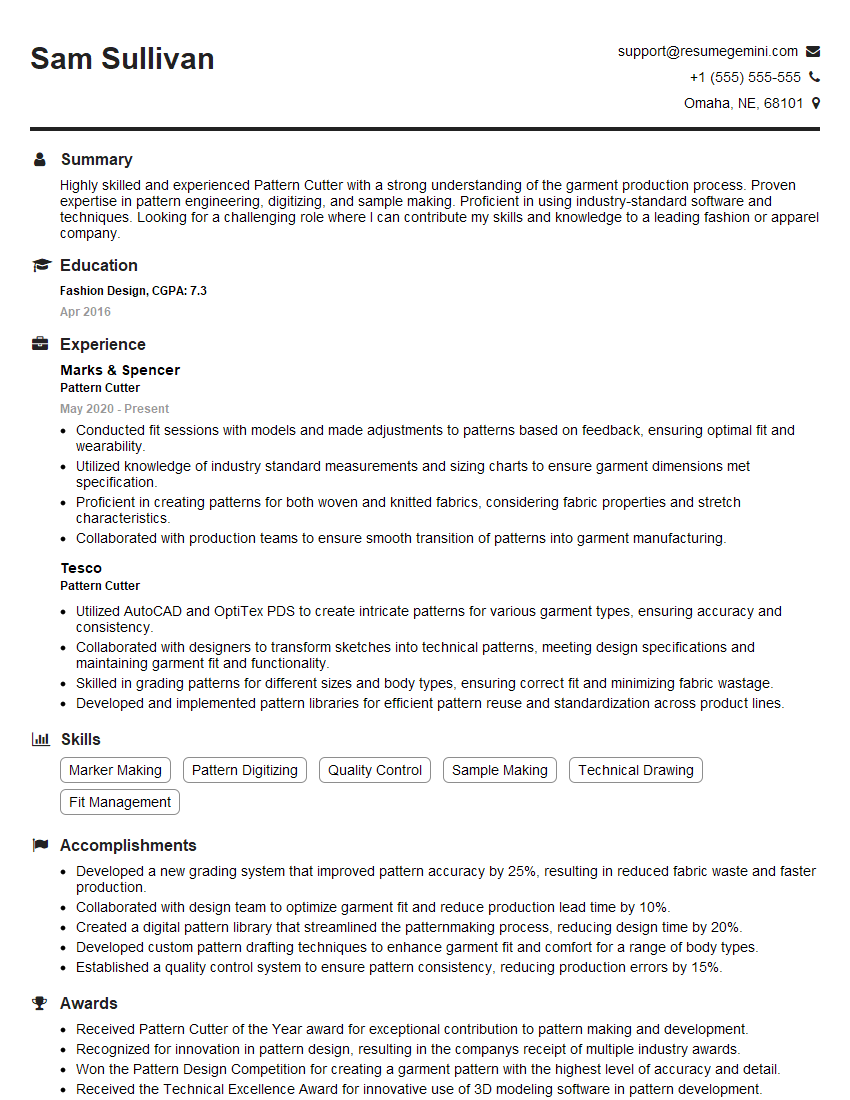
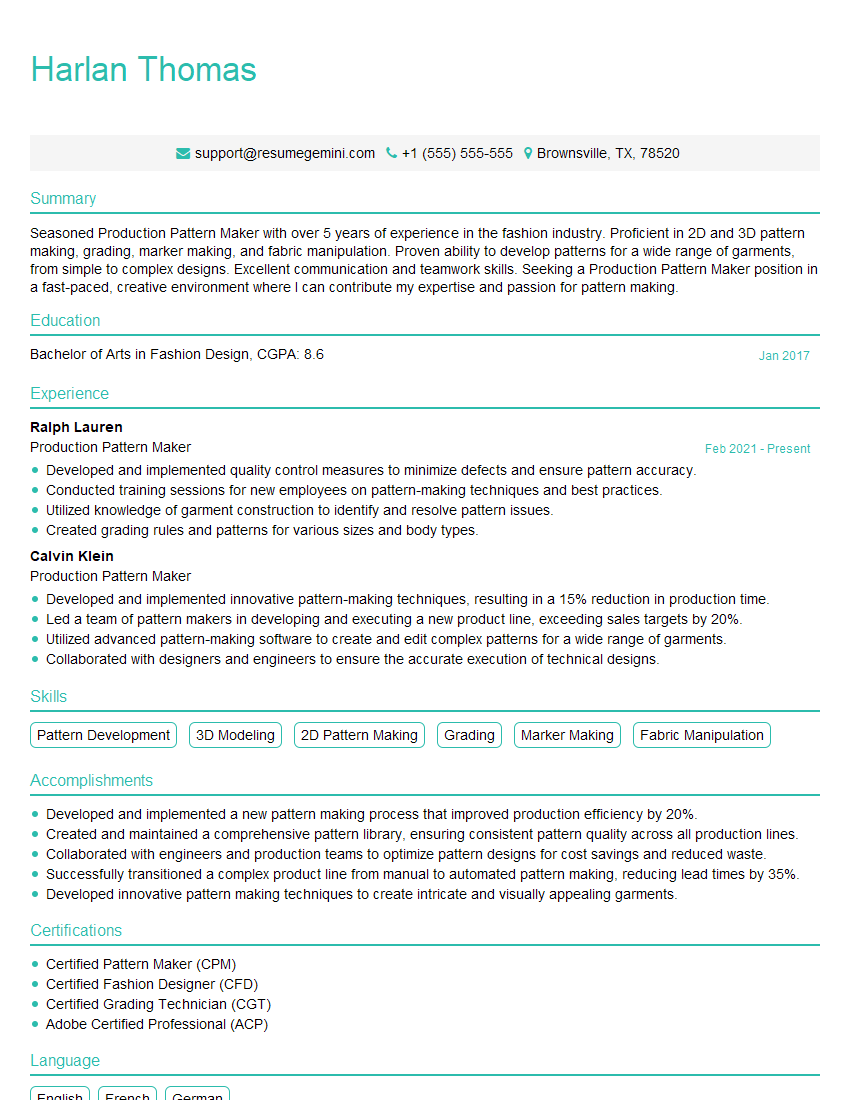
Mastering sewing pattern reading is crucial for career advancement in the fashion and apparel industries. A strong understanding of pattern interpretation directly translates to efficient production, accurate garment construction, and a competitive edge in the job market. To maximize your job prospects, focus on creating an ATS-friendly resume that highlights your skills and experience. ResumeGemini is a trusted resource that can help you build a professional and effective resume. We provide examples of resumes tailored to Sewing Pattern Reading to help guide you through the process. Take this opportunity to showcase your expertise and land your dream role!
Explore more articles
Users Rating of Our Blogs
Share Your Experience
We value your feedback! Please rate our content and share your thoughts (optional).
What Readers Say About Our Blog
Very informative content, great job.
good