The thought of an interview can be nerve-wracking, but the right preparation can make all the difference. Explore this comprehensive guide to Shaper Operation interview questions and gain the confidence you need to showcase your abilities and secure the role.
Questions Asked in Shaper Operation Interview
Q 1. Explain the different types of shaper machines.
Shaper machines are categorized primarily by their type of ram movement and construction. The most common types are:
- Horizontal Shapers: These are the most prevalent type, featuring a reciprocating ram that moves horizontally. The cutting tool is mounted on the ram, and the workpiece is clamped to the table. This allows for shaping operations on relatively large workpieces.
- Vertical Shapers: In these machines, the ram moves vertically. They are often used for specialized applications or when shaping a vertical surface on a workpiece is necessary. They typically have a smaller work envelope compared to horizontal shapers.
- Universal Shapers: These machines offer the flexibility of both horizontal and vertical ram movements, increasing their versatility for a broader range of shaping tasks. This versatility often comes at the cost of increased complexity and sometimes reduced accuracy in extreme angles.
The choice of shaper type depends heavily on the specific application and the geometry of the workpiece. For instance, a large, flat surface would ideally be shaped with a horizontal shaper, while a deeply recessed vertical feature might necessitate a vertical shaper or a universal shaper.
Q 2. Describe the safety procedures you follow when operating a shaper.
Safety is paramount when operating a shaper. My standard procedure always begins with a thorough machine inspection. I check for loose parts, proper lubrication, and that all guards are securely in place. I always wear appropriate personal protective equipment (PPE), including safety glasses, hearing protection, and work gloves. Before starting any operation, I ensure the workpiece is securely clamped to the table, avoiding any potential for movement. Never reach over a moving ram. I focus completely on the operation, eliminating distractions. When making adjustments, I always ensure the machine is turned off and the ram is locked in a safe position. Regular maintenance and inspection of the machine are also critical for preventing accidents.
I consider machine setup as a crucial safety aspect as well; incorrect setup can lead to dangerous conditions. Proper clamping techniques are especially important; using inadequate clamping can lead to the workpiece shifting, resulting in accidents.
Q 3. How do you ensure the accuracy of your work on a shaper?
Accuracy in shaper operation is achieved through a combination of careful setup and precise technique. This starts with ensuring the workpiece is accurately positioned and securely clamped. The use of accurate measuring tools, such as micrometers and dial indicators, is crucial for setting the depth of cut and ensuring the tool is properly aligned. I regularly check the alignment of the ram and the table to avoid errors. The feed rate is also a crucial element; setting it correctly according to the material being shaped helps maintain dimensional accuracy and finish. Regular maintenance of the machine itself, ensuring it is in good working order, helps maintain accuracy over the long term.
For instance, I once worked on a project requiring extremely tight tolerances. By utilizing a dial indicator to fine-tune the tool’s position and carefully monitoring the depth of cut, I was able to achieve tolerances within 0.005 inches—a critical element of the final product’s functionality.
Q 4. What are the common problems encountered while operating a shaper, and how do you troubleshoot them?
Common shaper problems include:
- Chatter: This vibration causes an uneven surface finish. Troubleshooting involves checking the workpiece clamping, tool sharpness, and feed rate. Sometimes reducing the depth of cut or increasing the speed can help.
- Tool breakage: This is often due to dull tools, improper feed rates, or excessive pressure. Regular tool inspection and replacement are necessary. Checking the tool’s condition and material compatibility with the workpiece is vital.
- Inaccurate cuts: This can result from poor workpiece clamping, misaligned tooling, or a worn machine. Careful setup, regular machine maintenance, and proper alignment are essential.
My troubleshooting approach follows a systematic process. I start by identifying the symptoms, then carefully examine the machine setup, the tool, and the workpiece, before making adjustments or replacements. A well-maintained machine, coupled with careful operation, drastically reduces troubleshooting needs.
Q 5. Explain the process of setting up a shaper for a specific job.
Setting up a shaper involves a series of steps:
- Workpiece mounting: Securely clamp the workpiece to the table, ensuring it’s firmly held and positioned correctly for the desired cut.
- Tool selection and mounting: Choose the appropriate tool based on the material and desired cut. Mount the tool securely in the ram, ensuring it’s properly aligned.
- Depth of cut adjustment: Set the depth of cut using the appropriate adjustments on the machine, based on the material being machined and the desired finish.
- Feed rate selection: Select the appropriate feed rate, also based on the material and desired finish. This is crucial to avoid tool breakage and obtain the desired cut quality.
- Trial cut: Perform a trial cut to check the accuracy of the setup before proceeding with the complete operation.
Each step requires precision and attention to detail. For example, an improper clamping technique can result in a flawed final product or even damage to the machine. Careful attention to detail at each stage minimizes errors and maximizes efficiency.
Q 6. How do you select the appropriate cutting tools for different materials on a shaper?
Tool selection depends on the material being shaped. High-speed steel (HSS) tools are commonly used for many materials, but for tougher materials like hardened steel, carbide-tipped tools offer better wear resistance. For softer materials such as aluminum or wood, HSS tools are usually sufficient. I also consider the type of cut required; a roughing cut may require a different tool profile than a finishing cut. The shape and size of the tool should also be selected to suit the specific shaping operation.
For example, shaping hardened steel would necessitate a carbide-tipped tool with a robust design to withstand the increased stress; while softwood can usually be shaped with a simpler HSS tool designed for smoother cuts. The choice of tool is directly linked to both the safety and efficiency of the operation.
Q 7. Describe your experience with different types of cutting fluids.
I have experience using various cutting fluids, each with its own properties and advantages:
- Water-based cutting fluids: These are commonly used and are relatively inexpensive. They offer good cooling and lubrication but may not be as effective for very high-speed or heavy-duty operations.
- Oil-based cutting fluids: These provide superior lubrication, especially for tougher materials, but they can be more expensive and pose environmental concerns.
- Synthetic cutting fluids: These offer a blend of the benefits of water-based and oil-based fluids, often providing better performance and environmental friendliness.
The choice of cutting fluid depends on several factors, including the material being machined, the cutting speed, and the desired finish. For example, I might use a water-based fluid for aluminum, but switch to a synthetic fluid for stainless steel for superior lubrication and heat dissipation. Improper selection of cutting fluid can lead to problems such as poor surface finish or rapid tool wear.
Q 8. How do you maintain and clean a shaper machine?
Maintaining a shaper machine involves regular cleaning and lubrication to ensure optimal performance and longevity. Think of it like caring for a finely tuned instrument – consistent maintenance prevents problems and extends its life.
Cleaning: After each use, remove chips and debris from the machine bed, ram, and tooling using a brush and compressed air. Pay close attention to the vise, ensuring no metal shavings obstruct its movement. Regularly wipe down all surfaces with a clean cloth to prevent rust and buildup.
Lubrication: Apply lubrication to all moving parts according to the manufacturer’s recommendations. This includes the ram ways, the table ways, and the vise mechanism. Using the correct lubricant is crucial; the wrong type can damage the machine. I generally prefer a high-quality, machine-grade grease for most moving parts.
Inspection: Regularly inspect the machine for any signs of wear, damage, or loose components. This includes checking the alignment of the ram and table, the tightness of all bolts and screws, and the condition of belts and pulleys. Addressing minor issues promptly prevents them from becoming major problems.
Tooling Care: Proper care of cutting tools is paramount. After each use, clean the tools thoroughly and store them safely to prevent damage or accidental injury. Dull or damaged tools can lead to poor surface finishes and potential hazards.
Remember, safety is paramount. Always disconnect the power before performing any maintenance on the shaper.
Q 9. What are the different types of shaper strokes?
Shaper strokes refer to the direction and type of movement the cutting tool makes during the shaping process. Understanding these different strokes is key to achieving the desired shape and surface finish. Think of it like painting – different brushstrokes create different effects.
Horizontal Stroke: The most common stroke, where the tool moves horizontally across the workpiece. It’s ideal for creating flat surfaces or removing material across a wide area.
Vertical Stroke: Used less frequently, this involves a vertical movement of the cutting tool. It’s useful for creating grooves, slots, or other features that require vertical cutting.
Compound Stroke: A combination of horizontal and vertical movements, offering more complex shaping capabilities. This allows for creating angled cuts or more intricate shapes. This is where experience and skill become vital.
Multiple Strokes: Often required for complex profiles. Multiple passes, with adjustments to the workpiece position and depth of cut, are used to achieve the desired shape.
Choosing the right stroke depends on the design of the workpiece and the desired outcome. Experienced shaper operators can adapt their stroke techniques to achieve the required precision and quality.
Q 10. Explain the concept of feed rate and its importance in shaper operation.
Feed rate, in shaper operation, refers to the speed at which the workpiece is fed into the cutting tool. It’s a crucial parameter that directly impacts the quality of the finished product, machine wear, and even safety. Think of it as the pace at which you ‘draw’ with the cutting tool – too fast and it’s rough; too slow and it’s inefficient.
A slower feed rate allows for a cleaner cut, smoother surface finish, and reduces the strain on the cutting tool and the machine. However, it also increases machining time. A faster feed rate can improve productivity but may lead to a rougher finish, increased heat generation, and potential tool breakage. The optimal feed rate depends on factors like the material being machined, the type of cutting tool, the depth of cut, and the desired surface finish.
In my experience, selecting the right feed rate often involves a bit of trial and error, starting with a conservative setting and gradually increasing it while monitoring the quality of the cut. Many modern machines allow for precise feed rate adjustment and even programmed feed rate variations for complex shapes.
Q 11. How do you measure and verify the dimensions of a workpiece after shaping?
Verifying the dimensions of a workpiece after shaping is essential for quality control. Precise measurement ensures the workpiece meets the required specifications. I typically use a combination of tools for accurate verification.
Vernier Calipers: Excellent for measuring linear dimensions with high accuracy. I use these for checking lengths, widths, and depths of cuts.
Micrometer: Provides even higher precision for critical dimensions. I’d often use a micrometer to check the thickness of a component after a shaping operation that requires close tolerances.
Dial Indicators: Useful for checking flatness, parallelism, and squareness. I’d employ a dial indicator on a surface plate to ensure the shaped surface is truly flat and free of warps.
Angle Gauge/Protractor: Used to check angles created by the shaper. Critical when working on angled cuts or features.
Depending on the complexity of the workpiece, I may use additional tools like height gauges, depth micrometers, or even coordinate measuring machines (CMMs) for more intricate verification.
Q 12. What are the limitations of a shaper machine?
Shaper machines, while versatile, have certain limitations compared to other machining methods such as CNC milling machines or lathes. Understanding these limitations helps in selecting the appropriate machine for a given task.
Limited Complexity: Shapers are best suited for relatively simple shapes. Creating intricate or three-dimensional profiles can be time-consuming and challenging.
Lower Productivity: Compared to CNC machines, shapers are generally slower and less efficient, particularly for high-volume production.
Surface Finish: While a good surface finish is achievable, it’s typically not as smooth as that produced by more advanced methods like milling.
Operator Skill Dependence: Shaper operation requires significant operator skill and experience to achieve accuracy and consistency. The operator’s expertise directly impacts the quality of the work.
Limited Material Removal Rate: The material removal rate is generally lower compared to other machining techniques.
These limitations shouldn’t be seen as drawbacks but rather as factors to consider when selecting the most appropriate machining technique for a particular job. If the task calls for simple shapes, good accuracy, and a manageable production volume, a shaper machine is a very capable and effective choice.
Q 13. Describe your experience with CNC shapers.
My experience with CNC shapers is extensive. I’ve worked with various models from different manufacturers, programming and operating them for a variety of applications. CNC shapers offer significant advantages over manual shapers, particularly in terms of accuracy, repeatability, and efficiency.
I’m proficient in using CAD/CAM software to create CNC programs for shapers, optimizing toolpaths for efficient material removal and superior surface finish. I’m also experienced in troubleshooting CNC shaper issues, diagnosing problems with the machine’s control system, and performing routine maintenance tasks. This experience includes working with both 2-axis and 3-axis CNC shapers.
One project that stands out involved the production of a series of highly precise aluminum components with complex shapes. Using a 3-axis CNC shaper, I developed a program that not only produced these parts to tight tolerances but also significantly reduced production time compared to manual methods. The ability to automate the process and achieve repeatable precision was a key success factor in that project.
Q 14. How do you interpret and follow blueprints or drawings when using a shaper?
Interpreting and following blueprints or drawings when using a shaper is fundamental to successful machining. It requires a thorough understanding of both the drawing and the capabilities of the shaper.
My approach involves:
Detailed Review: Carefully examine the drawing, noting all dimensions, tolerances, surface finishes, and material specifications. This includes understanding the overall shape, features like slots, grooves, or angles, and the order of operations required.
Workpiece Layout: Determine how the workpiece will be secured in the shaper vise, ensuring that it’s properly aligned and supported to prevent vibration or movement during operation.
Tool Selection: Select the appropriate cutting tools based on the material being machined and the desired surface finish. The correct tool is critical for effective cutting and to prevent damage to the workpiece or machine.
Step-by-Step Approach: Break down the shaping process into a series of sequential steps, carefully calculating the depth of cut and feed rate for each step. A planned approach minimizes errors and optimizes efficiency.
Continuous Measurement: Regularly check the workpiece dimensions against the drawing during the shaping process to ensure it remains on track.
Following a structured approach and continuously verifying measurements reduces the risk of errors and ensures the final product meets the required specifications. Remember, safety always comes first. Always ensure proper machine guarding is in place before operating the shaper.
Q 15. Explain the importance of proper workpiece clamping and fixturing.
Proper workpiece clamping and fixturing are paramount in shaper operation for safety and precision. Without secure clamping, the workpiece can move unexpectedly during cutting, leading to inaccurate cuts, damaged material, or, most importantly, serious injury to the operator. Think of it like trying to saw a piece of wood freehand – it’s much harder to control and far more dangerous than using a vise.
Effective fixturing ensures the workpiece is held firmly and positioned correctly relative to the cutting tool. This involves selecting the right clamps (vise, hold-downs, etc.) and strategically placing them to minimize workpiece movement. For instance, when shaping a long, narrow piece, using multiple hold-downs along its length prevents vibration and bowing during the cut.
- Vise clamping: Best for smaller workpieces, providing strong, consistent holding power.
- Hold-downs: Essential for larger pieces or those requiring multiple clamping points. They keep the workpiece securely in place.
- Stop blocks: Used to prevent movement along the fence, ensuring consistent cuts.
Choosing the appropriate method depends on the size, shape, and material of the workpiece, as well as the specific shaping operation being performed.
Career Expert Tips:
- Ace those interviews! Prepare effectively by reviewing the Top 50 Most Common Interview Questions on ResumeGemini.
- Navigate your job search with confidence! Explore a wide range of Career Tips on ResumeGemini. Learn about common challenges and recommendations to overcome them.
- Craft the perfect resume! Master the Art of Resume Writing with ResumeGemini’s guide. Showcase your unique qualifications and achievements effectively.
- Don’t miss out on holiday savings! Build your dream resume with ResumeGemini’s ATS optimized templates.
Q 16. What are the signs of a worn or damaged cutting tool, and how do you address them?
A worn or damaged cutting tool is a safety hazard and significantly impacts the quality of the cut. Signs include chipped or broken edges, excessive wear on the cutting edges leading to a dull tool, cracks, or excessive vibration. A dull tool forces the shaper to work harder, potentially leading to overheating and inaccuracies. Think of a dull knife – it requires much more force to cut through anything and is prone to slipping.
Addressing these issues involves:
- Inspection: Regularly inspect the cutting tool for signs of wear. Even minor chipping can affect the quality of the cut.
- Sharpening/Replacement: A chipped or severely worn tool should be sharpened or replaced. Sharpening should be done correctly to maintain the tool’s geometry. If the tool is beyond sharpening, replacement is necessary.
- Proper Tool Selection: Ensure you’re using the correct tool for the material being shaped. Using the wrong tool can lead to premature wear and damage.
Q 17. Describe your experience with different types of materials (e.g., wood, metal).
My experience spans various materials including hardwoods (oak, maple, cherry), softwoods (pine, fir), and metals (aluminum, mild steel). Each material requires a different approach to shaping. For example, hardwoods require sharper cutting tools and often slower feed rates due to their density, while softwoods are easier to shape but can be prone to tear-out if not handled carefully. Metals require specialized cutting tools designed for the specific metal type and the use of appropriate coolants to prevent overheating.
Working with different materials has honed my skills in selecting the right tools and techniques for each specific application. Understanding the material properties is critical for efficient and safe shaping. For instance, I’ve learned that using a high-speed steel tool for aluminum is far superior to using a high-carbon steel tool, leading to significantly better results and tool life.
Q 18. How do you handle emergencies or malfunctions on a shaper?
In the event of an emergency or malfunction, the immediate priority is safety. I’ve been trained to follow these procedures:
- Immediate Stop: Immediately shut off the machine using the main power switch and the emergency stop button.
- Assessment: Assess the situation to determine the nature of the problem. This might involve checking for damaged components, loose connections, or jammed parts.
- Safety Precautions: Ensure that no one is in danger and clear the area if necessary.
- Reporting: Report the incident to the supervisor and document the event for future reference.
- Repair/Maintenance: The shaper will not be restarted until the issue is diagnosed and repaired by a qualified technician.
For instance, if a workpiece gets unexpectedly caught, the emergency stop must be engaged, and the workpiece should be carefully dislodged only after the power has been completely disconnected. Safety is never compromised.
Q 19. What is your experience with preventive maintenance of shaper machines?
Preventive maintenance is crucial for the longevity and safety of a shaper. My experience includes regular inspections and cleaning to identify and address potential issues before they become major problems. This involves:
- Lubrication: Regularly lubricating moving parts such as bearings, gears, and guides to ensure smooth operation and prevent wear.
- Inspection of belts and pulleys: Checking for wear, cracks, or slippage.
- Checking for excessive vibration: This can be a sign of imbalanced components or wear.
- Cleaning: Regularly removing chips and debris to prevent buildup and maintain efficient operation.
- Blade Alignment: Periodically checking and adjusting blade alignment to ensure proper cutting action and avoid damage to the tool and workpiece.
Following a well-defined preventive maintenance schedule significantly reduces the risk of unexpected breakdowns and ensures the machine operates efficiently and safely.
Q 20. Describe a time you had to troubleshoot a problem on a shaper.
During a particularly demanding shaping project on a complex curve, the shaper started to vibrate excessively, leading to inaccurate cuts. I initially suspected a problem with the cutter, but careful examination revealed a slight misalignment in the fence. The fence guides the workpiece and even the slightest misalignment could cause vibrations and inaccurate cuts.
My troubleshooting steps:
- Isolate the problem: I systematically eliminated other potential causes – cutter sharpness, workpiece clamping, and motor issues – through careful visual checks and testing.
- Identify the root cause: By carefully observing the vibration pattern and the workpiece’s movement, I pinpointed the misaligned fence.
- Implement the solution: After making the appropriate adjustments to the fence, the vibration was eliminated, and the shaper performed flawlessly. The project proceeded efficiently with high-quality results.
This experience reinforced the importance of methodical troubleshooting and the significance of regular maintenance checks.
Q 21. How do you ensure the quality and precision of your work?
Ensuring quality and precision involves meticulous attention to detail at every stage of the shaping process.
- Proper Tool Selection: Choosing the right cutting tool for the material and application is fundamental.
- Accurate Setup: Precisely setting the fence, depth of cut, and speed are crucial for achieving consistent results.
- Secure Clamping: Firm clamping prevents workpiece movement, ensuring accuracy and safety.
- Careful Operation: Smooth and controlled operation prevents tear-out and other defects.
- Regular Inspection: Continuously inspecting the workpiece during shaping allows for immediate correction of any issues.
- Post-Processing: Depending on the project requirements, fine-tuning the shaped piece through sanding or other methods ensures a flawless result.
For example, in a recent project involving intricate mouldings, I used a combination of careful setup, precise feed rate control, and regular inspections to consistently achieve the required dimensions and quality. Regular inspection allowed me to make minute adjustments during the process, ensuring a high degree of accuracy and precision.
Q 22. Explain the difference between a shaper and a planer.
While both shapers and planers are woodworking machines used for shaping wood, they differ significantly in their operation and the types of cuts they produce. A shaper uses a rotating cutter, similar to a router, to create various profiles, mouldings, and decorative edges on a workpiece. The workpiece is typically moved against the stationary cutter. Think of it like a stationary router bit shaping the wood as it passes by. A planer, on the other hand, uses rotating cutters to smooth and flatten a workpiece’s surface. The workpiece is fed through the machine, and the cutters shave off material to achieve a uniform thickness and smoothness. Essentially, a shaper creates shapes and details, whereas a planer creates flat, even surfaces. Imagine using a shaper to carve intricate designs on a table leg, versus using a planer to smooth out a rough piece of lumber before further processing.
Q 23. What safety equipment do you use when operating a shaper?
Safety is paramount when operating a shaper. My standard safety equipment includes:
- Eye protection: Safety glasses or a face shield are mandatory to protect against flying wood chips and debris. I always make sure my eyewear is properly fitted and in good condition.
- Hearing protection: Earplugs or earmuffs reduce the noise level, which can be quite high, protecting my hearing from long-term damage.
- Dust mask or respirator: Shaping generates a significant amount of fine wood dust, which can be harmful if inhaled. I always use a respirator, especially when working with hardwoods.
- Cut-resistant gloves: These offer an extra layer of protection for my hands, minimizing the risk of cuts and injuries.
- Proper clothing: I avoid loose clothing and jewelry that could get caught in the machine. I prefer close-fitting shirts and pants made of sturdy material.
- Push sticks and featherboards: These tools help to keep my hands away from the cutter and guide the workpiece smoothly. This minimizes the chances of accidental contact with the dangerous cutter.
Regular machine inspections are also a critical safety measure. I always check for any loose parts or damaged cutters before starting any work.
Q 24. How do you manage your time effectively when operating a shaper?
Effective time management on a shaper involves careful planning and execution. I begin by thoroughly reviewing the project plans, ensuring I have all the necessary materials and tools prepared beforehand. I prioritize tasks based on urgency and complexity, tackling the most challenging aspects first while I’m most alert. To avoid interruptions, I work in focused blocks of time, setting realistic goals for each session. This minimizes downtime and maximizes productivity. I regularly inspect my work to catch and correct errors early, preventing time wasted on rework. For instance, if I’m making multiple identical pieces, I’ll set up a jig to ensure consistency and speed up the process.
Q 25. Describe your experience with different shaper controls (manual, automated).
My experience encompasses both manual and automated shaper controls. With manual shapers, I have developed a keen sense of touch and control, precisely adjusting the feed rate and depth of cut to achieve the desired results. This requires considerable skill and experience to ensure safety and accuracy. I’ve worked on numerous projects, from intricate carvings to basic shaping, honing my skills in judging the correct pressure and speed for a specific material and result. With automated shapers (CNC-controlled), I’m proficient in programming and operating CNC machines, employing CAM software to create precise cutting paths. I’m experienced with various control systems and programming languages commonly used in automated shapers, which has enabled me to work on a wider range of complex projects with enhanced precision and repeatability. For example, I’ve programmed complex mouldings using software that calculates and optimizes the cutting path to minimize material waste and maximize production efficiency.
Q 26. What are your strengths and weaknesses as a shaper operator?
My strengths include precision, attention to detail, and the ability to work efficiently and safely on both manual and automated shapers. I’m a quick learner and adept at adapting to new tools and techniques. My experience allows me to trouble-shoot and solve problems quickly and effectively. My weakness, if I had to identify one, is sometimes being overly meticulous, which can occasionally impact speed. However, I’m actively working on finding the balance between precision and efficiency. This constant pursuit of improvement is what drives me.
Q 27. Where do you see yourself in five years in the field of shaper operation?
In five years, I envision myself as a highly skilled and versatile shaper operator, possibly leading a team or mentoring apprentices. I aim to expand my expertise in CNC machining and explore advanced techniques such as 3D shaping. I also hope to be involved in designing and implementing new, more efficient workflows, contributing to improving the overall productivity and safety of the shop. I’m eager to contribute to the innovation and advancement of the field.
Q 28. Why are you interested in this specific shaper operator position?
I’m interested in this specific shaper operator position due to [Company Name]’s reputation for high-quality work and its commitment to safety. The opportunity to work with advanced equipment and on challenging projects aligns perfectly with my career goals. The potential to learn from experienced professionals in a collaborative environment is incredibly exciting. Moreover, [Company Name]’s focus on [mention specific company values or projects that interest you] particularly resonates with my professional values.
Key Topics to Learn for Shaper Operation Interview
- Understanding Shaper Operation Fundamentals: Grasp the core principles and workflow of Shaper Operation. This includes understanding its architecture and how different components interact.
- Practical Application of Shaper Operation Tools: Focus on hands-on experience with the software’s key features. Practice using various tools and functionalities to solve common operational challenges.
- Data Management and Analysis within Shaper Operation: Learn how to effectively manage, analyze, and interpret data generated by Shaper Operation. Understanding data visualization techniques is crucial.
- Troubleshooting and Problem-Solving: Develop your ability to identify, diagnose, and resolve common issues encountered while using Shaper Operation. Focus on efficient debugging strategies.
- Shaper Operation Integrations and APIs: Explore how Shaper Operation integrates with other systems and platforms. Understanding API functionalities can be a significant advantage.
- Security Best Practices in Shaper Operation: Familiarize yourself with security protocols and best practices for operating Shaper Operation securely and efficiently. Data privacy and protection are paramount.
- Advanced Techniques and Optimization: Explore advanced techniques for optimizing workflows and maximizing efficiency within Shaper Operation. This demonstrates a proactive approach to improvement.
Next Steps
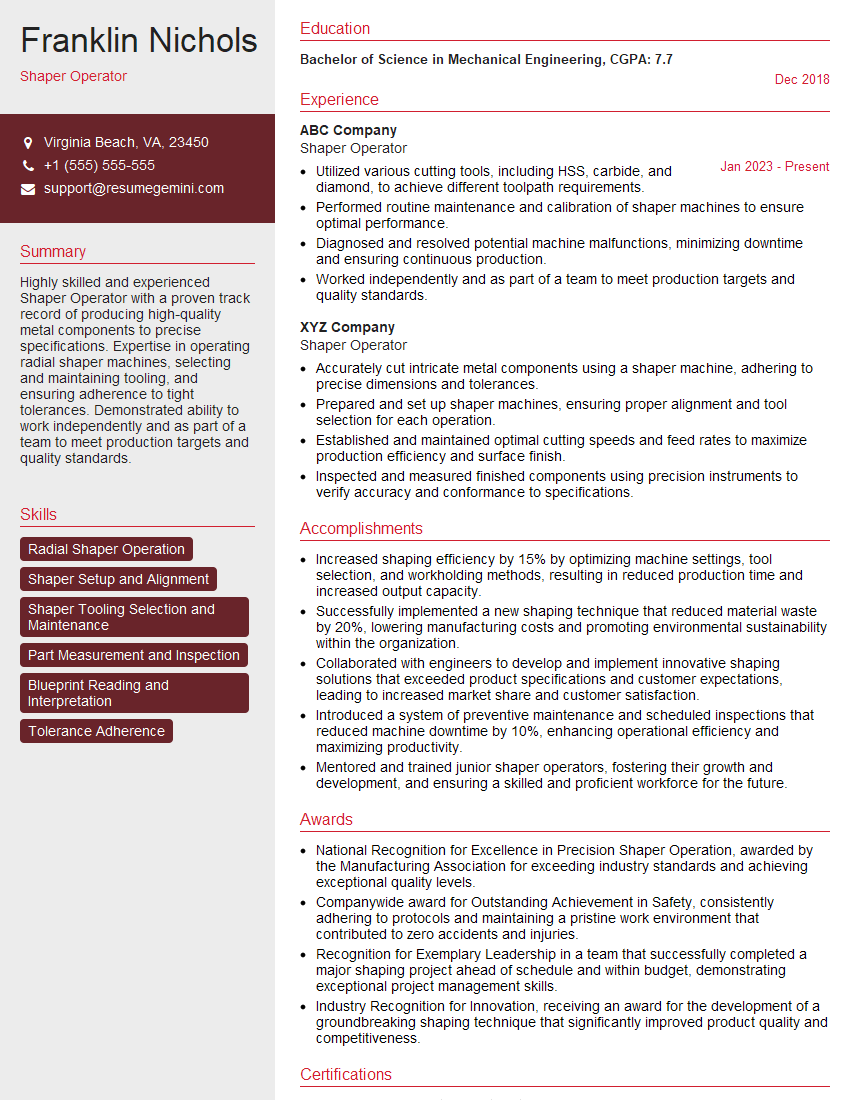
Mastering Shaper Operation opens doors to exciting career opportunities in a rapidly evolving technological landscape. Demonstrating proficiency in this area will significantly enhance your job prospects and position you for success in a competitive market. To increase your chances of landing your dream role, creating an ATS-friendly resume is crucial. ResumeGemini is a trusted resource that can help you build a professional and impactful resume tailored to highlight your Shaper Operation skills. We provide examples of resumes specifically designed for Shaper Operation roles to help you get started. Take advantage of these resources to present yourself effectively and confidently to potential employers.
Explore more articles
Users Rating of Our Blogs
Share Your Experience
We value your feedback! Please rate our content and share your thoughts (optional).
What Readers Say About Our Blog
Very informative content, great job.
good