Are you ready to stand out in your next interview? Understanding and preparing for Shoe Design interview questions is a game-changer. In this blog, we’ve compiled key questions and expert advice to help you showcase your skills with confidence and precision. Let’s get started on your journey to acing the interview.
Questions Asked in Shoe Design Interview
Q 1. Explain your design process from concept to final product.
My shoe design process is iterative and highly collaborative. It begins with concept development, where I explore initial sketches, mood boards, and market research to define the shoe’s purpose, target audience, and aesthetic direction. For example, I might start with a sketch for a new running shoe focusing on lightweight cushioning and breathability. This phase often includes brainstorming sessions with the design team and material specialists.
Next comes 3D modeling. I use software like Rhino and SolidWorks to create a detailed digital model, experimenting with different shapes, volumes, and construction methods. This allows for virtual prototyping and helps visualize the final product. We use this to refine the fit and assess potential manufacturing challenges.
Pattern making follows, translating the 3D model into 2D patterns for the individual shoe components. This crucial step ensures accurate construction and a precise fit. This phase involves meticulous attention to detail and often requires adjustments based on physical prototypes.
Then comes prototyping, where physical samples are created to test the design’s functionality, comfort, and durability. We produce multiple iterations, making changes based on feedback from wear testing and internal reviews.
Finally, the design moves into production. This stage involves working closely with manufacturers to finalize specifications, select materials, and oversee the manufacturing process, ensuring the final product matches the design intent and meets quality standards. Throughout the entire process, constant communication and feedback loops are essential for achieving the desired outcome.
Q 2. Describe your experience with different shoe construction methods (e.g., cemented, Goodyear welted).
I have extensive experience with various shoe construction methods, each with its own strengths and weaknesses. Cemented construction is widely used for its cost-effectiveness and speed. It involves bonding the upper and outsole with adhesive. This method is ideal for simpler designs and mass production but is less durable than other methods. I’ve used this for casual sneakers and certain athletic shoes.
Goodyear welted construction represents a higher level of craftsmanship and durability. The upper, welt, and insole are stitched together, providing excellent flexibility and support. This is a great choice for dress shoes and boots, offering longevity and repairability, although it’s more expensive and labor-intensive. I’ve incorporated Goodyear welting in several high-end boot designs.
Beyond these, I’m familiar with Stitch-down construction, offering a balance between durability and flexibility, often found in outdoor and work boots; and Blake construction, lighter and faster to produce than Goodyear welting, suitable for more casual styles.
My understanding of these different methods allows me to select the most appropriate construction based on the shoe’s intended use, target market, and desired aesthetic.
Q 3. How do you stay updated on current footwear trends and technologies?
Staying current in the dynamic footwear industry requires a multi-faceted approach. I regularly attend industry trade shows like MICAM and MAGIC, where I observe new materials, technologies, and design trends firsthand.
I closely follow fashion magazines, blogs, and online publications focused on footwear design and technology. This keeps me informed about emerging styles and evolving consumer preferences.
Furthermore, I actively participate in online communities and forums, engaging with other designers and industry professionals, exchanging ideas and insights. This allows for invaluable peer-to-peer learning and discovering innovative approaches.
Finally, I regularly research patent filings and scientific publications related to footwear materials and manufacturing processes. This approach ensures I’m aware of technological advancements and potential applications in shoe design.
Q 4. What software are you proficient in for shoe design (e.g., Rhino, SolidWorks, Adobe Illustrator)?
My proficiency in shoe design software is crucial to my workflow. I’m highly skilled in Rhino 3D, which is widely used in the industry for its powerful modeling capabilities. I use it extensively for creating complex 3D models, from initial concepts to highly detailed renderings.
I also have experience with SolidWorks, primarily for more technical aspects like stress analysis and ensuring the structural integrity of designs, particularly for athletic shoes or footwear with unusual designs.
Finally, I utilize Adobe Illustrator for 2D pattern making, graphic design elements, and creating presentations and technical illustrations. My combined proficiency in these programs allows for a seamless design process, from initial concept to final production specifications.
Q 5. How do you incorporate ergonomic principles into your shoe designs?
Ergonomics is paramount in shoe design; discomfort translates to poor user experience and potential injury. I incorporate ergonomic principles by carefully considering the anatomy of the foot and ankle. This includes ensuring adequate space in the toe box to prevent cramping, providing sufficient arch support to maintain proper foot alignment, and designing a heel counter that stabilizes the heel without causing pressure points.
I use anthropometric data – measurements of the human body – to create shoe lasts that accommodate a broad range of foot sizes and shapes. I also employ biomechanical analysis techniques, often using pressure mapping systems, to study pressure distribution during walking or running. This helps optimize the design to minimize pressure points and improve comfort and performance.
For example, when designing running shoes, I prioritize proper cushioning and shock absorption to reduce stress on the joints, considering the runner’s gait and stride length. For work boots, I prioritize support and stability to prevent fatigue and injury throughout the workday.
Q 6. Discuss your experience with different shoe lasts and their impact on fit.
Shoe lasts are fundamental to shoe fit and comfort. A last is a three-dimensional model of a foot used to shape the shoe during manufacturing. I have experience with various last shapes and sizes, understanding their impact on the final fit. A narrower last will result in a more snug fit, while a wider last will provide more room in the toe box. The height and curvature of the last also affect the arch support and overall feel of the shoe.
Different last shapes are optimized for various shoe types. For example, a running shoe last will typically have a wider toe box to accommodate foot splay during movement, whereas a dress shoe last might be more narrow and pointed. My experience allows me to select the appropriate last shape and size based on the intended use and target audience of the shoe. In my work, I often collaborate with last makers to fine-tune the last to achieve optimal fit and comfort.
I also consider variations within last types, such as accommodating different arch heights, heel shapes, and metatarsal widths to create a more inclusive and comfortable fit across diverse foot morphologies.
Q 7. Describe your understanding of footwear materials and their properties (e.g., leather, synthetics, rubber).
Understanding footwear materials and their properties is essential for successful shoe design. Leather, a classic material, offers breathability, durability, and a luxurious aesthetic but can be expensive and require careful treatment. Different types of leather (e.g., full-grain, suede, nubuck) offer varying degrees of durability and water resistance.
Synthetic materials such as PU (polyurethane) and TPU (thermoplastic polyurethane) are widely used due to their versatility, cost-effectiveness, and ability to mimic the properties of leather. They can be engineered to provide specific performance characteristics, like increased breathability or water resistance. They are frequently used in athletic footwear, offering lightweight and flexible constructions.
Rubber is essential for outsoles, providing grip, traction, and durability. Different rubber compounds offer varying degrees of abrasion resistance and flexibility. I consider the specific needs of the end-user when selecting rubber for outsole construction; for example, a hiking boot would require a more durable and high-traction rubber than a running shoe.
Beyond these main categories, I also have experience with other materials, including textiles, foams, and various specialized performance fabrics, each contributing unique properties to a shoe’s design and functionality. Choosing materials is a crucial decision that significantly impacts the shoe’s final look, feel, and performance.
Q 8. How do you balance aesthetics with functionality in your designs?
Balancing aesthetics and functionality in shoe design is a constant juggling act. It’s about creating a shoe that not only looks amazing but also performs exceptionally well. Think of it like building a beautiful bridge – it needs to be visually stunning, but also structurally sound and able to withstand stress.
I approach this by starting with the functionality. What is the purpose of this shoe? Is it for running, hiking, formal events, or everyday wear? This dictates the choice of materials, construction techniques, and overall form. For example, a running shoe requires breathable materials, responsive cushioning, and a flexible sole. Once the functional requirements are met, I focus on aesthetics. This includes the color palette, the silhouette, and the detailing. I always test prototypes extensively to ensure the aesthetic choices don’t compromise the performance.
For example, in designing a high-heeled dress shoe, I might initially focus on achieving a comfortable, stable heel height and a supportive insole. Then, I’d experiment with different toe shapes, heel designs, and material combinations to create an elegant and visually appealing shoe while retaining its structural integrity.
Q 9. How do you address manufacturing constraints in your design process?
Manufacturing constraints are a crucial aspect of the design process. Ignoring them leads to costly delays and potentially unfeasible designs. My approach involves a deep understanding of manufacturing capabilities, right from the initial concept stage. I collaborate closely with manufacturers and pattern makers to ensure my designs are both aesthetically pleasing and producible within their limitations.
This includes considering factors such as material availability, manufacturing techniques (e.g., injection molding, Goodyear welt construction), and production costs. I might need to simplify complex design elements, choose alternative materials that are easier to source, or adjust the construction methods to make the shoe easier to produce. For instance, if a design calls for an intricate laser-cut detail, but the manufacturer lacks that capability, I would explore alternative techniques, such as embossing or using a different material that can achieve a similar aesthetic effect.
I use 3D modeling software extensively to test the feasibility of my designs and identify potential manufacturing challenges early on. This iterative process involves refining the design until it’s both aesthetically pleasing and manufacturable efficiently and cost-effectively.
Q 10. Explain your experience with pattern making and grading.
Pattern making and grading are fundamental skills for any shoe designer. Pattern making involves creating the initial 2D shapes that will form the 3D shoe. I’m proficient in both manual and computer-aided pattern making techniques. This includes drafting patterns from scratch, modifying existing patterns, and adjusting them based on fit and style requirements.
Grading, on the other hand, is the process of scaling the pattern to different sizes. This is crucial for ensuring a consistent fit across the entire size range. I use specialized grading software to automate this process, ensuring accuracy and efficiency. I understand the complexities of shoe last shapes and how they influence the grading process. This includes understanding how changes in the last can affect the final fit and appearance of the shoe.
My experience ranges from creating patterns for simple slip-on shoes to complex boots with intricate stitching details. I’ve also worked on grading patterns for various shoe styles, encompassing diverse sizes and widths, ensuring a consistently excellent fit across the board.
Q 11. Describe your understanding of footwear sizing and fitting standards.
Understanding footwear sizing and fitting standards is critical to ensure a comfortable and well-fitting shoe. This knowledge extends beyond simply knowing size charts. It involves understanding the variations in foot shapes, widths, and lengths across different populations. I’m familiar with various sizing systems, including US, UK, and EU standards, and the nuances within each system. I’ve worked extensively with last specifications and fitting models.
I use different measurement techniques, including foot scanning and traditional measurement methods, to gather data and inform the development of lasts and patterns. My aim is to create shoes that accommodate a variety of foot shapes and provide a comfortable and supportive fit. I use statistical analysis of fit data to continuously improve the accuracy and consistency of my designs. For instance, I might find a need to adjust the last shape to better accommodate a broader range of foot widths based on collected data.
Moreover, I’m aware of the impact of materials on fit and comfort. Different materials have different properties of stretch and compression that influence the final fit. I take this into account when selecting materials and adjusting the patterns accordingly.
Q 12. How do you incorporate sustainability into your shoe designs?
Sustainability is a core value in my design process. I believe in creating shoes that minimize their environmental impact throughout their entire lifecycle, from material sourcing to end-of-life disposal. I actively seek out sustainable materials such as recycled fabrics, plant-based leathers, and recycled rubber. I also explore innovative manufacturing techniques that reduce waste and energy consumption.
For example, I might utilize zero-waste pattern cutting techniques to minimize material waste during production. I also prioritize durable materials to extend the lifespan of the shoes, reducing the need for frequent replacements. Furthermore, I consider the recyclability and biodegradability of materials at the design stage, making sure that at the end of their use, they can be easily recycled or composted.
Collaborating with suppliers who share my commitment to sustainability is crucial. I research and select suppliers who prioritize ethical labor practices and environmentally responsible production methods. Transparency in sourcing and manufacturing is key to building trust and ensuring the environmental benefits of the design are authentic.
Q 13. How do you handle design feedback and revisions?
Handling design feedback and revisions is an essential part of the design process. I view feedback as an opportunity to improve the design and refine it to meet the client’s and target market’s expectations. I actively seek constructive criticism from various stakeholders, including clients, manufacturers, and potential customers.
My approach involves carefully reviewing feedback, analyzing the suggestions, and prioritizing revisions based on their impact on functionality, aesthetics, and manufacturability. I always keep an open mind and avoid being defensive about initial design choices. I utilize iterative design techniques, producing prototypes and revisions based on the feedback. I use visual aids like sketches, 3D models, and samples to communicate design changes effectively. I always document all changes and revisions to track the design’s evolution and maintain transparency.
For example, if feedback highlights discomfort in a specific area of the shoe, I’d revisit the pattern and last to make adjustments for improved fit. If the feedback addresses aesthetic concerns, I’d experiment with different colors, materials, or detailing to enhance the visual appeal.
Q 14. Explain your experience working with a team in a design environment.
I thrive in collaborative design environments. Effective teamwork is crucial for creating high-quality shoe designs that meet market demands and technical specifications. I’m adept at communicating my ideas clearly and effectively to various team members, including designers, pattern makers, manufacturers, and marketing personnel. I understand the value of active listening and incorporating diverse perspectives into the design process.
My experience includes working on large-scale projects requiring coordination between multiple teams. I’m proficient in using collaborative design tools and platforms to streamline communication and ensure that everyone is on the same page. I value a positive and supportive team environment where everyone feels comfortable sharing their ideas and contributing their expertise. I foster an environment of mutual respect and open communication to achieve shared goals. For example, in a recent project, I collaborated closely with the manufacturing team to adjust the design to meet specific material and production constraints without compromising the overall aesthetic and functionality.
I believe in delegating tasks effectively and providing support to team members, ensuring all project milestones are met. In doing so, I prioritize clear communication and facilitate problem-solving using collaborative techniques. This helps in building strong team relationships and making efficient use of available resources.
Q 15. Describe a time you had to solve a challenging design problem.
One of the most challenging design problems I faced involved creating a high-performance running shoe that also prioritized comfort and style. The initial design, while aesthetically pleasing, lacked sufficient arch support and resulted in discomfort during long runs. Solving this required a multi-faceted approach.
- Biomechanical Analysis: I collaborated with a biomechanics expert to analyze runners’ foot movements and pressure points. This involved motion capture studies and pressure mapping to identify areas needing improvement.
- Material Selection: We experimented with various midsole materials. Initially, we used a lightweight foam, but it lacked the necessary cushioning and support. We then incorporated a more supportive, yet still lightweight, dual-density foam system. This offered excellent cushioning in the heel and responsive rebound in the forefoot.
- Iterative Prototyping: We created several prototypes, each iteration refining the design based on feedback from testing. This involved 3D printing rapid prototypes for quick adjustments and real-world testing by experienced runners. Changes to the insole curvature, outsole pattern, and upper material placement were significant in achieving the desired balance.
- Design Refinement: Finally, we integrated the improved performance features seamlessly with the overall aesthetic design to maintain visual appeal. This involved adjusting the silhouette and color palettes to ensure the shoe looked as good as it felt.
The final result was a shoe that received overwhelmingly positive feedback for its comfort, performance, and style, demonstrating the success of a collaborative and iterative design process.
Career Expert Tips:
- Ace those interviews! Prepare effectively by reviewing the Top 50 Most Common Interview Questions on ResumeGemini.
- Navigate your job search with confidence! Explore a wide range of Career Tips on ResumeGemini. Learn about common challenges and recommendations to overcome them.
- Craft the perfect resume! Master the Art of Resume Writing with ResumeGemini’s guide. Showcase your unique qualifications and achievements effectively.
- Don’t miss out on holiday savings! Build your dream resume with ResumeGemini’s ATS optimized templates.
Q 16. How do you manage your time effectively when working on multiple projects?
Managing multiple projects effectively requires a structured approach. I utilize a project management system that combines task prioritization, time-blocking, and regular progress reviews.
- Prioritization Matrix: I use an Eisenhower Matrix (urgent/important) to prioritize tasks across all projects. This ensures that I focus on the most critical tasks first.
- Time Blocking: I allocate specific blocks of time for each project, minimizing context switching. This allows for deeper focus and improved efficiency. For example, I might dedicate Monday mornings to sketching and design, Tuesday afternoons to material research, and so on.
- Regular Progress Reviews: Weekly reviews are crucial to assess progress, identify roadblocks, and adjust the schedule as needed. I track progress using project management software, allowing me to visualize the workflow across all projects.
- Delegation: When possible, I delegate tasks to others, which frees up my time to focus on higher-level design decisions and creative problem-solving.
This structured approach ensures I can manage multiple projects concurrently without compromising quality or deadlines. It’s like running a well-oiled machine—each component works in harmony to achieve the overall goal.
Q 17. How familiar are you with different footwear manufacturing processes?
My familiarity with footwear manufacturing processes is extensive. I understand the entire pipeline, from initial design concepts through to final production. This includes a deep understanding of various manufacturing methods:
- Lasting: I understand the different lasting methods (cement, Goodyear welt, stitch-down), their strengths, weaknesses, and cost implications. I know how these techniques affect the shoe’s durability, comfort, and aesthetic.
- Materials: I am knowledgeable about various materials used in shoe construction, including leather types, synthetic fabrics, foams, and outsoles. Understanding the properties of these materials is crucial for design optimization.
- Manufacturing Techniques: I’m familiar with various manufacturing techniques including injection molding, vulcanization, and traditional hand-stitching. This enables me to design shoes that are both innovative and feasible for production.
- Supply Chain: I have a working knowledge of global supply chains and understand the challenges related to sourcing materials and managing production schedules.
This broad understanding allows me to design not only aesthetically pleasing shoes but also those that are manufacturable, cost-effective, and durable.
Q 18. What are your strengths and weaknesses as a shoe designer?
My strengths lie in my creative problem-solving abilities, strong communication skills, and meticulous attention to detail. I can quickly translate abstract design concepts into practical, manufacturable products. My collaborative nature ensures effective teamwork with engineers, manufacturers, and marketing professionals.
A potential weakness could be my perfectionism. While it ensures high-quality designs, it can sometimes slow down the design process. I am actively working on managing this by setting realistic deadlines and prioritizing tasks effectively, using time management strategies discussed earlier.
Q 19. What are your salary expectations?
My salary expectations are in line with the industry standard for a shoe designer with my experience and skillset. I’m open to discussing a specific range based on the details of the role and the company’s compensation structure.
Q 20. Why are you interested in this specific job?
I’m highly interested in this specific job due to [Company Name]’s reputation for innovative design and commitment to high-quality footwear. The opportunity to contribute to a company with such a strong design ethos, and to work on [mention specific projects or aspects of the job that appeal to you], is particularly exciting. I’m particularly drawn to [mention a specific company value or initiative].
Q 21. What are your long-term career goals in shoe design?
My long-term career goals involve becoming a leading figure in sustainable and innovative shoe design. I aspire to lead design teams, mentor younger designers, and contribute to the development of more environmentally responsible manufacturing processes. I’m also keen to explore the intersection of technology and footwear design, perhaps integrating smart materials or wearable tech into future designs. Ultimately, I want to create footwear that is not only stylish and functional but also makes a positive impact on the world.
Q 22. Describe your experience with 3D modeling for footwear.
My experience with 3D modeling for footwear spans over a decade, encompassing various software like Rhino, SolidWorks, and specialized footwear design programs. I’m proficient in creating detailed 3D models from initial sketches to fully realized, production-ready designs. This includes not just the visual aspects but also the precise modeling of internal structures, critical for understanding comfort, fit, and manufacturing feasibility. For example, I recently used Rhino to design a new running shoe, meticulously modeling the midsole’s complex geometry to optimize cushioning and energy return. This involved generating complex curves and surfaces which would have been impossible using traditional methods. Beyond the basic shape, I’ve also integrated 3D scanning data of feet to ensure an accurate last (the mold around which the shoe is built), guaranteeing an optimal fit.
Furthermore, I’m experienced in using 3D printing to create rapid prototypes, allowing for quick iterations and testing of design concepts before committing to expensive tooling. This iterative process enables better designs through hands-on evaluation.
Q 23. How do you ensure the comfort and support of your designs?
Ensuring comfort and support in footwear design is paramount. It’s not just about aesthetics; it’s about biomechanics and ergonomics. I achieve this through a multi-pronged approach. Firstly, detailed anatomical studies inform the design of the last, ensuring the shoe comfortably accommodates the foot’s natural shape and movement. For example, I consider the arch height, heel-toe drop, and the overall shape to reduce pressure points and promote natural gait.
Secondly, I meticulously select materials based on their cushioning properties, breathability, and support capabilities. I consider the density and flexibility of midsoles (the layer between the outsole and insole), and the level of support provided by the insole and upper materials. Think of the difference between a supportive hiking boot with a rigid shank and a flexible running shoe. Each requires a different approach to materials and construction.
Finally, I utilize 3D modeling and simulation to test and refine designs for optimum comfort and support. For instance, Finite Element Analysis (FEA) can be employed to evaluate pressure distribution across the foot during different activities. This helps identify potential problem areas early in the design process and allows for necessary adjustments.
Q 24. Explain your understanding of different shoe soles and their functions.
Shoe soles are critical to the function and performance of a shoe. They vary significantly depending on the intended use.
- Cushioning Soles: These, often made of EVA (Ethylene-Vinyl Acetate) or PU (Polyurethane), are designed to absorb impact and provide comfort, vital in running shoes or athletic footwear. The density and thickness of these soles are crucial in determining their cushioning properties.
- Stability Soles: These soles, commonly found in walking or hiking shoes, focus on providing a stable base and support for the foot. They may incorporate features like a rigid shank to prevent excessive bending and twisting.
- Traction Soles: Outsole patterns are crucial for grip and traction on various surfaces. The tread design, depth, and material composition will differ drastically between a running shoe designed for road use and a hiking boot for rugged terrain. Rubber compounds are commonly used due to their durability and grip capabilities.
- Lightweight Soles: These are primarily found in performance footwear and prioritize reducing overall weight. Materials like carbon fiber or specialized foams are employed, sometimes compromising cushioning or durability in favor of speed and agility.
Understanding the interplay between these different aspects is crucial for designing a sole that meets the specific requirements of the shoe. For example, a high-performance running shoe might combine a cushioning midsole with a lightweight outsole and a strategically designed tread pattern for optimal grip and energy return.
Q 25. How do you choose appropriate materials based on design and performance requirements?
Material selection is a crucial stage, balancing design aesthetics with performance requirements and sustainability. I consider a range of factors including:
- Performance: Breathability, durability, water resistance, cushioning, and weight are critical. For instance, a waterproof hiking boot requires materials like Gore-Tex, while a breathable running shoe might utilize mesh fabrics.
- Aesthetics: The visual appeal and texture of the material play a significant role in the overall design. This could range from a smooth leather for a dress shoe to textured fabrics for a casual sneaker.
- Cost: Different materials come with varying price points. Finding a balance between performance, aesthetics, and cost is key to creating a commercially viable product.
- Sustainability: The environmental impact of the materials is increasingly important. I’m actively exploring and incorporating recycled and sustainable materials into my designs whenever feasible.
For instance, in designing a sustainable sneaker, I might opt for recycled polyester for the upper, a bio-based EVA for the midsole, and recycled rubber for the outsole. This requires careful research and material testing to ensure that the sustainable alternatives meet the desired performance standards.
Q 26. Describe your experience with creating technical design specifications.
Creating comprehensive technical design specifications (TDS) is essential for effective communication and manufacturing. My TDS typically include:
- Detailed 2D and 3D Drawings: Providing precise measurements, material specifications, and construction details.
- Bill of Materials (BOM): A complete list of all components and materials, including quantities and specifications.
- Manufacturing Instructions: Clear and concise instructions for the manufacturing process, including assembly techniques and quality control checkpoints.
- Tolerance Specifications: Defining acceptable variations in measurements to ensure consistent product quality.
I use industry-standard software and templates to create accurate and well-organized TDS, ensuring clarity and minimizing the potential for misunderstandings with manufacturers. A well-defined TDS is crucial for consistent production and avoiding costly errors during manufacturing.
Q 27. How do you manage design intellectual property?
Design intellectual property (IP) is crucial. I protect my designs through a multi-layered approach:
- Copyright: Automatically protects the original design, ensuring that unauthorized copying is prevented.
- Trademarks: Protecting unique brand names and logos associated with the shoe designs.
- Design Patents: Offers stronger legal protection for the overall aesthetic and functional aspects of the design, if the design is novel and non-obvious. This can be especially important for unique features or overall shapes.
- Non-Disclosure Agreements (NDAs): These are used to protect designs during the development phase, preventing information leaks to competitors.
I work closely with legal counsel to ensure that all necessary IP protection measures are in place. This includes registering trademarks and patents where appropriate and maintaining meticulous records of design development and iterations.
Q 28. Describe your understanding of relevant industry regulations and standards.
My understanding of industry regulations and standards is extensive. I am familiar with:
- Consumer Product Safety Commission (CPSC) regulations: These standards focus on ensuring that footwear is safe and does not pose a risk of injury. This includes testing for things such as flammability and small parts that could be choking hazards.
- ASTM (American Society for Testing and Materials) standards: Provides standardized testing methods for evaluating material properties and performance aspects of footwear components. This ensures consistency and comparability of test results across different manufacturers.
- International Organization for Standardization (ISO) standards: Covers various aspects of footwear manufacturing, including quality management and environmental considerations. Compliance with these standards is crucial for global market access.
- REACH (Registration, Evaluation, Authorization and Restriction of Chemicals) regulations (for Europe): Governs the use of chemicals in footwear manufacturing, requiring manufacturers to register certain chemicals and ensure they are used safely.
Staying up-to-date with these regulations and standards is essential to ensure that my designs meet all safety, performance, and legal requirements. It’s a continuous learning process involving regular review of updated standards and guidelines.
Key Topics to Learn for Shoe Design Interview
- Anatomy of a Shoe: Understanding the construction, components, and materials used in different shoe types (e.g., athletic, dress, casual).
- Design Principles & Aesthetics: Applying design principles like form, function, and ergonomics to create visually appealing and comfortable footwear. Consider sketching and presentation skills.
- Material Science & Selection: Knowledge of various materials (leather, synthetics, textiles) and their properties, including durability, breathability, and sustainability. Understanding material sourcing and ethical considerations.
- Manufacturing Processes: Familiarity with different shoe manufacturing techniques (e.g., Goodyear welt, cemented construction) and their impact on cost, quality, and production timelines.
- Lasting & Pattern Making: Understanding the process of creating a last (a three-dimensional model of the foot) and developing patterns for different shoe styles and sizes. This includes knowledge of grading and adjustments.
- CAD Software Proficiency: Demonstrating experience with industry-standard CAD software for shoe design (e.g., Rhino, Solidworks) and digital prototyping. Showcase your skills in 3D modeling and visualization.
- Trend Analysis & Market Research: Ability to identify current footwear trends, understand market demands, and translate them into innovative designs.
- Problem-Solving & Innovation: Demonstrating the ability to address design challenges, optimize designs for manufacturability, and propose creative solutions to improve comfort and performance.
- Sustainability and Ethical Considerations: Understanding the environmental impact of shoe production and the importance of using sustainable materials and manufacturing practices.
- Communication & Collaboration: Highlighting effective communication skills for collaboration with designers, manufacturers, and marketing teams.
Next Steps
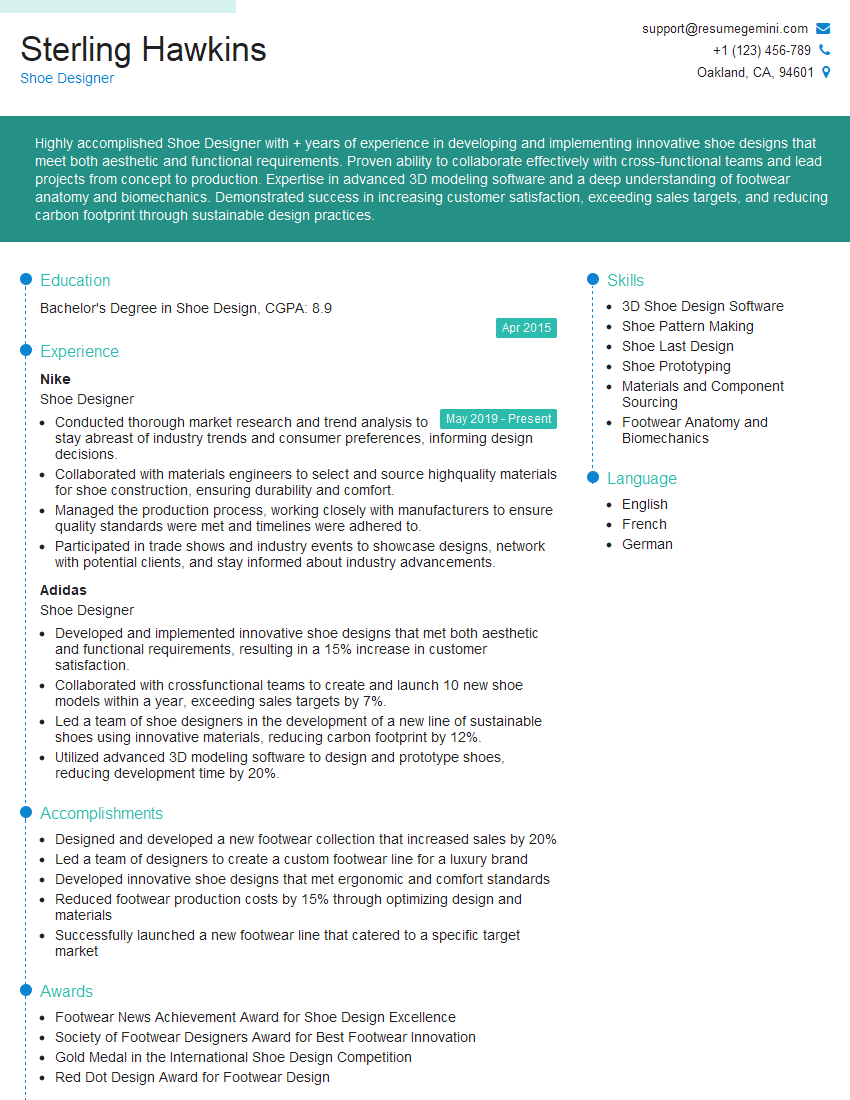
Mastering shoe design opens doors to exciting and rewarding careers in a dynamic industry. To maximize your job prospects, create a strong, ATS-friendly resume that highlights your skills and experience effectively. ResumeGemini is a trusted resource for building professional resumes that get noticed. They offer examples of resumes tailored to the shoe design field, helping you present yourself in the best possible light. Take advantage of these resources to showcase your expertise and land your dream job.
Explore more articles
Users Rating of Our Blogs
Share Your Experience
We value your feedback! Please rate our content and share your thoughts (optional).
What Readers Say About Our Blog
Very informative content, great job.
good