Cracking a skill-specific interview, like one for Shot Design, requires understanding the nuances of the role. In this blog, we present the questions you’re most likely to encounter, along with insights into how to answer them effectively. Let’s ensure you’re ready to make a strong impression.
Questions Asked in Shot Design Interview
Q 1. Explain the rule of thirds and its application in shot design.
The rule of thirds is a fundamental guideline in photography and filmmaking that enhances visual appeal and balance. Instead of centering your subject, imagine your frame divided into nine equal parts by two equally-spaced horizontal lines and two equally-spaced vertical lines. The points where these lines intersect are considered the four strongest points in the frame. Placing your subject or key elements at or near these points creates a more dynamic and engaging composition than simply centering everything.
Application: Imagine shooting a landscape. Instead of placing the horizon directly in the center, position it along the top or bottom horizontal line. This creates a more visually interesting image, perhaps emphasizing the sky or foreground depending on which line you choose. Similarly, in a portrait, position your subject’s eye along one of the horizontal lines and their body along a vertical line. This avoids a static, centered feel and leads the viewer’s eye through the shot more effectively.
Q 2. Describe different shot types (e.g., wide, medium, close-up) and their uses.
Shot types dictate the scale and perspective of your subject. They are crucial for controlling the narrative flow and emotional impact of your scene.
- Wide Shot (WS): Shows the entire subject and its surroundings, establishing context and setting the scene. Think of an establishing shot of a bustling city street before focusing on a specific character.
- Medium Shot (MS): Frames the subject from the waist up, providing a balance between context and detail. Useful for conversations or showing body language.
- Close-Up (CU): Shows a detailed view of a specific feature, such as a character’s face, emphasizing emotion or detail. Close-ups of a character’s eyes can convey intense emotion or fear.
- Extreme Close-Up (ECU): An even more magnified view, often focusing on a very specific detail, such as a person’s eye or a detail on an object. This creates a heightened sense of intimacy or suspense.
- Long Shot (LS): Similar to a wide shot, but even more expansive, emphasizing the subject’s scale within its environment.
- Extreme Long Shot (ELS): The subject is very small within the frame, emphasizing the vastness of the setting. Think of a lone figure standing on a vast plain.
Q 3. How do you use leading lines to enhance a shot’s composition?
Leading lines are compositional elements that guide the viewer’s eye through the frame towards the main subject. These can be roads, fences, rivers, or even lines of people. They create a sense of depth and movement.
How to use them: Position the lines so they naturally converge towards the subject, drawing the viewer’s attention. For example, a road leading towards a distant house emphasizes the house and creates a sense of journey or anticipation. Avoid lines that lead directly *away* from the main subject; this can be distracting.
Example: A photographer shooting a mountain range might use a winding road that curves up towards the mountain peaks as a leading line, drawing the viewer’s gaze to the imposing scenery.
Q 4. Explain the concept of framing and its impact on storytelling.
Framing involves using elements within the scene to isolate or highlight your subject. This can be achieved by using natural elements like doorways, windows, arches or even branches of trees. It’s a powerful technique for controlling the viewer’s focus and influencing the mood of the shot.
Impact on Storytelling: Framing can create a sense of confinement, isolation, or protection depending on the elements used. A character framed within a doorway might feel vulnerable, while one framed by a protective arch could feel safe. Framing adds layers of meaning and subtext beyond the literal image.
Q 5. Discuss the importance of headroom and eyeline in shot composition.
Headroom refers to the space between the top of a subject’s head and the top edge of the frame. Eyeline refers to the space between the subject’s eyes and the horizontal center of the frame.
Importance: Insufficient headroom can feel cramped and unnatural, while too much can make the subject appear distant and insignificant. Incorrect eyeline makes the shot feel unbalanced. A well-balanced shot has sufficient headroom (usually slightly less than what’s below the subject’s chin) and a natural eyeline. These elements subtly affect the viewer’s perception of the subject and the overall scene.
Q 6. How do you use depth of field to control focus and draw the viewer’s eye?
Depth of field controls the area of the image that is in sharp focus. A shallow depth of field (small f-stop number, e.g., f/1.4) results in a blurry background, isolating the subject and drawing the viewer’s eye to it. A deep depth of field (large f-stop number, e.g., f/16) keeps both the foreground and background in focus, highlighting the context and relationships between elements in the scene.
Controlling Focus: Using a shallow depth of field is ideal for portraits or to emphasize a specific element within a cluttered scene. Deep depth of field is suitable for landscape photography or when you want to show the entire scene in sharp focus.
Example: A shallow depth of field used in a portrait will blur the background, making the subject stand out dramatically, while a deep depth of field in a landscape photo will show every detail of the foreground and the background clearly.
Q 7. Explain how lighting affects mood and atmosphere in a shot.
Lighting is crucial for establishing mood and atmosphere. Different lighting styles evoke different feelings. High-key lighting (bright, even illumination) creates a cheerful, optimistic feel, whereas low-key lighting (dark with strong shadows) can create a sense of mystery, suspense or drama.
Examples: A brightly lit scene with soft shadows might suggest happiness and peace. Conversely, a scene shrouded in darkness with only a few highlights might convey a sense of foreboding or danger. The direction, intensity, and color temperature of the light all play a role in shaping the audience’s emotional response.
Q 8. Describe different lighting techniques (e.g., high-key, low-key, Rembrandt).
Lighting techniques are crucial for setting the mood and visual style of a shot. They manipulate the contrast, brightness, and shadows to achieve different effects.
- High-Key Lighting: This style uses bright, even illumination with minimal shadows. It creates a cheerful, upbeat atmosphere, often seen in comedies or romantic scenes. Think of a brightly lit beach scene – lots of light, few deep shadows.
- Low-Key Lighting: This technique employs mostly shadows with just a few areas of bright light. This generates a mysterious, dramatic, or suspenseful feeling, common in thrillers or horror films. A film noir scene with a character shrouded in darkness, illuminated only by a single lamp, is a prime example.
- Rembrandt Lighting: This is a classic portrait lighting style that creates a small, triangular highlight on the shadowed side of the face. It adds depth and drama while highlighting the subject’s features. Think of a dramatic close-up of an actor, where a single light source creates a small, distinct highlight on their cheekbone.
The choice of lighting technique profoundly impacts the storytelling. A high-key scene might feel hopeful, while a low-key scene may feel threatening.
Q 9. How do you use color to enhance the storytelling in a shot?
Color is a powerful storytelling tool in shot design. It can evoke emotions, establish a setting, and highlight key elements within a scene. Think of it as a silent language that speaks volumes.
- Color Palette: Warm colors (reds, oranges, yellows) generally evoke feelings of warmth, excitement, or anger. Cool colors (blues, greens, purples) often convey calmness, sadness, or mystery. Using a predominantly warm palette in a scene could indicate a happy moment, while a cool palette might suggest a tense situation.
- Color Contrast: Juxtaposing complementary colors (e.g., red and green) can create visual interest and draw the viewer’s eye to a specific element. A brightly colored object in a muted background will immediately grab attention.
- Color Saturation: High saturation makes colors vibrant and intense, often used to heighten drama or emotion. Low saturation creates a desaturated, muted look, which can be used to portray melancholy, nostalgia, or a dreamlike state.
For example, a scene set in a vibrant tropical rainforest would employ saturated greens and blues, while a scene portraying a cold, desolate landscape might utilize desaturated blues and grays. The strategic use of color enhances the visual narrative significantly.
Q 10. Explain the difference between a master shot and a coverage shot.
The master shot and coverage shots are essential components of filmmaking, working together to tell the story effectively.
- Master Shot: This is a wide shot that establishes the scene’s setting, characters, and action. It provides context for the entire scene and acts as a reference point for editors. Imagine a scene at a bustling market; the master shot would capture the entire market and all the characters within it.
- Coverage Shots: These are a series of closer shots that capture specific actions, reactions, or details within the scene. They are used to supplement the master shot and allow for flexibility in editing. Coverage shots might include close-ups of a character’s expression, medium shots of two characters interacting, or over-the-shoulder shots.
The master shot lays the groundwork, while the coverage shots provide the granular detail. Editors use this footage to craft the most engaging and coherent version of the scene.
Q 11. Describe your process for storyboarding a scene.
Storyboarding is a crucial pre-production step for visualizing the scene and communicating the shot design to the entire team. My process involves several key steps:
- Script Analysis: I carefully read the script, identifying key actions, emotions, and character interactions.
- Shot Selection: I decide on the types of shots (wide, medium, close-up, etc.) needed to tell the story effectively.
- Camera Angles and Movement: I determine the best camera angles and movement (pans, tilts, tracking shots) to enhance the narrative.
- Composition and Lighting: I sketch out the composition of each shot, paying attention to framing, rule of thirds, and lighting.
- Storyboard Creation: I create visual representations of each shot using a storyboard software or by hand.
- Review and Iteration: I review and refine the storyboard with the director and other key team members to ensure everyone is on the same page.
The resulting storyboard serves as a blueprint, guiding the shooting process and ensuring a consistent visual style throughout the scene.
Q 12. How do you collaborate with other departments (e.g., camera, lighting, VFX)?
Collaboration is key to successful shot design. I work closely with various departments to ensure a cohesive and effective final product.
- Camera Department: I discuss camera angles, movement, and lens choices with the cinematographer to ensure that the shots align with the vision. We might collaborate on choosing the best lens for a specific shot to achieve a particular look or perspective.
- Lighting Department: I work with the lighting team to achieve the desired mood and visual style for each shot. We might discuss the best lighting technique (high-key, low-key, etc.) to convey the intended emotion.
- VFX Department: If the shot requires visual effects, I collaborate with the VFX team to ensure that the planned shots can accommodate the visual effects. We might discuss where and how the VFX will integrate seamlessly.
Open communication and a shared understanding of the creative vision are paramount in this collaborative process. Regular meetings and feedback sessions ensure everyone remains aligned and informed.
Q 13. Explain your understanding of shot continuity and editing.
Shot continuity and editing are closely intertwined. Maintaining shot continuity ensures the narrative flow is smooth and believable for the viewer.
- Shot Continuity: This refers to the consistent visual and narrative elements across multiple shots. Maintaining consistent character positioning, screen direction, and lighting creates a seamless viewing experience. For example, a character shouldn’t change their position in the scene unexpectedly between shots.
- Editing: This is the process of assembling the shots into a cohesive sequence. A skilled editor uses the master shot and coverage shots to construct the story, adjusting pacing and emphasizing key moments.
Poor shot continuity or ineffective editing can disrupt the viewing experience, breaking immersion and causing confusion. Mastering both aspects is critical for successful filmmaking.
Q 14. How do you ensure consistency in shot design across a project?
Maintaining consistency in shot design throughout a project requires careful planning and attention to detail. Several strategies ensure a cohesive visual style:
- Shot List and Storyboards: A detailed shot list and comprehensive storyboards serve as a reference point throughout the production process.
- Style Guide: Developing a style guide for camera angles, lighting, and color palettes helps maintain consistency across different scenes.
- Regular Communication: Consistent communication with the director, cinematographer, and editor ensures that everyone is aligned with the overall visual approach.
- Review and Feedback: Regularly reviewing the footage and providing feedback helps to identify and correct any inconsistencies.
Maintaining consistency in shot design enhances the project’s overall aesthetic appeal and contributes to a stronger, more cohesive narrative.
Q 15. Describe your experience with different camera angles and their effects.
Camera angles are fundamental to shot design, dictating the audience’s perspective and emotional response. A simple change in angle can drastically alter the mood and meaning of a scene.
- Eye-level shots are neutral and create a sense of connection with the subject. Think of a conversation scene between two friends – eye-level shots usually work best here.
- High-angle shots make the subject appear smaller, weaker, or vulnerable. Imagine a villain looking down at a captive hero – a high angle emphasizes the villain’s power.
- Low-angle shots do the opposite, making the subject appear larger, more powerful, or intimidating. Think of a superhero standing tall against a backdrop – a low angle accentuates their might.
- Over-the-shoulder shots are commonly used in dialogue scenes, providing intimacy while maintaining a clear view of both characters. This creates a sense of shared space and closeness.
- Dutch angles (canted angles) are tilted shots that create a sense of unease, disorientation, or chaos. These are often used in action sequences or psychological thrillers to enhance the suspense.
Understanding the impact of each angle is crucial for storytelling. The choice is never arbitrary; it’s a deliberate decision that contributes to the overall narrative and visual style.
Career Expert Tips:
- Ace those interviews! Prepare effectively by reviewing the Top 50 Most Common Interview Questions on ResumeGemini.
- Navigate your job search with confidence! Explore a wide range of Career Tips on ResumeGemini. Learn about common challenges and recommendations to overcome them.
- Craft the perfect resume! Master the Art of Resume Writing with ResumeGemini’s guide. Showcase your unique qualifications and achievements effectively.
- Don’t miss out on holiday savings! Build your dream resume with ResumeGemini’s ATS optimized templates.
Q 16. How do you adapt your shot design to different genres and styles?
Adapting shot design to different genres requires a keen understanding of visual language and storytelling conventions. What works for a gritty crime thriller won’t necessarily translate to a whimsical children’s film.
- Action films often employ fast cuts, dynamic camera movements (like Steadicam shots or drone shots), and close-ups to heighten tension and excitement.
- Romantic comedies might utilize softer lighting, longer takes, and more static camera positions to create a more intimate and relaxed atmosphere. A steady camera often signifies calm and romantic connection.
- Horror films frequently use low-angle shots, dark shadows, and unconventional camera angles to build suspense and fear. Unexpected shifts in perspective and quick cuts can startle the audience.
- Documentaries often emphasize realism with natural lighting and less stylized camera work, focusing on capturing authentic moments.
My approach is to analyze the genre’s established visual grammar and then use it as a springboard for innovation. I’ll brainstorm how to leverage established conventions to create something unique and compelling within that framework. The goal is always to serve the story.
Q 17. Explain how you handle creative differences with directors or clients.
Creative differences are inevitable in any collaborative project. My approach is rooted in open communication, mutual respect, and a commitment to finding the best solution for the project.
I begin by actively listening to the director or client’s vision. I then present my ideas clearly, explaining the rationale behind my choices, using storyboards and visual references to illustrate my points. If there’s a disagreement, I try to understand the underlying reason for their preference. It’s often not about aesthetics alone; sometimes it’s about conveying a specific emotion or adhering to budgetary limitations.
Compromise and collaboration are key. Sometimes, I’ll adapt my initial ideas to incorporate their input, and sometimes, I’ll respectfully present compelling arguments to justify my approach. Ultimately, the goal is to create a unified vision that everyone is happy with.
Q 18. Describe a time you had to solve a complex shot design challenge.
During a recent project, we needed to film a complex action scene inside a rapidly collapsing building. The challenge was simulating the destruction realistically while ensuring the safety of the actors and crew.
We initially considered extensive CGI, but the budget was restrictive. My solution involved a combination of practical effects and carefully planned camera work. We used controlled demolition techniques for some segments, capturing the controlled destruction with high-speed cameras. For other sections, we built a detailed set and used practical effects like pyrotechnics and strategically placed props to simulate the collapse. The camera angles were key – low-angle shots emphasizing the scale of the destruction, close-ups to capture intense emotions, and quick cuts to maintain pace. The result was a visually stunning and immersive sequence, despite the budget constraints.
Q 19. How do you stay updated with the latest trends in shot design?
Staying updated in shot design requires consistent effort and a multi-faceted approach.
- Film Festivals and Awards Shows: Attending film festivals and award shows like the Oscars provides exposure to innovative shot design and cinematography.
- Online Resources: Websites, blogs, and online communities dedicated to filmmaking are invaluable for exploring the work of other professionals and learning about new techniques.
- Industry Publications: Magazines and journals dedicated to filmmaking offer in-depth articles, interviews, and analyses of current trends.
- Networking: Attending workshops and conferences allows for direct interaction with other professionals, enabling the exchange of knowledge and insights.
I also actively analyze the visual language of successful films and television shows, dissecting their shot choices to understand their effect on the audience and narrative.
Q 20. What software and tools are you proficient in (e.g., Maya, Cinema 4D, After Effects)?
My proficiency spans several industry-standard software packages. I’m highly skilled in:
- Adobe Creative Suite: After Effects for compositing and visual effects, Photoshop for image manipulation, and Premiere Pro for editing.
- Autodesk Maya: For 3D modeling, animation, and rendering. I use Maya extensively for pre-visualization and complex shot design elements.
- Cinema 4D: A versatile 3D software package, particularly useful for motion graphics and character animation. I use it frequently to supplement Maya.
I’m also proficient in various other tools depending on project needs, including matchmoving software and virtual production environments.
Q 21. Explain your workflow for creating a shot from concept to final render.
My workflow is iterative and adaptable, but typically follows these steps:
- Concept and Storyboarding: I begin by thoroughly understanding the script and collaborating with the director to develop the visual concept for the shot. This includes creating detailed storyboards that illustrate camera angles, movements, and overall composition.
- Pre-visualization: Using software like Maya or Cinema 4D, I create pre-visualizations (previs) to test different camera angles, movements, and lighting setups. This allows for experimentation and refinement before actual filming.
- Shot Planning and Production: I work closely with the director of photography (DP) to translate the previs into a practical shooting plan. This involves detailed shot lists, camera specifications, and lighting diagrams.
- Filming and Capture: I assist in ensuring that the shots are captured as planned on set. This includes monitoring the technical aspects of the shoot to maintain consistency with the previs and storyboards.
- Post-Production: I oversee or actively participate in post-production tasks, including visual effects, color grading, and final compositing. The goal is to maintain visual consistency and realize the original creative vision.
- Final Render and Delivery: The final step involves rendering the shot and ensuring that it meets the highest quality standards for delivery to the client.
This process isn’t always linear; feedback and revisions are incorporated throughout, ensuring the final product aligns with the creative vision.
Q 22. Describe your experience with pre-visualization and its benefits.
Pre-visualization, in shot design, is the process of planning and outlining the visual aspects of a film or video project before actual filming begins. Think of it as creating a detailed storyboard, but often incorporating more technical information such as camera angles, lens choices, and lighting schemes. This can involve storyboarding, animatics (rough animated sequences), or even using 3D modeling software to create virtual sets and camera movements.
The benefits are numerous: It allows for efficient pre-production planning, helping to identify potential problems early on and saving valuable time and resources during filming. It facilitates clear communication amongst the team, ensuring everyone is on the same page regarding the visual aesthetic and narrative flow. It helps refine the creative vision by allowing for experimentation and iterative improvements before committing to expensive shoots. For example, I once used pre-visualization to identify a potential issue with a crane shot in a tight space – the pre-vis revealed the crane’s arm would interfere with a set element, prompting us to adjust the scene’s staging well in advance.
Q 23. How do you balance creative vision with technical limitations?
Balancing creative vision with technical limitations is a constant juggling act in shot design. It’s about finding the sweet spot between artistic ambition and practical feasibility. The key is to approach the process iteratively. I start with the ideal shot, driven purely by the story and creative vision. Then, I assess the technical limitations: budget, equipment availability, location constraints, time limitations, etc.
Where there’s a conflict, I explore alternative solutions. This might involve simplifying the shot, finding creative workarounds, or suggesting alternative locations or equipment. For instance, if the ideal shot requires a helicopter shot, but the budget doesn’t allow, I might explore using a drone or even achieving a similar effect through clever camera angles and post-production effects. The process requires open communication with the director, cinematographer, and other crew members to find the best compromise that remains faithful to the creative intent.
Q 24. Explain your understanding of visual storytelling and its connection to shot design.
Visual storytelling is the art of conveying a narrative through images. In shot design, this is paramount. Every shot should contribute to the story, not just be a pretty picture. It’s about consciously using camera angles, framing, movement, and composition to elicit specific emotions, build tension, reveal character, or advance the plot.
For example, a low-angle shot can make a character appear powerful, while a high-angle shot might make them seem vulnerable. A close-up can emphasize emotion, whereas a wide shot can establish setting and context. The connection is direct: shot design is the language of visual storytelling. Each shot, carefully crafted, contributes to the overall narrative experience. I always consider how a given shot will affect the audience emotionally and intellectually, helping to guide their interpretation and engagement with the story.
Q 25. How do you ensure your shot design is both aesthetically pleasing and effective?
Achieving both aesthetic appeal and effectiveness in shot design is a matter of understanding the fundamentals of composition, visual grammar, and storytelling principles. Aesthetically pleasing shots often employ the rule of thirds, leading lines, symmetry, and other compositional techniques to create visually engaging frames. Effectiveness, on the other hand, is about ensuring that each shot serves a specific narrative purpose. It’s not enough for a shot to look good; it must also contribute meaningfully to the story.
I approach this by first defining the narrative purpose of each shot. Once that’s clear, I can choose the composition and framing that best serve that purpose while maintaining visual appeal. For example, a visually stunning shot of a sunset might be beautiful but ineffective if it doesn’t advance the story or evoke the appropriate emotion for the scene. The balance lies in marrying artistic choices with narrative requirements, ensuring that form and function work harmoniously.
Q 26. What are your strengths and weaknesses as a shot designer?
My strengths lie in my strong understanding of visual storytelling, my ability to pre-visualize complex scenes, and my proficiency in various shot design software. I am adept at problem-solving, finding creative solutions to technical challenges, and collaborating effectively with diverse teams. I also pride myself on my meticulous attention to detail and my commitment to delivering high-quality work within deadlines.
One area I’m continually working on is expanding my knowledge of emerging technologies like virtual production. While I’m familiar with the basics, staying at the cutting edge of these advancements requires ongoing learning and experimentation. This is an active area of professional development for me.
Q 27. Describe your experience with different aspect ratios and their implications.
Aspect ratios significantly impact the visual storytelling and composition of a shot. Different ratios offer distinct aesthetic qualities and influence how viewers perceive the scene. For example, the classic 4:3 ratio offers a more traditional, sometimes more intimate feel, while the widescreen 16:9 provides a more cinematic and expansive feel.
My experience spans various aspect ratios, including standard definition (4:3), high definition (16:9), and even more cinematic ratios like 2.39:1. I understand how each ratio affects the framing of the shot, the emphasis of certain elements, and the overall mood. Choosing the appropriate aspect ratio is crucial, as it influences not only the aesthetics but also the narrative impact. I always consider the intended platform and audience when deciding on the most suitable aspect ratio for a project. For example, a project intended for a theatrical release might best benefit from a wider aspect ratio like 2.39:1, whereas content designed for mobile viewing might be better suited to 16:9.
Q 28. How do you manage your time and prioritize tasks in a fast-paced environment?
Time management and prioritization are vital in a fast-paced environment. I employ several strategies, starting with a detailed shot list that breaks down each scene into individual shots, specifying their purpose, technical requirements, and estimated time. I use project management software to track progress, set deadlines, and allocate resources efficiently. I prioritize tasks based on their urgency and importance, focusing on critical shots that are essential to the narrative flow.
Furthermore, I regularly communicate with the director and other team members, keeping them informed about progress and addressing any potential roadblocks proactively. This collaborative approach ensures that any delays are identified and mitigated early, minimizing their impact on the overall schedule. Proactive communication and planning are key to efficient time management in this dynamic field.
Key Topics to Learn for Shot Design Interview
- Composition and Framing: Understanding the rule of thirds, leading lines, and other compositional techniques to create visually appealing and effective shots. Practical application: Analyzing existing shots and identifying strengths and weaknesses in their composition.
- Camera Angles and Movement: Mastering different camera angles (high angle, low angle, etc.) and movement techniques (panning, tilting, zooming) to convey specific emotions and information. Practical application: Planning shot sequences for a short film or commercial, considering the impact of each angle and movement.
- Lighting and Exposure: Knowledge of lighting techniques (three-point lighting, high-key, low-key) and how to achieve proper exposure for different shooting conditions. Practical application: Troubleshooting lighting issues on set and adjusting settings to achieve desired results.
- Shot Types and Sequences: Understanding various shot types (wide shot, medium shot, close-up, etc.) and how to use them effectively within a sequence to tell a story. Practical application: Designing a shot list for a scene, considering the pacing and emotional impact of each shot.
- Storytelling through Shot Design: Understanding how shot design contributes to the overall narrative and emotional impact of a film or video. Practical application: Analyzing how shot design choices influence the viewer’s understanding and interpretation of a scene.
- Technical Aspects: Understanding camera settings, lenses, and other technical aspects relevant to shot design. Practical application: Troubleshooting technical difficulties during a shoot and making informed decisions about equipment choices.
- Collaboration and Communication: Effectively communicating your shot design ideas to the director, cinematographer, and other crew members. Practical application: Presenting a shot list and storyboard to a team and explaining your creative vision.
Next Steps
Mastering shot design is crucial for career advancement in film, video production, and related fields. A strong understanding of visual storytelling and technical expertise significantly enhances your value as a creative professional. To maximize your job prospects, it’s vital to create an ATS-friendly resume that highlights your skills and experience effectively. ResumeGemini is a trusted resource that can help you build a professional and impactful resume. We provide examples of resumes tailored specifically to Shot Design to guide you in crafting your own compelling application.
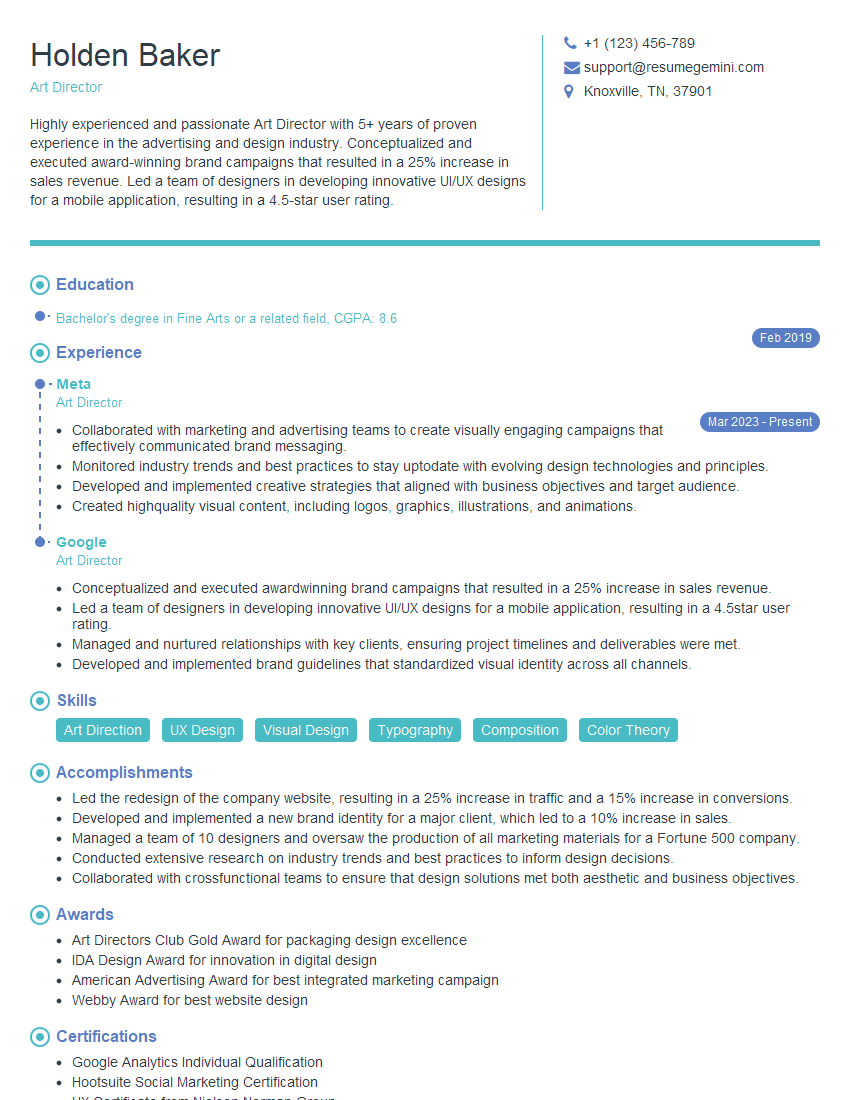
Art Director Resume Sample
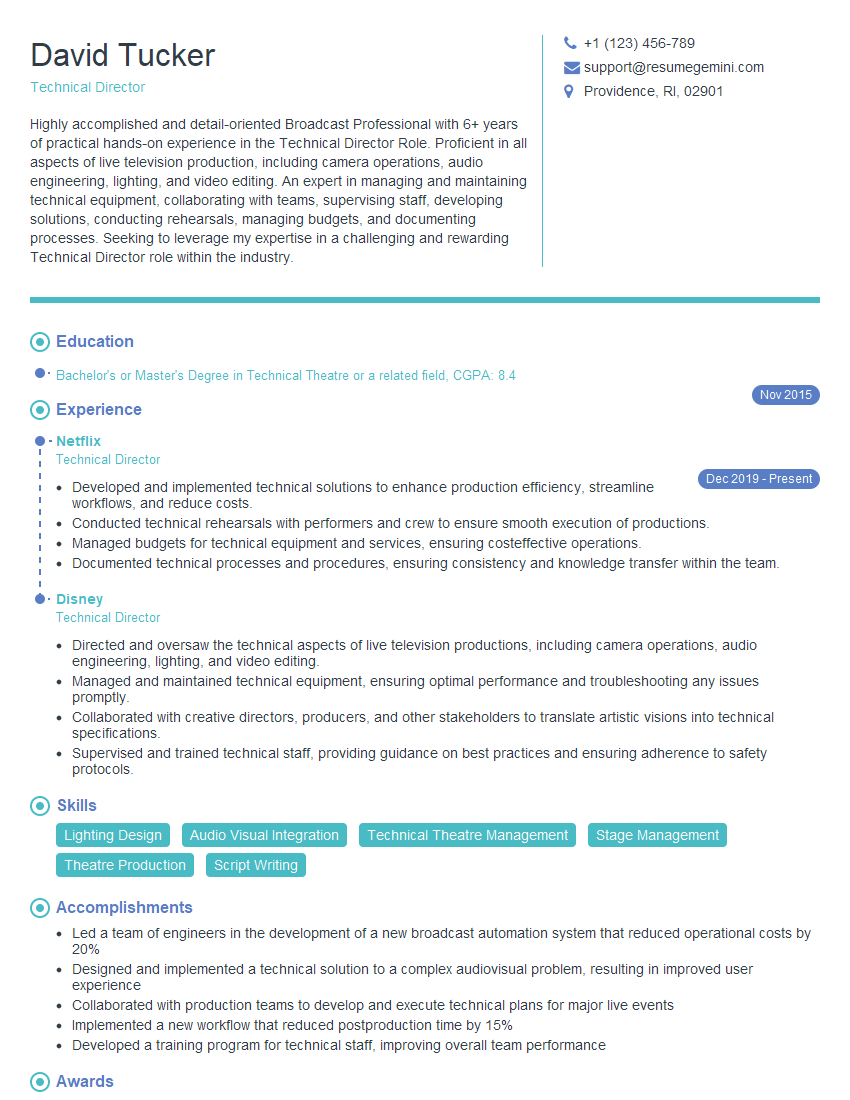
Technical Director Resume Sample
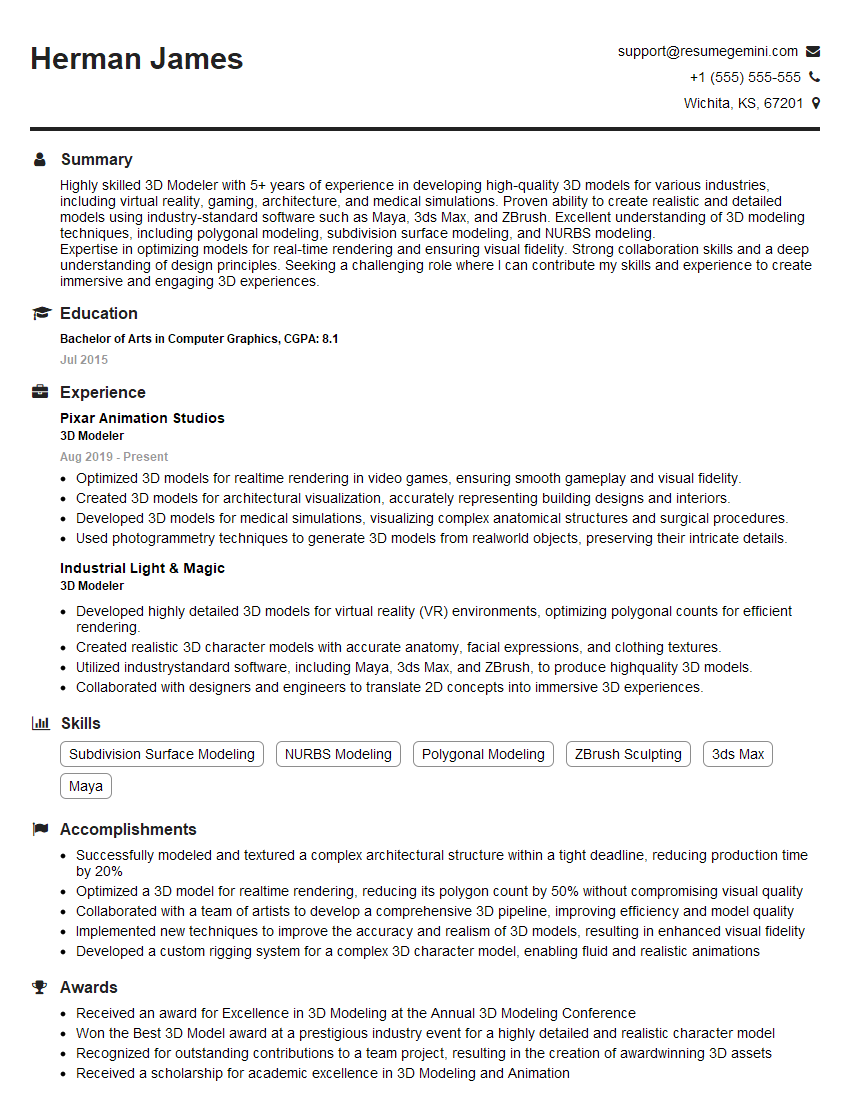
3D Modeler Resume Sample
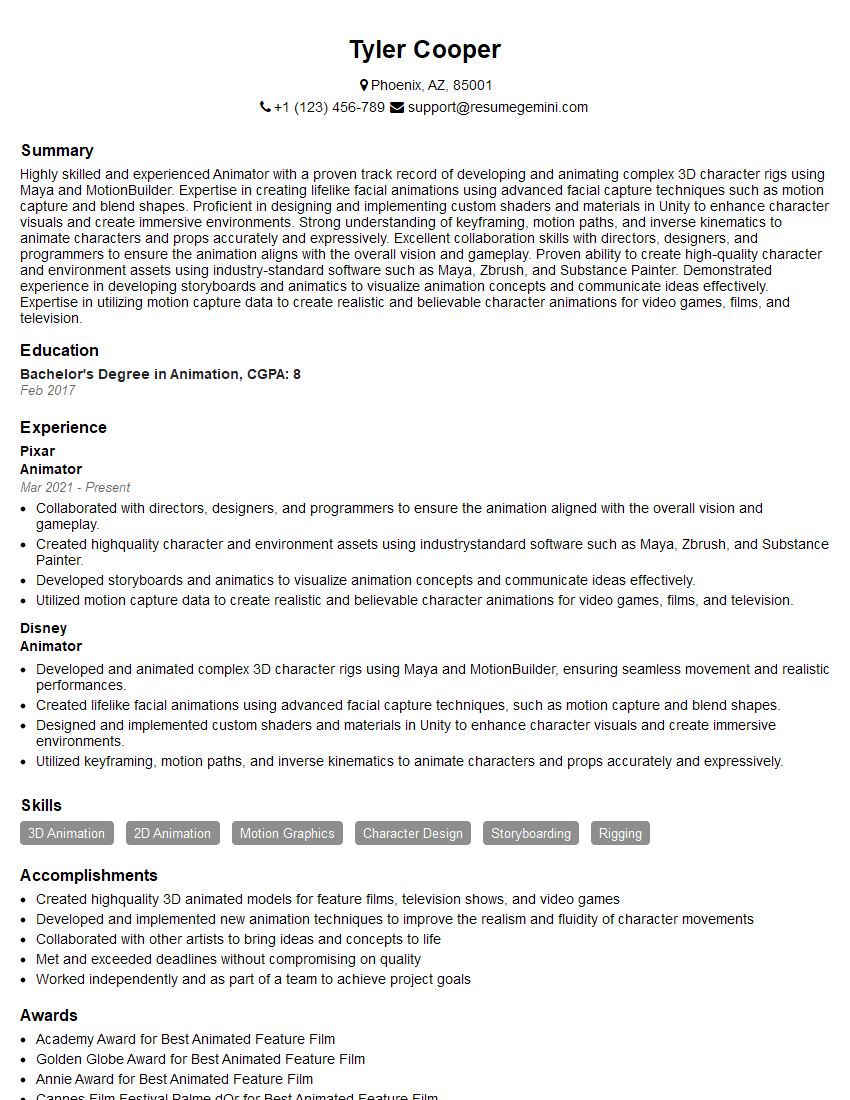
Animator Resume Sample
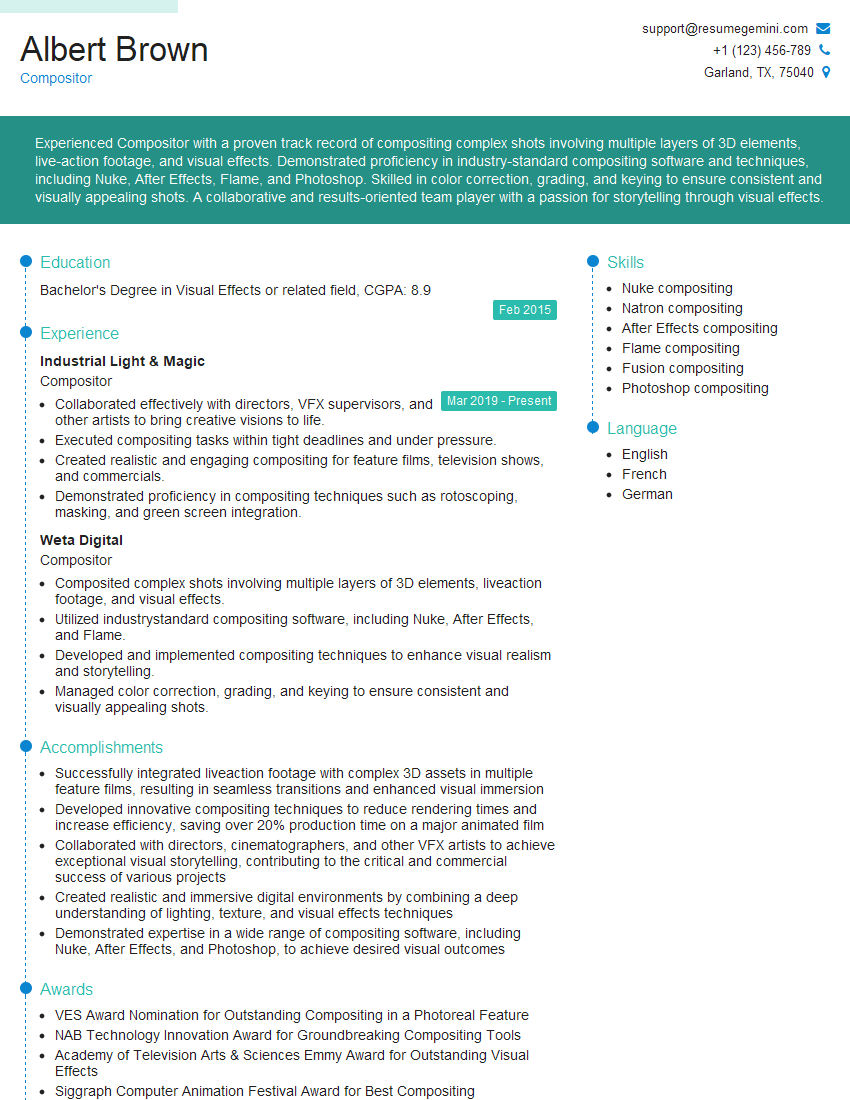
Compositor Resume Sample
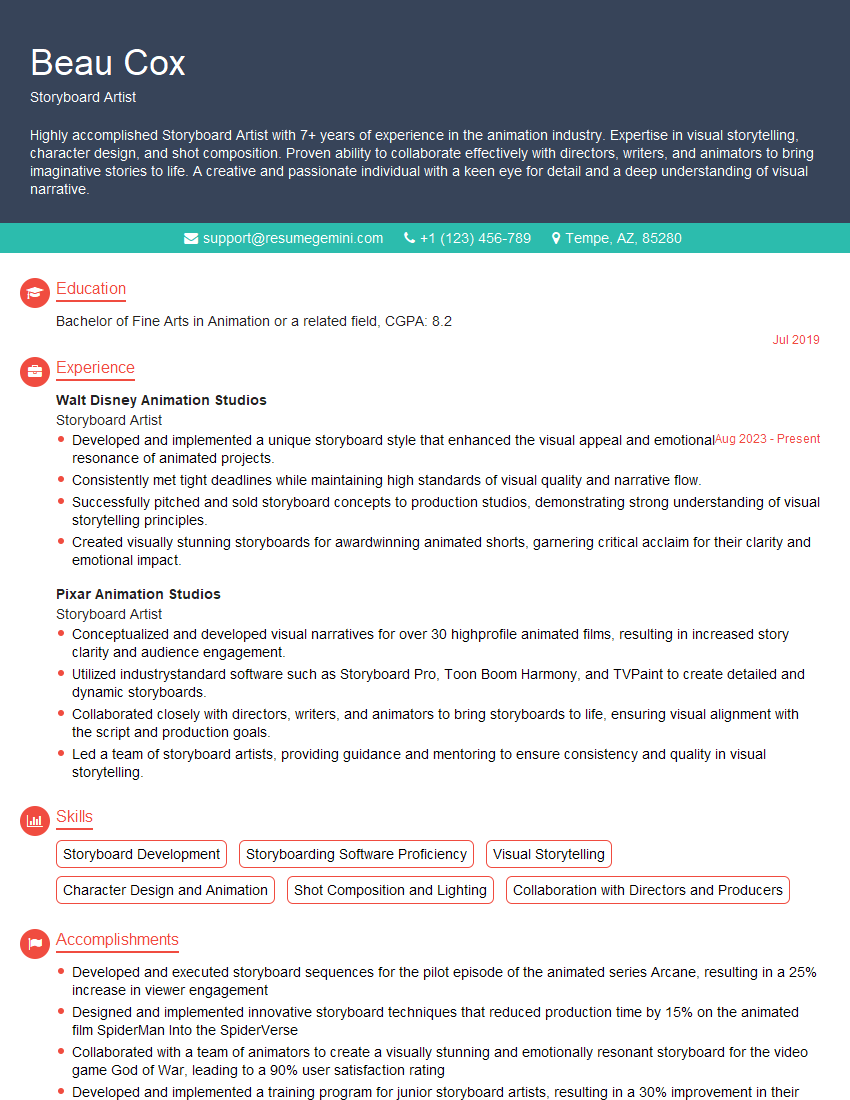
Storyboard Artist Resume Sample
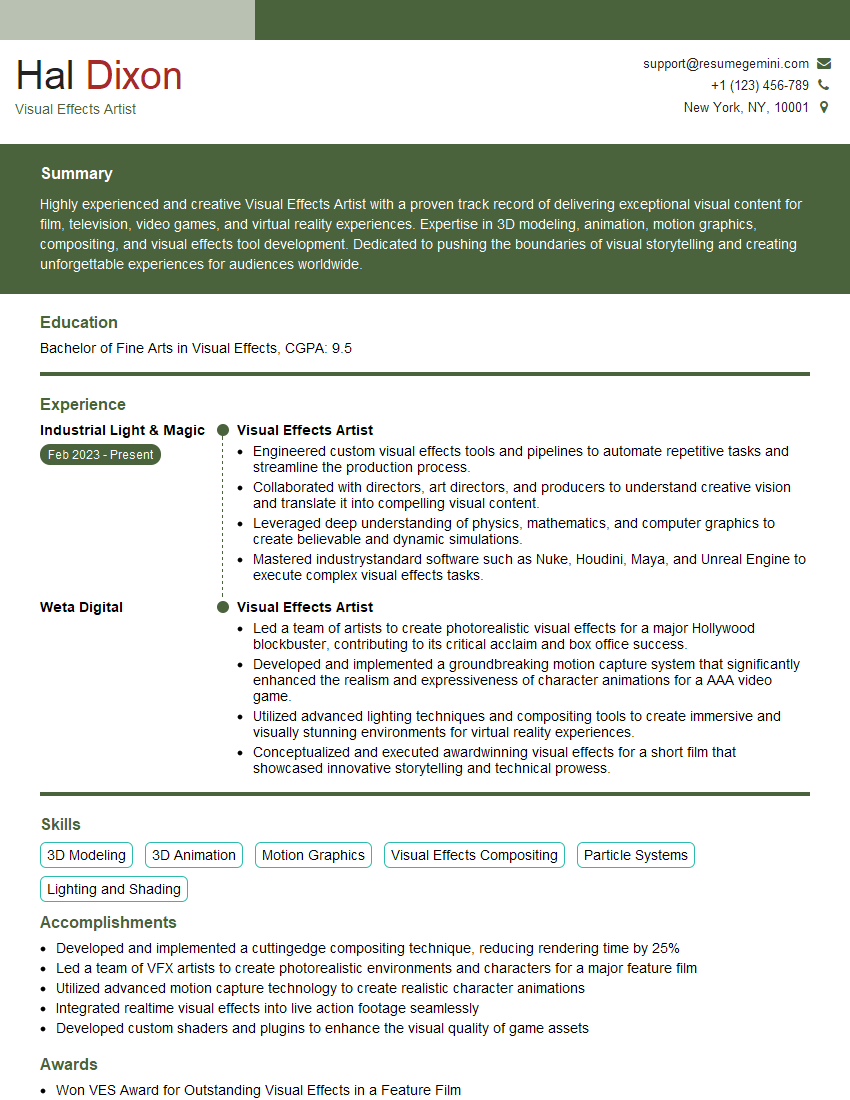
Visual Effects Artist Resume Sample
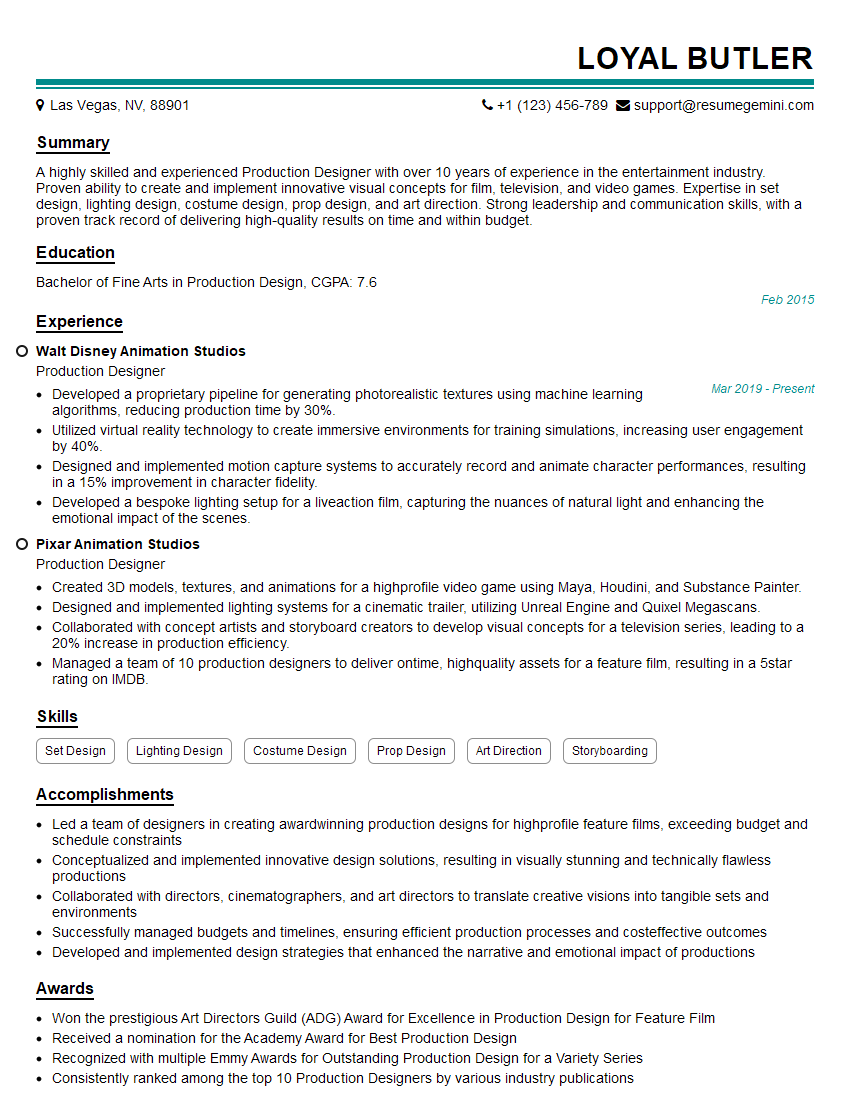
Production Designer Resume Sample
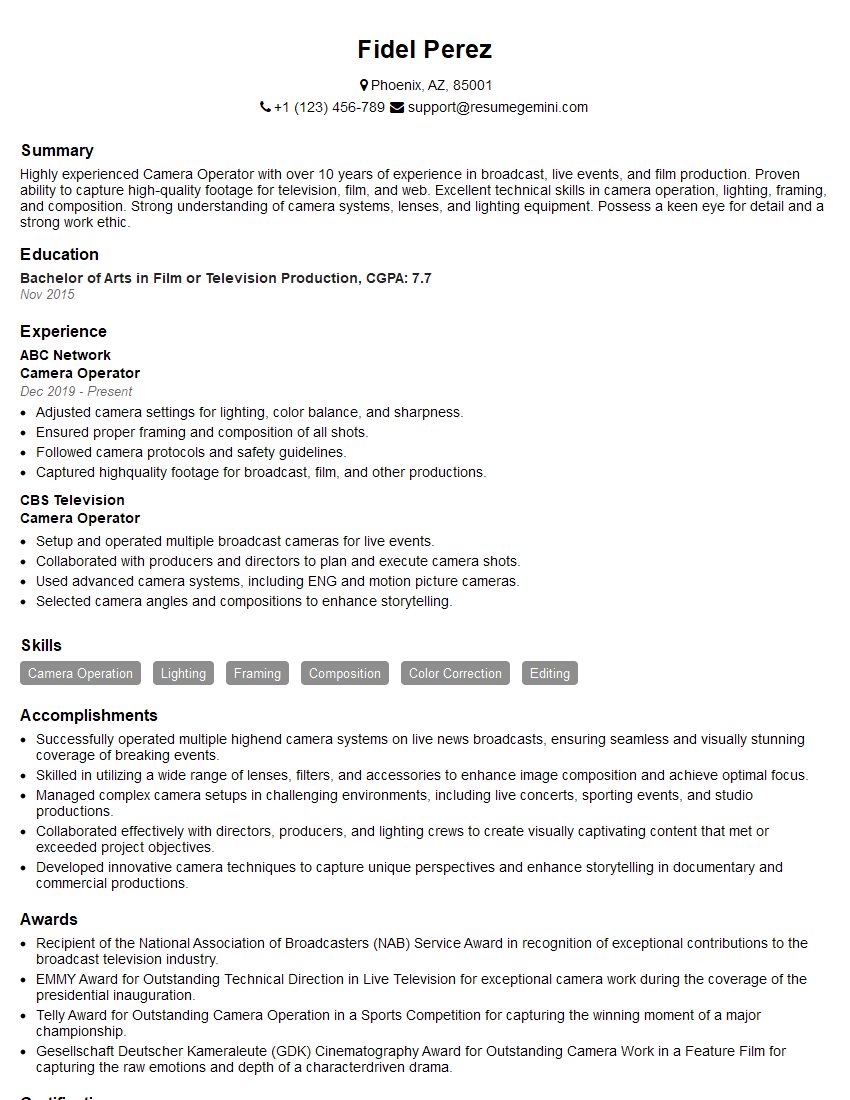
Camera Operator Resume Sample
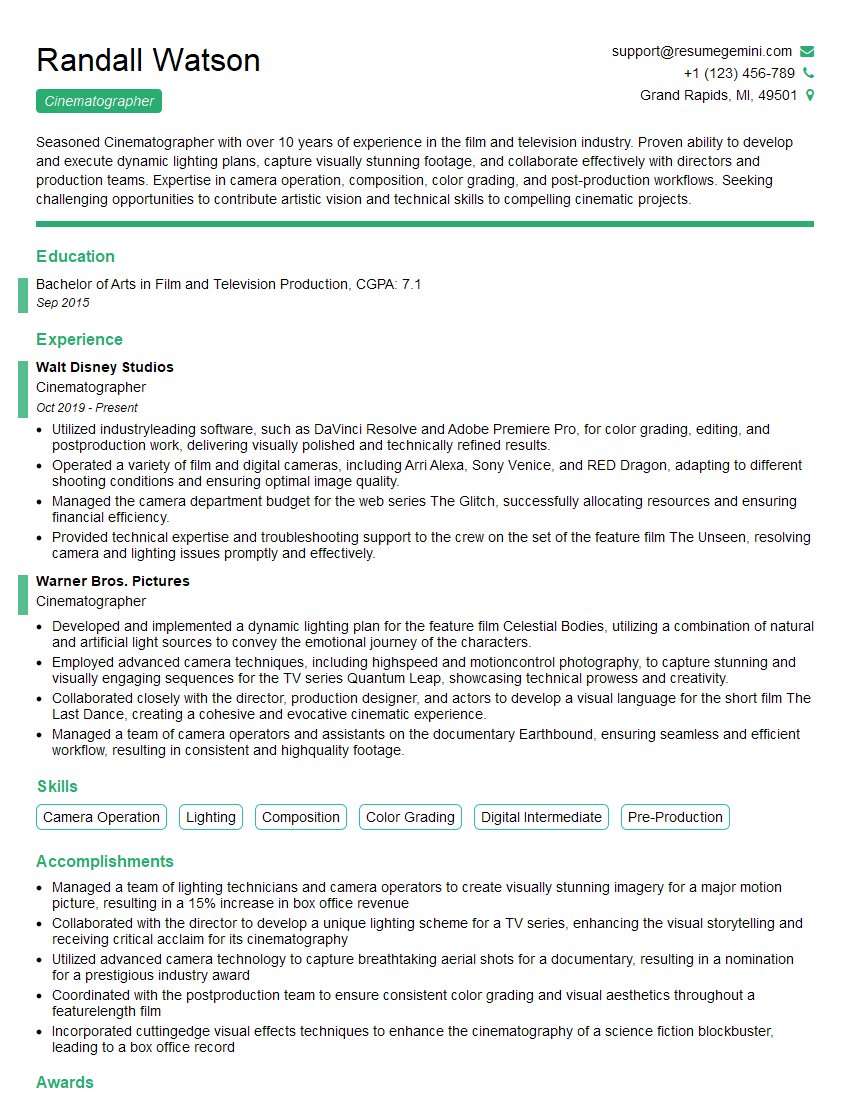
Cinematographer Resume Sample
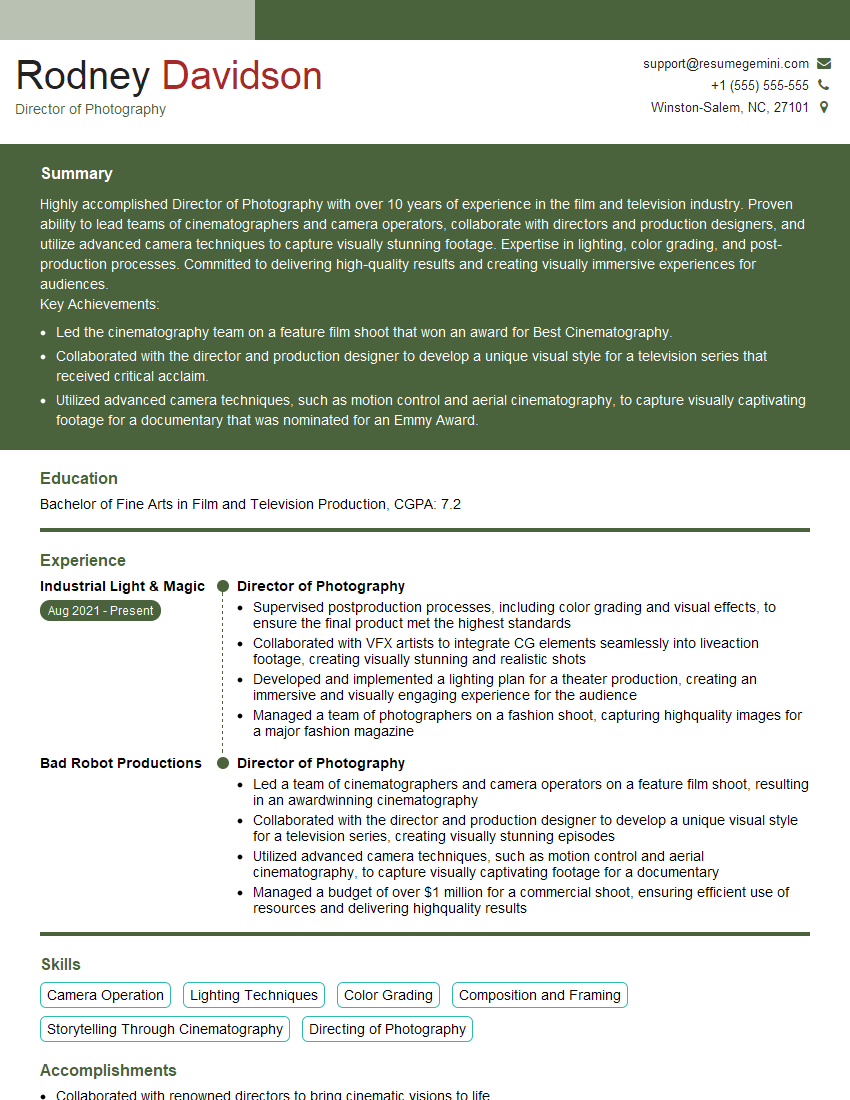
Director of Photography Resume Sample
Explore more articles
Users Rating of Our Blogs
Share Your Experience
We value your feedback! Please rate our content and share your thoughts (optional).
What Readers Say About Our Blog
Very informative content, great job.
good