Preparation is the key to success in any interview. In this post, we’ll explore crucial SIGINT/EW Equipment Maintenance interview questions and equip you with strategies to craft impactful answers. Whether you’re a beginner or a pro, these tips will elevate your preparation.
Questions Asked in SIGINT/EW Equipment Maintenance Interview
Q 1. Explain the difference between SIGINT and EW.
SIGINT (Signals Intelligence) and EW (Electronic Warfare) are closely related but distinct disciplines within the broader field of electronic warfare. SIGINT focuses on intercepting and analyzing electromagnetic emissions to gather intelligence. Think of it like listening in on a conversation – you’re passively collecting information. EW, on the other hand, is about actively influencing the electromagnetic environment. This can involve jamming enemy signals (preventing them from communicating), deceiving them with false signals, or protecting your own systems from enemy attacks. It’s like participating in the conversation – you’re not just listening, you’re actively shaping the communication landscape.
For example, a SIGINT system might intercept enemy radio chatter to determine their troop movements. An EW system might then jam their communication frequencies to disrupt their coordination, or use deception techniques to mislead them about our own troop positions.
Q 2. Describe your experience with troubleshooting RF systems.
My experience with troubleshooting RF systems spans over ten years, encompassing a wide range of equipment, from handheld radios to sophisticated array antennas. I’m adept at using various diagnostic tools to pinpoint malfunctions. A common scenario involves a receiver showing reduced sensitivity. My troubleshooting approach would start with visual inspection for obvious damage, followed by checking power supply levels and signal integrity at various points in the chain using spectrum analyzers and signal generators. If the issue persists, I’d isolate potential problem areas systematically, testing components like mixers, filters, and amplifiers until the fault is identified. I then meticulously document the repair process, including the faulty component and the steps taken to remedy the situation. For example, I once traced a recurring intermittent signal loss in a high-frequency receiver to a faulty solder joint on the RF input circuit, a seemingly minor problem that caused significant operational disruption.
Q 3. How familiar are you with different types of test equipment used in SIGINT/EW maintenance?
I’m highly familiar with a diverse range of test equipment critical to SIGINT/EW maintenance. This includes spectrum analyzers for signal analysis, signal generators for signal injection and testing, network analyzers for measuring transmission characteristics, oscilloscopes for waveform analysis, power meters for measuring power levels, and various multimeter types for basic electrical measurements. I also have experience with specialized equipment like time-interval analyzers, modulation analyzers, and direction finders. Furthermore, I am proficient in using automated test equipment (ATE) for system-level testing and fault isolation in complex systems. Understanding the capabilities and limitations of each piece of equipment is crucial for efficient and accurate diagnostics.
Q 4. What are the common causes of failures in SIGINT/EW equipment?
Failures in SIGINT/EW equipment stem from a variety of sources. Environmental factors like extreme temperatures, humidity, and vibration can cause component degradation and failures. Poor maintenance practices can also lead to issues, such as connectors corroding or internal components overheating due to insufficient cooling. Component failures, such as damaged transistors or faulty integrated circuits, are frequent causes. Additionally, antenna issues, including misalignment, damage, or poor connections, can significantly impact system performance. In addition, software glitches or firmware bugs can lead to system malfunctions that require software updates or reprogramming.
Q 5. How do you diagnose and repair faulty components in SIGINT/EW systems?
Diagnosing and repairing faulty components starts with a systematic approach. After identifying the malfunction through initial testing, I’d isolate the affected subsystem using schematics and troubleshooting guides. I use various test equipment to analyze signals and waveforms at different points within the system to pinpoint the faulty component. Once identified, I’d carefully remove the faulty component, adhering to anti-static precautions. Replacement involves selecting an appropriate replacement component from documented specifications, installing it correctly, and then conducting rigorous retesting to confirm the repair was successful. Documentation is critical, recording all diagnostic steps, the faulty component’s details (part number, etc.), and the repair procedure.
Q 6. Explain your experience with preventative maintenance procedures for SIGINT/EW equipment.
Preventative maintenance is paramount in ensuring the reliability and longevity of SIGINT/EW equipment. My experience includes developing and implementing preventative maintenance schedules that involve regular inspections, cleaning, and testing of critical components. This involves cleaning connectors to prevent corrosion and checking for loose connections or signs of physical damage. Thermal testing to ensure components are operating within safe temperature ranges is also conducted. Software updates and firmware upgrades are applied to address known vulnerabilities or performance improvements. Regular calibration of test equipment is key to maintaining measurement accuracy. A well-structured preventative maintenance plan significantly reduces downtime and increases system reliability, minimizing the chance of unexpected failures during critical operations.
Q 7. Describe your experience with calibration and testing of SIGINT/EW equipment.
Calibration and testing are crucial steps in maintaining the accuracy and performance of SIGINT/EW equipment. This involves using calibrated test equipment to verify the accuracy of the system’s measurements. For example, a spectrum analyzer’s frequency accuracy would be verified against a traceable standard. Calibration involves adjusting the system to meet the specified tolerances. Testing is a more comprehensive process and may involve signal injection at various frequencies and power levels to assess the system’s response. Testing procedures are often documented in detailed test plans that outline the steps needed to fully evaluate the performance of the equipment. I have experience creating and executing these plans, and I am familiar with the various standards and regulations that govern calibration and testing practices within the SIGINT/EW domain.
Q 8. What safety procedures do you follow when working with SIGINT/EW equipment?
Safety is paramount when handling SIGINT/EW equipment, which often involves high voltages, sensitive electronics, and potentially hazardous electromagnetic fields. My safety procedures begin with a thorough risk assessment specific to the task at hand. This includes identifying potential hazards like RF exposure, electrical shock, and physical injury from heavy equipment.
- Personal Protective Equipment (PPE): I always wear appropriate PPE, including safety glasses, gloves (often specialized anti-static gloves), and hearing protection. For high-power systems, additional shielding may be necessary.
- Lockout/Tagout (LOTO): Before any maintenance, I meticulously follow LOTO procedures to isolate power sources and prevent accidental energization. This is critical to prevent injury and damage to the equipment.
- RF Safety Precautions: I understand the potential dangers of RF exposure and always adhere to the recommended safe distances and exposure limits specified in the equipment’s documentation and relevant safety standards. This may involve using RF meters to monitor exposure levels.
- Grounding and Bonding: Proper grounding and bonding techniques are crucial to prevent static discharge and electrical shocks, especially when working with sensitive electronic components.
- Emergency Procedures: I am familiar with the emergency procedures for the specific site and equipment, including the location of emergency shutoff switches and the emergency response protocols.
For example, during a recent maintenance task on a high-power directional finding antenna, I meticulously implemented LOTO procedures before accessing the internal components, ensuring the system was completely de-energized and safe to work on. I also used an RF meter to verify the absence of harmful RF radiation before beginning the work.
Q 9. How do you interpret technical manuals and schematics for SIGINT/EW systems?
Interpreting technical manuals and schematics is fundamental to my work. It’s a skill developed through years of experience and a systematic approach. I start by understanding the overall system architecture and the function of each component. Schematics provide a visual representation of the signal flow and component interconnections, while the manuals provide detailed descriptions of the operation, maintenance procedures, and troubleshooting steps.
- Hierarchical Approach: I begin with a high-level overview, then drill down to specific details as needed. This involves understanding the system’s block diagram and functional descriptions before examining individual circuit diagrams.
- Symbol Recognition: Proficiency in recognizing electronic symbols (resistors, capacitors, transistors, integrated circuits, etc.) is essential for understanding schematics. This knowledge is developed through training and practical experience.
- Cross-Referencing: Often, the schematic needs to be cross-referenced with the manual to understand the function and specifications of each component and its role within the system.
- Troubleshooting Guides: The manuals also contain valuable troubleshooting guides, which I use to isolate and resolve faults in the equipment. These guides often include flowcharts and diagnostic procedures.
For instance, when troubleshooting a malfunctioning signal processing unit, I’ll first consult the block diagram to understand the signal path. Then I’ll examine the relevant circuit schematics to identify potential points of failure, cross-referencing the information with the troubleshooting section in the manual.
Q 10. Describe your experience with digital signal processing techniques relevant to SIGINT/EW.
Digital Signal Processing (DSP) techniques are central to modern SIGINT/EW systems. My experience encompasses several key areas:
- Signal Filtering: I’m proficient in applying various digital filters (FIR, IIR) to remove noise and isolate signals of interest. This involves selecting appropriate filter parameters to optimize performance based on the specific signal characteristics and noise environment.
- Signal Detection: I have extensive experience with various signal detection algorithms, including energy detection, matched filtering, and cyclostationary feature detection. This is critical for identifying weak signals masked by noise.
- Signal Modulation Recognition: I can identify different types of modulation schemes (e.g., AM, FM, PSK, QAM) using techniques like autocorrelation and spectral analysis. This is crucial for identifying and classifying intercepted signals.
- Signal Parameter Estimation: I’m experienced in estimating signal parameters like frequency, amplitude, phase, and time of arrival. This information is vital for geolocation and signal characterization.
- Software Defined Radios (SDRs): I possess hands-on experience working with SDRs and using DSP software packages such as MATLAB and GNU Radio to implement and test DSP algorithms in real-time.
For example, I once used a combination of matched filtering and cyclostationary feature detection to isolate a weak, spread-spectrum signal buried in a significant amount of noise. This involved careful selection of filter parameters and threshold settings to optimize signal detection while minimizing false alarms.
Q 11. How familiar are you with different types of antennas used in SIGINT/EW systems?
My familiarity with antennas used in SIGINT/EW systems is extensive. I understand the different types, their characteristics, and applications:
- Dipole Antennas: Simple, widely used, and effective for many applications. I understand their polarization properties and limitations.
- Yagi-Uda Antennas: High-gain, directional antennas, suitable for receiving weak signals from a specific direction. I understand how element spacing and configuration affect their performance.
- Horn Antennas: Used for applications requiring high gain and wide bandwidth. I understand their various designs and their radiation patterns.
- Parabolic Reflectors (Dish Antennas): High-gain, highly directional antennas, capable of focusing signals onto a small receiver element. I’m aware of different feed designs and their impact on performance.
- Phased Array Antennas: Sophisticated antennas capable of electronic beam steering and multiple simultaneous beam forming. I understand the principles of beamforming and phase control.
- Helical Antennas: Used for circular polarization and often found in satellite communication systems.
The choice of antenna depends heavily on the specific application. For example, a highly directional parabolic reflector might be used for intercepting a specific satellite signal, while a less directional antenna like a dipole might be more appropriate for general surveillance purposes.
Q 12. Explain your experience with troubleshooting network issues in SIGINT/EW systems.
Troubleshooting network issues in SIGINT/EW systems requires a systematic approach, combining hardware and software expertise. My experience involves:
- Network Topology Understanding: I’m adept at understanding complex network topologies, including LANs, WANs, and wireless networks. This involves identifying network devices (routers, switches, firewalls) and their interconnections.
- Protocol Analysis: I’m proficient in analyzing network traffic using tools like Wireshark to identify bottlenecks, errors, and security vulnerabilities.
- IP Addressing and Subnetting: I’m skilled in configuring IP addresses, subnets, and routing tables to ensure proper network connectivity.
- Network Security: I’m aware of various network security protocols and practices. This includes securing the network against unauthorized access and mitigating cyber threats.
- Remote Diagnostics: I’m comfortable using remote diagnostic tools to troubleshoot network issues remotely, reducing downtime and minimizing site visits.
A recent example involved a network outage affecting a critical data processing server. Using Wireshark, I isolated the problem to a faulty switch port causing packet loss. Replacing the faulty switch resolved the issue and restored service.
Q 13. How do you manage your workload and prioritize tasks during equipment maintenance?
Managing workload and prioritizing tasks effectively is crucial in this demanding field. I use a combination of strategies:
- Prioritization Matrix: I use a prioritization matrix (e.g., Eisenhower Matrix) to categorize tasks based on urgency and importance. Critical tasks that directly impact operational capability are always prioritized.
- Task Scheduling: I utilize task scheduling tools to plan and track my work, ensuring deadlines are met. This includes allocating sufficient time for each task, considering potential delays and dependencies.
- Time Management Techniques: I employ time management techniques like the Pomodoro Technique to maintain focus and avoid burnout. Taking regular breaks can actually improve efficiency.
- Communication and Collaboration: Effective communication with team members and supervisors is essential for efficient workload management. Regular updates and collaborative problem-solving can prevent delays and conflicts.
- Documentation: Maintaining detailed records of completed tasks and outstanding issues allows for accurate tracking of progress and facilitates efficient handoffs.
For instance, during a period of high workload, I prioritized the repair of a critical communication system over less urgent maintenance tasks using my prioritization matrix. This ensured mission-critical capabilities were maintained while still addressing other maintenance needs.
Q 14. Describe your experience with documenting maintenance procedures and findings.
Detailed documentation of maintenance procedures and findings is vital for ensuring system reliability, traceability, and efficient future maintenance. My documentation process involves:
- Maintenance Logs: I meticulously maintain electronic and/or paper-based logs documenting all maintenance activities, including dates, times, tasks performed, parts replaced, and any observations or issues encountered.
- Troubleshooting Reports: For complex problems, I generate detailed troubleshooting reports outlining the symptoms, diagnostic steps taken, solutions implemented, and any preventative measures identified.
- Preventative Maintenance Schedules: I help develop and maintain preventative maintenance schedules to minimize equipment downtime and extend its lifespan.
- Technical Drawings and Diagrams: I create or update technical drawings and diagrams as needed to reflect modifications made during maintenance.
- Standard Operating Procedures (SOPs): I contribute to the development and updating of SOPs to standardize maintenance procedures and ensure consistency across the team.
For example, after a successful repair of a faulty receiver, I created a comprehensive troubleshooting report documenting the fault diagnosis, the implemented solution, and recommendations to prevent similar issues in the future. This information was then used to update relevant SOPs.
Q 15. How do you ensure the confidentiality and security of SIGINT/EW data and systems?
Ensuring the confidentiality and security of SIGINT/EW data and systems is paramount. It’s a multi-layered approach encompassing physical, procedural, and technical safeguards.
- Physical Security: This involves controlled access to equipment rooms, use of security cameras and alarms, and employing strict visitor protocols. Think of it like a high-security vault – only authorized personnel with proper credentials can enter.
- Procedural Security: This focuses on standardized operating procedures, data handling protocols, and robust security awareness training for all personnel. Regular audits and assessments ensure compliance.
- Technical Security: This is the most complex layer, incorporating encryption at rest and in transit, access control lists (ACLs), intrusion detection systems (IDS), and regular security patching and updates. Imagine it like multiple layers of a castle wall, each designed to deter potential breaches. We utilize strong encryption algorithms like AES-256 and employ robust authentication methods, including multi-factor authentication, to restrict access to sensitive data and systems.
Regular vulnerability assessments and penetration testing are critical to identify and mitigate weaknesses. Furthermore, data loss prevention (DLP) tools monitor data movement to prevent unauthorized exfiltration.
Career Expert Tips:
- Ace those interviews! Prepare effectively by reviewing the Top 50 Most Common Interview Questions on ResumeGemini.
- Navigate your job search with confidence! Explore a wide range of Career Tips on ResumeGemini. Learn about common challenges and recommendations to overcome them.
- Craft the perfect resume! Master the Art of Resume Writing with ResumeGemini’s guide. Showcase your unique qualifications and achievements effectively.
- Don’t miss out on holiday savings! Build your dream resume with ResumeGemini’s ATS optimized templates.
Q 16. What experience do you have with specific SIGINT/EW equipment (e.g., specific model numbers)?
My experience encompasses a wide range of SIGINT/EW equipment, including but not limited to the Harris Falcon III AN/PRC-152A manpack radio, the Rohde & Schwarz R&S EB100 electronic warfare receiver, and the L3Harris AN/ALR-69A radar warning receiver. I have extensive hands-on experience with their maintenance, troubleshooting, and repair.
For example, with the AN/PRC-152A, I’ve addressed issues ranging from antenna misalignment affecting signal reception to software glitches impacting communication reliability. This required a deep understanding of the radio’s architecture, its communication protocols, and the ability to effectively use its built-in diagnostic tools.
With the R&S EB100, I’ve focused on calibrating the receiver’s frequency response and ensuring the accuracy of signal measurements. This involved precise adjustments and rigorous testing procedures to maintain the system’s operational integrity.
Q 17. How do you stay current with the latest technologies and advancements in SIGINT/EW?
Staying current in SIGINT/EW is a continuous process. I actively participate in industry conferences like the IEEE International Symposium on Phased Array Systems and Technology, and the Association of Old Crows (AOC) symposium.
- Professional Development Courses: I regularly attend specialized training courses focused on new technologies and advancements, often vendor-specific, provided by companies like Harris, L3Harris, and Rohde & Schwarz.
- Publications and Journals: I maintain subscriptions to relevant publications such as ‘IEEE Transactions on Aerospace and Electronic Systems’ and ‘Signal Processing Magazine’ to stay informed on the latest research and developments.
- Online Resources: I leverage online forums, professional networking sites (LinkedIn), and manufacturer websites to access technical documentation, software updates, and troubleshooting tips.
This multi-faceted approach ensures I remain at the forefront of the field’s technological evolution.
Q 18. Describe your experience with working in a team environment during equipment maintenance.
Teamwork is essential in SIGINT/EW equipment maintenance. I’ve been part of numerous teams, each with specific expertise – RF engineers, software specialists, and technicians. My role has always involved effective communication and collaboration.
For instance, during a recent major system upgrade, I worked closely with a software engineer to resolve a complex integration problem. We had to meticulously trace the signal flow, identify the conflicting code modules, and collaboratively develop a solution that ensured seamless operation. Clear communication, a willingness to learn from others’ expertise, and respectful collaboration were key to our success.
Q 19. How do you handle unexpected problems or equipment failures during maintenance?
Unexpected equipment failures are commonplace. My approach involves a structured, systematic process.
- Initial Assessment: The first step is to isolate the problem and assess its impact. What specific system or component has failed? What is the immediate risk?
- Troubleshooting: Utilize available diagnostic tools, schematics, and technical documentation to systematically identify the root cause. This often involves checking power supplies, signal integrity, and component functionality.
- Emergency Repair/Workaround: Implement temporary fixes or workarounds to restore partial functionality if necessary, ensuring operational safety and minimizing downtime.
- Documentation & Reporting: Thoroughly document the problem, the steps taken to resolve it, and any necessary corrective actions. Generate a report for future analysis and preventive measures.
The key is a calm and methodical approach, coupled with the ability to adapt to unpredictable situations.
Q 20. Describe a time you had to troubleshoot a complex problem in SIGINT/EW equipment.
I once encountered a perplexing issue with a Harris AN/PRC-150 radio system where intermittent communication dropouts occurred. Initial diagnostics pointed to several potential causes, from antenna problems to software bugs.
My troubleshooting involved systematically eliminating possibilities. We started by verifying the antenna connection and signal strength. Then, we ran diagnostic tests to rule out hardware failures. Finally, we analyzed the radio’s internal logs and discovered an infrequent memory leak within the system’s software. This was a subtle issue not immediately apparent in initial testing. The solution involved a firmware update and a configuration change to mitigate memory usage. This required a deep understanding of embedded systems programming and software debugging.
Q 21. What is your experience with using diagnostic software for SIGINT/EW equipment?
I have extensive experience with various diagnostic software packages for SIGINT/EW equipment. This includes both vendor-specific tools and general-purpose diagnostic software. Examples include the Harris RF test set software, Rohde & Schwarz’s diagnostic software for their receivers, and NI LabVIEW for custom data acquisition and analysis.
Understanding the capabilities of these tools, their limitations, and how to interpret the generated data is crucial. This allows for rapid fault isolation and efficient repairs. For instance, using NI LabVIEW allows for the development of custom test routines tailored to specific needs, going beyond the capabilities of standard built-in diagnostic tools.
Q 22. Explain your familiarity with different types of modulation techniques used in SIGINT/EW.
Understanding modulation techniques is fundamental in SIGINT/EW. Modulation is the process of varying one or more properties of a periodic waveform, called the carrier signal, with a modulating signal which typically contains the information. Different modulation schemes offer varying trade-offs in terms of bandwidth efficiency, power efficiency, noise immunity, and complexity.
- Amplitude Modulation (AM): The amplitude of the carrier signal varies in proportion to the instantaneous amplitude of the modulating signal. Think of it like the volume of a radio station fluctuating to represent the music. It’s relatively simple but susceptible to noise.
- Frequency Modulation (FM): The frequency of the carrier signal varies in proportion to the instantaneous amplitude of the modulating signal. Think of it like changing the pitch of a sound to represent information. It’s more robust against noise than AM.
- Phase Modulation (PM): The phase of the carrier signal varies in proportion to the instantaneous amplitude of the modulating signal. Similar to FM, it’s relatively resistant to noise and often used in data transmission.
- Digital Modulation Techniques: These include techniques like Binary Phase Shift Keying (BPSK), Quadrature Phase Shift Keying (QPSK), and others. They are highly efficient for digital data transmission and common in modern communications systems. Their specific implementation impacts detection and decryption challenges in SIGINT.
My experience encompasses practical application in identifying and analyzing these modulation schemes using spectrum analyzers and signal processing software, crucial for determining the type of communication and extracting intelligence.
Q 23. Describe your experience with signal analysis and interpretation.
Signal analysis and interpretation is the heart of SIGINT/EW. It involves identifying, characterizing, and understanding the information embedded within intercepted signals. This includes determining the modulation type, identifying the source, and decoding the message, if possible. My experience covers a wide range of techniques.
- Spectrum Analysis: Using spectrum analyzers to identify the frequency components of a signal and look for patterns or anomalies.
- Time-Domain Analysis: Examining the signal’s amplitude over time to identify features like pulses or bursts of energy.
- Digital Signal Processing (DSP): Employing algorithms and software tools to filter noise, demodulate signals, and extract relevant information. This often involves programming in languages like MATLAB or Python, and leveraging specialized software packages.
- Protocol Analysis: Identifying and decoding communication protocols used in the intercepted signals, which allows for a deeper understanding of the communication context.
For example, I once worked on a project where we were able to identify a hidden communication channel by analyzing the subtle timing variations in what initially appeared to be innocuous background noise. It required a combination of spectrum analysis, time-domain analysis and advanced signal processing techniques to isolate and interpret the hidden signal.
Q 24. How familiar are you with electromagnetic compatibility (EMC) standards?
Electromagnetic Compatibility (EMC) standards are critical in SIGINT/EW to ensure that equipment doesn’t interfere with other systems and to protect it from interference. My understanding extends beyond mere awareness to practical application within the context of maintaining and repairing sensitive equipment.
I am familiar with standards such as MIL-STD-461 (for military systems) and CISPR standards (for civilian systems). These standards specify limits on emitted electromagnetic radiation and susceptibility to electromagnetic interference. During maintenance, adherence to these standards is paramount to prevent accidental interference or damage to equipment.
For example, when repairing a receiver, improperly shielded components could lead to a failure to meet EMC standards, potentially causing interference with other sensitive equipment in close proximity. A thorough understanding of these standards ensures we maintain the integrity and operational capabilities of the entire system.
Q 25. Describe your experience with the repair and maintenance of power supplies in SIGINT/EW systems.
Power supplies are critical components in SIGINT/EW systems, providing stable and regulated power to sensitive electronic components. Failure in these systems can lead to malfunctions or even damage. My experience includes diagnosing and repairing various types of power supplies, from simple linear supplies to sophisticated switching power supplies used in high-performance signal processors.
Troubleshooting involves using multimeters, oscilloscopes, and other test equipment to identify faults like failed components (capacitors, transistors, diodes), short circuits, and open circuits. Repair may include replacing components, repairing circuit boards, and recalibrating the supply to ensure it meets specified voltage and current output levels. Understanding the intricacies of different power supply topologies is crucial for effective troubleshooting and repair, including linear, switching, and DC-DC converters.
I remember a challenging case where a complex switching power supply was malfunctioning. Using a combination of schematic diagrams and advanced diagnostic equipment, I was able to pinpoint the issue to a failing control IC. Replacing the IC resolved the problem and restored the system’s functionality.
Q 26. How proficient are you with soldering and other electronic repair techniques?
Proficiency in soldering and other electronic repair techniques is essential. I am highly proficient in surface mount technology (SMT) soldering, through-hole soldering, and various desoldering techniques. This includes using different soldering irons, rework stations, and vacuum pick-up tools. The ability to perform clean, reliable solder joints is crucial for maintaining the integrity and reliability of electronic circuits within SIGINT/EW systems.
Beyond soldering, I possess expertise in other repair techniques like component level repair and board repair. This includes skills like trace repair using conductive epoxy, replacing damaged components, and understanding various circuit board repair techniques. The quality of the repair work directly impacts the operational reliability and the longevity of the systems.
Precision is key; a poorly executed solder joint can lead to intermittent faults or even short circuits. This skillset extends beyond manual dexterity to encompass an understanding of thermal management and component handling during repair processes.
Q 27. What is your experience with using specialized tools and equipment for SIGINT/EW maintenance?
Working with SIGINT/EW equipment necessitates familiarity with specialized tools and equipment. My experience includes using and maintaining various tools including:
- Spectrum Analyzers: For analyzing signal frequencies and power levels.
- Signal Generators: For testing receiver sensitivity and signal processing modules.
- Logic Analyzers: For monitoring digital signals and debugging digital circuitry.
- Oscilloscopes: For examining waveforms and identifying timing issues.
- Multimeters: For measuring voltage, current, and resistance.
- Specialized Test Sets: Unique equipment for testing specific functionalities of the SIGINT/EW systems.
Proper calibration and maintenance of these tools are also important. Using improperly calibrated equipment leads to inaccurate measurements and could result in incorrect diagnoses and repairs. My expertise extends to understanding the operational principles of these devices and the methods needed to maintain their accuracy. This careful approach ensures the reliability of the maintenance and repair process.
Q 28. Explain your understanding of signal-to-noise ratio (SNR) and its importance in SIGINT/EW.
The Signal-to-Noise Ratio (SNR) is a crucial metric in SIGINT/EW, representing the ratio of the desired signal power to the unwanted noise power. A higher SNR indicates a stronger signal relative to noise, leading to better signal clarity and intelligibility.
In SIGINT, a low SNR makes it challenging to extract information from intercepted signals as the noise might mask the desired signal. Improving the SNR is essential for successful signal processing and intelligence gathering. Techniques for SNR improvement include using directional antennas to focus on the desired signal and employing advanced signal processing algorithms like filtering and noise cancellation. The success of intelligence extraction is often directly proportional to the SNR.
In EW, a high SNR is important for jamming and deception efforts. A strong jamming signal with a high SNR can effectively mask the intended target signal. Conversely, a low SNR for the enemy’s signal might limit the effectiveness of their jamming operations.
Understanding and managing the SNR is fundamental to all aspects of SIGINT/EW systems design, operation, and maintenance.
Key Topics to Learn for SIGINT/EW Equipment Maintenance Interview
- Understanding SIGINT/EW Systems: Gain a comprehensive grasp of the architecture, functionalities, and limitations of various SIGINT and EW systems. This includes both hardware and software components.
- Troubleshooting and Diagnostics: Develop proficiency in identifying and resolving malfunctions in SIGINT/EW equipment. Practice using diagnostic tools and interpreting error codes.
- Preventive Maintenance Procedures: Familiarize yourself with routine maintenance tasks, including cleaning, calibration, and component replacement, to ensure optimal system performance and longevity.
- RF Theory and Principles: A solid understanding of radio frequency principles is crucial for diagnosing and repairing signal processing and transmission issues within SIGINT/EW systems.
- Signal Processing Techniques: Learn about the fundamental signal processing techniques used in SIGINT/EW systems, such as filtering, modulation, and demodulation.
- Test Equipment Usage: Master the operation and application of various test equipment commonly used in SIGINT/EW maintenance, such as spectrum analyzers, oscilloscopes, and signal generators.
- Safety Procedures and Regulations: Demonstrate familiarity with relevant safety protocols and regulations concerning handling sensitive electronic equipment and high-power RF signals.
- Documentation and Reporting: Understand the importance of meticulous record-keeping and the ability to clearly document maintenance procedures, findings, and repairs.
- Problem-Solving and Analytical Skills: Highlight your ability to approach complex technical problems systematically, employing logical reasoning and analytical skills to identify root causes and implement effective solutions.
- Teamwork and Communication: Emphasize your collaborative skills and ability to effectively communicate technical information to both technical and non-technical audiences.
Next Steps
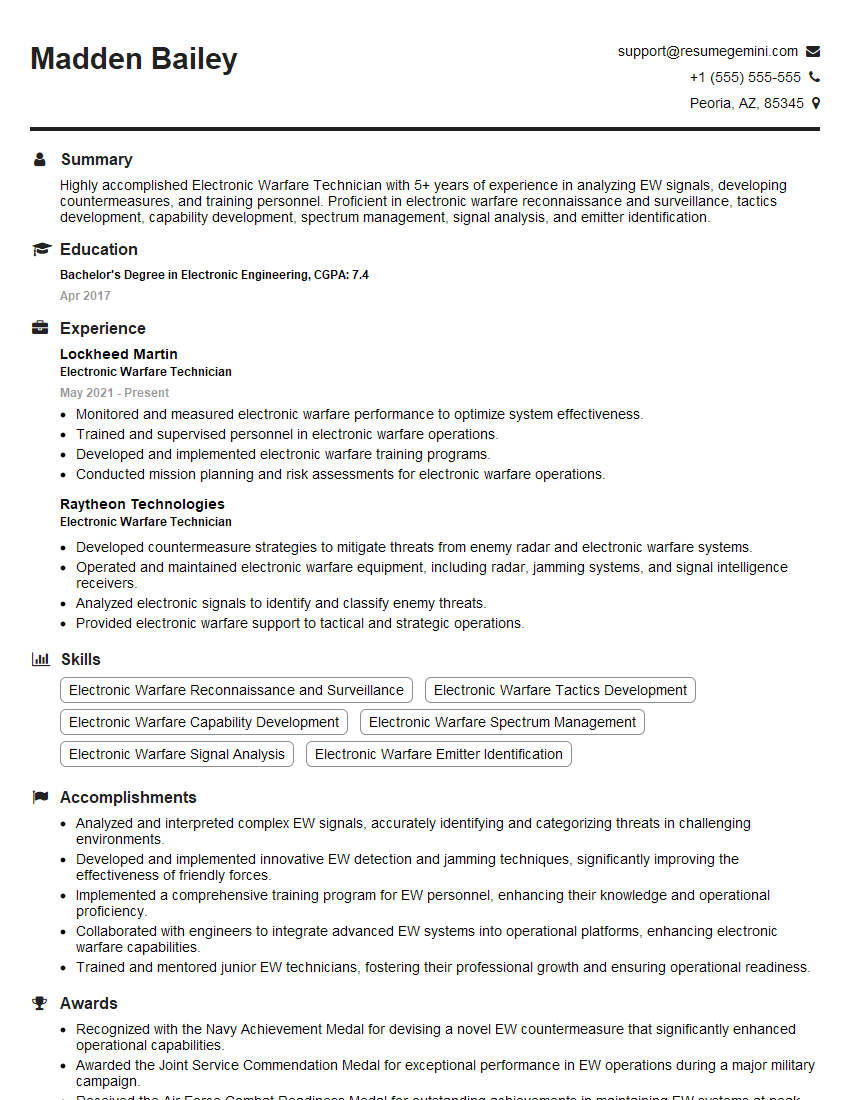
Mastering SIGINT/EW Equipment Maintenance opens doors to a rewarding and challenging career with significant growth potential. Advancement opportunities often involve specialization, project leadership, and increasingly complex system maintenance roles. To maximize your job prospects, creating an ATS-friendly resume is crucial. ResumeGemini is a trusted resource that can help you build a professional and impactful resume that highlights your skills and experience effectively. Examples of resumes tailored to SIGINT/EW Equipment Maintenance are available to help guide you.
Explore more articles
Users Rating of Our Blogs
Share Your Experience
We value your feedback! Please rate our content and share your thoughts (optional).
What Readers Say About Our Blog
Hello,
we currently offer a complimentary backlink and URL indexing test for search engine optimization professionals.
You can get complimentary indexing credits to test how link discovery works in practice.
No credit card is required and there is no recurring fee.
You can find details here:
https://wikipedia-backlinks.com/indexing/
Regards
NICE RESPONSE TO Q & A
hi
The aim of this message is regarding an unclaimed deposit of a deceased nationale that bears the same name as you. You are not relate to him as there are millions of people answering the names across around the world. But i will use my position to influence the release of the deposit to you for our mutual benefit.
Respond for full details and how to claim the deposit. This is 100% risk free. Send hello to my email id: [email protected]
Luka Chachibaialuka
Hey interviewgemini.com, just wanted to follow up on my last email.
We just launched Call the Monster, an parenting app that lets you summon friendly ‘monsters’ kids actually listen to.
We’re also running a giveaway for everyone who downloads the app. Since it’s brand new, there aren’t many users yet, which means you’ve got a much better chance of winning some great prizes.
You can check it out here: https://bit.ly/callamonsterapp
Or follow us on Instagram: https://www.instagram.com/callamonsterapp
Thanks,
Ryan
CEO – Call the Monster App
Hey interviewgemini.com, I saw your website and love your approach.
I just want this to look like spam email, but want to share something important to you. We just launched Call the Monster, a parenting app that lets you summon friendly ‘monsters’ kids actually listen to.
Parents are loving it for calming chaos before bedtime. Thought you might want to try it: https://bit.ly/callamonsterapp or just follow our fun monster lore on Instagram: https://www.instagram.com/callamonsterapp
Thanks,
Ryan
CEO – Call A Monster APP
To the interviewgemini.com Owner.
Dear interviewgemini.com Webmaster!
Hi interviewgemini.com Webmaster!
Dear interviewgemini.com Webmaster!
excellent
Hello,
We found issues with your domain’s email setup that may be sending your messages to spam or blocking them completely. InboxShield Mini shows you how to fix it in minutes — no tech skills required.
Scan your domain now for details: https://inboxshield-mini.com/
— Adam @ InboxShield Mini
Reply STOP to unsubscribe
Hi, are you owner of interviewgemini.com? What if I told you I could help you find extra time in your schedule, reconnect with leads you didn’t even realize you missed, and bring in more “I want to work with you” conversations, without increasing your ad spend or hiring a full-time employee?
All with a flexible, budget-friendly service that could easily pay for itself. Sounds good?
Would it be nice to jump on a quick 10-minute call so I can show you exactly how we make this work?
Best,
Hapei
Marketing Director
Hey, I know you’re the owner of interviewgemini.com. I’ll be quick.
Fundraising for your business is tough and time-consuming. We make it easier by guaranteeing two private investor meetings each month, for six months. No demos, no pitch events – just direct introductions to active investors matched to your startup.
If youR17;re raising, this could help you build real momentum. Want me to send more info?
Hi, I represent an SEO company that specialises in getting you AI citations and higher rankings on Google. I’d like to offer you a 100% free SEO audit for your website. Would you be interested?
Hi, I represent an SEO company that specialises in getting you AI citations and higher rankings on Google. I’d like to offer you a 100% free SEO audit for your website. Would you be interested?
good