Feeling uncertain about what to expect in your upcoming interview? We’ve got you covered! This blog highlights the most important Singing Lessons interview questions and provides actionable advice to help you stand out as the ideal candidate. Let’s pave the way for your success.
Questions Asked in Singing Lessons Interview
Q 1. Explain the different vocal registers (chest, head, mix).
Understanding vocal registers is crucial for singers. Think of your voice as having different sections, each with a unique tonal quality and comfortable range. We primarily discuss three: chest, head, and mix.
- Chest voice: This is your lower, more powerful register. Imagine the deep, resonant sound you use for speaking or singing low notes. It feels like the vibration is centered in your chest. For example, a baritone singing a low note in a song uses primarily their chest voice.
- Head voice: This is your higher, lighter register. The vibrations feel more concentrated in your head and mask. Think of the high notes a soprano might sing – light, airy, and less forceful. It’s the sound you might use to hum quietly.
- Mix voice: This is the blend of chest and head voice, bridging the gap between your lower and higher ranges. It’s the ideal sound for most singing, offering power and control across a wide range. Many professional singers use mix voice skillfully, preventing a noticeable break between registers. It takes practice to achieve a seamless transition.
A well-trained singer can smoothly transition between these registers, resulting in a consistent and expansive vocal range.
Q 2. Describe your teaching methodology for beginners.
My teaching methodology for beginners focuses on building a solid foundation. We start with the basics of posture, breathing, and vocal production. It’s like learning to walk before you run!
- Posture: Good posture allows for optimal breath support and reduces tension. We work on proper alignment – head up, shoulders relaxed, feet grounded.
- Breathing: Diaphragmatic breathing is key; I teach students to breathe deeply into their diaphragm, engaging their core muscles. This provides the air support needed for sustained notes and powerful phrasing.
- Vocal production: We start with simple vocal exercises to develop breath control, improve resonance, and develop a sense of pitch. We’ll begin with simple scales and warm-ups. We avoid pushing the voice before it is ready, focusing on healthy vocal habits from the very beginning.
- Listening and Ear Training: We’ll work on recognizing pitch, intervals, and rhythm – fundamental musical concepts that help the student connect with their instrument and sing in tune.
It’s crucial to create a relaxed and supportive learning environment. Success is a marathon, not a sprint, and early stages should focus on understanding fundamentals, not immediate high notes.
Q 3. How do you identify and correct vocal tension in students?
Identifying and correcting vocal tension is a vital part of my teaching. Tension manifests in various ways, including strained sounds, limited range, breathiness, and even pain.
- Observation: I carefully observe students’ physical posture and singing technique, looking for signs of tension in the neck, shoulders, jaw, and tongue.
- Listening: I listen for strained sounds, breathiness, and inconsistencies in tone. A tense voice often sounds thinner, harder, and lacks resonance.
- Palpation: Gently touching the student’s neck and throat can help identify areas of muscle tension. This requires a gentle touch and sensitive approach.
- Relaxation techniques: I teach students relaxation techniques such as deep breathing, progressive muscle relaxation, and gentle stretches to release tension. We’ll explore visualization to help the student relax their body and voice.
- Adjusting technique: We identify any vocal habits contributing to the tension and work together to adjust the student’s breathing, posture, and vocal production techniques. We focus on creating a free and open throat.
It’s an iterative process, requiring patience and a keen understanding of the student’s physical and emotional state. We celebrate small victories along the way to build confidence.
Q 4. What breathing techniques do you teach, and why?
I primarily teach diaphragmatic breathing, also known as abdominal breathing, because it’s the most efficient way to support singing. It’s different from the shallow chest breathing most people do.
- Diaphragmatic breathing: I guide students to breathe deeply into their diaphragm, expanding their abdomen and lower ribs. It’s like filling up a balloon in your belly rather than your chest. This provides a steady flow of air for singing, essential for controlling pitch, volume, and tone.
- Controlled Exhalation: Equally important is the controlled release of air. Students learn to manage the airflow, providing a constant stream of air for sustained notes. It’s about regulating the breath like a gentle stream, not a burst of air.
We practice these techniques through exercises such as sustained humming, breathing exercises in different positions, and even singing short phrases with breath control as the main focus. The goal is to make it natural and second-nature.
Q 5. How do you adapt your teaching style to different learning styles?
Adapting to different learning styles is crucial. I use a variety of methods:
- Visual learners: I use diagrams, videos, and demonstrations to illustrate vocal techniques. We use visual aids to represent concepts like breath support or resonance.
- Auditory learners: I incorporate listening exercises, feedback on pitch and tone, and a lot of singing. We use recordings for self-assessment and feedback.
- Kinesthetic learners: I emphasize hands-on exercises, physical adjustments, and tactile feedback. The student explores movement and feeling the breath support in their body.
- Combination of Styles: Of course, most learners have a combination of learning styles. I create personalized lesson plans that combine these approaches to ensure each student learns effectively.
Regular check-ins and open communication allow me to understand their progress and adjust my teaching methods accordingly. It’s about finding the key that unlocks their understanding.
Q 6. Explain the importance of vocal warm-ups.
Vocal warm-ups are essential for preparing the voice for singing. Think of it as stretching your muscles before exercise; you wouldn’t run a marathon without warming up!
- Preparing the Vocal Cords: Warm-ups gradually increase blood flow to the vocal cords, improving flexibility and reducing the risk of injury.
- Improving Range and Control: Exercises improve range and control by lubricating the vocal cords and enhancing the ability to coordinate breathing and vocal production.
- Increasing Vocal Agility: Warm-ups prepare the voice for dynamic changes in pitch, volume, and tone.
- Building Confidence: Starting with simple exercises builds confidence, reducing tension and anxiety.
Typical warm-ups include humming, lip trills, tongue trills, scales, and sirens. The specific exercises are tailored to the student’s needs and level, progressing in difficulty over time.
Q 7. How do you assess a student’s vocal range and capabilities?
Assessing a student’s vocal range and capabilities is a multi-step process. It’s not just about hitting the highest and lowest notes.
- Vocal Range: I start by having the student sing ascending and descending scales to determine their comfortable high and low notes. We’ll slowly explore the full range, noting any breaks or tensions in the voice.
- Vocal Tone: I listen for the quality of their voice – resonance, timbre, and clarity. This helps determine their strengths and areas for improvement.
- Breath Support: Assessing breath support helps evaluate their ability to sustain notes and control their volume. We’ll listen for consistency in airflow.
- Technique: I observe their posture, breathing technique, and use of the vocal apparatus, looking for signs of tension or inefficient habits. The entire technique contributes to range and capabilities.
- Musicality: While technically proficient, I also evaluate their musicality – their sense of pitch, rhythm, and phrasing. A singer needs technical skills but also expression.
This holistic approach allows me to create a personalized teaching plan tailored to their individual needs and goals.
Q 8. What are common vocal problems you encounter, and how do you address them?
Common vocal problems I encounter include tension in the neck and shoulders, breath support issues, improper posture, vocal strain leading to hoarseness, and inconsistent tone production. Addressing these requires a multi-faceted approach.
- Tension: I address tension through body awareness exercises, focusing on relaxation techniques like progressive muscle relaxation and mindful breathing. We might incorporate gentle stretches for the neck and shoulders.
- Breath Support: Weak breath support is tackled through diaphragmatic breathing exercises, visualization techniques, and exercises that strengthen the respiratory muscles. I often use analogies like blowing up a balloon to illustrate proper breath control.
- Posture: Correct posture is crucial. I guide students to stand tall with relaxed shoulders, ensuring proper alignment to optimize vocal resonance. We might use mirrors to visualize correct posture.
- Vocal Strain/Hoarseness: If vocal strain or hoarseness is present, I prioritize rest and hydration. We’ll reduce vocal load and might incorporate vocal rest days. In severe cases, I recommend consultation with a laryngologist.
- Inconsistent Tone: This is often addressed by focusing on vocal placement, resonance, and consistent airflow. We use vocal exercises that target specific areas like vowel modification and legato singing.
My approach is always individualized, adapting exercises and techniques to the student’s specific needs and vocal characteristics. It’s a collaborative process, regularly assessing progress and adjusting strategies as needed.
Q 9. Describe your approach to teaching sight-reading.
Sight-reading is a crucial skill for any singer. My approach is gradual and builds upon foundational skills. I start with simple melodies, focusing on rhythm and note recognition. We use solfege (do-re-mi) initially to connect notes to sounds before introducing notation.
- Rhythm Exercises: We start with rhythmic patterns using body percussion and clapping, gradually adding notes. This reinforces rhythmic understanding before tackling complex melodies.
- Interval Training: We practice identifying and singing intervals (distance between notes) – this helps students predict the next note based on the current one. Games and exercises make this engaging.
- Melodic Dictation: I’ll play simple melodies and have the student try to write them down, improving their ability to translate sound into notation.
- Gradual Increase in Complexity: We slowly increase the complexity of the music, introducing different time signatures and key signatures as the student progresses.
- Real-World Application: We incorporate sight-reading exercises with pieces of music the student enjoys, making the learning process more motivating.
Regular practice is key. I encourage daily sight-reading sessions, even if it’s only for a few minutes, to build fluency and confidence.
Q 10. How do you incorporate performance skills into your lessons?
Performance skills are integral to singing. My approach integrates performance elements throughout the lessons, not just at the end.
- Stage Presence: We work on posture, eye contact, and movement. We practice performing in front of a mirror to build confidence and assess their stage presence.
- Mic Technique: For students interested in performing with a microphone, we cover proper mic technique, including distance and breath control.
- Interpretation: I encourage students to explore the emotional content of the song, helping them to connect with the lyrics and communicate that emotion through their singing.
- Storytelling: We discuss the narrative of a song, exploring how to use vocal dynamics and phrasing to tell a compelling story.
- Feedback and Recording: I use video recordings and provide detailed feedback on their performance, focusing on both vocal technique and stage presence. This allows them to see their progress and identify areas for improvement.
Ultimately, the goal is to help them become comfortable and confident performers, able to connect with their audience authentically.
Q 11. What is your experience with different vocal styles (e.g., pop, classical, jazz)?
My experience spans various vocal styles, including pop, classical, and jazz. Each style requires a unique approach, but the fundamental principles of breath control, tone production, and resonance remain essential.
- Pop: In pop singing, I focus on vocal agility, stylistic expression, and a strong rhythmic foundation. We work on vocal riffs, runs, and contemporary vocal techniques.
- Classical: Classical training emphasizes breath control, accurate intonation, and clear diction. We practice vocal exercises that develop vocal range and power, often focusing on Italian vocal techniques.
- Jazz: Jazz singing demands improvisation, phrasing, and a strong understanding of harmony. We explore scat singing, improvisation exercises, and develop the ability to interpret musical phrasing.
My flexibility allows me to cater to diverse musical tastes and learning styles. I understand the nuances of each genre, ensuring that the student is given the appropriate tools and techniques to succeed within their chosen style.
Q 12. How do you handle students with performance anxiety?
Performance anxiety is a common issue. My approach is to create a safe and supportive learning environment. I work with students to understand the root causes of their anxiety.
- Gradual Exposure: We start with small performances, like singing for me in the lesson, slowly increasing the audience size as their confidence grows.
- Relaxation Techniques: We practice relaxation techniques like deep breathing, meditation, or visualization to manage anxiety during performances.
- Positive Self-Talk: We develop positive affirmations and challenge negative thoughts to promote self-confidence.
- Mental Rehearsal: We practice the performance mentally, visualizing a successful outcome, to build confidence and reduce fear.
- Performance Strategies: We discuss performance strategies such as focusing on the music and connecting with the audience rather than on their anxiety.
Building confidence is a process. Patience, encouragement, and a tailored approach to managing anxiety are essential for helping students overcome this challenge.
Q 13. How do you structure a typical singing lesson?
A typical singing lesson is structured to optimize learning and progress. Each lesson includes several key components.
- Warm-up: We begin with vocal warm-ups to prepare the vocal cords and body for singing. This usually includes breathing exercises, scales, and vocalizations.
- Technical Work: We work on specific vocal techniques such as breath support, resonance, and articulation. Exercises are tailored to the student’s current skill level and goals.
- Repertoire Work: We work on pieces the student is learning, focusing on interpretation, musicality, and technique.
- Performance Practice: We incorporate performance practice into every lesson, even if it’s just singing a short phrase. This helps build confidence and stage presence.
- Feedback and Goal Setting: I provide constructive feedback and we collaboratively set goals for the next lesson. This ensures consistent progress and keeps the student motivated.
The lesson structure is flexible and adapts based on the student’s individual needs and progress. I value creating a supportive and encouraging environment where students feel comfortable exploring their vocal abilities.
Q 14. What software or tools do you use to assist in teaching?
Several software and tools enhance my teaching.
- Recording Software: I use recording software (like Audacity or GarageBand) to record students’ singing, allowing for detailed analysis and feedback on their progress.
- Music Notation Software: Software like MuseScore or Sibelius helps me create tailored exercises and sheet music for my students.
- Online Platforms: I utilize platforms like Zoom or Skype for online lessons, ensuring seamless communication and a convenient learning experience for my students.
- Metronome Apps: Metronome apps on smartphones or computers are essential for rhythm practice and developing timing precision.
- Tuner Apps: Tuner apps provide immediate feedback on pitch accuracy, helping students develop good intonation skills.
These tools empower me to provide individualized instruction, track student progress effectively, and make the learning process more engaging and efficient.
Q 15. Explain the importance of vocal health and hygiene.
Vocal health is paramount for singers, akin to a finely tuned instrument needing careful maintenance. Neglecting it can lead to injury and hinder progress. Vocal hygiene encompasses practices that protect and enhance your voice.
Hydration: Drinking plenty of water throughout the day keeps your vocal cords lubricated, preventing dryness and strain. Think of it like oiling a machine for smooth operation.
Rest: Adequate sleep allows your vocal cords to repair themselves. Just as athletes need rest, your voice needs recovery time after strenuous use.
Proper Breathing Techniques: Learning diaphragmatic breathing supports healthy vocal production and prevents strain. It’s like building a strong foundation for your singing.
Avoiding Irritants: Smoking, excessive alcohol consumption, and exposure to pollutants severely damage vocal cords. These are like sandpaper to your voice.
Warm-ups and Cool-downs: Gentle vocal exercises prepare your voice for singing and help prevent injury. Think of this as stretching before and after a workout.
Career Expert Tips:
- Ace those interviews! Prepare effectively by reviewing the Top 50 Most Common Interview Questions on ResumeGemini.
- Navigate your job search with confidence! Explore a wide range of Career Tips on ResumeGemini. Learn about common challenges and recommendations to overcome them.
- Craft the perfect resume! Master the Art of Resume Writing with ResumeGemini’s guide. Showcase your unique qualifications and achievements effectively.
- Don’t miss out on holiday savings! Build your dream resume with ResumeGemini’s ATS optimized templates.
Q 16. How do you create a positive and supportive learning environment?
Creating a positive and supportive learning environment is crucial for student success. It’s about fostering a space where students feel comfortable taking risks, making mistakes, and celebrating progress. I achieve this through:
Building Rapport: I start by getting to know each student individually, understanding their musical background, goals, and learning styles. This allows me to tailor my teaching approach to their needs.
Positive Reinforcement: I focus on celebrating successes, both big and small, to build confidence. Every step forward is a win, regardless of size.
Constructive Feedback: I provide feedback that’s specific, actionable, and encouraging, avoiding judgmental language. It’s about guiding students towards improvement, not pointing out flaws.
Creating a Safe Space: My classroom is a judgment-free zone where students can experiment freely without fear of criticism. It’s crucial that they feel safe to explore their voices.
Encouraging Collaboration: When appropriate, I incorporate group activities to foster a sense of community and peer learning. This makes learning a shared experience.
Q 17. Describe your experience working with students of different ages.
I’ve had the pleasure of working with students spanning a wide age range, from young children to adults. Each age group presents unique challenges and rewards.
Children: With younger students, I employ playful methods and interactive games to keep them engaged and make learning fun. It’s about developing a love for music and building a solid foundation.
Teenagers: Teenagers often have specific musical interests and goals, which I incorporate into the lessons. Building their confidence is key, recognizing their individual preferences and pushing them to their potential.
Adults: Adult students often come with different levels of experience and a wide variety of goals. I adapt my teaching to meet their individual aspirations, whether it’s performing on stage or simply enjoying singing for personal fulfillment. A collaborative, respectful environment is paramount.
Adaptability is key. My teaching style is fluid and adapts to the individual needs and learning styles of each student, regardless of age.
Q 18. How do you assess student progress and provide feedback?
Assessing student progress is an ongoing process, not a single event. I use a multi-faceted approach:
Regular Check-ins: I have regular discussions with my students to assess their progress towards their goals, both musical and personal.
Audio/Video Recordings: Recordings provide tangible evidence of improvement over time. These are helpful tools for both the student and myself to track progress.
Performance Evaluations: I encourage students to perform regularly, whether it’s a simple song or a more complex piece. This is a fantastic opportunity to showcase their skills and identify areas for improvement.
Written Assessments: For students who would benefit, I might include quizzes or written exercises on music theory to complement their vocal development.
Feedback Sessions: Feedback is an integral part of the learning process. I offer constructive criticism, focusing on what’s working well and areas where improvement can be made. I do this in a supportive environment.
Q 19. What are your strategies for motivating students?
Motivation is key to success in any endeavor, and singing is no exception. My strategies include:
Setting Achievable Goals: I work with students to set realistic and attainable goals that build their confidence and maintain momentum. Small, consistent progress builds motivation over time.
Celebrating Achievements: I actively celebrate each student’s achievements, no matter how small. Positive reinforcement strengthens their commitment and self-belief.
Incorporating Student Interests: I integrate students’ musical tastes and preferences into the lessons to maintain engagement and excitement. This makes learning more enjoyable and relevant.
Providing Opportunities for Performance: Performing for an audience, whether it’s a friend, family member, or a larger group, is highly motivational and builds confidence.
Encouraging Self-Reflection: I encourage students to reflect on their progress and identify areas where they’ve grown. This self-awareness promotes intrinsic motivation.
Q 20. How do you address student’s individual goals and learning needs?
Every student is unique, with individual goals and learning needs. My approach is highly personalized. I begin by understanding what each student hopes to achieve through singing lessons, whether it’s improving their vocal technique, preparing for an audition, or simply enjoying the process of singing.
Needs Assessment: I conduct a thorough assessment of each student’s vocal abilities, musical background, and learning style. This informs my teaching approach.
Tailored Lesson Plans: Based on the needs assessment, I create customized lesson plans that address each student’s specific goals. The lesson plans are adaptable and change as the student progresses.
Differentiated Instruction: I utilize various teaching methods and materials to cater to different learning styles. Some students learn best through visual aids, others through auditory learning, and some respond well to kinesthetic methods.
Open Communication: I maintain open communication with my students and their parents (if applicable), regularly discussing their progress, challenges, and goals. This creates a collaborative partnership.
Q 21. What is your approach to teaching music theory relevant to singing?
Music theory is an essential component of vocal training, providing the theoretical framework for understanding how music works. However, I don’t approach it as a dry, academic subject. Instead, I integrate it organically into my lessons, making it relevant and practical to the student’s singing.
Rhythm and Meter: I teach basic rhythm and meter through vocal exercises and rhythmic games, making the concepts fun and engaging. It’s about understanding the pulse and feel of the music.
Melody and Intervals: I explain melodic construction and intervals using examples from songs that the student enjoys. Hearing and seeing the theoretical aspects in familiar songs helps learning.
Chord Progressions: I introduce basic chord progressions in a way that supports understanding vocal phrasing and harmony. It makes them appreciate the underlying structure.
Sight-reading: I encourage students to develop their sight-reading skills, which helps them understand how musical notation translates into sound. It adds an important skill to their capabilities.
Contextual Learning: I teach music theory within the context of actual songs, making it relevant and applicable. Theory becomes a tool rather than an abstract concept.
Q 22. Describe your experience with different vocal exercises.
My experience with vocal exercises spans a wide range, encompassing techniques from classical to contemporary styles. I utilize a holistic approach, tailoring exercises to each student’s specific needs and vocal type. This includes foundational exercises like breathing exercises (diaphragmatic breathing, rib cage expansion), warm-ups focusing on scales and arpeggios to develop range and flexibility (major, minor, chromatic scales), and resonance exercises to improve tone quality (humming, vowel modification). I also incorporate more advanced techniques such as siren exercises for vocal agility, vocal fry exercises (used cautiously and sparingly), and exercises targeting specific weaknesses like breath support or articulation. For example, I’ve worked with students who struggled with breath control, so we focused on sustained vowel sounds and exercises with gradually increasing phrases. Another student needed help with vibrato, so we implemented exercises gradually introducing the vibrato technique using scales and sustained notes.
- Breathing Exercises: Diaphragmatic breathing, rib cage expansion exercises.
- Warm-ups: Scales (major, minor, chromatic), arpeggios.
- Resonance Exercises: Humming, vowel modification, nasal resonance exercises.
- Agility Exercises: Siren exercises, trills.
- Articulation Exercises: Tongue twisters, consonant-vowel combinations.
Q 23. How do you maintain professional development in vocal pedagogy?
Maintaining professional development in vocal pedagogy is crucial. I actively participate in workshops and conferences focused on the latest research and teaching methodologies. I regularly attend seminars on vocal health, voice science, and different pedagogical approaches. I also stay updated on the latest research in voice science through journals and publications. Furthermore, I actively engage in peer-to-peer learning and mentorship programs with other vocal instructors. This continuous learning process ensures I am equipped with the most effective techniques and remain at the forefront of the field. For instance, I recently completed a workshop on the Alexander Technique, which profoundly impacted my understanding of posture and its relationship to vocal production. I now integrate these principles into my teaching to optimize student technique and prevent injury.
Q 24. What is your approach to dealing with vocal injuries or issues?
My approach to vocal injuries or issues is to prioritize prevention and early intervention. If a student experiences any vocal discomfort, we immediately halt the strenuous exercises and focus on gentle vocal rest. I always advise them to consult a medical professional (ENT doctor) for a proper diagnosis. Once the issue is identified, I collaborate closely with the physician to develop a rehabilitation plan. This plan typically involves modified vocal exercises, voice rest, and hydration strategies, tailored specifically to the nature and severity of the injury. For example, if a student has vocal nodules, the treatment involves a period of complete vocal rest, followed by very gentle humming exercises and careful progression toward speaking and singing. I emphasize the importance of proper vocal hygiene, including hydration, avoiding vocal strain, and healthy lifestyle choices.
Q 25. What is your understanding of the anatomy and physiology of the voice?
A strong understanding of the anatomy and physiology of the voice is fundamental to effective vocal pedagogy. This involves a detailed knowledge of the larynx (voice box), vocal cords, resonating chambers (pharynx, mouth, nasal cavity), and the respiratory system (lungs, diaphragm). I understand how air pressure, airflow, and vocal fold vibration interact to produce sound. I recognize the importance of proper breath support, efficient vocal cord closure, and resonance for optimal vocal health and performance. For example, I can explain how the different registers (chest voice, head voice, mixed voice) involve variations in vocal fold vibration and resonance patterns. This detailed understanding allows me to effectively address vocal issues, diagnose problems, and customize exercises to improve technique and efficiency.
Q 26. How do you manage lesson scheduling and administration?
I utilize a scheduling system that combines online booking software with a personal calendar. This allows students to easily schedule and manage their lessons. The online system sends automatic reminders and confirmations. I maintain a detailed record of lessons, student progress, and financial transactions. For administrative tasks like invoicing and communication, I employ dedicated software to ensure efficiency and professional organization. This structured approach allows for seamless scheduling and effective communication between me and the students.
Q 27. How do you communicate with parents or guardians (if applicable)?
Communication with parents or guardians is essential. I establish regular channels of communication, including email updates on student progress, and scheduled parent-teacher conferences. I believe in open and honest dialogue about the student’s achievements, challenges, and overall development. I tailor the communication style to the parents’ preferences, ensuring clarity and transparency. For example, if a student is struggling with a particular aspect of singing, I’ll proactively reach out to the parent to discuss the issue, outline strategies, and collaborate on a solution. I always aim for a collaborative relationship with the parents to ensure their child receives comprehensive vocal training.
Q 28. Describe your experience using technology to teach singing (e.g., online lessons)
My experience with technology in teaching singing, particularly online lessons, has been overwhelmingly positive. I utilize video conferencing platforms that provide high-quality audio and video for real-time feedback. I’ve found that screen sharing can be very useful for demonstrating exercises and techniques. I also incorporate recording features to allow students to review their performance and track their progress. This approach has broadened my reach and allowed me to work with students from various geographical locations. While some aspects of in-person teaching, such as direct physical touch and immediate observation, are challenging to replicate online, effective use of technology has minimized these limitations and ensured the delivery of a high-quality learning experience.
Key Topics to Learn for Singing Lessons Interview
- Vocal Technique: Understanding breath support, posture, resonance, and vocal production mechanisms. Practical application includes demonstrating proper breathing exercises and explaining how these techniques impact vocal health and tone.
- Music Theory Fundamentals: Knowledge of scales, intervals, chords, and basic music notation. Practical application includes sight-reading simple melodies and explaining how theoretical understanding informs vocal performance and interpretation.
- Pedagogical Approaches: Familiarizing yourself with different teaching methodologies, lesson planning, and adapting techniques for various learning styles and age groups. Practical application includes describing your preferred teaching style and how you would address a student’s specific challenges.
- Repertoire Selection & Application: Understanding how to select appropriate vocal pieces based on student skill level and goals. Practical application includes discussing criteria for choosing repertoire and explaining how you would tailor a lesson plan around specific musical selections.
- Student Assessment & Feedback: Developing strategies for evaluating student progress and providing constructive criticism. Practical application includes explaining how you would provide feedback on a student’s performance and identify areas for improvement.
- Vocal Health & Hygiene: Understanding vocal health issues, preventative measures, and strategies for managing vocal fatigue. Practical application includes discussing vocal warm-ups, cool-downs, and strategies for preventing vocal strain.
Next Steps
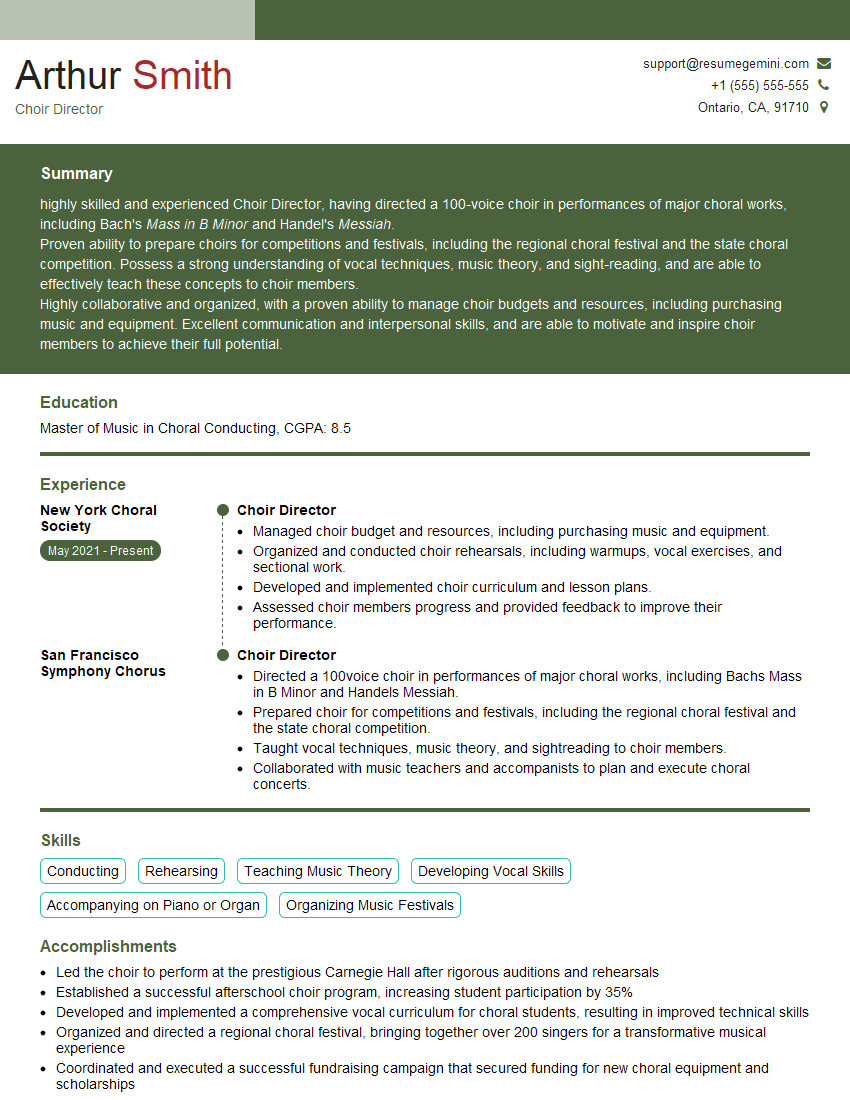
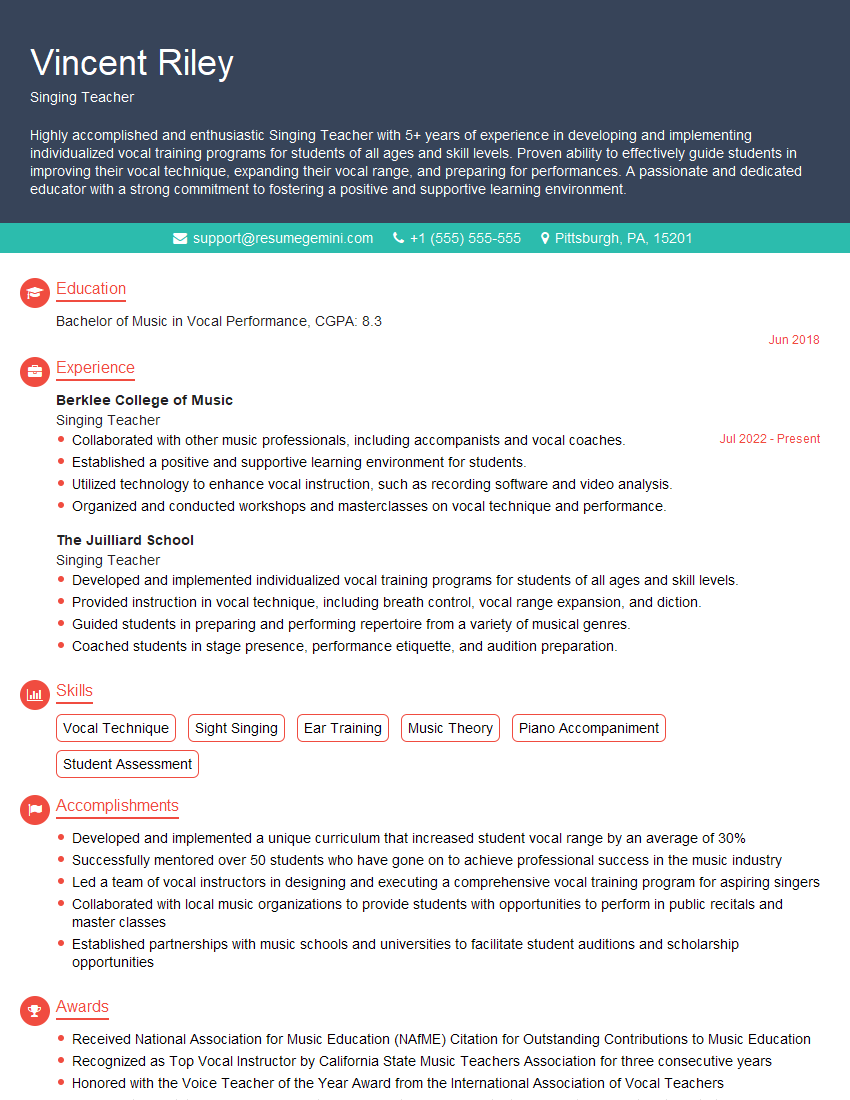
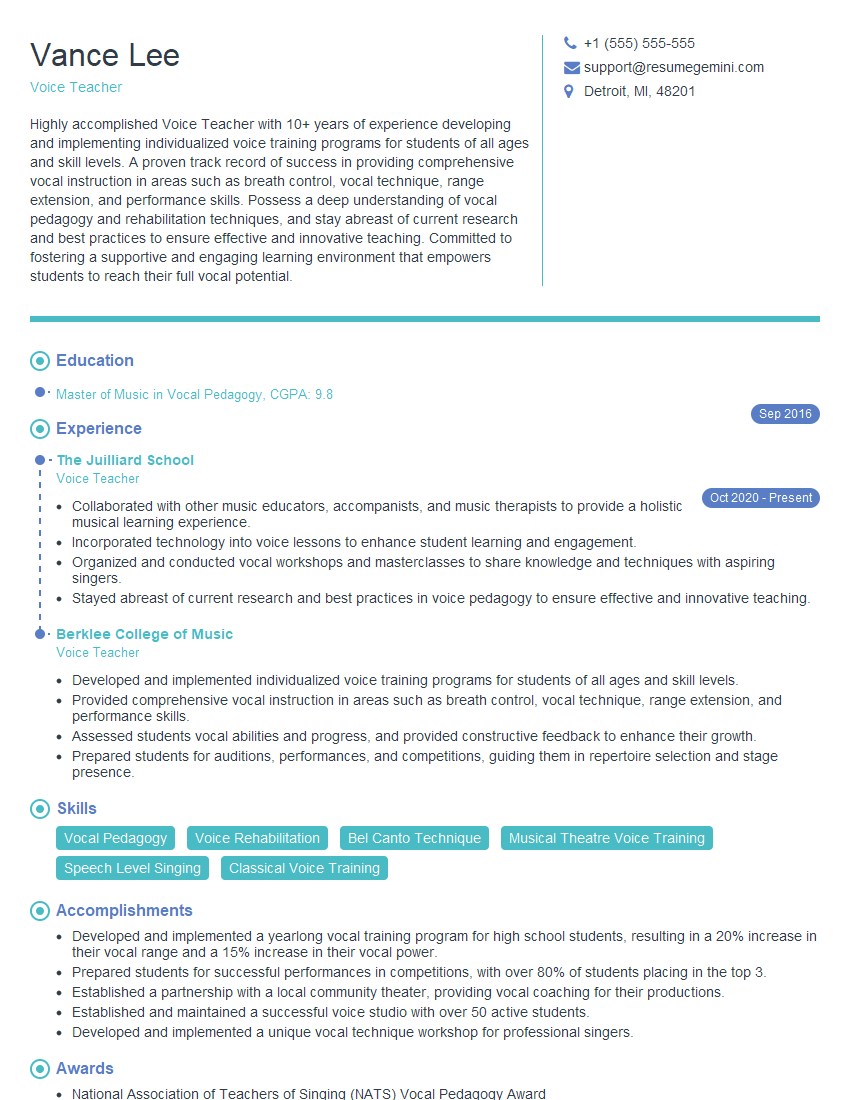
Mastering the art of singing instruction is crucial for a rewarding and successful career. A strong understanding of vocal technique, pedagogy, and music theory will set you apart from other candidates. To significantly improve your job prospects, create an ATS-friendly resume that highlights your skills and experience effectively. ResumeGemini is a trusted resource that can help you build a professional and impactful resume. We provide examples of resumes tailored to Singing Lessons to guide you in showcasing your unique qualifications. Take advantage of these resources to confidently present yourself to potential employers.
Explore more articles
Users Rating of Our Blogs
Share Your Experience
We value your feedback! Please rate our content and share your thoughts (optional).
What Readers Say About Our Blog
Very informative content, great job.
good