Unlock your full potential by mastering the most common Single Needle Machine Operation interview questions. This blog offers a deep dive into the critical topics, ensuring you’re not only prepared to answer but to excel. With these insights, you’ll approach your interview with clarity and confidence.
Questions Asked in Single Needle Machine Operation Interview
Q 1. What types of single needle sewing machines have you operated?
Throughout my career, I’ve operated a wide variety of single needle sewing machines, ranging from basic industrial models like the Juki DDL-8700 and Singer 14U134 to more specialized machines for heavy-duty fabrics such as the Consew 206RB-1 and those equipped with advanced features like automatic thread trimming and speed control. My experience encompasses machines used in diverse applications, including apparel manufacturing, upholstery, and leatherwork. Each machine has its unique strengths and nuances, and I’ve adapted my techniques to efficiently operate each one.
Q 2. Describe your experience with different needle types and their applications.
Needle selection is crucial for successful sewing. The type of needle dictates the outcome and affects the quality and durability of your work. I’ve worked with a range of needles, including:
- System needles (130/705 H): These are the workhorse needles, ideal for most fabrics and commonly used in industrial settings. I’ve used these extensively in apparel manufacturing.
- Ballpoint needles: These needles are designed for knit fabrics; their rounded tips prevent snagging or tearing. I’ve used these for sewing athletic wear and hosiery.
- Sharp needles: These needles are for woven fabrics, providing clean, precise stitches. They’re essential when sewing crisp lines or detailed work, such as tailoring or leather applications.
- Stretch needles: These needles are similar to ballpoint, but their shape is slightly different for even greater flexibility, perfect for very stretchy materials like Lycra.
- Leather needles: These heavy-duty needles are specifically designed for leather and other heavy-duty materials; their robust construction prevents bending or breakage.
The choice of needle depends heavily on the fabric type and desired stitch quality. Using the wrong needle can lead to skipped stitches, broken needles, or damage to the fabric.
Q 3. How do you troubleshoot common single needle machine malfunctions?
Troubleshooting single needle machines involves a systematic approach. My process begins with identifying the problem. For example:
- Skipped stitches: This could be due to incorrect threading, a bent or dull needle, improper tension, or lint build-up. I’d check each of these systematically.
- Broken needles: This points to issues with the needle plate, a faulty needle, or improper material handling. Inspecting for defects in the needle plate and selecting the right needle for the fabric is critical here.
- Uneven stitch length: This is usually an adjustment to the stitch length dial or could indicate a problem with the feed dogs.
- Machine jams: I’d inspect for obstructions in the bobbin case or the feed mechanism. This often involves careful removal of any thread or fabric pieces to restore smooth operation.
I always begin with the simplest solutions, like rethreading and checking the tension, before moving on to more complex mechanical checks. Regular maintenance significantly reduces the frequency of malfunctions.
Q 4. Explain the process of threading a single needle sewing machine.
Threading a single needle machine is a straightforward process but requires attention to detail. It typically involves these steps:
- Raise the presser foot and needle to their highest positions.
- Insert the bobbin (following the machine’s specific instructions for the type of bobbin it uses).
- Thread the needle from the spool, guiding the thread through the tension discs, and down to the take-up lever.
- Pass the thread around the various guides and then through the needle eye, making sure that the thread is not twisted.
- Pull a length of thread downwards to confirm that the thread path is clear.
- Slowly lower the needle and presser foot, ensuring the thread is not caught or tangled.
- Perform a test stitch to check for proper threading.
Incorrect threading is a common source of sewing machine problems, emphasizing the need for precision at each step.
Q 5. How do you adjust stitch length and width on a single needle machine?
Most single needle machines have dials or controls to adjust stitch length and width. The stitch length dial usually ranges from very short to very long stitches (measured in stitches per inch). Adjusting it modifies the distance between stitches. For example, a shorter stitch is ideal for curves and durability, while longer stitches are suitable for straight seams where speed is prioritized. Adjustments are typically made via a dial on the machine. Width, or zigzag stitch width, is determined by a different adjustment knob. This allows adjustment of the stitch oscillation for different patterns. Always consult your machine’s manual for specific instructions.
Q 6. What safety precautions do you follow when operating a single needle sewing machine?
Safety is paramount when operating any sewing machine. My practices include:
- Proper machine setup: Ensuring the machine is stable and the area around it is free of clutter.
- Hand protection: Keeping hands away from moving parts, especially the needle.
- Eye protection: Utilizing safety glasses to protect against flying debris or thread.
- Machine maintenance: Regular cleaning and lubrication to prevent malfunctions and potential hazards.
- Clothing awareness: Avoiding loose clothing that could get caught in the machine.
- Using correct tools: Using the appropriate screwdrivers and other tools when performing maintenance.
I’ve experienced minor injuries in the past, which reinforced the importance of these preventative safety measures, making safety an integral part of my workflow.
Q 7. How do you maintain and clean a single needle sewing machine?
Regular maintenance is crucial for extending the life and ensuring the smooth operation of a single needle sewing machine. My maintenance routine involves:
- Daily cleaning: Removing lint, thread scraps, and dust from the machine using a brush and compressed air. I’ll also inspect the needle and bobbin case.
- Lubrication: Applying appropriate sewing machine oil to designated lubrication points as recommended in the machine’s manual. This prevents friction and wear.
- Periodic inspection: Regularly checking for loose screws, broken or worn parts, and making minor adjustments as needed.
- Professional servicing: Undertaking professional servicing every 6 months or annually, depending on usage intensity. This involves a thorough cleaning, lubrication, and inspection by a qualified technician.
Preventive maintenance saves time and money in the long run by preventing costly repairs and ensuring consistent performance.
Q 8. Describe your experience with different sewing machine feet and their uses.
Different sewing machine feet are specialized tools that dramatically impact stitch quality and application. Think of them as attachments that tailor the machine to specific tasks. My experience encompasses a wide range, including:
- General-purpose foot: This is the workhorse, ideal for most straight stitching and zig-zag applications. It’s my go-to for everyday sewing.
- Zipper foot: Its narrow design allows for precise stitching close to the zipper teeth, crucial for clean, professional-looking zippers. I’ve used it extensively on various garment types.
- Buttonhole foot: This specialized foot guides the fabric consistently for perfect buttonholes every time. Mastering its use significantly improves efficiency and consistency. I’ve utilized many variations – automatic, manual, and those designed for specific buttonhole types.
- Walking foot: This is invaluable for sewing multiple layers of thick fabrics or tricky materials like leather or vinyl. It prevents slippage and ensures even feed, preventing puckering or stretching. I’ve relied on it heavily for upholstery and other multi-layered projects.
- Blind hem foot: This creates almost invisible hems, ideal for professional finishes on garments. I find it essential for achieving a clean, tailored look.
Selecting the correct foot is paramount. For instance, attempting to sew a zipper with a general-purpose foot will likely result in uneven stitching and a messy finish. The right foot dramatically improves both speed and quality.
Q 9. How do you identify and resolve tension issues on a single needle machine?
Tension issues manifest as uneven stitches, skipped stitches, or thread breakage. Diagnosing the problem requires a systematic approach. I first check the upper tension dial, making small adjustments until the tension is balanced. If this doesn’t resolve the issue, I move on to:
- Lower tension: This is often overlooked. Check the bobbin case for any obstructions or damage. Ensure the bobbin is properly wound and seated.
- Thread: Use the correct thread type and weight for the fabric. Damaged or frayed thread is a common culprit. Inspect the thread path, ensuring there are no knots or tangles.
- Needle: A bent or dull needle can disrupt stitch formation. Replace it immediately if any damage is apparent. Ensure the correct needle size for the fabric is used.
- Fabric type: Different fabrics require different tensions. A very tightly woven fabric will need slightly higher tension than a loosely woven one.
Troubleshooting is iterative; I systematically check each component until I isolate the root cause. It’s like solving a puzzle; each step brings you closer to the solution. Often, it’s a combination of factors, not just a single issue.
Q 10. What is your experience with different types of fabrics and their impact on sewing machine settings?
Fabric type significantly influences sewing machine settings. My experience spans a wide range of fabrics, and I adjust settings accordingly:
- Lightweight fabrics (silk, chiffon): Require a finer needle (size 60/8), lower stitch length, and moderate tension to prevent breakage.
- Medium-weight fabrics (cotton, linen): Adapt to a slightly larger needle (size 70/10), slightly longer stitch length, and adjust tension as needed.
- Heavyweight fabrics (denim, canvas): Need a heavier needle (size 90/14 or larger), longer stitch length, and potentially higher tension, especially with multiple layers.
- Stretch fabrics (knit, jersey): These necessitate a ballpoint needle to prevent snagging and often require a stretch stitch. The tension needs to be carefully balanced to accommodate the stretch.
For example, sewing silk with settings appropriate for denim would result in a ruined fabric. Understanding fabric characteristics is fundamental to achieving quality results.
Q 11. How do you ensure consistent stitch quality across various fabrics?
Consistent stitch quality across diverse fabrics relies on a holistic approach, not just adjustments to individual machine settings. It’s a combination of meticulous preparation and precise operation. The key steps involve:
- Proper needle selection: Choosing the right needle size and type for the fabric is paramount. A dull or wrong needle will result in inconsistencies.
- Correct tension: Balancing upper and lower tension is crucial. A tension gauge can be helpful for fine-tuning.
- Appropriate stitch length: The stitch length should complement the fabric weight and design. Shorter stitches are better for curves and areas that need extra strength.
- Consistent speed: Maintain a steady sewing speed to avoid variations in stitch formation. Avoid rushing.
- Regular maintenance: Cleaning, oiling, and checking the machine’s components regularly will prevent unexpected issues and ensure smooth operation.
Think of it like baking a cake: Following the recipe exactly, using the right ingredients, and consistent baking technique will result in a perfect cake every time. Sewing requires a similar attention to detail.
Q 12. Describe your experience with high-speed single needle sewing machines.
High-speed single-needle machines demand precision and experience. I’ve worked extensively with these machines, understanding their unique characteristics. The speed requires increased focus on:
- Precise thread feeding: The higher speed necessitates a perfectly smooth and continuous thread supply to prevent breakage.
- Consistent fabric feeding: Maintaining a steady feed rate is essential to avoid puckering or missed stitches.
- Lubrication and maintenance: These machines require more frequent lubrication and maintenance to operate optimally.
Working with high-speed machines is like driving a high-performance car—it demands greater skill and precision but rewards you with significantly increased productivity and efficiency.
Q 13. How do you handle needle breakage during operation?
Needle breakage is a common occurrence, often caused by a dull needle, improper needle size for the fabric, hitting a pin or other obstruction, or high sewing speeds. My immediate actions are:
- Safety first: Always turn off the machine before attempting any repairs.
- Inspect the needle bar: Check for any obstructions or damage.
- Replace the needle: Install a new needle of the correct type and size for the fabric being used.
- Check the fabric: Examine the fabric for any hidden objects, like pins or staples, that may have caused the breakage.
- Inspect thread: Ensure there are no knots or excessive tension in the thread.
Preventing needle breakage involves regular needle inspections and proper maintenance—a small investment that saves significant downtime.
Q 14. How do you deal with thread breakage during operation?
Thread breakage, much like needle breakage, has several possible causes. My troubleshooting process starts with:
- Tension: Check both the upper and lower thread tensions. Imbalanced tension is a major cause of thread breakage.
- Thread quality: Ensure the thread is of good quality and appropriate for the fabric. Damaged or old thread is more prone to breakage.
- Thread path: Inspect the entire thread path for any snags, tangles, or obstructions. Clear any debris or knots.
- Needle condition: A bent or dull needle can also cause thread breakage. Replace it with a new needle if necessary.
- Fabric type: Some fabrics are more prone to causing thread breakage. This might require an adjustment to the needle or tension.
Addressing thread breakage requires a systematic review, starting from the simplest potential causes to the more intricate ones. Prevention is always best – keeping the machine clean and using high-quality thread minimizes the risks.
Q 15. What is your experience with different types of seams?
My experience encompasses a wide range of seams crucial in garment construction. I’m proficient in creating various types, each suited for specific fabrics and garment styles. For instance, a simple straight stitch is ideal for lightweight fabrics, offering durability and clean aesthetics. A more complex seam, like a French seam, is perfect for finer fabrics, creating a neat, invisible finish. I’m also experienced with felled seams for durable outerwear, flat felled seams for added strength and a professional look, and decorative seams to add visual appeal.
- Straight Stitch: Used extensively for basic seams, offering strength and simplicity.
- Zigzag Stitch: Primarily for preventing fraying on edges and adding stretch to seams.
- French Seam: Encases raw edges completely, giving a high-quality finish, best for delicate fabrics.
- Felled Seam: Highly durable, best for workwear or outdoor clothing. One seam allowance is wrapped over the other and stitched down.
- Flat Felled Seam: Very strong and neat; commonly used in high-end shirts and jeans.
Choosing the appropriate seam is critical to the garment’s overall quality and longevity. My selection depends on the fabric type, the garment’s intended use, and the desired aesthetic.
Career Expert Tips:
- Ace those interviews! Prepare effectively by reviewing the Top 50 Most Common Interview Questions on ResumeGemini.
- Navigate your job search with confidence! Explore a wide range of Career Tips on ResumeGemini. Learn about common challenges and recommendations to overcome them.
- Craft the perfect resume! Master the Art of Resume Writing with ResumeGemini’s guide. Showcase your unique qualifications and achievements effectively.
- Don’t miss out on holiday savings! Build your dream resume with ResumeGemini’s ATS optimized templates.
Q 16. How do you calculate production rates on a single needle sewing machine?
Calculating production rates on a single-needle machine involves several factors. First, I need to determine the standard time it takes to complete one unit of production (e.g., one shirt). This includes the time needed for stitching, turning, pressing, and any other process steps. For example, I might time myself sewing a sample shirt, averaging the time taken per operation.
Then, we account for machine downtime, like thread changes, machine adjustments, and short breaks. Let’s say my average time per shirt is 10 minutes. However, I know from experience I’ll need about 1 minute for every two shirts for breaks and thread changes. This impacts the overall calculation. We’ll estimate a 5% downtime, in this case.
Finally, to calculate the daily production rate, we consider the total available working hours. Assuming an 8-hour workday (480 minutes), we can estimate the number of units I can complete.
Calculation Example:
Production time per unit = 10 minutes
Downtime per two units = 1 minute; equivalent to 5% downtime for every shirt.
Effective production time per unit = 10 minutes + (10 minutes * 0.05) = 10.5 minutes
Total available time in an 8-hour workday = 480 minutes
Estimated daily production = 480 minutes / 10.5 minutes/unit ≈ 45.7 units
Therefore, I can produce approximately 46 shirts per day. Note that this is just an estimate and can vary based on the complexity of the item being sewn.
Q 17. How do you maintain consistent speed and accuracy while operating a single needle machine?
Maintaining consistent speed and accuracy on a single-needle machine requires a combination of skill, practice, and proper machine setup. Consistent speed is achieved through steady hand-eye coordination and proper foot control. I focus on a rhythmic flow, avoiding jerky motions that can lead to inconsistent stitches. Practicing consistently helps achieve this muscle memory.
Accuracy hinges on precise needle placement, appropriate stitch length, and maintaining consistent tension. Regularly checking the stitch quality prevents problems from accumulating. I use tension adjustment tools to ensure uniform stitching. The fabric is fed evenly, and I pay close attention to avoid puckering or stretching.
Before starting, I make sure the machine is properly set up. The needle is correctly positioned in relation to the feed dogs, and the stitch length is adjusted to the correct specifications. My years of experience help me adapt quickly to various projects and materials, maintaining speed and accuracy without compromising quality.
Q 18. Describe your experience with using different types of sewing machine oil.
My experience includes using a variety of sewing machine oils, each with specific properties and applications. High-quality, lightweight oils are preferable for single-needle machines to ensure smooth operation and prevent gumming. I’ve used both general-purpose sewing machine oils and specialized oils for different machine parts, like those specifically formulated for high-speed operation or those designed for older machines.
The key is to use the right oil in the right amount. Over-lubrication can lead to oil buildup and attract dust and lint, potentially causing damage. Under-lubrication leads to friction and accelerated wear. I always follow the manufacturer’s recommendations for the specific machine model and consult with technicians when selecting and using new oils. Checking the oil level regularly and wiping away any excess oil are integral parts of my routine maintenance.
Q 19. What is your understanding of different sewing machine lubrication techniques?
Proper lubrication is vital for the longevity and smooth operation of a single-needle sewing machine. My understanding of lubrication techniques involves using the correct type of oil and applying it strategically. I use a high-quality sewing machine oil and a small oiler bottle, ensuring only a drop or two is applied to the appropriate areas.
I follow the machine’s manual for specific lubrication points, such as the hook, shuttle, and bobbin case. I avoid over-lubrication to prevent oil build-up. Regularly, I also clean the machine, removing lint and dust particles to maintain lubrication effectiveness. Using the right tools and proper cleaning, I ensure even oil distribution, minimizing friction and extending the machine’s life. The process includes regularly wiping away any excess oil to keep the machine clean and functional.
Q 20. How do you handle large orders and meet deadlines?
Handling large orders and meeting deadlines requires meticulous planning and efficient execution. First, I thoroughly review the order details, identifying potential challenges and developing a detailed production plan. This includes assessing the number of units, the required materials, and potential bottlenecks.
I prioritize tasks based on urgency and complexity, using techniques like timeboxing to ensure efficient workload management. I might divide large orders into smaller, manageable batches. Communication is key; I maintain open lines with management, keeping them informed of progress and flagging potential issues early on. If necessary, I collaborate with colleagues or request additional resources to stay on schedule. I’m also very adept at prioritizing tasks and managing my time to optimize production, thereby ensuring deadlines are consistently met.
Q 21. What are your preferred methods for quality control in sewing?
My preferred quality control methods involve a multi-stage approach, beginning with inspecting the materials before sewing. During the sewing process, I maintain consistent quality checks at regular intervals, ensuring the stitch quality is uniform and the seams are correctly aligned. I check for any inconsistencies like skipped stitches or thread breaks.
Once a batch of garments is completed, I conduct a final inspection of each piece, ensuring it meets the required standards. This includes checking for any flaws, misalignments, or inconsistencies. I also look at the overall finish and neatness of the seams. Any rejected garments are set aside for rectification or further assessment. Documentation of quality checks and any identified issues is maintained throughout the process. This meticulous approach helps guarantee the high quality of the final products.
Q 22. How familiar are you with different sewing machine parts and their functions?
My familiarity with single-needle machine parts is extensive. I understand not just their names but their intricate functions and interrelationships. For instance, I know the critical role of the needle clamp screw in preventing needle breakage, or how the tension discs regulate the upper thread tension, impacting stitch quality and preventing skipped stitches or thread breakage.
- Needle: The heart of the operation, piercing the fabric and creating the stitch. Different needle types (e.g., ballpoint, sharp) are chosen depending on the fabric.
- Feed Dogs: These teeth move the fabric consistently under the needle, crucial for even stitching. I know how to adjust their height for different fabric thicknesses.
- Presser Foot: Holds the fabric firmly in place during stitching. I understand the importance of selecting the correct presser foot for various applications, such as zippers or buttons.
- Stitch Length Regulator: Controls the distance between stitches, allowing adjustments for different stitch densities and aesthetics.
- Bobbin and Bobbin Case: The lower thread delivery system; I am adept at winding bobbins correctly and troubleshooting bobbin-related issues.
- Tension Controls (Upper and Lower): These finely tuned mechanisms balance the upper and lower thread tensions to create a balanced stitch. I can accurately diagnose and adjust imbalances.
Understanding each part allows me to proactively maintain the machine and troubleshoot effectively, minimizing downtime and maximizing productivity.
Q 23. Explain your problem-solving approach when facing machine malfunctions.
My problem-solving approach is systematic and methodical. I follow a structured process, beginning with careful observation and listening. I’ll first assess the issue: Is the machine making unusual noises? Are the stitches uneven or breaking? Is the thread tangled?
- Identify the Problem: Precisely define the malfunction. Is it a mechanical issue (broken part), a thread issue (incorrect tension), or a fabric issue (incorrect fabric type)?
- Gather Information: What were the conditions before the malfunction occurred? What type of fabric was being used?
- Investigate: I systematically check each component, starting from the most likely cause. For instance, if there’s a skipped stitch, I’d check the needle, thread tension, and bobbin tension first.
- Test and Adjust: Based on my investigation, I’ll make adjustments. If the problem persists, I may consult the machine’s manual or seek advice from experienced colleagues.
- Implement Solutions: Once I find the cause, I’ll implement the necessary repairs or adjustments.
- Document Findings: For recurring issues, I maintain records to learn from past mistakes and enhance preventative maintenance.
For example, if stitches are inconsistent, I might systematically check and adjust the needle, thread tension, presser foot pressure, and feed dog height, eliminating each possibility until I find the source. This systematic approach ensures rapid and effective troubleshooting.
Q 24. Describe your experience with working in a team environment.
I thrive in team environments. In my previous role, I was part of a team responsible for meeting daily production quotas. We collaborated closely, supporting each other when facing challenges. For example, one colleague had expertise in advanced stitching techniques that I learned from; in return, I helped others with troubleshooting machine issues.
Effective communication and mutual respect are crucial for successful teamwork. I am always willing to share my knowledge and learn from others, fostering a collaborative atmosphere that contributes to overall team productivity and a positive work environment. We often worked together to identify bottlenecks and optimize our workflow to ensure timely delivery of quality products.
Q 25. How do you adapt to changes in production requirements?
Adapting to changing production requirements is a fundamental aspect of my role. I am comfortable working with diverse fabrics and stitch patterns, and readily adjust my speed and technique to meet production targets and deadlines.
For example, if a rush order requires a different stitch type or fabric, I can quickly adapt by consulting the relevant specifications, adjusting machine settings, and selecting appropriate needles and presser feet. I am also proficient in reading and interpreting work orders and understanding production schedules. I am not afraid to ask clarifying questions to ensure a complete understanding of the task before starting.
Q 26. What are your strengths and weaknesses as a single needle sewing machine operator?
My strengths include my meticulous attention to detail, my ability to troubleshoot effectively, and my consistent output of high-quality work. I am also a quick learner and eager to adapt to new challenges. I am proud of my ability to maintain a high level of precision even under pressure.
My weakness, if I had to identify one, would be a tendency to be overly perfectionistic, which can sometimes slow down my work. I am actively working on balancing my attention to detail with maintaining efficient productivity. I’m actively implementing time management strategies to improve this aspect of my work.
Q 27. What are your salary expectations?
My salary expectations are in line with the industry standard for experienced single-needle machine operators with my skills and experience. I am open to discussing this further based on the specific details of the role and the company’s compensation structure.
Q 28. Do you have any questions for me?
Yes, I have a few questions. I’d be interested in learning more about the specific types of sewing projects this role will involve, the company’s training and development opportunities, and the team I would be working with. Understanding the daily workflow and expected production targets would also be helpful. Finally, could you tell me about the company’s commitment to safety and the measures in place to prevent workplace injuries?
Key Topics to Learn for Single Needle Machine Operation Interview
- Machine Setup and Operation: Understanding the different components of a single needle machine, including the needle, thread, bobbin, tension, and stitch length. Knowing how to properly thread the machine, adjust tension, and select the appropriate stitch type for different fabrics.
- Fabric Handling and Feeding: Mastering techniques for smoothly feeding fabric through the machine, minimizing wrinkles and ensuring consistent stitch quality. Understanding how different fabric types require varied approaches.
- Troubleshooting Common Issues: Identifying and resolving common problems such as broken needles, thread jams, skipped stitches, and inconsistent stitch length. Knowing preventative maintenance procedures.
- Safety Procedures: Understanding and adhering to all safety regulations and best practices related to operating sewing machinery. This includes proper machine maintenance, handling of sharp objects, and emergency procedures.
- Seam Types and Applications: Familiarity with various seam types (e.g., straight stitch, zigzag stitch) and their appropriate applications in garment construction. Understanding the impact of stitch type on seam strength and durability.
- Quality Control and Inspection: Recognizing and addressing defects in stitching, such as uneven stitches, puckering, and broken threads. Understanding quality control standards and how to meet them consistently.
- Production Efficiency and Speed: Optimizing sewing speed while maintaining high-quality results. Understanding techniques for improving efficiency and minimizing downtime.
Next Steps
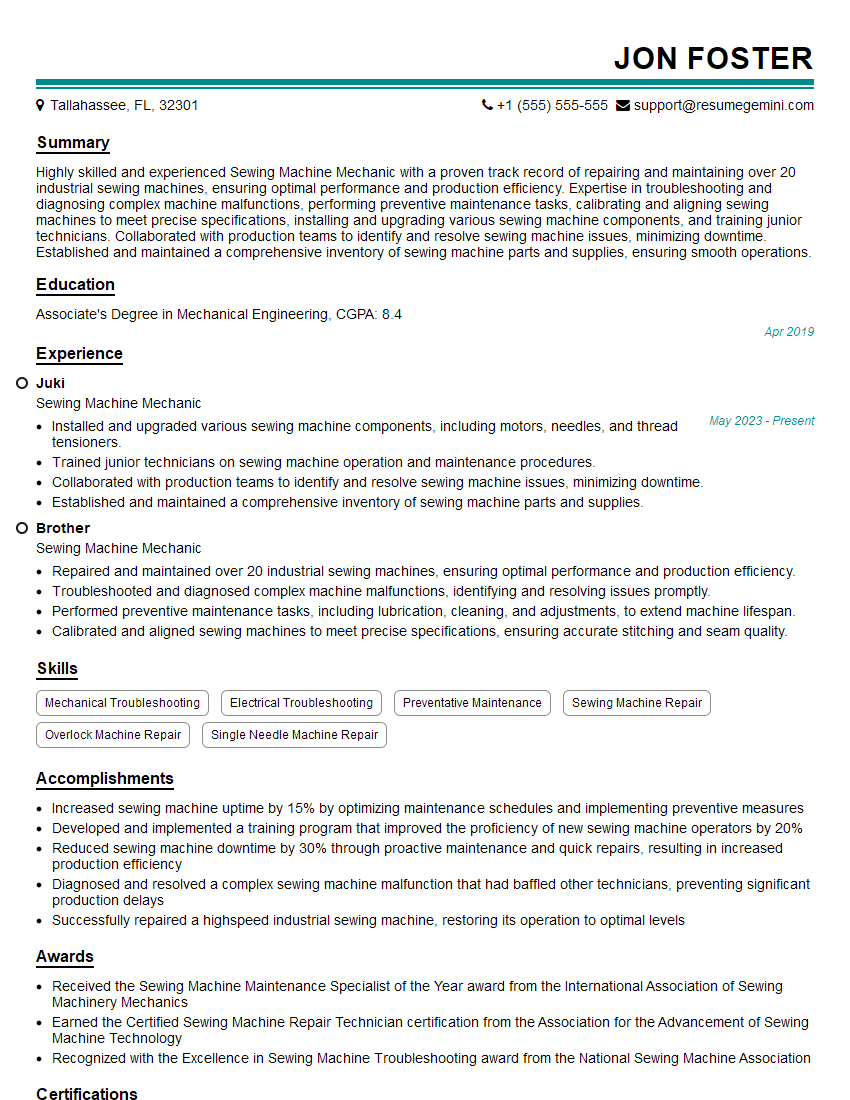
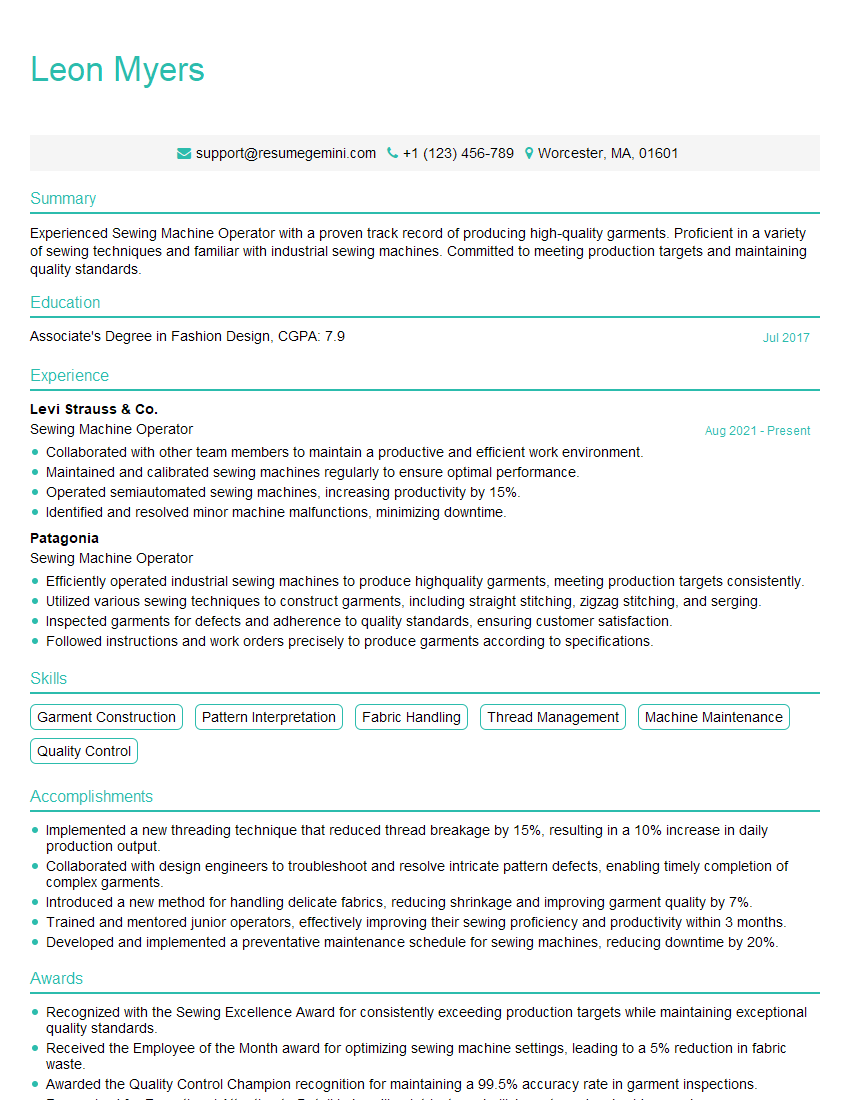
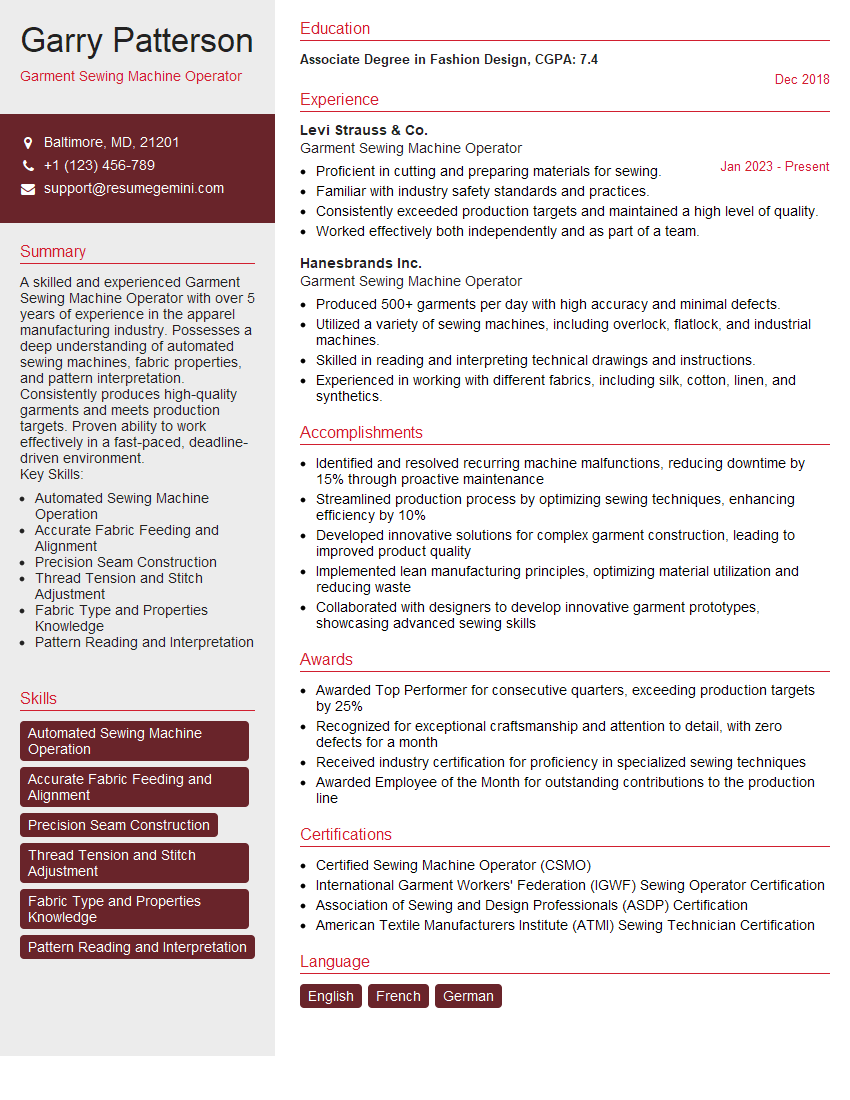
Mastering single needle machine operation is crucial for a successful and rewarding career in the sewing and garment industry. It opens doors to diverse roles with increasing responsibility and earning potential. To maximize your job prospects, it’s vital to create a professional and ATS-friendly resume that highlights your skills and experience effectively. ResumeGemini is a trusted resource that can help you build a compelling resume showcasing your expertise in single needle machine operation. Examples of resumes tailored to this specific skillset are available within ResumeGemini to guide you.
Explore more articles
Users Rating of Our Blogs
Share Your Experience
We value your feedback! Please rate our content and share your thoughts (optional).
What Readers Say About Our Blog
Very informative content, great job.
good