Feeling uncertain about what to expect in your upcoming interview? We’ve got you covered! This blog highlights the most important Ski Patrol interview questions and provides actionable advice to help you stand out as the ideal candidate. Let’s pave the way for your success.
Questions Asked in Ski Patrol Interview
Q 1. Describe your experience with avalanche rescue techniques.
Avalanche rescue is a critical aspect of ski patrol, demanding proficiency in a sequence of coordinated actions. It begins with probing the snowpack to locate the victim, followed by shoveling to expose the victim. The entire process requires speed and precision, as time is of the essence. My experience encompasses numerous scenarios, from single-victim rescues to large-scale operations involving multiple victims and challenging terrain. I’m proficient in various search strategies, including systematic probing patterns and the use of companion rescue devices. For example, during a recent training exercise, we simulated a multi-victim scenario buried under significant snow. The exercise honed our teamwork and reinforced the importance of systematic searching and efficient excavation techniques.
Beyond the physical techniques, a crucial element is efficient communication. Clear and concise communication is necessary between rescue team members to effectively coordinate the search and rescue efforts. We often practice using hand signals to minimize verbal communication in loud, chaotic scenarios.
Q 2. Explain your proficiency in using avalanche safety equipment (beacon, probe, shovel).
My proficiency with avalanche safety equipment – beacons, probes, and shovels – is a product of years of rigorous training and real-world experience. I am certified in the use of all three, and I regularly participate in refresher courses to maintain my skills. I understand the nuances of each piece of equipment and can quickly diagnose and resolve any technical issues that might arise in the field. For instance, knowing how to optimize beacon search patterns significantly reduces search time, particularly in the case of multiple burials. Proper probe technique, using both systematic and targeted probing strategies, is essential for accurately locating buried victims. Finally, efficient shoveling techniques are crucial for rapid excavation while minimizing the risk of further avalanche triggering.
I am familiar with the different models of beacons on the market and understand their limitations and strengths. I know how to effectively use beacon practice searches and understand the importance of regularly testing beacons for functionality and proper operation. I am skilled in using the shovel and probe for creating efficient rescue routes, ensuring minimum disruption of the snowpack.
Q 3. What are the different types of ski injuries you’ve encountered and treated?
Over the years, I’ve encountered a wide range of ski injuries, from minor sprains and bruises to severe fractures and head trauma. Common injuries include:
- Lower extremity injuries: Knee injuries (ACL tears, meniscus tears), ankle sprains, fractures of the tibia and fibula.
- Upper extremity injuries: Colles fractures (wrist fractures), shoulder dislocations, clavicle fractures.
- Head injuries: Concussions, skull fractures.
- Spine injuries: A particularly serious concern, requiring immediate and specialized care.
- Soft tissue injuries: Sprains, strains, lacerations.
The severity of these injuries varies depending on the mechanism of injury and the impact force. My training allows me to rapidly assess the situation, provide immediate first aid, and effectively communicate the patient’s condition to emergency medical services.
Q 4. How would you handle a multiple-casualty incident on the mountain?
Handling a multiple-casualty incident requires a structured approach based on the principles of triage and mass casualty management. This necessitates a swift assessment of injuries followed by prioritization of care based on severity.
My approach includes:
- Scene safety: Securing the area, ensuring the safety of rescuers and victims.
- Triage: Rapid assessment of injuries to prioritize patients based on the severity of their injuries (using methods like START or JumpSTART triage).
- Resource allocation: Effectively utilizing available personnel and equipment to maximize efficiency.
- Communication: Maintaining clear and concise communication with emergency medical services and other responders.
- Evacuation planning: Determining the safest and most efficient method of transporting patients to a location where they can receive further medical care.
The key is efficient organization and teamwork, and the ability to delegate tasks effectively while maintaining a clear overview of the situation. A practical example would be a large-scale avalanche where we might use a command system to delegate tasks effectively, and the appropriate use of communication devices to contact medical services.
Q 5. Outline your procedure for assessing and stabilizing a spinal injury on a slope.
Assessing and stabilizing a spinal injury on a slope demands immediate attention and careful technique. The priority is to minimize further injury and ensure patient safety during transport. My procedure involves:
- Initial assessment: Rapidly assessing the patient’s airway, breathing, and circulation (ABCs). Check for responsiveness and signs of spinal injury, such as pain, tenderness, or deformity.
- Manual stabilization: Gently immobilizing the patient’s head and neck, maintaining neutral alignment.
- Cervical collar application: Applying a cervical collar to provide further support and stability.
- Long spine board immobilization: Carefully and safely log-rolling the patient onto a long spine board, ensuring the head, neck, and spine remain aligned.
- Secure patient to board: Securing the patient firmly using straps and padding.
- Evacuation: Carefully transporting the patient down the slope using an appropriate method (e.g., toboggan, litter).
Every step requires careful coordination and awareness of the patient’s condition and the surrounding terrain. The process requires a calm and deliberate approach to minimize further injury and prevent complications during transport.
Q 6. Explain your understanding of different snowpack layers and avalanche formation.
Understanding snowpack layers and avalanche formation is fundamental to avalanche safety. Snowpack is stratified, consisting of various layers with different densities, grain sizes, and bond strengths. Weak layers within the snowpack, often formed by changes in temperature, precipitation, or wind, can create unstable conditions. An avalanche occurs when the forces exerted on a weak layer exceed its strength, causing it to fail.
I am familiar with different snowpack analysis techniques, including snow profile assessment which helps determine the presence of weak layers and their potential to initiate an avalanche. The process includes digging a snow pit, closely examining the various layers and performing tests to assess their stability. Identifying persistent weak layers, such as depth hoar or buried surface hoar, is critical. Understanding the relationship between weather patterns and snowpack evolution is vital for predicting avalanche risk and implementing appropriate mitigation measures. For example, a warm spell followed by a snowfall can create a weak layer of surface hoar, that might later trigger an avalanche.
Q 7. Describe your experience with wilderness first aid and emergency medical care.
My wilderness first aid and emergency medical care experience is extensive, encompassing both formal training and real-world application. I hold a Wilderness First Responder (WFR) certification, and I regularly refresh my skills. My experience goes beyond typical first aid; I’m competent in managing various traumatic injuries, including fractures, dislocations, and head injuries, in remote settings. I am proficient in using various rescue techniques, such as splinting and immobilization. In addition to trauma care, I have significant experience in managing hypothermia, altitude sickness, and other environmental emergencies.
My understanding extends to the limitations of wilderness medicine and the critical importance of rapid evacuation when necessary. I am adept at prioritizing patient care, effectively communicating with emergency services, and making sound judgment calls in challenging and rapidly evolving circumstances. One instance that solidified my understanding of the limitations of wilderness medicine was a high-altitude rescue where the patient’s condition rapidly deteriorated due to altitude-related complications. This experience reinforced the need for rapid evacuation in such situations.
Q 8. How would you communicate effectively with injured skiers and bystanders in a stressful situation?
Effective communication in a stressful ski patrol situation hinges on calm, clear, and concise messaging. With an injured skier, I prioritize assessing their condition quickly while simultaneously providing reassurance. This involves a calm, authoritative tone, making eye contact, and using simple, direct language. I’d introduce myself and my role, explaining the steps we’re taking to help. For example, I might say, “Hi, I’m Sarah, I’m with the ski patrol. We’re going to get you help right away. Can you tell me where you’re hurt?”
With bystanders, I’d maintain a similar calm demeanor while giving clear instructions. This might involve crowd control, asking bystanders to create a safe space around the patient, or assigning specific tasks like calling for additional support or retrieving first-aid supplies. Clear, concise instructions prevent confusion and enhance efficiency. For example, I might say, “Please create a perimeter around the patient to keep the area clear. Someone, please radio dispatch for immediate assistance and a toboggan.”
Q 9. What is your experience with mountain rescue techniques, including rope systems and evacuation procedures?
My experience encompasses a wide range of mountain rescue techniques. I’m proficient in various rope systems, including the use of Z-pulleys and three-to-one mechanical advantage systems for hauling patients up or down steep slopes. I’m also skilled in the use of various evacuation methods, from toboggans and litter carries to more complex scenarios involving snowmobiles and helicopters. Safety is paramount, so I always employ appropriate safety protocols and perform thorough risk assessments before initiating any rescue operation.
For example, during a recent rescue, we utilized a three-to-one system to extract a skier from a heavily wooded area with a steep incline. This involved securing the patient to a litter, establishing anchor points, and using the rope system to safely lower them to a more accessible location. Proper communication and teamwork were key to successful execution of this maneuver.
Q 10. Describe a time you had to make a difficult decision under pressure in a ski patrol context.
During a blizzard, I faced the decision of whether to evacuate a group of skiers stranded on a remote part of the mountain or to wait out the storm. Visibility was near zero, and the conditions were deteriorating rapidly. Evacuating immediately posed significant risks due to the severe weather. However, delaying the evacuation risked the skiers’ safety as the storm intensified. I assessed the situation, consulted with senior members of the patrol, considered the weather forecast, and weighed the potential consequences of each option. Ultimately, we decided to proceed with a cautious evacuation using snowmobiles equipped with specialized lighting and communication gear. It was a high-risk decision, but our thorough preparation and coordinated effort ensured everyone was brought back to safety.
Q 11. How would you identify and manage potential hazards on a ski slope?
Identifying and managing potential hazards on a ski slope is an ongoing process. It involves regularly patrolling the area, looking for obvious hazards like exposed rocks, ice patches, and tree wells. I also assess less obvious risks, such as avalanche terrain and changing snow conditions. This requires a keen understanding of snow science and weather forecasting. Furthermore, I monitor skier traffic patterns, looking for potential areas of congestion or high-risk behavior.
Hazard management involves mitigation strategies, ranging from setting up safety barriers and signage to closing hazardous areas. For example, if an avalanche risk is high, the area will be closed, and skiers will be diverted to safer routes. We also regularly conduct avalanche control procedures, using explosives or other methods to reduce the avalanche hazard. This process requires meticulous planning and coordination with other members of the ski patrol.
Q 12. How familiar are you with radio communication protocols and emergency dispatch procedures?
I am highly proficient in radio communication protocols and emergency dispatch procedures. I understand and adhere to all relevant standards and protocols. This includes utilizing clear and concise language, employing proper radio etiquette, and accurately relaying information. My experience includes using both handheld and vehicle-mounted radios in various communication scenarios, from routine patrol communication to urgent emergency situations. I’m adept at prioritizing information, efficiently handling multiple radio transmissions, and maintaining clear communication even under duress.
For instance, in the event of a serious injury, I’d transmit information according to a standardized format including the location, nature of the injury, the number of patients, and the required level of assistance (e.g., “Dispatch, this is Ski Patrol 3. We have a Level 1 trauma, skier down, Black Diamond run, near the second lift tower. Request immediate assistance and a toboggan. Over.”).
Q 13. What is your experience with snowmobile operation and maintenance?
I have extensive experience operating and maintaining snowmobiles. I am certified in snowmobile operation and safety and am familiar with routine maintenance tasks. This includes pre-trip inspections, ensuring the machine is functioning safely and effectively. This covers everything from checking oil and fuel levels to examining the tracks, brakes, and other critical components. I am also comfortable performing basic repairs in the field when necessary. Regular maintenance is crucial for ensuring both safety and operational reliability.
Q 14. Explain your understanding of mountain weather patterns and forecasting.
Understanding mountain weather patterns is critical for ski patrol work. I possess a strong grasp of meteorological principles, including the factors influencing weather changes at high altitudes, such as temperature inversions, wind shear, and the formation of snowpack. I interpret weather reports and forecasts effectively, using them to predict changing conditions and identify potential hazards. I also understand how these weather conditions affect avalanche risks, visibility, and overall safety. This understanding is critical for risk assessment and decision-making regarding slope closures, rescue operations, and safety protocols.
For example, I know that a sudden temperature increase following a period of snowfall can dramatically increase the risk of avalanches. I would use this knowledge to increase patrols in high-risk areas, potentially close certain slopes, and coordinate avalanche control measures. Regular review of weather forecasts and ongoing observation of current conditions are essential elements of my daily routine.
Q 15. How would you conduct a scene assessment at a ski accident?
A ski accident scene assessment is a systematic process crucial for effective patient care. It’s like a detective investigating a crime scene, but with a focus on the injured person and the circumstances surrounding the accident. My approach involves a methodical process focusing on safety, initial assessment, and scene control.
- Safety First: Secure the scene to prevent further injuries. This includes managing approaching skiers, controlling traffic, and assessing potential hazards like unstable snow or cliffs. I’ll use scene tape or personnel to create a safety perimeter.
- Initial Assessment: I quickly assess the victim’s level of consciousness, breathing, and circulation (ABCs). This establishes the severity and guides immediate action. I look for obvious injuries like bleeding or deformities. The environment is also assessed for potential secondary hazards like exposure to elements or unstable terrain.
- Scene Control: This involves communication with dispatch and other responders. I designate roles for my team – someone to manage the scene, someone to focus on patient care, and someone to communicate with outside parties. If the terrain requires, securing a helicopter landing zone will be essential.
- Gathering Information: I collect information from witnesses regarding the mechanism of injury (e.g., speed of impact, type of collision, terrain features involved). This helps understand the cause of the injury and its potential extent.
For example, during a high-speed collision, immediate attention to spinal stabilization becomes paramount. In a less severe case involving a simple fall, careful assessment would focus on musculoskeletal injuries. Every scene is unique, demanding adaptable, informed responses.
Career Expert Tips:
- Ace those interviews! Prepare effectively by reviewing the Top 50 Most Common Interview Questions on ResumeGemini.
- Navigate your job search with confidence! Explore a wide range of Career Tips on ResumeGemini. Learn about common challenges and recommendations to overcome them.
- Craft the perfect resume! Master the Art of Resume Writing with ResumeGemini’s guide. Showcase your unique qualifications and achievements effectively.
- Don’t miss out on holiday savings! Build your dream resume with ResumeGemini’s ATS optimized templates.
Q 16. What is your experience with patient packaging and transportation from a mountain environment?
Patient packaging and transportation from a mountain environment require specialized skills and equipment. It’s a delicate balance between providing optimal stabilization and safely moving the patient across challenging terrain. My experience includes extensive work with:
- Spine Boards and Cervical Collars: Securely immobilizing patients with suspected spinal injuries using spine boards and cervical collars is essential. Proper technique ensures the patient’s spinal alignment is maintained during transport.
- Stretcher Selection and Use: Selecting the right type of stretcher – toboggan, basket stretcher, or even a snowmobile depending on the terrain and patient’s condition. This includes knowing how to properly load, secure and transport a patient using appropriate techniques.
- Weather Considerations: Packaging needs to account for weather conditions. In harsh weather, we need rapid transport and add additional layers of insulation to prevent hypothermia.
- Helicopter Evacuations: I have substantial experience coordinating with helicopter rescue teams, including preparing the patient for hoisting and ensuring a safe landing zone.
During one rescue, we used a toboggan to transport a patient down a steep, icy slope, while constantly monitoring their condition. The coordination and teamwork required for these situations are vital to patient safety.
Q 17. Explain your knowledge of different types of splints and immobilization techniques.
Understanding various splints and immobilization techniques is fundamental. The choice depends on the type and location of the injury. Improper splinting can cause further harm.
- Rigid Splints: These include inflatable splints, SAM splints (splints that mold to the limb), and vacuum splints. They’re effective for fractures and dislocations providing excellent stability.
- Traction Splints: These are used for femur fractures, applying gentle traction to align the bone fragments. Proper application requires thorough training and precision.
- Soft Splints: These include pillows, blankets, and padded boards. Suitable for soft tissue injuries, reducing swelling and providing comfort.
- Immobilization Techniques: These include using triangular bandages, slings, and swaths to immobilize various body parts and reduce pain. For example, a collar and cuff sling can be used for shoulder injuries. We also use various types of bandages and taping techniques.
For instance, a skier with a suspected tibia fracture would receive a rigid splint to stabilize the leg before transport. Each situation demands a careful assessment and selection of the appropriate splint and immobilization method based on injury severity and location.
Q 18. Describe your experience with backcountry rescue and navigation.
Backcountry rescue and navigation present unique challenges. Extensive training and experience are crucial for safely navigating difficult terrain and rescuing injured individuals in remote areas.
- Avalanche Rescue: I’m proficient in avalanche rescue techniques, including companion rescue, using beacons, probes, and shovels. Understanding snowpack stability and avalanche forecasting is critical.
- Navigation and Map Reading: Accurately determining location, plotting routes, and using compass and map are vital for safe and efficient rescue operations in areas without cell service. GPS devices are supplementary but may fail.
- Rescue Equipment: Proficiency with specialized rescue equipment such as ropes, harnesses, and pulleys is vital for traversing challenging terrain and extracting patients from difficult locations.
- Search Patterns: Employing systematic search patterns when searching for lost or injured individuals in the backcountry is critical to efficient and successful rescue.
One incident involved a lost skier who got separated from their group. By using a systematic search pattern and effective communication, we were able to locate and safely evacuate them, demonstrating the importance of training and teamwork in such cases.
Q 19. How do you maintain your fitness and physical preparedness for ski patrol duties?
Maintaining fitness and physical preparedness is paramount for ski patrol duties. The job is physically demanding, requiring strength, endurance, and agility.
- Cardiovascular Training: Regular cardio workouts such as running, cycling, or cross-country skiing improve endurance, which is critical for long rescue missions and patrolling large areas.
- Strength Training: Building strength is vital for lifting and carrying patients, equipment, and potentially moving through challenging terrain. This includes bodyweight training, weightlifting, and functional fitness exercises.
- Agility and Flexibility: Ski patrol requires agility and flexibility to navigate challenging terrain. Activities such as yoga and plyometrics aid in improving mobility and coordination.
- Specific Ski Training: Maintaining strong skiing abilities is essential for quick response and navigating various slopes. This includes practicing advanced techniques and different terrains.
I combine these with a healthy diet and adequate sleep, recognizing that this holistic approach is essential to perform at my best.
Q 20. How do you manage conflict or disagreements with other members of the ski patrol team?
Conflict resolution is vital within a team environment. Open communication and mutual respect are essential to resolve disagreements professionally and ensure efficient operations.
- Open Dialogue: Addressing conflicts directly through calm and respectful conversation is crucial. I foster an environment where team members feel comfortable expressing concerns.
- Active Listening: Understanding each other’s perspectives is key. Active listening ensures that everyone feels heard and valued.
- Finding Common Ground: Focusing on shared goals and objectives helps in finding mutually acceptable solutions and de-escalating conflicts.
- Seeking Mediation if Necessary: In cases where internal resolution proves difficult, seeking mediation from a senior member of the team or management is a positive step.
In one instance, a disagreement arose regarding a particular rescue technique. Through open discussion and a willingness to listen, we were able to find a mutually acceptable approach that ensured the safety of the patient and maximized our efficiency.
Q 21. What are your strategies for preventing ski accidents and injuries?
Preventing ski accidents and injuries is the proactive aspect of ski patrol. It involves a multi-pronged approach focusing on education, enforcement, and environmental awareness.
- Education and Awareness: Educating skiers about terrain assessment, appropriate speed control, and recognizing their own limits is key. This is done through pre-ski briefings, trail signage, and public announcements.
- Enforcement of Rules and Regulations: Strict enforcement of resort rules, such as speed limits, trail closures, and lift etiquette, is necessary for ensuring skier safety.
- Terrain Management: Regular monitoring and maintenance of slopes, ensuring appropriate signage for hazard areas, and proactive hazard mitigation is essential.
- Weather Monitoring: Closely monitoring weather conditions and adjusting operations accordingly, issuing warnings to skiers of potential hazards, and closing areas as needed is paramount to safety.
- Proactive Hazard Management: Identifying and mitigating potential hazards such as icy patches, tree wells, or avalanche-prone areas. This includes closing trails as needed and implementing control measures.
For instance, regularly inspecting and grooming trails reduces the risk of falls, while educating skiers on avalanche safety awareness reduces backcountry incidents. A comprehensive approach is key.
Q 22. How would you handle an unruly or intoxicated skier?
Handling an unruly or intoxicated skier requires a calm and professional approach, prioritizing the safety of both the individual and others on the mountain. My first step is to assess the situation – is the skier a danger to themselves or others? If so, immediate intervention is necessary. This could involve politely but firmly asking them to leave the area, or if necessary, contacting ski patrol management or local law enforcement for assistance.
If the skier is simply being disruptive but not posing an immediate threat, I would try de-escalation techniques. This might include speaking calmly and respectfully, explaining the rules and potential consequences of their behavior. Offering water or assistance if they seem disoriented can sometimes be helpful. It’s crucial to maintain a non-confrontational stance while ensuring their behavior doesn’t escalate.
Documentation is key. I would meticulously record the incident, including the time, location, the skier’s behavior, any statements made, and the actions taken. This documentation is crucial for legal purposes and future reference. Ultimately, the goal is to ensure the safety of everyone on the mountain while upholding the ski area’s policies.
Q 23. Explain your understanding of liability and legal considerations in ski patrol work.
Liability and legal considerations are paramount in ski patrol work. We operate under the principle of ‘reasonable care’ – we are expected to take actions a reasonably prudent ski patroller would take in a similar situation. This includes proper training, using appropriate equipment, following established protocols, and documenting all incidents thoroughly.
Ski areas can be held liable for incidents on their property, and ski patrollers, as employees, are often involved in these legal actions. Understanding Good Samaritan Laws is essential, as these laws offer varying levels of protection to those providing aid. However, negligence or recklessness can void these protections. Accurate documentation of incidents, including witness statements, and adherence to established protocols are vital in mitigating potential liability. Regular training on relevant laws and regulations is crucial for all ski patrollers.
For example, if a skier sustains an injury due to a patrol’s negligence (such as failing to properly secure a scene or using faulty equipment), the ski area and patroller could face legal repercussions. Conversely, if a patroller acts reasonably and appropriately, they are more likely to be protected under Good Samaritan laws and avoid liability.
Q 24. How would you prioritize multiple emergencies occurring simultaneously?
Prioritizing multiple simultaneous emergencies necessitates a rapid and systematic approach. We use a triage system, similar to the one used in emergency medicine, to assess the severity of each situation. The most critical cases, those that pose an immediate threat to life or limb, are addressed first. This is often done through clear communication within the patrol team, using radios to relay information and coordinate responses.
Imagine a scenario with a serious head injury, a broken leg, and a minor collision. The head injury would be the top priority, requiring immediate stabilization and evacuation. The broken leg would be the next priority, needing immobilization and transport to medical care. The minor collision could be addressed afterward once the higher priority injuries are being managed. This prioritization is constantly reassessed as the situation evolves, and resources are allocated based on the severity and urgency of each incident.
Effective communication, clear roles, and the ability to adapt quickly to changing circumstances are key to successfully managing multiple emergencies. Teamwork and training are essential to ensure the most effective and efficient response.
Q 25. Describe your experience with ski area operations and safety regulations.
My experience with ski area operations and safety regulations is extensive. I’m familiar with all aspects of mountain operations, from lift maintenance and snowmaking to terrain management and emergency response planning. I understand the importance of adhering to all safety regulations, including those set forth by the National Ski Areas Association (NSAA) and any local or state regulations. I’ve been involved in regular safety training, including avalanche safety, first aid, and emergency medical response procedures.
For example, I have a deep understanding of the roles and responsibilities of different departments within the ski area, including lift operations, snowmaking, grooming, and guest services. I understand how these operations affect safety and how to collaborate effectively with these teams to maintain a safe environment. This includes participating in regular meetings, reviewing risk assessments, and contributing to the development and implementation of safety protocols.
My understanding encompasses the implementation of avalanche control measures, slope management procedures, and the importance of regular safety checks of equipment and facilities. I’m also familiar with the communication systems used in a ski area during emergencies, ensuring efficient coordination between different teams and personnel.
Q 26. What is your experience with maintaining ski patrol equipment?
Maintaining ski patrol equipment is critical for the safety of both the patroller and the skiers. My experience includes regular inspections, cleaning, and preventative maintenance of all equipment, including toboggans, snowmobiles, avalanche transceivers, first-aid kits, and rescue gear. I’m proficient in identifying potential issues and performing minor repairs or coordinating with mechanics for major repairs.
This involves daily checks of equipment functionality before each shift, documenting any issues, and making sure all equipment is properly stored and maintained according to manufacturer guidelines. For instance, I ensure that avalanche transceivers are tested regularly, first-aid kits are fully stocked and appropriately organized, and snowmobiles are serviced to prevent malfunctions. We also participate in regular equipment training sessions to learn about new technologies and best practices for maintenance and use.
Proper equipment maintenance is not just about functionality; it’s also about safety. A malfunctioning piece of equipment in a rescue situation could have dire consequences. Therefore, we emphasize meticulous care and regular checks to ensure optimal performance and safety.
Q 27. How familiar are you with different types of ski lifts and their safety mechanisms?
I am very familiar with different types of ski lifts and their safety mechanisms. This includes chairlifts, gondolas, surface lifts (T-bars, J-bars, rope tows), and funiculars. I understand the operational procedures for each type of lift, including loading and unloading procedures, emergency shutdown protocols, and safety features like the emergency brakes and safety bars.
My knowledge extends to the various components of lift systems, such as the drive mechanisms, towers, cables, and terminals. I understand the potential hazards associated with lift malfunctions and how to respond to them, including evacuations and assisting trapped passengers. I’m also aware of the safety regulations governing lift operations and have participated in training programs covering these aspects.
For example, I’m trained to handle lift evacuations, which can range from a simple situation where people are simply stuck to complex operations that require specialized equipment and coordination with lift maintenance personnel. Understanding how each lift system works and identifying potential problems is vital for ensuring passenger safety.
Q 28. Describe your understanding of risk management in a ski patrol environment.
Risk management in ski patrol is a proactive and continuous process, aimed at minimizing potential hazards and ensuring the safety of both patrollers and skiers. It involves identifying potential risks, assessing their likelihood and severity, developing strategies to mitigate those risks, and regularly reviewing and updating these strategies. This process incorporates risk assessments for specific events, daily operations, and emerging hazards.
A key component of risk management is regular training and education. This ensures all patrollers are equipped with the knowledge and skills to deal with various situations, from avalanche rescue to handling medical emergencies. Regular drills and simulations allow us to practice our responses and improve our coordination. Furthermore, we actively participate in the development of safety protocols and emergency response plans.
For example, before an avalanche control procedure, a comprehensive risk assessment is conducted. This considers factors such as the snowpack stability, weather conditions, and the potential impact of the control measures. This process helps to determine the best approach and to identify any potential hazards to patrollers involved. After the event, a post-incident review takes place, analyzing what went well and what could be improved, feeding this information back into our risk management plan.
Key Topics to Learn for Your Ski Patrol Interview
- Patient Assessment and First Aid: Understanding the unique challenges of providing medical care in a mountain environment, including hypothermia, trauma, and altitude sickness. Practical application involves demonstrating knowledge of triage, splinting techniques, and emergency evacuation procedures.
- Mountain Safety and Rescue Techniques: Mastering avalanche safety protocols, including terrain assessment, companion rescue, and the use of avalanche safety equipment. Practical application includes explaining your experience with beacon searches, shoveling techniques, and probe use.
- Ski and Snowboard Skills: Demonstrating advanced skiing or snowboarding abilities, emphasizing controlled skiing in challenging conditions and the ability to maneuver effectively in varied terrain. This also includes understanding and applying safe riding practices.
- Communication and Teamwork: Highlighting effective communication skills, especially in stressful situations, and the ability to work collaboratively within a team to provide efficient and coordinated patient care and rescue operations. Consider scenarios involving communication with dispatch, other patrollers, and the public.
- Regulations and Policies: A solid understanding of relevant regulations and policies governing ski patrol operations, including safety protocols, incident reporting, and emergency response plans. Prepare to discuss the practical application of these rules in various situations.
- Risk Management and Prevention: Demonstrate your understanding of identifying and mitigating risks associated with skiing and snowboarding, including avalanche hazard, weather conditions, and human factors. Explain how you would assess and address potential hazards to ensure a safe environment.
Next Steps
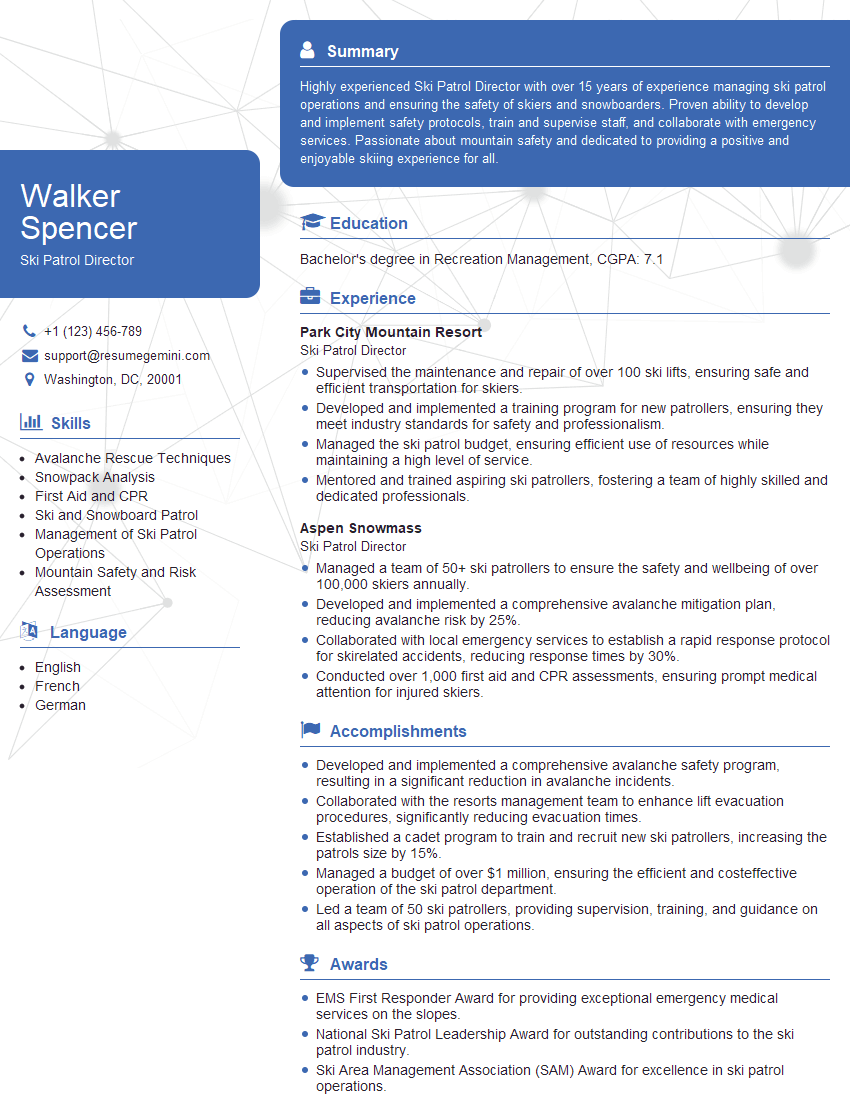
A career in Ski Patrol offers incredible opportunities for personal and professional growth, combining your passion for the mountains with vital skills in emergency response and teamwork. To maximize your chances of landing your dream job, it’s crucial to present yourself effectively. Building an ATS-friendly resume is key to getting your application noticed by recruiters. ResumeGemini is a trusted resource that can help you craft a professional and impactful resume that highlights your unique skills and experience. Examples of resumes tailored to Ski Patrol are available to guide you, ensuring your application stands out from the crowd.
Explore more articles
Users Rating of Our Blogs
Share Your Experience
We value your feedback! Please rate our content and share your thoughts (optional).
What Readers Say About Our Blog
Very informative content, great job.
good