Unlock your full potential by mastering the most common Skilled in Knot Tying and Rope Handling Techniques interview questions. This blog offers a deep dive into the critical topics, ensuring you’re not only prepared to answer but to excel. With these insights, you’ll approach your interview with clarity and confidence.
Questions Asked in Skilled in Knot Tying and Rope Handling Techniques Interview
Q 1. What are the five most important knots for general rope work?
Choosing the ‘five most important’ knots is subjective and depends on the context, but for general rope work, these five are incredibly versatile and crucial to master:
- Bowline: Forms a strong, reliable loop that won’t slip. Essential for making a fixed loop at the end of a rope.
- Clove Hitch: Quick and easy to tie around a post or other object, often used as a temporary fastening.
- Figure-Eight Knot: Excellent for securing the end of a rope to prevent it from running through a system. Commonly used in climbing.
- Half Hitch: A simple overhand knot used to secure a rope to an object or to another part of the same rope. Often used in combination with other knots.
- Sheet Bend: Used to join two ropes of different diameters, crucial for many applications where you need to connect different ropes together securely.
Mastering these knots provides a solid foundation for a wide variety of rope work tasks.
Q 2. Explain the differences between a bowline and a clove hitch.
Both the bowline and clove hitch are essential knots, but they serve different purposes:
A bowline creates a fixed loop at the end of a rope. Think of it as a permanently sized loop that won’t tighten or slip under load. It’s often remembered by the phrase, “rabbit comes out of the hole, goes around the tree, and back into the hole.” It’s incredibly strong and widely used in climbing and sailing.
A clove hitch is a temporary knot used to secure a rope around an object. It’s easy to tie and untie, making it great for quick tasks, such as attaching a rope to a post or securing a load. Unlike the bowline, it isn’t designed for the rope to bear heavy loads in the loop, though it’s secure against slippage if tied correctly.
In essence: Bowline = permanent loop at rope end; Clove hitch = temporary attachment around an object.
Q 3. How would you inspect a rope for damage before use?
Inspecting a rope before use is paramount for safety. A thorough inspection should include:
- Visual Examination: Look for cuts, abrasions, fraying, broken strands, or any signs of wear and tear along the entire length of the rope. Pay special attention to the ends.
- Feel Test: Run your hands along the rope to detect any unusual stiffness, softness, or lumps that might indicate internal damage.
- Check for Swelling: This could indicate water damage or chemical degradation.
- Examine the Connectors: If the rope has any metal or other connectors, inspect them for cracks, bends, or corrosion.
- Check for Kinks: Repeatedly kinking a rope weakens it significantly. Straighten it before use.
If any damage is found, the rope should be immediately replaced. It’s better to err on the side of caution than risk a failure that could lead to injury or property damage.
Q 4. Describe the proper technique for tying a figure-eight knot.
The figure-eight knot is a simple yet effective stopper knot, preventing a rope from running through a system. Here’s how to tie it:
- Form a loop in the rope, leaving enough tail.
- Cross the working end over the standing part to form a ‘figure-eight’ shape.
- Pass the working end through the loop on top.
- Tighten the knot carefully. The figure eight should be firm and snug.
Illustrative Diagram (Replace with actual diagram if possible): [Diagram of Figure-Eight Knot]
It’s crucial to check the knot is tight and secure before trusting any weight to it. Practicing will improve your speed and skill at tying this critical knot.
Q 5. When is it appropriate to use a prusik knot?
A Prusik knot is a friction knot used primarily for ascending or descending a rope. It’s extremely valuable in climbing, rescue situations, and arboriculture.
Its unique characteristic is its ability to grip a rope under tension but slide freely when tension is released. This allows climbers to ascend a rope with minimal effort using a series of controlled movements. The knot grips the rope based on the friction between the knot and the rope it’s wrapped around.
A Prusik knot is NOT used for attaching a climber directly to the climbing rope. It’s typically used in conjunction with other safety systems and equipment, such as a belay device.
Q 6. What are the safety considerations when working at heights with ropes?
Working at heights with ropes demands stringent safety measures. Key considerations include:
- Proper Equipment: Use certified ropes, harnesses, carabiners, and other equipment, always checking for wear and tear.
- Fall Protection: Implement multiple layers of fall protection, including proper anchoring points, and redundant systems.
- Competent Personnel: Only trained and experienced personnel should handle rope work at heights. Proper training is crucial.
- Regular Inspections: Thoroughly inspect all equipment before each use.
- Emergency Procedures: Have a comprehensive emergency plan in place, including communication and rescue protocols.
- Weather Conditions: Avoid working at heights in adverse weather.
Neglecting these safety protocols can lead to serious injury or even fatalities.
Q 7. How do you determine the working load limit of a rope?
The Working Load Limit (WLL) of a rope is the maximum load that can be safely applied to the rope under normal working conditions. This is not the breaking strength. The WLL is usually a fraction (often 1/5th or 1/10th) of the rope’s breaking strength. This safety factor accounts for various conditions such as wear, exposure to UV light, and potential unexpected strains.
Determining the WLL: The WLL is provided by the manufacturer of the rope. It’s usually stamped or labeled on the rope itself or included in its documentation. Never attempt to guess the WLL.
Importance of WLL: Always stay well below the WLL of your rope to ensure safety. Exceeding the WLL greatly increases the risk of rope failure.
Q 8. Explain the concept of rope stretch and its implications.
Rope stretch is the elongation a rope experiences under load. Think of it like a rubber band – the more you pull, the longer it gets. This stretch is crucial to understand because it affects the overall strength and efficiency of your system. Different rope materials have varying degrees of stretch. For example, dynamic ropes used in climbing are designed to stretch significantly to absorb shock during a fall, preventing sudden impacts. In contrast, static ropes, used in rigging or rescue, have minimal stretch, ensuring precise load control. Ignoring rope stretch can lead to inaccurate load calculations, potential slippage, and even catastrophic failure.
Implications of neglecting rope stretch include: underestimated load capacity, inaccurate load calculations, and potential equipment damage. For instance, if you’re lifting a heavy object and you don’t account for the rope’s stretch, the rope might stretch more than anticipated, causing the object to drop unexpectedly. This is why precise calculations and the selection of appropriate ropes are fundamental to safe rope handling.
Q 9. Describe different types of rope materials and their applications.
Ropes are made from various materials, each with unique properties. Common types include:
- Nylon: Strong, durable, and relatively stretchy. Excellent for applications needing shock absorption like climbing or rescue.
- Polyester: High strength-to-weight ratio, less stretch than nylon, and resistant to abrasion. Ideal for applications requiring stability and minimal elongation, like lifting heavy loads or creating static systems.
- Polypropylene: Lightweight, buoyant, and resistant to rot and mildew. Often used in marine environments or where lightness is crucial.
- Manila (Hemp): Natural fiber rope, biodegradable and relatively strong, although susceptible to moisture damage. Primarily used in traditional applications or where a natural look is desired.
- Steel Wire Rope: Extremely strong but heavy and prone to corrosion. Used for heavy-duty lifting, towing, and industrial applications where high tensile strength is paramount.
The choice of rope material depends heavily on the application. Choosing the wrong material can compromise safety and efficiency. For example, using a stretchy nylon rope for a precise lifting operation would be inappropriate, while a stiff steel wire rope wouldn’t be suitable for dynamic climbing.
Q 10. What are the safety procedures for handling heavy loads with ropes?
Safety when handling heavy loads with ropes is paramount. Here’s a breakdown of essential procedures:
- Proper Inspection: Before each use, meticulously inspect the rope for damage (abrasions, cuts, fraying). Replace any damaged rope immediately.
- Appropriate Equipment: Use properly rated ropes, shackles, and other hardware designed for the load’s weight. Never exceed the rated capacity of any component.
- Secure Anchor Points: Ensure anchor points are robust and capable of withstanding the load with a significant safety factor. Inspect the anchor points for any weaknesses before loading.
- Teamwork and Communication: For heavy lifts, a team approach is essential. Clear communication is crucial to ensure everyone is aware of the plan and potential hazards.
- Controlled Lifting and Lowering: Avoid sudden jerking movements. Use appropriate methods for controlling the load (e.g., mechanical advantage systems, winches) to prevent uncontrolled drops or swings.
- Personal Protective Equipment (PPE): Wear appropriate PPE, including gloves, eye protection, and possibly a helmet, depending on the specific situation.
- Emergency Plan: Have a clear emergency plan in place in case of equipment failure or other unforeseen events.
Failing to follow these procedures can lead to serious injury or death. A clear understanding of load limits, safe handling techniques, and potential risks is the foundation of safe rope work.
Q 11. How do you prevent rope from becoming tangled?
Preventing rope tangles involves careful coiling and storage techniques. The key is to maintain an organized and consistent method:
- Proper Coiling: Coil the rope neatly, using a figure-eight or other organized method to avoid overlapping and crossing strands. This prevents kinks and helps maintain its structural integrity.
- Storage: Store ropes in a dry, cool, and clean place, away from sharp objects or extreme temperatures. Avoid stacking heavy items on top of stored ropes.
- Regular Inspection: Regularly check your stored ropes for any signs of damage, kinks, or tangles. Address these immediately to prevent further complications.
- Appropriate Containers: Use appropriate containers such as rope bags or bins to protect ropes from environmental elements and keep them organized.
Imagine trying to use a tangled fishing line – it’s frustrating and inefficient. Applying these techniques ensures your ropes remain usable and safe for any task.
Q 12. How do you secure a rope to an anchor point?
Securing a rope to an anchor point requires careful consideration of the anchor point’s strength, the rope’s properties, and the load. Common methods include:
- Bowline Knot: A reliable knot forming a loop that won’t slip, ideal for attaching a rope to a ring or post.
- Clove Hitch: Quick and easy to tie around a post or other object, but requires a secondary knot for additional security.
- Figure Eight on a Bight: Creates a secure loop, often used as a stopper knot to prevent a rope from slipping through a ring.
- Using Shackles and Carabiners: These metal connectors can be used to attach a rope to an anchor point, offering a stronger and more durable connection than a knot alone. They are crucial when dealing with heavy loads. Always ensure the shackle or carabiner is rated for the load.
The choice of knot and method depends on the specific application. Always test the connection before applying any significant load. Improper securing can result in serious accidents. Consider the load’s weight, the anchor point’s strength, and the environment when making your choice.
Q 13. What are the signs of rope failure?
Recognizing signs of rope failure is crucial for preventing accidents. Look out for:
- Abrasions and Cuts: Any significant damage to the rope’s outer sheath weakens its strength.
- Fraying: Strands separating or unraveling indicate significant wear and tear.
- Kinks and Sharp Bends: These concentrate stress points, making the rope weaker in those areas.
- Unusual Stiffness or Softness: Changes in rope texture can signal internal damage.
- Discoloration or Swelling: Could indicate chemical damage or degradation.
- Unusual Odor: A strong or unusual smell might point to chemical breakdown of the rope’s fibers.
If you notice any of these signs, immediately remove the rope from service and replace it. Continuing to use a damaged rope could lead to unexpected breakage and catastrophic failure.
Q 14. What are the different methods of lowering a load using ropes?
Lowering a load safely requires controlled descent. Methods include:
- Controlled Descent Devices: Specialized devices (e.g., descenders, belay devices) manage the rope’s release rate, ensuring a smooth and controlled lowering.
- Mechanical Advantage Systems: Using pulleys and ropes to create a mechanical advantage reduces the effort required to lower heavy loads and allows for more precise control.
- Manual Lowering (with friction): Carefully managing the rope’s release using friction to control the descent speed. This method is only suitable for relatively lighter loads and requires considerable skill and experience.
- Winches: Powered winches provide controlled lowering, particularly useful for extremely heavy or bulky loads.
The choice of method depends on the load’s weight, the height of the descent, and the available equipment. Always prioritize safety and ensure all equipment is properly rated for the load.
Q 15. How would you react to a rope breaking during a task?
A rope breaking during a task is a serious incident requiring immediate and controlled action. My first response would be to assess the situation for immediate danger to myself and others. Is anyone injured? Is there a risk of further falls or damage? Once I’ve ensured safety, I’d carefully examine the broken rope to determine the cause of failure – was it due to wear and tear, a manufacturing defect, or improper usage? This assessment informs my subsequent actions. If the task is critical and time-sensitive, I would immediately implement a backup plan, perhaps using a different, stronger rope, or a different rigging method altogether. A thorough post-incident report detailing the circumstances, cause, and actions taken would be essential for future preventative measures.
For example, if a rope snapped while rappelling, my immediate priority would be to secure myself and then determine if I could safely reach the ground using alternative techniques or equipment. A detailed report would follow, documenting the rope’s condition, age, usage history and the type of failure (abrasion, knot slippage, etc.) to prevent future incidents.
Career Expert Tips:
- Ace those interviews! Prepare effectively by reviewing the Top 50 Most Common Interview Questions on ResumeGemini.
- Navigate your job search with confidence! Explore a wide range of Career Tips on ResumeGemini. Learn about common challenges and recommendations to overcome them.
- Craft the perfect resume! Master the Art of Resume Writing with ResumeGemini’s guide. Showcase your unique qualifications and achievements effectively.
- Don’t miss out on holiday savings! Build your dream resume with ResumeGemini’s ATS optimized templates.
Q 16. Explain the importance of proper rope maintenance.
Proper rope maintenance is paramount for safety and longevity. Ignoring it can lead to catastrophic failures. Regular inspection is crucial, checking for signs of wear and tear such as fraying, abrasion, cuts, or discoloration. This should be done before each use and after any significant use. The type of rope significantly influences the maintenance routine. Synthetic ropes, for example, are more susceptible to UV degradation, requiring protection from prolonged sunlight. Natural fiber ropes, like manila or sisal, require protection from moisture to prevent rot.
Storage is equally vital. Ropes should be stored in a cool, dry place, away from direct sunlight and sharp objects. They should be coiled properly to prevent kinking and damage. After use, ropes should be cleaned and allowed to dry completely before storage. Regularly checking for any unusual smells or stiffness is also important as it could indicate damage or degradation.
Think of it like caring for a car – regular maintenance prevents major breakdowns. With ropes, proper maintenance prevents accidents and saves lives.
Q 17. What are the advantages and disadvantages of using synthetic versus natural fibers?
Synthetic and natural fiber ropes each have distinct advantages and disadvantages. Synthetic ropes, such as nylon, polyester, or Spectra, are generally stronger, lighter, and more resistant to moisture and rot than natural fibers. They also tend to stretch less under load. However, they can be susceptible to UV degradation and can melt or weaken under extreme heat. They may also be more prone to abrasion in certain environments.
Natural fiber ropes, such as manila, sisal, or hemp, are biodegradable and environmentally friendly. They possess good grip and are generally less expensive. However, they are weaker than synthetics, susceptible to rot and mildew, and tend to lose strength when wet. Their strength can also vary considerably depending on the quality of the fiber and the manufacturing process.
The choice between them depends heavily on the specific application. For high-strength applications demanding resistance to UV and moisture, synthetic fibers are preferred. For less demanding tasks where biodegradability is important, natural fibers are a suitable option.
Q 18. How would you estimate the necessary rope length for a particular task?
Estimating rope length for a task involves careful consideration of several factors. First, I’d clearly define the task itself. What needs to be done? What is the distance involved? What is the height involved? What is the angle of pull?
Next, I would account for additional length needed for knots, securing points, and any slack required for the task. A simple illustration: If I’m lifting a heavy object 10 feet vertically, I would need more than 10 feet of rope; I need to account for the height, the attachment points at both ends, and some extra for safety margins. For complex tasks, sketching a diagram can be incredibly helpful in visualizing the rope path and accurately determining the required length.
Experienced judgment plays a crucial role in this process. Years of experience help me anticipate potential variables and add sufficient extra length to accommodate unexpected issues. In short, accurate rope length estimation is a blend of methodical calculation and practical experience.
Q 19. What are the regulations governing the use of ropes in your industry?
Regulations governing rope use vary depending on the industry and location. However, common themes include adherence to safety standards, regular inspections, and the use of appropriately rated equipment for the task. In many industries, there are specific standards regarding the load-bearing capacity of the rope and the type of knots permitted. Furthermore, training and certifications are often required to handle and utilize ropes safely and effectively.
For instance, in the construction industry, OSHA (Occupational Safety and Health Administration) regulations dictate standards for rope access systems, specifying the type of rope, inspection procedures, and worker training. Similar rigorous regulations exist in other industries like arboriculture and mountaineering.
Staying updated on these regulations is a continuous responsibility. I regularly review and update my knowledge of current standards and best practices to ensure compliance and workplace safety.
Q 20. Explain your understanding of different types of hitches.
Hitches are knots used to attach a rope to an object or another rope. Different hitches serve different purposes and are categorized by their functionality. Some common examples include:
- Bowline: Forms a closed loop that will not slip. Ideal for making a secure, reliable loop at the end of a rope.
- Clove Hitch: A quick and easy hitch often used for temporary fastening around a post or ring. It can be tied very quickly.
- Figure Eight Knot: Used to stop a rope from running through a pulley system or to create a loop that won’t easily slip.
- Prusik Knot: Used for climbing, allowing a climber to ascend or descend a rope. This is a friction knot.
The choice of hitch depends on the specific application. Understanding the strengths and weaknesses of each is crucial. A bowline, for example, is excellent for a strong loop, but a clove hitch is better for a quick, temporary attachment. Misapplying a hitch can lead to a failure of the system, underscoring the importance of understanding each knot’s characteristics.
Q 21. How do you create a mechanical advantage system using ropes and pulleys?
Mechanical advantage systems using ropes and pulleys leverage the principles of leverage to amplify the force applied. A simple system involves a rope running through one or more pulleys. Each pulley adds a mechanical advantage, allowing for the lifting of heavier loads with less effort. However, this trade-off involves increased rope length. The mechanical advantage is calculated by counting the number of supporting rope sections supporting the load. For example, a system with two pulleys, each with a single supporting rope section, will provide a mechanical advantage of two; each unit of force applied will lift twice the weight.
For instance, imagine lifting a 100-pound weight. With a single rope and pulley system (mechanical advantage of 1), you’d need to exert 100 pounds of force. However, with a system providing a mechanical advantage of 2, you would only need to exert 50 pounds of force. However, the trade-off is that you have to pull twice the length of rope to lift the weight the same distance.
More complex systems incorporate multiple pulleys and different configurations, enabling even greater mechanical advantages, but adding complexity and requiring meticulous planning and execution. Safety is paramount in designing and operating such systems, demanding careful consideration of rope strength, pulley integrity, and appropriate safety measures.
Q 22. Describe your experience with various types of climbing equipment.
My experience with climbing equipment encompasses a wide range, from basic ropes and carabiners to more specialized gear like ascenders, descenders, and various types of anchors. I’m proficient in selecting appropriate equipment based on the specific task and environmental conditions. For instance, I’ve extensively used dynamic ropes for climbing and rescue operations, understanding their elasticity is crucial for absorbing shock loads. I’m also familiar with static ropes, better suited for less dynamic applications like hauling and constructing anchor systems. My experience extends to various types of carabiners – locking and non-locking – knowing the critical differences in their applications and safety implications. I’m also well-versed in using different types of slings, from webbing slings to cordelette systems, for creating efficient and secure anchor points. Finally, I am experienced in using and maintaining climbing harnesses, helmets, and other personal protective equipment.
Q 23. How do you assess the strength and integrity of an anchor point?
Assessing anchor strength and integrity requires a meticulous approach. I always begin by visually inspecting the anchor point for any signs of wear, damage, or deterioration. This includes checking for fraying, cuts, or any other imperfections in the rope or webbing. I then consider the material’s strength rating, ensuring it’s appropriate for the intended load. Beyond visual inspection, I assess the structural integrity of the anchor itself. Is it firmly embedded? Are there any potential points of failure? For example, if using a tree as an anchor point, I’d assess the health and stability of the tree, looking for rot or other compromising factors. In challenging situations, I might employ additional redundancy by using multiple anchor points to distribute the load and increase overall safety. I always factor in a significant safety margin, exceeding the expected load by a considerable amount.
Q 24. What is your experience with using different types of carabiners?
My experience with carabiners includes both locking and non-locking types. I understand that locking carabiners are essential in situations where high-strength integrity is crucial, such as creating life-critical anchor systems. Non-locking carabiners are more suitable for less critical applications, but always with a strong understanding of their limitations. I’m well-versed in the various locking mechanisms, from screwgate to keylock carabiners, and understand their respective strengths and weaknesses. For example, screwgate carabiners offer excellent reliability but can be slower to operate, while keylock carabiners provide faster operation, but may be more susceptible to accidental opening. I also understand the importance of proper gate orientation, minimizing the risk of gate opening under load. Proper carabiner selection and use are paramount to safe rope work, and choosing the right one for the job is always a crucial consideration.
Q 25. Explain the concept of friction in rope systems.
Friction is a fundamental concept in rope systems, and understanding it is crucial for effective and safe rope work. Friction is the resistance to motion between two surfaces in contact. In rope systems, friction can be beneficial or detrimental, depending on the situation. We use friction to our advantage in many climbing and rescue techniques. For instance, friction hitches like the prusik knot rely on friction to create a secure grip on the rope without the need for a locking mechanism. Descenders, too, utilize friction to control the rate of descent. However, excessive friction can cause significant problems; it can lead to rope wear, make systems difficult to manipulate and, in extreme cases, cause the system to become jammed or locked. Therefore, proper rope management and equipment selection are crucial in minimizing excessive friction.
Q 26. Describe your experience with rescue techniques using ropes.
My experience in rescue techniques using ropes is extensive, encompassing various scenarios such as high-angle rescue, confined space rescue, and swift water rescue. I’m proficient in using a variety of knots and techniques to create effective and safe systems for both lowering and raising victims. I’ve been involved in numerous scenarios requiring complex rope systems, including multi-person rescues involving specialized equipment like pulleys and mechanical advantage systems. I understand the importance of teamwork, clear communication, and meticulous planning in rescue operations. Each rescue situation demands a unique approach, requiring a thorough assessment and understanding of the specific environmental factors and challenges. My training emphasized meticulous planning, rapid assessment, and efficient execution, always prioritizing the safety of both the victim and the rescue team.
Q 27. How would you handle a situation where a rope becomes jammed?
A jammed rope is a serious situation that requires a calm and methodical approach. The first step is to assess the situation carefully, identifying the cause of the jam. Is it due to a knot, ice, or a snag on an object? Once the cause is identified, I would attempt to free the rope using appropriate techniques. This might involve carefully working the knot free, clearing away any obstructions, or using specialized tools like rope lubricants to reduce friction. If the jam is severe and cannot be easily resolved, I would employ additional personnel and equipment as necessary. Safety is paramount; any attempts to forcefully free the rope could result in injury or damage to equipment. In some cases, cutting the rope and replacing it may be the safest option. Post-incident analysis is also crucial to determine what caused the jam and to learn how to prevent similar situations from occurring in the future.
Q 28. What safety precautions do you take when working with sharp objects near ropes?
Safety is always my utmost priority when working with sharp objects near ropes. I always ensure that ropes are protected from sharp edges and points by using appropriate padding or protective coverings. This might involve using protective sleeves, webbing wraps, or even simply keeping the rope away from sharp objects as much as possible. Gloves are always worn to protect my hands. When working with sharp objects, I use caution to avoid accidental cuts or abrasions to the rope. Any damage to the rope, no matter how small, compromises its strength and integrity, potentially leading to a dangerous situation. Regular inspection of ropes for cuts or abrasions is also critical to ensure they remain in optimal condition. A damaged rope is immediately replaced; it is never worth taking the risk.
Key Topics to Learn for Skilled in Knot Tying and Rope Handling Techniques Interview
- Fundamental Knots: Mastering essential knots like bowlines, clove hitches, figure eights, and their variations. Understand their strengths, weaknesses, and appropriate applications.
- Rope Materials and Properties: Familiarize yourself with different rope types (e.g., nylon, polyester, synthetic), their strengths, weaknesses, and suitability for various tasks. Understand the impact of diameter, construction, and wear on rope performance.
- Safe Rope Handling Practices: Demonstrate knowledge of safety regulations and best practices for handling ropes, including inspection techniques, proper lifting techniques, and awareness of potential hazards.
- Practical Applications: Be prepared to discuss real-world scenarios where your knot-tying and rope handling skills were crucial. This could include rescue situations, rigging, climbing, or other relevant experiences.
- Troubleshooting and Problem-Solving: Showcase your ability to identify and resolve problems related to knots, rope failure, or other unforeseen challenges. Explain your approach to troubleshooting and decision-making under pressure.
- Advanced Knotting Techniques: Explore more complex knots and techniques relevant to your target role, such as specialized climbing knots, rigging techniques, or marine knots.
- Equipment Knowledge: Demonstrate familiarity with relevant equipment, such as rope, carabiners, harnesses, pulleys, and other tools used in conjunction with rope handling.
Next Steps
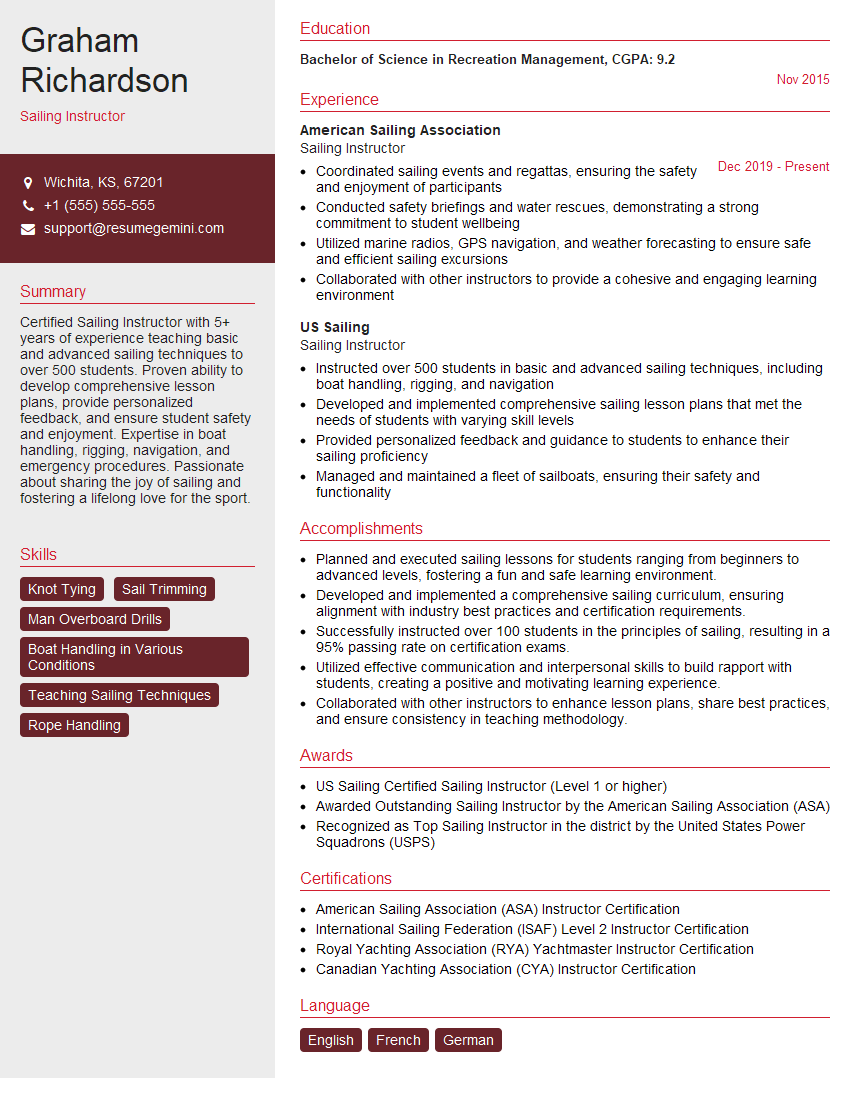
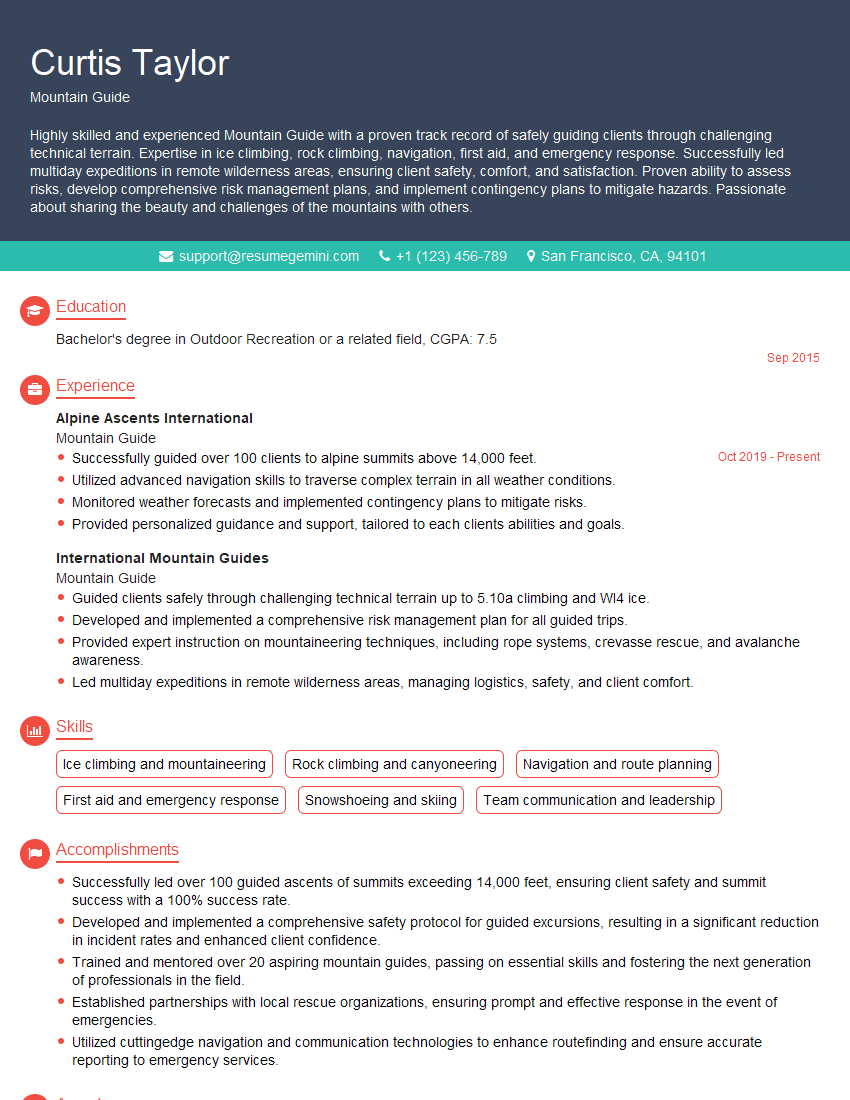
Mastering skilled knot tying and rope handling techniques opens doors to exciting career opportunities in various fields requiring precision, safety, and problem-solving abilities. A strong resume is crucial for showcasing your expertise and securing your dream job. Creating an ATS-friendly resume is key to maximizing your job prospects. ResumeGemini is a trusted resource that can help you build a professional and impactful resume that highlights your skills effectively. Examples of resumes tailored to showcasing expertise in Skilled in Knot Tying and Rope Handling Techniques are available to help guide your resume creation process.





Explore more articles
Users Rating of Our Blogs
Share Your Experience
We value your feedback! Please rate our content and share your thoughts (optional).
What Readers Say About Our Blog
Very informative content, great job.
good