The right preparation can turn an interview into an opportunity to showcase your expertise. This guide to Software Safety interview questions is your ultimate resource, providing key insights and tips to help you ace your responses and stand out as a top candidate.
Questions Asked in Software Safety Interview
Q 1. Explain the difference between safety and security in software.
While both safety and security are crucial for software, they address different aspects. Safety focuses on preventing unintended harm or hazards that could result from software malfunctions. Think of a self-driving car; a safety issue would be the car unexpectedly accelerating, potentially causing an accident. Security, on the other hand, concerns protecting the software and its data from unauthorized access, use, disclosure, disruption, modification, or destruction. For the same self-driving car, a security issue would be a hacker remotely taking control of the vehicle.
In essence, safety is about preventing accidents, while security is about preventing malicious attacks. They are not mutually exclusive; a secure system is more likely to be a safe system, but not necessarily vice versa. A perfectly secure system could still have a design flaw that leads to an accident (a safety issue).
Q 2. Describe the V-model for software development in the context of safety.
The V-model is a software development lifecycle model that emphasizes verification and validation at each stage. In the context of safety, this is crucial because it ensures that safety requirements are addressed systematically throughout the entire process. The left side of the ‘V’ represents the development phases (requirements, design, implementation), while the right side shows the corresponding verification and validation activities (unit testing, integration testing, system testing, acceptance testing).
For instance, during the requirements phase, safety requirements are clearly defined. During the design phase, these requirements are translated into a safe design. The implementation phase produces code. On the right side, unit testing verifies individual components, integration testing checks interactions between components, system testing evaluates the complete system, and finally, acceptance testing ensures that the system meets the initial safety requirements. Each testing stage maps directly to a development phase, creating a strong traceability link crucial for safety argumentation.
Imagine building a medical device. The V-model guides you through rigorously testing each component (unit testing) and then the interaction of the components (integration testing) to ensure that the final device (system testing) meets its life-critical safety standards.
Q 3. What are the key elements of a hazard analysis and risk assessment (HARA)?
Hazard Analysis and Risk Assessment (HARA) is a systematic process to identify potential hazards in a system and assess the associated risks. Key elements include:
- Hazard Identification: This involves brainstorming potential hazards that could occur due to software malfunction. Examples include system crashes, unexpected outputs, or incorrect data processing.
- Hazard Analysis: This involves determining the severity, probability, and controllability of identified hazards. Severity refers to the potential harm caused (e.g., minor injury, major injury, fatality). Probability refers to the likelihood of the hazard occurring. Controllability reflects the degree to which the hazard can be mitigated.
- Risk Assessment: This combines the severity and probability of hazards to determine the overall risk level. This often involves a risk matrix that categorizes risks based on their severity and probability.
- Risk Mitigation: Once risks are assessed, strategies are developed to reduce the likelihood or severity of the identified hazards. This could include design modifications, redundancy measures, or safety mechanisms.
For example, in a flight control system, a hazard could be a software failure leading to loss of control. HARA would assess the severity (catastrophic), probability (low but non-negligible), and controllability (through redundancy and validation). The identified risk would then be mitigated by incorporating redundant systems and rigorous testing.
Q 4. Explain the concept of a safety case and its importance.
A safety case is a structured argument that demonstrates that a system is sufficiently safe for its intended use. It’s a comprehensive document that systematically presents evidence to justify the claims about the system’s safety. It’s vitally important because it provides a clear and auditable record of the safety justification.
A safety case typically includes:
- Hazard analysis and risk assessment: The results of the HARA process.
- Safety requirements: The specific safety requirements derived from the HARA.
- Design description: Detailed description of the system design, including safety mechanisms.
- Verification and validation evidence: Evidence demonstrating that the system meets its safety requirements.
- Safety arguments: The logical chain of reasoning demonstrating how the system achieves its safety goals.
Imagine a medical implant. The safety case would demonstrate that the device won’t malfunction and cause harm to the patient, including evidence from testing and simulations. Regulatory bodies often require a safety case for approval.
Q 5. What are some common safety-related standards (e.g., ISO 26262, IEC 61508)?
Several standards provide guidance for developing safe software. Some of the most prominent include:
- ISO 26262: This standard focuses on functional safety for road vehicles. It defines Automotive Safety Integrity Levels (ASILs) to classify the required safety level for different functions.
- IEC 61508: This is a more general standard for functional safety of electrical/electronic/programmable electronic safety-related systems. It defines Safety Integrity Levels (SILs) similar to ASILs.
- DO-178C: This standard addresses software considerations in airborne systems and equipment certification.
- EN 50128: This standard covers the software for railway control and protection systems.
These standards provide a framework for managing safety throughout the software development lifecycle, defining requirements for safety analysis, design, verification, and validation.
Q 6. How do you determine the Automotive Safety Integrity Level (ASIL) or Safety Integrity Level (SIL)?
The Automotive Safety Integrity Level (ASIL) in ISO 26262 and the Safety Integrity Level (SIL) in IEC 61508 are determined through a hazard analysis and risk assessment (HARA). The HARA process considers the severity, probability, and controllability of potential hazards to determine the required safety integrity level. The levels are typically ranked from A (most stringent) to D (least stringent) for ASIL and 1 (least stringent) to 4 (most stringent) for SIL.
The process involves:
- Hazard identification and analysis: Identifying potential hazards related to software malfunctions.
- Risk assessment: Determining the severity, probability, and controllability of each hazard.
- ASIL/SIL determination: Mapping the assessed risks to the corresponding ASIL or SIL based on predefined severity, probability, and controllability criteria.
A higher ASIL/SIL indicates a higher level of safety required, demanding more rigorous development processes and verification and validation activities. For example, a hazard with high severity, high probability, and low controllability would likely result in an ASIL D or SIL 4.
Q 7. What techniques are used for software verification and validation in safety-critical systems?
Various techniques are employed for software verification and validation in safety-critical systems, focusing on ensuring the software behaves as intended and meets its safety requirements. Key techniques include:
- Static Analysis: Analyzing the code without executing it, using tools to detect potential errors like coding style violations, memory leaks, or potential buffer overflows.
- Dynamic Analysis: Executing the code with various inputs to observe its behavior. This includes techniques like unit testing, integration testing, and system testing.
- Formal Methods: Using mathematical techniques to formally prove properties of the software, providing rigorous assurance of correctness. Examples include model checking and theorem proving.
- Software Fault Injection: Intentionally injecting faults into the software to observe its response and robustness. This helps in assessing fault tolerance and safety mechanisms.
- Simulation and Modeling: Using models to simulate system behavior and test the software under various scenarios, particularly useful for systems that are difficult or impossible to test in a real-world environment.
- Code Reviews and Inspections: Systematic reviews of the code by multiple developers to identify errors and inconsistencies.
For instance, in a flight control system, formal methods might be used to prove that the system will not respond incorrectly to sensor failures. Simulation would be used to test the response of the system to extreme wind conditions.
Q 8. Describe your experience with Fault Tree Analysis (FTA) and Failure Mode and Effects Analysis (FMEA).
Fault Tree Analysis (FTA) and Failure Mode and Effects Analysis (FMEA) are crucial techniques for proactively identifying and mitigating risks in safety-critical systems. FTA is a deductive, top-down approach that starts with an undesired event (top event) and works backward to identify the underlying causes, represented as a tree diagram. FMEA, on the other hand, is a bottom-up, inductive approach that systematically examines each component or function to identify potential failure modes, their effects, and the severity of those effects.
In my experience, I’ve used FTA extensively in analyzing complex system failures, like a power plant shutdown or an aircraft emergency. For instance, in analyzing an aircraft’s landing gear failure, FTA would start with the top event ‘Landing Gear Failure’ and branch down to potential causes like hydraulic system failure, sensor malfunction, or software error. Each cause would then be further broken down until basic events are identified. These events are then evaluated to assess their probability of occurrence and contribution to the top event.
FMEA, conversely, is better suited for design reviews and identifying potential weaknesses during the development lifecycle. Imagine a self-driving car. A FMEA would systematically analyze each component – sensors, actuators, software modules – identifying possible failure modes for each (e.g., sensor drift, actuator jam, software bug). For each failure mode, we assess the severity, likelihood of occurrence, and the ability of detection, resulting in a Risk Priority Number (RPN) that helps prioritize mitigation efforts.
I’ve successfully integrated both methods in several projects, using FTA for post-incident investigation and FMEA for proactive risk management throughout the development lifecycle, leading to significantly improved system safety and reliability.
Q 9. How do you manage technical debt in a safety-critical project?
Managing technical debt in a safety-critical project requires a disciplined and proactive approach. Technical debt, essentially shortcuts in the development process, can compromise safety and reliability if left unaddressed. In a safety-critical context, this is unacceptable.
My strategy involves:
- Prioritization based on risk: Not all technical debt is created equal. We categorize debt based on its potential impact on safety. High-risk debt, for instance, a poorly implemented safety algorithm, requires immediate attention. Low-risk debt, such as minor code style inconsistencies, can be deferred, but still tracked.
- Formal documentation and tracking: We maintain a detailed register of technical debt, including its type, risk level, and planned remediation. This ensures transparency and accountability.
- Dedicated time allocation: Unlike in less critical projects, we dedicate specific sprint cycles or portions of sprints to addressing technical debt. This avoids letting it become an insurmountable problem.
- Automated static analysis and testing: Automated tools play a crucial role in identifying potential safety issues early on. This ensures that even minor coding errors don’t slip through the cracks.
- Code reviews with a focus on safety: During code reviews, we scrutinize code for potential safety implications even more rigorously than in a non-safety-critical context.
- Regular risk assessments: We periodically reassess the risk profile of outstanding technical debt, adjusting our remediation plan as needed.
By employing these methods, we maintain a balance between rapid development and the highest levels of safety, ensuring the successful delivery of a safe and reliable product.
Q 10. Explain the importance of code reviews in a safety-critical environment.
Code reviews are paramount in safety-critical environments; they act as a crucial safety net. In a non-safety critical project, a bug might lead to minor inconvenience. In a safety-critical system, a bug could have catastrophic consequences. Hence, rigorous code reviews are non-negotiable.
Our code review process emphasizes:
- Multiple reviewers: More than one experienced engineer reviews the code, providing diverse perspectives.
- Formal checklist: We use a checklist that covers safety-relevant aspects, like adherence to coding standards, proper handling of error conditions, and resource management.
- Static analysis tools integration: The results from static analysis tools are integrated into the review process, highlighting potential issues automatically.
- Focus on safety-critical sections: Reviewers pay particular attention to sections of the code that directly affect safety, like interrupt handlers, critical timing routines, and safety-related algorithms.
- Traceability to requirements: We ensure that the code aligns with safety requirements.
A recent example involved a code review that uncovered a race condition in a critical timing loop. This condition, had it gone undetected, could have led to system instability, potentially causing harm. The rigorous code review identified and rectified this defect before it could reach production, demonstrating the invaluable role of code reviews in safety.
Q 11. What are some common software safety hazards?
Common software safety hazards in safety-critical systems include:
- Software errors: Bugs, such as buffer overflows, race conditions, and deadlocks, can lead to unpredictable system behavior.
- Data corruption: Loss of data integrity or accidental modification of critical data structures can cause malfunctions.
- Timing errors: Incorrect timing or missed deadlines can lead to missed critical events or incorrect responses.
- Resource exhaustion: Depletion of system resources, such as memory or processing power, can cause crashes or failures.
- Unhandled exceptions: Failure to handle exceptions properly can lead to unexpected system behavior or crashes.
- Concurrency issues: In multi-threaded or multi-process systems, synchronization problems can lead to data corruption or deadlocks.
- Insufficient testing: Inadequate testing can allow undetected bugs to reach production.
- Security vulnerabilities: Security breaches can compromise system functionality or integrity.
It’s critical to remember that these hazards often interact and can amplify each other’s effects, emphasizing the importance of a robust safety engineering process.
Q 12. How do you handle software safety requirements in an agile development process?
Integrating software safety requirements into an agile process requires a delicate balance between agility and rigor. The key is not to compromise safety for speed.
Our approach involves:
- Safety requirements as user stories: We express safety requirements as user stories, making them clear and understandable to the development team.
- Dedicated safety engineer in the team: A dedicated safety engineer participates in all sprint activities, guiding the team on safety-related aspects.
- Regular safety reviews and risk assessments: We conduct regular safety reviews and risk assessments throughout the development process to identify and address potential safety hazards early on.
- Continuous integration and continuous testing: Automated testing, including unit tests, integration tests, and system tests, are crucial for identifying safety issues early in the process.
- Safety-critical code separate consideration: Safety-critical components are treated differently, often following more rigorous development processes.
- Traceability from requirements to code: We ensure clear traceability from safety requirements through the design and implementation to the code, demonstrating that all requirements have been met.
This approach allows us to maintain the flexibility and adaptability of agile while ensuring the safety of the system remains the top priority.
Q 13. Explain the difference between deterministic and probabilistic safety analysis.
Deterministic and probabilistic safety analyses differ fundamentally in how they approach risk assessment.
Deterministic safety analysis focuses on identifying hazards and demonstrating that safety mechanisms prevent them from causing accidents. It’s qualitative in nature and is often expressed using techniques like Failure Modes and Effects Analysis (FMEA) and Fault Tree Analysis (FTA). The goal is to show that a design will not fail, regardless of the specific inputs or conditions.
Probabilistic safety analysis, on the other hand, quantifies the risk by considering the likelihood of failure and its consequences. It uses quantitative methods and employs probability distributions to estimate the chances of undesired events and their impact. Techniques like Fault Tree Analysis (FTA) with probabilities assigned to basic events, Markov models, or Monte Carlo simulations are commonly used. The goal here is to calculate the probability of accidents, often expressed as a failure rate or risk metric. It goes beyond simply identifying hazards and tries to assess their likelihood and severity.
For example, a deterministic analysis of a braking system might demonstrate that even if one brake fails, the other will still provide sufficient stopping power. A probabilistic analysis might go further, assigning probabilities to the failure of each brake, the severity of an accident resulting from brake failure, and calculating the overall probability of an accident occurring during braking.
Q 14. What is a safety requirement specification document, and what should it contain?
A Safety Requirement Specification (SRS) document is a formal document that outlines all safety-related requirements for a system. It serves as a blueprint for developing and verifying a safe system, ensuring that all safety concerns are addressed throughout the development lifecycle. Think of it as the safety contract between the development team and the stakeholders.
A comprehensive SRS should contain:
- System overview: A high-level description of the system and its intended function.
- Hazard identification and analysis: A detailed list of potential hazards, along with their severity, probability, and potential consequences.
- Safety goals and objectives: Clearly defined safety goals and objectives, quantifying acceptable risk levels.
- Safety requirements: Specific and measurable safety requirements, expressed in a clear and unambiguous manner, often using a consistent format (e.g., shall, should).
- Safety mechanisms: Descriptions of the safety mechanisms implemented to mitigate identified hazards.
- Verification and validation methods: A plan for verifying and validating that the safety requirements have been met.
- Traceability matrix: A matrix that traces safety requirements from their origin to the design, implementation, and testing phases. This ensures complete coverage.
A well-written SRS is crucial for successful safety engineering. It ensures that everyone involved understands the safety requirements and that these requirements are consistently met throughout the development lifecycle.
Q 15. Describe your experience with static and dynamic code analysis tools.
Static and dynamic code analysis are crucial techniques in software safety. Static analysis examines code without executing it, identifying potential issues like buffer overflows, null pointer dereferences, and race conditions through automated tools like Lint or Coverity. Think of it as a thorough code review performed by a tireless, rule-following robot. Dynamic analysis, on the other hand, involves executing the code and monitoring its behavior to detect runtime errors, memory leaks, and performance bottlenecks. Tools like Valgrind or runtime assertion checkers are commonly used.
In my experience, I’ve used both extensively. For instance, in a previous project developing flight control software, static analysis helped us catch a potential integer overflow early in development, preventing a potentially catastrophic failure. Later, during integration testing, dynamic analysis revealed a memory leak that only surfaced under high-load conditions, something static analysis alone would have missed. The combined use of both approaches provides a comprehensive safety net.
The choice between static and dynamic analysis often depends on the project’s complexity, budget, and available time. For projects with stringent safety requirements, a combination of both is typically necessary.
Career Expert Tips:
- Ace those interviews! Prepare effectively by reviewing the Top 50 Most Common Interview Questions on ResumeGemini.
- Navigate your job search with confidence! Explore a wide range of Career Tips on ResumeGemini. Learn about common challenges and recommendations to overcome them.
- Craft the perfect resume! Master the Art of Resume Writing with ResumeGemini’s guide. Showcase your unique qualifications and achievements effectively.
- Don’t miss out on holiday savings! Build your dream resume with ResumeGemini’s ATS optimized templates.
Q 16. How do you ensure traceability between safety requirements and implementation?
Traceability between safety requirements and implementation is paramount in safety-critical systems. It ensures that every safety requirement is properly addressed in the code and allows us to easily trace back any defects to their root cause. We achieve this through rigorous documentation and a structured development process. This often involves using a requirements management tool that links requirements to design documents, code modules, and test cases.
For example, imagine a requirement stating ‘The system shall not allow unauthorized access to critical functions.’ This requirement would be assigned a unique ID and linked to specific code modules responsible for authentication and authorization. Each code modification related to this requirement would also be documented and linked back to the original requirement. During testing, test cases specifically designed to verify this requirement would be clearly linked as well. This creates an auditable trail allowing quick identification of the source of any problems.
In practice, this often involves using tools that support traceability matrices and automated linking between artifacts throughout the software lifecycle.
Q 17. Explain the concept of safety mechanisms and redundancy.
Safety mechanisms are features designed to prevent or mitigate hazards, while redundancy involves incorporating duplicate components or functions to enhance reliability. These are crucial in safety-critical systems to ensure continued operation even in the event of a single-point failure.
For example, a safety mechanism in an automotive system might be an emergency braking system that automatically activates if a collision is imminent. Redundancy, in this same context, might involve having two independent braking systems, each with its own sensors and actuators. If one fails, the other can take over. Think of it like having a backup parachute in skydiving – you hope to never need it, but it’s there if your primary parachute fails.
Implementing safety mechanisms and redundancy is a delicate balance. It requires a thorough risk assessment to identify potential hazards and determine the appropriate level of safety and redundancy needed. Over-engineering can lead to increased cost and complexity, whereas under-engineering can compromise safety.
Q 18. How do you handle safety-critical incidents or failures?
Handling safety-critical incidents involves a structured process aimed at containing the immediate impact, investigating the root cause, and implementing corrective actions to prevent recurrence. This often involves immediate steps to mitigate any ongoing risk or harm. A failure analysis and reporting process, including fault tree analysis (FTA) and failure mode and effects analysis (FMEA), are vital components for identifying failure pathways.
First, we would immediately isolate the faulty component or system to prevent further damage or injury. Next, we would gather data on the incident – logs, sensor readings, witness statements – to establish the sequence of events. A thorough investigation follows to identify the root cause, potentially involving code analysis, hardware inspection, and simulation. Finally, based on the root cause analysis, we would implement corrective actions, which might involve code fixes, design changes, or updated operational procedures. The whole process is carefully documented and reviewed.
An example would be a failure in a medical device. A thorough investigation would determine the exact sequence of events, examine design documents, evaluate manufacturing processes, check software logs, and interview clinicians to ascertain the root cause of malfunction.
Q 19. What is your experience with safety certification processes?
I have extensive experience with various safety certification processes, including DO-178C for airborne systems and IEC 61508 for industrial automation. These processes involve rigorous documentation, testing, and verification to demonstrate that the software meets the specified safety requirements. It’s a very demanding process with specific guidelines for each certification standard. For example, DO-178C has defined levels of software integrity, from A (highest) to E (lowest), based on the criticality of the system.
My experience includes developing and executing safety cases, participating in design reviews and audits, and managing the certification documentation. I’m familiar with the various artifacts required, such as the Software Safety Assessment, Software Verification Plan, and Software Verification Results. I have led teams through the entire certification process for several safety-critical projects.
The key to successful certification is meticulous planning, meticulous attention to detail, and a thorough understanding of the relevant standards.
Q 20. Describe your experience with different software safety methodologies (e.g., Waterfall, Agile).
I have experience applying both Waterfall and Agile methodologies in safety-critical software development. Waterfall’s structured, sequential approach is often preferred for projects with stringent safety requirements due to its emphasis on upfront planning and thorough verification at each stage. It’s well-suited to projects where changes are costly and risk-averse, a common situation in safety-critical applications. This approach often uses V-model, which emphasizes verification and validation activities at each stage of the development process.
However, Agile’s iterative and incremental approach can be adapted for safety-critical development with careful consideration for the safety aspects of the software. For instance, we might use Scrum but incorporate rigorous safety reviews at the end of each sprint and emphasize continuous integration and continuous testing to reduce potential risks. Key safety activities such as hazard analysis and risk assessment remain critical throughout the iterative development. Agile’s flexibility can enable faster response to emerging issues and changes.
The best choice depends on the specific project needs and risk profile. A hybrid approach, combining aspects of both methodologies, might be optimal in certain situations.
Q 21. How do you ensure software safety throughout the entire software lifecycle?
Ensuring software safety throughout the entire software lifecycle requires a proactive and systematic approach that starts with hazard analysis and risk assessment and continues through development, testing, deployment, and maintenance. This involves implementing a safety management system and embedding safety considerations into every aspect of the process.
- Requirements phase: Define safety requirements and allocate safety integrity levels.
- Design phase: Implement safety mechanisms and redundancy, and conduct hazard analysis and risk assessment.
- Implementation phase: Use static and dynamic analysis, and adhere to coding standards.
- Testing phase: Perform rigorous testing, including verification and validation activities.
- Deployment phase: Ensure secure and reliable deployment and monitoring.
- Maintenance phase: Implement a process for handling incidents, performing updates, and providing continuous support.
Throughout the lifecycle, rigorous documentation is crucial, ensuring complete traceability and enabling audits to be conducted. The key is to consider safety not as an afterthought but as an integral part of every decision, from initial requirements gathering to the final decommissioning of the system.
Q 22. Explain your understanding of software architectural patterns for safety-critical systems.
Software architectural patterns for safety-critical systems prioritize reliability, fault tolerance, and predictable behavior. They often involve redundancy, separation of concerns, and well-defined interfaces to minimize the impact of failures. Some common patterns include:
- Layered Architecture: This pattern divides the system into layers with increasing levels of abstraction. A failure in one layer ideally won’t propagate to others. Think of it like an onion – peeling away layers, each with its own safety checks, until you reach the core functionality. For example, a flight control system might have layers for hardware abstraction, sensor processing, flight control algorithms, and actuator control.
- Microservices Architecture (with careful consideration): While offering flexibility, microservices in safety-critical contexts require robust inter-service communication and meticulous fault handling to prevent cascading failures. Each microservice needs its own rigorous safety analysis and verification. This is only suitable if the communication protocols and failure handling mechanisms are rigorously defined and tested.
- Redundant Architectures: These use multiple components performing the same function. If one component fails, another takes over seamlessly. This is critical in systems where failure is unacceptable, such as aircraft flight control or nuclear power plant monitoring. A common approach is N-version programming, where multiple independent teams develop the same code. Their outputs are then compared, and discrepancies investigated.
- Watchdog Timers: A simple yet powerful pattern. If a component fails to respond within a predefined time, a watchdog timer triggers a safety mechanism, typically a fail-safe state.
The choice of architecture depends heavily on the specific safety requirements, the system’s complexity, and the acceptable risk level. A thorough hazard analysis and risk assessment must precede any architectural decisions.
Q 23. What are some common software safety metrics you would track?
Software safety metrics provide quantitative measures of a system’s safety attributes. These metrics should be tracked throughout the software lifecycle. Some common metrics include:
- Number of safety-related defects found: Tracks the effectiveness of the testing process and identifies areas needing improvement.
- Defect density: The number of defects per lines of code (KLOC). This helps to compare the safety of different software modules.
- Mean Time Between Failures (MTBF): The average time between failures, often calculated from testing and operational data. A higher MTBF indicates greater reliability.
- Mean Time To Repair (MTTR): The average time taken to restore the system to operation after a failure. Lower MTTR is crucial for safety.
- Reliability growth: Monitors the improvement in reliability over time as defects are identified and resolved.
- Safety requirements coverage: Measures the percentage of safety requirements that have been verified and validated.
- Failure rate: The number of failures per unit of time or operational hours. This provides insights into the system’s resilience.
These metrics need to be interpreted in context, considering the system’s criticality and operational environment. Regularly reviewing these metrics allows for proactive identification of safety vulnerabilities and facilitates continuous improvement.
Q 24. How do you address safety concerns related to third-party components?
Using third-party components introduces significant safety risks. Addressing these requires a multi-faceted approach:
- Careful Selection: Choose vendors with a proven track record of producing reliable and safe components. Verify their safety processes and certifications (e.g., ISO 26262 for automotive systems).
- Rigorous Vetting: Perform thorough reviews of the component’s documentation, source code (where possible), and test results. This includes static analysis and dynamic testing.
- Independent Verification & Validation (IV&V): Conduct independent testing to verify the component’s functionality and safety claims. This is particularly important for components with significant safety implications.
- Interface Control: Strictly define the interfaces between the third-party component and the rest of the system. This limits potential vulnerabilities and simplifies integration.
- Monitoring and Logging: Implement monitoring and logging mechanisms to detect malfunctions and anomalies in the third-party component. This helps in timely responses to issues.
- Fallback Mechanisms: Design fallback mechanisms to mitigate the impact of component failures. This might involve fail-safe modes or redundant components.
Remember, complete reliance on a vendor’s claims is insufficient. Independent verification is paramount for safety-critical systems. The level of scrutiny should be proportional to the component’s criticality.
Q 25. Describe your experience with safety-related testing techniques (e.g., fault injection).
My experience encompasses various safety-related testing techniques. Fault injection, in particular, is a powerful method for assessing a system’s robustness and resilience. This involves deliberately introducing faults into the system to observe its response. Techniques include:
- Hardware Fault Injection: Physically injecting faults into the hardware (e.g., using lasers or voltage spikes). This is more resource-intensive but often provides realistic results.
- Software Fault Injection: Introducing faults into the software, such as incorrect data, corrupted memory, or timing errors. This can be done through mutation testing or by manipulating the software’s inputs.
- Operational Profile-Based Fault Injection: Injecting faults based on a system’s operational profile to mimic real-world failure scenarios. This enhances the realism of the testing.
Other techniques I’ve utilized include:
- Stress testing: Pushing the system to its limits to identify weaknesses.
- Regression testing: Retesting after code changes to ensure no new defects have been introduced.
- Static analysis: Analyzing the code without execution to find potential defects.
The choice of techniques depends on the system’s criticality and the resources available. Fault injection is extremely valuable, allowing for a proactive approach to identify potential system vulnerabilities and verifying the effectiveness of safety mechanisms.
Q 26. How do you balance safety and performance considerations in software design?
Balancing safety and performance is a fundamental challenge in safety-critical systems. It often requires trade-offs. Strategies include:
- Prioritize Safety: Safety is paramount. Performance optimizations should never compromise safety. This means accepting potentially lower performance if it enhances safety.
- Asymmetric Design: Design for the most likely scenarios and optimize performance there. Less likely scenarios might require less performance optimization as their impact on the system is smaller.
- Targeted Optimization: Focus optimization efforts on the most performance-critical sections of the code. This involves careful profiling and benchmarking. Avoid premature optimization.
- Code Reviews & Static Analysis: Perform thorough code reviews and static analysis to ensure that optimizations do not introduce unintended safety hazards.
- Formal Verification: Using formal methods to verify that optimizations do not violate safety properties. This is more computationally intensive but offers a higher degree of assurance.
The balance is often context-dependent. For example, a medical device might prioritize safety over performance even if it means a slight delay in diagnosis. In contrast, an autopilot system might allow for some controlled performance reduction during a critical failure mode to ensure stability and recoverability.
Q 27. Explain your experience with using formal methods for software safety.
Formal methods offer a mathematically rigorous approach to verifying software safety. My experience involves applying techniques such as:
- Model checking: Using tools to automatically verify that a system model satisfies its safety properties. This is particularly effective for state-based systems with limited complexity.
- Theorem proving: Manually or semi-automatically proving the correctness of code or specifications using logical reasoning. This is useful for more complex systems and provides higher assurance but demands significant expertise.
- Static analysis using formal methods: Combining static analysis with formal verification techniques to detect potential safety violations before runtime.
I’ve used these methods to:
- Verify critical properties like deadlock freedom and absence of runtime errors.
- Validate safety requirements through formal model checking.
- Prove the correctness of safety-critical algorithms.
Formal methods add significant rigor to the safety verification process. Though resource-intensive, their contribution to safety and reliability, especially in systems with high stakes, is invaluable. Their application requires specialized skills and tools, and their effectiveness depends on the accurate representation of the system in the formal model.
Key Topics to Learn for Software Safety Interview
- Safety Requirements and Standards: Understanding standards like ISO 26262 (automotive), DO-178C (aviation), or IEC 61508 (industrial) and how to apply them to software development processes.
- Hazard Analysis and Risk Assessment: Techniques like HAZOP, FMEA, and FTA to identify potential hazards and assess their risks. Practical application involves participating in risk assessments and contributing to mitigation strategies.
- Safety Architectures and Design Patterns: Exploring different architectural approaches (e.g., layered architectures, redundancy) to improve software safety and applying design patterns that enhance safety-critical features.
- Verification and Validation Techniques: Understanding and applying various verification and validation methods, including testing strategies (unit, integration, system), static analysis, formal methods, and code reviews, to ensure software meets safety requirements.
- Software Safety Metrics and Analysis: Learning to define and measure relevant safety metrics, analyze failure data, and interpret results to continually improve software safety processes.
- Safety Cases and Argumentation: Understanding the principles of constructing a safety case, documenting safety arguments, and justifying the safety of software systems to regulatory bodies.
- Fault Tolerance and Recovery Mechanisms: Exploring methods to design fault-tolerant systems capable of handling failures gracefully, including redundancy techniques, error detection and correction, and recovery procedures.
- Software Safety Tools and Technologies: Familiarity with tools used in software safety, such as static analysis tools, model checkers, and requirements management systems.
Next Steps
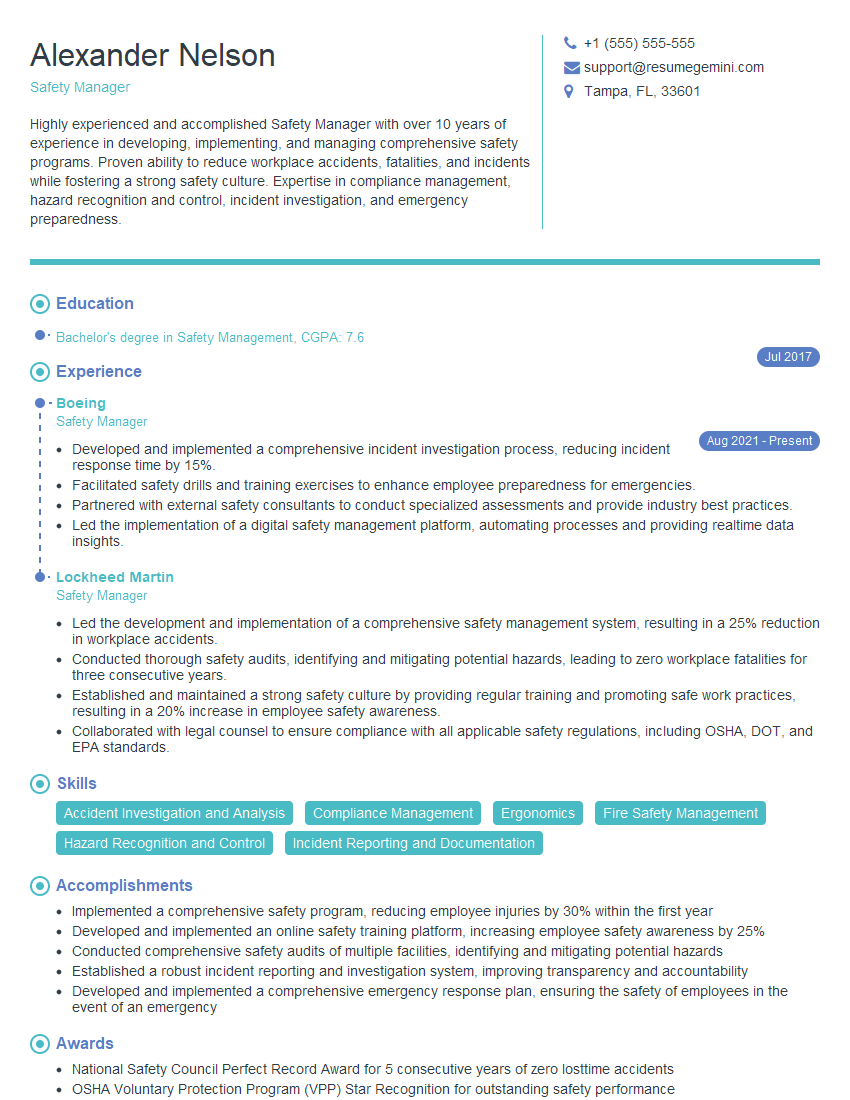
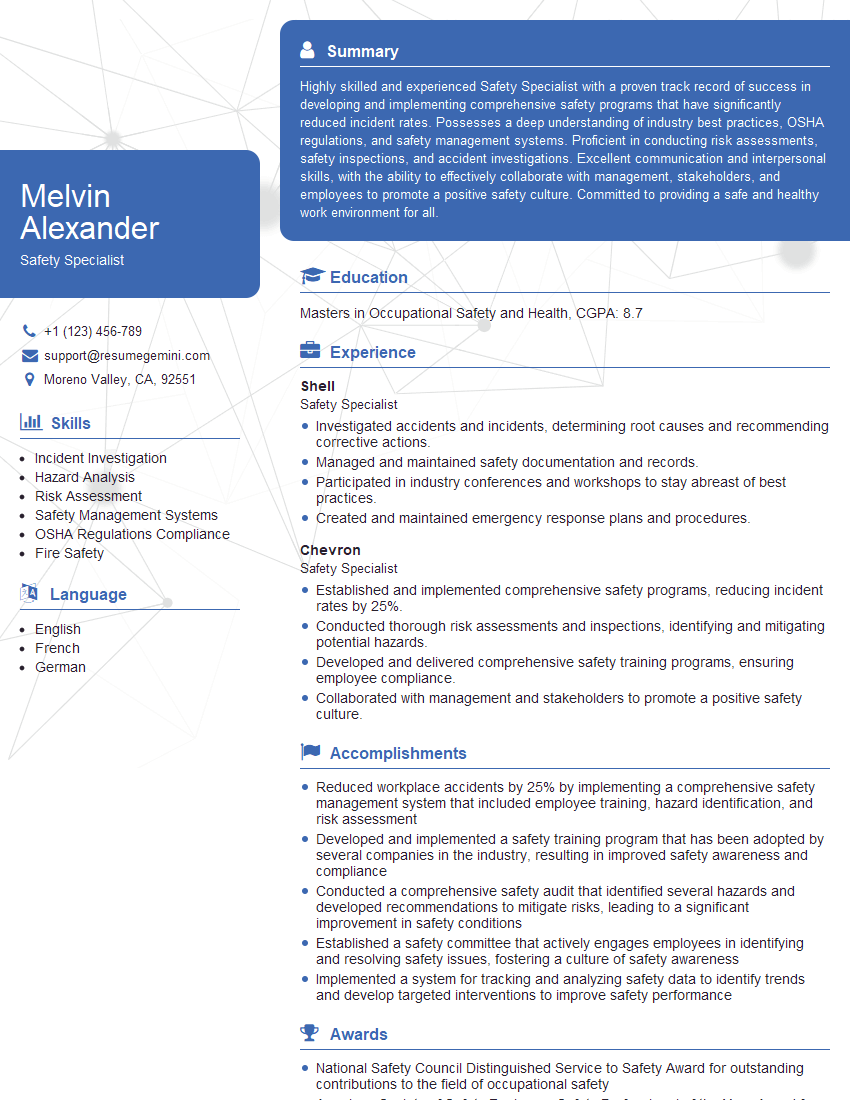
Mastering Software Safety is crucial for a rewarding and impactful career, opening doors to high-demand roles with significant responsibility. A strong resume is your key to unlocking these opportunities. Crafting an ATS-friendly resume, optimized to highlight your skills and experience in Software Safety, is essential for getting noticed by recruiters. We strongly encourage you to use ResumeGemini to build a professional and impactful resume. ResumeGemini provides you with the tools and resources to create a compelling document, and examples of resumes tailored to Software Safety are available to guide you. Invest time in refining your resume – it’s your first impression and a vital step in your career journey.
Explore more articles
Users Rating of Our Blogs
Share Your Experience
We value your feedback! Please rate our content and share your thoughts (optional).
What Readers Say About Our Blog
Very informative content, great job.
good