Interviews are more than just a Q&A session—they’re a chance to prove your worth. This blog dives into essential Solar Energy Systems interview questions and expert tips to help you align your answers with what hiring managers are looking for. Start preparing to shine!
Questions Asked in Solar Energy Systems Interview
Q 1. Explain the difference between monocrystalline, polycrystalline, and thin-film solar panels.
The main difference between monocrystalline, polycrystalline, and thin-film solar panels lies in their manufacturing process and resulting efficiency.
- Monocrystalline panels: These are made from a single, large silicon crystal, resulting in a uniform structure. Think of it like a perfectly clear diamond. This uniformity leads to higher efficiency (typically 18-22%), meaning they generate more power per unit area. They also tend to have a longer lifespan and a sleeker, all-black appearance. However, they are generally more expensive.
- Polycrystalline panels: These are made from multiple silicon crystals melted together. Imagine a mosaic of smaller crystal fragments. This process is less energy-intensive and therefore cheaper than monocrystalline production. Their efficiency is slightly lower (typically 15-17%) but still quite good. They have a slightly speckled blue appearance.
- Thin-film panels: These panels use a thin layer of photovoltaic material deposited on a substrate like glass or plastic. This makes them flexible and lightweight, allowing for more creative installation options (e.g., on curved roofs or integrated into building materials). However, their efficiency is generally lower (typically 8-13%), and they tend to have a shorter lifespan than crystalline panels.
The choice between these panel types depends on the specific project requirements, budget, and aesthetic preferences. For example, a homeowner prioritizing high efficiency might opt for monocrystalline panels despite the higher cost, whereas a large-scale solar farm might favour polycrystalline panels for their cost-effectiveness.
Q 2. Describe the process of designing a solar energy system for a residential building.
Designing a residential solar energy system involves a systematic approach. It’s like creating a personalized recipe for clean energy.
- Energy Audit: First, we assess the homeowner’s energy consumption patterns to determine their electricity needs. This involves analyzing past utility bills to understand their peak demand and overall usage.
- Site Assessment: This crucial step involves evaluating the roof’s orientation, shading (from trees, buildings, etc.), and structural integrity. We use specialized software and on-site measurements to determine the optimal panel placement and system size. We also consider the available space and any potential obstructions.
- System Design: Based on the energy audit and site assessment, we design a system that meets the homeowner’s energy needs. This includes choosing the appropriate number and type of solar panels, inverters, and other components. We create detailed schematics and ensure compliance with local building codes and safety regulations.
- Component Selection: This step focuses on selecting high-quality, reliable components from reputable manufacturers. We consider factors like panel efficiency, inverter performance, and warranty periods. A balanced approach considers both performance and longevity.
- Permitting and Installation: We obtain the necessary permits from the local authorities and then proceed with the professional installation of the system. This involves mounting the panels, wiring the system, and connecting it to the electrical grid. Rigorous quality checks are implemented at every step.
- Monitoring and Maintenance: Post-installation, we provide ongoing monitoring to ensure optimal system performance. Regular maintenance, including cleaning the panels, helps to maximize energy production and extend the system’s lifespan.
Throughout this process, clear communication with the homeowner is paramount. We explain each step, answer their questions, and manage expectations to ensure a smooth and successful project.
Q 3. What are the key components of a solar energy system?
A typical solar energy system comprises several key components, working together like a well-oiled machine.
- Solar Panels (Photovoltaic modules): These are the heart of the system, converting sunlight into direct current (DC) electricity.
- Inverter: This crucial component converts the DC electricity from the panels into alternating current (AC) electricity, which is what homes and businesses use.
- Mounting System: This secures the solar panels to the roof or ground, ensuring proper orientation and stability.
- Wiring and Conduits: These connect all the system components, safely transferring electricity from the panels to the inverter and then to the electrical panel.
- Electrical Panel and Meter: This is where the AC electricity enters the building’s electrical system and is metered for consumption tracking (possibly including net metering).
- Monitoring System (Optional): Many systems include a monitoring system to track energy production, system performance, and identify potential issues remotely. Think of it as a dashboard for your solar power plant.
- Batteries (Optional): Energy storage systems using batteries allow for storing excess solar energy produced during the day for use at night or during periods of low sunlight.
Q 4. How do you calculate the energy output of a solar panel?
Calculating a solar panel’s energy output isn’t just about looking at its wattage. It’s about understanding its performance under real-world conditions.
The basic formula is: Energy Output (kWh/day) = Panel Wattage (Wp) x Peak Sun Hours x Performance Ratio
- Panel Wattage (Wp): This is the rated power output of the solar panel under standard test conditions (STC), typically around 1000W/m². You’ll find this information on the panel’s specifications.
- Peak Sun Hours (PSH): This represents the average number of hours per day that the sun shines at its peak intensity. This value varies significantly based on location, time of year, and weather conditions. Data sources like the National Renewable Energy Laboratory (NREL) provide this information for specific locations.
- Performance Ratio (PR): This factor accounts for real-world losses, such as shading, temperature effects, soiling (dirt on the panels), and inverter efficiency. A typical PR value ranges from 0.7 to 0.8. A lower PR indicates higher losses.
Example: A 300Wp panel in a location with 5 PSH and a PR of 0.75 would produce approximately:
300 Wp x 5 PSH x 0.75 = 1125 Wh/day or 1.125 kWh/day
It’s important to note that this is an estimate. Actual energy output will vary based on numerous factors.
Q 5. What are the different types of inverters used in solar energy systems?
Inverters are crucial for converting the DC electricity from solar panels into usable AC electricity. Different types cater to various system needs.
- String Inverters: These are the most common and cost-effective type. They connect multiple panels in series (a string) and convert the combined DC output to AC. Simpler and often cheaper, but a single fault can impact the entire string.
- Microinverters: These are small inverters attached to each individual panel, converting DC to AC at the panel level. More expensive upfront, but offer superior performance and module-level monitoring, allowing for more efficient energy generation and easier troubleshooting.
- Power Optimizers: These devices sit between the panel and the string inverter, maximizing energy production from each panel independently. They are often used in conjunction with string inverters to improve overall system performance and address shading issues.
The choice depends on factors like system size, budget, and desired performance level. For large systems, string inverters may be economical, while microinverters offer advantages in terms of reliability and monitoring for smaller systems.
Q 6. Explain the concept of net metering.
Net metering is a billing mechanism that allows solar panel owners to sell excess electricity generated by their system back to the utility grid.
Imagine your solar panels are like a little power plant in your home. During the day, they produce more electricity than you consume. Instead of this excess energy going to waste, net metering allows you to feed it back into the grid. The utility company then credits your account for the amount of electricity you’ve supplied, effectively reducing your overall electricity bill. At night, or when your solar panels aren’t producing enough electricity, you draw power from the grid as usual. Your bill then reflects the net difference between the electricity you consumed and the electricity you generated. This is essentially a trade: you provide clean energy to the grid during peak production hours, and the grid provides power when your system isn’t generating enough.
Net metering policies vary between utilities and jurisdictions, so it’s crucial to understand the specific rules in your area before investing in a solar system.
Q 7. What are the common causes of solar panel degradation?
Solar panel degradation is the gradual decrease in their energy output over time. It’s a natural process, but several factors can accelerate it.
- Environmental Factors: Exposure to UV radiation, extreme temperatures, wind, and moisture can all contribute to degradation. Think of it like the sun’s harsh rays slowly fading a piece of fabric.
- Soiling: Dust, dirt, bird droppings, and other debris accumulating on the panel surface reduce their ability to absorb sunlight. Regular cleaning helps mitigate this effect.
- Potential Induced Degradation (PID): This is a more technical issue related to voltage differences within the panel, particularly common in humid environments. Proper grounding and panel design can minimize PID.
- Manufacturing Defects: Faulty cells or connections can lead to reduced performance. Reputable manufacturers and quality assurance processes help minimize this risk.
- Microcracks: These tiny cracks in the silicon cells can develop over time, reducing efficiency. Careful handling during installation and transportation helps prevent microcracks.
Regular inspections, cleaning, and high-quality components are crucial for minimizing degradation and maximizing the lifespan of your solar panel system. It’s like keeping your car well-maintained to extend its useful life.
Q 8. How do you troubleshoot a malfunctioning solar energy system?
Troubleshooting a malfunctioning solar energy system requires a systematic approach. Think of it like diagnosing a car problem – you need to isolate the issue step-by-step.
- Visual Inspection: Start with a thorough visual check of all components. Look for loose connections, damaged wires, cracked panels, or any obvious signs of physical damage. This often reveals the culprit quickly. For example, a bird might have nested in the array, causing a short circuit.
- Check the Inverter: The inverter converts the DC power from the panels into AC power for your home. Check its display for error codes or indicators. Many inverters provide diagnostic information that can pinpoint the problem. If the inverter is faulty, even a perfectly functioning array will not produce usable power.
- Measure Voltage and Current: Use a multimeter to measure the voltage and current at various points in the system. This helps identify where the power flow is interrupted. For instance, low voltage at the panels could indicate shading or a faulty panel, while low current might signal a problem with the wiring.
- Inspect the Wiring and Connections: Carefully examine all wiring for loose connections, corrosion, or damage. Loose connections are a frequent cause of malfunctions. Consider using thermal imaging cameras to detect hotspots indicating high resistance and potential fire hazards.
- Check the Battery Bank (if applicable): If your system includes a battery bank, inspect the battery levels and connections. Low voltage or damaged cells can significantly affect system performance. Regular battery maintenance is crucial for long-term reliability.
- Consult System Monitoring Data: Many modern solar systems have monitoring capabilities that provide real-time performance data. Analyzing this data can reveal patterns and anomalies that indicate problems. A sudden drop in energy production can be a clear sign of a malfunction.
- Professional Help: If you can’t identify the problem, it’s essential to call a qualified solar technician. Working with high-voltage DC electricity is dangerous; professional help is critical for safety and efficient repair.
Q 9. What are the safety precautions you take when working with solar panels?
Safety is paramount when working with solar panels. Remember, you’re dealing with high-voltage DC electricity, which can be lethal. Here are key precautions:
- Always Assume the System is Live: Never assume the system is switched off. Always treat it as if it’s energized.
- Lockout/Tagout Procedures: Before working on any part of the system, follow proper lockout/tagout procedures to ensure the power is completely isolated. This involves switching off the disconnects and physically locking them to prevent accidental re-energization.
- Personal Protective Equipment (PPE): Wear appropriate PPE, including insulated gloves, safety glasses, and sturdy footwear. Using appropriate tools and equipment is just as important as wearing PPE.
- Work with a Partner: Never work alone on a solar system, especially when dealing with high-voltage components. Have a spotter to assist and ensure your safety.
- Understanding Electrical Safety: You must have a thorough understanding of electrical safety practices before working on any solar power system. Formal training is recommended and often mandatory for qualified electricians.
- Proper Tools and Equipment: Use only insulated tools designed for working with high-voltage DC electricity. Never use ordinary tools as they might fail and result in electrocution.
- Follow Manufacturer’s Instructions: Always adhere to the manufacturer’s instructions for installation and maintenance. The manufacturers know their system best and the instructions will be tailored to that specific equipment.
Q 10. What is the difference between DC and AC power in solar systems?
Solar panels generate direct current (DC) electricity, while most household appliances and the grid operate on alternating current (AC). The difference lies in how the electrons flow.
- Direct Current (DC): Electrons flow in one direction. Think of it like water flowing consistently in a single pipe. This is the electricity generated directly by solar panels.
- Alternating Current (AC): Electrons change direction periodically. Imagine the water flowing back and forth in the pipe. This is the type of electricity used in our homes and transmitted over long distances.
In a solar energy system, the inverter plays a crucial role in converting the DC power generated by the solar panels into AC power that can be used by household appliances or fed into the grid. This conversion is necessary because the DC output of the solar panel is not directly compatible with the AC grid.
Q 11. Explain the concept of Maximum Power Point Tracking (MPPT).
Maximum Power Point Tracking (MPPT) is a crucial technology in solar energy systems. It ensures that the solar panels operate at their optimal power output, maximizing energy generation. Imagine a water pump; MPPT is like adjusting the pump to extract the maximum amount of water consistently.
Solar panels don’t produce a constant power output. Their performance varies depending on factors like sunlight intensity, temperature, and panel shading. MPPT algorithms constantly monitor the voltage and current of the panels and adjust the operating point to maintain the maximum power output. Different MPPT algorithms exist, with each employing different techniques for achieving this optimization. A Perturb and Observe MPPT algorithm is common, changing the operating point slightly to see if more power is generated.
Without MPPT, the solar panel may not produce its full potential, leading to energy losses. An MPPT controller is incorporated into many inverters or separate MPPT charge controllers to increase the efficiency of the energy harvesting process.
Q 12. What are the different types of solar trackers?
Solar trackers are systems designed to adjust the orientation of solar panels throughout the day, following the sun’s movement to maximize energy capture. Think of it as providing the panels with a continuous ‘sunbath’. There are several types:
- Single-Axis Trackers: These trackers rotate on a single axis, either east-west or north-south, depending on your geographic location. They follow the sun’s movement across the sky on one plane.
- Dual-Axis Trackers: These trackers rotate on two axes, allowing them to track the sun’s movement in both azimuth (east-west) and elevation (up-down) angles. These provide the greatest energy yield, but are significantly more complex and expensive.
- Passive Trackers: These do not use motors or electronics. They employ simpler mechanical designs such as reflective materials or specialized panel shapes to capture more solar energy. Their simplicity often compromises performance.
- Fixed-Tilt Systems: While not strictly trackers, it’s worth mentioning that fixed-tilt systems maintain a constant angle throughout the year. They are simple and cost-effective but provide lower energy generation than trackers.
The choice of tracker type depends on factors such as available budget, land constraints, and the desired energy yield. While dual-axis trackers provide the best performance, single-axis trackers offer a good balance between cost and efficiency.
Q 13. Describe the process of commissioning a solar energy system.
Commissioning a solar energy system involves a series of steps to verify that the system is installed correctly and is operating as designed. Think of it as the final quality control check before handing over the keys to the new owner.
- Visual Inspection: A thorough visual inspection of all components, ensuring correct installation and no visible damage.
- Wiring and Connections: Verification of all wiring connections, ensuring proper grounding and safety compliance.
- Electrical Tests: Performing various electrical tests, including voltage and current measurements, to confirm proper system functionality and absence of shorts or faults.
- Performance Testing: Measuring the system’s energy production under various conditions to confirm that it meets the design specifications. This often involves using specialized monitoring equipment.
- Safety Checks: Ensuring that all safety measures are in place, including proper grounding, isolation devices, and protective equipment.
- Documentation Review: Reviewing all relevant documentation, including installation manuals, test results, and inspection reports, to ensure compliance with all relevant standards and regulations.
- System Handoff: Providing the client with a comprehensive training session, operating manual, and maintenance schedule, equipping them to manage the system effectively.
A properly commissioned system ensures optimal performance, safety, and longevity. Thorough commissioning reduces the likelihood of future problems and ensures a satisfied client.
Q 14. How do you perform a site assessment for a solar energy project?
A site assessment for a solar energy project is crucial for determining the feasibility and optimal design of the system. It’s like laying the groundwork for a building before construction begins.
- Energy Consumption Analysis: Assessing the client’s energy usage patterns to determine the required system size. This typically involves reviewing past energy bills to understand the client’s electricity demands. This ensures the system is adequately sized.
- Shading Analysis: Identifying potential shading sources, such as trees, buildings, or other obstructions, that can reduce energy production. This often involves using specialized software or on-site surveys. This can be crucial, especially in urban environments.
- Roof Assessment: Evaluating the suitability of the roof for solar panel installation, considering factors like roof orientation, slope, structural integrity, and available space. This ensures structural integrity, load-bearing capacity, and enough area for the array.
- Sunlight Analysis: Determining the amount of sunlight available at the site throughout the year, using tools such as solar irradiance maps and sunlight simulation software. This provides the critical data for system design and performance prediction.
- Grid Connection Assessment: Evaluating the existing electrical grid infrastructure to determine the feasibility of grid-tied system integration. This ensures a seamless connection to the grid.
- Environmental Considerations: Assessing any potential environmental impacts, such as impacts on wildlife or sensitive ecosystems. This fulfills environmental regulations and respects the local environment.
- Regulatory Compliance: Determining the necessary permits and approvals required for the project, ensuring compliance with local building codes and regulations. This safeguards the legality and safety of the project.
A comprehensive site assessment is essential for designing a solar energy system that is both effective and safe.
Q 15. What are the different types of batteries used in solar energy storage systems?
Several battery types are used in solar energy storage, each with its own pros and cons. The choice depends on factors like cost, lifespan, energy density, and environmental impact.
- Lead-acid batteries: These are the most mature and cost-effective technology, but they have a shorter lifespan and lower energy density compared to other options. They’re often used in smaller off-grid systems or as backup power sources. Think of them as the trusty workhorse – reliable, but not the most high-tech.
- Lithium-ion batteries: These are becoming increasingly popular due to their higher energy density, longer lifespan, and faster charging capabilities. They are more expensive upfront but offer better long-term value. Different chemistries exist within lithium-ion, like LFP (Lithium Iron Phosphate), NMC (Nickel Manganese Cobalt), and NCA (Nickel Cobalt Aluminum), each with varying performance characteristics and safety profiles. They’re like the sports car of batteries – high performance, but with a higher price tag.
- Flow batteries: These are particularly suitable for large-scale energy storage, offering long lifespans and high power output. They separate the energy storage from the power delivery, allowing for independent scaling of capacity and power. Imagine them as the reliable freight train – capable of carrying huge loads over long distances.
- Other emerging technologies: Research is ongoing into other battery chemistries, including solid-state batteries, which promise even higher energy density and improved safety. These are the experimental prototypes – still developing but with the potential to revolutionize the field.
Selecting the right battery depends entirely on the specific application and budget. A detailed assessment of energy needs, lifecycle costs, and environmental considerations is crucial.
Career Expert Tips:
- Ace those interviews! Prepare effectively by reviewing the Top 50 Most Common Interview Questions on ResumeGemini.
- Navigate your job search with confidence! Explore a wide range of Career Tips on ResumeGemini. Learn about common challenges and recommendations to overcome them.
- Craft the perfect resume! Master the Art of Resume Writing with ResumeGemini’s guide. Showcase your unique qualifications and achievements effectively.
- Don’t miss out on holiday savings! Build your dream resume with ResumeGemini’s ATS optimized templates.
Q 16. Explain the concept of solar irradiance and its importance.
Solar irradiance refers to the amount of solar energy that reaches a particular surface area on Earth. It’s measured in watts per square meter (W/m²). This is crucial because it directly impacts the power output of a solar panel. Think of it like the intensity of a spotlight – the brighter the spotlight (higher irradiance), the more light (energy) it delivers.
Several factors affect solar irradiance, including time of day, season, weather conditions (cloud cover, atmospheric dust), and geographical location. Higher irradiance leads to increased solar panel output, whereas lower irradiance results in reduced energy production. For example, a solar panel in Arizona will typically receive much higher irradiance than one in Seattle, leading to significantly more electricity generation in Arizona.
Understanding solar irradiance is vital for accurate solar energy system design and sizing. It allows engineers to predict the system’s performance and ensure it meets the energy demands of the building or location. We use historical irradiance data, often obtained from meteorological stations or satellite measurements, to model expected energy production.
Q 17. What is the role of a charge controller in a solar energy system?
A charge controller is a crucial component in a solar energy system. Its main role is to regulate the flow of electricity from the solar panels to the batteries and/or the load (e.g., your home’s electrical system). Think of it as the traffic controller of your solar power system.
Without a charge controller, the voltage from the solar panels could exceed the battery’s capacity, potentially damaging or destroying the batteries. The charge controller prevents overcharging, over-discharging, and reverse current flow, thereby protecting both the batteries and the rest of the system.
There are two main types of charge controllers: Maximum Power Point Tracking (MPPT) and Pulse Width Modulation (PWM). MPPT controllers are more efficient as they constantly adjust to maximize the power drawn from the solar panels regardless of varying sunlight conditions. PWM controllers are simpler and less expensive but less efficient.
In a practical sense, a malfunctioning charge controller can lead to decreased battery lifespan, system failure, and even fire hazards. Regular maintenance and careful selection of a properly sized charge controller are essential for a reliable and long-lasting solar energy system.
Q 18. What are the environmental impacts of solar energy production?
While solar energy is a clean and renewable energy source, its production does have some environmental impacts, although generally far less significant than fossil fuels.
- Manufacturing: The manufacturing process of solar panels involves the use of energy and materials, some of which can be environmentally harmful if not responsibly managed. This includes the use of certain chemicals and the energy needed for production. The industry is actively working towards more sustainable manufacturing practices.
- Land use: Large-scale solar farms require significant land areas, potentially impacting ecosystems and habitats. Careful site selection and consideration of ecological impacts are crucial in mitigating this effect.
- Disposal: At the end of their lifespan (typically 25-30 years), solar panels need to be responsibly disposed of to prevent the leaching of harmful materials into the environment. Recycling infrastructure for solar panels is constantly improving.
- Transportation: The transportation of solar panels from manufacturing facilities to installation sites can also contribute to greenhouse gas emissions.
However, the overall environmental impact of solar energy production is considerably smaller than that of fossil fuels over the entire life cycle of a system. The benefits of reducing reliance on fossil fuels greatly outweigh these environmental concerns, and ongoing technological advancements continually improve the sustainability of solar energy production.
Q 19. Explain the difference between grid-tied and off-grid solar systems.
The key difference lies in their connection to the electrical grid:
- Grid-tied systems: These systems are connected to the utility grid. During the day, they generate power that is used directly in the home and any excess is fed back into the grid (net metering). At night, or when solar production is insufficient, the home draws power from the grid. They are generally less expensive to install but offer no power during grid outages.
- Off-grid systems: These systems operate independently of the utility grid. They use batteries to store energy generated during the day, providing power at night or during grid outages. They are more expensive upfront because of the battery storage component but offer energy independence and reliability during grid failures. Imagine a remote cabin in the mountains – off-grid is the only practical option.
The best choice depends on the location, energy needs, and budget. Grid-tied systems are common in areas with reliable grid infrastructure, while off-grid systems are necessary in remote locations or for applications requiring uninterrupted power supply.
Q 20. What is your experience with different solar energy financing models?
My experience encompasses several solar energy financing models:
- Cash purchase: This is the simplest option, where the customer pays the full cost upfront. It provides immediate ownership and avoids interest payments.
- Loans: These can be secured or unsecured and allow customers to finance the system over time. Different loan terms and interest rates are available.
- Leases and Power Purchase Agreements (PPAs): These are increasingly popular options, especially for residential customers. In a lease, you don’t own the system, but you pay a monthly fee to use the power it generates. With a PPA, you don’t own the system or pay for it upfront; instead, you pay for the energy produced. This avoids upfront costs but may result in higher long-term electricity expenses.
- Incentives and rebates: Government incentives, tax credits, and rebates can significantly reduce the cost of a solar energy system, making it more accessible to a wider range of customers. Navigating these incentives requires expertise to ensure clients maximize their financial benefits.
Choosing the right financing model requires a careful assessment of the customer’s financial situation, long-term goals, and risk tolerance. I guide clients through the options, explaining the advantages and disadvantages of each approach and helping them select the best fit for their specific needs.
Q 21. Describe the process of obtaining permits for a solar energy installation.
The process of obtaining permits for a solar energy installation varies by location but generally involves the following steps:
- Site assessment and design: A qualified solar installer conducts a site assessment to determine the optimal location for the panels, considering factors like shading, roof orientation, and structural integrity. Preliminary designs are prepared.
- Permit application: The installer prepares and submits a permit application to the relevant authorities, usually the local building department or planning commission. This typically includes the site plan, system specifications, and electrical design drawings.
- Review and approval: The authorities review the application to ensure compliance with building codes, zoning regulations, and safety standards. This process can take several weeks or even months depending on the jurisdiction’s workload and complexity of the project.
- Inspections: Once the installation is complete, inspections are conducted by the authorities to verify that the system meets the approved plans and safety regulations. Common inspections include electrical, structural, and fire inspections.
- Permit issuance: Upon successful completion of inspections, the final permit is issued, allowing the system to be connected to the grid (if applicable) and used.
Navigating the permit process requires a deep understanding of local regulations and effective communication with authorities. An experienced solar installer will handle this process, ensuring timely approvals and compliance with all necessary rules and regulations.
Q 22. What are the various methods of solar energy system monitoring?
Monitoring a solar energy system is crucial for optimizing performance and identifying potential issues. There are several methods, ranging from simple visual inspections to sophisticated data analytics platforms.
- Visual Inspection: A basic but essential method. Regularly checking for visible damage to panels, loose connections, or debris buildup is vital. This is often combined with checking inverter performance indicators.
- Data Loggers: These devices record key performance indicators (KPIs) like voltage, current, power output, and temperature. This data can be downloaded and analyzed to identify trends and anomalies.
- Remote Monitoring Systems: Many modern inverters are equipped with communication capabilities (e.g., Wi-Fi, cellular) allowing for remote monitoring via web portals or mobile apps. This provides real-time data and alerts for potential problems.
- SCADA Systems (Supervisory Control and Data Acquisition): For larger installations, SCADA systems provide centralized monitoring and control of multiple inverters and other system components. These systems allow for sophisticated data analysis and automated responses to system events.
- Power Meters: Measuring the energy produced by the system and consumed by the building provides critical data for assessing overall system efficiency and energy savings.
For example, a homeowner might use a remote monitoring app to see their daily energy generation and identify a sudden drop in production, prompting them to check for shading or a faulty panel. A large-scale solar farm would use a SCADA system for detailed monitoring and control of hundreds or thousands of individual units.
Q 23. Explain the concept of the solar resource assessment.
Solar resource assessment is the process of determining the amount of solar energy available at a specific location. This is crucial for designing and sizing a solar energy system that meets the energy needs while maximizing return on investment. It involves considering several factors:
- Solar Irradiance: This measures the amount of solar energy received per unit area. Data is typically obtained from meteorological databases, satellite imagery, or ground-based measurements. Higher irradiance means more potential energy generation.
- Climate Data: Temperature, cloud cover, and precipitation significantly affect solar energy production. Understanding the climate helps predict energy output throughout the year.
- Shading Analysis: Identifying potential shading from trees, buildings, or other obstacles is critical. Shading can significantly reduce energy production.
- Terrain Analysis: The topography of a site influences the angle of sunlight and the amount of solar radiation received. South-facing slopes in the Northern Hemisphere generally receive the most sun.
Think of it like planning a garden: you wouldn’t plant sun-loving flowers in the shade! Similarly, accurate solar resource assessment is essential for a successful solar energy project. We use specialized software to model these factors and determine optimal panel orientation and tilt angles.
Q 24. How do you calculate the payback period for a solar energy system?
The payback period is the time it takes for the cumulative savings from a solar energy system to equal its initial cost. Calculating it involves several steps:
- Determine the initial investment: This includes the cost of panels, inverters, installation, permits, and any other related expenses.
- Estimate annual energy production: Use the solar resource assessment and system design to project the amount of electricity the system will generate each year.
- Calculate annual energy savings: This depends on the electricity price and the amount of energy the system offsets from the grid.
- Calculate the simple payback period: Divide the initial investment by the annual energy savings. This provides a simplified estimate, ignoring factors like inflation and the system’s lifespan.
- Consider the discounted payback period (more accurate): This method accounts for the time value of money, factoring in inflation and the potential for future energy price increases. This calculation is more complex and often involves using financial modeling software.
Example: If a system costs $10,000 and saves $1,000 annually, the simple payback period is 10 years (10,000/1,000 = 10). However, a discounted payback period would likely be slightly longer.
Q 25. What software or tools are you familiar with for solar energy system design?
I am proficient in several software tools for solar energy system design, each with its strengths and weaknesses:
- PVsyst: A comprehensive simulation software widely used for detailed system design, performance analysis, and yield estimations. It allows for detailed modeling of various system components and environmental factors.
- Helioscope: A user-friendly software for rapid system design and shading analysis. Its strength lies in its intuitive interface and quick generation of system layouts and performance reports.
- Autodesk AutoCAD: While not specifically solar-focused, AutoCAD is crucial for creating detailed drawings and schematics of the system’s layout and installation details.
- SketchUp: Another powerful 3D modeling tool useful for creating visual representations of the solar array and its integration with the building.
The choice of software depends on the project’s complexity and the required level of detail. For instance, PVsyst is more suitable for larger, complex projects needing precise performance analysis, while Helioscope is excellent for quicker designs and preliminary assessments.
Q 26. Describe your experience with different types of solar mounting systems.
I have extensive experience with various solar mounting systems, each suited to specific applications and roof types:
- Roof-mounted systems: These are the most common, utilizing various methods such as racking systems for pitched roofs or ballast systems for flat roofs. The choice depends on factors like roof material, structural integrity, and building codes.
- Ground-mounted systems: Used for larger installations, these systems utilize ground-mounted racks or poles to support the solar panels. They require sufficient land area and proper grounding.
- Carport-mounted systems: These provide shade and shelter while generating solar power. They are often aesthetically pleasing and can integrate well with parking areas.
- Wall-mounted systems: These systems are installed on building walls, usually facing south (in the Northern Hemisphere) for optimal sunlight exposure. They must adhere to building codes and structural requirements.
For example, a residential installation on a pitched tile roof might use a rail-less racking system, while a large commercial installation on a flat roof might opt for a ballast system or ground mounts. Choosing the right system is crucial for safety, efficiency, and longevity. Each installation needs a thorough structural analysis to ensure compatibility and compliance.
Q 27. What are the challenges in integrating solar energy into existing grids?
Integrating solar energy into existing grids presents several challenges:
- Grid Stability: The intermittent nature of solar energy can cause voltage fluctuations and frequency imbalances on the grid. Sophisticated grid management systems are needed to mitigate these effects.
- Grid Capacity: Existing grids may lack the capacity to handle the influx of solar power, requiring upgrades or expansions. This can lead to delays and increased costs.
- Safety Regulations: Strict safety standards and regulations govern grid connection, requiring rigorous testing and compliance procedures.
- Reverse Power Flow: When solar energy production exceeds local demand, power flows back into the grid, requiring appropriate metering and protection systems to prevent backfeeding and safety hazards.
- Net Metering Policies: Regulations surrounding net metering – the process of crediting excess solar energy fed into the grid – vary widely and can influence the economic viability of solar installations.
Addressing these challenges requires collaboration among various stakeholders, including utility companies, system integrators, and regulators. Technological advancements, such as smart inverters with grid-forming capabilities and advanced grid management software, are crucial in ensuring seamless integration.
Q 28. What are your strategies for maintaining and repairing solar panels?
Maintaining and repairing solar panels involves proactive measures and responsive actions when issues arise.
- Regular Visual Inspections: At least twice a year, inspect panels for visible damage such as cracks, discoloration, or debris buildup. Clean the panels regularly, especially in dusty or snowy environments.
- Performance Monitoring: Regularly check system performance data to identify anomalies in energy production. A significant drop in power output may indicate a problem with individual panels or other system components.
- Leak Detection: Check for signs of water ingress, which can cause significant damage. Pay close attention to panel frames, seals, and wiring connections.
- Professional Cleaning: Depending on the environment, professional cleaning may be necessary to remove stubborn dirt, bird droppings, or other contaminants.
- Panel Replacement: Faulty panels should be promptly replaced with certified replacements to maintain optimal system performance.
- Inverter Maintenance: Inverters are key components and require regular maintenance and checks. This often includes cleaning and checking for proper ventilation.
Proactive maintenance significantly extends the lifespan of a solar panel system and reduces the risk of costly repairs. Regular cleaning and visual inspections are simple yet effective measures to ensure optimal system performance and long-term energy savings.
Key Topics to Learn for Your Solar Energy Systems Interview
- Photovoltaic (PV) Technology: Understand the principles of solar cell operation, including the photovoltaic effect, different cell types (monocrystalline, polycrystalline, thin-film), and efficiency considerations. Explore the impact of various materials and manufacturing processes.
- Solar Energy System Design: Learn about system sizing, component selection (panels, inverters, batteries, racking), and system architecture (grid-tied, off-grid, hybrid). Practice calculating energy production based on solar irradiance, panel specifications, and system losses.
- Energy Storage: Gain a working knowledge of battery technologies (lead-acid, lithium-ion, etc.), their applications in solar systems, and their impact on system performance and cost. Understand the principles of battery management systems (BMS).
- System Installation and Maintenance: Familiarize yourself with safe installation practices, troubleshooting common issues, and preventative maintenance procedures. This includes understanding relevant safety regulations and codes.
- Grid Integration and Net Metering: Understand how solar systems interact with the electrical grid, including net metering policies and their impact on energy costs. Explore different grid interconnection requirements and procedures.
- Economic Analysis and Financial Modeling: Learn to assess the financial viability of solar projects, including calculating return on investment (ROI), payback periods, and levelized cost of energy (LCOE). Understand different financing options for solar installations.
- Environmental Impact and Sustainability: Discuss the environmental benefits of solar energy, its role in reducing carbon emissions, and the lifecycle assessment of solar PV systems.
- Emerging Technologies: Stay abreast of advancements in solar technology, such as perovskite solar cells, concentrated solar power (CSP), and advancements in energy storage solutions.
Next Steps
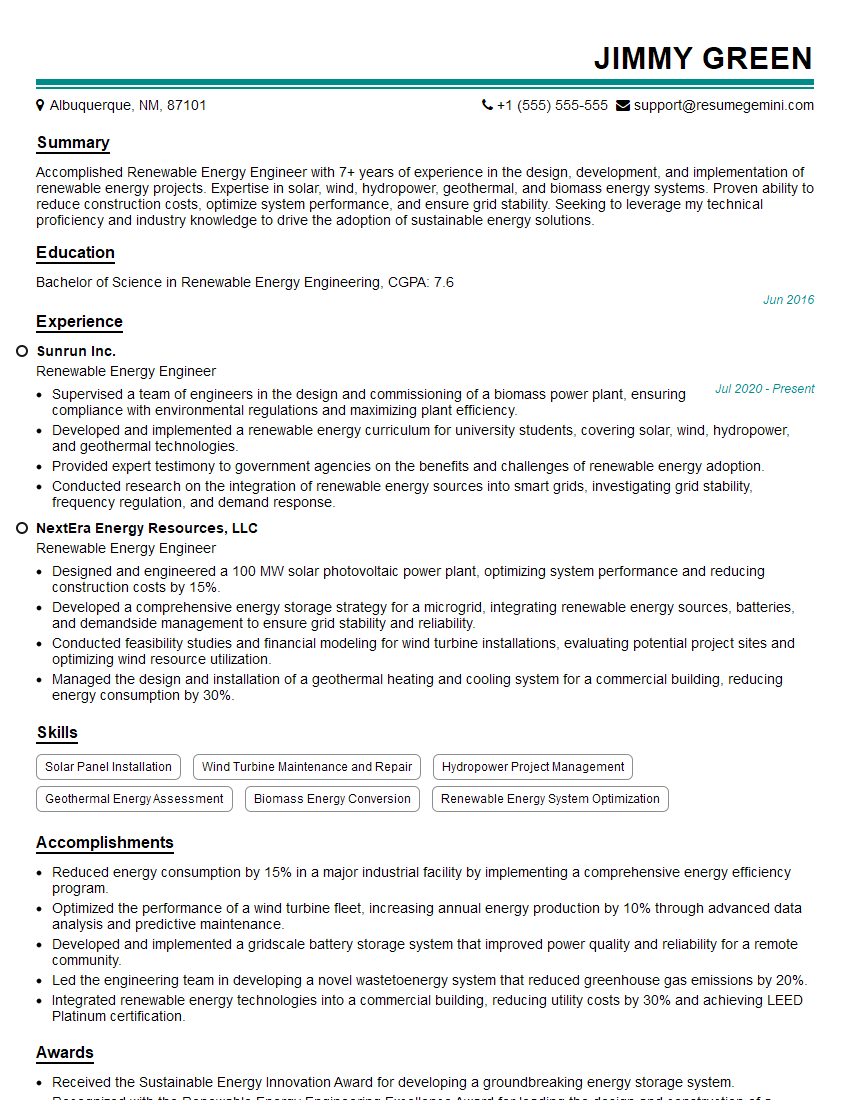
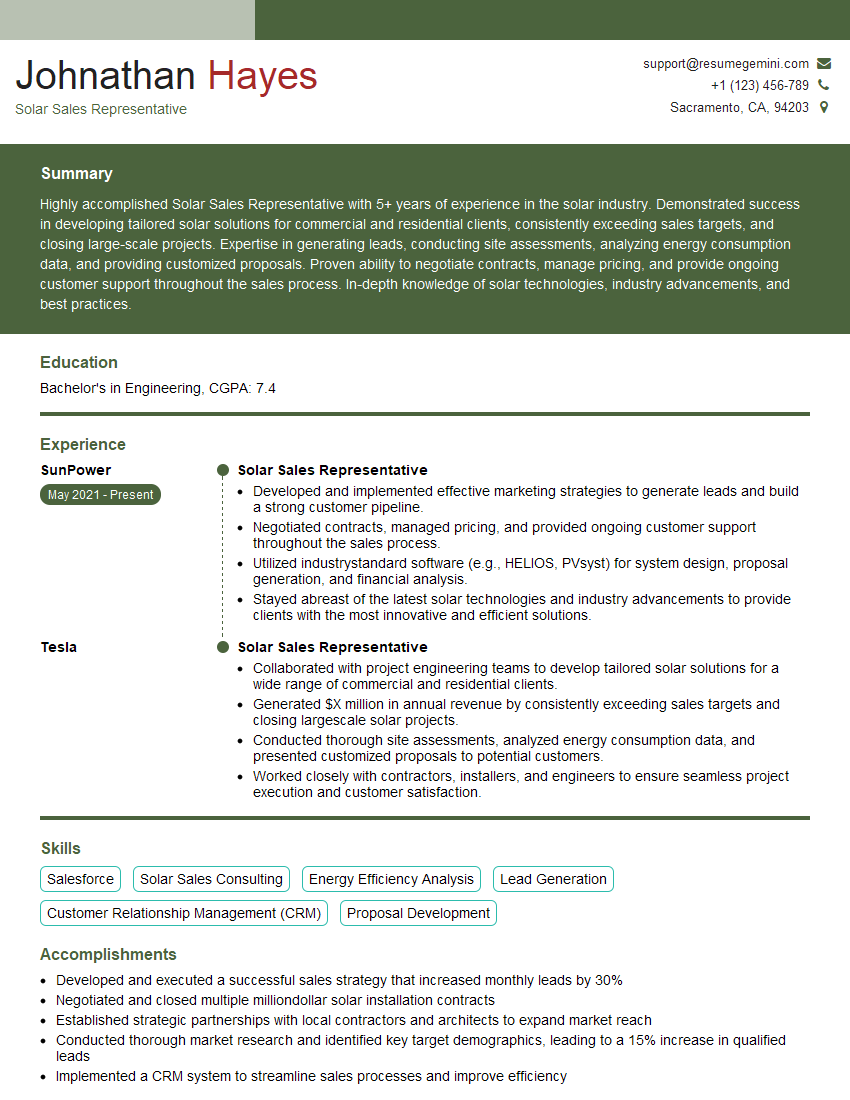
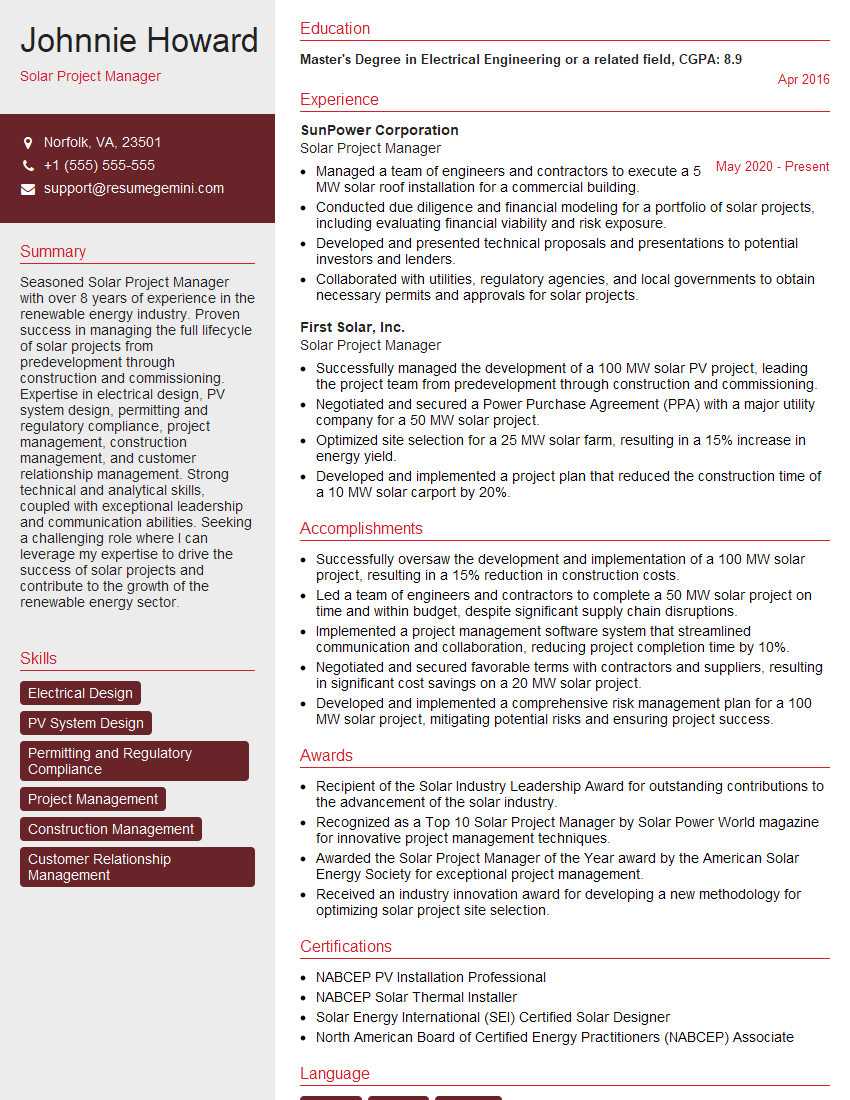
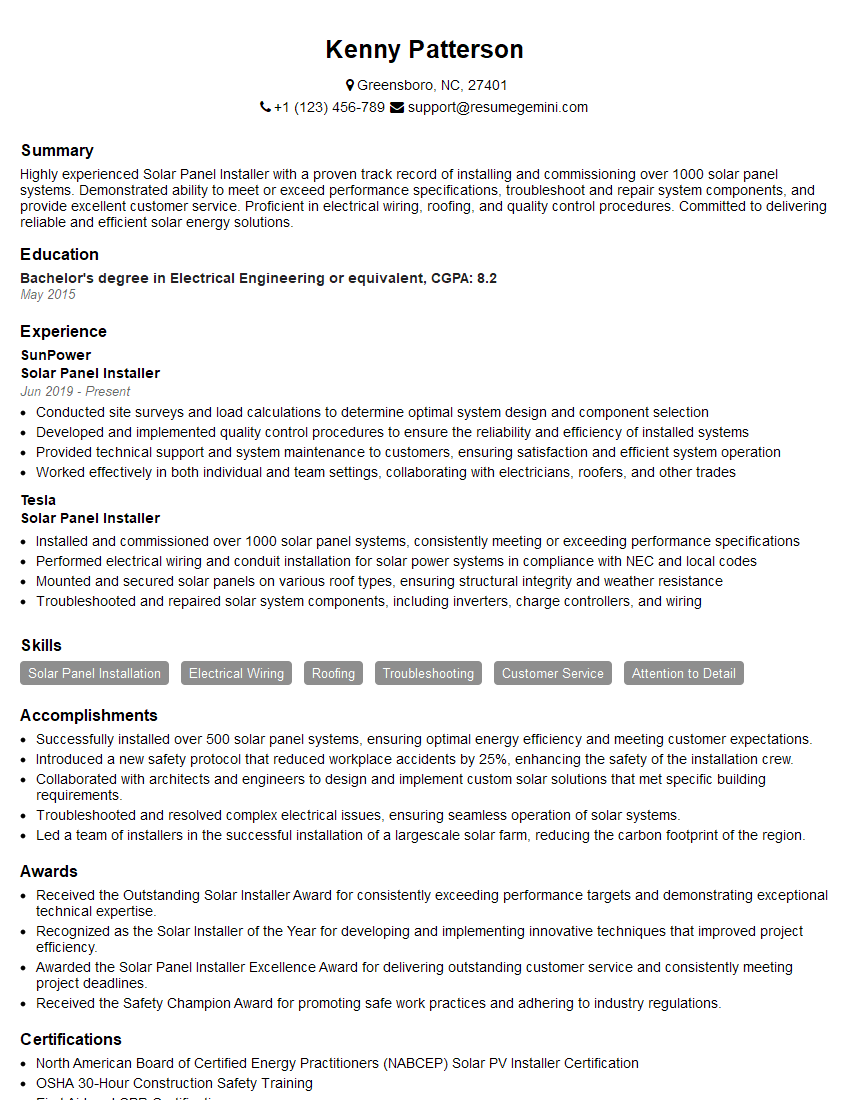
Mastering these aspects of solar energy systems will significantly boost your career prospects in this rapidly growing field. A strong understanding of these concepts demonstrates technical expertise and problem-solving skills highly sought after by employers. To further enhance your job search, create an ATS-friendly resume that highlights your relevant skills and experience. ResumeGemini is a trusted resource to help you build a professional and impactful resume. They offer examples of resumes tailored to the Solar Energy Systems industry, ensuring your qualifications shine through to potential employers.


Explore more articles
Users Rating of Our Blogs
Share Your Experience
We value your feedback! Please rate our content and share your thoughts (optional).
What Readers Say About Our Blog
Very informative content, great job.
good