Preparation is the key to success in any interview. In this post, we’ll explore crucial Free-Diving interview questions and equip you with strategies to craft impactful answers. Whether you’re a beginner or a pro, these tips will elevate your preparation.
Questions Asked in Free-Diving Interview
Q 1. Explain the physiological effects of breath-hold diving.
Breath-hold diving profoundly impacts the body. As you descend, the increasing pressure compresses your lungs, reducing their volume. This can lead to feelings of pressure in the chest and ears. Your body initiates a series of physiological adaptations to conserve oxygen. Your heart rate slows (bradycardia), blood flow is shunted away from extremities and towards vital organs like the brain and heart, and your spleen releases stored red blood cells increasing oxygen-carrying capacity. These are all beneficial in extending your dive time but can also be dangerous if pushed too far. The build-up of carbon dioxide also becomes a significant factor in determining the limit of your dive, leading to feelings of urgency to surface long before oxygen depletion actually becomes critical. After surfacing, the body needs time to re-oxygenate and recover.
Q 2. Describe the mammalian diving reflex and its importance in freediving.
The mammalian diving reflex is an instinctive physiological response triggered by the face contacting cold water. It’s a crucial survival mechanism for aquatic mammals and plays a vital role in freediving. The reflex slows your heart rate significantly (bradycardia), constricts peripheral blood vessels (vasoconstriction), and shunts blood flow to the brain and heart. This prioritizes oxygen delivery to critical organs, extending the time you can remain submerged. Think of it as your body’s built-in survival kit for underwater adventures. For freedivers, understanding this reflex helps them appreciate the body’s natural capabilities and limits, making them safer and more efficient divers. The colder the water, the stronger the reflex – making cold-water freediving potentially more challenging and requiring more meticulous planning and execution.
Q 3. What are the different types of freediving disciplines?
Freediving encompasses several disciplines, each demanding specific skills and techniques.
- Constant Weight (CWT): Divers descend and ascend using only their body’s power, typically using fins.
- Free Immersion (FIM): Divers use a rope to pull themselves down and up. This technique allows for deeper dives than CWT.
- No Limits (NLT): Divers use a sled to descend rapidly, using a tow line for ascent. This is the deepest discipline, but also the most dangerous.
- Dynamic No Fins (DNF): Divers swim horizontally underwater, without the use of fins. This focuses on horizontal distance covered.
- Dynamic With Fins (DYN): Similar to DNF, but divers use fins, maximizing distance covered.
- Static Apnea (STA): Divers remain completely stationary underwater, focusing on holding their breath for the longest possible time while submerged.
Q 4. What are the safety procedures for freediving?
Safety is paramount in freediving. Never freedive alone; always dive with a buddy who is trained in freediving rescue techniques and carries appropriate safety equipment. This includes a safety buoy, a dive flag, and a properly maintained dive line with a clear marking system. Before any dive, there should be a thorough pre-dive check to ensure everyone is ready. Divers should always maintain awareness of their body’s signals and surface immediately at the first sign of discomfort or difficulty. Regular training and practice with experienced instructors build awareness and confidence and are crucial for enhancing skills and reducing risk.
Q 5. How do you identify and respond to signs of freediving emergencies?
Recognizing and responding to freediving emergencies requires vigilance and quick action. Signs of distress include uncontrolled struggling, loss of consciousness, blackouts (passing out), and uncontrolled swimming movements. A freediver who fails to surface within a reasonable time after their planned dive should be immediately investigated. If a diver is unresponsive, initiating rescue breathing and CPR are crucial while summoning emergency medical services. Early recognition and swift response are vital to increase the chances of survival. Training in CPR and rescue techniques is mandatory for all serious freedivers.
Q 6. Explain the equalization techniques used in freediving.
Equalization is the process of equalizing the pressure in your ears and sinuses with the surrounding water pressure as you descend. Failure to equalize can result in serious injury, including ruptured eardrums. Common techniques include:
- Frenzel Maneuver: This involves closing your mouth, pinching your nose, and creating pressure in your sinuses by swallowing or pushing air from your throat into your ears.
- Valsalva Maneuver: This involves closing your mouth, pinching your nose, and forcefully exhaling against a closed airway, pushing air into your ears.
- Toynbee Maneuver: Swallowing while holding your nose closed.
- Lowry Maneuver: A combination of Frenzel and Valsalva.
Q 7. Describe the risks associated with freediving and how to mitigate them.
Freediving carries inherent risks, including shallow water blackout (SWB), which occurs when a diver loses consciousness near the surface due to insufficient oxygen. Other dangers include lung squeeze, nitrogen narcosis (at depth), and barotrauma. Mitigation strategies involve: proper training from qualified instructors, adherence to strict safety procedures, gradual progression in depth and dive time, understanding and respect for individual limits, diving with a buddy, and using appropriate safety equipment. Thorough pre-dive checks, excellent physical health, and careful planning are also vital factors in reducing risk. Always err on the side of caution, never pushing your limits beyond your training and experience.
Q 8. What are the different types of freediving equipment and their functions?
Freediving equipment is crucial for safety and performance. While minimal gear is needed for shallow dives, deeper dives require more specialized equipment. Here’s a breakdown:
- Mask: A low-volume mask minimizes air space, reducing the effort required for equalization (clearing your ears). A good seal is paramount.
- Snorkel: Allows for easy breathing at the surface before and after a dive. A comfortable mouthpiece and a good purge valve are essential.
- Fins: Provide propulsion underwater. Different fin types (e.g., bi-fins, monofins) cater to various diving styles and preferences. The right fin length is vital for efficiency and comfort.
- Wetsuit/Drysuit: Provides thermal protection, especially important in colder waters. A well-fitting suit is critical for preventing discomfort and maximizing buoyancy control.
- Weight Belt: Adds weight to counteract buoyancy from the wetsuit and create neutral buoyancy at depth. Proper weight distribution is crucial for safety and efficient diving.
- Dive Computer: Tracks depth, dive time, and ascent rate. It’s invaluable for monitoring safety parameters, especially in deeper dives.
- Dive Float (Surface marker buoy): A surface marker helps to signal your location to surface support and to mark your entry and exit points.
- Dive Gloves and Hood: Offer extra thermal protection and are essential in cold water.
For example, in a cold-water freedive, a 7mm wetsuit, a hood, and gloves become essential to maintain body temperature. Similarly, a dive computer is a must for safety when attempting deeper dives, ensuring you avoid rapid ascents or stay within safe no-decompression limits.
Q 9. How do you maintain proper buoyancy control during a freedive?
Maintaining proper buoyancy control is crucial for efficient and safe freediving. This involves managing your lung volume and using your body position to achieve neutral buoyancy (neither sinking nor floating).
Before the dive, you need to adjust your weight belt to achieve near-neutral buoyancy at the surface with full lungs. As you descend, the increasing water pressure compresses your lungs, making you more negatively buoyant. You can manage this by slightly exhaling during your descent, but you shouldn’t completely empty your lungs. On the ascent, the opposite happens; your lungs expand, making you more buoyant. A controlled, slow ascent is vital. Your body position also plays a role; streamlining your body and minimizing drag helps maintain control.
Imagine a hot air balloon; as you descend, some hot air escapes, similarly, controlled exhalation maintains buoyancy. As the balloon ascends, it expands, so controlled ascent is vital to prevent over-expansion of the lungs.
Practice is key! Regular training in a controlled environment will help you master buoyancy control, becoming almost second nature.
Q 10. Explain the importance of proper training and certification in freediving.
Proper training and certification are absolutely non-negotiable in freediving. It’s not just about learning to hold your breath; it’s about learning life-saving skills and developing safe diving practices.
A reputable freediving course will teach you:
- Equalization techniques: To safely manage pressure changes in your ears and sinuses during descent and ascent.
- Breath-hold techniques: Efficient breathing patterns to maximize oxygen uptake and minimize oxygen consumption.
- Safety procedures: Recognizing and responding to potential emergencies, both for yourself and your dive buddy.
- Rescue techniques: Performing effective rescues in various situations.
- Understanding of physiology: Learning the effects of depth and pressure on your body.
Certification provides a recognized standard of competence, demonstrating your understanding of safety procedures and your ability to dive responsibly. It also shows you’ve received proper instruction and reduces the risk of accidents. Think of it like a driver’s license – you wouldn’t drive a car without one.
Q 11. How do you plan a safe freediving dive?
Planning a safe freedive involves careful consideration of various factors. Here’s a step-by-step approach:
- Check weather conditions: Avoid diving in stormy or rough seas.
- Assess the dive site: Choose a location with good visibility, easy access, and no significant hazards.
- Dive with a buddy: Never freedive alone; a buddy can provide assistance in case of an emergency.
- Plan your dive profile: Determine your target depth and duration, keeping within your limits. Start conservatively and gradually increase depth and duration as your skills develop. Don’t push yourself beyond your limits.
- Prepare your equipment: Ensure your gear is in good condition and fits properly. Check your weight belt for appropriate weighting.
- Follow safety protocols: Implement safety stops at appropriate depths. Ensure you stay within no-decompression limits to avoid decompression sickness.
- Communicate clearly: Maintain clear communication with your dive buddy throughout the dive.
- Monitor your dive computer: Stay within safe limits and pay close attention to your depth, dive time, and ascent rate.
Remember, a well-planned dive dramatically reduces risk. Always prioritize safety over pushing personal limits.
Q 12. What are the signs and symptoms of nitrogen narcosis?
Nitrogen narcosis, sometimes called ‘rapture of the deep,’ is a reversible altered state of consciousness that can occur during deep dives due to the effects of increased nitrogen pressure on the nervous system. Symptoms can vary, but generally include:
- Euphoria or altered mood: Feeling overly happy, relaxed, or even giddy.
- Impaired judgment and decision-making: Making poor choices or losing awareness of risk.
- Confusion and disorientation: Difficulty thinking clearly or understanding your surroundings.
- Hallucinations: In severe cases, experiencing visual or auditory hallucinations.
- Loss of fine motor control: Difficulty manipulating equipment or performing tasks.
The best way to avoid nitrogen narcosis is to avoid diving to depths where it’s likely to occur. Proper training and understanding of your personal limits are crucial.
Q 13. What are the signs and symptoms of decompression sickness?
Decompression sickness (DCS), also known as the bends, occurs when nitrogen bubbles form in the blood and tissues after a dive, due to a rapid ascent. Symptoms can manifest immediately or several hours after a dive and range from mild to severe. These may include:
- Joint pain: Pain in the joints, often described as a deep ache.
- Fatigue and weakness: Feeling unusually tired or weak.
- Skin rash (the ‘cutis marmorata’): A mottled or marbled appearance of the skin.
- Neurological symptoms: Numbness, tingling, paralysis, or changes in vision or hearing in severe cases.
- Breathing difficulties: Shortness of breath or chest pain.
DCS is a serious condition requiring immediate medical attention. Slow, controlled ascents, proper dive planning, and adhering to no-decompression limits are crucial in prevention. If DCS is suspected, immediately seek hyperbaric oxygen therapy.
Q 14. How do you perform a proper rescue in freediving?
Freediving rescues require swift and efficient action. The most important aspect is to prioritize a safe approach and to assess the situation quickly. This includes:
- Assess the situation: Determine the nature of the emergency and the location of the diver.
- Approach the diver: Swim to the diver calmly and carefully, maintaining awareness of potential hazards.
- Provide assistance: If the diver is conscious, assist them to the surface and ensure they’re breathing normally. If unconscious, support the diver’s head, begin rescue breathing, and tow them to the surface.
- Check for breathing and pulse: Begin CPR if necessary and call for emergency medical services.
- Get the diver out of the water and onto stable ground: Keep them warm and comfortable.
- Keep the diver still and don’t move them unless it is essential for their immediate safety: Monitor their vital signs until help arrives.
Training is vital, including learning various rescue techniques in different scenarios. A rescue scenario can change quickly, so proper training will prepare you for such events. Remember that safety and proper training are vital in a freediving environment.
Q 15. What are the best practices for safe freediving buddy systems?
A safe freediving buddy system is paramount. It’s not just about having someone there; it’s about a proactive, coordinated approach to managing risk. The best systems involve pre-dive planning, constant visual contact and communication, and a clear understanding of roles and responsibilities.
- Pre-dive briefing: Discuss the dive plan, including depth, duration, and any potential hazards. Agree on hand signals for communication underwater.
- Continuous observation: The buddy should maintain constant visual contact with the diver, observing for any signs of distress such as unusual movements or prolonged surface intervals.
- Clear roles: One diver acts as the primary diver, while the other acts as the safety diver. This ensures there’s someone focused solely on the safety of the primary diver. The roles might switch between dives.
- Emergency response: The buddy must know how to respond to an emergency, such as assisting with a rescue or summoning help.
- Post-dive debrief: Following each dive, discuss what worked well, any challenges encountered, and whether any adjustments to the plan are needed for subsequent dives.
For example, imagine one diver signalling they need to ascend quickly. The buddy needs to immediately react, providing assistance if necessary. Effective communication prevents accidents.
Career Expert Tips:
- Ace those interviews! Prepare effectively by reviewing the Top 50 Most Common Interview Questions on ResumeGemini.
- Navigate your job search with confidence! Explore a wide range of Career Tips on ResumeGemini. Learn about common challenges and recommendations to overcome them.
- Craft the perfect resume! Master the Art of Resume Writing with ResumeGemini’s guide. Showcase your unique qualifications and achievements effectively.
- Don’t miss out on holiday savings! Build your dream resume with ResumeGemini’s ATS optimized templates.
Q 16. Describe your experience with different freediving techniques.
My freediving experience encompasses various techniques, each suited to different goals and environments. I’ve practiced static apnea (holding your breath motionless), dynamic apnea (swimming horizontally underwater), and free immersion (using a rope to ascend and descend). I’ve also explored constant weight (using fins and descending/ascending unassisted) and free falling (vertical freefall).
Static apnea hones breath-holding capacity and mental focus. Dynamic apnea is about efficient body positioning and propulsion. Free immersion is excellent for deep dives. Constant weight provides a blend of strength and technique, while free-falling emphasizes streamlining and speed. The choice of technique depends heavily on personal preference, training goals, and the environment. Each requires careful attention to safety and proper training.
Q 17. Explain your understanding of freediving depth limits and personal limitations.
Understanding depth limits and personal limitations is crucial. There’s no universal depth limit; it’s highly individual and depends on factors like training, experience, and physical condition. Ignoring personal limitations is extremely dangerous.
Depth limits are dictated by several factors including: physiological tolerances (how long you can hold your breath, manage pressure changes), and equipment capability. It’s also essential to consider the environment’s complexities such as water temperature, currents, and visibility, alongside your comfort and confidence levels. Pushing yourself beyond your limits leads to serious consequences.
I always adhere to a conservative approach, starting with shallower dives and gradually increasing depth only after mastering the techniques and feeling comfortable at each level. Regular self-assessment is key. Paying attention to your body’s signals, such as increasing heart rate or discomfort, is critical and is as much about mental as physical preparedness.
Q 18. How do you handle unexpected situations during a freedive?
Handling unexpected situations demands quick thinking and calm decision-making. My training emphasizes proactive risk management, but unexpected events can still occur. The first step involves remaining calm and assessing the situation.
Examples include equipment malfunction or encountering strong currents. If equipment fails, I immediately prioritize a controlled ascent, signaling my buddy for assistance. With a current, I adjust my dive plan, possibly aborting the dive altogether or seeking a safer route. Knowing how to perform emergency ascents, such as the safety stop, is essential to prevent decompression sickness. Always having a reliable buddy ensures extra safety in difficult situations. I regularly practice emergency ascent scenarios in training, which greatly improves the ability to react calmly and efficiently under pressure.
Q 19. What is your experience with freediving equipment maintenance?
Proper equipment maintenance is vital for safety and performance. I meticulously inspect my mask, snorkel, fins, wetsuit, and weight belt before every dive. This involves checking for any tears, leaks, or damage. Regular rinsing with fresh water after each dive prevents salt buildup and extends equipment lifespan. I regularly service my equipment (such as regulators if I use one in deeper dives), including replacing worn parts as needed. I keep detailed records of maintenance tasks to ensure everything remains in top condition. Neglected maintenance increases the risk of equipment failure during a dive, which can have serious consequences.
Q 20. Describe your understanding of freediving physiology and its relation to depth.
Freediving physiology is intimately linked to depth. As you descend, increasing water pressure affects your body. This pressure impacts your lungs, sinuses, and middle ear. Equalization techniques (like the Frenzel maneuver) are essential to maintain equal pressure within and outside these air spaces. At greater depths, oxygen consumption increases, and the risk of shallow water blackout (SWB) due to lack of oxygen rises.
Understanding these physiological changes allows me to adjust my dive plans accordingly. I know that my breath-hold capacity decreases with depth, so I limit my dive times at greater depths. I also understand the importance of slow, controlled ascents to avoid decompression sickness. The combination of physical conditioning and a thorough understanding of freediving physiology reduces the risks associated with increasing depth.
Q 21. What are your personal safety protocols before, during, and after freediving?
My personal safety protocols are rigorous and encompass all phases of freediving.
- Before the dive: I thoroughly check my equipment, review my dive plan with my buddy, and assess environmental conditions. I ensure I’m well-hydrated, rested, and have eaten a light meal. I avoid alcohol or any substances that could impair my judgment or performance.
- During the dive: I maintain constant awareness of my body’s signals, follow my dive plan meticulously, and communicate clearly with my buddy. I utilize proper equalization techniques and perform safety stops.
- After the dive: I carefully review the dive, noting any issues that need addressing. I rinse my equipment thoroughly and ensure I rehydrate and rest properly. I don’t engage in strenuous activity immediately after a deep dive.
These protocols are not merely checklists; they’re deeply ingrained habits that help me manage risks effectively and responsibly.
Q 22. How do you assess environmental conditions before embarking on a freedive?
Assessing environmental conditions before a freedive is paramount to safety. It’s not just about checking the weather; it’s a holistic evaluation. I consider several key factors:
- Water Conditions: This includes water temperature (hypothermia is a serious risk), visibility (affects navigation and comfort), currents (strong currents can be incredibly dangerous), and the presence of any hazards like debris or marine life.
- Weather Conditions: I check the forecast for wind, rain, and waves. Strong winds can create rough surface conditions, making entry and exit difficult, and impacting visibility. Waves can cause disorientation underwater.
- Location Specifics: I familiarize myself with the dive site, noting potential dangers like strong underwater currents, uneven seabed, or the presence of dangerous marine life. I also consider access points and emergency procedures. For example, a remote location necessitates a more thorough pre-dive risk assessment.
- Personal Factors: My own physical and mental state plays a crucial role. Am I well-rested? Have I properly hydrated and eaten? Am I feeling any stress or anxiety that could impair my judgment? If not, I postpone the dive.
For instance, during a recent dive planned in a new location, I discovered a strong, unexpected thermocline (a rapid change in water temperature). This would have affected my comfort and could have increased the risk of hypothermia, so I adjusted the depth and duration of the dive to mitigate this risk. A thorough pre-dive assessment prevents potentially dangerous situations.
Q 23. What are your strengths and weaknesses as a freediver?
My strengths as a freediver lie in my breath-hold technique, mental discipline, and calm demeanor under pressure. Years of training have honed my ability to relax and focus during dives, even in challenging conditions. I also excel in assessing risk and managing safety procedures. I’m adept at efficient finning techniques, conserving energy and maximizing my dive time.
My weaknesses, however, include occasionally being too focused on pushing my limits, which can sometimes override caution. I am actively working to address this by incorporating more mindful training techniques, constantly reiterating the importance of safety first. Also, while my experience is extensive, there is always room for improvement in specific aspects of freediving techniques, such as equalization and body positioning. I actively seek feedback and participate in ongoing training to continuously refine my skills.
Q 24. Describe your experience with freediving training programs.
My freediving training has been a journey, encompassing various programs and instructors. I began with introductory courses focusing on breath-hold techniques, equalization, and safety procedures. These laid the foundation for safe and efficient diving. I then progressed to more advanced courses, covering deeper dives, longer durations, and rescue techniques. Specific programs I’ve participated in include AIDA and PADI Freediver courses, each offering a slightly different approach but ultimately reinforcing the core principles of safety and skill development. I’ve also benefitted greatly from workshops focused on specific aspects such as dynamic apnea (horizontal distance) and static apnea (breath-holding in a stationary position). Continuous professional development is critical in this field, and I regularly participate in workshops and refreshers to remain proficient and up-to-date on best practices and safety measures.
Q 25. What are the ethical considerations of freediving?
Ethical freediving is about minimizing our impact on the marine environment and respecting marine life. This includes:
- No-touch policy: We should avoid touching or disturbing marine life, coral reefs, or other underwater ecosystems. Remember, we are visitors in their world.
- Responsible waste disposal: Leaving the ocean cleaner than we found it is fundamental. This means carrying out all trash and avoiding the use of any single-use plastics.
- Respecting marine reserves: Adhering to all regulations and restrictions in protected areas is crucial. These areas are designated for conservation and their protection is paramount.
- Safety and self-responsibility: Freediving is an inherently risky activity, and we must prioritize safety for ourselves and those around us. It is never ethical to undertake a dive beyond our skill level or without appropriate safety measures.
For example, I always take a buddy with me, conduct thorough pre-dive checks, and plan emergency procedures. Furthermore, choosing dive locations carefully, to avoid disturbing sensitive ecosystems, is a top priority. Ethical freediving goes beyond personal safety; it is about preserving the beauty and health of the underwater world for future generations.
Q 26. How do you handle difficult clients or students?
Handling difficult clients or students requires patience, empathy, and a calm, professional approach. I begin by actively listening to their concerns and understanding their perspective. I avoid judgment and focus on building a collaborative relationship built on trust and mutual respect.
If a student is struggling with a particular technique, I break it down into smaller, manageable steps, providing positive reinforcement and constructive feedback. If a client is exhibiting unsafe behavior, I address the issue directly and firmly but with respect, explaining the risks involved. Sometimes, a simple change in teaching method, or providing more personalized attention, can resolve an issue. Safety always comes first, and in rare instances, I might have to ask a client or student to cease participation if their behavior poses a safety risk.
Q 27. Describe your experience with underwater photography/videography (if applicable).
Underwater photography and videography are significant parts of my freediving practice. I am proficient in using various underwater cameras and housings, allowing me to capture stunning images and videos that illustrate the beauty and fragility of the underwater world. This allows me to share the experience and wonder of freediving with a wider audience, promoting environmental awareness and responsible diving practices. My skills allow me to showcase the importance of conservation and responsible diving to my students and clients and enhance educational material.
I am experienced in various filming techniques, including using external strobes for lighting, mastering composition underwater, and editing footage for optimum impact. For instance, during a recent trip to the Great Barrier Reef, I captured an extensive collection of images and videos showcasing the vibrancy of the coral reef and highlighting the effects of climate change on this vital ecosystem. These images are being used for environmental awareness campaigns.
Q 28. What are your career goals in freediving?
My career goals in freediving involve a blend of professional practice, education, and conservation. I aim to continue developing my skills as a freediving instructor, sharing my passion and expertise with others while ensuring safety and responsibility are at the forefront of everything I do. I also plan to expand my underwater photography and videography work, creating more educational content that promotes conservation and fosters a deeper appreciation for the ocean. Ultimately, my goal is to contribute to a more sustainable and mindful approach to freediving, helping others experience the wonder of the underwater world while respecting its delicate balance.
Key Topics to Learn for Your Free-Diving Interview
- Physiology of Freediving: Understand the body’s response to breath-hold diving, including oxygen consumption, carbon dioxide buildup, and the mammalian diving reflex. Consider the impact of equalization techniques and the role of relaxation.
- Diving Techniques and Safety: Mastering equalization techniques (Frenzel, Valsalva, etc.), finning techniques for efficient propulsion, and safety procedures like buddy systems and emergency ascent protocols are crucial. Practice explaining your understanding of these in detail.
- Equipment Knowledge: Demonstrate familiarity with various freediving equipment (masks, fins, wetsuits, weights), their functions, and how to choose appropriate gear for different diving conditions. Be prepared to discuss maintenance and care.
- Environmental Awareness: Discuss your understanding of marine ecosystems and the importance of responsible diving practices to minimize environmental impact. This demonstrates commitment to sustainability and safety.
- Risk Assessment and Management: Explain your approach to assessing risks before a dive and implementing strategies to mitigate potential hazards. This showcases your ability to prioritize safety and make informed decisions.
- Training and Certifications: Be ready to discuss your freediving certifications, training experiences, and the skills you’ve acquired. Highlight any advanced training or specialized skills you possess.
- Problem-Solving and Decision-Making Under Pressure: Freediving often requires quick thinking and problem-solving. Be ready to discuss scenarios where you had to adapt to unexpected situations or make critical decisions while diving.
Next Steps
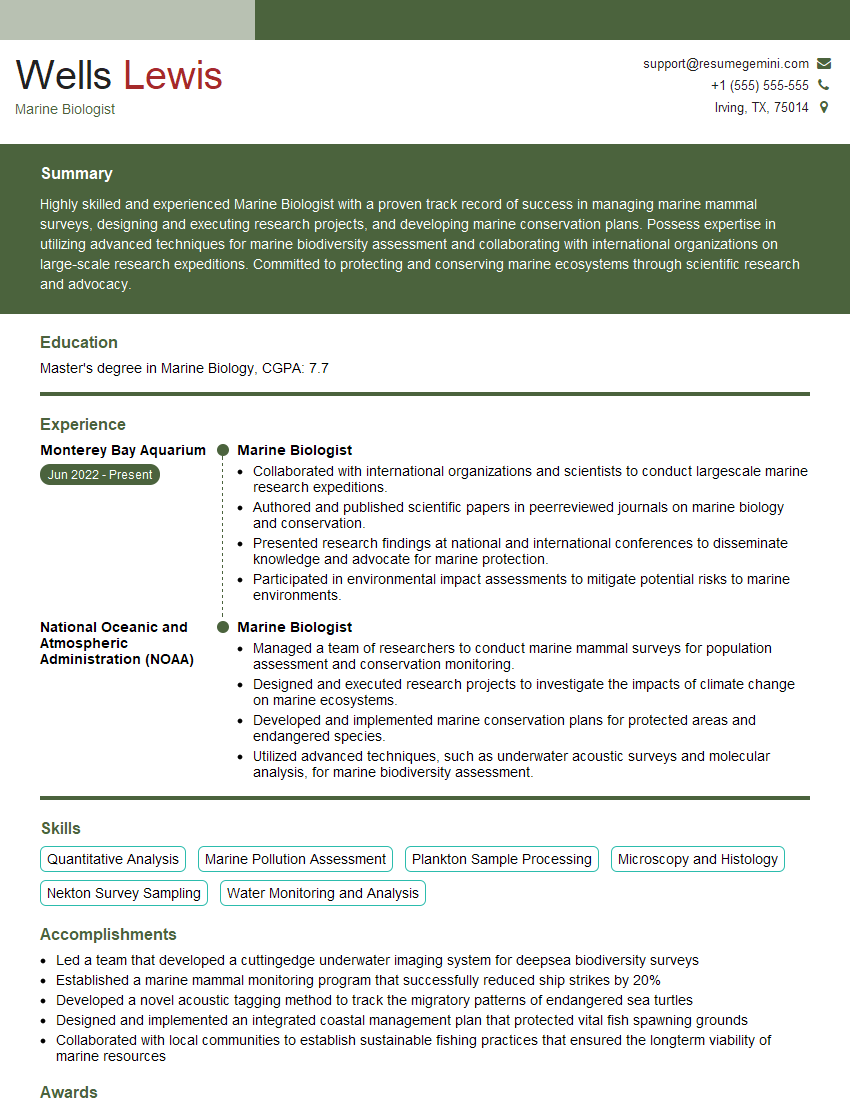
Mastering freediving demonstrates dedication, discipline, and a unique skill set highly valued in many fields. To maximize your career prospects, a strong, ATS-friendly resume is essential. This is where ResumeGemini can help. ResumeGemini provides a user-friendly platform to craft a professional resume that highlights your freediving expertise and other relevant skills, ensuring your application stands out. Examples of resumes tailored specifically to the freediving industry are available to guide you. Take the next step towards your dream career – build a winning resume with ResumeGemini.

Check Out Resume Samples at ResumeGemini

Check Out Resume Samples at ResumeGemini

Check Out Resume Samples at ResumeGemini

Check Out Resume Samples at ResumeGemini

Check Out Resume Samples at ResumeGemini

Check Out Resume Samples at ResumeGemini

Check Out Resume Samples at ResumeGemini
Explore more articles
Users Rating of Our Blogs
Share Your Experience
We value your feedback! Please rate our content and share your thoughts (optional).
What Readers Say About Our Blog
Very informative content, great job.
good