The right preparation can turn an interview into an opportunity to showcase your expertise. This guide to SolidState Electronics interview questions is your ultimate resource, providing key insights and tips to help you ace your responses and stand out as a top candidate.
Questions Asked in SolidState Electronics Interview
Q 1. Explain the difference between n-type and p-type semiconductors.
The difference between n-type and p-type semiconductors lies in their majority charge carriers. Both start with a pure silicon or germanium crystal (intrinsic semiconductor), which has a nearly equal number of electrons and holes. However, we introduce impurities to alter this balance.
- n-type semiconductor: We add pentavalent impurities (like phosphorus or arsenic) with five valence electrons. Four electrons bond with silicon atoms, leaving one extra electron free to move, becoming a majority carrier. These extra electrons are negatively charged, hence ‘n-type’. The impurities are called ‘donors’ because they donate electrons.
- p-type semiconductor: Here, we introduce trivalent impurities (like boron or aluminum) with three valence electrons. These impurities create ‘holes’, which are the absence of an electron in the crystal lattice. Holes act as positive charge carriers, becoming the majority carriers. The impurities are called ‘acceptors’ because they accept electrons from the silicon atoms.
Think of it like this: imagine a parking lot. In an intrinsic semiconductor, there are an equal number of parked cars (electrons) and empty spaces (holes). In an n-type semiconductor, we add extra cars, and in a p-type semiconductor, we add extra empty spaces.
Q 2. Describe the operation of a p-n junction diode.
A p-n junction diode is formed by joining p-type and n-type semiconductors. When they meet, electrons from the n-side diffuse across the junction to fill holes on the p-side. This diffusion leaves behind positively charged ions on the n-side and negatively charged ions on the p-side. This creates a depletion region, a zone devoid of free charge carriers.
The depletion region acts as a barrier that prevents further diffusion. When an external voltage is applied, the behavior changes:
- Forward Bias: A positive voltage is applied to the p-side and a negative voltage to the n-side. This reduces the depletion region width, allowing current to flow easily. It’s like pushing the cars closer together in our parking lot analogy, making it easier for them to move.
- Reverse Bias: A negative voltage is applied to the p-side and a positive voltage to the n-side. This widens the depletion region, significantly reducing the current flow. It’s like pulling the cars further apart, making movement more difficult.
This one-way current flow is the basis of a diode’s function as a rectifier, allowing current to flow in only one direction.
Q 3. What is a depletion region, and how does it form?
The depletion region is a zone near the p-n junction that is depleted of mobile charge carriers (electrons and holes). It forms due to the diffusion of majority carriers across the junction.
Electrons from the n-type region diffuse into the p-type region, where they recombine with holes. Similarly, holes from the p-type region diffuse into the n-type region and combine with electrons. This diffusion leaves behind immobile ionized impurity atoms: positive ions on the n-side and negative ions on the p-side. The electric field created by these ions opposes further diffusion, leading to an equilibrium state where the diffusion current is balanced by the drift current caused by the electric field. This region devoid of free charge carriers is the depletion region.
The width of the depletion region depends on the doping concentration and the applied voltage. A larger doping concentration results in a narrower depletion region, while a reverse bias voltage widens it.
Q 4. Explain the concept of forward and reverse bias in a diode.
Forward and reverse bias refer to the polarity of the external voltage applied across a p-n junction diode.
- Forward Bias: The positive terminal of the voltage source is connected to the p-side and the negative terminal to the n-side. This reduces the potential barrier at the junction, allowing the majority carriers to easily cross and current to flow. It’s like pushing a ball downhill; it requires minimal effort.
- Reverse Bias: The negative terminal of the voltage source is connected to the p-side and the positive terminal to the n-side. This increases the potential barrier at the junction, making it very difficult for majority carriers to cross. Only a small reverse saturation current flows due to minority carriers. It’s like pushing a ball uphill; it requires significant effort.
The diode conducts significantly more current under forward bias than under reverse bias, exhibiting a rectifying behavior.
Q 5. What is the difference between a Zener diode and a regular diode?
The main difference between a Zener diode and a regular diode lies in their breakdown behavior. A regular diode breaks down at a high reverse voltage, typically causing irreversible damage. A Zener diode, however, is specifically designed to operate in the reverse breakdown region without being damaged. This breakdown occurs at a precisely defined reverse voltage called the Zener voltage (Vz).
This controlled breakdown is achieved through heavy doping of the p-n junction. In a regular diode, reverse breakdown is caused by avalanche multiplication, while in a Zener diode, at lower voltages, it is caused by Zener breakdown (tunneling of electrons through the depletion region). Above a certain voltage, avalanche multiplication is the dominant mechanism for both types.
Zener diodes are used as voltage regulators, providing a stable voltage across a wide range of currents. Regular diodes are primarily used for rectification and other switching applications.
Q 6. Describe the operation of a bipolar junction transistor (BJT).
A Bipolar Junction Transistor (BJT) is a three-terminal semiconductor device consisting of two p-n junctions. It’s essentially two diodes back-to-back, but its operation depends on the interaction between the two junctions. A BJT can operate in either of two modes:
- Common Base Configuration: The base terminal is shared between the input and the output. The input signal (current) is applied to the emitter, while the output is taken from the collector.
- Common Emitter Configuration: The emitter is common to both input and output. The input signal is applied to the base, while the output is taken from the collector.
- Common Collector Configuration: The collector is common to both input and output. The input signal is applied to the base, while the output is taken from the emitter.
BJTs are current-controlled devices; a small base current controls a larger collector current, leading to current amplification. They are used as amplifiers, switches, and in various other applications in electronic circuits. The transistor’s operation depends on whether it’s forward or reverse biased. The BJT can act as a switch or amplify a signal based on the bias provided.
Q 7. Explain the difference between common emitter, common base, and common collector configurations of a BJT.
The three configurations of a BJT – common emitter, common base, and common collector – differ in which terminal is common to both the input and output circuits. This choice affects the transistor’s characteristics, including its current gain, input impedance, and output impedance.
- Common Emitter (CE): High current gain (β), medium input impedance, medium output impedance. This is the most common configuration due to its high gain.
- Common Base (CB): Current gain slightly less than 1 (α), high input impedance, low output impedance. Used in high-frequency applications and impedance matching.
- Common Collector (CC): Current gain approximately 1, low input impedance, high output impedance. Often used as a buffer amplifier due to its impedance matching capabilities.
The choice of configuration depends on the specific application requirements. For example, the common emitter configuration is preferred when high current gain is needed, while the common collector configuration is ideal when impedance matching is crucial. The common base configuration is commonly used in high-frequency applications due to its low input capacitance.
Q 8. Describe the operation of a field-effect transistor (FET).
A Field-Effect Transistor (FET) is a semiconductor device that controls the flow of current between two terminals (source and drain) by varying the electric field applied to a third terminal (gate). Imagine a water pipe; the source and drain are the pipe ends, and the gate is a valve controlling the water flow. Unlike bipolar junction transistors (BJTs), FETs are voltage-controlled devices, meaning the gate voltage regulates the current, not the gate current itself.
Here’s how it works: A potential difference between the gate and the channel (the region between source and drain) modifies the channel’s conductivity. In an n-channel FET, a positive gate voltage attracts electrons, creating a conductive channel, allowing current to flow from source to drain. A negative gate voltage repels electrons, reducing or completely cutting off the current. The opposite happens in a p-channel FET, where a negative gate voltage creates a conductive channel.
This voltage control offers several advantages: high input impedance (meaning minimal current drawn by the gate), low power consumption, and excellent scaling properties for miniaturization, making FETs the backbone of modern integrated circuits.
Q 9. What are the differences between MOSFETs and JFETs?
Both MOSFETs (Metal-Oxide-Semiconductor Field-Effect Transistors) and JFETs (Junction Field-Effect Transistors) are FETs, but they differ significantly in their structure and operation:
- Gate Insulation: MOSFETs utilize a thin insulating oxide layer (typically silicon dioxide) between the gate and the channel. This oxide layer provides extremely high input impedance, leading to minimal gate current. JFETs, on the other hand, have a pn junction that acts as the gate, resulting in significantly lower input impedance.
- Gate Control: In MOSFETs, the gate voltage controls the formation of the channel. In JFETs, the gate-source voltage modifies the width of an already existing channel. This difference impacts their characteristics in terms of threshold voltage and current control.
- Fabrication: MOSFET fabrication involves more steps and is more complex, but allows for better scaling and higher integration densities compared to JFETs.
- Applications: MOSFETs dominate in modern digital integrated circuits due to their superior scaling and higher density. JFETs find niche applications where their unique characteristics are advantageous, such as high-frequency amplifiers and certain analog circuits.
Think of it like this: MOSFETs are like advanced, insulated valves offering precise control and high efficiency. JFETs are more like simpler valves with direct contact, resulting in some limitations.
Q 10. Explain the concept of CMOS technology.
CMOS (Complementary Metal-Oxide-Semiconductor) technology is a fabrication process that uses both NMOS (n-channel MOSFET) and PMOS (p-channel MOSFET) transistors on the same chip. It’s the dominant technology in modern digital integrated circuits for several compelling reasons:
- Low Power Consumption: In a CMOS inverter, one transistor is always off when the other is on, resulting in minimal static power dissipation. This contrasts with older technologies like TTL (Transistor-Transistor Logic), which consumed significantly more power.
- High Noise Immunity: The complementary nature of NMOS and PMOS transistors provides excellent noise immunity.
- High Integration Density: CMOS technology allows for extremely high transistor density, enabling complex circuits to be fabricated on a single chip.
- Scalability: CMOS technology scales well to smaller feature sizes, allowing for continuous improvements in performance and power efficiency.
The cornerstone of CMOS is the CMOS inverter, a fundamental logic gate built using an NMOS and a PMOS transistor in parallel. It provides a very efficient way to invert a logic signal while consuming minimal power. The widespread adoption of CMOS technology is a testament to its superior performance and power efficiency, making it the foundation of nearly all modern microprocessors, memory chips, and other integrated circuits.
Q 11. What are the different types of MOSFETs (e.g., NMOS, PMOS, depletion mode, enhancement mode)?
MOSFETs come in several variations:
- NMOS (n-channel MOSFET): Uses electrons as charge carriers. A positive gate voltage creates a conductive channel.
- PMOS (p-channel MOSFET): Uses holes (absence of electrons) as charge carriers. A negative gate voltage creates a conductive channel.
- Enhancement Mode: The channel is formed only when a sufficient gate-source voltage is applied. This is the most common type used in digital circuits.
- Depletion Mode: A conductive channel exists even without a gate voltage. A gate voltage of the opposite polarity can deplete the channel, reducing or cutting off the current. Depletion mode MOSFETs are often used as load devices in some analog circuits.
Understanding these types is crucial because they determine the circuit’s behavior. For instance, CMOS logic relies on the complementary behavior of NMOS and PMOS enhancement mode transistors to achieve low power consumption. Depletion mode MOSFETs, however, are often utilized in specific analog circuit designs to establish an initial current level.
Q 12. Describe the process of semiconductor fabrication.
Semiconductor fabrication, often referred to as chip manufacturing, is a complex multi-step process involving photolithography, etching, diffusion, and ion implantation to create intricate patterns of transistors and other components on a silicon wafer. Think of it as building a tiny city on a thin slice of silicon.
The process typically involves:
- Wafer Preparation: Starting with a highly purified silicon wafer.
- Oxidation: Growing a silicon dioxide layer for insulation.
- Photolithography: Using light and photoresist to transfer circuit patterns onto the wafer.
- Etching: Removing unwanted material based on the photoresist patterns.
- Ion Implantation: Introducing dopant atoms to create n-type and p-type regions.
- Diffusion: Further controlling dopant concentration and distribution.
- Metallization: Depositing metal layers to interconnect the components.
- Testing and Packaging: Testing the finished chips and packaging them for use.
Each step requires highly controlled environments and sophisticated equipment. Cleanrooms are essential to prevent contamination that could ruin the entire process. The precision involved is staggering, with features often measured in nanometers.
Q 13. Explain the importance of doping in semiconductors.
Doping is the process of intentionally introducing impurity atoms into an intrinsic (pure) semiconductor to alter its electrical properties. This is crucial for creating the n-type and p-type regions necessary for transistors and other semiconductor devices.
n-type doping: Adding pentavalent impurities (like phosphorus or arsenic) provides extra electrons, making the semiconductor negatively charged (n-type). These extra electrons become the majority charge carriers.
p-type doping: Adding trivalent impurities (like boron or gallium) creates ‘holes’ (absence of electrons), making the semiconductor positively charged (p-type). Holes become the majority charge carriers.
Without doping, silicon would be essentially an insulator. Doping creates the necessary conductivity differences that allow for current control within transistors and other semiconductor devices, enabling the functionalities we rely on in modern electronics.
Imagine doping as adding specific ingredients to a base recipe. The pure silicon is like plain flour – it’s there, but it doesn’t do much on its own. Adding the right dopants (like phosphorus or boron) is like adding yeast or baking powder; it transforms the plain flour into something entirely new and functional (a transistor, for example).
Q 14. What are the different types of integrated circuits (ICs)?
Integrated circuits (ICs) come in a wide variety of types, categorized by their function and complexity:
- Microprocessors: The ‘brains’ of computers, performing calculations and controlling operations.
- Memory chips (RAM, ROM): Store data for immediate use (RAM) or permanent storage (ROM).
- Logic ICs: Implement digital logic functions like AND, OR, NOT gates, forming the basis of more complex circuits.
- Analog ICs: Process analog signals, such as audio or sensor data, typically involving operational amplifiers (op-amps).
- Mixed-signal ICs: Combine both digital and analog circuits on a single chip.
- ASICs (Application-Specific Integrated Circuits): Designed for a specific application, offering optimized performance and reduced size.
- FPGAs (Field-Programmable Gate Arrays): Programmable logic devices offering flexibility in circuit design without requiring custom fabrication.
The diversity of ICs reflects the wide range of applications in electronics, from simple consumer devices to high-performance computing systems. The choice of IC type depends heavily on the specific requirements of the application.
Q 15. Explain the concept of carrier mobility and its impact on device performance.
Carrier mobility describes how easily electrons and holes move through a semiconductor material in response to an applied electric field. Think of it like this: imagine a crowded room. Electrons and holes are like people trying to move through the room. High mobility means they can move easily and quickly, while low mobility means they’re constantly bumping into each other (impurities, lattice vibrations) and getting stuck, slowing down the flow of current.
This significantly impacts device performance. Higher mobility translates to faster switching speeds in transistors, leading to more powerful and energy-efficient processors in computers and smartphones. In solar cells, higher mobility means more efficient charge collection, resulting in higher energy conversion efficiency. Lower mobility leads to slower device operation, increased power consumption, and reduced overall performance.
Several factors affect carrier mobility, including temperature (higher temperatures lead to increased lattice vibrations and thus lower mobility), doping concentration (too many impurities scatter carriers, reducing mobility), and crystal quality (defects in the crystal structure impede carrier movement).
Career Expert Tips:
- Ace those interviews! Prepare effectively by reviewing the Top 50 Most Common Interview Questions on ResumeGemini.
- Navigate your job search with confidence! Explore a wide range of Career Tips on ResumeGemini. Learn about common challenges and recommendations to overcome them.
- Craft the perfect resume! Master the Art of Resume Writing with ResumeGemini’s guide. Showcase your unique qualifications and achievements effectively.
- Don’t miss out on holiday savings! Build your dream resume with ResumeGemini’s ATS optimized templates.
Q 16. What are the different types of semiconductor memories (e.g., SRAM, DRAM, Flash)?
Semiconductor memories are broadly classified based on their volatility (whether they retain data when power is off) and access method. Here are some key types:
- SRAM (Static Random Access Memory): Uses bistable flip-flops to store each bit. It’s fast, but consumes more power and has lower density compared to DRAM. Think of it as a highly organized filing cabinet where each file (bit) is kept in a dedicated, stable location.
- DRAM (Dynamic Random Access Memory): Stores each bit as a charge in a capacitor. It’s denser and uses less power per bit than SRAM but requires periodic refreshing to prevent data loss. Imagine a less organized storage space where items need periodic rearrangement to stay in place.
- Flash Memory: Non-volatile memory that stores data in floating-gate transistors. It’s slower than SRAM and DRAM but retains data even when power is off. This is like an extremely durable, but slower, external hard drive. There are different types of Flash memory (NOR and NAND flash), each with its own advantages and disadvantages in terms of speed, density, and cost.
The choice of memory type depends on the application. SRAM is used in CPU caches for speed, DRAM is used for main memory, and flash memory is used in SSDs, USB drives, and embedded systems.
Q 17. Explain the concept of diffusion and drift in semiconductors.
Both diffusion and drift are mechanisms describing how charge carriers move in a semiconductor. They are fundamentally different processes:
- Diffusion: This is the movement of charge carriers from a region of high concentration to a region of low concentration, driven by the concentration gradient. Think of dropping a drop of ink in water; the ink molecules (carriers) spread out to even out the concentration. In semiconductors, this happens due to the random thermal motion of electrons and holes.
- Drift: This is the movement of charge carriers under the influence of an external electric field. The field exerts a force on the carriers, causing them to move in a specific direction. Imagine pushing a ball down a slope; the slope (electric field) causes the ball (carrier) to move.
In most semiconductor devices, both diffusion and drift play important roles. For example, in a p-n junction diode, diffusion causes the formation of the depletion region, while drift current flows when a voltage is applied across the junction. Understanding these processes is crucial for analyzing the behavior of semiconductor devices.
Q 18. What are the different types of semiconductor lasers?
Semiconductor lasers are classified based on several factors, including the material used, the wavelength of emitted light, and the operating mechanism. Some major types include:
- Homojunction Lasers: These lasers use a single semiconductor material with a p-n junction. They are relatively simple to fabricate but have lower efficiency and power output compared to other types.
- Heterojunction Lasers: Use different semiconductor materials to form the p-n junction. This creates a better confinement of light and carriers, resulting in higher efficiency and power output. This is a very common type used in many applications.
- Quantum Well Lasers: Utilize quantum wells, extremely thin layers of semiconductor material, to enhance the laser’s performance characteristics. The quantum confinement effect improves efficiency and allows for temperature-stable operation.
- Quantum Dot Lasers: Employ zero-dimensional quantum dots. They are known for their very narrow spectral linewidth and potential for high-speed modulation.
- Vertical Cavity Surface Emitting Lasers (VCSELs): Emit light perpendicular to the surface of the chip. They are popular in optical communication and sensing applications due to their compact size and efficient fabrication processes.
The choice of laser type depends on the specific application requirements, such as desired wavelength, power output, efficiency, and cost.
Q 19. Describe the principles of operation of a light-emitting diode (LED).
A Light-Emitting Diode (LED) is a semiconductor device that converts electrical energy into light energy. It relies on the principle of electroluminescence. When a forward bias is applied across a p-n junction in a semiconductor material, electrons from the n-side and holes from the p-side recombine in the depletion region. This recombination process releases energy in the form of photons (light). The energy of the emitted photons (and thus the color of the light) is determined by the bandgap energy of the semiconductor material.
For example, a gallium arsenide (GaAs) LED emits infrared light because GaAs has a relatively small bandgap energy. On the other hand, gallium nitride (GaN) LEDs are used to produce blue, green, and white light because GaN has a larger bandgap energy.
The efficiency of an LED depends on factors such as the quality of the semiconductor material, the design of the p-n junction, and the packaging of the device. LEDs are widely used in various applications, from lighting and displays to optical communication and sensing.
Q 20. Explain the concept of bandgap engineering.
Bandgap engineering is the controlled manipulation of the bandgap of a semiconductor material to achieve desired properties. The bandgap, simply put, is the energy difference between the valence band and the conduction band. This energy difference directly relates to the material’s electrical and optical properties. By carefully selecting materials and their composition, we can tailor the bandgap to suit specific applications.
One common technique is alloying, where two or more semiconductors are combined to create a material with an intermediate bandgap. For instance, by varying the ratio of gallium arsenide (GaAs) and aluminum arsenide (AlAs), we can create a range of alloys (AlGaAs) with different bandgaps, allowing us to design devices with specific optical or electronic characteristics. Another approach involves using quantum wells, where thin layers of different semiconductors are stacked to create quantum mechanical confinement and manipulate energy levels.
Bandgap engineering is crucial in designing heterostructure devices like high-efficiency solar cells, high-speed transistors, and advanced optoelectronic components. It allows for precisely controlling the energy levels of carriers and thus their behavior in the device, ultimately optimizing device performance.
Q 21. What are the challenges in miniaturizing semiconductor devices?
Miniaturizing semiconductor devices, while leading to increased performance and reduced cost, presents several significant challenges:
- Short Channel Effects: As transistors shrink, the electric field becomes increasingly non-uniform, leading to reduced control over current flow and increased leakage current.
- Quantum Mechanical Effects: At nanoscale dimensions, quantum mechanical phenomena like tunneling become prominent, affecting device characteristics unpredictably.
- Heat Dissipation: Smaller devices generate higher power densities, making heat dissipation a major concern. Excessive heat can damage the device and limit its performance.
- Lithography Limitations: Creating smaller features requires advanced lithography techniques, which are becoming increasingly expensive and complex. It becomes difficult to maintain consistent patterning at such small scales.
- Material Properties: As dimensions decrease, material properties at the nanoscale can differ significantly from those at larger scales, requiring new materials and fabrication methods.
- Interconnect Scaling: Connecting numerous miniaturized devices efficiently also poses significant challenges as interconnects become more resistive and capacitive.
Overcoming these challenges requires continuous innovation in materials science, device design, and fabrication technologies. Researchers are exploring new materials like graphene and 2D materials, novel device architectures, and advanced lithographic techniques to push the boundaries of miniaturization.
Q 22. Describe different methods for characterizing semiconductor devices.
Characterizing semiconductor devices involves a range of techniques to understand their electrical behavior and performance. These methods can be broadly categorized into DC, AC, and specialized tests. DC characterization focuses on static parameters like current-voltage (I-V) curves, which reveal the device’s operating characteristics under constant voltage or current. This is fundamental to understanding things like threshold voltage (Vth) in MOSFETs or the breakdown voltage in diodes. AC characterization involves applying AC signals of varying frequencies to study the device’s response. This includes measurements like capacitance-voltage (C-V) curves which provide information on doping profiles and interface states, and small-signal parameters like gain and bandwidth, critical for amplifier design. Specialized techniques, often employed for advanced devices, might involve techniques like deep-level transient spectroscopy (DLTS) for identifying defects within the semiconductor material or electron beam induced current (EBIC) for visualizing current flow and identifying defects microscopically.
- I-V Measurements: A simple yet crucial test using a source-measure unit (SMU) to obtain the current-voltage characteristic of a diode or transistor, yielding parameters like forward voltage drop or breakdown voltage.
- C-V Measurements: Using a capacitance meter to measure the capacitance as a function of applied voltage, revealing information about the doping profile and interface traps in MOS structures.
- S-parameters: Measuring scattering parameters of a device under RF stimulation gives information about the device’s behavior at high frequencies, crucial for high-frequency circuit design. These parameters describe how power is reflected and transmitted through the device.
For example, when designing a high-power amplifier, S-parameter measurements would be essential to ensure the amplifier meets specifications for gain and impedance matching at the intended operating frequency.
Q 23. Explain the concept of thermal runaway in power devices.
Thermal runaway is a destructive phenomenon in power devices where an initial increase in temperature leads to a further increase in power dissipation, causing a positive feedback loop that results in catastrophic failure. This typically happens due to the temperature dependence of device parameters. As temperature increases, the device’s resistance might decrease, causing increased current flow for a constant voltage. This increased current further increases power dissipation (P = I2R), leading to even higher temperatures, ultimately resulting in runaway heating. This process can be likened to a snowball rolling downhill, gaining momentum and size as it goes.
Several factors contribute to thermal runaway: the positive temperature coefficient of resistance in some devices, poor thermal management (inadequate heat sinking), and high operating currents.
Mitigation strategies focus on proper thermal design and device selection. Using devices with a negative temperature coefficient of resistance is advantageous. Employing effective heat sinks to dissipate the generated heat is crucial. Furthermore, incorporating thermal protection mechanisms, such as current limiting circuits or thermal shutdown features, prevents the device from operating beyond safe temperature limits.
Q 24. How do you ensure the reliability of semiconductor devices?
Ensuring the reliability of semiconductor devices is paramount. It involves a multifaceted approach spanning the entire lifecycle, from design and manufacturing to testing and operation. Robust design practices that consider potential failure mechanisms are fundamental. This includes using appropriate design margins, implementing redundancy where necessary, and designing for manufacturability. Rigorous quality control during manufacturing is essential to minimize defects and inconsistencies. This involves using highly purified materials, meticulous processing steps, and rigorous inspection methods. Extensive testing and screening are conducted on devices to weed out failures. This may involve burn-in tests to accelerate aging and identify early failures, and various environmental stress tests like thermal cycling and humidity tests.
Reliability prediction models are used to estimate the device’s lifetime and failure rate under various operating conditions. These models rely on accelerated life testing data to extrapolate behavior over longer time scales. Finally, field data from deployed devices provide crucial feedback to refine reliability models and design improvements.
For instance, during the design of a space-borne electronics system, radiation hardness assurance becomes critically important. This necessitates using specialized semiconductor technologies capable of withstanding the harsh radiation environment.
Q 25. Describe different failure mechanisms in semiconductor devices.
Semiconductor devices can fail due to a variety of mechanisms, often categorized as either physical or electrical. Physical failures are often caused by defects in the material or manufacturing process. Examples include:
- Electromigration: The movement of metal ions in conductors due to high current density, causing voids and open circuits.
- Void formation: The formation of voids or empty spaces in metal interconnects, leading to increased resistance and potential failure.
- Stress-induced voiding: The creation of voids due to mechanical stress, especially prevalent in packaging and interconnection.
- Dielectric breakdown: The failure of the insulating layers due to excessive electric fields.
Electrical failures often result from over-stressing the device beyond its operating limits. Examples include:
- Electrostatic discharge (ESD): Damage caused by static electricity discharge.
- Overcurrent: Excessive current exceeding the device’s capacity.
- Overvoltage: Voltage exceeding the device’s maximum rating.
- Latch-up: Parasitic bipolar transistors within CMOS circuits turning on, causing excessive current flow and potential damage.
Understanding these mechanisms is crucial for designing reliable devices and predicting their lifetime.
Q 26. Explain the concept of noise in electronic circuits.
Noise in electronic circuits refers to unwanted fluctuations in voltage or current that interfere with the desired signal. These fluctuations can originate from various sources, both internal and external to the circuit. Internal noise sources can be due to the thermal motion of electrons (thermal noise), shot noise (random fluctuations in current due to discrete charge carriers), and flicker noise (low-frequency noise with a 1/f frequency dependence). External noise sources might include electromagnetic interference (EMI) picked up from external sources, power supply noise, and environmental factors. Noise degrades the signal-to-noise ratio (SNR), impacting the accuracy and reliability of the circuit’s performance.
Different types of noise have different frequency characteristics and dependencies, making them more prominent in specific applications. For example, thermal noise is white noise, meaning it has a relatively flat power spectral density across a broad range of frequencies. Flicker noise, on the other hand, is dominant at lower frequencies. Understanding the dominant noise sources is crucial for designing low-noise circuits. Techniques for noise reduction include proper circuit design (using low-noise components, shielding, and filtering), and signal processing techniques to improve the SNR.
Q 27. How do you handle power dissipation issues in integrated circuits?
Power dissipation in integrated circuits (ICs) is a major concern, especially in high-performance chips. Excessive heat generation can lead to performance degradation, reliability issues, and even catastrophic failure. Managing power dissipation requires a multi-pronged approach:
- Low-power design techniques: Employing design methodologies that minimize power consumption, such as clock gating, power gating, and voltage scaling.
- Efficient circuit topologies: Using circuit designs that inherently consume less power. For instance, choosing low-power logic gates or using more energy efficient operational amplifiers.
- Thermal management: Implementing effective heat dissipation mechanisms, including the use of heat sinks, thermal vias, and optimized package designs.
- Process technology advancements: Utilizing advanced semiconductor fabrication processes that enable lower power consumption.
One example is the use of FinFET transistors, which offer improved performance and power efficiency compared to traditional planar transistors. Another critical aspect is the use of thermal simulation tools to predict temperature distributions within the IC and optimize the cooling strategy.
Q 28. Describe your experience with specific semiconductor design software (e.g., Cadence, Synopsys)
I have extensive experience using Cadence Virtuoso and Synopsys Custom Compiler for analog and mixed-signal integrated circuit design. In my previous role, I utilized Cadence Virtuoso extensively for the design and simulation of a high-speed data converter. This involved schematic capture, layout design using the layout editor, and circuit simulation using Spectre. I performed various simulations including DC, AC, transient, and noise analyses to verify circuit performance and meet specifications. The experience encompassed all aspects of the design flow, from concept to final verification. Specifically, I employed Spectre’s advanced analysis capabilities to model and mitigate noise in the converter’s critical path.
With Synopsys Custom Compiler, I’ve focused on the design of RF circuits, specifically in the area of low-noise amplifiers (LNAs). This involved using the tool’s schematic entry and layout capabilities along with its advanced simulation features to optimize the LNA for noise figure, gain, and linearity. The tool’s automatic layout generation capabilities proved valuable for improving design efficiency. Both tools are indispensable for modern semiconductor design, enabling the creation of complex circuits with high levels of accuracy and efficiency.
Key Topics to Learn for SolidState Electronics Interview
- Semiconductor Physics Fundamentals: Understanding energy bands, doping, carrier transport (drift and diffusion), and p-n junctions is crucial. This forms the bedrock of all solid-state devices.
- Diodes and Transistors: Master the operation principles of diodes (including different types like Zener and Schottky), BJTs, and MOSFETs. Be prepared to analyze their characteristic curves and applications in circuits.
- Integrated Circuit Fabrication: Familiarize yourself with the basic steps involved in IC manufacturing, including photolithography, etching, and doping. Understanding the limitations and challenges of this process is valuable.
- Device Modeling and Simulation: Gain proficiency in using simulation tools (e.g., SPICE) to analyze circuit behavior and optimize device performance. This demonstrates practical problem-solving skills.
- Analog and Digital Circuits: Understand the design principles of both analog and digital circuits using solid-state devices. Be ready to discuss amplifiers, logic gates, and other fundamental building blocks.
- Power Electronics: Explore power semiconductor devices like IGBTs and thyristors and their applications in power supplies, motor drives, and other high-power systems.
- Optoelectronics: Learn about the principles of light emission and detection in solid-state devices, including LEDs, lasers, and photodetectors.
- Emerging Technologies: Stay updated on advancements in areas like nanotechnology, 2D materials, and quantum computing as they relate to solid-state electronics. This showcases your proactive learning approach.
- Problem-Solving and Analytical Skills: Practice solving circuit analysis problems, understanding device characteristics, and applying theoretical concepts to real-world scenarios.
Next Steps
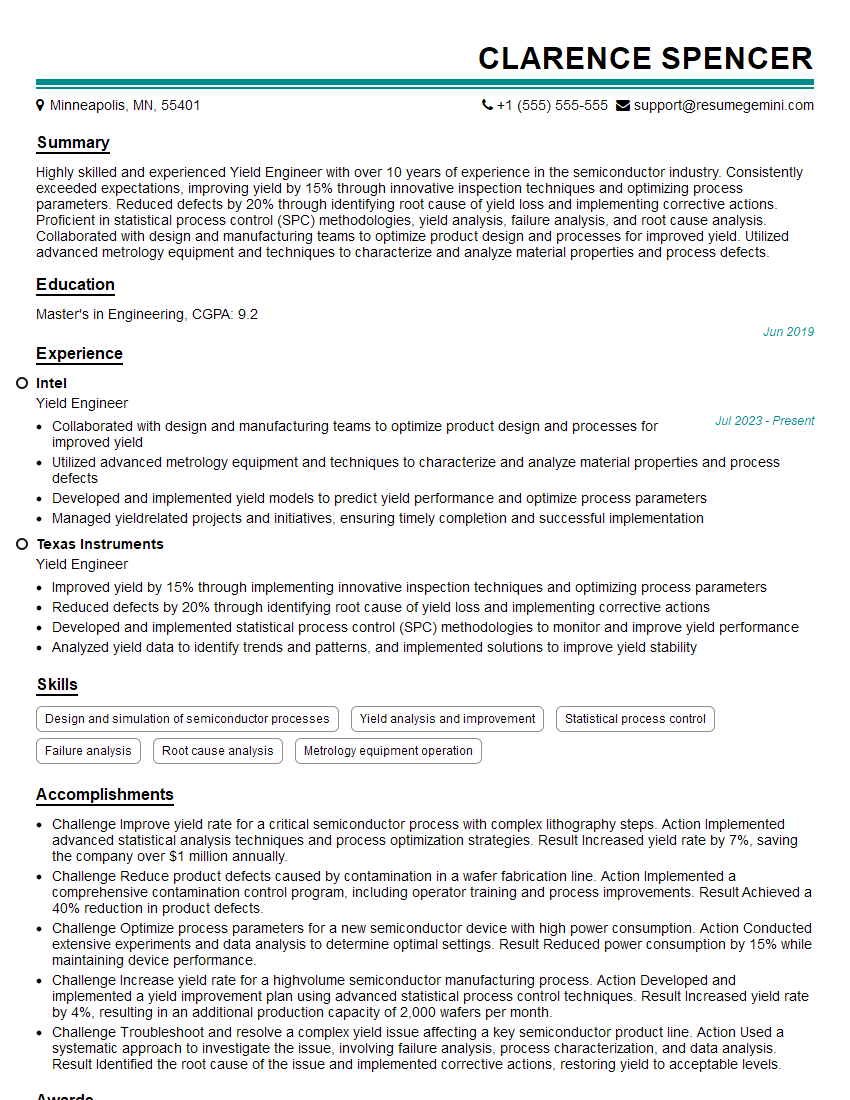
Mastering solid-state electronics opens doors to exciting careers in diverse fields, from microelectronics and telecommunications to renewable energy and automotive engineering. A strong foundation in this area significantly enhances your job prospects. To maximize your chances, creating an ATS-friendly resume is vital. ResumeGemini is a trusted resource to help you build a professional and impactful resume that showcases your skills and experience effectively. We provide examples of resumes tailored to SolidState Electronics roles to guide you through the process.
Explore more articles
Users Rating of Our Blogs
Share Your Experience
We value your feedback! Please rate our content and share your thoughts (optional).
What Readers Say About Our Blog
Hello,
we currently offer a complimentary backlink and URL indexing test for search engine optimization professionals.
You can get complimentary indexing credits to test how link discovery works in practice.
No credit card is required and there is no recurring fee.
You can find details here:
https://wikipedia-backlinks.com/indexing/
Regards
NICE RESPONSE TO Q & A
hi
The aim of this message is regarding an unclaimed deposit of a deceased nationale that bears the same name as you. You are not relate to him as there are millions of people answering the names across around the world. But i will use my position to influence the release of the deposit to you for our mutual benefit.
Respond for full details and how to claim the deposit. This is 100% risk free. Send hello to my email id: [email protected]
Luka Chachibaialuka
Hey interviewgemini.com, just wanted to follow up on my last email.
We just launched Call the Monster, an parenting app that lets you summon friendly ‘monsters’ kids actually listen to.
We’re also running a giveaway for everyone who downloads the app. Since it’s brand new, there aren’t many users yet, which means you’ve got a much better chance of winning some great prizes.
You can check it out here: https://bit.ly/callamonsterapp
Or follow us on Instagram: https://www.instagram.com/callamonsterapp
Thanks,
Ryan
CEO – Call the Monster App
Hey interviewgemini.com, I saw your website and love your approach.
I just want this to look like spam email, but want to share something important to you. We just launched Call the Monster, a parenting app that lets you summon friendly ‘monsters’ kids actually listen to.
Parents are loving it for calming chaos before bedtime. Thought you might want to try it: https://bit.ly/callamonsterapp or just follow our fun monster lore on Instagram: https://www.instagram.com/callamonsterapp
Thanks,
Ryan
CEO – Call A Monster APP
To the interviewgemini.com Owner.
Dear interviewgemini.com Webmaster!
Hi interviewgemini.com Webmaster!
Dear interviewgemini.com Webmaster!
excellent
Hello,
We found issues with your domain’s email setup that may be sending your messages to spam or blocking them completely. InboxShield Mini shows you how to fix it in minutes — no tech skills required.
Scan your domain now for details: https://inboxshield-mini.com/
— Adam @ InboxShield Mini
Reply STOP to unsubscribe
Hi, are you owner of interviewgemini.com? What if I told you I could help you find extra time in your schedule, reconnect with leads you didn’t even realize you missed, and bring in more “I want to work with you” conversations, without increasing your ad spend or hiring a full-time employee?
All with a flexible, budget-friendly service that could easily pay for itself. Sounds good?
Would it be nice to jump on a quick 10-minute call so I can show you exactly how we make this work?
Best,
Hapei
Marketing Director
Hey, I know you’re the owner of interviewgemini.com. I’ll be quick.
Fundraising for your business is tough and time-consuming. We make it easier by guaranteeing two private investor meetings each month, for six months. No demos, no pitch events – just direct introductions to active investors matched to your startup.
If youR17;re raising, this could help you build real momentum. Want me to send more info?
Hi, I represent an SEO company that specialises in getting you AI citations and higher rankings on Google. I’d like to offer you a 100% free SEO audit for your website. Would you be interested?
Hi, I represent an SEO company that specialises in getting you AI citations and higher rankings on Google. I’d like to offer you a 100% free SEO audit for your website. Would you be interested?
good