Interviews are opportunities to demonstrate your expertise, and this guide is here to help you shine. Explore the essential Solution Analysis interview questions that employers frequently ask, paired with strategies for crafting responses that set you apart from the competition.
Questions Asked in Solution Analysis Interview
Q 1. Explain your understanding of the Solution Analysis process.
Solution analysis is a crucial phase in the software development lifecycle (SDLC) where we bridge the gap between a business problem and a technical solution. It’s a systematic process of understanding the problem, defining the requirements, and designing a solution that effectively addresses the needs of the stakeholders. This involves deep investigation, rigorous analysis, and creative problem-solving. It’s less about writing code and more about understanding the ‘why’ behind the software.
The process typically includes these steps:
- Understanding the problem: This involves thorough investigation of the business context, challenges, and goals. We might use techniques like SWOT analysis or stakeholder interviews to uncover the root causes.
- Requirement elicitation: Gathering information from various stakeholders (users, clients, managers) about their needs and expectations. This often involves workshops, surveys, and prototyping.
- Requirement analysis: Analyzing the gathered information to identify, organize, and prioritize requirements. This stage involves resolving conflicts and ensuring consistency.
- Solution design: Developing a high-level design of the solution, outlining its architecture, components, and functionality. This may involve UML diagrams and other modeling techniques.
- Feasibility study: Evaluating the technical and economic feasibility of the proposed solution. This assesses resources, timelines, and potential risks.
- Documentation: Creating comprehensive documentation of the requirements, design, and other aspects of the solution. This ensures clarity and facilitates communication among stakeholders.
For example, in a project to improve a company’s customer service system, solution analysis would involve understanding current customer service processes, identifying bottlenecks, and determining how technology can improve response times and customer satisfaction. The analysis would result in a detailed design document outlining the system’s functionality and how it integrates with existing systems.
Q 2. Describe your experience eliciting requirements from stakeholders.
Eliciting requirements effectively is about building rapport with stakeholders and employing a variety of techniques to capture their needs accurately. It’s not just about asking questions; it’s about active listening, observing, and interpreting their responses within the larger context of the business.
My experience includes using various methods, including:
- Interviews: Conducting structured and unstructured interviews with individual stakeholders to gather detailed information about their roles, responsibilities, and expectations.
- Workshops: Facilitating workshops with groups of stakeholders to foster collaboration and discussion, brainstorming solutions, and reaching consensus.
- Surveys: Distributing surveys to gather feedback from a large number of stakeholders in a cost-effective manner.
- Prototyping: Creating interactive prototypes to visualize the solution and gather feedback early in the development process. This helps clarify ambiguities and reduces misunderstandings.
- Document review: Examining existing documentation (reports, procedures, etc.) to understand the current processes and identify areas for improvement.
For instance, in one project involving a logistics company, I used a combination of interviews with dispatchers, drivers, and clients, along with workshops to identify pain points in their delivery tracking system. This led to prioritized requirements that improved efficiency and client satisfaction.
Q 3. How do you identify and analyze business problems?
Identifying and analyzing business problems is about looking beyond the surface symptoms to uncover the root causes. This involves a combination of analytical thinking, critical questioning, and a deep understanding of the business context. I use a structured approach including:
- Problem definition: Clearly articulating the problem, including its scope, impact, and potential consequences.
- Root cause analysis: Employing techniques like the ‘5 Whys’ to delve deeper into the underlying causes of the problem, going beyond the obvious symptoms.
- Stakeholder analysis: Identifying all stakeholders impacted by the problem and their perspectives. This helps in a holistic understanding.
- Data analysis: Collecting and analyzing data (e.g., sales figures, customer feedback) to quantify the problem’s impact and inform potential solutions.
- SWOT analysis: Assessing the Strengths, Weaknesses, Opportunities, and Threats related to the problem to identify potential solutions and risks.
For example, if a company is experiencing declining sales, I wouldn’t just accept that as the problem. I’d investigate potential causes like increased competition, changes in market trends, or internal inefficiencies in sales processes. This deeper dive would allow for more targeted and effective solutions.
Q 4. What methods do you use to document solution designs?
Documenting solution designs is essential for clear communication and effective collaboration among stakeholders. The choice of documentation methods depends on the project’s complexity and the audience. I utilize a variety of techniques:
- UML diagrams: Using UML (Unified Modeling Language) diagrams such as use case diagrams, class diagrams, sequence diagrams, and activity diagrams to visualize the system’s architecture, behavior, and interactions.
- Data flow diagrams (DFDs): Showing how data flows through the system, identifying data sources, processes, and destinations.
- Textual descriptions: Providing detailed textual descriptions of the system’s functionality, algorithms, and data structures for specific components.
- Wireframes and mockups: Creating low-fidelity visual representations of user interfaces to illustrate user interactions and screen layouts.
- Prototypes: Developing interactive prototypes to simulate the system’s behavior and gather user feedback.
For example, a sequence diagram can illustrate the interactions between different components of a system, while a class diagram provides a visual representation of the system’s classes and their relationships. A well-documented design ensures everyone understands the solution before development starts.
Q 5. How do you prioritize competing requirements in a solution design?
Prioritizing competing requirements is a critical skill in solution analysis. It often involves trade-offs and balancing various factors. I use several methods:
- MoSCoW method: Categorizing requirements as Must have, Should have, Could have, and Won’t have. This helps prioritize essential features from desirable ones.
- Value vs. Effort matrix: Plotting requirements on a matrix based on their business value and implementation effort. High-value, low-effort requirements are prioritized.
- Prioritization matrix: Using a matrix based on factors such as urgency, importance, and risk. This helps to see the relative importance across multiple factors.
- Stakeholder negotiation: Facilitating discussions among stakeholders to reach consensus on the prioritization of requirements. This involves clear communication and conflict resolution.
For example, in a project with budget constraints, we might prioritize features with high business value even if they require more effort, while delaying less critical features with similar effort.
Q 6. Explain your experience with UML diagrams or other modeling techniques.
UML diagrams are a cornerstone of my solution design process. I’m proficient in using various UML diagrams, including:
- Use case diagrams: To model the interactions between users and the system.
- Class diagrams: To illustrate the system’s classes, attributes, and relationships.
- Sequence diagrams: To visualize the sequence of interactions between objects in the system.
- Activity diagrams: To model the flow of activities within a process or use case.
- State machine diagrams: To model the states and transitions of an object.
Beyond UML, I also leverage other modeling techniques like data flow diagrams (DFDs) and Entity-Relationship Diagrams (ERDs), depending on the project requirements. These tools provide a common language for communication among developers, stakeholders, and other team members, reducing misunderstandings and clarifying complex systems. I often use these tools in conjunction with each other to create a comprehensive system model.
For instance, in a recent project, a class diagram helped clarify the relationships between different entities in a database, while a sequence diagram illustrated the interactions between a user interface and a backend service.
Q 7. Describe your approach to risk assessment in solution analysis.
Risk assessment is an integral part of solution analysis. It’s about proactively identifying potential problems and developing mitigation strategies to minimize their impact. My approach involves:
- Risk identification: Systematically identifying potential risks related to technical feasibility, project timelines, resource constraints, stakeholder issues, and business requirements.
- Risk analysis: Assessing the likelihood and impact of each identified risk, assigning a severity level based on probability and consequence.
- Risk mitigation: Developing strategies to reduce the likelihood or impact of high-severity risks. This might involve alternative design approaches, contingency planning, or risk transfer.
- Risk monitoring and control: Continuously monitoring identified risks throughout the project lifecycle and adjusting mitigation strategies as needed.
For example, in a project with tight deadlines, a risk might be the unavailability of key personnel. A mitigation strategy could involve cross-training other team members, establishing clear communication protocols, and having a backup plan. This proactive approach reduces the likelihood of project delays or failures due to unforeseen circumstances.
Q 8. How do you handle conflicting stakeholder needs?
Conflicting stakeholder needs are a common challenge in solution analysis. Think of it like a group project where everyone has a different vision for the final product. My approach involves a structured process to prioritize and reconcile these differences. First, I meticulously document all stakeholder requirements, using techniques like requirement workshops and stakeholder interviews. This ensures everyone feels heard and their concerns are acknowledged. Next, I use prioritization matrices, such as MoSCoW (Must have, Should have, Could have, Won’t have) or value vs. effort analysis, to rank requirements based on their importance and feasibility. This allows for transparent decision-making, often involving facilitated discussions to reach consensus. Finally, I document the trade-offs made and ensure all stakeholders understand the rationale behind the chosen path. For instance, in a recent project developing a new e-commerce platform, marketing wanted extensive personalization features while development prioritized platform stability. Using a MoSCoW analysis, we prioritized platform stability as a ‘Must have’, allowing us to implement phased personalization features, starting with the ‘Should haves’.
Q 9. How do you ensure the feasibility of a proposed solution?
Ensuring feasibility is crucial; it’s like checking if you have the right tools and resources before starting a complex DIY project. My approach involves a thorough feasibility study incorporating technical, operational, economic, and schedule assessments. The technical assessment considers existing infrastructure, technology limitations, and the availability of skilled resources. The operational assessment evaluates workflow impacts, integration with existing systems, and potential risks to existing operations. Economic feasibility analyzes costs, return on investment (ROI), and budget constraints. The schedule assessment involves creating a realistic project timeline, considering potential delays and dependencies. For example, in a project involving implementing a new CRM system, we conducted a technical feasibility study confirming the compatibility of the new CRM with our existing database and infrastructure. We also assessed the operational impact, estimating training time for employees and potential disruption during the transition phase. A detailed cost-benefit analysis helped in securing the necessary budget approval.
Q 10. Explain your experience with Agile methodologies in solution analysis.
Agile methodologies are central to my approach to solution analysis. I have extensive experience working within Scrum and Kanban frameworks. In Scrum, I actively participate in sprint planning, daily stand-ups, sprint reviews, and retrospectives. This iterative approach allows for continuous feedback and adaptation, ensuring the solution remains aligned with evolving stakeholder needs and market realities. For example, in a project developing a mobile application, we used Scrum to deliver the application in incremental builds. Each sprint focused on a specific feature set, enabling us to gather user feedback early and iterate on the design and functionality based on that feedback. With Kanban, I leverage its visual workflow management to track progress and manage tasks effectively, ensuring transparency and facilitating collaboration amongst team members. I find the flexibility of Kanban particularly useful in managing projects with fluctuating priorities.
Q 11. How do you measure the success of a deployed solution?
Measuring the success of a deployed solution requires a multi-faceted approach. It’s like evaluating the success of a restaurant – you consider customer satisfaction, revenue, and operational efficiency. I define key performance indicators (KPIs) before deployment, focusing on both quantitative and qualitative measures. Quantitative KPIs might include metrics like system uptime, user adoption rates, transaction processing speed, and cost savings. Qualitative KPIs might involve user satisfaction surveys, feedback from customer support interactions, and an assessment of the solution’s impact on overall business goals. After deployment, I continuously monitor these KPIs, using dashboards and reporting tools to track progress and identify areas for improvement. Regular review meetings with stakeholders ensure alignment on performance and allow for necessary adjustments. For instance, in a project deploying a new customer service platform, we measured success based on reduced average handling time, increased customer satisfaction scores, and improved agent efficiency. These KPIs were tracked using a custom dashboard, enabling us to monitor performance and make data-driven improvements.
Q 12. Describe your experience with data analysis relevant to solution design.
Data analysis is an integral part of effective solution design. I routinely use data to understand user behavior, identify patterns, and inform design decisions. This involves various techniques, including exploratory data analysis (EDA) to gain insights from existing datasets, statistical analysis to identify correlations and trends, and data visualization to communicate findings effectively. I leverage tools like SQL, Python (with libraries such as Pandas and Matplotlib), and data visualization platforms to process and analyze data. For example, in a project aimed at improving website conversion rates, we analyzed website traffic data to identify user drop-off points and user journeys. This analysis revealed areas where the website design could be improved to enhance user experience and increase conversion rates. This data-driven approach ensured the solution directly addressed the identified challenges, leading to a significant improvement in conversion rates.
Q 13. How do you present complex technical information to non-technical audiences?
Communicating complex technical information to non-technical audiences requires clear, concise, and engaging communication. I avoid technical jargon and instead use analogies, metaphors, and visualizations to explain complex concepts. I tailor my communication style to the audience, using simple language and focusing on the key benefits and impacts of the solution. I often use visual aids like diagrams, charts, and presentations, making sure the information is easy to digest and understand. For example, when explaining the intricacies of a database architecture to a group of business stakeholders, I would use a simple analogy, comparing the database to a well-organized filing cabinet, explaining how different tables represent different folders and how data is accessed and retrieved. This helped stakeholders grasp the core concepts without delving into technical details.
Q 14. What is your experience with different software development methodologies?
I have experience with various software development methodologies, including Agile (Scrum and Kanban), Waterfall, and Prototyping. Waterfall is a sequential approach well-suited for projects with clearly defined requirements and minimal anticipated changes. Agile, as mentioned earlier, is ideal for projects requiring flexibility and iterative development. Prototyping allows for quick development and testing of initial designs, allowing for early feedback and adjustments before significant resources are invested. My choice of methodology depends on the specific project requirements, the level of uncertainty, and the client’s preferences. Each methodology has its strengths and weaknesses, and I adapt my approach accordingly. Choosing the right methodology is crucial for project success and delivering a solution that meets stakeholder needs within time and budget constraints.
Q 15. How do you collaborate effectively with cross-functional teams?
Effective collaboration with cross-functional teams is crucial for successful solution analysis. My approach centers around clear communication, active listening, and a proactive, collaborative mindset. I believe in fostering a shared understanding of project goals and individual responsibilities from the outset.
- Regular Communication: I schedule regular meetings, utilizing tools like Microsoft Teams or Jira, to keep everyone informed and aligned. This includes sharing progress updates, identifying roadblocks, and soliciting feedback.
- Empathetic Listening: I actively listen to perspectives from various team members, recognizing that different departments may have unique needs and viewpoints. This ensures that the final solution addresses all relevant concerns.
- Shared Documentation: I utilize collaborative platforms like Confluence or Google Docs to ensure everyone accesses and contributes to project documentation, reducing confusion and maintaining a single source of truth.
- Conflict Resolution: I proactively address conflicts through open discussion, focusing on finding mutually agreeable solutions that satisfy project objectives.
For example, in a recent project involving a new CRM system, I facilitated workshops that brought together sales, marketing, and IT teams to define requirements and workflows. This collaborative approach led to a solution that effectively met the needs of all departments.
Career Expert Tips:
- Ace those interviews! Prepare effectively by reviewing the Top 50 Most Common Interview Questions on ResumeGemini.
- Navigate your job search with confidence! Explore a wide range of Career Tips on ResumeGemini. Learn about common challenges and recommendations to overcome them.
- Craft the perfect resume! Master the Art of Resume Writing with ResumeGemini’s guide. Showcase your unique qualifications and achievements effectively.
- Don’t miss out on holiday savings! Build your dream resume with ResumeGemini’s ATS optimized templates.
Q 16. Describe a challenging solution analysis project and how you overcame obstacles.
One particularly challenging project involved analyzing and designing a solution for a legacy system migration. The client’s system was outdated, poorly documented, and reliant on several unsupported technologies. The biggest obstacle was the lack of comprehensive documentation and the risk of data loss during the migration.
To overcome these obstacles, I implemented a phased approach. First, we conducted a thorough data audit to identify critical data points and potential data integrity issues. This involved working closely with database administrators and subject matter experts. Second, we developed a detailed migration plan that included rigorous testing and rollback procedures to mitigate the risk of data loss. This involved breaking down the migration into smaller, manageable phases, allowing us to validate each step before proceeding.
We also created a comprehensive knowledge base documenting the legacy system’s functionality. This helped us understand the system’s complexities and ensured a smoother transition to the new platform. Through meticulous planning, proactive risk management, and excellent team collaboration, we successfully migrated the system with minimal disruption and data loss.
Q 17. What are your preferred tools for solution analysis and design?
My preferred tools for solution analysis and design depend on the project’s complexity and requirements. However, I frequently utilize a combination of tools to optimize my workflow.
- Modeling Tools: I use tools like Lucidchart or draw.io for creating visual representations of system architecture, data flows, and user workflows. These tools facilitate clear communication and understanding among stakeholders.
- Project Management Tools: Jira or Asana are invaluable for managing tasks, tracking progress, and collaborating with team members.
- Data Analysis Tools: Depending on the project, I utilize tools like SQL or Python (with libraries like Pandas) to analyze data and uncover insights to inform solution design.
- Prototyping Tools: For user interface design, I often leverage Figma or Adobe XD to create interactive prototypes and gather user feedback.
The choice of tools is driven by project needs and team preferences. The key is to leverage the right tools to improve efficiency and collaboration.
Q 18. How do you stay updated with the latest trends in solution analysis?
Staying updated with the latest trends in solution analysis is crucial for remaining competitive and delivering cutting-edge solutions. My approach combines several strategies:
- Industry Publications: I regularly read industry publications, such as technical journals and online blogs, focusing on topics like cloud computing, AI, and emerging technologies.
- Conferences and Webinars: I attend industry conferences and webinars to learn from experts and network with peers. This provides exposure to new ideas and best practices.
- Online Courses and Certifications: I regularly invest in online courses and certifications to improve my skills in specific areas like cloud architecture or data analytics.
- Professional Networks: I participate in professional networks, such as LinkedIn groups, to engage in discussions and stay informed about new trends.
By continuously learning and adapting, I ensure my approach remains relevant and effective in the constantly evolving landscape of solution analysis.
Q 19. Explain your experience with different types of solution architectures.
My experience encompasses a wide range of solution architectures, including:
- Microservices Architecture: This involves breaking down a large application into smaller, independent services. This architecture promotes scalability, flexibility, and maintainability. I have utilized this architecture in projects requiring high availability and rapid development cycles.
- Event-Driven Architecture: This approach relies on asynchronous communication between components using events. This is particularly useful in applications requiring real-time processing and loosely coupled systems. I have experience designing event-driven architectures using message brokers like Kafka or RabbitMQ.
- Layered Architecture: This traditional approach separates an application into distinct layers, such as presentation, business logic, and data access. It’s known for its clarity and ease of maintenance. I’ve worked extensively with this approach, particularly in enterprise applications.
- Cloud-Native Architectures: My experience includes designing and implementing solutions leveraging cloud platforms like AWS, Azure, and GCP. This involves understanding serverless computing, containerization, and microservices.
Choosing the right architecture is crucial and depends on factors such as scalability requirements, performance needs, and budget constraints. I always carefully consider these factors before recommending a specific architecture.
Q 20. How do you manage scope creep in a solution analysis project?
Scope creep, the uncontrolled expansion of project requirements, is a major threat to project success. My approach to managing scope creep is proactive and involves:
- Clearly Defined Scope: I work closely with stakeholders to establish a clear and concise project scope document at the beginning of the project. This includes a detailed list of requirements, deliverables, and acceptance criteria.
- Change Management Process: I implement a formal change management process. All requests for changes to the scope are documented, evaluated, and approved by stakeholders. This includes assessing the impact of changes on project timelines and budgets.
- Regular Reviews: We conduct regular reviews of the project scope to ensure it remains aligned with project objectives. This allows for early identification and addressing of potential scope creep.
- Prioritization: When faced with requests for additional features, I facilitate discussions with stakeholders to prioritize requirements based on their value and impact. Features that don’t align with core project objectives may be deferred to future iterations.
By proactively managing scope, I ensure the project stays on track, within budget, and delivers the intended value.
Q 21. How do you handle ambiguous requirements?
Ambiguous requirements are a common challenge in solution analysis. My approach involves a combination of techniques to clarify these requirements:
- Elicitation Techniques: I employ various elicitation techniques, such as interviews, workshops, and surveys, to gather detailed information from stakeholders. This helps identify the underlying needs and expectations behind ambiguous statements.
- Prototyping: Creating prototypes, even low-fidelity ones, can be highly effective in clarifying ambiguous requirements. Presenting a visual representation of the proposed solution often helps stakeholders articulate their needs more precisely.
- Use Cases and User Stories: I use use cases and user stories to describe the system’s functionality from a user’s perspective. This helps illustrate how the system will be used and address potential ambiguities in functional requirements.
- Questioning and Clarification: I employ a systematic approach to questioning and clarification, asking stakeholders open-ended questions to probe deeper into their requirements. I also continuously challenge assumptions and seek clarification when needed.
Through a combination of these techniques, I strive to uncover the true needs behind ambiguous requirements, leading to a more robust and effective solution.
Q 22. What is your approach to defining key performance indicators (KPIs)?
Defining Key Performance Indicators (KPIs) is crucial for measuring the success of a solution. My approach is a collaborative, data-driven process that starts with understanding the business objectives. I don’t just pick KPIs; I meticulously align them with strategic goals.
- Understand Business Objectives: First, I work closely with stakeholders to clearly define the goals the solution aims to achieve. For example, if the goal is to increase customer engagement, we might focus on KPIs like website traffic, session duration, and conversion rates.
- Identify Relevant Metrics: Once the objectives are clear, we identify the metrics that best reflect progress towards those goals. These metrics should be measurable, achievable, relevant, and time-bound (SMART).
- Prioritize KPIs: Not all metrics are created equal. We prioritize KPIs based on their importance to the overall success of the solution. Focusing on too many KPIs can dilute efforts; we concentrate on a smaller set of critical indicators.
- Establish Baselines: Before implementation, I establish baseline measurements for each KPI to track improvement over time. This provides a benchmark against which to compare future performance.
- Regular Monitoring and Reporting: Finally, I ensure the KPIs are regularly monitored and reported on to stakeholders, allowing for adjustments to the solution if needed. This iterative process of review and adjustment is essential for optimizing performance.
For example, in a project aimed at improving customer service response times, we might use KPIs like average response time, customer satisfaction scores (CSAT), and first-contact resolution rate. Tracking these KPIs allows us to measure the impact of our solution and make data-driven improvements.
Q 23. Describe your experience with cost-benefit analysis for solution proposals.
Cost-benefit analysis is integral to justifying any solution proposal. My experience involves a structured approach that goes beyond simply comparing costs and benefits.
- Identify Costs: This includes all direct and indirect costs, such as development, implementation, maintenance, training, and ongoing operational expenses. I often use spreadsheet software or specialized project management tools to meticulously track these.
- Quantify Benefits: This is often the most challenging part. I strive to quantify benefits in monetary terms wherever possible. For instance, increased efficiency translates to reduced labor costs, and improved customer satisfaction can lead to higher retention rates. We use various techniques like discounted cash flow analysis to account for the time value of money.
- Consider Intangible Benefits: While challenging to quantify, intangible benefits like improved brand reputation or enhanced employee morale are still vital. I create a qualitative assessment to capture these and explain their overall importance to the business.
- Sensitivity Analysis: Uncertainty is inherent in any prediction. I perform sensitivity analysis to examine the impact of changes in key cost or benefit assumptions on the overall outcome. This helps determine the robustness of the analysis.
- Return on Investment (ROI) Calculation: Finally, I calculate the ROI to demonstrate the financial return the solution is expected to provide. This helps stakeholders make informed decisions about resource allocation.
In a recent project, I conducted a cost-benefit analysis for implementing a new CRM system. I compared the costs of the software, implementation, training, and ongoing maintenance with the anticipated benefits of improved sales efficiency, enhanced customer relationship management, and reduced administrative overhead. The analysis revealed a significant positive ROI, justifying the investment.
Q 24. How do you ensure the security and privacy of data in your solution designs?
Security and privacy are paramount in my solution designs. I employ a multi-layered approach throughout the entire solution lifecycle, adhering to best practices and relevant regulations like GDPR and CCPA.
- Data Minimization: I only collect and process data necessary for the specific solution’s purpose, minimizing the potential risk of data breaches.
- Data Encryption: Data is encrypted both in transit and at rest, using industry-standard encryption algorithms to protect against unauthorized access.
- Access Control: Robust access control mechanisms are implemented to restrict access to data based on the principle of least privilege. Only authorized personnel can access sensitive information.
- Security Audits and Penetration Testing: Regular security audits and penetration testing are conducted to identify and address vulnerabilities before deployment.
- Compliance with Regulations: I ensure all designs comply with relevant data privacy and security regulations, incorporating appropriate safeguards and controls.
- Secure Development Practices: Secure coding practices are implemented to prevent vulnerabilities from being introduced during the development process.
For example, in a healthcare application, I would ensure all patient data is encrypted using strong algorithms, access is restricted to authorized medical professionals, and the system complies with HIPAA regulations. This layered security approach mitigates risks and protects sensitive patient information.
Q 25. Explain your understanding of different solution deployment strategies.
Solution deployment strategies vary depending on the context of the project and the specific needs of the client. My experience encompasses several common approaches:
- Big Bang Deployment: This involves a single, large-scale deployment of the entire solution at once. It’s efficient but carries higher risk and requires thorough testing.
- Phased Rollout: The solution is deployed in stages, allowing for feedback and adjustments after each phase. This minimizes risk but extends the deployment timeline.
- Pilot Deployment: A small-scale trial is conducted before a full rollout. This allows for testing in a real-world setting and identifying potential issues before widespread deployment.
- Parallel Run: The new solution runs concurrently with the existing system for a period, allowing users to compare and providing a safety net during the transition.
- Blue-Green Deployment: Two identical environments (blue and green) are maintained. The new solution is deployed to the green environment, and traffic is then switched over once testing is complete. This minimizes downtime and allows for quick rollback if necessary.
The choice of deployment strategy requires careful consideration of factors such as project complexity, risk tolerance, budget constraints, and the impact on users. For example, a critical system might benefit from a phased rollout or a parallel run, while a less critical application might be suitable for a big bang approach.
Q 26. How do you use data to inform your solution design choices?
Data is the cornerstone of effective solution design. I use data to inform my choices at every stage, from initial requirements gathering to final testing and validation.
- Requirements Gathering: Data analysis helps understand user needs and current processes, informing the design of a solution that directly addresses these needs.
- Feature Prioritization: Data provides insights into the frequency and impact of various user behaviors, allowing us to prioritize features based on their importance and potential impact.
- Design Optimization: Usability testing and A/B testing using real user data can help optimize the user experience and overall effectiveness of the solution.
- Performance Monitoring: Post-deployment, data helps us monitor the solution’s performance, identify bottlenecks, and make necessary adjustments.
- Predictive Modeling: Data can be used to create predictive models that anticipate future needs and proactively improve the solution.
For example, analyzing website analytics might reveal that users frequently abandon their shopping carts at a particular stage. This data would inform the design of a solution focused on improving the checkout process, perhaps by simplifying the steps or offering better support.
Q 27. What are your strengths and weaknesses as a Solution Analyst?
My strengths lie in my analytical abilities, my collaborative nature, and my ability to translate complex technical concepts into clear, understandable language for non-technical audiences. I’m also adept at identifying and solving problems creatively and efficiently.
A weakness I’m actively working on is delegating tasks. While I’m thorough and detail-oriented, I sometimes find it difficult to let go of control and trust others to execute tasks effectively. I’m addressing this by proactively seeking mentorship and employing project management techniques to manage my workload more efficiently.
Q 28. Describe your experience with testing and validation of solutions.
Testing and validation are critical to ensuring the quality and reliability of any solution. My approach to testing is comprehensive and incorporates various techniques.
- Unit Testing: Testing individual components of the solution to ensure they function as expected.
- Integration Testing: Testing the interactions between different components of the solution.
- System Testing: Testing the entire solution as a complete system to verify it meets requirements.
- User Acceptance Testing (UAT): Involving end-users in the testing process to validate that the solution meets their needs.
- Performance Testing: Testing the solution’s performance under various load conditions to ensure scalability and stability.
- Security Testing: Testing the solution’s security to identify and address vulnerabilities.
I use a combination of automated and manual testing techniques, employing tools such as Selenium or JMeter for automated tests and creating detailed test plans and cases for manual testing. Documentation of test results is crucial for tracking progress and ensuring thoroughness.
In one project, we utilized a phased testing approach, starting with unit tests, progressing to integration and system tests, and finally conducting UAT with a representative group of end-users. This iterative process allowed us to identify and address issues early in the development lifecycle, ensuring a robust and reliable final product.
Key Topics to Learn for Solution Analysis Interview
- Requirements Elicitation and Analysis: Understanding how to effectively gather, analyze, and document client needs and translate them into technical specifications. Practical application involves working through scenarios where ambiguous requirements need clarification.
- Solution Design and Architecture: Developing high-level and detailed designs for proposed solutions, considering factors like scalability, performance, security, and maintainability. Practical application involves sketching out different architectural approaches and comparing their trade-offs.
- Problem Decomposition and Modular Design: Breaking down complex problems into smaller, manageable components for easier development and testing. Practical application includes practicing decomposition techniques on sample problems.
- Data Modeling and Analysis: Understanding how data flows through a system and designing appropriate data structures and models to support the solution. Practical application involves designing database schemas or data models for a given scenario.
- Algorithm Design and Efficiency: Designing efficient algorithms and data structures to solve specific problems within the solution. Practical application includes analyzing algorithm complexity and optimizing for performance.
- Feasibility Analysis and Risk Assessment: Evaluating the technical, economic, and operational feasibility of a proposed solution, and identifying potential risks and mitigation strategies. Practical application involves conducting a SWOT analysis of a potential solution.
- Communication and Collaboration: Effectively communicating technical concepts to both technical and non-technical audiences. Practical application involves practicing clear and concise explanations of complex technical topics.
Next Steps
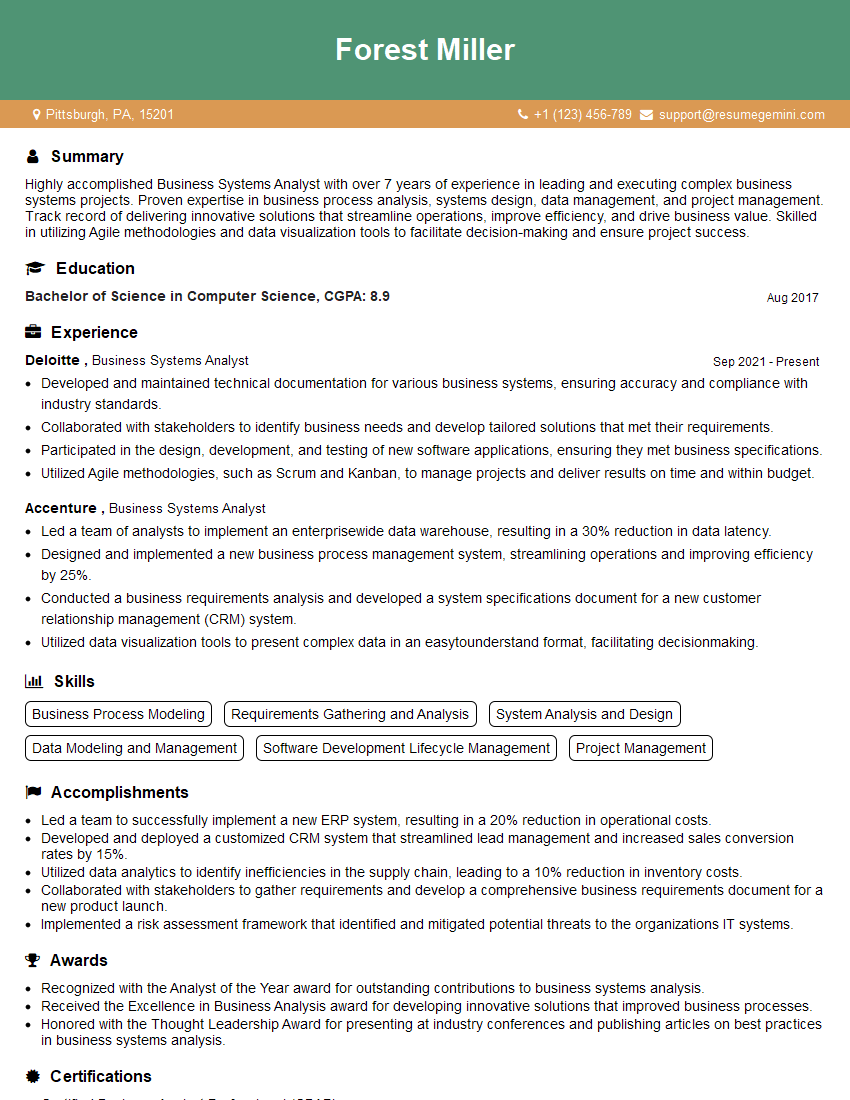
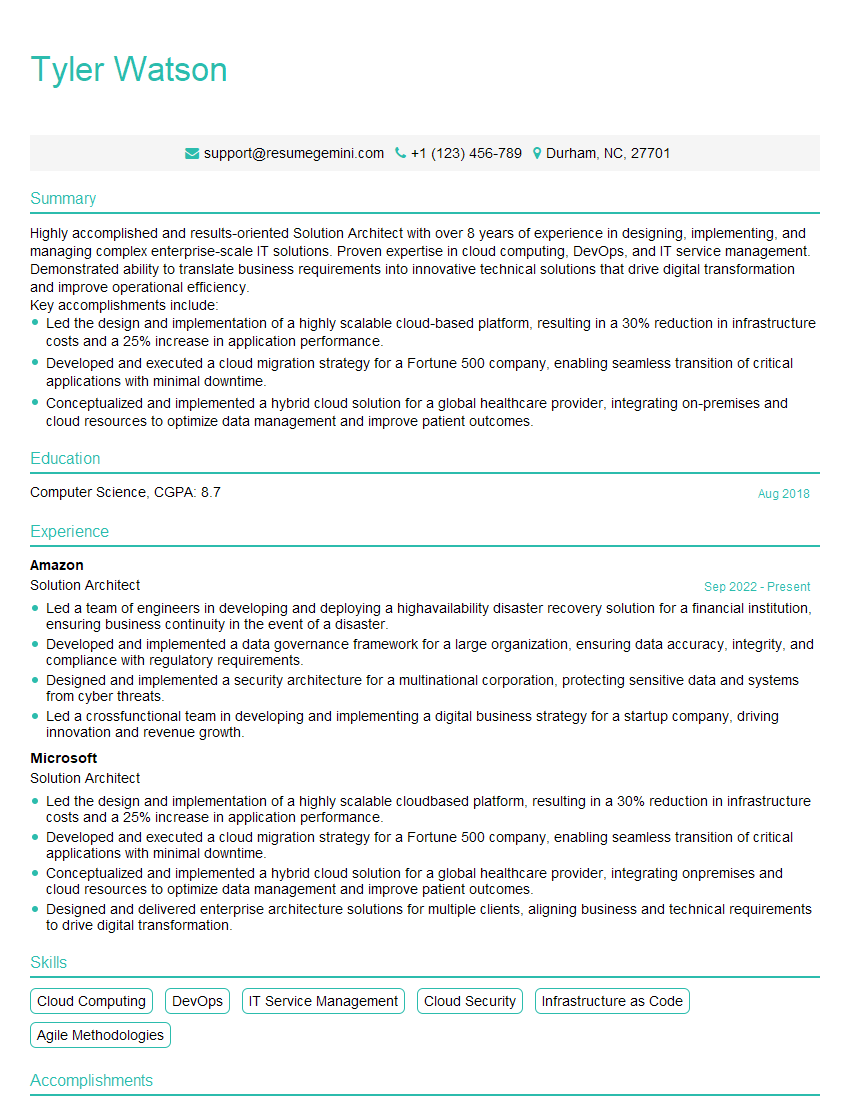
Mastering Solution Analysis is crucial for career advancement in the technology sector. It demonstrates your ability to think critically, solve complex problems, and communicate effectively – highly valued skills across various roles. To significantly boost your job prospects, focus on creating an ATS-friendly resume that highlights your relevant skills and experience. ResumeGemini is a trusted resource to help you build a professional and impactful resume that gets noticed. We provide examples of resumes tailored to Solution Analysis to help guide you. Take advantage of these resources to showcase your expertise and land your dream job!
Explore more articles
Users Rating of Our Blogs
Share Your Experience
We value your feedback! Please rate our content and share your thoughts (optional).
What Readers Say About Our Blog
Very informative content, great job.
good