Cracking a skill-specific interview, like one for Sorting and Classifying, requires understanding the nuances of the role. In this blog, we present the questions you’re most likely to encounter, along with insights into how to answer them effectively. Let’s ensure you’re ready to make a strong impression.
Questions Asked in Sorting and Classifying Interview
Q 1. Explain the difference between sorting and classifying data.
Sorting and classifying are both data organization techniques, but they serve different purposes. Sorting arranges data items in a specific order based on a defined criterion (e.g., numerical or alphabetical order). Think of it like arranging books alphabetically by author’s last name on a shelf. Classifying, on the other hand, groups data items into categories based on shared characteristics. This is like organizing those same books into categories such as fiction, non-fiction, and biographies. Sorting focuses on order within a single set, while classifying focuses on grouping items into distinct sets based on shared properties.
Q 2. Describe three common sorting algorithms and their time complexities.
Three common sorting algorithms are:
- Bubble Sort: This algorithm repeatedly steps through the list, compares adjacent elements, and swaps them if they are in the wrong order. It’s simple to understand but inefficient for large datasets. Time Complexity: O(n2) in the worst and average cases, O(n) in the best case (already sorted).
- Merge Sort: A divide-and-conquer algorithm that recursively divides the list into smaller sublists until each sublist contains only one element. Then it repeatedly merges the sublists to produce new sorted sublists until there is only one sorted list remaining. It’s efficient even for large datasets. Time Complexity: O(n log n) in all cases.
- Quick Sort: Another divide-and-conquer algorithm that selects a ‘pivot’ element and partitions the other elements into two sub-arrays, according to whether they are less than or greater than the pivot. The sub-arrays are then recursively sorted. Generally very fast, but its worst-case time complexity can be O(n2) if the pivot selection is poor. Average Time Complexity: O(n log n).
Q 3. What are the advantages and disadvantages of using a merge sort versus a quick sort?
Merge Sort Advantages: Guaranteed O(n log n) time complexity, stable (preserves the relative order of equal elements), well-suited for external sorting (data that doesn’t fit in memory).
Merge Sort Disadvantages: Requires extra space for merging (not in-place), can be slower than Quick Sort in practice for smaller datasets.
Quick Sort Advantages: Generally faster than Merge Sort in practice for smaller to medium-sized datasets, can be implemented in-place (using less memory).
Quick Sort Disadvantages: Worst-case time complexity is O(n2), not stable.
In short: Choose Merge Sort for guaranteed performance and large datasets; choose Quick Sort for generally faster performance on smaller datasets where memory usage is a primary concern, but be aware of the potential for worst-case performance.
Q 4. Explain how you would sort a large dataset that doesn’t fit into memory.
Sorting a large dataset that exceeds available memory requires external sorting. A common approach is to use a multi-way merge sort. This involves:
- Divide: Break the dataset into smaller chunks that fit into memory.
- Sort: Sort each chunk individually using an efficient in-memory sorting algorithm (like Quick Sort or Merge Sort).
- Write: Write each sorted chunk to a temporary file on disk.
- Merge: Use a k-way merge algorithm to merge the sorted chunks from the temporary files into a single sorted output file. This involves maintaining k pointers (one for each temporary file), repeatedly selecting the smallest element among the k pointers, writing it to the output, and advancing the corresponding pointer.
This approach avoids loading the entire dataset into memory at once, making it suitable for datasets far larger than available RAM.
Q 5. Describe a scenario where you had to sort or classify data. What method did you use and why?
In a previous project involving customer transaction data, I needed to analyze purchasing patterns. The dataset was massive, containing millions of records with timestamps and product IDs. To identify popular products within specific timeframes, I first had to sort the data chronologically. I chose to implement an external merge sort due to the dataset size. The sorted data allowed for efficient analysis using sliding windows and other time-series analysis techniques. The chronological sorting made it much simpler to calculate moving averages, identify seasonal trends, and extract insights that would otherwise be computationally infeasible without a well-ordered dataset.
Q 6. How would you handle duplicate values when sorting data?
Handling duplicate values during sorting depends on the desired outcome. Most sorting algorithms will place duplicates adjacent to each other. If you want to eliminate duplicates, you can easily do so after sorting by iterating through the sorted list and keeping track of the last unique value. If you need to maintain the original order of duplicates, you can incorporate a secondary sorting key based on the original order (e.g., an index).
Q 7. What are the key considerations when choosing a sorting algorithm for a specific application?
Choosing the right sorting algorithm depends on several key factors:
- Dataset size: For smaller datasets, the overhead of more complex algorithms might outweigh the benefit of faster asymptotic complexity. Simple algorithms like Bubble Sort or Insertion Sort might suffice.
- Data characteristics: Is the data nearly sorted? Are there many duplicates? If the data is nearly sorted, Insertion Sort can be very efficient. If there are many duplicates, a stable sort might be preferred.
- Memory constraints: If the data doesn’t fit in memory, external sorting algorithms are necessary.
- Stability requirements: Does the relative order of equal elements need to be preserved? If yes, you need a stable sort (like Merge Sort).
- Implementation complexity: The trade-off between development time and runtime performance should be considered.
It’s often beneficial to profile different algorithms on a representative subset of your data to empirically determine the best choice for your specific application.
Q 8. Explain the concept of stability in sorting algorithms.
Stability in sorting algorithms refers to the algorithm’s behavior when dealing with equal elements. A stable sorting algorithm maintains the relative order of equal elements in the sorted output. Imagine you’re sorting a deck of cards: a stable sort would ensure that if you have two Jacks of different suits, their original order (say, Jack of Hearts followed by Jack of Spades) remains the same after sorting.
Example: Consider the list [2, 5, 3, 5, 1]. If we sort it using a stable algorithm, two possible outputs are [1, 2, 3, 5, 5] and [1, 2, 3, 5, 5]. The relative order of the two ‘5’s might differ depending on the algorithm, but it doesn’t matter – it remains stable. However, an unstable algorithm might produce [1, 2, 3, 5, 5] or [1, 2, 3, 5, 5] but also [1, 2, 5, 3, 5], changing the order of the 5s from the original input. This is crucial in scenarios where you need to preserve the original order of duplicates, like maintaining the order of records with the same timestamp.
Algorithms: Merge sort and insertion sort are examples of stable sorting algorithms. Quick sort and heap sort are generally unstable.
Q 9. What are some common classification algorithms?
Common classification algorithms fall into several categories. Here are a few prominent examples:
- Decision Trees: Create a tree-like model of decisions based on features to classify data. Simple to understand and visualize but prone to overfitting.
- k-Nearest Neighbors (k-NN): Classifies data points based on the majority class among their k-nearest neighbors. Simple but computationally expensive for large datasets.
- Naive Bayes: A probabilistic classifier based on Bayes’ theorem, assuming feature independence. Efficient and works well with high-dimensional data.
- Support Vector Machines (SVM): Finds the optimal hyperplane to separate different classes. Effective in high-dimensional spaces and robust to outliers.
- Logistic Regression: Predicts the probability of a data point belonging to a certain class. Simple, efficient, and widely used.
- Neural Networks: Complex models capable of learning intricate patterns but require significant data and computational resources.
Q 10. Explain the difference between supervised and unsupervised classification.
The key difference between supervised and unsupervised classification lies in the presence or absence of labeled data.
- Supervised Classification: Uses labeled data, meaning each data point is already associated with a known class. The algorithm learns from these labeled examples to classify new, unseen data points. Examples include training a spam filter on a dataset of emails labeled as ‘spam’ or ‘not spam’.
- Unsupervised Classification: Uses unlabeled data, where the classes are unknown. The algorithm aims to discover inherent patterns and group similar data points together. Examples include customer segmentation based on purchase history without pre-defined customer segments.
In essence, supervised learning is like having a teacher who provides the correct answers during training, while unsupervised learning is like exploring a dataset without a map or guide.
Q 11. Describe the k-nearest neighbors algorithm and its applications.
The k-Nearest Neighbors (k-NN) algorithm is a simple yet effective instance-based learning algorithm. It classifies a new data point based on the majority class among its ‘k’ nearest neighbors in the feature space. ‘k’ is a user-defined parameter.
How it works:
- Calculate Distances: For a new data point, calculate the distance (e.g., Euclidean distance) to all existing data points in the training dataset.
- Find Nearest Neighbors: Identify the ‘k’ data points with the smallest distances.
- Determine Class: Assign the new data point the class that is most frequent among its ‘k’ nearest neighbors.
Applications: k-NN is used in various domains, including:
- Recommendation Systems: Recommending products or movies based on the preferences of similar users.
- Image Recognition: Classifying images based on the features of similar images.
- Anomaly Detection: Identifying outliers or unusual data points by comparing them to their nearest neighbors.
- Medical Diagnosis: Predicting the likelihood of a disease based on patient characteristics.
Q 12. What is the decision tree algorithm and how does it work?
A decision tree is a tree-like model used for classification (and regression). It uses a series of decisions based on features to classify data points. Each node in the tree represents a test on a feature, each branch represents the outcome of the test, and each leaf node represents a class label.
How it works: The algorithm recursively partitions the data based on the feature that best separates the classes. This is often measured using metrics like Gini impurity or information gain. The process continues until a stopping criterion is met (e.g., a maximum depth or minimum number of samples per leaf).
Example: Imagine classifying fruits based on size and color. The root node might test ‘size’. If the size is ‘large’, one branch leads to a node testing ‘color’. If the color is ‘red’, it could lead to a leaf node ‘apple’. The algorithm learns which features are most informative for classification and creates a hierarchical decision structure.
Q 13. Explain the concept of overfitting in classification.
Overfitting in classification occurs when a model learns the training data too well, including its noise and outliers. It becomes overly complex and performs exceptionally well on the training data but poorly on unseen data. Imagine learning a specific route to work by heart; you’ll be very efficient on that route but completely lost if there’s a road closure or detour.
Causes: Overfitting often arises from:
- Complex models: Using models with high capacity (e.g., deep neural networks) that can memorize the training data.
- Insufficient data: Not having enough data to generalize well.
- High dimensionality: Having too many features relative to the number of data points.
Consequences: Poor generalization to new data, low accuracy on test data, and lack of robustness.
Mitigation Techniques: Techniques to reduce overfitting include:
- Cross-validation: Evaluate model performance on multiple folds of the data.
- Regularization: Add penalties to the model’s complexity.
- Pruning (Decision Trees): Removing unnecessary branches in the tree.
- Feature selection: Reducing the number of features used in the model.
Q 14. How do you evaluate the performance of a classification model?
Evaluating a classification model’s performance requires several metrics depending on the context and goals. Key metrics include:
- Accuracy: The proportion of correctly classified instances (overall correctness).
- Precision: Out of all instances predicted as a specific class, what proportion was actually that class (avoiding false positives).
- Recall (Sensitivity): Out of all instances that truly belong to a specific class, what proportion was correctly identified (avoiding false negatives).
- F1-score: The harmonic mean of precision and recall, providing a balanced measure.
- Confusion Matrix: A table showing the counts of true positives, true negatives, false positives, and false negatives, giving a detailed overview of performance.
- ROC Curve (Receiver Operating Characteristic Curve): Plots the true positive rate against the false positive rate for different classification thresholds. The area under the ROC curve (AUC) is a summary measure of the model’s overall performance.
Choosing the right metric depends on the specific application. For example, in medical diagnosis, high recall (minimizing false negatives) is crucial, even if it means accepting some false positives. In spam filtering, high precision (minimizing false positives) might be prioritized.
Q 15. What are precision and recall, and how are they used in classification?
Precision and recall are two crucial metrics used to evaluate the performance of a classification model, particularly when dealing with imbalanced datasets. Think of it like this: you’re searching for a specific type of flower (your positive class) in a vast field (your dataset).
Precision answers: “Out of all the flowers I identified as the target flower, what proportion was actually the target flower?” It’s the ratio of true positives (correctly identified target flowers) to the total number of predicted positives (all flowers identified as the target flower, including false positives). A high precision means you have a low rate of false positives – you’re confident in your positive predictions. The formula is: Precision = True Positives / (True Positives + False Positives)
Recall answers: “Out of all the actual target flowers in the field, what proportion did I correctly identify?” It’s the ratio of true positives to the total number of actual positives (all instances of the target flower, including those missed). A high recall means you have a low rate of false negatives – you’re good at finding most of the target flowers. The formula is: Recall = True Positives / (True Positives + False Negatives)
Example: Imagine a spam filter. High precision means few legitimate emails are flagged as spam (low false positives). High recall means few spam emails slip through undetected (low false negatives).
Career Expert Tips:
- Ace those interviews! Prepare effectively by reviewing the Top 50 Most Common Interview Questions on ResumeGemini.
- Navigate your job search with confidence! Explore a wide range of Career Tips on ResumeGemini. Learn about common challenges and recommendations to overcome them.
- Craft the perfect resume! Master the Art of Resume Writing with ResumeGemini’s guide. Showcase your unique qualifications and achievements effectively.
- Don’t miss out on holiday savings! Build your dream resume with ResumeGemini’s ATS optimized templates.
Q 16. Explain the F1-score and its importance in classification.
The F1-score is a single metric that combines precision and recall, providing a balanced measure of a classifier’s performance. It’s particularly useful when dealing with imbalanced datasets where optimizing for precision alone or recall alone might be misleading.
The F1-score is the harmonic mean of precision and recall. The harmonic mean gives more weight to lower values, so a high F1-score requires both high precision and high recall. A low F1-score indicates that either precision or recall (or both) is poor.
The formula is: F1-score = 2 * (Precision * Recall) / (Precision + Recall)
Importance: The F1-score is important because it provides a balanced perspective. A model might have high precision but low recall (e.g., it’s very accurate when it makes a positive prediction but misses many true positives). Similarly, it might have high recall but low precision (e.g., it finds most true positives but also many false positives). The F1-score helps you choose the model that provides a good balance between both.
Example: In medical diagnosis, a high recall is crucial (don’t want to miss any disease cases, even if it means some false positives). In fraud detection, high precision is critical (avoiding unnecessary investigations, even if it means missing some fraudulent transactions). The F1-score helps determine the best compromise depending on the context.
Q 17. How do you handle imbalanced datasets in classification?
Imbalanced datasets, where one class significantly outnumbers others, pose a challenge for classification models. A model trained on such a dataset might become biased towards the majority class, performing poorly on the minority class. Here’s how to handle this:
- Resampling Techniques:
- Undersampling: Removing instances from the majority class to balance the dataset. This is simple but can lead to information loss.
- Oversampling: Adding instances to the minority class. This can involve creating synthetic samples (SMOTE – Synthetic Minority Over-sampling Technique) or duplicating existing ones. While effective, it can lead to overfitting if not carefully done.
- Cost-Sensitive Learning: Assigning different misclassification costs. Penalizing misclassifications of the minority class more heavily during model training. This encourages the model to pay more attention to the minority class.
- Ensemble Methods: Combining multiple models trained on different subsets of the data or using different resampling techniques. This can improve overall robustness and performance.
- Anomaly Detection Techniques: If the minority class represents anomalies, consider using anomaly detection algorithms designed for such scenarios.
Example: In fraud detection, fraudulent transactions are the minority class. Oversampling or cost-sensitive learning can be employed to improve the model’s ability to detect these rare but critical events.
Q 18. What is cross-validation and why is it important?
Cross-validation is a resampling technique used to evaluate a model’s performance and avoid overfitting. It involves splitting the dataset into multiple subsets (folds), training the model on some folds, and testing it on the remaining fold(s). This process is repeated multiple times, using different folds for training and testing each time.
Types: k-fold cross-validation is the most common, where the data is split into k equal-sized folds. Leave-one-out cross-validation (LOOCV) is an extreme case where each data point is treated as a test set, and the remaining data is used for training. Stratified k-fold ensures that the class distribution is similar in each fold.
Importance: Cross-validation provides a more robust estimate of the model’s performance than using a single train-test split. It helps assess how well the model generalizes to unseen data, reducing the risk of overfitting, where the model performs well on the training data but poorly on new data.
Example: If you train a model using a single train-test split, and it performs well on the test set, it doesn’t guarantee that it will perform equally well on new data. Cross-validation mitigates this by providing a more reliable performance estimate across different subsets of the data.
Q 19. What are some techniques for feature scaling and why are they necessary?
Feature scaling transforms the features of a dataset to a similar range of values. This is crucial for many machine learning algorithms, especially distance-based algorithms like k-Nearest Neighbors and those using gradient descent like linear regression and neural networks.
Techniques:
- Min-Max Scaling (Normalization): Scales features to a range between 0 and 1. The formula is:
x_scaled = (x - x_min) / (x_max - x_min) - Z-Score Standardization: Centers the data around 0 with a standard deviation of 1. The formula is:
x_scaled = (x - μ) / σwhere μ is the mean and σ is the standard deviation. - Robust Scaling: Uses the median and interquartile range (IQR) instead of mean and standard deviation, making it less sensitive to outliers.
Necessity: Features with larger values might dominate the algorithm, leading to biased results. Scaling ensures that all features contribute equally. It improves the convergence speed of gradient-based algorithms and prevents features with larger magnitudes from overwhelming others.
Example: If one feature ranges from 0 to 1 and another from 0 to 1000, the second feature will disproportionately influence distance-based algorithms. Scaling ensures that both features have an equal weight.
Q 20. How would you handle missing data in a dataset you need to sort or classify?
Handling missing data is a critical preprocessing step before sorting or classifying. Ignoring missing data can lead to biased results. Here’s how to address it:
- Deletion: Removing rows or columns with missing values. This is simple but can lead to substantial information loss, especially if many values are missing.
- Imputation: Filling in missing values with estimated values. Common techniques include:
- Mean/Median/Mode Imputation: Replacing missing values with the mean, median, or mode of the respective feature. Simple, but can distort the distribution if many values are missing.
- K-Nearest Neighbors Imputation: Using the values of the k nearest neighbors to estimate the missing value.
- Regression Imputation: Predicting the missing values using a regression model trained on the complete data.
- Advanced Techniques: Multiple Imputation, which creates multiple imputed datasets and combines the results, provides a more robust estimation than single imputation.
The best approach depends on the amount of missing data, the pattern of missingness, and the impact on the analysis. It’s always crucial to document the method used for handling missing data.
Example: In a dataset with missing ages, mean imputation might be sufficient if the number of missing values is small. However, if there’s a systematic pattern to the missing data (e.g., older individuals are more likely to have missing ages), more advanced techniques like multiple imputation might be necessary.
Q 21. Explain the concept of dimensionality reduction and its relevance to classification.
Dimensionality reduction techniques aim to reduce the number of features (variables) in a dataset while preserving as much relevant information as possible. This is particularly useful in high-dimensional datasets, where many features might be redundant or irrelevant for classification.
Benefits: Reduces computational cost, simplifies models, removes noise and redundancy, can improve model performance by preventing overfitting.
Techniques:
- Principal Component Analysis (PCA): A linear transformation that projects the data onto a lower-dimensional subspace while maximizing variance. It finds the principal components that capture the most important information.
- t-distributed Stochastic Neighbor Embedding (t-SNE): A non-linear dimensionality reduction technique that is particularly good for visualization of high-dimensional data. It aims to preserve local neighborhood structure.
- Linear Discriminant Analysis (LDA): A supervised technique that finds linear combinations of features that maximize the separation between classes. It’s specifically designed for classification problems.
Relevance to Classification: Dimensionality reduction can improve classification by reducing noise and irrelevant features, leading to simpler, more interpretable models and potentially better generalization to unseen data. For example, if you’re classifying images, PCA might reduce the number of pixels needed without significantly affecting the classification accuracy.
Q 22. How do you choose the appropriate number of clusters in k-means clustering?
Choosing the optimal number of clusters (k) in k-means clustering is a crucial step, as it directly impacts the quality of the results. There isn’t a single perfect method, but several techniques can help. Imagine you’re sorting marbles by color – too few clusters, and you’ll have mixed colors; too many, and you’ll have overly specific groupings that aren’t meaningful.
Elbow Method: This involves plotting the within-cluster sum of squares (WCSS) against the number of clusters. WCSS represents the sum of squared distances between each data point and its cluster centroid. As k increases, WCSS decreases. The ‘elbow point’ on the plot, where the rate of decrease slows significantly, often suggests a good k value. It’s like finding the point where adding more clusters provides diminishing returns in terms of improved grouping.
Silhouette Analysis: This method calculates the silhouette coefficient for each data point, which measures how similar it is to its own cluster compared to other clusters. A higher average silhouette coefficient indicates better clustering. You iterate through different k values and choose the one with the highest average silhouette score.
Gap Statistic: This compares the WCSS of your data to the WCSS of random data. The optimal k is where the gap statistic is maximized, signifying a significant difference between your clustered data and random data.
Domain Knowledge: Sometimes, prior knowledge about the data can guide the choice of k. If you know there are naturally three distinct groups in your data based on pre-existing categories, you might start with k=3.
It’s often beneficial to try several methods and compare the results before making a final decision. Visual inspection of the clusters and consideration of the practical implications are also valuable.
Q 23. What is hierarchical clustering and how does it differ from k-means clustering?
Hierarchical clustering builds a hierarchy of clusters, represented as a dendrogram (tree-like diagram). It differs fundamentally from k-means in its approach. K-means is a partitional method, meaning it directly assigns data points to a predefined number of clusters. Hierarchical clustering, on the other hand, builds a hierarchy of clusters iteratively, either agglomeratively (bottom-up) or divisively (top-down).
Agglomerative (bottom-up) starts with each data point as a separate cluster and successively merges the closest clusters until a single cluster remains. Divisive (top-down) begins with all data points in one cluster and recursively splits it into smaller clusters.
Key Differences Summarized:
Number of Clusters: K-means requires specifying the number of clusters beforehand, while hierarchical clustering doesn’t – you can choose the number of clusters later by cutting the dendrogram at a desired level.
Iterative vs. Hierarchical: K-means is iterative, refining cluster assignments until convergence. Hierarchical clustering builds a complete hierarchy in a single pass.
Computational Cost: Hierarchical clustering can be computationally expensive for large datasets, especially agglomerative methods, while k-means is generally more efficient.
Cluster Shape: K-means often assumes spherical clusters, while hierarchical clustering can handle more complex shapes.
Imagine sorting books: k-means is like assigning books to predefined shelves (number of shelves = k). Hierarchical clustering is like building a detailed library catalog, grouping books based on genre, subgenre, author, etc., creating nested categories.
Q 24. Explain the concept of a confusion matrix.
A confusion matrix is a visual representation of the performance of a classification model. It’s a table showing the counts of true positive (TP), true negative (TN), false positive (FP), and false negative (FN) predictions. Think of it as a report card for your classifier.
Let’s say you’re building a spam filter. The confusion matrix would look like this:
| Predicted Spam | Predicted Not Spam | |
|---|---|---|
| Actual Spam | TP (correctly identified spam) | FN (missed spam) |
| Actual Not Spam | FP (falsely flagged as spam) | TN (correctly identified not spam) |
Interpretation:
TP: Number of spam emails correctly classified as spam.
TN: Number of non-spam emails correctly classified as non-spam.
FP: Number of non-spam emails incorrectly classified as spam (false alarms).
FN: Number of spam emails incorrectly classified as non-spam (missed spam).
From the confusion matrix, various metrics like accuracy, precision, recall, and F1-score can be calculated to assess the model’s performance. For example, high precision means few false positives (low rate of misclassifying non-spam as spam), and high recall means few false negatives (low rate of missing actual spam).
Q 25. Describe how you would approach classifying unstructured data.
Classifying unstructured data, like text or images, requires a different approach than structured data. The process typically involves several steps:
Data Preprocessing: This is crucial. For text, it might include tokenization (breaking down text into words), stemming (reducing words to their root form), stop word removal (removing common words like ‘the’ and ‘a’), and potentially using techniques like TF-IDF or word embeddings to represent the text numerically.
Feature Extraction: Extract meaningful features from the preprocessed data. For text, features could be word frequencies, sentiment scores, or topic modeling results. For images, features might include texture, color histograms, or features learned from convolutional neural networks (CNNs).
Model Selection: Choose an appropriate classification algorithm. Common choices include Support Vector Machines (SVMs), Naive Bayes, Random Forests, or deep learning models like CNNs (for images) or Recurrent Neural Networks (RNNs) (for sequential data like text).
Model Training and Evaluation: Train the selected model on a labeled dataset and evaluate its performance using metrics like accuracy, precision, and recall (often using a confusion matrix). Techniques like cross-validation are crucial for robust evaluation.
Model Deployment and Monitoring: Deploy the trained model and monitor its performance in a real-world setting, retraining or fine-tuning as needed.
For example, classifying customer reviews as positive or negative involves preprocessing the text, extracting sentiment features, training a classifier (e.g., a Naive Bayes or SVM model), and evaluating its ability to accurately predict sentiment.
Q 26. What are some common challenges in data sorting and classification, and how would you address them?
Several challenges arise in data sorting and classification:
High Dimensionality: Dealing with datasets containing many features (variables) can lead to the ‘curse of dimensionality,’ making it harder to find patterns and increasing computational costs. Dimensionality reduction techniques like Principal Component Analysis (PCA) can help.
Imbalanced Data: When one class has significantly more instances than others, the model may become biased towards the majority class. Addressing this involves techniques like oversampling the minority class, undersampling the majority class, or using cost-sensitive learning.
Noisy Data: Errors or inconsistencies in the data can significantly impact the performance of sorting and classification algorithms. Data cleaning and preprocessing steps like outlier detection and handling missing values are crucial.
Choosing the Right Algorithm: Different algorithms are suited to different types of data and tasks. Carefully selecting an appropriate algorithm based on data characteristics and desired outcome is crucial.
Computational Complexity: Some algorithms, especially those dealing with large datasets, can be computationally expensive. Careful algorithm selection and optimization techniques are needed to manage computational resources.
Addressing these challenges involves a combination of careful data preprocessing, appropriate algorithm selection, and potentially advanced techniques like ensemble methods or dimensionality reduction.
Q 27. How would you optimize the performance of a sorting or classification algorithm?
Optimizing the performance of sorting and classification algorithms depends heavily on the context. General strategies include:
Algorithm Choice: Select an algorithm appropriate for the data size and structure. For example, quicksort is efficient for many cases, but merge sort offers guaranteed O(n log n) performance. For massive datasets, consider external sorting algorithms.
Data Structures: Using efficient data structures like heaps or balanced trees can significantly improve performance, especially for certain algorithms.
Preprocessing: Cleaning and preparing the data before sorting or classification can dramatically improve speed and accuracy. This includes handling missing values, outlier removal, and feature scaling.
Parallelization: For large datasets, parallelizing the algorithm using multiple cores or distributed computing frameworks can significantly reduce processing time.
Indexing: For searching and retrieval tasks related to classification, using indexes (like B-trees or hash tables) can dramatically speed up lookup operations.
Approximation Algorithms: In some cases, accepting slightly less accurate results for a significant speedup is worthwhile. Approximation algorithms can trade accuracy for efficiency.
Profiling the code to identify bottlenecks is essential for targeted optimization. Tools like profilers can pinpoint slow sections of code, allowing you to focus optimization efforts where they are most effective.
Q 28. Describe your experience with any specific sorting or classification libraries or tools.
I have extensive experience with various sorting and classification libraries and tools. In Python, I frequently use scikit-learn (sklearn) for a wide range of classification algorithms (Logistic Regression, SVM, Random Forest, etc.) and for various clustering techniques. Its efficiency and comprehensive documentation make it a go-to tool for many machine learning tasks. For large-scale data processing, I have experience with Spark MLlib, which offers scalable machine learning algorithms optimized for distributed computing environments. I’m also proficient in using pandas for data manipulation and preprocessing before applying sorting and classification methods.
For specific sorting algorithms, Python’s built-in sort() function (which uses Timsort, a hybrid algorithm) is highly efficient for most general-purpose sorting tasks. I’ve also worked with custom implementations of algorithms like merge sort and quicksort for educational or comparative analysis purposes.
Key Topics to Learn for Sorting and Classifying Interviews
- Fundamental Sorting Algorithms: Understand the time and space complexity of algorithms like Bubble Sort, Insertion Sort, Merge Sort, Quick Sort, Heap Sort. Be prepared to discuss their strengths and weaknesses in different scenarios.
- Sorting Algorithm Selection: Learn to choose the appropriate sorting algorithm based on factors such as dataset size, data characteristics (e.g., nearly sorted, duplicates), and memory constraints. Practice analyzing the trade-offs.
- Classification Techniques: Explore various classification methods, including supervised learning techniques (e.g., decision trees, support vector machines, naive Bayes) and unsupervised learning techniques (e.g., k-means clustering, hierarchical clustering).
- Data Structures for Sorting and Classifying: Familiarize yourself with relevant data structures like arrays, linked lists, trees, and heaps, and how their properties impact the efficiency of sorting and classification algorithms.
- Practical Applications: Be ready to discuss real-world applications of sorting and classifying, such as database indexing, search engine optimization, recommendation systems, and data analysis.
- Big O Notation and Algorithm Analysis: Master the use of Big O notation to analyze the efficiency of different algorithms and compare their performance. This is crucial for demonstrating your understanding of algorithm complexity.
- Handling Large Datasets: Discuss strategies for efficiently sorting and classifying extremely large datasets, including techniques like external sorting and distributed algorithms.
- Error Handling and Robustness: Consider how to design sorting and classifying systems that are robust and can handle errors or edge cases gracefully.
Next Steps
Mastering sorting and classifying algorithms is essential for success in many technical roles, demonstrating your problem-solving abilities and understanding of fundamental computer science concepts. This skill significantly enhances your candidacy and opens doors to exciting career opportunities. To maximize your chances, create a resume that highlights these skills effectively. An ATS-friendly resume is crucial for getting your application noticed by recruiters. We encourage you to leverage ResumeGemini, a trusted resource for building professional resumes. ResumeGemini provides examples of resumes tailored to Sorting and Classifying roles, helping you showcase your expertise effectively and land your dream job.

Warehouse Manager Resume Sample

Logistics Coordinator Resume Sample

Project Manager Resume Sample

Research Associate Resume Sample

Compliance Officer Resume Sample

Supply Chain Analyst Resume Sample

Business Analyst Resume Sample
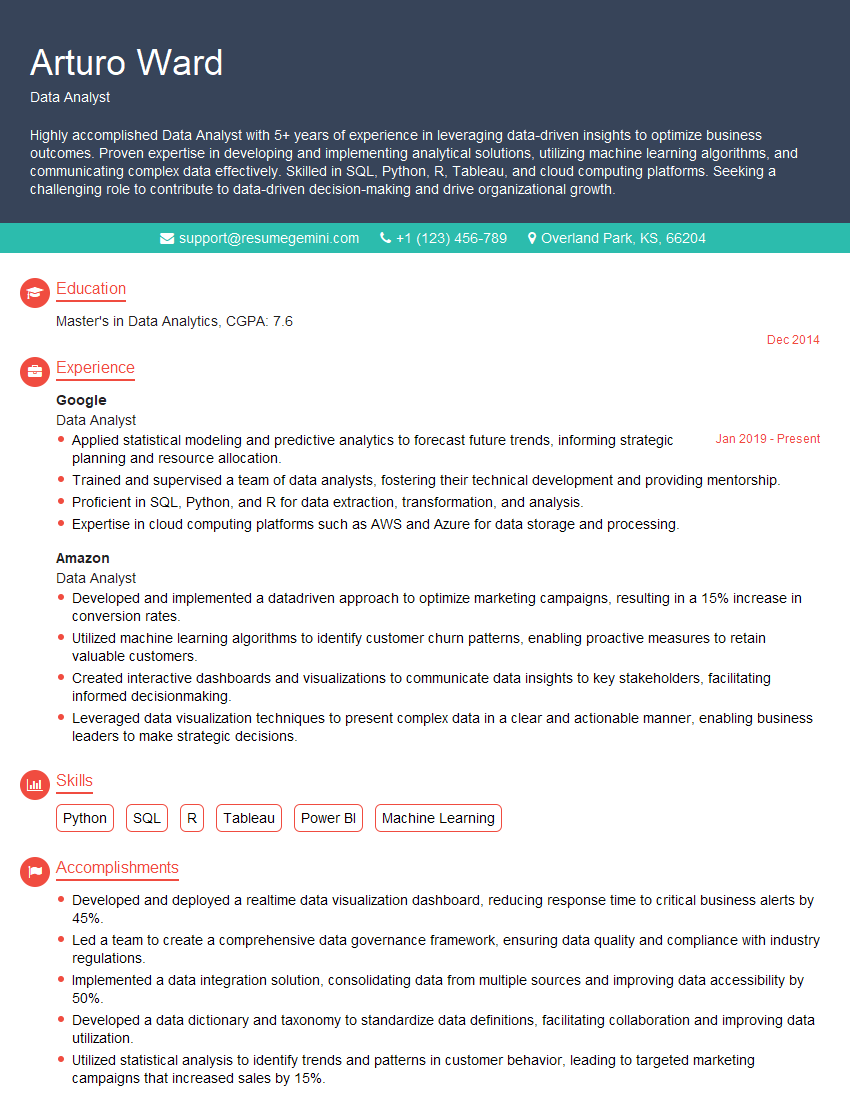
Data Analyst Resume Sample

Data Scientist Resume Sample

Information Architect Resume Sample

Records Manager Resume Sample

Operations Research Analyst Resume Sample

Quality Control Specialist Resume Sample

Taxonomist Resume Sample

Librarian Resume Sample

Archivist Resume Sample

Cataloger Resume Sample
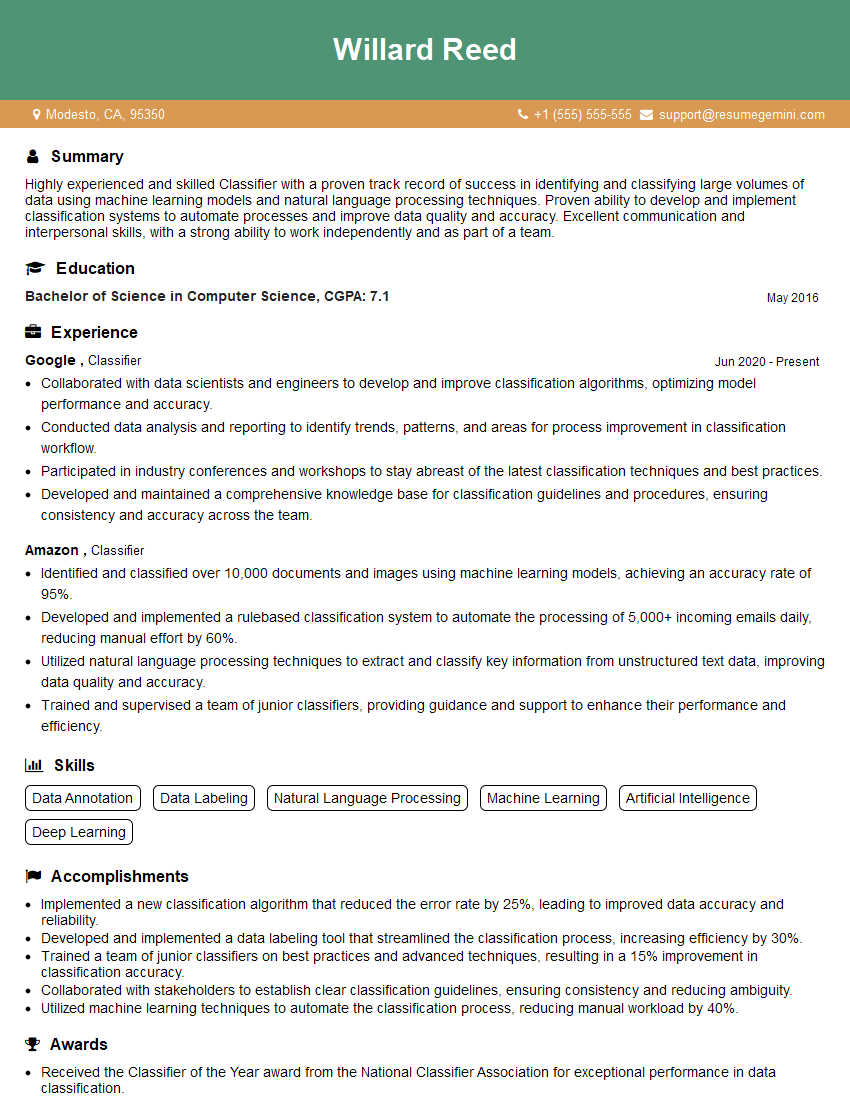
Classifier Resume Sample
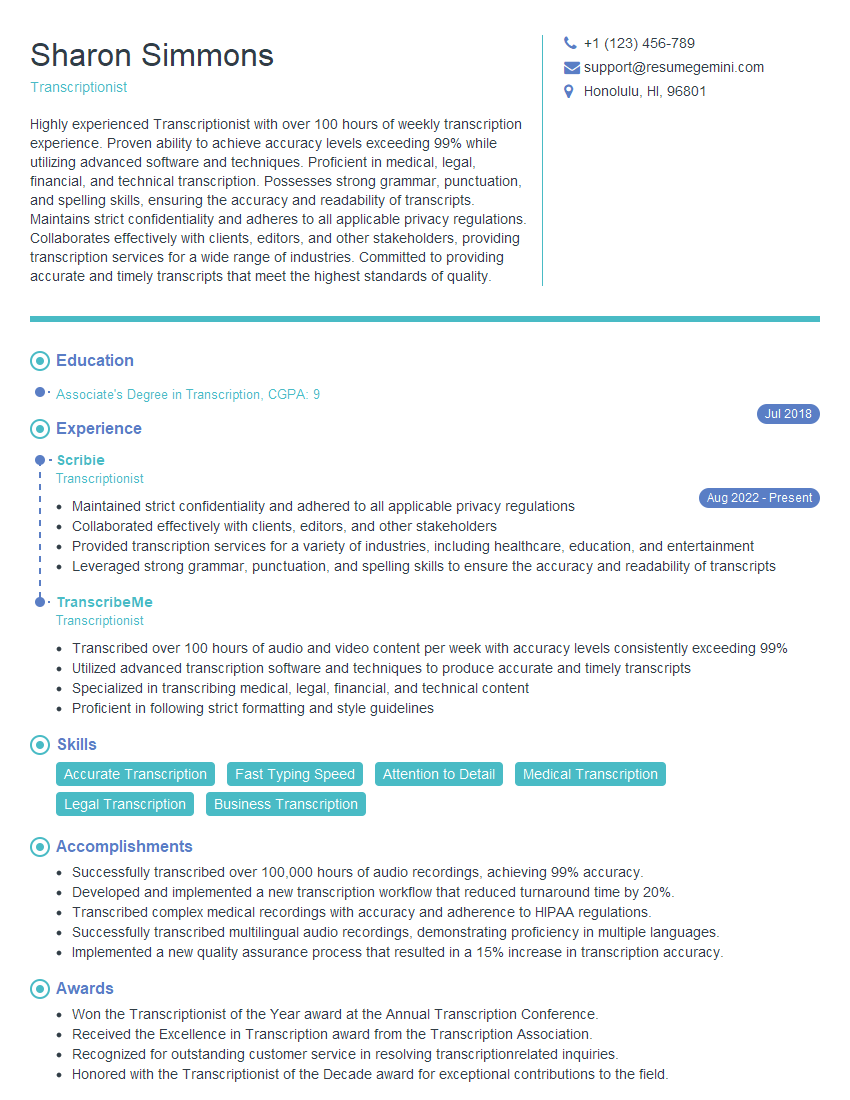
Transcriptionist Resume Sample

Medical Coder Resume Sample

Sorter Resume Sample

Inventory Control Specialist Resume Sample
- Warehouse Manager
- Logistics Coordinator
- Project Manager
- Research Associate
- Compliance Officer
- Supply Chain Analyst
- Business Analyst
- Data Analyst
- Data Scientist
- Information Architect
- Records Manager
- Operations Research Analyst
- Quality Control Specialist
- Taxonomist
- Librarian
- Archivist
- Cataloger
- Classifier
- Transcriptionist
- Medical Coder
- Sorter
- Inventory Control Specialist
Explore more articles
Users Rating of Our Blogs
Share Your Experience
We value your feedback! Please rate our content and share your thoughts (optional).
What Readers Say About Our Blog
Very informative content, great job.
good