The thought of an interview can be nerve-wracking, but the right preparation can make all the difference. Explore this comprehensive guide to Special Effects Design and Implementation interview questions and gain the confidence you need to showcase your abilities and secure the role.
Questions Asked in Special Effects Design and Implementation Interview
Q 1. Explain your experience with different particle simulation software.
My experience with particle simulation software spans several industry-leading packages. I’m proficient in Houdini, a powerful node-based system ideal for complex simulations, offering unparalleled control over fluid dynamics, fire, smoke, and destruction effects. I’ve also worked extensively with Maya’s nParticles system, which, while perhaps less flexible than Houdini for highly detailed simulations, offers a solid, integrated workflow within a familiar 3D environment. Finally, I have experience with Phoenix FD, a plugin known for its user-friendly interface and robust real-time feedback, making it particularly effective for iterative design and quick prototyping.
Each software has its strengths and weaknesses. Houdini shines in complex, physically accurate simulations, demanding a steeper learning curve. Maya’s nParticles are more accessible for artists less familiar with procedural methods, while Phoenix FD bridges the gap, offering high quality with a simplified workflow. My choice of software depends on the project’s complexity, timeline, and client requirements.
Q 2. Describe your process for creating realistic fire effects.
Creating realistic fire effects involves understanding the underlying physics and then translating those principles into a digital representation. My process typically starts with a base simulation, often in Houdini, using a combination of volume-based techniques and particle systems. Volume rendering allows for subtle nuances in density and temperature, giving the fire its characteristic glow and translucency. Particles, on the other hand, enable the creation of embers, sparks, and smoke, adding detail and dynamism.
I utilize various techniques like turbulence fields to create chaotic movement, temperature maps to control the color variations (ranging from deep orange to bright yellow and white), and absorption and scattering simulations to render the smoke plumes accurately. Post-processing is crucial. I use compositing software like Nuke to enhance the fire’s luminance, add subtle atmospheric effects like haze, and blend the elements seamlessly with live-action footage.
For example, on a recent project involving a large-scale bonfire, I used Houdini to simulate the core fire, meticulously adjusting parameters to achieve realistic flickering and volumetric density. Then, I added separate particle simulations for embers and sparks, carefully controlling their lifespans, velocities, and decay rates. Finally, I layered in smoke simulations and applied post-processing effects to match the scene’s lighting and atmosphere.
Q 3. How do you handle complex simulations to maintain performance?
Managing performance in complex simulations requires a multi-faceted approach. First, optimizing the simulation itself is key. This often involves reducing the resolution of the simulation where possible without sacrificing visual quality. For example, using proxy geometries instead of high-poly models can significantly improve performance. Subdivision surface techniques can help maintain a sense of detail while lowering the polygon count.
Secondly, I utilize caching techniques extensively. Instead of calculating the entire simulation in real-time, I cache portions of it to disk, allowing for faster playback and iterations during compositing. Finally, procedural generation can help. Instead of manually placing hundreds of individual fire sources, I might use a procedural system to generate them, vastly improving efficiency. In cases of extremely high demand, I would consider distributing the computation across multiple computers using render farms.
For instance, on a project with a large-scale destruction sequence, I broke down the simulation into smaller, manageable chunks. I cached each chunk’s simulation data separately, allowing me to review and edit different parts of the effect without recalculating the entire scene repeatedly. This dramatically reduced render times and improved the overall workflow efficiency.
Q 4. What are your preferred methods for creating realistic water simulations?
Realistic water simulations depend on accurate representation of fluid dynamics, surface tension, and interaction with other elements. My preferred methods involve using fluid simulation software like Houdini or RealFlow. These tools utilize sophisticated solvers that accurately model the movement and behavior of water, taking into account factors like viscosity, buoyancy, and turbulence.
For calmer water effects, I often start with a simple fluid simulation and focus on surface detail, using techniques like displacement mapping to create subtle ripples and waves. For more dynamic scenes, such as crashing waves or water splashes, I rely on more complex particle systems to create splashes, foam, and spray, carefully adjusting parameters to ensure visually convincing results. Post-processing plays a vital role, often involving enhancing reflections, refractions, and subsurface scattering effects to make the water look more realistic.
On a recent project involving a boat speeding through rough seas, I used Houdini’s fluid dynamics solver to simulate the turbulent waves. I created separate particle simulations for the spray and foam, ensuring that they interacted realistically with the simulated waves and the boat’s hull. Finally, I used a combination of image-based lighting and physically based rendering to accurately capture the water’s reflections and refractions.
Q 5. Discuss your experience with compositing software (e.g., Nuke, After Effects).
My compositing experience is extensive, primarily using Nuke and After Effects. Nuke is my go-to for complex shots requiring intricate node-based workflows and precision control, particularly in high-end VFX work. Its versatility in handling multiple layers, keying, rotoscoping, and color correction makes it ideal for integrating CG elements with live-action footage. After Effects, on the other hand, offers a more streamlined, intuitive interface, well-suited for smaller tasks, motion graphics, and quick adjustments.
I often use Nuke for complex tasks like seamless integration of CG environments, keying out green screens, and creating realistic lighting matches between CG and live-action elements. After Effects is useful for simpler tasks such as adding subtle effects, text animations, and color grading adjustments. Selecting between the two depends on the specific demands of each project. I often use both in tandem, leveraging the strengths of each for optimal results.
Q 6. How do you integrate CG elements seamlessly into live-action footage?
Seamlessly integrating CG elements into live-action footage demands meticulous attention to detail and a thorough understanding of both 3D and 2D workflows. The process starts long before the actual compositing phase; it begins with careful planning during pre-production. This includes creating 3D models and environments that accurately match the live-action footage’s scale, lighting, and camera angles.
During the compositing stage, techniques like matchmoving and camera tracking are crucial for precisely aligning the CG elements with the live-action footage. Careful lighting matching is also critical; I often use techniques like light wrapping and shadow projection to make sure the CG elements look believably integrated with their environment. Additional techniques like depth of field adjustments, motion blur, and subtle color grading adjustments ensure consistency and realism.
A successful example involves a project where I integrated a CG dinosaur into a jungle scene. We meticulously tracked the camera movement in the live-action footage to ensure accurate placement of the dinosaur in the 3D space. The dinosaur’s lighting and shadows were carefully adjusted to match the live-action scene’s lighting conditions. This involved careful matching of the color temperature, specular highlights, and ambient occlusion. The final composite was indistinguishable from the original live-action footage.
Q 7. Describe your experience with different 3D modeling software packages.
My experience encompasses several leading 3D modeling packages, including Maya, 3ds Max, and Blender. Maya is my primary software, known for its powerful tools and robust animation capabilities. It’s particularly well-suited for creating high-fidelity models, rigging complex characters, and generating high-quality textures. 3ds Max is also a powerful option, often favored for its architectural and environmental modeling capabilities. Blender, a free and open-source alternative, provides a fantastic set of features, increasingly popular for its versatility and robust community support. My choice of software depends on the project’s specifics and the desired workflow.
For example, for a project requiring intricate character modeling, I typically use Maya, leveraging its sculpting tools and robust animation features. For architectural modeling, I might lean on 3ds Max, its tools offering optimized workflows for building complex environments. Blender’s efficiency and accessibility have made it valuable for various tasks, from quick modeling to complex simulations and rendering.
Q 8. Explain your workflow for creating realistic textures for various materials.
Creating realistic textures is a cornerstone of believable VFX. My workflow begins with reference gathering – studying real-world photographs and samples of the material I’m aiming for. This informs my choices throughout the process. I then move to creating base textures, often using a combination of techniques. For example, if I need a rusty metal texture, I might start with a procedural noise texture, then sculpt in details like scratches and pitting using a 3D sculpting program like ZBrush. Then I’d use Substance Painter or similar software to layer in additional details, such as dirt, grime, and wear using masks and various brushes.
Photogrammetry can be a powerful tool, allowing me to scan real-world objects and generate high-fidelity textures. However, this often requires significant post-processing to achieve the desired artistic effect. I frequently combine procedural generation with photogrammetry to get the best of both worlds – procedural for consistent tiling and repeatable elements, photogrammetry for highly detailed surface imperfections. Finally, the texture is meticulously tweaked and refined within the rendering engine, adjusting parameters like roughness, specular, and normal maps to perfect the realism and match lighting conditions.
For example, I once worked on a project requiring incredibly detailed wood textures. By combining photogrammetry scans of weathered planks with procedural wood grain patterns, I managed to create convincingly detailed textures that were both unique and consistent across a large surface area. This involved carefully adjusting the normal map to accurately depict the micro-details of wood grain and the roughness map to simulate the wear and tear on the aged planks.
Q 9. How do you approach creating believable character rigs?
Creating believable character rigs hinges on understanding anatomy and biomechanics. Before even touching a rigging software, I spend time studying reference material – both anatomical charts and videos of real people moving. This ensures my rigs not only look correct but also move realistically. I typically start with a simple base mesh, then build the rig using a hierarchical system of bones and joints. The key is to create a rig that’s both robust and flexible. A robust rig can handle a wide variety of poses without breaking or causing strange deformations. Flexibility allows for expressive and nuanced character animation.
I use a modular approach, creating reusable components for different body parts to increase efficiency and consistency. Advanced techniques such as secondary rigging (to control skin deformation) and muscle systems (to simulate muscle bulge and sag) can significantly enhance realism. Finally, I thoroughly test the rig in various poses and animations, making adjustments to ensure smooth, natural movement. Software choices vary, but Autodesk Maya and Blender are industry standards, each offering powerful rigging tools.
One project involved creating a believable rig for a fantastical creature. By carefully studying the anatomy of similar real-world animals and applying biomechanical principles, I created a rig that allowed animators to create complex movements in a fluid and convincing manner, showcasing the creature’s strength and agility.
Q 10. What techniques do you use for optimizing rendering times?
Optimizing rendering times is crucial for large-scale VFX projects. My approach focuses on a multi-pronged strategy:
- Proxy Geometry: Replacing high-poly models with low-poly versions during initial rendering passes saves significant time. The high-detail models are then rendered only for final passes.
- Efficient Shaders: Simple, optimized shaders can greatly improve rendering speed without compromising visual fidelity. Avoiding unnecessary calculations and optimising for the specific renderer are key.
- Render Layers: Breaking down complex scenes into manageable layers allows for selective rendering, making it easier to isolate and troubleshoot problems and enabling efficient rendering of only necessary elements.
- Resolution Management: Rendering at lower resolutions for initial tests and gradually increasing the resolution only for the final renders can be remarkably efficient.
- Tile Rendering: Dividing a large scene into smaller tiles and rendering them simultaneously drastically reduces overall render time, especially helpful for extremely large environments.
- Using Render Farms: Distributing the rendering workload across multiple machines within a render farm is the most effective method for handling very large scenes or projects with tight deadlines.
For instance, on a recent project involving a large-scale city destruction sequence, employing these techniques reduced our render times by over 60%, allowing us to meet our deadline comfortably.
Q 11. How do you manage a large VFX project pipeline?
Managing a large VFX project pipeline requires meticulous planning and organization. I typically leverage a combination of tools and methodologies:
- Project Management Software: Tools like Shotgun or Ftrack are essential for tracking tasks, managing assets, and maintaining version control. They offer clear communication and workflow visualization.
- Asset Management: A robust asset management system prevents version conflicts and keeps track of all visual resources. This system should be integrated into the project management software.
- Clear Communication: Frequent meetings, clear documentation, and a well-defined communication protocol are essential for keeping the team synchronized and informed.
- Version Control: Using a version control system like Git (for code and scripts) helps manage code changes efficiently and prevents data loss.
- Pipeline Automation: Automating repetitive tasks can save a lot of time and reduce potential human error. This can involve custom scripting or using existing pipeline tools.
The entire pipeline should be carefully mapped out from concept art to final compositing, with clear responsibilities for each team member. Regular reviews of the progress and proactive problem-solving are key to keeping the project on schedule and within budget.
Q 12. Explain your problem-solving skills in a VFX context.
Problem-solving in VFX is a daily occurrence. My approach involves a systematic process:
- Identify the problem: Accurately pinpoint the issue – is it a technical glitch, an artistic discrepancy, or a workflow bottleneck?
- Gather information: Collect all relevant data – error messages, screenshots, relevant files, and feedback from others involved.
- Isolate the cause: Systematically eliminate potential causes to pinpoint the root problem. This might involve testing different approaches or reviewing logs.
- Develop solutions: Brainstorm and evaluate potential solutions. This involves both technical expertise and creative problem-solving skills.
- Implement and test: Implement the chosen solution and thoroughly test to verify its effectiveness and to ensure it doesn’t introduce new problems.
- Document the solution: Document both the problem and the solution to prevent similar issues in the future.
For example, I once encountered a rendering issue where certain textures wouldn’t load correctly in a specific scene. After a systematic investigation, I discovered that the file paths were incorrectly specified in the scene file. By correcting the paths, I quickly resolved the problem and documented the issue to avoid it happening again.
Q 13. What are your preferred methods for creating realistic lighting?
Realistic lighting is fundamental to believable VFX. I employ several methods, often in combination:
- Image-Based Lighting (IBL): Using HDRI images to create realistic environment lighting is extremely efficient and yields highly realistic results. This method captures the complexity of real-world lighting conditions very well.
- Physical-Based Rendering (PBR): This approach uses physically accurate models to simulate light interactions with materials. This allows for more predictable and realistic results.
- Global Illumination (GI): GI algorithms simulate how light bounces around a scene, creating subtle yet important lighting effects like indirect lighting and ambient occlusion, crucial for realism.
I also often use a combination of point lights, area lights, and directional lights to achieve specific lighting effects. For example, a point light could simulate a small lamp, an area light might be used to represent a window, and a directional light could simulate sunlight. Careful consideration of light intensity, color temperature, and shadows is critical for creating a believable and atmospheric scene. Understanding the principles of light interaction with different materials, such as reflections and refractions, is essential for creating realistic lighting that reinforces material properties.
Q 14. Describe your experience with different rendering engines.
My experience encompasses a range of rendering engines, each with its own strengths and weaknesses:
- Arnold: Known for its photorealistic rendering capabilities, especially in architectural visualization and high-end film work. Excellent at handling complex lighting and materials.
- RenderMan: A powerful and highly versatile renderer used extensively in the film industry, known for its ability to render highly complex scenes with speed and accuracy.
- Redshift: A fast and efficient GPU-accelerated renderer that is well-suited for interactive rendering and large-scale projects.
- V-Ray: Another popular renderer for both CPU and GPU rendering, widely used in architectural visualization and product design. Very versatile and feature rich.
- Octane Render: A highly efficient GPU-based renderer known for its speed and real-time capabilities, suitable for interactive workflows.
The choice of rendering engine depends heavily on project requirements and constraints. Factors to consider include render speed, features, rendering quality and ease of use. I always strive to select the most suitable engine to optimize both visual quality and production efficiency.
Q 15. How do you use color correction and grading to enhance VFX shots?
Color correction and grading are crucial for seamlessly integrating VFX shots into live-action footage. Color correction focuses on fixing inconsistencies, such as correcting white balance or removing color casts. Grading, on the other hand, is a more artistic process, used to enhance mood, style, and overall visual appeal. Think of it like this: correction is fixing a flawed photograph, while grading is enhancing it to create a specific look.
In practice, I use tools like DaVinci Resolve or After Effects to adjust parameters such as hue, saturation, brightness, contrast, and color curves. For example, I might subtly adjust the color temperature of a digitally added explosion to match the ambient lighting of the scene. Or, I might use a LUT (Look Up Table) to give a fantasy scene a more magical, dreamlike quality.
A recent project involved integrating a CGI dragon into a medieval battle scene. The dragon’s scales, initially too vibrant, were corrected to match the muted tones of the environment. Then, grading was applied to subtly desaturate the overall scene to create a more atmospheric and less jarring effect.
Career Expert Tips:
- Ace those interviews! Prepare effectively by reviewing the Top 50 Most Common Interview Questions on ResumeGemini.
- Navigate your job search with confidence! Explore a wide range of Career Tips on ResumeGemini. Learn about common challenges and recommendations to overcome them.
- Craft the perfect resume! Master the Art of Resume Writing with ResumeGemini’s guide. Showcase your unique qualifications and achievements effectively.
- Don’t miss out on holiday savings! Build your dream resume with ResumeGemini’s ATS optimized templates.
Q 16. Discuss your understanding of different camera tracking techniques.
Camera tracking is the process of accurately mapping the 3D movement of a camera in a live-action shot. This information is essential for integrating CGI elements seamlessly into the scene. There are various techniques, each with strengths and weaknesses:
- 2D Tracking: This method uses feature points in the image to create a visual track. It’s simpler and faster but less accurate for complex camera movements.
- 3D Tracking (Point Tracking): This uses identifiable points in the scene, determining their 3D position and camera movement. It’s more accurate than 2D but requires more planning and preparation.
- 3D Tracking (Plane Tracking): This method tracks planar surfaces in the image, such as a wall or floor. It’s useful for establishing ground planes and camera orientations.
- Matchmoving: This involves solving the camera’s position and orientation in 3D space by comparing the image sequence to a 3D model of the scene. It is a very precise but complex technique often used in high-end VFX.
Software like PFTrack and Boujou are commonly used for these techniques. In one project, 3D camera tracking was vital in placing a spaceship accurately in a desert landscape shot; point tracking helped to define the perspective precisely and allow the spaceship to properly interact with the environment.
Q 17. Explain your experience with motion capture data integration.
Motion capture (mocap) data integration is crucial for creating realistic character animation. My experience spans from basic skeletal animation to more complex facial and performance capture. The process generally involves:
- Data Cleaning: Removing noise and outliers from the raw mocap data.
- Retargeting: Mapping the mocap data onto a different 3D character model.
- Editing and Adjustment: Refining the animation, adjusting timing, and adding secondary motion.
- Integration with CGI: Combining the animated character with the surrounding environment and effects.
Software like MotionBuilder and Maya are commonly used. For instance, I worked on a project where mocap data of an actor’s performance was used to animate a CGI creature. We carefully retargeted the data to fit the creature’s unique anatomy and then refined the motion to give it a more believable and expressive style.
Q 18. Describe your experience with different types of shaders.
Shaders are programs that determine how a 3D object looks by defining the way light interacts with its surface. I have extensive experience with various types:
- Diffuse Shaders: Simulate a matte surface where light reflects equally in all directions.
- Specular Shaders: Simulate shiny surfaces with highlights.
- Subsurface Scattering Shaders: Simulate light penetrating the surface and scattering internally, creating realistic skin or wax textures.
- Principled BSDF Shaders: A versatile shader combining many properties like diffuse, specular, and subsurface scattering into a single material.
// Example of a simple diffuse shader in GLSL void main() { gl_FragColor = vec4(0.5, 0.5, 0.5, 1.0); // Gray diffuse color }
Understanding shaders is crucial for creating believable materials. In one project, I used subsurface scattering shaders to make a character’s skin look realistic. The level of detail achievable using various shader types greatly enhances the quality of the final render.
Q 19. How do you create realistic cloth and hair simulations?
Realistic cloth and hair simulations are complex but crucial for visual believability. It involves using physics engines and specialized simulation tools. For cloth, techniques like mass-spring systems and finite element methods are used to model the fabric’s behavior based on its material properties (weight, stiffness, etc.). Hair simulation is even more challenging, often employing particle systems and techniques to simulate individual hair strands’ interactions and dynamics. Parameters such as stiffness, gravity, friction, and wind are fine-tuned.
Software like Maya with nCloth or Houdini are industry standards. Challenges often involve balancing realism with performance and efficient rendering. In one animation, I had to simulate a long flowing dress on a character; careful parameter adjustment and collision detection were crucial to preventing interpenetration between the dress and the character.
Q 20. Explain your experience with procedural modeling techniques.
Procedural modeling is the generation of 3D models using algorithms instead of manual sculpting or polygon modeling. It’s essential for creating complex and detailed geometries efficiently. Techniques like L-systems (used for trees and plants), noise functions (for creating textures and organic shapes), and fractals are common. Procedural modeling is particularly useful for creating repetitive elements, organic shapes, and large-scale environments.
Software like Houdini excels in procedural workflows. For example, I used a procedural approach to generate a vast alien landscape featuring unique rock formations. This allowed for efficient creation of variations and avoided tedious manual modeling of every individual rock.
Q 21. How do you maintain consistency in VFX across multiple shots?
Maintaining VFX consistency across multiple shots is paramount for a cohesive final product. This requires careful planning and execution, encompassing:
- Establishing a Style Guide: Defining a consistent look and feel regarding lighting, color, and material properties.
- Creating Master Assets: Using consistent 3D models, textures, and shaders across multiple shots.
- Using Shot Matching Tools: Employing software and techniques to align lighting, color, and camera parameters across different shots.
- Version Control: Implementing robust version control for assets and render outputs to track changes and ensure consistency.
One project involved creating a series of shots with a CGI character. Maintaining consistency involved using the same character model, textures, and shaders, adjusting lighting and environment to match the different shot setups while closely referencing the style guide.
Q 22. How do you handle feedback and revisions on VFX projects?
Feedback is the lifeblood of any VFX project. My approach centers around active listening and collaborative problem-solving. I start by carefully reviewing all feedback, ensuring I fully understand the director’s vision, the client’s expectations, and any technical limitations. I then categorize the feedback: are these major changes requiring significant re-work, minor adjustments, or stylistic preferences? For major changes, I’ll discuss the implications – time, budget, and technical feasibility – before proceeding. For minor adjustments, I implement them directly and present a quick turnaround. I always maintain open communication throughout the revision process, providing regular updates and seeking clarification whenever necessary. For example, on a recent project involving a dragon’s scales, the director initially found them too shiny. Instead of simply dulling them, we discussed the lighting conditions and ultimately agreed on a more subtle adjustment, adding subtle shadows to create depth and realism, maintaining the visual appeal without compromising on the original artistic intent.
Q 23. Explain your approach to troubleshooting technical issues in VFX projects.
Troubleshooting in VFX is like detective work. My systematic approach begins with identifying the symptoms – is it a rendering error, a texture issue, a problem with animation, or something else? I then isolate the problem by systematically testing different components of the pipeline. This often involves checking the scene file for errors, reviewing the logs for clues, and testing individual assets. I leverage debugging tools within the software and meticulously examine the code if necessary. For example, if rendering times are unexpectedly long, I’ll start by checking for inefficient geometry, unnecessary lights, and excessive polygon counts. I might optimize the scene by using proxies or reducing the resolution of high-resolution textures during pre-renders. If the problem persists, I consult relevant documentation, online forums, and colleagues for advice. I document each step of the troubleshooting process, creating a record that helps prevent similar issues in the future and aids in collaborative problem-solving.
Q 24. Describe your experience with version control systems for VFX projects.
Version control is crucial for collaborative VFX projects. My experience primarily lies with Git, and I’m proficient in using platforms like Perforce and Shotgun. I understand the importance of branching, merging, and committing changes regularly to track progress and manage revisions effectively. I use clear and descriptive commit messages to document each change, making it easy for others to understand the evolution of the project. I also adhere to established workflows to minimize merge conflicts and ensure the integrity of the project files. For example, on a recent feature film, we utilized Perforce for managing character assets, ensuring that multiple artists could work simultaneously without overwriting each other’s progress. This system allowed us to easily revert to earlier versions if needed and track changes throughout the production process. This minimized conflicts and enabled efficient collaboration.
Q 25. What are your skills in pre-visualization and storyboarding?
Pre-visualization and storyboarding are essential for effective VFX planning. I’m skilled in creating pre-vis using programs such as Maya and Blender, generating quick rough animations to visualize complex shots and sequences. My storyboarding skills allow me to translate the director’s vision into a series of visual panels, clarifying camera angles, character movements, and special effects. I understand how to create a visual narrative that communicates the overall mood and style of the project. For example, when working on a scene involving a collapsing building, I used pre-vis to determine the optimal camera angles and simulate realistic debris and dust effects, allowing the team to anticipate potential challenges and plan accordingly before any significant resources were committed to the full production. This pre-planning saved time and budget later.
Q 26. Describe your knowledge of different rendering optimization strategies.
Rendering optimization is critical for meeting deadlines and managing resources. My strategies include optimizing geometry (reducing polygon counts, using level of detail meshes), efficient lighting setups (using fewer, strategically placed lights), employing global illumination techniques judiciously, and using appropriate render settings. I also utilize techniques like render layers and AOVs (arbitrary output variables) to increase flexibility during post-production. For example, instead of rendering a full scene with intricate details multiple times for different shots, I might separate elements like characters, environment, and effects into distinct layers for easier compositing. Using AOVs allows for easy adjustments in post-production without rerendering the entire scene. This significantly reduces render times and makes the workflow more efficient.
Q 27. How familiar are you with current trends and advancements in VFX technology?
I actively follow advancements in VFX technology, regularly attending industry events and workshops, and staying informed through professional journals and online communities. I’m familiar with the increasing use of AI in VFX, including procedural generation tools, intelligent upscaling algorithms, and machine learning-based effects. The adoption of cloud rendering services and real-time rendering techniques is also highly relevant to my work. I’m always experimenting with new tools and workflows to stay at the forefront of the field. For instance, I recently experimented with a new AI-powered tool that could automatically generate realistic smoke simulations based on pre-defined parameters, significantly reducing the time and effort required for this complex effect. Staying up-to-date ensures I can contribute innovative and efficient solutions to any VFX challenge.
Q 28. How do you collaborate effectively with other artists and departments?
Effective collaboration is paramount in VFX. I communicate clearly and concisely, using appropriate tools and channels for different tasks. I actively participate in team meetings and provide constructive feedback, respecting diverse perspectives. I understand the importance of actively listening to my collaborators’ viewpoints and integrating their suggestions wherever possible. For example, when working with a lighting artist, I ensure my asset preparations are optimized for efficient lighting workflows, and I provide clear feedback on how the lighting impacts the overall look of the shot. I’m a firm believer in open and transparent communication; this ensures everyone is on the same page and avoids misunderstandings and delays. This collaborative approach contributes to a positive team environment and fosters high-quality results.
Key Topics to Learn for Special Effects Design and Implementation Interview
- Modeling and Texturing: Understanding different 3D modeling software (e.g., Maya, Blender, 3ds Max), polygon modeling techniques, UV mapping, and texturing workflows. Practical application: Creating realistic or stylized assets for a given scene.
- Simulation and Dynamics: Knowledge of particle systems, fluid simulation, cloth simulation, and rigid body dynamics. Practical application: Simulating realistic fire, water, or cloth movement in a scene.
- Lighting and Rendering: Mastering lighting techniques (e.g., three-point lighting, global illumination), shader creation, and rendering pipelines (e.g., physically based rendering). Practical application: Achieving photorealistic or stylized lighting and rendering for a project.
- Compositing and Post-Production: Familiarity with compositing software (e.g., Nuke, After Effects), keying techniques, color correction, and rotoscoping. Practical application: Combining elements from different sources to create a seamless final shot.
- Pipeline and Workflow: Understanding the entire VFX pipeline, from asset creation to final output, and the role of different artists and departments. Practical application: Describing your experience working within a team environment and your ability to manage your tasks effectively.
- Software Proficiency: Demonstrating strong proficiency in relevant industry-standard software packages and a willingness to learn new technologies. Practical application: Discuss your ability to quickly adapt to new software and workflows.
- Problem-Solving and Creativity: The ability to troubleshoot technical challenges, think creatively to overcome obstacles, and present innovative solutions. Practical application: Describe how you approached a challenging VFX problem in a past project.
Next Steps
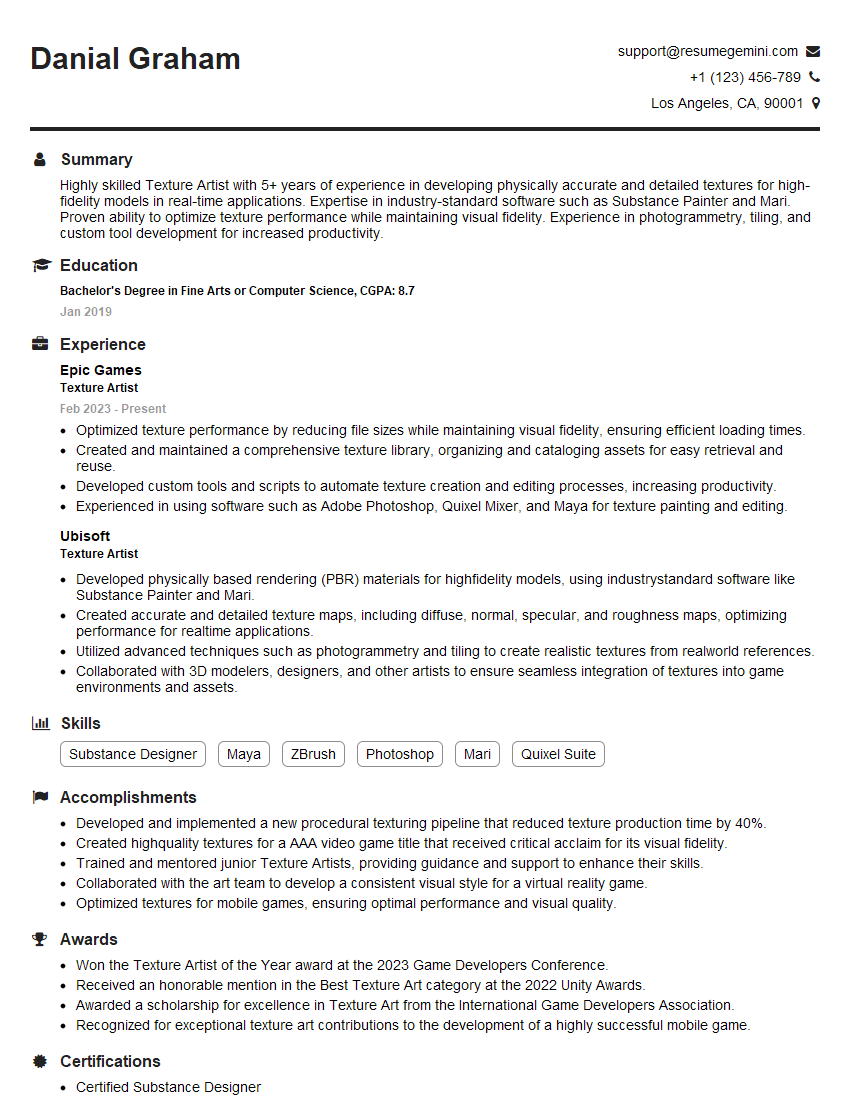
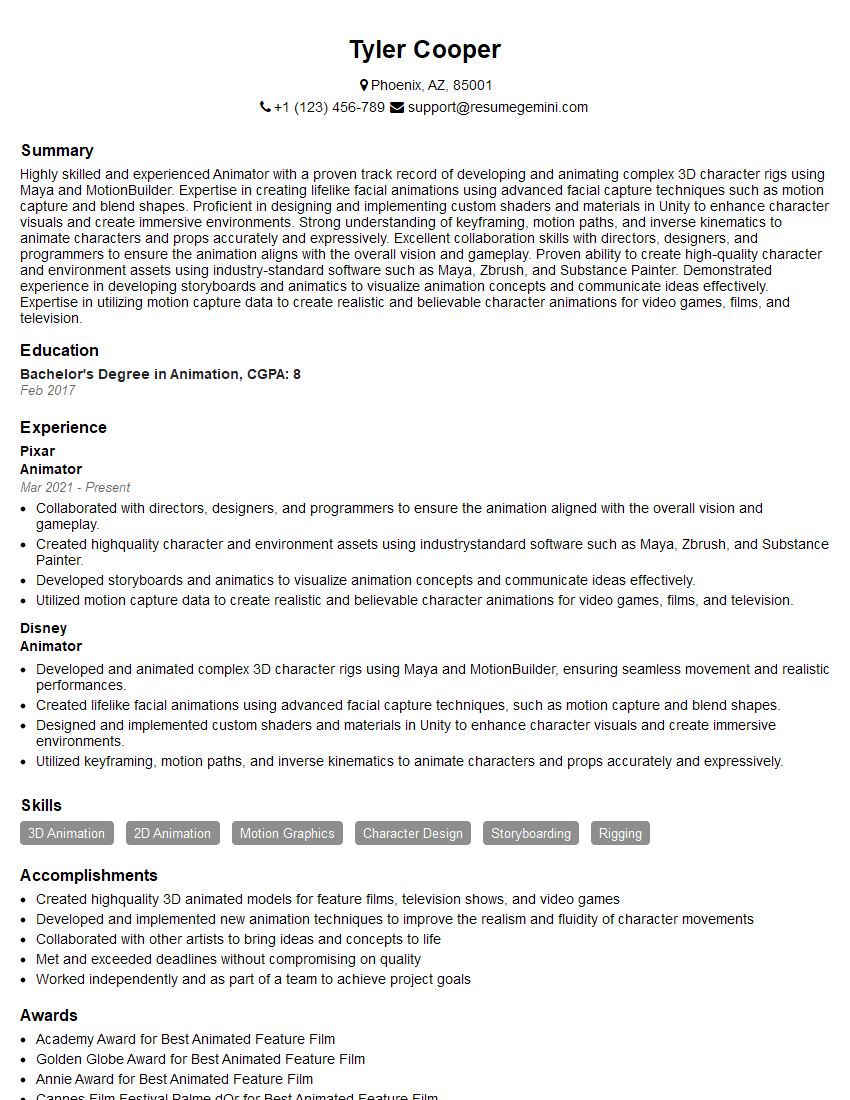
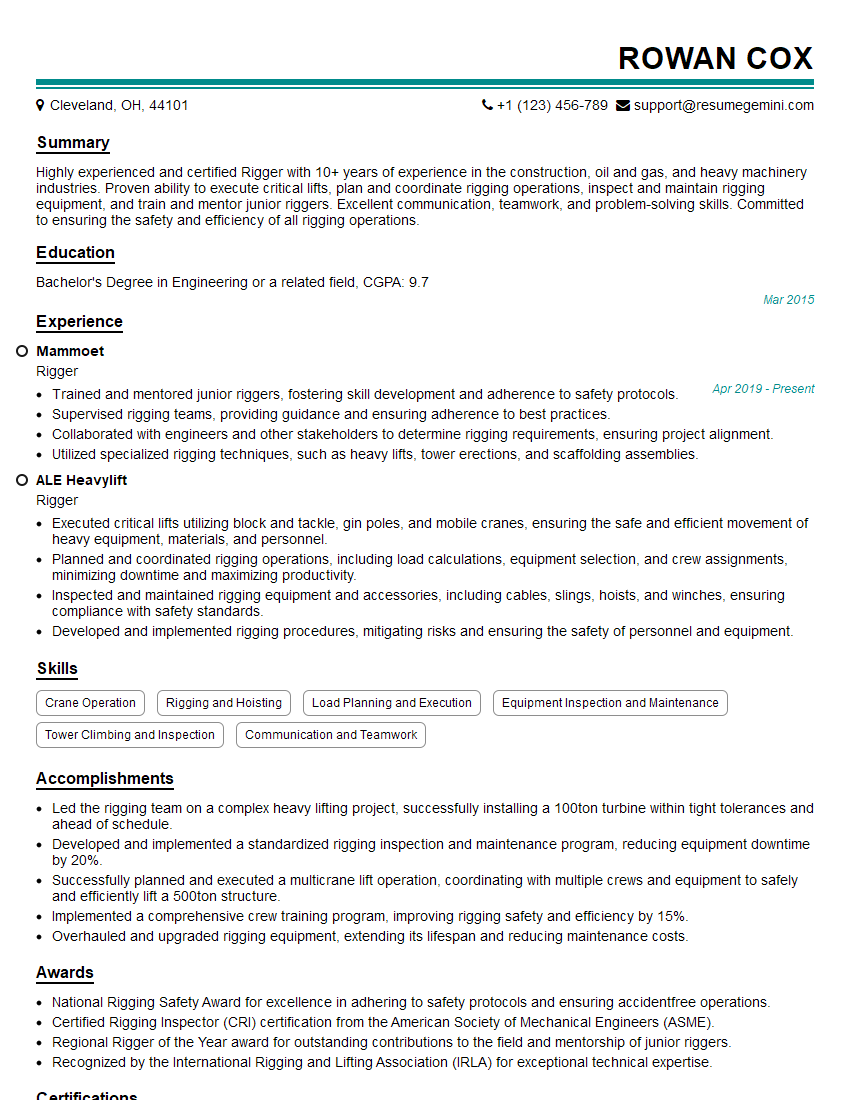
Mastering Special Effects Design and Implementation opens doors to exciting and rewarding careers in film, television, gaming, and advertising. To significantly boost your job prospects, focus on crafting a compelling and ATS-friendly resume that showcases your skills and experience effectively. ResumeGemini is a trusted resource that can help you build a professional and impactful resume tailored to your specific experience. Examples of resumes tailored to Special Effects Design and Implementation are available to guide you through the process.

Explore more articles
Users Rating of Our Blogs
Share Your Experience
We value your feedback! Please rate our content and share your thoughts (optional).
What Readers Say About Our Blog
Very informative content, great job.
good