Are you ready to stand out in your next interview? Understanding and preparing for Specialization in Marble interview questions is a game-changer. In this blog, we’ve compiled key questions and expert advice to help you showcase your skills with confidence and precision. Let’s get started on your journey to acing the interview.
Questions Asked in Specialization in Marble Interview
Q 1. Describe the different types of marble and their properties.
Marble, a metamorphic rock formed from limestone, comes in a dazzling variety of types, each with unique properties. These variations arise from the original limestone’s composition, the intensity of the metamorphism, and the presence of impurities. For instance, the presence of different minerals can create striking veining and colorations.
- Calacatta Marble: Known for its bright white background and bold, dramatic gray or gold veining. It’s prized for its luxurious appearance and is often more expensive than other varieties.
- Carrara Marble: Originating from Carrara, Italy, this marble is famous for its pure white to grayish-white background with delicate gray veining. It’s a classic choice for sculptures and high-end applications.
- Statuario Marble: Similar to Carrara, but usually purer white with even finer veining, making it exceptionally sought after. Its high cost reflects its rarity and elegance.
- Crema Marfil Marble: A warm, beige-toned marble with subtle veining. Its creamy color lends a softer, more inviting feel to spaces.
- Nero Marquina Marble: A dramatic black marble with striking white veining, offering a stark contrast that’s perfect for modern designs.
The properties of marble vary depending on the type. Some are harder and more resistant to scratching and staining than others. Porosity also plays a significant role; some marbles are more porous, making them more susceptible to liquid absorption and staining. Understanding these properties is crucial for selecting the right marble for a specific application.
Q 2. Explain the process of marble fabrication from raw block to finished product.
Transforming a raw marble block into a finished product is a multi-stage process requiring precision and skill. It begins with careful selection of the block, ensuring it’s free from major flaws. Then:
- Cutting: Large gang saws or wire saws cut the block into slabs of desired thickness. This requires precise control to avoid waste and maintain consistent dimensions.
- Surface Finishing: The slabs undergo surface treatments like honing, polishing, or sandblasting to achieve the desired look and feel. Honing creates a smooth, matte finish, while polishing produces a high-gloss shine. Sandblasting gives a more rustic, textured surface.
- Fabrication: The slabs are cut and shaped into specific pieces using advanced machinery like CNC routers or water jet cutters. This allows for intricate designs and precise dimensions for countertops, flooring, or other applications.
- Edge Detailing: The edges of the fabricated pieces are carefully finished, with various profiles available – eased, beveled, bullnose – to match the desired aesthetic.
- Installation: The finished marble pieces are carefully installed, with proper attention paid to securing them and filling any gaps with appropriate sealant.
Each step requires expertise and the right tools to maintain quality and ensure a beautiful end result. For example, improper cutting can lead to cracks, while incorrect polishing can dull the marble’s shine. This is why experience is vital.
Q 3. What are the common tools and equipment used in marble fabrication?
Marble fabrication demands a range of specialized tools and equipment. The technology used has evolved significantly, improving efficiency and precision.
- Gang Saws and Wire Saws: For cutting blocks into slabs.
- CNC Routers and Water Jet Cutters: For precise cutting and shaping of slabs.
- Honing and Polishing Machines: For achieving various surface finishes.
- Grinders and Sanders: For refining edges and removing imperfections.
- Measuring and Layout Tools: For ensuring accuracy.
- Safety Equipment: Including dust masks, eye protection, and hearing protection are absolutely essential.
The specific equipment used might vary based on the scale of operation and the complexity of the project. Larger workshops often invest in automated systems to boost productivity.
Q 4. How do you ensure the quality and consistency of your marble work?
Maintaining quality and consistency is paramount in marble fabrication. It starts with meticulous selection of raw materials and continues through each step of the process.
- Careful Block Selection: Inspecting blocks for flaws before cutting is critical to avoid wasting material and producing substandard pieces.
- Precise Cutting and Shaping: Using advanced machinery and skilled operators minimizes errors and maximizes yield.
- Consistent Surface Finishing: Employing standardized processes and regular calibration of equipment ensures uniform finishes.
- Quality Control Checks: Regular inspections at each stage identify and correct any imperfections before they become major issues.
- Experienced Craftsmanship: Highly skilled fabricators with an eye for detail are essential for superior results.
A well-managed quality control system, including detailed documentation and regular training for staff, is indispensable for consistent high-quality output. We also prioritize feedback from our clients to continuously improve our processes.
Q 5. What safety precautions are crucial when working with marble?
Safety is a top priority when working with marble. It’s a hard, heavy material that can cause serious injuries if handled improperly.
- Eye Protection: Marble dust can irritate the eyes, so safety glasses are essential.
- Respiratory Protection: Dust masks are necessary to prevent inhalation of harmful particles.
- Hearing Protection: The machinery used can be very loud, necessitating earplugs or earmuffs.
- Hand Protection: Gloves protect against cuts and abrasions.
- Proper Lifting Techniques: Large slabs of marble are heavy and require proper lifting techniques to avoid back injuries.
- Machine Safety: Regular maintenance and adherence to manufacturer’s safety guidelines for all machinery is crucial.
Regular safety training for all personnel is crucial. We conduct regular safety audits and enforce strict safety protocols to minimize risk and create a safe working environment for everyone.
Q 6. Explain the process of marble polishing and the different techniques used.
Marble polishing enhances its beauty and durability. It involves a progressive series of steps, using abrasives of decreasing grit size to achieve a mirror-like shine.
- Honing: The initial stage uses coarser abrasives to remove scratches and level the surface.
- Polishing: Finer abrasives progressively smooth the surface, enhancing its glossiness.
- Buffing: This final step uses very fine abrasives or polishing compounds to achieve the ultimate high-gloss finish.
Different techniques, such as using diamond polishing pads or resin-bonded abrasives, can be employed depending on the desired level of shine and the marble’s characteristics. The process requires patience, precision, and a good understanding of the properties of the marble to avoid damaging the surface.
For example, certain types of marble might require a different polishing compound or technique to bring out their unique characteristics. This is where the expertise of a seasoned polisher really shows.
Q 7. How do you handle cracks or imperfections in marble during fabrication?
Cracks or imperfections in marble present challenges, but they don’t necessarily mean the material is unusable. The approach depends on the severity and location of the flaw.
- Small Cracks: These can sometimes be filled with epoxy resin that closely matches the marble’s color. This requires precision to ensure a seamless repair that’s invisible to the naked eye.
- Larger Cracks or Imperfections: These might necessitate cutting out the damaged section and replacing it with a matching piece of marble. This is a more complex process requiring skillful cutting and patching.
- Surface Imperfections: These can often be minimized through careful polishing and honing. However, severe pitting or discoloration might be harder to completely remove.
In some cases, the imperfection might be incorporated into the design, turning a flaw into a unique feature. The key is careful assessment and selecting the best approach based on the specific situation. We always aim for the most elegant and structurally sound solution.
Q 8. Describe the process of marble restoration and repair.
Marble restoration and repair is a meticulous process requiring specialized knowledge and techniques. It aims to return damaged marble to its original beauty and structural integrity. The process typically involves several steps:
Assessment: A thorough inspection to identify the type of damage (e.g., scratches, chips, stains, etching), its severity, and the marble’s composition. This helps determine the appropriate repair method.
Cleaning: Gentle cleaning using pH-neutral cleaners removes surface dirt and grime. Aggressive cleaning methods can damage the marble, so this step requires careful consideration of the marble type.
Repair: This involves filling chips and cracks with epoxy resin carefully matched to the marble’s color. For larger repairs, specialized patching techniques may be needed, potentially involving the replacement of damaged sections.
Polishing: Using progressively finer grits of diamond polishing pads, the surface is honed to a smooth, even finish. This restores the marble’s shine and luster.
Sealing: Applying a high-quality sealant protects the marble from future damage and staining, enhancing its durability and longevity. The choice of sealant depends on the type of marble and its intended use.
For example, a small scratch on a kitchen countertop might only require cleaning and polishing, while a deeply chipped floor tile might demand more extensive repair involving epoxy filling and repolishing.
Q 9. What are the common causes of marble damage and deterioration?
Marble, despite its durability, is susceptible to various forms of damage and deterioration. Common causes include:
Acidic substances: Lemons, vinegar, and other acidic materials can etch the marble’s surface, leaving dull spots. Think of it like slowly dissolving the marble with acid.
Abrasive cleaners: Harsh cleaning agents and abrasive scrubbing can scratch and dull the polished surface.
Staining: Spilled liquids like wine or coffee can penetrate the marble and leave permanent stains if not cleaned up promptly.
Thermal shock: Extreme temperature changes can cause cracking or shattering, especially if the marble is thin or poorly installed.
Physical impact: Dropped heavy objects or impacts can cause chips, cracks, or breakage.
Weathering (for exterior applications): Exposure to rain, frost, and UV radiation can gradually erode and degrade the marble’s surface.
Understanding these causes is crucial for preventative maintenance and informed repair strategies.
Q 10. How do you determine the best cleaning and sealing methods for different types of marble?
Determining the best cleaning and sealing methods for different types of marble requires careful consideration of its porosity and sensitivity. Some marbles are more porous and absorbent than others. For example, Carrara marble is known for its relatively high porosity, while some denser marbles are less so.
Porous marbles (like Carrara) require gentler cleaning methods, using pH-neutral cleaners and avoiding abrasive materials. A sealant is essential to protect against staining.
Less porous marbles (like Calacatta) are more resistant to staining but still benefit from regular cleaning with pH-neutral solutions. Sealing is still recommended for added protection.
Testing a cleaning solution on an inconspicuous area is always recommended before applying it to the entire surface. Similarly, different sealers are designed for different levels of protection and sheen. A professional assessment can help determine the most suitable approach for a specific marble type.
Q 11. Explain the different types of marble sealers and their applications.
Several types of marble sealers are available, each with specific properties and applications:
Impregnating sealers: These penetrate the marble’s pores, creating a barrier against moisture and staining without altering the surface’s appearance. They’re ideal for porous marbles.
Topical sealers: These form a film on the marble’s surface, offering protection against scratches and abrasion. They’re available in various sheens, from matte to high-gloss.
Solvent-based sealers: These offer excellent protection but require thorough ventilation during application due to strong fumes.
Water-based sealers: These are generally low-odor and easier to clean up but might offer slightly less protection than solvent-based sealers.
The choice of sealer depends on factors like the marble’s porosity, the desired level of protection, and the environment where the marble is installed. For instance, a highly porous marble in a high-traffic area would benefit from an impregnating sealer followed by a topical sealer for extra protection.
Q 12. What are the common challenges in marble installation?
Marble installation presents unique challenges due to its fragility and the precision required for proper setting and finishing. Common challenges include:
Substrate preparation: The substrate (the surface onto which the marble is installed) must be perfectly level and free of debris or imperfections to ensure proper adhesion and prevent cracking.
Accurate cutting and fitting: Cutting and fitting marble pieces precisely to achieve seamless joints requires specialized tools and expertise. Errors can result in uneven surfaces or gaps.
Adhesive selection: Choosing the right adhesive is crucial to ensure proper bonding and prevent the marble from shifting or detaching over time.
Handling and transportation: Marble slabs are heavy and fragile; careful handling is necessary during transportation and installation to avoid breakage or chipping.
Moisture control: Marble is susceptible to moisture damage; proper moisture control is crucial during and after installation, especially in damp environments.
Overcoming these challenges requires careful planning, precise execution, and a good understanding of the material’s properties.
Q 13. How do you measure and cut marble accurately for installation?
Accurate measurement and cutting of marble for installation is critical for a seamless and aesthetically pleasing result. The process typically involves:
Precise measurements: Taking detailed measurements of the installation area using a measuring tape and ensuring accuracy to within millimeters is crucial.
Creating templates: Creating precise cardboard or plywood templates based on the measurements helps visualize and plan the cuts.
Using specialized tools: Employing specialized tools such as diamond-tipped saws, wet saws, and angle grinders allows for precise cutting and avoids chipping or fracturing the marble.
Dry fitting: Before applying adhesive, dry-fitting the pieces helps check the fit and make necessary adjustments before committing to the final installation.
Using a straight edge: Utilizing a straight edge or laser level to ensure all cuts are perfectly aligned.
For example, when installing marble tiles around a curved wall, careful templating and precise cuts are crucial to ensure the tiles fit seamlessly without gaps.
Q 14. What are the different methods for fixing marble to various substrates?
The method of fixing marble to various substrates depends on factors such as the substrate’s material, the marble’s thickness, and the intended application. Common methods include:
Thin-set mortar: A widely used method for installing marble tiles and slabs onto concrete or cement board substrates. This adhesive creates a strong bond that can withstand weight and stress.
Epoxy adhesive: Used for specific applications where exceptional bonding strength is required, such as fixing marble to glass or metal substrates. Epoxy is also useful for repairing broken marble sections.
Mechanical fasteners: For thicker marble slabs and certain applications (like exterior cladding), mechanical fasteners like anchors or screws can be used in conjunction with adhesive for added security.
Silicone sealant: Although primarily used for sealing gaps and joints, silicone can also be used for fixing marble to smooth, non-porous surfaces. However, it’s not ideal for weight-bearing applications.
The choice of fixing method is critical. Using the wrong adhesive or fastener can lead to loose marble pieces, cracking, or even complete failure of the installation. Proper preparation of the substrate is also essential for the success of any fixing method.
Q 15. Describe your experience with different marble finishing techniques.
Marble finishing techniques significantly impact the final look and durability of a project. My experience encompasses a wide range, from the classic to the contemporary.
- Polishing: This creates a high-gloss, reflective surface. The process involves using progressively finer abrasives, culminating in a diamond polishing compound for that mirror-like sheen. I’ve used this extensively on high-end residential projects, achieving stunning results on Carrara marble, for example.
- Honing: This produces a matte or satin finish, less reflective than polished marble. It’s ideal for areas where a less slippery surface is preferred, such as bathroom floors. I successfully employed this technique in a recent commercial project, enhancing the safety and aesthetic appeal of the space.
- Sandblasting: This creates a textured, anti-slip surface. It’s perfect for outdoor applications or high-traffic areas. I’ve used it on several exterior projects, particularly where frost resistance was a concern, transforming the marble’s look and enhancing durability.
- Leathering: This technique results in a soft, velvety appearance. Achieved through specialized grinding and polishing, it offers a unique tactile experience, perfect for accent pieces or statement features. I recently used this on a fireplace surround, enhancing its elegance.
- Flamed: This involves heating the marble surface to a high temperature, causing the surface crystals to fracture and creating a textured, rustic look. Ideal for outdoor applications demanding durability and a rugged aesthetic. I’ve used it for paving projects, especially in regions with harsh weather.
Career Expert Tips:
- Ace those interviews! Prepare effectively by reviewing the Top 50 Most Common Interview Questions on ResumeGemini.
- Navigate your job search with confidence! Explore a wide range of Career Tips on ResumeGemini. Learn about common challenges and recommendations to overcome them.
- Craft the perfect resume! Master the Art of Resume Writing with ResumeGemini’s guide. Showcase your unique qualifications and achievements effectively.
- Don’t miss out on holiday savings! Build your dream resume with ResumeGemini’s ATS optimized templates.
Q 16. How do you manage a marble project from start to finish?
Managing a marble project from start to finish demands meticulous planning and execution. My approach involves a phased methodology:
- Initial Consultation: Understanding the client’s vision, budget, and desired aesthetic is paramount. This involves site visits, material selection discussions, and detailed design reviews.
- Design & Planning: This phase includes detailed drawings, material sourcing, and logistics planning. Accurate measurements and templates are crucial to minimize waste and ensure a perfect fit.
- Fabrication: This involves cutting, shaping, and finishing the marble. Quality control is crucial at every stage. I personally oversee this process, ensuring adherence to specifications and high-quality standards.
- Installation: This requires a skilled team to ensure precise placement and secure fixing. I carefully coordinate this phase, ensuring the integrity of the marble and minimal disruption to the client.
- Quality Assurance & Handover: A final inspection ensures everything meets the agreed-upon specifications. Addressing any minor issues promptly and providing comprehensive aftercare instructions is essential for client satisfaction.
Q 17. Explain your experience with budgeting and cost estimation for marble projects.
Accurate budgeting and cost estimation are essential for successful marble projects. My approach involves:
- Detailed Material Specifications: Precise quantities of marble, including allowance for waste and potential damage, are determined. The specific type and grade of marble significantly impact the cost.
- Labor Costs: Accurate estimation of labor hours required for fabrication, transportation, and installation is crucial. This includes accounting for skilled labor rates and potential overtime.
- Equipment & Tools: The cost of specialized tools and equipment necessary for cutting, polishing, and installation is factored into the estimate.
- Contingency Planning: A percentage is added to account for unforeseen circumstances, such as material defects or unexpected site conditions.
- Profit Margin: A reasonable profit margin is included to ensure project profitability.
I use specialized software to assist with cost estimation, constantly refining my approach based on past project data and market fluctuations. Transparency is key; I provide clients with a detailed breakdown of all costs, allowing them to make informed decisions.
Q 18. How do you communicate effectively with clients and other stakeholders?
Effective communication is vital. I prioritize clear, concise, and proactive communication with clients and stakeholders. My strategies include:
- Regular Updates: Providing regular updates on project progress through email, phone calls, and site visits keeps everyone informed.
- Visual Aids: Using photographs, 3D renderings, and samples helps to visualize the project and address any concerns proactively.
- Open Communication Channels: Encouraging open communication and responding promptly to questions or concerns builds trust and ensures everyone is on the same page.
- Documentation: Maintaining detailed records of all communication, decisions, and changes helps to manage expectations and resolve disputes effectively.
- Professionalism: Maintaining a professional demeanor throughout the project fosters a positive collaborative environment.
Q 19. Describe your problem-solving skills in relation to marble fabrication or restoration.
Problem-solving is inherent to marble work. I approach challenges systematically:
- Identify the Problem: Thoroughly assess the issue, determining its root cause. This may involve visual inspection, material testing, or consultation with other experts.
- Gather Information: Collect relevant information, such as project specifications, material properties, and past experiences with similar issues.
- Develop Solutions: Brainstorm potential solutions, considering their feasibility, cost-effectiveness, and impact on the project timeline.
- Implement the Solution: Execute the chosen solution, carefully monitoring its effectiveness.
- Evaluate the Results: Assess the outcome, making adjustments if necessary. Documenting the problem and its resolution helps to avoid similar issues in the future.
For example, I once encountered unexpected hairline cracks in a slab of Calacatta marble during fabrication. By using epoxy resin repair and careful polishing, I successfully restored the piece, minimizing disruption to the project schedule.
Q 20. How do you handle difficult or unexpected situations on a job site?
Unexpected situations are common in construction. My approach involves:
- Remain Calm & Assess: Maintaining composure is critical. I assess the situation objectively, identifying the scope of the problem and potential risks.
- Communicate Effectively: I immediately communicate the issue to the relevant parties, including the client and other stakeholders. Transparency is key in managing expectations.
- Develop Contingency Plans: I have backup plans to handle potential delays or material shortages. This includes having alternative materials readily available or engaging additional resources as needed.
- Adapt & Implement Solutions: I work with the team to find effective and efficient solutions, prioritizing safety and minimizing disruptions.
- Document Everything: Maintaining detailed records of the issue, the solution implemented, and the outcome is crucial for future reference and risk mitigation.
For instance, a recent project faced unexpected delays due to inclement weather. By proactively adjusting the schedule and communicating effectively, I ensured the project was completed on time and within budget.
Q 21. What are your strengths and weaknesses as a marble specialist?
My strengths lie in my meticulous attention to detail, my problem-solving abilities, and my commitment to client satisfaction. I have a proven track record of delivering high-quality marble projects on time and within budget. My deep understanding of various marble types and finishing techniques allows me to advise clients effectively and execute their vision flawlessly.
My weakness, if I had to identify one, would be my perfectionism. While this ensures exceptional quality, it can sometimes lead to longer working hours. I’m actively working on managing my time more effectively to balance my drive for excellence with a healthy work-life balance.
Q 22. Describe your experience with different types of marble cutting equipment.
My experience with marble cutting equipment spans a wide range, from traditional methods to the latest CNC technology. I’m proficient in operating various saw types, including gang saws for high-volume production, bridge saws for precise cutting of large blocks, and wire saws for intricate designs and complex shapes. I’m also skilled in using waterjet cutters for delicate work and intricate details, and hand tools like chisels and pneumatic hammers for finishing and detailing.
For example, during a recent project involving a large-scale sculpture, the intricate details required the precision of a waterjet cutter, while the initial block shaping benefitted significantly from the speed and efficiency of a bridge saw. Understanding the strengths and limitations of each tool is critical for selecting the most efficient and cost-effective approach for each job. I’ve also trained extensively on the safety procedures associated with each piece of equipment, ensuring both my own safety and the safety of my colleagues.
Q 23. Explain your knowledge of marble sourcing and procurement.
Marble sourcing and procurement require a keen eye for quality, a deep understanding of geological formations, and strong relationships with suppliers. My process begins with identifying the desired marble type and its specific characteristics – color, veining, durability, etc. – based on the client’s needs and the project’s specifications. Then I research potential quarries, considering factors like geographical location, transportation costs, and the quarry’s reputation for quality and ethical practices.
I’ve worked extensively with quarries in Italy (Carrara, for example, is renowned for its white marble), Greece, Turkey, and China, each region offering unique marble varieties. Directly visiting quarries allows for thorough assessment of the available blocks, ensuring I select material that meets the project’s quality standards and minimizes waste. Negotiating fair prices and ensuring timely delivery are essential aspects of the procurement process. I also prioritize environmentally responsible sourcing, selecting quarries with sustainable practices.
Q 24. How do you stay updated on the latest trends and technologies in the marble industry?
Staying updated in this dynamic industry requires a multi-pronged approach. I regularly attend industry trade shows and conferences like Marmomacc, which provides access to the latest machinery, technologies, and design trends. I actively subscribe to industry publications like Stone World and Natural Stone Design, and I follow key influencers and companies on social media platforms like LinkedIn.
Moreover, I participate in online forums and communities dedicated to marble fabrication and design, allowing for a continuous exchange of ideas and knowledge with other professionals in the field. Continual learning is crucial; I’m always seeking opportunities to expand my expertise through workshops and online courses, particularly focusing on new advancements in CNC machining, 3D modeling for stone, and sustainable fabrication techniques.
Q 25. What are your salary expectations?
My salary expectations are in line with the industry standard for a professional with my experience and expertise in marble specialization. Given my proven track record and advanced skill set encompassing various cutting techniques, sourcing expertise, and knowledge of the latest technologies, I’m looking for a compensation package that reflects the value I will bring to your team. I’m open to discussing a comprehensive compensation plan that takes into account base salary, benefits, and potential bonuses based on project success.
Q 26. Why are you interested in this position?
I’m deeply interested in this position because it aligns perfectly with my passion for marble and my desire to contribute to a company known for its commitment to quality and innovation. Your company’s reputation for using sustainable practices and producing high-end projects is particularly appealing. I believe my extensive experience and expertise in all facets of marble handling, from sourcing to fabrication, would be a valuable asset to your team.
The opportunity to work on challenging and prestigious projects, and to collaborate with a skilled team of professionals, is incredibly exciting to me. I am confident that I can make a significant contribution to your company’s continued success.
Q 27. What are your long-term career goals in the marble industry?
My long-term career goals in the marble industry involve taking on increasing responsibility and leadership roles. I envision myself progressing to a senior management position where I can contribute to strategic decision-making and oversee major projects. I am eager to develop my expertise in project management and potentially specialize in a niche area like large-scale marble installations or restoration work.
Ultimately, I aim to become a recognized leader in the industry, known for my expertise, commitment to sustainable practices, and contributions to innovative designs. I am keen to share my knowledge and mentor future generations of marble specialists.
Q 28. Do you have any questions for me?
Yes, I do have a few questions. Firstly, could you elaborate on the specific projects the team will be working on in the coming year? Secondly, what opportunities are available for professional development and training within the company? Finally, what is the company culture like, and how does it foster collaboration and innovation?
Key Topics to Learn for Your Specialization in Marble Interview
- Marble Geology and Classification: Understand the different types of marble, their geological origins, and physical properties. This includes knowledge of mineral composition, texture, and color variations.
- Marble Extraction and Processing: Familiarize yourself with the methods used for quarrying, cutting, shaping, and finishing marble. Consider the impact of different techniques on the final product’s quality and cost.
- Marble Applications in Construction and Design: Explore the diverse applications of marble in architecture, interior design, and sculpture. Analyze the factors influencing material selection in specific projects.
- Marble Quality Control and Testing: Learn about the various tests and methods used to assess the quality, durability, and consistency of marble. This includes understanding standards and specifications.
- Marble Maintenance and Restoration: Understand the techniques and procedures for cleaning, protecting, and restoring damaged marble surfaces. Consider the different cleaning agents and methods available.
- Sustainability and Ethical Sourcing in Marble Industry: Become familiar with the environmental considerations and ethical practices related to marble production and consumption. Discuss sustainable sourcing strategies.
- Industry Trends and Innovations: Stay updated on current trends, emerging technologies, and innovative applications in the marble industry. This demonstrates your commitment to professional development.
Next Steps
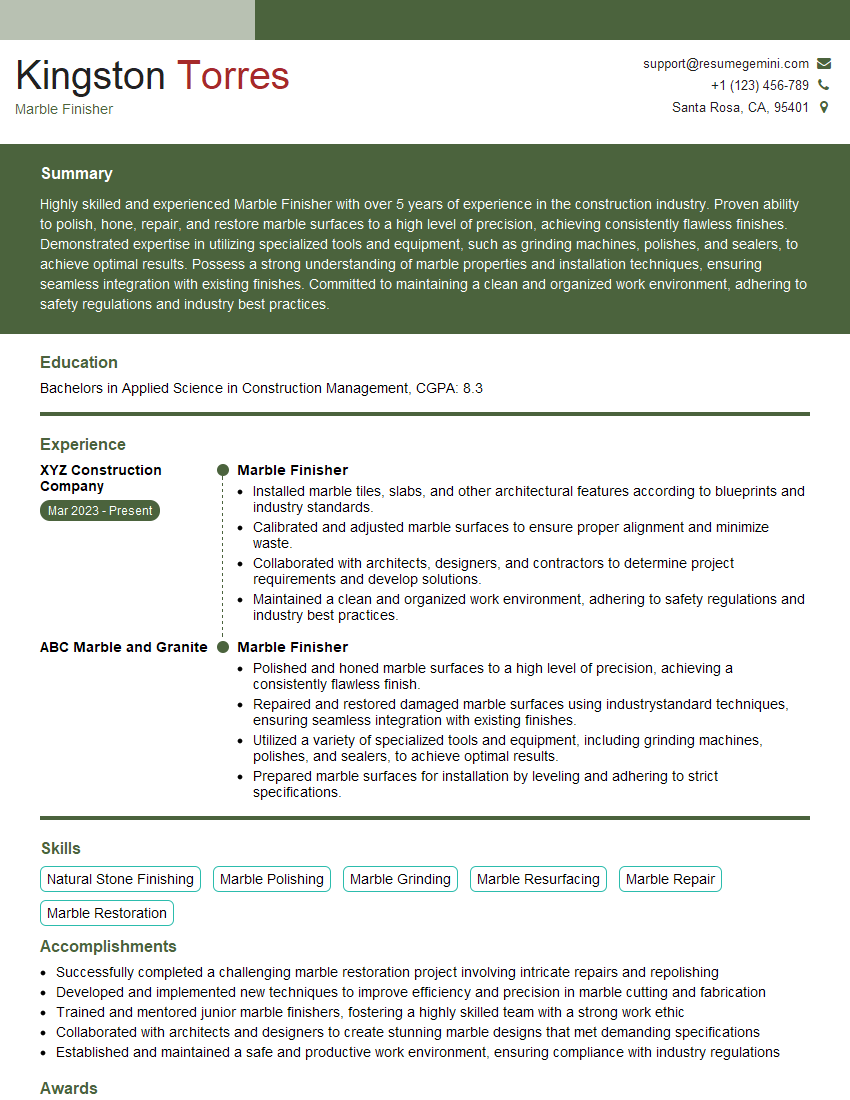
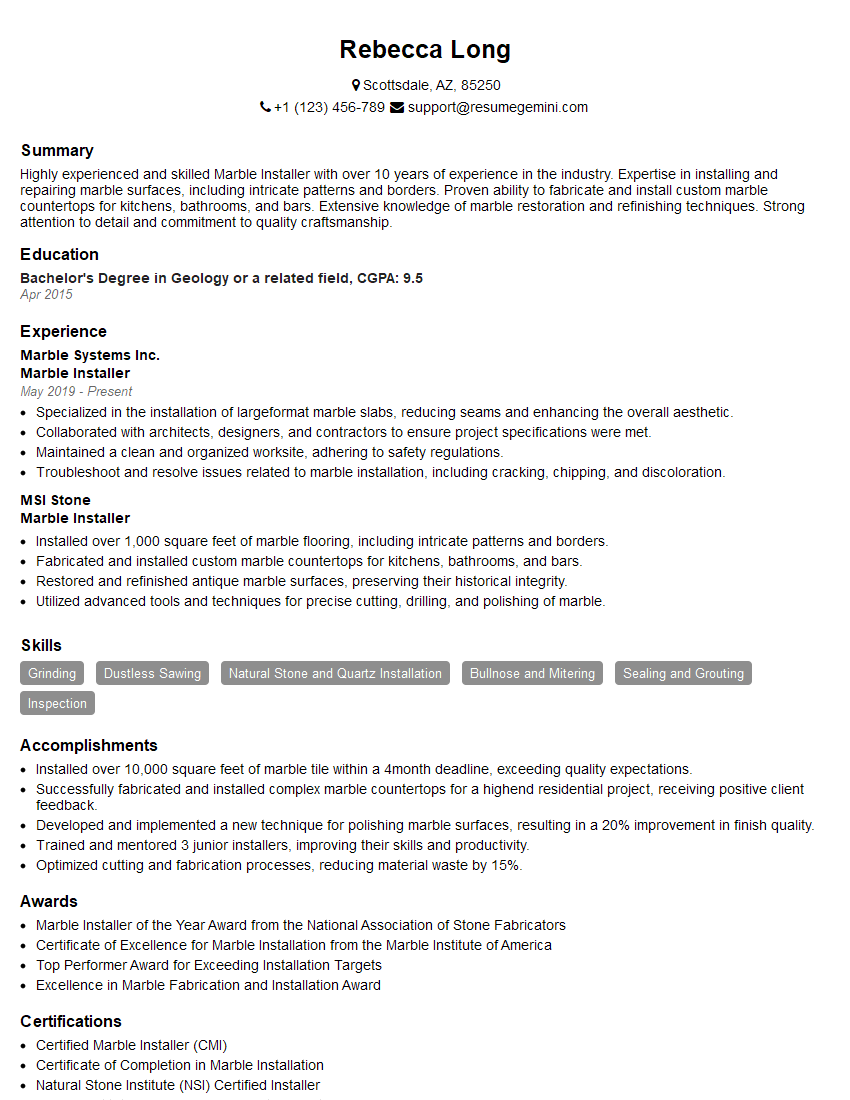
Mastering the intricacies of marble specialization significantly enhances your career prospects within the construction, design, and manufacturing sectors. A strong understanding of the topics above positions you for success in demanding roles. To maximize your job search effectiveness, create an ATS-friendly resume that highlights your skills and experience. ResumeGemini is a trusted resource that can help you build a professional and impactful resume tailored to your specific experience in marble specialization. Examples of resumes optimized for this field are available, ensuring your application stands out.
Explore more articles
Users Rating of Our Blogs
Share Your Experience
We value your feedback! Please rate our content and share your thoughts (optional).
What Readers Say About Our Blog
Very informative content, great job.
good