Unlock your full potential by mastering the most common Splicing, Testing, and Troubleshooting of Fiber Optic Cables interview questions. This blog offers a deep dive into the critical topics, ensuring you’re not only prepared to answer but to excel. With these insights, you’ll approach your interview with clarity and confidence.
Questions Asked in Splicing, Testing, and Troubleshooting of Fiber Optic Cables Interview
Q 1. Explain the different types of fiber optic connectors and their applications.
Fiber optic connectors are crucial for establishing reliable connections between fiber optic cables and equipment. Different connectors are designed for various applications based on factors such as size, performance requirements, and environmental conditions. Here are some common types:
- SC (Subscriber Connector): A push-pull connector, widely used due to its simplicity and reliability. Often found in data centers and telecommunications.
- FC (Ferrule Connector): Uses a threaded coupling mechanism, offering excellent precision and repeatability. It’s often preferred in applications requiring high stability and durability, such as in harsh environments.
- LC (Lucent Connector): A compact, high-density connector increasingly popular in high-speed networks. Its small size allows for more connectors per rack space. Often used in data centers and metro networks.
- ST (Straight Tip): A bayonet-style connector, easy to connect and disconnect. Although once common, it’s less frequently used now due to the availability of smaller and more robust alternatives.
- MT-RJ (Mechanical Transfer-Registered Jack): A dual-fiber connector often used in telecommunications due to its ability to accommodate two fibers in a single connector, saving space.
The choice of connector depends heavily on the application. For instance, while LC connectors are ideal for high-density environments like data centers, SC connectors might be preferred in applications where simplicity and cost-effectiveness are priorities.
Q 2. Describe the process of fusion splicing fiber optic cables.
Fusion splicing is a precise technique for permanently joining two fiber optic cables. It involves melting the ends of the fibers together using an electric arc, creating a continuous glass structure. The process ensures minimal signal loss and provides a strong, reliable connection.
- Fiber Preparation: The cable ends are carefully cleaved using a precision cleaver to create a perfectly flat and perpendicular surface. A poor cleave can significantly impact the splice quality.
- Fiber Alignment: The prepared fiber ends are precisely aligned using a splicing machine. Accurate alignment is critical to minimize signal loss. Modern machines use V-grooves or other precise mechanisms to ensure optimal alignment.
- Fusion Splicing: An electric arc is applied to the aligned fiber ends, melting and fusing them together. The heat melts the glass, forming a single, continuous fiber. The machine monitors the fusion process to ensure a high-quality splice.
- Splice Protection: After splicing, a protective sleeve or heat-shrink tubing is applied over the fused fibers to safeguard the delicate connection from environmental damage.
Imagine it like welding two glass rods together – precision and heat are key to a seamless join. Incorrect alignment or insufficient fusion will lead to increased signal loss and potential connection failure.
Q 3. What are the common causes of fiber optic cable attenuation?
Attenuation in fiber optic cables refers to the loss of optical power as the light signal travels along the fiber. Several factors contribute to this:
- Absorption: The fiber material itself absorbs some of the light signal, particularly at certain wavelengths. This is inherent to the material and varies depending on the type of fiber used.
- Scattering: Impurities and imperfections in the fiber cause the light to scatter in different directions, reducing the amount of light reaching the destination. This scattering can be caused by microscopic imperfections in the glass or by bends in the fiber.
- Bending Loss: Excessive bending of the fiber can cause significant attenuation as light escapes the core of the fiber. Sharp bends are particularly problematic.
- Connector Loss: Imperfectly polished or misaligned connectors introduce significant signal loss at connection points. Dirt or debris in the connector interface will further increase this loss.
Understanding these causes is crucial for diagnosing and resolving attenuation problems. For example, excessive bending loss might point to a cabling issue, while high connector loss could indicate a need for connector cleaning or replacement.
Q 4. How do you identify and troubleshoot a fiber optic cable break?
Identifying a fiber optic cable break requires a systematic approach. Visual inspection is the first step, followed by more advanced testing techniques if a break is suspected.
- Visual Inspection: Carefully examine the cable’s exterior for any obvious damage, such as cuts, kinks, or signs of rodent activity.
- OTDR Testing (Optical Time-Domain Reflectometer): An OTDR sends light pulses down the fiber and analyzes the reflected signals. A significant drop in the signal strength or a backscatter event indicates a break or significant loss. The OTDR pinpoints the location of the break.
- Power Meter and Light Source: If the location is known, a power meter and light source can be used to verify the break. A significant drop in power levels at a suspected break location confirms the problem.
For instance, if an OTDR test reveals a sudden signal drop at a specific point, and visual inspection reveals a sharp bend or damage near that point, this confirms the cable break. Then, you can work on repair or replacement.
Q 5. What are the different types of fiber optic testing equipment and their functions?
Various equipment is used for testing fiber optic cables. Here are some key examples:
- Optical Power Meter: Measures the optical power level at a specific point in the fiber optic link, used to assess signal strength and detect attenuation.
- Optical Light Source (OLS): Provides a stable optical signal at a specific wavelength which is used in conjunction with the power meter for signal strength measurements.
- Optical Time-Domain Reflectometer (OTDR): Measures the backscattered light to identify faults, attenuation, and locate events such as breaks, connectors, or splices along the fiber optic cable.
- Fiber Optic Microscope: Allows for high-magnification visual inspection of fiber end faces to detect scratches, dirt, or other imperfections that could cause attenuation or connection problems.
- Fiber Cleaver: Creates precisely cleaved fiber ends, which is critical for minimizing connector loss during fusion splicing or connector termination.
These tools work together. For example, an OLS and power meter measure signal strength after connection, while an OTDR provides a comprehensive picture of the entire fiber link’s health.
Q 6. Explain the OTDR testing procedure and how to interpret the results.
OTDR testing involves sending light pulses down the fiber and analyzing the reflected signals to assess the cable’s condition. It’s like sending an echolocation signal and listening to the return.
- Connect the OTDR: Connect the OTDR to the fiber under test.
- Set Test Parameters: Configure parameters like wavelength and pulse width. The choice depends on the fiber type and distance being measured.
- Initiate Test: Start the OTDR test. The instrument sends pulses and records backscatter and Fresnel reflections.
- Analyze Results: The OTDR displays a trace showing signal attenuation, event locations (connectors, splices, breaks), and reflections. Each event is characterized by its position and signal loss.
- Interpret the Results: Analyze the trace for any anomalies. Attenuation should be consistent across the link. Sudden drops or reflections indicate problems.
An example: A sudden drop in signal strength could represent a fiber break. A small reflection might indicate a poorly cleaved connector or splice. Understanding this allows for targeted troubleshooting. Interpreting an OTDR trace correctly requires experience but is crucial for accurate fault diagnosis.
Q 7. How do you perform a visual inspection of fiber optic cables?
Visual inspection is a crucial first step in any fiber optic troubleshooting. It’s a simple but effective way to quickly identify many potential problems.
- Check for Physical Damage: Inspect the cable’s exterior for any physical damage, like cuts, bends, or crush marks. Look for signs of rodent damage or external stress.
- Examine Connectors: Carefully examine the connectors for dirt, scratches, or damage. Use a fiber optic microscope for closer inspection to identify microscopic issues.
- Inspect the Fiber End Faces: If possible, inspect the fiber end faces under magnification to look for scratches, pits, or other imperfections that could affect signal quality.
- Check for Proper Labeling: Verify that the cables are properly labeled so the tested fiber is the one you intended to test.
Think of it like a doctor’s initial assessment. You might not need extensive testing if a clear cut is immediately visible. A visual inspection will often save time and focus testing efforts, pinpointing where the issue is.
Q 8. What safety precautions should be taken when working with fiber optic cables?
Safety is paramount when working with fiber optic cables. The biggest concern is the potential for eye injury from the intense light emitted from a laser source used in some testing equipment or even from accidental exposure to the fiber itself in high-power applications. Always wear appropriate laser safety eyewear rated for the wavelength of light used. This is non-negotiable. Furthermore, fiber optic cables can be fragile, so handle them with care to avoid breakage. Avoid unnecessary bending or twisting, and use appropriate cable management techniques.
Additional safety precautions include:
- Grounding: Ensure proper grounding to prevent electrostatic discharge (ESD) that can damage the fiber or equipment.
- Personal Protective Equipment (PPE): Always use cut-resistant gloves to prevent injuries from sharp fiber ends.
- Proper Training: Only trained and qualified personnel should work on fiber optic systems.
- Working Environment: Always work in a clean and well-lit area.
Imagine you’re working on a high-rise building. Safety is not optional; it’s critical to both your well-being and the successful completion of the project. The same applies to fiber optics – proper safety protocols ensure a safe and efficient working environment.
Q 9. Describe the different types of fiber optic cable and their properties.
Fiber optic cables come in various types, primarily categorized by their core size and the type of glass used. The core is the central part of the fiber where light travels. The cladding surrounds the core and keeps the light contained through total internal reflection.
- Single-Mode Fiber: Has a very small core (typically 8-10 microns) and is used for long-distance, high-bandwidth applications like long-haul telecommunications and high-speed data centers. It transmits only one mode of light, minimizing signal distortion.
- Multi-Mode Fiber: Has a larger core (typically 50 or 62.5 microns) and is used for shorter distances and lower bandwidth applications like local area networks (LANs) in buildings. It can transmit multiple modes of light, leading to greater signal dispersion over longer distances.
- Fiber Types by Material: Both single-mode and multi-mode fibers can be made from different types of glass, each with different refractive indices and attenuation properties affecting transmission quality. Common types include silica, fluorine-doped silica and others
Think of it like this: single-mode fiber is like a single-lane highway—efficient for long distances, but only one car can travel at a time. Multi-mode fiber is like a multi-lane highway—more cars can travel simultaneously, but congestion can occur over long distances. The choice depends on the specific application needs.
Q 10. Explain the concept of optical return loss and its significance.
Optical Return Loss (ORL), often measured in decibels (dB), quantifies how much of the light signal is reflected back toward the source. A high ORL indicates significant reflections, which can degrade signal quality and cause performance issues. A lower ORL is desirable, reflecting better transmission.
Its significance lies in its impact on signal integrity and network performance. Reflections can cause signal distortion, interference, and even system instability. A high ORL often points to problems like poor connector terminations, fiber breaks, or connector mismatches. ORL measurements are crucial in troubleshooting and maintaining the integrity of a fiber optic network.
For instance, a connector with a high ORL, due to a poorly polished end face, will reflect a significant portion of the signal back toward the transmitter, reducing the power reaching the receiver and potentially causing communication errors. In testing, low ORL values are preferable.
Q 11. How do you test for fiber optic cable continuity?
Testing fiber optic cable continuity involves verifying a clear path exists between two ends. This is different than verifying signal transmission quality; it simply confirms there are no physical breaks or major flaws in the fiber.
The most common method uses an Optical Time-Domain Reflectometer (OTDR). An OTDR sends pulses of light down the fiber and analyzes the reflected light to identify any breaks, splices, connectors, or other discontinuities. The OTDR provides a visual representation of the fiber’s characteristics, including the location of any faults. Other methods like visual inspection and simple light sources are useful for very short cables but offer significantly less detail.
Imagine the OTDR as a sonar for fiber optics. It sends a signal and measures the time it takes to return, thus showing the distance and characteristics of the fiber.
Q 12. What are the different methods of cleaning fiber optic connectors?
Cleaning fiber optic connectors is essential for maintaining signal quality. Dirt, dust, and other contaminants can significantly increase optical return loss and cause signal degradation. Several methods exist:
- Isopropyl Alcohol (IPA) and lens tissue: IPA is the most common cleaning agent, applied with a lint-free wipe or lens tissue. Always use a fresh section of the wipe for each swipe.
- Pre-saturated wipes: These are single-use wipes containing IPA and are convenient for fast cleaning.
- Fiber optic cleaning pens: These pens contain a cleaning tip that removes contaminants from the connector.
- Compressed air: Use only high-quality compressed air that is specifically designed for cleaning optical equipment to prevent contamination from other contaminants in the air.
Always clean connectors gently, from the center outward, avoiding scratching the polished surface. Proper cleaning techniques are a fundamental part of maintaining the health of your fiber network, contributing to optimal data speeds.
Q 13. How do you troubleshoot a fiber optic network experiencing high error rates?
High error rates in a fiber optic network indicate a problem with signal transmission. Troubleshooting involves a systematic approach:
- Visual Inspection: Begin by visually inspecting the cables and connectors for any signs of damage, bends, or dirt.
- OTDR Testing: Use an OTDR to locate any breaks, splices with high loss, or connector issues.
- Power Meter and Light Source: Measure the optical power at various points in the network to identify power losses.
- Check Connectors: Clean or replace any suspect connectors.
- Verify Splices: Ensure proper fusion splicing or mechanical splice integrity.
- Environmental Factors: Check the physical environment for potential sources of interference.
- Equipment Check: Verify transmitter and receiver functionality.
Think of this as detective work. Each test gives clues, guiding you to the root cause. A methodical approach is critical to efficiently identify and resolve issues, saving valuable time and preventing downtime.
Q 14. Explain the difference between single-mode and multi-mode fiber optic cables.
The key difference between single-mode and multi-mode fiber lies in their core size and the number of light paths they support.
- Single-mode fiber has a much smaller core diameter (around 9 microns) allowing only one mode (path) of light to propagate through it. This minimizes modal dispersion (light spreading out over time), enabling long-distance transmission of high-bandwidth signals with minimal signal degradation. Ideal for long-haul applications.
- Multi-mode fiber has a larger core diameter (50/62.5 or 100 microns), allowing multiple modes (paths) of light to travel simultaneously. However, this leads to modal dispersion, where different light paths travel at different speeds, causing signal distortion. This limits its effective range to shorter distances. Suitable for shorter distances within buildings or campuses.
Imagine sending a group of runners through a course. Single-mode is like a narrow track where everyone runs the same distance and arrives at approximately the same time. Multi-mode is like a wide field where runners take different paths, arriving at different times resulting in less efficient group performance.
Q 15. What are the common causes of fiber optic connector failures?
Fiber optic connector failures are a common source of network issues. These failures stem from several factors, often related to improper handling, environmental conditions, or manufacturing defects.
- Contamination: Dust, dirt, fingerprints, or even microscopic particles can severely impact connection quality. Think of it like trying to connect two pipes with debris clogging the joint; it won’t work efficiently or at all.
- Misalignment: Imperfect alignment of the fiber optic cores within the connector leads to significant signal loss. This is especially critical with single-mode fibers, which have a smaller core diameter.
- Physical Damage: Rough handling, bending, or crushing of the connector can cause fractures, resulting in signal degradation or complete failure. Picture a delicate glass component being accidentally dropped – the damage is often irreversible.
- Improper Cleaning: Using unsuitable cleaning methods or materials can scratch the connector’s delicate end face, further reducing signal transmission.
- Environmental Factors: Exposure to extreme temperatures, moisture, or chemicals can degrade the connector’s materials over time.
Regular inspection and cleaning, along with proper handling techniques, are crucial for preventing these failures.
Career Expert Tips:
- Ace those interviews! Prepare effectively by reviewing the Top 50 Most Common Interview Questions on ResumeGemini.
- Navigate your job search with confidence! Explore a wide range of Career Tips on ResumeGemini. Learn about common challenges and recommendations to overcome them.
- Craft the perfect resume! Master the Art of Resume Writing with ResumeGemini’s guide. Showcase your unique qualifications and achievements effectively.
- Don’t miss out on holiday savings! Build your dream resume with ResumeGemini’s ATS optimized templates.
Q 16. How do you identify and resolve macrobends and microbends in fiber optic cables?
Macrobends and microbends are both types of fiber optic cable bends that cause signal attenuation. The difference lies in their scale.
Macrobends are large-radius bends easily visible to the naked eye. They occur when a cable is sharply bent or crushed. Identifying macrobends is straightforward: visually inspect the cable for any obvious bends. Resolution involves carefully straightening the cable to reduce the bend radius. Severe macrobends may require cable replacement.
Microbends, conversely, are tiny bends invisible to the naked eye. They often result from cable compression, twisting, or improper handling during installation. These bends create tiny discontinuities in the fiber, scattering light and causing signal loss. Identifying microbends requires specialized optical time-domain reflectometry (OTDR) testing, which can pinpoint the location and severity of the microbends. Resolution might involve replacing the affected cable section, ensuring proper cable management, and using cable strain relief during installation.
Think of it like this: a macrobend is like bending a garden hose sharply; you immediately see the effect. A microbend is like countless tiny kinks in that same hose, each causing slight resistance, only detectable with specialized equipment.
Q 17. Describe the process of terminating fiber optic cables.
Terminating fiber optic cables involves preparing the cable end to receive a connector. This is a precision process requiring specialized tools and techniques to maintain the integrity of the fiber. The exact steps depend on the type of connector used (e.g., SC, LC, ST), but the general procedure involves:
- Cable Preparation: Cut the fiber cleanly using a fiber cleaver to ensure a perfectly flat and perpendicular end face. A poorly cleaved end face leads to significant signal loss.
- Stripping and Cleaning: Carefully remove the outer jacket and any protective layers. Clean the fiber with appropriate cleaning solutions and lint-free wipes to remove any contaminants.
- Connector Installation: Insert the prepared fiber into the connector body, aligning it precisely. Epoxy or other adhesive is often used to secure the fiber in place.
- Curing: Allow the adhesive (if used) to cure completely according to the manufacturer’s instructions.
- Polishing: Polish the end face to a mirror finish using different polishing stages to achieve optimal optical performance. Polishing removes any imperfections or residual epoxy.
- Testing: Test the connection with an optical power meter and OTDR to confirm that the signal is strong and consistent.
Any flaws in these steps can lead to connector failures, highlighting the need for careful, precision work. Imagine building a skyscraper; the foundation needs to be perfect. Similarly, the termination of fiber needs to be meticulous to ensure the signal quality.
Q 18. What are the different types of fiber optic cable splices?
Fiber optic cable splicing joins two fiber optic cables together. Several types exist, each with its own advantages and disadvantages:
- Mechanical Splices: These use precision alignment mechanisms to join the fibers mechanically without fusion. They are relatively quick and easy to install, but generally offer lower performance and are more susceptible to environmental factors than fusion splicing.
- Fusion Splices: These use an electric arc to melt and fuse the ends of two fibers together, creating a permanent, high-performance connection with minimal signal loss. They are the preferred method in many applications due to their superior performance and reliability, but require specialized fusion splicers.
- Connectable Splices: These combine the benefits of splicing and connectors by using a reusable splice enclosure that accommodates a fusion or mechanical splice, and allows the connection of standard optical connectors.
The choice of splice depends on factors such as budget, required performance, and environmental conditions. Fusion splicing is often chosen for its high performance and reliability in critical networks, while mechanical splicing can be a cost-effective option for less demanding applications.
Q 19. Explain the significance of polarization mode dispersion (PMD).
Polarization Mode Dispersion (PMD) is a phenomenon in optical fibers that causes different polarization states of light to travel at slightly different speeds. This results in pulse broadening and signal distortion, particularly problematic for high-speed data transmission. Imagine sending two identical messages down separate pathways. If one path is slightly longer than the other, the messages arrive out of sync. PMD is like having two pathways for light, one slightly longer than the other.
PMD is caused by imperfections and stress in the fiber’s structure, as well as environmental factors. It limits the bandwidth and transmission distance of optical systems. PMD compensation techniques are often employed in high-speed optical communication systems to mitigate its effects, ensuring signal integrity over long distances.
Q 20. How do you measure the power levels in a fiber optic network?
Measuring power levels in a fiber optic network is critical for troubleshooting and maintaining optimal performance. This is done using an optical power meter, which measures the optical power in decibels (dBm or dBµW).
To measure power levels: connect the optical power meter to the fiber under test. Select the appropriate wavelength. Then, record the power readings at various points in the network, such as at the transmitter, receiver, and intermediate points along the fiber. Comparing these readings helps to identify signal loss and pinpoint potential problem areas. If the received power is significantly lower than expected, it points towards issues like connector contamination, fiber damage, or bending loss. A lower power level at a certain point indicates a loss of signal between that point and the previous measurement.
Q 21. What are the common standards and certifications related to fiber optic cabling?
Several standards and certifications ensure the quality and interoperability of fiber optic cabling systems. These standards cover various aspects, from cable construction and connector specifications to testing methodologies.
- TIA/EIA (Telecommunications Industry Association/Electronic Industries Alliance): TIA standards, such as TIA-568 and TIA-492, define cabling standards for commercial buildings. These are widely adopted globally.
- IEC (International Electrotechnical Commission): IEC standards provide international guidelines for fiber optic cable design and testing.
- ISO (International Organization for Standardization): ISO standards cover various aspects of fiber optics, including testing methodologies and quality management systems.
- ITU-T (International Telecommunication Union – Telecommunication Standardization Sector): ITU-T standards define protocols and standards for optical communication networks.
Certifications such as those from organizations like Fluke Networks ensure that the cabling system is compliant with relevant standards. This is crucial for ensuring high-quality, reliable performance of the network.
Q 22. Describe your experience with different fiber optic testing instruments.
My experience with fiber optic testing instruments spans a wide range, encompassing both basic and advanced equipment. I’m proficient in using Optical Power Meters (OPMs) to measure optical power levels in dBm or µW, Optical Time-Domain Reflectometers (OTDRs) for identifying faults and measuring fiber length, and Optical Spectrum Analyzers (OSAs) for analyzing the spectral characteristics of the light signal. I’ve also worked with visual fault locators (VFLs) for quickly identifying macroscopic fiber damage. For example, in one project, I used an OTDR to pinpoint a microbend in a long-haul fiber link, saving significant time and resources compared to a blind search. The OTDR’s ability to generate a visual representation of the fiber, showing attenuation and reflection points, was invaluable. I am also familiar with more specialized equipment like chromatic dispersion testers and polarization mode dispersion testers, crucial in high-speed network environments.
- Optical Power Meters (OPMs): Used for measuring the optical power levels at various points in a fiber optic system.
- Optical Time-Domain Reflectometers (OTDRs): Used for locating faults, measuring fiber length, and assessing fiber quality.
- Optical Spectrum Analyzers (OSAs): Used for analyzing the spectral characteristics of the optical signal, crucial for identifying wavelength issues or signal distortion.
- Visual Fault Locators (VFLs): Used for quickly identifying macroscopic bends, breaks, and connector issues.
Q 23. How do you interpret the results of a fiber optic power meter reading?
Interpreting an OPM reading involves understanding the units (dBm or µW) and comparing the measured power to the expected power. A lower-than-expected reading indicates signal loss, which could be caused by various factors such as attenuation due to fiber length, poor connector quality, or a fault in the fiber itself. For instance, a -20 dBm reading might be acceptable in a short link, but it could indicate a significant problem in a longer link. To interpret the results accurately, one must also consider the wavelength being measured, since power levels can vary across different wavelengths. I always compare readings to specifications and use multiple measurements to account for variability. Any significant deviation warrants further investigation using an OTDR or VFL.
Example: If the expected power at the receiver is -15 dBm, and the OPM reading is -25 dBm, it means there's a 10 dB power loss, indicating a potential problem that needs to be investigated further using an OTDR or other diagnostics.Q 24. How do you handle a situation where you encounter unexpected cable damage?
Encountering unexpected cable damage requires a methodical approach prioritizing safety and network integrity. First, I’d secure the area to prevent further damage or injury. Then, I’d carefully assess the extent of the damage using a VFL and, if necessary, an OTDR. Depending on the type and location of the damage, the solution may involve splicing the cable, replacing a section, or, in severe cases, replacing the entire cable. I would thoroughly document the damage and repair process, including photos and detailed notes. If the damage impacts critical network operations, a temporary workaround (such as using a backup cable or rerouting traffic) might be implemented while the repair is undertaken. The repair method would depend on the severity of the damage, with small cuts often fixed by splicing and larger breaks requiring a cable replacement.
For example, during a recent project, a construction crew accidentally cut a fiber cable. After ensuring worker safety, I used an OTDR to pinpoint the location of the break and then spliced the fiber using a fusion splicer, meticulously cleaning and aligning the fiber ends before fusing them.
Q 25. Explain your experience with different types of fiber optic cable installation.
My experience encompasses various fiber optic cable installations, including aerial, underground, and indoor deployments. Aerial installations involve carefully suspending cables from utility poles or towers, using appropriate hardware to ensure stability and protection from environmental factors. Underground installations require trenching, laying the cable in conduits, and backfilling to protect it from damage and environmental elements. Indoor installations involve careful routing of cables through walls, ceilings, and floors, utilizing appropriate cable management systems to prevent damage and maintain neatness. I am familiar with different cable types (single-mode, multi-mode, armored, etc.) and their respective installation best practices. For example, installing armored cable in areas with high rodent activity or direct-bury cable in locations where conduit is not feasible. Each scenario calls for specialized techniques and safety procedures, and I adhere to safety protocols meticulously.
Q 26. What is your experience in using different splicing machines?
I have extensive experience using various fusion splicing machines from different manufacturers. These machines use precise arc discharges to fuse fiber optic ends together, creating a strong and transparent splice. My experience includes using both manual and automated fusion splicers. Manual splicers require precise alignment of the fiber ends using microscopes, while automated splicers automate this process, typically resulting in more consistent and faster splicing. I’m familiar with the process of pre-processing the fiber ends (cleaning, cleaving), proper alignment, fusion, and quality assessment of the splice, as measured by the splicing machine and verified by OTDR measurements. I understand the importance of maintaining the splicer’s calibration and regularly checking its performance to ensure high-quality splices, minimizing signal loss.
Q 27. How do you ensure the safety of yourself and the network while working?
Safety is paramount in my work. I always follow established safety protocols, including wearing appropriate personal protective equipment (PPE) such as safety glasses, gloves, and safety footwear. Before commencing any work, I conduct a thorough risk assessment to identify and mitigate potential hazards. When working with energized equipment, I follow strict lockout/tagout procedures to prevent accidental exposure to high voltages. I am familiar with emergency procedures and know how to respond to accidents or emergencies. When working in proximity to live electrical equipment, I maintain a safe distance and use appropriate tools and equipment to minimize the risk of electrical shock or arc flash. I also ensure proper grounding of equipment to prevent static electricity discharges which can damage the fiber. Continuous awareness and adherence to best practices are crucial to ensure both personal safety and the integrity of the network.
Q 28. Describe a time you had to troubleshoot a complex fiber optic network issue.
In one instance, we were experiencing intermittent outages in a high-capacity fiber optic network. Initial testing with OPMs showed fluctuating power levels, but the problem wasn’t immediately apparent. I employed a systematic troubleshooting approach, starting with visual inspection of the cabling, followed by OTDR testing along the entire length. The OTDR revealed intermittent high attenuation points that shifted locations. This was atypical of a simple break or connector issue. After further investigation, we discovered a section of the cable was improperly installed, causing microbends in the fiber due to excessive stress. The intermittent nature of the outages was due to the cable shifting slightly with temperature changes. By carefully rerouting the cable and securing it properly, we eliminated the problem. This experience highlighted the importance of thorough testing, a systematic approach, and careful installation practices to prevent future issues. The detailed OTDR trace was critical in identifying the subtle, yet significant, problem.
Key Topics to Learn for Splicing, Testing, and Troubleshooting of Fiber Optic Cables Interview
- Fiber Optic Cable Types and Properties: Understanding single-mode vs. multi-mode fibers, their characteristics, and applications. This includes knowing the impact of different fiber types on signal transmission and loss.
- Splicing Techniques: Mastering fusion splicing, mechanical splicing, and their respective advantages and disadvantages. Be prepared to discuss the tools and procedures involved, and the importance of proper cleave quality.
- Testing Methods: Familiarity with OTDR (Optical Time-Domain Reflectometer) operation and interpretation of results. Understanding the significance of attenuation, back reflection, and event identification. Also include knowledge of power meters and visual fault locators (VFL).
- Troubleshooting Common Issues: Diagnosing problems like high attenuation, signal loss, connector issues, and breaks. Describe systematic troubleshooting procedures and how to isolate the fault location efficiently.
- Optical Connectors: Deep understanding of different connector types (SC, LC, ST, FC etc.), their properties, and proper termination techniques. Be able to discuss connector cleanliness and its impact on signal quality.
- Safety Procedures: Knowledge of relevant safety regulations and practices when working with fiber optic cables and equipment. This includes laser safety and proper handling techniques.
- Fiber Optic Network Architecture: A foundational understanding of basic network topologies and their relevance to fiber optic cable installation and maintenance.
- Practical Applications: Be prepared to discuss real-world scenarios where you’ve applied your skills, highlighting problem-solving abilities and successful outcomes.
Next Steps
Mastering the splicing, testing, and troubleshooting of fiber optic cables opens doors to rewarding and in-demand careers in telecommunications, data centers, and network infrastructure. A strong resume is your key to unlocking these opportunities. Creating an ATS-friendly resume is crucial to getting your application noticed by recruiters. ResumeGemini is a trusted resource to help you build a professional and impactful resume that highlights your skills and experience effectively. Examples of resumes tailored to Splicing, Testing, and Troubleshooting of Fiber Optic Cables are available to guide you.
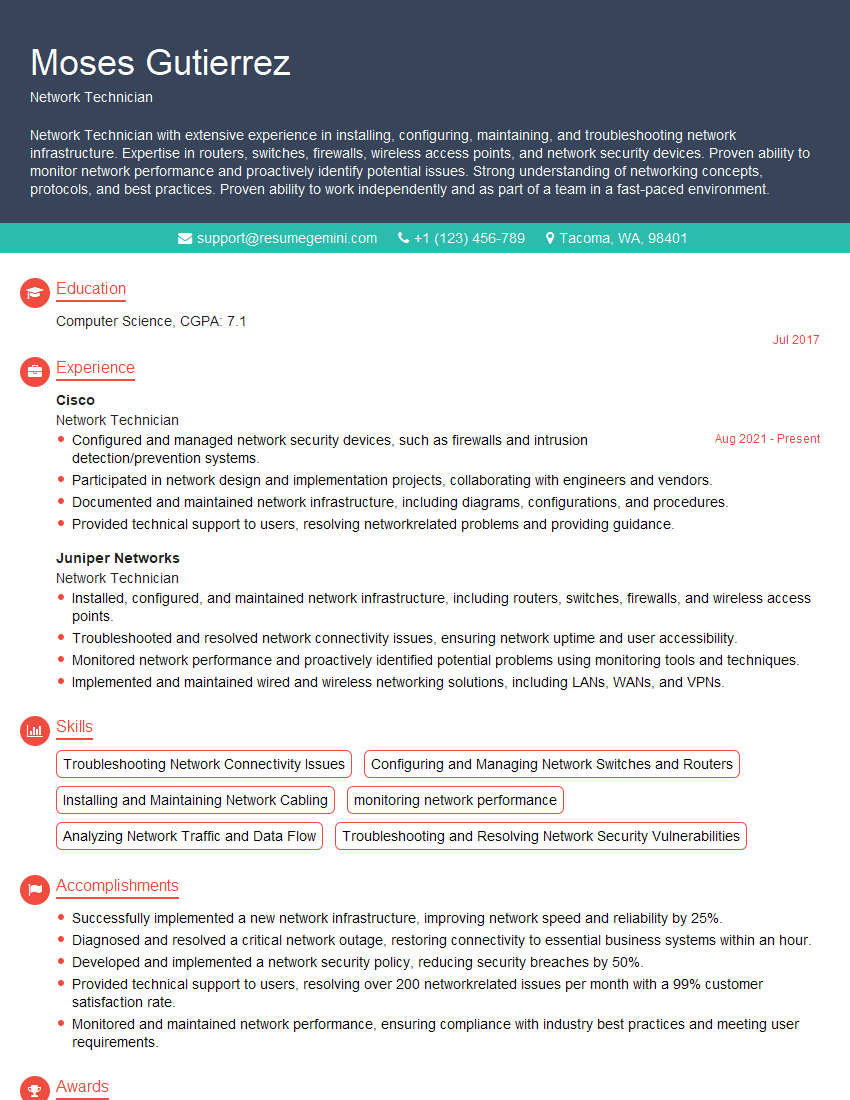
Network Technician Resume Sample

Fiber Optic Technician Resume Sample

Infrastructure Technician Resume Sample
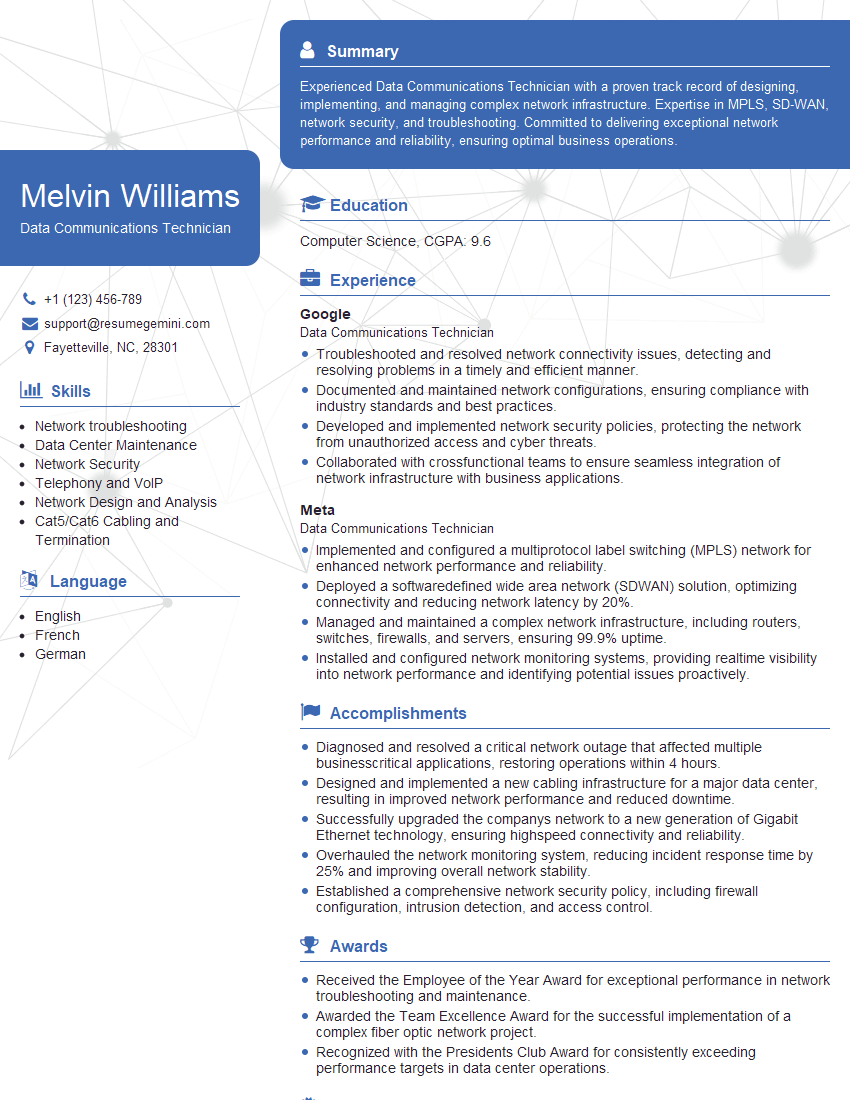
Data Communications Technician Resume Sample
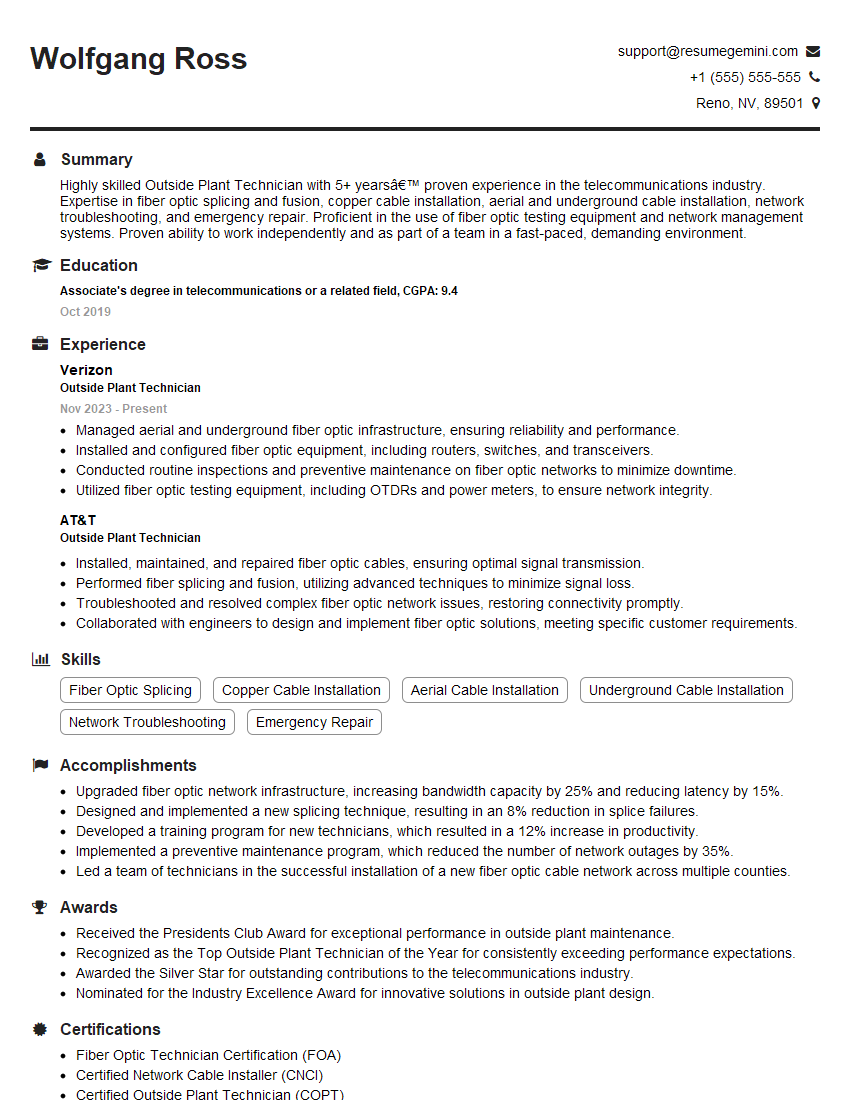
Outside Plant Technician Resume Sample
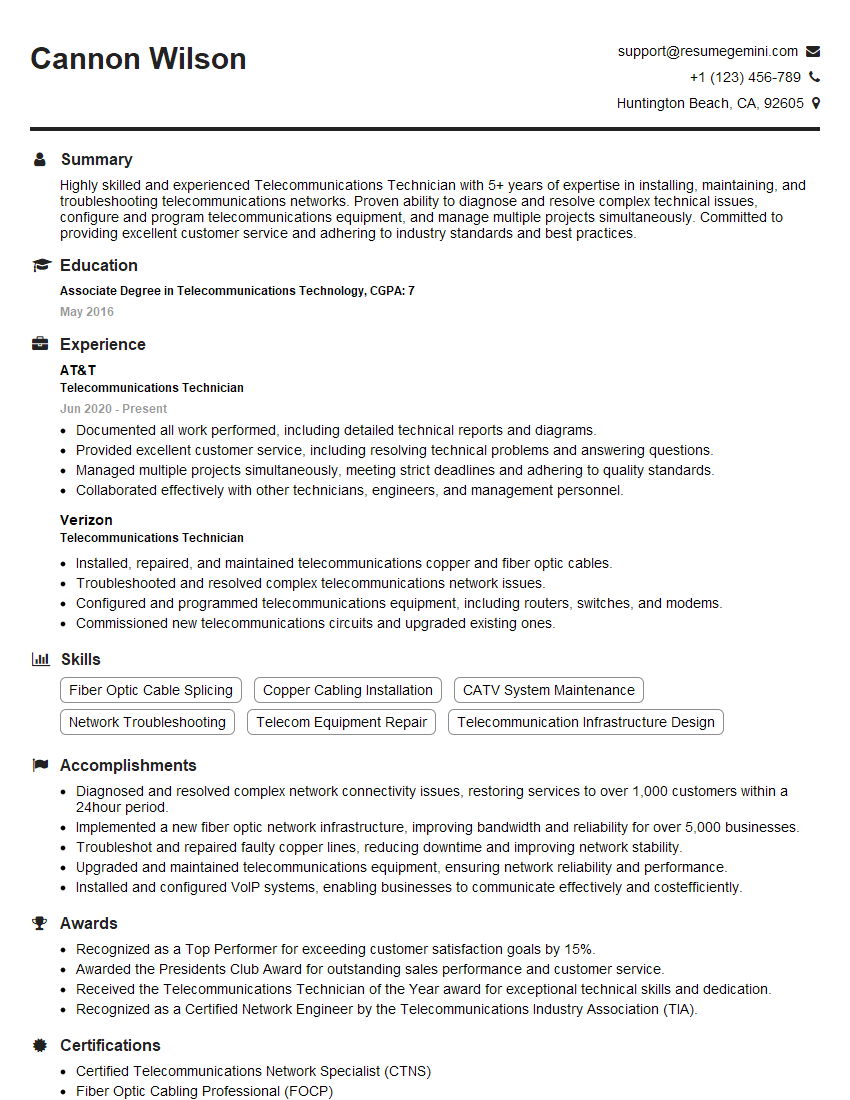
Telecommunications Technician Resume Sample

Cable Splicer Resume Sample

Fiber Optic Splicer Resume Sample
Explore more articles
Users Rating of Our Blogs
Share Your Experience
We value your feedback! Please rate our content and share your thoughts (optional).
What Readers Say About Our Blog
Very informative content, great job.
good