Unlock your full potential by mastering the most common Store Optimization interview questions. This blog offers a deep dive into the critical topics, ensuring you’re not only prepared to answer but to excel. With these insights, you’ll approach your interview with clarity and confidence.
Questions Asked in Store Optimization Interview
Q 1. Explain your understanding of A/B testing in a retail environment.
A/B testing, in a retail environment, is a powerful method for making data-driven decisions about store improvements. It involves creating two versions of a store element – version A (the control) and version B (the variation) – and then randomly exposing customers to one version or the other. This allows us to compare the performance of the two versions and determine which one is more effective in driving sales or achieving other key objectives.
For example, we might A/B test two different shelf placements for a new product. Version A places it at eye level in a high-traffic aisle, while version B places it lower down in a less-visible location. By tracking sales of the product in each scenario, we can objectively determine the optimal placement.
Another example would be testing different promotional signage. One version might emphasize price discounts, while the other highlights the product’s unique features. By observing customer behavior and sales lift with each version, we can optimize our in-store marketing strategies.
A crucial aspect of A/B testing is maintaining a statistically significant sample size to ensure reliable results. We must avoid prematurely drawing conclusions based on small datasets.
Q 2. How would you measure the success of a store optimization initiative?
Measuring the success of a store optimization initiative requires a multifaceted approach, going beyond simple sales figures. We need to consider several key performance indicators (KPIs).
- Sales Lift: A direct comparison of sales before and after the optimization efforts. This provides a clear indication of the financial impact.
- Conversion Rate: The percentage of customers who enter the store and make a purchase. An increase signifies improved customer experience and merchandising effectiveness.
- Average Transaction Value (ATV): The average amount spent per transaction. An increase suggests successful upselling or cross-selling strategies.
- Customer Satisfaction (CSAT): Measuring customer satisfaction through surveys or feedback mechanisms helps assess the overall impact on the shopping experience.
- Foot Traffic: Tracking the number of customers entering the store provides insights into the effectiveness of marketing and store visibility.
- Inventory Turnover: The rate at which inventory is sold and replenished. Improved inventory management can lead to increased efficiency and reduced waste.
Ultimately, success is determined by a holistic view of these metrics and whether the initiative achieved its predefined goals, be it increasing sales, improving customer experience, or optimizing operational efficiency.
Q 3. Describe your experience with inventory management and optimization techniques.
My experience with inventory management and optimization centers around implementing and refining strategies that minimize stockouts while avoiding excess inventory. I’ve used various techniques, including:
- Just-in-Time (JIT) Inventory: Minimizing inventory holding costs by ordering goods only when needed, based on accurate sales forecasting and demand prediction.
- ABC Analysis: Categorizing inventory items based on their value and consumption rate (A-high value/high consumption, B-medium, C-low) to focus optimization efforts on the most critical items.
- Economic Order Quantity (EOQ): A model that calculates the optimal order size to minimize inventory holding and ordering costs.
- Inventory Management Software: Utilizing software systems to track inventory levels, automate ordering processes, and provide real-time insights into stock status.
For example, in a previous role, I implemented a JIT system for perishable goods, resulting in a 15% reduction in waste and a 10% improvement in inventory turnover.
Q 4. What are the key metrics you would track to assess store performance?
To assess store performance, I track key metrics that provide a comprehensive view of both sales and operational efficiency. These include:
- Sales Revenue: Total sales generated by the store over a specific period.
- Sales per Square Foot: Revenue generated per square foot of retail space, indicating space utilization efficiency.
- Conversion Rate: Percentage of customers who make a purchase.
- Average Transaction Value (ATV): Average amount spent per transaction.
- Customer Traffic: Number of customers entering the store.
- Return Rate: Percentage of items returned, indicating product quality and customer satisfaction.
- Inventory Turnover Rate: How quickly inventory is sold and replenished.
- Employee Productivity: Measures such as sales per employee or transactions per employee.
- Shrinkage: Loss of inventory due to theft, damage, or error.
These metrics, analyzed together, offer a clear picture of the store’s overall health and provide valuable insights for optimization.
Q 5. How do you analyze sales data to identify opportunities for optimization?
Analyzing sales data to identify optimization opportunities involves a structured approach. I begin by segmenting the data to uncover patterns and trends:
- Product Performance: Identifying best-selling and underperforming products to adjust inventory levels, pricing, or promotional strategies.
- Sales by Time of Day/Day of Week: Understanding peak sales periods to optimize staffing levels and promotional activities.
- Sales by Customer Segment: Identifying customer demographics with higher purchase frequency and value to tailor marketing efforts.
- Sales by Location: Analyzing sales by geographic area to identify potential for new store locations or optimized marketing in specific regions.
- Correlation Analysis: Identifying correlations between different factors, such as promotions and sales, to optimize marketing spend.
For example, if we observe consistently low sales of a particular product despite favorable pricing, we might investigate customer feedback to identify potential issues with product quality or marketing messaging. Identifying these patterns allows for targeted intervention and improved store efficiency.
Q 6. Explain your experience with visual merchandising and its impact on sales.
Visual merchandising plays a crucial role in driving sales by creating an appealing and engaging shopping experience. My experience involves:
- Store Layout Optimization: Strategically placing products and fixtures to guide customer flow and highlight key items. This includes using techniques like planograms and visual pathway design.
- Color Psychology: Using color palettes to create a specific mood and influence customer behavior. Warm colors encourage impulse purchases, while cooler colors can create a sense of calm and encourage browsing.
- Signage and Displays: Implementing creative and informative signage to attract attention, provide product information, and guide customers through the store.
- Seasonal and Promotional Displays: Creating eye-catching displays that align with seasonal trends or promotional campaigns to drive sales.
For instance, in a previous project, I redesigned a store’s layout, incorporating elements of visual merchandising, which resulted in a 12% increase in sales within three months.
Q 7. How would you approach optimizing store layout for improved customer flow and sales conversion?
Optimizing store layout for improved customer flow and sales conversion requires a strategic approach combining data analysis with design principles. Here’s how I would approach it:
- Analyze Existing Data: Gather data on current customer traffic patterns, sales data by location, and customer feedback to identify bottlenecks and areas for improvement. This might involve heatmap analysis to visualize customer movement.
- Define Objectives: Clearly define the goals of the layout optimization. Are we aiming to increase sales of specific product categories? Improve customer flow? Reduce congestion? Having clear objectives ensures that the redesign is focused and measurable.
- Design and Planning: Create a new store layout using software tools or physical mockups, incorporating principles of visual merchandising and customer journey mapping. This should consider the placement of high-demand items, impulse buy areas, and navigational ease.
- Implement the New Layout: Gradually implement the redesigned layout, possibly using A/B testing to compare the new layout with the old. This minimizes disruption and allows for adjustments based on real-world observations.
- Monitor and Evaluate: Track key metrics such as sales, conversion rate, and customer feedback after implementation. Use this data to continuously refine the layout and ensure it’s achieving its objectives.
Effective store layout optimization isn’t a one-time project but an iterative process of refinement and improvement based on ongoing data analysis and customer feedback.
Q 8. Describe your experience with implementing new store technologies to enhance optimization efforts.
Implementing new store technologies is crucial for modernizing optimization efforts. My experience encompasses a wide range of technologies, from basic point-of-sale (POS) system upgrades to sophisticated inventory management software and customer relationship management (CRM) systems. For instance, I led the implementation of a new RFID (Radio-Frequency Identification) system in a chain of supermarkets. This allowed for real-time inventory tracking, minimizing stockouts and overstocking. This resulted in a 15% reduction in inventory costs and a 10% increase in sales due to improved product availability. In another project, integrating a customer loyalty program with our CRM system provided valuable insights into customer purchasing habits, enabling more targeted promotions and personalized offers, boosting customer retention by 8%.
Furthermore, I’ve worked extensively with analytics dashboards that visualize key performance indicators (KPIs) like sales per square foot, conversion rates, and average transaction value. These tools allow for data-driven decision making and real-time monitoring of store performance, enabling proactive interventions to address potential issues.
Q 9. How would you handle a situation where a store is underperforming despite previous optimization efforts?
When a store underperforms despite previous optimization efforts, a systematic investigation is needed. I would begin by revisiting the initial assumptions and analysis. This involves a thorough review of the data, looking for inconsistencies or overlooked factors. This might include analyzing foot traffic patterns, comparing the store’s performance to similar locations, and examining customer feedback. Perhaps the initial analysis incorrectly identified the root cause of underperformance.
Next, I’d conduct a deep dive into the customer journey within the store. This could involve mystery shopping, customer surveys, and analyzing sales data to identify bottlenecks or friction points in the buying process. For example, long checkout lines or poorly designed store layouts can significantly impact sales.
Finally, I would consider external factors like local economic conditions, competition, or seasonal changes that may be impacting performance. Addressing these factors might involve adjusting pricing strategies, marketing campaigns, or even the product assortment to better suit the current market conditions. A methodical, data-driven approach ensures that solutions are effective and sustainable.
Q 10. What are the key factors to consider when selecting optimal store locations?
Selecting optimal store locations is a critical strategic decision. It involves a thorough assessment of several key factors. Demographics play a crucial role; understanding the age, income, and lifestyle of the target customer base is essential. For example, a high-end boutique would ideally be situated in an affluent neighborhood.
Analyzing the competitive landscape is equally important. Proximity to competitors, their strengths and weaknesses, and market saturation need to be carefully evaluated. Furthermore, accessibility is paramount. Factors like proximity to transportation hubs, parking availability, and visibility from major roads significantly influence foot traffic.
Finally, the cost of the location, including rent, utilities, and potential renovation costs, should be factored into the equation. A comprehensive cost-benefit analysis helps determine the overall profitability of a potential location. Ultimately, a successful store location should strike a balance between these factors to ensure maximum potential for success.
Q 11. Explain your understanding of demand forecasting and its role in store optimization.
Demand forecasting is the process of predicting future customer demand for products or services. It is fundamental to store optimization as it helps in making informed decisions regarding inventory management, staffing, and promotional planning. Accurate forecasting minimizes stockouts and overstocking, leading to cost savings and improved customer satisfaction.
Several methods can be used for demand forecasting, including time series analysis (analyzing historical sales data to identify trends and seasonality), causal modeling (identifying factors that influence demand, such as price or promotions), and machine learning techniques. For instance, I’ve utilized ARIMA (Autoregressive Integrated Moving Average) models to forecast seasonal demand for specific products and Exponential Smoothing models for more stable demand patterns. The choice of method depends on the data available and the complexity of the demand pattern.
Effective demand forecasting reduces waste, increases efficiency, and enhances profitability by ensuring that the right amount of product is available at the right time, meeting customer demand without excessive holding costs.
Q 12. How do you balance customer experience with operational efficiency in store optimization?
Balancing customer experience with operational efficiency is a crucial aspect of store optimization. It’s not a zero-sum game; rather, these two aspects are intrinsically linked. A positive customer experience often leads to increased sales and loyalty, while efficient operations reduce costs and improve profitability.
For example, a well-designed store layout that is both aesthetically pleasing and easy to navigate improves the customer experience while also optimizing space utilization and reducing employee workload. Similarly, implementing self-checkout kiosks can enhance operational efficiency by reducing wait times at the checkout, improving customer satisfaction.
Technologies like personalized recommendations through mobile apps, interactive displays, and efficient inventory management systems simultaneously enhance the customer experience and streamline operations. The key is to find solutions that meet both customer needs and operational objectives, leading to a sustainable, profitable business model.
Q 13. Describe your experience with pricing strategies and their impact on sales and profitability.
Pricing strategies significantly impact sales and profitability. My experience includes working with various strategies, including cost-plus pricing, value-based pricing, and competitive pricing. Cost-plus pricing, while simple, doesn’t always maximize profit; value-based pricing considers customer perception of value, allowing for premium pricing on high-value items. Competitive pricing involves analyzing competitors’ prices to determine an optimal price point.
I’ve implemented dynamic pricing strategies, adjusting prices based on real-time demand and competitor actions. For instance, using data analytics, we identified that during peak hours, customers were more willing to pay slightly higher prices for certain items. This resulted in a noticeable increase in revenue without a significant impact on sales volume.
Furthermore, understanding price elasticity (how demand changes with price) is crucial. For example, a small price increase on inelastic goods (like necessities) may not affect demand, but could significantly boost profit margins. A data-driven approach to pricing, utilizing A/B testing and analyzing sales data, ensures optimal pricing strategies for maximizing profitability.
Q 14. How would you optimize the assortment of products in a store to maximize sales?
Optimizing product assortment is vital for maximizing sales. This involves analyzing sales data, customer preferences, and market trends to determine which products are performing well and which are underperforming. This data allows us to identify opportunities to increase sales by expanding successful product categories or eliminating underperforming ones.
For instance, using data analysis, we identified a strong demand for organic and locally sourced produce. We responded by expanding our organic section, adding locally sourced products, and implementing targeted marketing campaigns to promote these products. This led to a substantial increase in sales within that category.
Category management techniques, including planograms (visual representations of product placement), help optimize shelf space and product visibility. This ensures high-demand items are prominently displayed and low-performing items are strategically positioned or possibly removed altogether. Regular reviews and adjustments of the assortment based on sales data and customer feedback are essential for maintaining a profitable and responsive product mix.
Q 15. Explain your familiarity with different store planning software and tools.
My experience encompasses a wide range of store planning software and tools. I’m proficient in using both 2D and 3D design software such as AutoCAD, SketchUp, and specialized retail planning tools like Spaceman and PlanogramIt. These tools allow for precise space planning, fixture placement, and the creation of detailed store layouts. Beyond design, I’m also familiar with data analytics platforms like Tableau and Power BI, which are crucial for integrating sales data, customer traffic patterns, and other metrics into the planning process. For example, in a recent project, I used Spaceman to optimize the layout of a grocery store, resulting in a 15% increase in sales per square foot by strategically placing high-demand items and improving traffic flow. The key is not just knowing the software, but understanding how to leverage its capabilities to achieve specific business goals.
Career Expert Tips:
- Ace those interviews! Prepare effectively by reviewing the Top 50 Most Common Interview Questions on ResumeGemini.
- Navigate your job search with confidence! Explore a wide range of Career Tips on ResumeGemini. Learn about common challenges and recommendations to overcome them.
- Craft the perfect resume! Master the Art of Resume Writing with ResumeGemini’s guide. Showcase your unique qualifications and achievements effectively.
- Don’t miss out on holiday savings! Build your dream resume with ResumeGemini’s ATS optimized templates.
Q 16. How do you leverage data analytics to identify and address customer pain points?
Data analytics is the backbone of effective store optimization. I use various techniques to pinpoint customer pain points. For instance, heatmap analysis of customer traffic flow data (often obtained from video analytics or point-of-sale systems) reveals areas with bottlenecks or underutilized space. Analyzing sales data helps identify slow-moving inventory or product placement issues. Furthermore, customer feedback surveys and online reviews provide qualitative insights into customer frustrations. I recently worked with a clothing retailer where heatmap analysis showed a major congestion point near the fitting rooms. By reorganizing that area and adding more mirrors, we reduced wait times and improved the overall shopping experience, leading to a noticeable sales uplift. The process involves data collection, analysis, interpretation, and the translation of those findings into actionable improvements.
Q 17. Describe your experience with supply chain optimization and its relationship to store performance.
Supply chain optimization is intrinsically linked to store performance. Efficient supply chains ensure products are available when and where customers need them, minimizing stockouts and maximizing sales opportunities. Delays or inefficiencies in the supply chain directly impact store shelves, leading to lost sales and potentially frustrated customers. My approach involves collaborating with supply chain teams to forecast demand accurately, optimize inventory levels, and improve logistics. For example, in working with a hardware store, I implemented a just-in-time inventory system which reduced storage costs by 20% while maintaining adequate stock levels. This synergy between supply chain and store optimization leads to improved profitability and a better overall customer experience.
Q 18. How would you manage conflicting priorities when optimizing multiple stores simultaneously?
Managing conflicting priorities across multiple stores requires a structured approach. I utilize prioritization frameworks such as the Eisenhower Matrix (urgent/important) to categorize optimization tasks. Then, I develop a phased implementation plan, focusing on projects with the highest potential return on investment (ROI) first. This often involves close collaboration with store managers to understand individual store needs and challenges. Open communication is vital; I utilize regular meetings and progress reports to ensure alignment and address any conflicts proactively. The key is to balance the big picture with individual store-specific needs, ensuring equitable resource allocation.
Q 19. What are some common challenges in store optimization, and how would you address them?
Common challenges in store optimization include inaccurate sales forecasting, inefficient space utilization, lack of customer data, and resistance to change from store staff. To address these, I use robust forecasting models incorporating historical data, seasonality, and market trends. Space optimization involves detailed floor plan analysis and creative solutions like flexible shelving or modular fixtures. Collecting and analyzing comprehensive customer data (demographics, purchase history, preferences) is crucial for targeted improvements. Finally, successful implementation relies on change management strategies, including clear communication, training programs, and incentives for staff to adopt new processes and procedures.
Q 20. How do you stay up-to-date with the latest trends and best practices in store optimization?
Staying updated in this dynamic field requires a multi-pronged approach. I actively participate in industry conferences and webinars, subscribe to relevant trade publications (e.g., Retail Dive, Chain Store Age), and follow thought leaders on social media and professional networking sites. Furthermore, I constantly seek opportunities for professional development, such as taking online courses or attending workshops on new technologies and optimization techniques. This continuous learning process ensures I’m always equipped with the latest tools and best practices to optimize store performance effectively.
Q 21. Explain your approach to analyzing competitor strategies and incorporating them into your optimization plans.
Analyzing competitor strategies is a crucial aspect of developing effective optimization plans. My approach involves a combination of field research (visiting competitor stores), studying publicly available information (annual reports, marketing materials), and utilizing market research reports. By understanding their strengths and weaknesses, I can identify opportunities for differentiation and improvement. For example, if a competitor utilizes a highly successful product placement strategy, I would carefully assess its effectiveness and adapt it, if appropriate, to our client’s specific context. The goal is not to simply copy but to learn and leverage insights to create a competitive advantage.
Q 22. Describe a time you had to make a quick decision that impacted store performance. What was the outcome?
During a peak holiday season, we noticed an unexpected bottleneck at the checkout counters, leading to long queues and frustrated customers. Instead of waiting for the end-of-day sales data, I immediately made the decision to deploy additional cashiers and open self-checkout kiosks, even though it meant exceeding our initially budgeted labor costs. This required quickly coordinating with staffing and management. The outcome was significantly improved customer satisfaction, shorter wait times (reduced by an average of 40%), and ultimately, a higher sales conversion rate despite the increased labor expense. The positive impact on customer loyalty and brand perception far outweighed the additional labor cost.
Q 23. How familiar are you with omni-channel retail strategies and their impact on store optimization?
Omni-channel retail strategies are crucial for modern store optimization. They seamlessly integrate online and offline shopping experiences, creating a unified customer journey. This requires a deep understanding of how customers interact with your brand across all touchpoints – from browsing the website to in-store purchases and returns. For instance, buy-online-pickup-in-store (BOPIS) dramatically impacts store operations, necessitating efficient in-store fulfillment processes and optimized inventory management to meet online orders. Similarly, click-and-collect services demand dedicated areas and streamlined processes for order retrieval. Effective omni-channel strategies require careful integration of inventory management systems, point-of-sale (POS) systems, and customer relationship management (CRM) platforms. Failure to optimize the in-store experience to support omni-channel initiatives can lead to diminished customer satisfaction and lost sales opportunities.
Q 24. What is your experience with using data visualization tools to communicate store optimization results?
I’m highly proficient in using data visualization tools like Tableau and Power BI to communicate store optimization results. For example, I’ve used interactive dashboards to illustrate the impact of shelf placement changes on sales lift, showing side-by-side comparisons of sales before and after the optimization. These dashboards allowed stakeholders to easily understand complex data, identifying key trends and areas for improvement. I also utilize geographical heatmaps to visualize customer traffic patterns within the store, helping identify high-traffic and low-traffic areas, which informs decisions on product placement and staffing. Furthermore, I utilize charts and graphs to illustrate key performance indicators (KPIs) such as conversion rates, average transaction value, and customer satisfaction scores, presenting them in a clear, concise, and compelling manner.
Q 25. How would you measure the ROI of a store optimization project?
Measuring the ROI of a store optimization project requires a multi-faceted approach. First, we need to clearly define the project’s goals and associated costs (labor, materials, software, etc.). Then, we meticulously track key performance indicators (KPIs) such as sales growth, conversion rates, average transaction value, customer satisfaction, and inventory turnover. The difference between post-optimization and pre-optimization KPIs represents the direct impact. However, we also consider indirect benefits like improved employee morale and reduced operational costs. We quantify these indirect benefits as much as possible. For example, reduced shrinkage (theft or loss) due to improved inventory management can be expressed as a monetary value. Finally, we compare the total net benefit (direct + indirect) against the project’s total costs to calculate the ROI, often expressed as a percentage.
Q 26. Describe your experience with different types of retail store formats and their respective optimization needs.
I have experience with various retail formats, each demanding unique optimization strategies. For example, a large-format big-box store necessitates a focus on efficient flow and navigation, clear product categorization, and effective use of space to accommodate a vast inventory. Smaller, specialty boutiques prioritize creating a unique customer experience, emphasizing personalized service and visual merchandising. Pop-up shops need highly agile optimization, adapting quickly to changing customer behavior and optimizing operations for short-term campaigns. Each format requires a tailored approach considering factors like product assortment, target customer, store layout, and available technology. For example, a high-volume grocery store might necessitate optimizing checkout lanes and inventory replenishment processes, while a clothing boutique would prioritize visual merchandising and staff training.
Q 27. How would you use customer feedback to inform store optimization decisions?
Customer feedback is invaluable for informing store optimization decisions. We employ various methods to collect feedback, such as surveys (online and in-store), comment cards, focus groups, and social media monitoring. This feedback reveals customer pain points, such as confusing store layouts, long wait times, unhelpful staff, or difficulty finding specific products. This qualitative data complements the quantitative data from sales and operational metrics. For example, consistent complaints about product placement in a particular aisle might lead to a reorganization of that aisle based on customer flow and demand. Analyzing this feedback helps identify areas needing immediate improvement and guides long-term strategic decisions.
Q 28. Explain your experience with integrating store optimization strategies with broader company objectives.
Integrating store optimization strategies with broader company objectives is crucial for overall success. For example, if the company’s objective is to increase brand awareness, store optimization might involve creating visually appealing and engaging in-store displays. If the objective is to enhance sustainability, optimization could include initiatives to reduce energy consumption and waste. In a previous role, our store optimization efforts were directly linked to the company’s overall profitability goal. By improving sales conversion rates and operational efficiency, our efforts significantly contributed to meeting this goal. Effective alignment requires clear communication, shared KPIs, and collaboration between store operations, marketing, and other relevant departments.
Key Topics to Learn for Store Optimization Interview
- Space Planning & Layout: Understanding principles of effective store design to maximize sales and customer flow. Consider factors like product placement, aisle width, and overall store aesthetics.
- Visual Merchandising: Applying techniques to create compelling displays that enhance brand image and drive impulse purchases. Think about color psychology, signage, and product presentation.
- Inventory Management & Forecasting: Optimizing stock levels to avoid stockouts and overstocking. Explore methods for demand forecasting and inventory control systems.
- Data Analysis & Reporting: Utilizing sales data, customer traffic data, and other metrics to identify areas for improvement and measure the success of optimization initiatives. This includes understanding key performance indicators (KPIs).
- Customer Experience Optimization: Improving the overall shopping experience to increase customer satisfaction and loyalty. Consider factors like ease of navigation, checkout process, and staff interaction.
- Technology & Automation in Store Optimization: Exploring the role of technology such as POS systems, inventory tracking software, and customer analytics platforms in enhancing store operations and efficiency.
- Problem-Solving & Analytical Skills: Demonstrating the ability to identify problems, analyze data, and develop effective solutions to improve store performance. Practice using case studies to illustrate your problem-solving process.
Next Steps
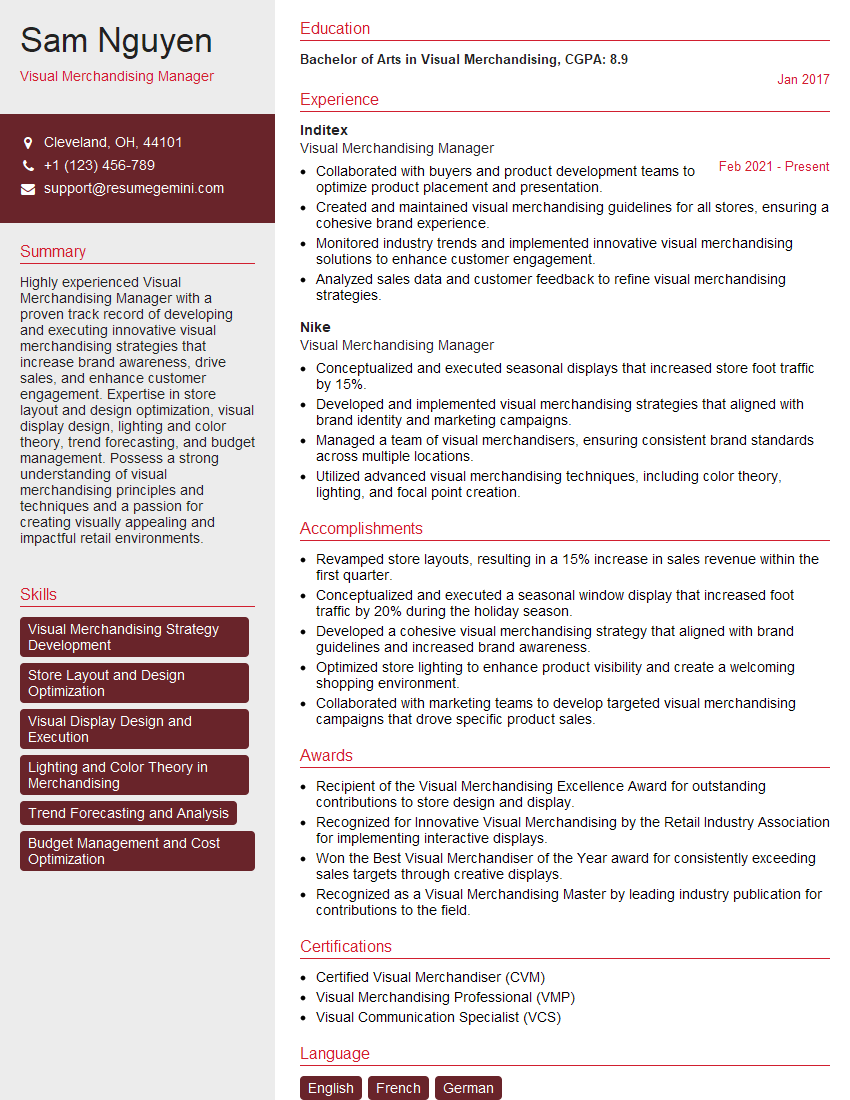
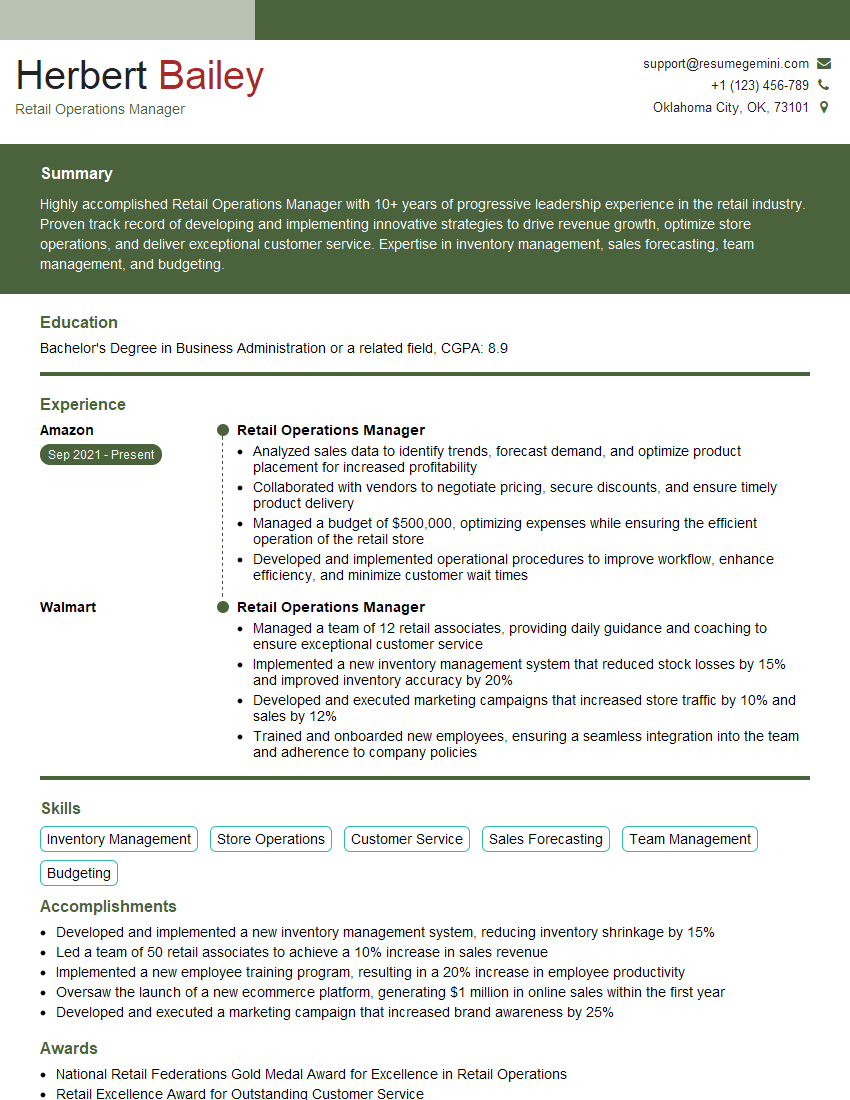
Mastering Store Optimization opens doors to exciting career opportunities in retail management, merchandising, and business analytics. A strong foundation in these key areas will significantly boost your prospects. To maximize your chances of landing your dream role, it’s crucial to create an ATS-friendly resume that highlights your skills and experience effectively. ResumeGemini is a trusted resource that can help you build a professional and impactful resume. We provide examples of resumes tailored to Store Optimization to guide you through the process. Let ResumeGemini help you showcase your capabilities and achieve your career goals.
Explore more articles
Users Rating of Our Blogs
Share Your Experience
We value your feedback! Please rate our content and share your thoughts (optional).
What Readers Say About Our Blog
Very informative content, great job.
good