Every successful interview starts with knowing what to expect. In this blog, we’ll take you through the top Straight Stitch Sewing interview questions, breaking them down with expert tips to help you deliver impactful answers. Step into your next interview fully prepared and ready to succeed.
Questions Asked in Straight Stitch Sewing Interview
Q 1. Explain the different types of straight stitch machines and their applications.
Straight stitch machines come in various types, each suited for specific applications. The core difference lies in their power source and features. We have:
- Mechanical Straight Stitch Machines: These are typically hand-cranked or foot-pedal operated, offering great control and simplicity, ideal for beginners or delicate work. They are robust and reliable, often used in tailoring and mending.
- Electric Straight Stitch Machines: These are powered by electricity, providing consistent speed and power. They are commonly used in industrial settings or home sewing where high-volume or heavy-duty stitching is needed. Variations exist with features like automatic needle threaders and adjustable stitch length.
- Industrial Straight Stitch Machines: These are heavy-duty machines built for high-speed, continuous operation. They are often found in garment factories, producing thousands of stitches per minute with remarkable consistency. Features include reinforced internal components and specialized feet for specific fabric types.
- Walking Foot Machines: A type of electric or industrial machine incorporating a walking foot, which moves the fabric evenly from both top and bottom, preventing slippage and ensuring even stitching, especially useful for thicker fabrics like leather or multiple layers.
Choosing the right machine depends heavily on the application. For delicate crafts, a mechanical machine provides the finesse and control required. For large-scale projects, electric or industrial machines are essential for efficiency and durability.
Q 2. Describe the process of setting up a straight stitch machine for optimal performance.
Setting up a straight stitch machine for optimal performance involves a methodical approach:
- Thread the machine correctly: Follow the machine’s manual precisely. Incorrect threading can lead to skipped stitches or broken threads. Pay close attention to the tension discs and the path the thread takes through the machine.
- Select the correct needle: The needle type and size are critical. The wrong needle can cause damage to the fabric or break easily. Use a sharp needle appropriate for the fabric type. A finer needle for delicate fabrics, a heavier needle for thicker ones.
- Adjust the presser foot pressure: Too much pressure can cause puckering; too little can lead to skipped stitches. The pressure should be just enough to hold the fabric firmly in place without causing distortion. This is often adjustable via a dial or screw on the machine.
- Check bobbin winding: A properly wound bobbin is essential. Uneven winding leads to inconsistent stitching. Make sure the bobbin is correctly seated and filled to the appropriate level.
- Test the stitch: Always test the stitch on a scrap piece of the same fabric you will be using for your project. This allows for adjustments to tension and stitch length before starting your main work. Observe the stitches for evenness and consistency.
Remember, the machine’s manual is your best guide. Familiarize yourself with your specific model’s instructions for optimal results.
Q 3. What adjustments would you make to stitch length and tension for different fabrics?
Stitch length and tension adjustments are crucial for achieving quality results with different fabrics. Think of it like this: stitch length is the stride, and tension is the grip.
- Stitch Length: Longer stitches are suitable for basting or seams that need some give (e.g., stretchy fabrics). Shorter stitches are necessary for areas requiring durability and precision (e.g., buttonholes, seams under stress). For example, a denim project might use a stitch length of 2.0-2.5 mm, whereas a delicate silk garment may only require 1.5 mm or less.
- Tension: This controls how tightly the upper and lower threads interlock. Loose tension can result in loose stitches that easily unravel. Tight tension can cause puckering and breakage. Heavier fabrics usually require slightly higher tension, while lighter fabrics need less. Experiment on scraps to find the ideal balance for each fabric.
For instance, when sewing chiffon, you’d use a much shorter stitch length and a lower tension to prevent puckering and breakage. Conversely, for canvas, you would increase the stitch length slightly and the tension to ensure durability. Always make test stitches to fine-tune the settings.
Q 4. How do you troubleshoot common straight stitch machine problems, such as skipped stitches or uneven tension?
Troubleshooting is a key skill for any sewer. Let’s tackle some common issues:
- Skipped Stitches: This often indicates incorrect threading, a bent or dull needle, or incorrect tension. Check the threading path meticulously, replace the needle, and adjust the tension. Also, inspect the bobbin case and bobbin for any snags or damage.
- Uneven Tension: This can be due to improper threading, incorrect tension settings, or a damaged bobbin case. Again, check the threading, adjust the tension dial, and inspect the bobbin case and bobbin for any damage or obstructions. Sometimes, a slightly loose bobbin can cause tension issues.
- Broken Needles: Using the wrong needle for the fabric is a common cause. Always use a needle appropriate for the fabric weight. A bent or dull needle should be immediately replaced. Furthermore, ensure you’re not forcing the machine.
- Fabric Puckering: This is usually a sign of too much tension. Reduce the tension setting and try again. Ensure the presser foot pressure is correctly adjusted as well. Sometimes using a different presser foot can improve things.
A systematic approach, starting with the simplest solutions, is essential. Refer to your machine’s manual for detailed troubleshooting guides specific to your model.
Q 5. What safety precautions do you take when operating a straight stitch sewing machine?
Safety is paramount when operating a sewing machine. Here’s what I always do:
- Keep fingers clear: Never put your fingers near the needle while the machine is running.
- Use the appropriate needle size and type: Using the incorrect needle can lead to breakage and injury.
- Keep the area clear: Avoid clutter around the sewing machine to prevent accidents.
- Unplug the machine: Always unplug the machine before cleaning, adjusting internal parts, or making any repairs.
- Use appropriate accessories: Make sure to use the correct presser foot and other accessories for your project.
- Follow the manual: Read and understand the instructions that come with your sewing machine and adhere to all safety guidelines.
Think of safety as an integral part of the sewing process – not an afterthought. A moment’s carelessness can lead to serious injury.
Q 6. How do you maintain and clean a straight stitch sewing machine to ensure its longevity?
Regular maintenance ensures your straight stitch machine’s longevity and optimal performance:
- Regular cleaning: Use a soft brush or compressed air to remove dust and lint from the machine’s interior. Pay attention to the bobbin area and feed dogs.
- Lubrication: Apply a drop of sewing machine oil to designated areas (check your manual), to prevent friction and wear. Don’t overdo it!
- Needle replacement: Replace the needle regularly, even if it doesn’t appear dull or bent. A dull needle causes skipped stitches and fabric damage.
- Bobbin case cleaning: Clean the bobbin case regularly to remove any lint or debris that may interfere with smooth operation.
- Professional servicing: It’s advisable to have your machine professionally serviced once a year or as needed to identify potential issues early on.
Think of regular maintenance as preventive medicine. A small amount of care goes a long way in extending the life of your machine.
Q 7. Explain the importance of consistent stitch length and tension in achieving quality results.
Consistent stitch length and tension are vital for achieving high-quality results. Inconsistent stitching leads to unprofessional-looking work that can easily unravel.
- Aesthetic Appeal: Even stitches create a clean, professional finish. Uneven stitches are distracting and detract from the overall quality.
- Durability: Consistent stitching ensures the seams are strong and durable. Inconsistent stitching creates weak points that can easily break.
- Fabric Integrity: Proper tension prevents puckering and fabric distortion, preserving the integrity of the garment or project.
Imagine a perfectly tailored suit versus one with uneven, loose stitches. The difference is night and day! Consistent stitch length and tension are fundamental to achieving a high-quality and professional finish.
Q 8. Describe different needle types and their suitability for various fabrics.
Selecting the right needle is crucial for a successful straight stitch. Different needles are designed with varying points, shanks, and sizes to accommodate the diverse properties of fabrics. Think of it like choosing the right tool for a specific job – you wouldn’t use a hammer to screw in a screw!
- Universal Needles: These are your workhorses, suitable for a wide range of fabrics, from cotton to linen to lightweight blends. They’re a great starting point for beginners.
- Sharps Needles: These needles have a sharper point, ideal for crisp, clean stitches in woven fabrics like cotton, silk, and linen. They are particularly useful for sewing seams where precision is important.
- Ballpoint Needles: These are essential for knit fabrics. Their rounded point glides between the loops of the knit fabric, preventing snags and runs. Imagine how a ballpoint pen moves smoothly on paper – that’s how a ballpoint needle moves through knit fabric.
- Stretch Needles: Similar to ballpoint needles, but designed for more stretchy materials like jersey and spandex. They offer a slightly larger eye to accommodate thicker threads, commonly required when working with stretch knits.
- Microtex Needles: These needles have a very fine point, designed for delicate fabrics like silk, chiffon, and fine lace. They’re great for projects where invisible stitches are crucial.
- Jeans Needles: These heavy-duty needles have a strong, reinforced point capable of piercing thick denim and canvas materials without bending or breaking.
Needle size is indicated by a number; smaller numbers mean finer needles. Always choose the needle size appropriate to your fabric’s weight and type. Consulting your sewing machine manual and fabric information will guide you in this selection.
Q 9. How do you identify and resolve common fabric feeding issues?
Fabric feeding problems, often manifested as skipped stitches or puckering, are common but solvable. Think of your fabric feeding like a dance – both the feed dogs (the teeth under the needle plate) and the fabric need to move in perfect harmony.
- Uneven Fabric Feeding: This is usually caused by inconsistent fabric tension, dirty feed dogs, or dull needles. Clean the feed dogs with a brush, replace the needle, and check your fabric tension settings. Try to ensure your fabric is not bunched or pulled.
- Puckering: This happens when one layer of fabric is feeding faster than another. Reduce stitch length and check your tension settings. If the problem persists, try using a walking foot (a special presser foot with its own feed dogs), which ensures even fabric feed for multiple layers. Think of it as adding a second pair of feet to help with the dance!
- Skipped Stitches: This is typically caused by a dull needle, improper threading, lint build-up, or incorrect tension settings. Check each of these possibilities systematically. A dull needle is like a blunt pencil; it struggles to make a clean mark.
Troubleshooting often involves a process of elimination: Start by checking the simple things first (needle, tension, cleanliness), and move on to more complex issues (feed dogs, walking foot) if necessary. Always consult your sewing machine manual for specifics relevant to your model.
Q 10. How do you handle different types of thread and their appropriate applications?
Thread selection is as important as needle selection. The type of thread influences stitch quality, durability, and the overall appearance of your project. It’s about choosing the right partner for your fabric.
- Cotton Thread: A versatile option suitable for most woven fabrics. It’s strong, easy to work with, and comes in a wide range of colors. Ideal for everyday sewing.
- Polyester Thread: Stronger and more resistant to stretching than cotton. It’s a good choice for projects requiring durability, like upholstery or clothing that will withstand frequent wear and tear. Think of it as the workhorse thread, always reliable.
- Silk Thread: A luxurious choice for delicate fabrics, offering a beautiful sheen. However, it’s more fragile than cotton or polyester.
- Rayon Thread: Often used for decorative stitching due to its silky texture and soft drape. It’s slightly weaker than polyester and cotton.
- Metallic Thread: Adds a touch of glamour, but can be difficult to sew with and can break easily. Use a sharper needle and a slower sewing speed.
Thread weight (thickness) is also crucial; higher numbers indicate thicker thread. Choose a thread weight compatible with your fabric and needle. Using the wrong thread weight can lead to broken needles or skipped stitches. Always test your thread and needle combination on a scrap piece of fabric before starting your project.
Q 11. Explain the concept of stitch density and its impact on the final product.
Stitch density refers to the number of stitches per inch (SPI). A higher SPI means stitches are closer together, creating a stronger and more durable seam, but it can also make the fabric less flexible. Think of it as the spacing between bricks in a wall; more tightly packed bricks make for a stronger wall.
The ideal stitch density depends on the fabric and the intended use. A garment requiring flexibility might benefit from lower SPI, while something like a heavy-duty bag might need a higher SPI. Experimenting with different stitch densities on scraps of fabric will help you find the sweet spot.
A lower SPI results in a looser, more flexible seam, often preferred for stretchy fabrics or areas requiring movement. A higher SPI produces a denser, stronger, and less likely to fray seam; great for seams that experience considerable stress or need to be durable.
Q 12. What is the significance of proper needle threading in preventing machine malfunction?
Proper needle threading is paramount to prevent machine malfunctions. Incorrect threading can lead to skipped stitches, broken needles, tangled threads, or even damage to the sewing machine’s internal components. It’s the foundation upon which all else is built.
When the thread is not properly threaded, it can cause tension issues, resulting in inconsistent stitches or thread breakage. Furthermore, if thread is incorrectly placed, it may jam the machine’s mechanisms, potentially causing damage or requiring expensive repairs.
Before starting any sewing project, always double-check your threading, ensuring the thread path is correct from the spool to the needle. Refer to your machine’s manual for specific threading instructions. A correctly threaded machine is a smoothly functioning machine!
Q 13. How do you achieve precise stitching when sewing curves or corners?
Sewing curves and corners requires a combination of technique and skill. Think of it as guiding a dancer through a graceful, controlled movement.
- Slow and Steady: Reduce your sewing speed when approaching curves and corners. This prevents the fabric from bunching and allows for more precise control.
- Pivot Technique: For sharp corners, stop with the needle down in the fabric. Raise the presser foot, pivot the fabric, and lower the presser foot again to continue sewing. This creates a clean, crisp corner.
- Guide the Fabric: Gently guide the fabric with your fingers as you sew. This prevents pulling or bunching, leading to a smoother curve.
- Clipping Curves: For very tight curves, clip the seam allowance to allow for better movement and prevent puckering. This is especially useful when working with thicker fabrics.
- Use Seam Guides: Some sewing machines offer seam guides which can be very helpful when sewing curves and straight lines consistently.
Practice is key! Sewing curves and corners takes practice, but with patience and attention to detail, you’ll master this essential skill.
Q 14. How would you adjust the stitch settings for sewing thick versus thin fabrics?
Adjusting stitch settings for different fabric weights is crucial for obtaining quality stitches. Think of it as adjusting your driving speed according to road conditions; you’d go slower on a rough road.
- Thick Fabrics: For thicker fabrics like denim or canvas, you’ll generally need to increase the stitch length (to allow for the needle to easily penetrate the multiple layers) and potentially increase the stitch tension (to ensure the stitches are secure and don’t loosen easily). Using a heavier needle is also beneficial. Longer stitches also reduce stress on the needle and machine.
- Thin Fabrics: For thin fabrics like silk or chiffon, decrease the stitch length (to prevent puckering) and possibly reduce the stitch tension. Using a finer needle and a lighter thread weight also prevents the fabric from being damaged or pulled.
Always test your stitch settings on a scrap piece of the fabric you’re working with before starting your project. This ensures your stitches are appropriate for your specific fabric weight and type. Remember, adjustments might also be needed based on the thread weight you’ve selected.
Q 15. Describe your experience working with different types of sewing machine feet.
My experience with various sewing machine feet is extensive, encompassing a wide range of applications. I’m proficient with the standard straight stitch foot, essential for most straight stitching tasks. Beyond that, I regularly use zipper feet for neat zipper insertion, buttonhole feet for consistent buttonholes, and walking feet to manage multiple layers of fabric or slippery materials without slippage. I’ve also worked extensively with edge stitching feet for precise edge finishing and quilting feet for intricate quilting patterns. The selection of the appropriate foot is crucial for achieving a high-quality finish, and I always consider the fabric type and desired outcome when making my choice. For example, a walking foot is indispensable when sewing multiple layers of denim, ensuring even feed and preventing puckering.
- Standard Straight Stitch Foot: Used for most straight stitching tasks.
- Zipper Foot: Enables precise stitching close to zippers.
- Buttonhole Foot: Creates consistent and accurate buttonholes.
- Walking Foot: Prevents fabric slippage when sewing multiple layers or slippery fabrics.
- Edge Stitching Foot: Allows for accurate stitching along edges.
- Quilting Foot: Facilitates intricate quilting designs.
Career Expert Tips:
- Ace those interviews! Prepare effectively by reviewing the Top 50 Most Common Interview Questions on ResumeGemini.
- Navigate your job search with confidence! Explore a wide range of Career Tips on ResumeGemini. Learn about common challenges and recommendations to overcome them.
- Craft the perfect resume! Master the Art of Resume Writing with ResumeGemini’s guide. Showcase your unique qualifications and achievements effectively.
- Don’t miss out on holiday savings! Build your dream resume with ResumeGemini’s ATS optimized templates.
Q 16. What is your understanding of different seam finishes and when to apply them?
Seam finishes are crucial for preventing fraying, adding durability, and creating a professional look. The choice of seam finish depends heavily on the fabric type, the garment’s intended use, and the desired aesthetic. Some common seam finishes include:
- Serging/Overlocking: Creates a neat, finished edge, ideal for stretchy fabrics and preventing fraying. Think of a t-shirt seam—serging is a great option here.
- Zigzag Stitch: A simple way to prevent fraying on less stretchy fabrics, but not as durable as serging.
- Pinked Edges: A quick solution for lightweight fabrics prone to fraying, achieved with pinking shears. Good for cotton lawn or quilting cotton, but not sturdy enough for high-stress seams.
- French Seams: A high-quality finish for fine fabrics, offering a clean, enclosed seam. Excellent for sheer fabrics or garments where a completely clean inside is needed.
- Hong Kong Finish: A professional finish where bias binding covers the raw edges of a seam allowance. Very durable and gives a high-end look, often used in tailored garments.
For instance, I’d use a serged finish on a knit fabric like jersey, a French seam on a silk blouse, and a zigzag stitch on a cotton dress where a less-refined finish is acceptable.
Q 17. How do you perform a straight stitch seam on a variety of fabrics with varying thicknesses?
Sewing straight stitch seams on various fabrics requires adjusting the machine settings and selecting the correct needle and thread. For thinner fabrics like silk or chiffon, I use a finer needle (size 70/10 or smaller), a lighter thread, and a shorter stitch length (around 1.5-2 mm). For heavier fabrics like denim or canvas, I’d opt for a heavier needle (size 90/14 or larger), stronger thread, and a slightly longer stitch length (around 2.5-3 mm). It’s crucial to adjust the pressure foot for optimal results. Too much pressure can cause thinner fabrics to pucker, while too little pressure can lead to skipped stitches in thicker fabrics. Always test on a scrap of the same fabric first to refine your settings before working on the final piece. Furthermore, using a walking foot on layered fabrics or fabrics with differing textures ensures even feeding and prevents puckering.
Q 18. What are some common errors associated with straight stitching, and how can they be avoided?
Common straight stitching errors include skipped stitches, uneven seam allowance, puckering, and fabric stretching. Skipped stitches often result from using a dull needle, incorrect tension settings, or improper needle threading. Uneven seam allowance arises from inattention or inconsistent guidance of fabric. Puckering happens due to uneven fabric feed or incorrect tension. Fabric stretching is caused by pulling on the fabric during stitching. To prevent these issues, I always:
- Use sharp needles appropriate for the fabric.
- Maintain proper tension settings, tailored to the fabric and thread.
- Guide the fabric evenly without pulling or tugging.
- Select appropriate stitch length for the fabric type.
- Regularly clean and maintain my sewing machine.
Regular cleaning of the bobbin case and feed dogs is essential for smooth operation and consistent stitch quality. A preventative approach is key to avoiding costly errors and rework.
Q 19. Explain the difference between a lockstitch and a chainstitch.
A lockstitch forms an interlocked stitch, where the top and bobbin threads intertwine within the fabric. It’s strong, durable, and ideal for most sewing projects. In contrast, a chainstitch is formed by a loop of thread, creating a chain-like structure. It’s less durable than a lockstitch and often seen in temporary stitching or decorative work. A lockstitch is a much stronger, more reliable stitch that will not unravel easily, whereas a chainstitch is often used in situations where the stitch does not need to be overly strong, like basting.
Q 20. How do you ensure consistent speed and accuracy while sewing long seams?
Maintaining consistent speed and accuracy during long seams involves several key techniques. Firstly, I focus on smooth and even fabric feeding, avoiding pulling or tugging on the fabric. I also keep a steady hand and avoid rushing the process. For extra long seams, I use a pin cushion nearby to help me efficiently place pins for precise movement and prevent fabric bunching, and I might use clips instead for sections where this is easier. Periodically checking the seam allowance helps maintain consistency, and pausing briefly to reposition or to reset my placement helps to maintain accuracy, especially in more complex projects. Regular breaks to avoid fatigue also help maintain accuracy. A tired hand is not a precise hand.
Q 21. Explain how to use a seam ripper efficiently and safely.
Efficient and safe seam ripper use is crucial. I always hold the seam ripper at a comfortable angle, using the sharp hook to carefully lift and slice the stitches. I avoid excessive force to prevent damaging the fabric. Gentle, controlled movements are key. I also utilize the smaller end of a seam ripper for delicate fabrics to minimize damage. I always work on a flat, well-lit surface to improve visibility and control. Safety is paramount – I’m mindful of keeping my fingers clear of the blade throughout the process.
Q 22. How do you maintain quality control during high-volume straight stitch sewing?
Maintaining quality control in high-volume straight stitch sewing relies on a multi-pronged approach. It’s not just about the final product; it’s about consistent quality throughout the entire process.
Regular Machine Maintenance: Preventative maintenance is key. Daily checks of needles, tension, and bobbin cases are essential. A well-maintained machine produces consistent stitches. Think of it like a finely tuned engine – regular servicing ensures peak performance.
Operator Training: Skilled operators are crucial. Thorough training on stitch length, tension adjustment, and fabric handling techniques ensures consistency. We use standardized training materials and regular skill assessments to ensure everyone meets our quality benchmarks.
Quality Checks at Each Stage: Implementing checkpoints at various production stages, rather than just at the end, allows for early detection and correction of any flaws. This could involve a spot-check of every tenth garment or a full inspection after every hundred, depending on the complexity of the product.
Statistical Process Control (SPC): We use SPC methods to monitor stitch length, tension, and other parameters over time. This allows us to identify trends and take corrective action before issues escalate. It’s like having a dashboard that tells you the ‘health’ of our stitching process. Any deviations from the norm trigger immediate investigation.
Documentation: Keeping detailed records of machine settings, operator performance, and material used allows for traceability and problem-solving. If we find a defect, we can trace it back to pinpoint the root cause.
Q 23. Describe your experience with different industrial sewing machine brands and models.
My experience spans several leading industrial sewing machine brands and models. I’ve extensively worked with Juki, Singer, and Dürkopp Adler machines, encompassing various models suited for different fabrics and stitch types. For example, I’ve used Juki’s high-speed, straight-stitch models for mass production of lightweight fabrics, while Dürkopp Adler’s heavy-duty machines have been invaluable for thicker materials like denim. My familiarity extends beyond simply operating these machines; I understand their internal mechanisms, maintenance requirements, and potential limitations. I’m confident in troubleshooting issues across these brands.
Q 24. How do you handle complex patterns requiring precise straight stitching?
Handling complex patterns with precise straight stitching requires meticulous planning and execution. The key is breaking down the pattern into manageable sections. I begin by carefully studying the pattern, identifying critical alignment points, and strategizing the stitching order to ensure smooth transitions. This often involves using marking tools like tailor’s chalk or water-soluble markers to create guidelines for accurate stitching. Using specialized sewing machine attachments such as edge guides and walking feet can ensure consistent stitching even on challenging curves or complex seams. I always prioritize quality over speed, taking the time needed to achieve precision in every stitch.
Q 25. What is your approach to troubleshooting a broken needle?
Troubleshooting a broken needle follows a systematic approach. First, I ensure the machine is turned off and unplugged for safety. Next, I carefully examine the broken needle, noting the point of breakage. This often reveals the cause. A bent needle often indicates hitting a hard object like a pin or a button. A broken needle near the eye might suggest incorrect threading. After identifying the likely culprit, I replace the needle with a fresh one of the correct size and type for the fabric. Before resuming sewing, I check the tension and thread path again to ensure everything is set correctly.
Q 26. How familiar are you with different types of bobbins and bobbin winding techniques?
I’m highly familiar with various bobbin types, including class 15, class 66, and others. The choice depends on the sewing machine model and the fabric being used. I’m proficient in both manual and automatic bobbin winding techniques, ensuring consistent bobbin tension and preventing issues like bird’s nests. Proper bobbin winding is critical for consistent stitching and preventing skipped stitches. An improperly wound bobbin can cause significant disruptions and lead to thread jams. I know the importance of carefully selecting the correct bobbin type and winding method for optimum performance and quality control.
Q 27. How would you address inconsistent stitching throughout a garment?
Inconsistent stitching often stems from several factors, and addressing them requires a systematic approach. I would first inspect the fabric itself to check for inconsistencies in weight or weave. Then, I would systematically examine the sewing machine. This would include verifying the needle is the correct type and size for the fabric, checking the thread tension settings (both upper and lower), checking bobbin tension and winding, and ensuring the feed dogs are working correctly. If these checks don’t resolve the problem, then other factors such as machine maintenance issues or operator technique need to be examined. Often, a combination of these elements needs adjustment to solve inconsistencies.
Q 28. Describe your experience with teamwork and communication in a sewing production environment.
Effective teamwork and communication are essential in a sewing production environment. In my experience, clear communication is key, especially in coordinating tasks and troubleshooting issues. We use daily briefings to discuss production goals, identify potential roadblocks, and address any concerns. We also rely on effective delegation and support among team members. If one team member faces a challenge, others provide assistance to maintain efficiency. This collaborative approach promotes a positive work environment and ensures consistent output. I value contributing to a team, offering solutions and proactively collaborating towards the common goal of producing high-quality garments.
Key Topics to Learn for Straight Stitch Sewing Interview
- Machine Operation & Maintenance: Understanding different straight stitch machines, their functionalities, and basic troubleshooting (e.g., needle threading, tension adjustment, bobbin winding).
- Stitch Types & Applications: Knowing the variations within straight stitch (e.g., length, width adjustments) and their appropriate uses in different fabrics and projects (e.g., seams, topstitching, basting).
- Fabric Selection & Preparation: Understanding how different fabric types impact stitch selection and the importance of pre-sewing fabric preparation (e.g., cutting, pressing, pre-shrinking).
- Seam Construction Techniques: Mastering different seam finishes (e.g., serging, pinking, zigzagging) to prevent fraying and enhance garment durability. Understanding the importance of accurate seam allowances.
- Troubleshooting & Problem Solving: Identifying and resolving common sewing issues like skipped stitches, broken needles, uneven stitching, and fabric puckering.
- Safety Procedures: Demonstrating knowledge of safe sewing practices, including proper needle handling, machine maintenance, and workspace organization.
- Quality Control & Inspection: Understanding the importance of consistent stitch quality and the ability to identify and correct defects.
- Production Efficiency & Speed: Discussing strategies for maintaining consistent speed and efficiency while maintaining high quality stitching.
Next Steps
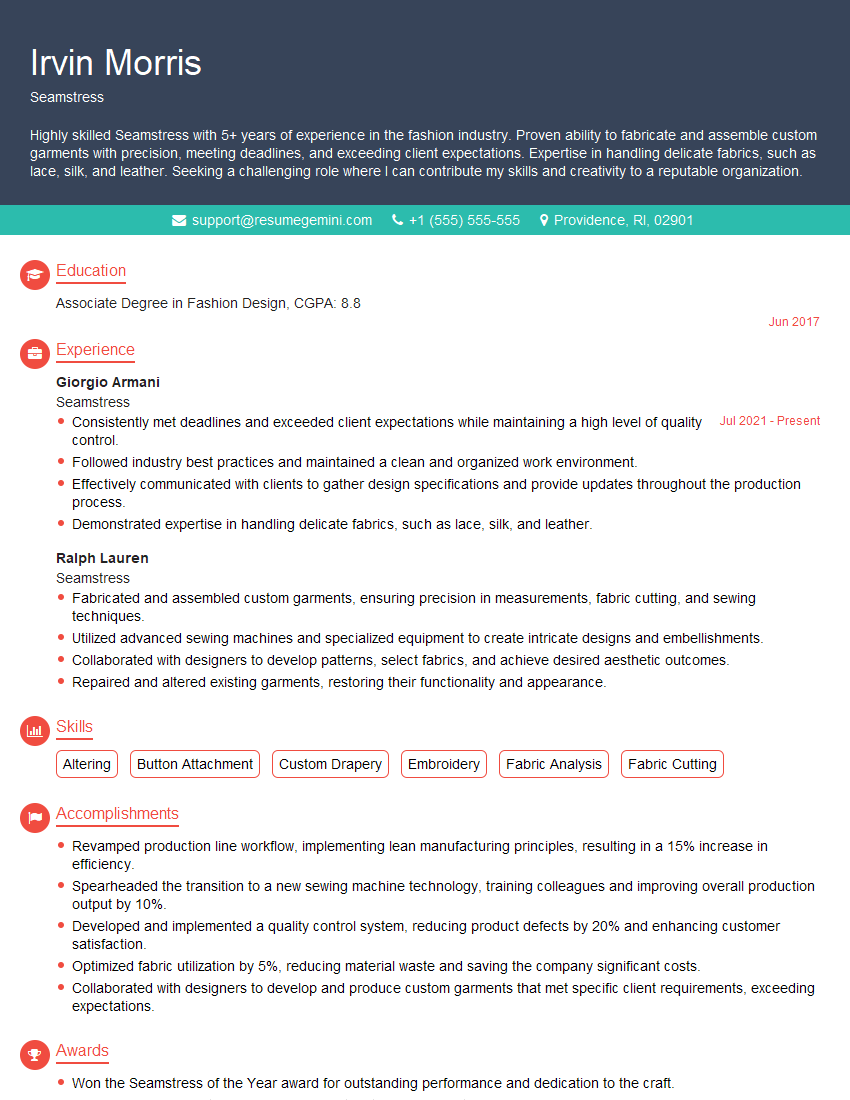
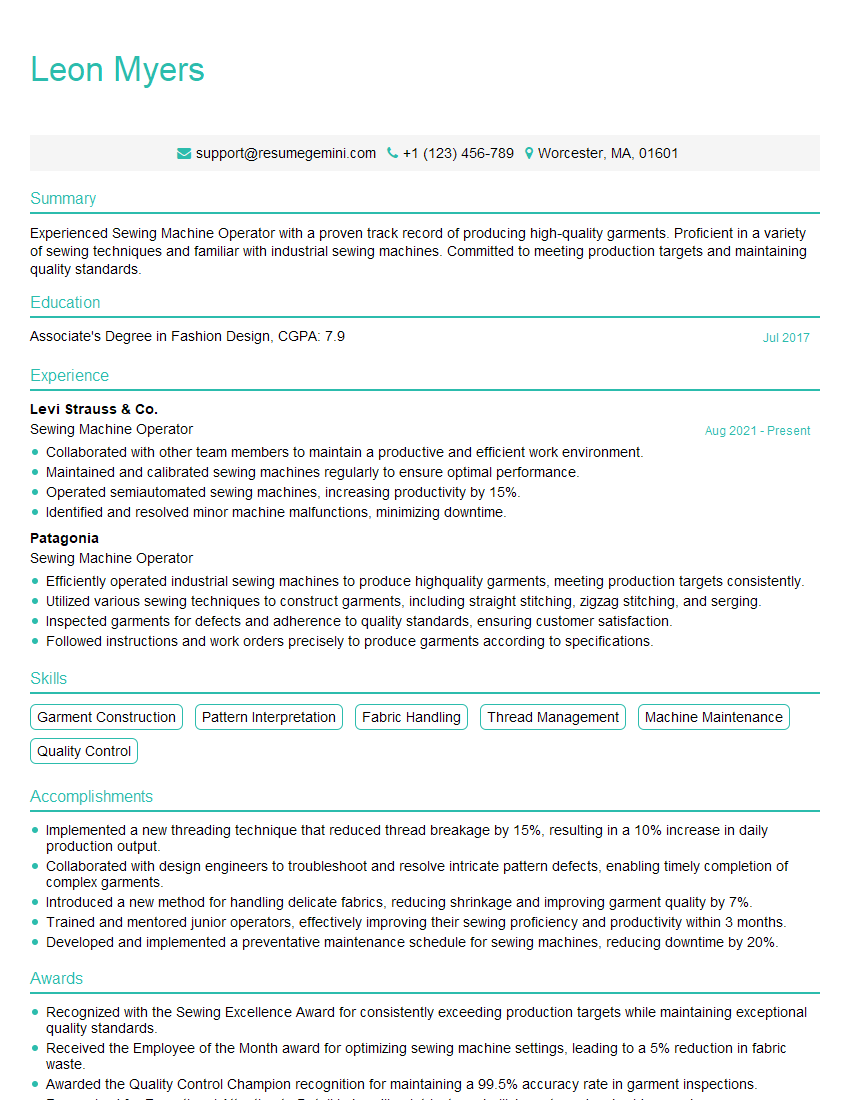
Mastering straight stitch sewing is fundamental to success in many textile and garment production roles. A strong understanding of this technique showcases your foundational skills and attention to detail, crucial for career advancement. To maximize your job prospects, create an ATS-friendly resume that highlights your skills and experience effectively. ResumeGemini is a trusted resource to help you build a professional and impactful resume that gets noticed. Examples of resumes tailored to Straight Stitch Sewing expertise are available to guide you. Take the next step towards your dream career today!
Explore more articles
Users Rating of Our Blogs
Share Your Experience
We value your feedback! Please rate our content and share your thoughts (optional).
What Readers Say About Our Blog
Very informative content, great job.
good