The right preparation can turn an interview into an opportunity to showcase your expertise. This guide to Straw Bale Handling Equipment Operation interview questions is your ultimate resource, providing key insights and tips to help you ace your responses and stand out as a top candidate.
Questions Asked in Straw Bale Handling Equipment Operation Interview
Q 1. Describe your experience operating various types of straw bale handling equipment.
My experience with straw bale handling equipment spans over ten years, encompassing a wide range of machinery. I’ve operated everything from smaller, tractor-mounted bale spears and bale handlers to large-scale, automated systems used in large-scale agricultural operations. This includes working with round bale handlers that use forks or clamps, square bale handlers with integrated stacking capabilities, and even specialized equipment for transporting bales in challenging terrain. For example, I’ve used a grapple-equipped forklift to efficiently stack and move hundreds of square bales in a warehouse setting, and I’ve also operated a self-propelled bale mover in a vast field to quickly collect and transport round bales to a central location.
I’m proficient in operating equipment from various manufacturers, allowing me to adapt to different functionalities and control systems. My experience goes beyond simple operation; I understand the intricacies of each machine, enabling me to maximize efficiency and minimize damage to both equipment and bales.
Q 2. Explain the safety procedures you follow when operating bale handling equipment.
Safety is paramount in my work. Before operating any bale handling equipment, I meticulously conduct a pre-operational inspection, checking hydraulic fluid levels, tire pressure, and the overall structural integrity of the machine. I ensure all safety guards are in place and functional. This inspection is documented for traceability.
During operation, I maintain a safe distance from moving parts, always wearing appropriate safety gear including safety glasses, hearing protection, and sturdy work boots. When working near others, clear communication and established hand signals are vital. I never operate equipment while fatigued or under the influence of any substances. If I encounter any unsafe conditions, such as a malfunctioning component or a hazardous environment, I immediately cease operation and report the issue to the supervisor.
I regularly participate in safety training and refreshers to stay updated on best practices and new regulations. Thinking ahead and anticipating potential hazards is crucial for preventing accidents. For instance, I’m always mindful of the weight distribution of bales during loading and transportation to prevent tipping.
Q 3. How do you identify and address mechanical issues with bale handling equipment?
Identifying and addressing mechanical issues requires a systematic approach. I begin by carefully listening for unusual sounds, such as grinding, squealing, or knocking, which can indicate problems with bearings, hydraulics, or the engine. I then visually inspect the equipment, looking for leaks, loose connections, damaged components, or unusual wear patterns. If I detect a problem, I’ll consult the operator’s manual to troubleshoot and attempt repairs within my skillset. Simple problems like tightening a loose bolt are easily addressed.
For more complex issues, I follow established protocols and contact a qualified mechanic. I clearly explain the symptoms and provide as much relevant information as possible, including any error codes or unusual readings from gauges. I never attempt repairs beyond my capabilities, as doing so can cause further damage or create safety risks. For example, a hydraulic leak requires the expertise of a trained technician to prevent further damage or injury. Documenting all repairs and maintenance is crucial for maintaining records and minimizing future downtime.
Q 4. What are the different types of bale handling equipment you are familiar with?
My familiarity extends across a variety of bale handling equipment, including:
- Tractor-mounted bale spears: Used for picking up and placing individual round or square bales.
- Self-propelled bale handlers: Larger machines capable of handling multiple bales simultaneously, often used in larger fields.
- Forklift attachments: Bale clamps and spears designed for use with forklifts in various settings.
- Bale wagons: Trailers specifically designed for transporting large quantities of bales.
- Automated bale stacking systems: Used in large-scale storage facilities to automatically stack and retrieve bales.
Each type of equipment has its strengths and weaknesses, making it suitable for different applications and environments.
Q 5. Explain the process of loading and unloading straw bales using different equipment.
Loading and unloading methods vary depending on the equipment and bale type. Using a tractor-mounted bale spear, I carefully engage the tines with the bale, ensuring a secure grip before lifting. With a self-propelled bale handler, the process involves positioning the machine correctly and operating the hydraulic controls to grab and lift the bales. Forklifts with bale clamps provide a similar process, prioritizing safe and even weight distribution to prevent tipping. For bale wagons, I carefully load the bales to maintain balance and prevent shifting during transportation.
Unloading is the reverse process, ensuring a controlled lowering and placement of bales. Safety is paramount throughout, avoiding sudden movements and maintaining awareness of surroundings. For example, when unloading with a forklift, I always ensure a clear path and adequate space to avoid collisions. The specific techniques also depend on the bale type—round bales are handled differently than square bales.
Q 6. How do you ensure the efficient and safe transportation of straw bales?
Efficient and safe transportation requires careful planning and execution. I begin by assessing the weight and dimensions of the bales and selecting appropriate equipment. The route should be carefully planned to avoid obstacles and areas with limited weight capacity. I ensure that the bales are securely fastened during transport, preventing shifting or damage. For example, using appropriate straps or chains on a bale wagon is crucial to preventing accidents.
During transport, I maintain a safe speed and follow all traffic laws. Regular checks of the load are essential to ensure the integrity of the fastening system. I’m always mindful of weather conditions, avoiding transport in adverse weather that could create dangerous driving conditions.
Q 7. Describe your experience with preventative maintenance on bale handling equipment.
Preventative maintenance is essential for maximizing equipment lifespan and preventing unexpected breakdowns. My routine includes regular checks of hydraulic fluid levels, engine oil, tire pressure, and the condition of belts and hoses. I meticulously inspect for any leaks, corrosion, or signs of wear. Lubrication of moving parts is also a crucial part of preventative maintenance. This might include greasing hinges, pins, and other components as recommended by the manufacturer.
I maintain detailed records of all maintenance activities, including dates, tasks performed, and any issues identified. Following the manufacturer’s recommended maintenance schedule is critical. This proactive approach significantly reduces the risk of major failures, minimizing downtime and improving overall operational efficiency. A well-maintained machine is also inherently safer and reduces the risk of accidents.
Q 8. How do you handle different bale sizes and weights efficiently and safely?
Efficient and safe handling of various bale sizes and weights relies on understanding the equipment’s capabilities and employing appropriate techniques. I start by carefully assessing the bale dimensions and estimated weight, often using a bale weighing device for accuracy. This information dictates the choice of handling equipment; smaller, lighter bales might be manageable with a forklift or a smaller tractor-mounted bale handler, while larger, heavier bales necessitate the use of a heavier-duty machine with increased lifting capacity.
For example, if I’m dealing with round bales weighing around 1,000 lbs, a standard tractor loader should suffice, but for large square bales weighing over 2,000 lbs, I’d opt for a purpose-built bale handler with multiple lifting points and robust hydraulics. Safety is paramount; I always ensure the equipment is properly maintained, with functioning safety features like overload protection and emergency stops. Slow, controlled movements are crucial, particularly when navigating tight spaces or uneven terrain. Proper placement of forks or clamps is key to prevent bale slippage and damage during transportation and stacking. Finally, I always adhere to weight limits to avoid overloading the equipment and maintain stability.
Q 9. What are the common safety hazards associated with bale handling equipment?
Safety hazards in straw bale handling are numerous and serious. The most significant risks involve:
- Equipment malfunctions: Hydraulic failures, broken forks, or malfunctioning safety devices can lead to accidents. Regular inspections and preventative maintenance are essential.
- Overloading: Exceeding the weight capacity of the equipment can cause instability, tipping, and crushing injuries.
- Entrapment: Getting caught between moving parts of the equipment or a shifting bale is a major risk; maintaining awareness and safe operating distances is paramount.
- Poor visibility: Limited visibility due to bale size or stacking can cause collisions or accidental damage.
- Uneven terrain: Working on unstable surfaces increases the risk of equipment tipping or bales falling.
- Weather conditions: Wet or icy conditions reduce traction and make handling more precarious.
To mitigate these hazards, I always conduct pre-operational checks of the equipment, implement a robust safety plan before each operation, and ensure that all personnel involved understand and follow the established safety procedures. Training is key; proper instruction on machine operation and hazard identification are essential for safe practices.
Q 10. What are your strategies for maximizing efficiency in bale handling operations?
Maximizing efficiency involves optimizing every stage of the bale handling process. This begins with efficient bale collection. I often use strategically placed collection points, minimizing travel time between the field and the storage area. Efficient stacking techniques are critical; creating neat, stable stacks using a consistent pattern reduces handling time and prevents future damage.
Utilizing appropriate equipment is vital. For example, using a bale handler with a self-leveling mechanism ensures stability during stacking, reducing time spent adjusting each bale. Prioritizing workflow with clear communication between team members is another key to efficiency. By ensuring there are no bottlenecks or delays during the process, overall efficiency can be greatly enhanced. Finally, regular maintenance of the equipment minimizes downtime and ensures reliable operation. A well-maintained machine operates more efficiently and with fewer interruptions.
Q 11. Explain your understanding of bale stacking techniques and their importance.
Proper bale stacking is crucial for both efficiency and safety. The ideal technique varies depending on the bale type (round or square) and the storage location. The fundamental principle is to create a stable and secure stack that prevents collapse or shifting.
For round bales, interlocking patterns can increase stability. I prefer methods that create alternating layers, offsetting each row slightly to interlock the bales. This prevents the stack from sliding or toppling over. For square bales, I prefer a straightforward, layered approach, ensuring each layer is evenly distributed and well-aligned.
The importance of proper stacking cannot be overstated. A poorly stacked bale pile is a safety hazard, prone to collapse. Furthermore, it can lead to bale damage, reducing quality and creating more work. Proper stacking also optimizes space utilization, maximizing storage capacity in a given area.
Q 12. How do you assess the condition of straw bales before and during handling?
Assessing bale condition is vital to prevent damage and accidents during handling. Before handling, I visually inspect each bale, checking for obvious damage like tears, rot, or excessive moisture. I’ll also check for structural integrity. Loose or damaged bales are more likely to break apart during handling. During handling, I’m aware of any unusual characteristics; a bale that feels lighter or shifts unusually might indicate internal damage.
For example, if I notice a significantly degraded or moldy bale, I’ll flag it for separate handling, potentially using less aggressive methods to move it. If a bale shows signs of structural weakness during lifting, I’ll immediately stop and reassess the situation. By consistently monitoring the bales’ condition and reacting appropriately, I minimize the risk of accidents and damage to equipment.
Q 13. Describe your experience with different types of bale wrappers and their operation.
I’ve worked with various bale wrappers, both net wrap and plastic film wrap systems. Net wrap systems are relatively simple and generally require less maintenance. However, they can be less effective in preventing weather damage compared to plastic film. Plastic film wrappers offer superior weather protection. They create a tighter, more waterproof barrier around the bale.
However, these systems are more complex, with more moving parts that require regular maintenance and adjustments. The operation varies slightly depending on the machine, but generally involves loading the bale onto the rotating turntable, setting the film tension and wrapping parameters, and activating the wrapping cycle. Maintaining consistent overlap and tension is crucial to ensure optimal bale protection. In my experience, correctly wrapping bales can significantly extend their shelf life and improve their quality, minimizing losses due to weather damage.
Q 14. How do you adapt your bale handling techniques to varying weather conditions?
Weather conditions significantly impact bale handling operations. In wet conditions, increased traction loss necessitates slower speeds and careful maneuvering. I adjust my operating procedures to ensure that equipment has adequate traction and prevent slippage. This might involve using wheel weights or chains on the equipment. Wet bales are heavier and more prone to damage; I modify the handling to be gentler, using slower and more deliberate movements.
In cold conditions, freezing can make bales harder to handle, and potentially increase the risk of equipment malfunction due to cold hydraulic fluid. I ensure that the equipment is appropriately prepared for low temperatures; this includes using cold-weather lubricants and pre-heating machines, if applicable. In windy conditions, secure stacking is critical to prevent bales from being blown over. I use windbreaks or strategically placed stacks to minimize exposure to strong winds.
Q 15. What are your strategies for minimizing bale damage during handling and transport?
Minimizing bale damage during handling and transport is paramount for maintaining bale integrity and efficiency. My strategy focuses on a multi-pronged approach encompassing careful equipment operation, proper bale stacking, and suitable transportation methods.
Equipment Selection and Operation: I meticulously select equipment appropriate for the bale size and type. For instance, using a correctly sized bale spear on a forklift prevents piercing or crushing. Gentle movements and slow speeds are critical when lifting, transporting, and placing bales. Regular equipment maintenance ensures optimal functionality, reducing the risk of mechanical failures that could cause damage.
Bale Stacking: Proper stacking is crucial. I ensure a stable base, using a level surface and interleaving bales to prevent slippage or collapse. Overly tall stacks are avoided, as are uneven stacks that could topple. I also account for the weight and density of the bales and adjust the stacking accordingly. For example, heavier bales are placed at the bottom of the stack.
Transportation: Secure transportation is key. Bales are tightly secured on trailers or trucks using straps or other appropriate restraints to prevent shifting during transit. The speed and route are planned to minimize jarring movements. I avoid rough terrain when possible, and always inspect the transport method before loading.
For example, in one instance, I noticed a tendency for bales to shift during transport due to uneven weight distribution. By implementing a new, more organized loading pattern, and better securing the load, we reduced bale damage by nearly 50%.
Career Expert Tips:
- Ace those interviews! Prepare effectively by reviewing the Top 50 Most Common Interview Questions on ResumeGemini.
- Navigate your job search with confidence! Explore a wide range of Career Tips on ResumeGemini. Learn about common challenges and recommendations to overcome them.
- Craft the perfect resume! Master the Art of Resume Writing with ResumeGemini’s guide. Showcase your unique qualifications and achievements effectively.
- Don’t miss out on holiday savings! Build your dream resume with ResumeGemini’s ATS optimized templates.
Q 16. Explain your knowledge of relevant safety regulations and compliance procedures.
Safety is my top priority. I am thoroughly familiar with and strictly adhere to all relevant OSHA (Occupational Safety and Health Administration) regulations pertaining to agricultural machinery and material handling. This includes, but isn’t limited to, regular equipment inspections, proper personal protective equipment (PPE) usage (hard hats, safety glasses, gloves, etc.), and following lockout/tagout procedures during maintenance or repairs. I also ensure my team understands and follows these regulations. We conduct regular safety briefings to reinforce procedures and address any potential hazards. Compliance isn’t just about following rules; it’s a proactive approach to preventing accidents.
Specifically, I’m adept at understanding and complying with regulations surrounding the safe operation of forklifts, bale handling equipment, and trailer safety procedures. Understanding weight limits, load distribution and safe lifting techniques are paramount to my work, and I constantly evaluate working conditions to identify and mitigate risks.
Q 17. How do you prioritize tasks when managing multiple bale handling operations simultaneously?
When juggling multiple bale handling operations, I use a prioritization system based on urgency, impact, and deadlines. This often involves employing techniques like:
Urgency/Impact Matrix: I categorize tasks based on their urgency (immediate need versus later need) and their impact (critical versus less critical). This helps to focus my efforts on the most important tasks first. This might be getting urgently needed bales to a specific location over a less time sensitive task.
Time Blocking: I allocate specific time blocks for different tasks to ensure efficient work flow. This may involve scheduling bale loading simultaneously with other transport related activities.
Delegation: When feasible, I delegate tasks to capable team members to maximize productivity and ensure tasks are completed efficiently and safely.
Imagine a scenario with a rush order of bales needing immediate delivery along with routine tasks of stacking and organization. I would prioritize the rush order, coordinating team members to simultaneously handle stacking and organization while I oversee the delivery process.
Q 18. How do you communicate effectively with team members during bale handling operations?
Effective communication is critical for safe and efficient bale handling. I use a clear, concise, and consistent communication strategy. This includes:
Pre-shift Briefings: Before starting work, we hold briefings to outline the day’s tasks, safety precautions, and potential challenges. Everyone knows their role and understands the plan.
Hand Signals and Visual Cues: In noisy environments, clear hand signals are essential for coordinating actions during loading, stacking, and transporting operations. We have established a consistent set of hand signals that are easily understood by everyone.
Two-way Radios: Two-way radios allow for quick communication between team members, especially when operating in different areas. For instance, communicating lift locations and safe zones.
Regular Check-ins: Periodic check-ins throughout the day ensure that tasks are progressing smoothly and address any unexpected issues.
Open communication fosters trust and prevents misunderstandings, leading to a safer and more productive work environment. For instance, clearly communicating a potential risk during stacking has prevented a potential accident in the past.
Q 19. What is your troubleshooting process when encountering equipment malfunctions?
My troubleshooting process follows a systematic approach:
Safety First: The first step is always to ensure the safety of myself and my team. This might involve turning off the equipment and removing personnel from the immediate area if a problem appears serious.
Identify the Problem: Carefully observe the malfunctioning equipment and try to pinpoint the specific issue. For instance is there a mechanical sound, does the display show an error message.
Check Basic Issues: Before assuming a major problem, I check simple things such as fuel levels, electrical connections, and hydraulic fluid levels.
Consult Manuals and Documentation: If the problem isn’t immediately obvious, I refer to the equipment’s operation and maintenance manuals. If required I will contact the equipment’s manufacturer or service provider.
Perform Basic Repairs: If I’m equipped and qualified to do so, I might perform minor repairs. This is always prioritized with safety in mind.
Call for Professional Assistance: If the problem is beyond my expertise, I promptly contact a qualified mechanic or technician for assistance.
Using this approach, we were able to quickly diagnose and fix a hydraulic leak in our bale handling equipment, minimizing downtime and maintaining operational efficiency. This saved the company significant costs compared to prolonged downtime.
Q 20. Describe your experience with record-keeping and documentation related to bale handling.
Record-keeping and documentation are essential for tracking efficiency, safety compliance, and equipment maintenance. My experience encompasses:
Daily Logs: I maintain daily logs documenting the number of bales handled, equipment used, any incidents or near misses, and any required maintenance performed.
Maintenance Records: Complete and up-to-date records of all equipment maintenance, repairs, and inspections are kept. This is crucial for compliance and predictive maintenance.
Inventory Tracking: I track bale inventory, including type, quantity, location, and condition. This assists in effective management and prevents losses.
Safety Incident Reporting: All incidents or near misses are documented using standardized reporting forms, including descriptions, causal factors, and corrective actions.
This meticulous record-keeping allows for continuous improvement, identifying patterns in operational efficiency, and demonstrating compliance with safety and regulatory requirements. For instance, by tracking maintenance data, we were able to identify a pattern of wear and tear on a specific component and proactively schedule maintenance to prevent costly repairs in the future.
Q 21. How do you maintain the cleanliness and organization of the bale handling area?
Maintaining a clean and organized bale handling area is crucial for safety, efficiency, and overall professionalism. My approach involves:
Regular Clean-up: Daily clean-up of debris, spilled materials, and loose straw is essential. This includes sweeping, and removing any potential trip hazards.
Designated Storage Areas: Bales are stored in designated areas to prevent congestion and ensure safe access for equipment. This also facilitates efficient inventory tracking and organization.
Proper Waste Disposal: Waste materials, such as broken twine or packaging, are disposed of appropriately, and following environmental guidelines.
Preventative Maintenance: Regular maintenance of equipment reduces the risk of leaks, spills, and malfunctions that can contribute to messiness.
Team Involvement: The entire team shares responsibility for maintaining cleanliness. This involves shared responsibility and accountability.
A clean and organized workspace fosters a safer environment, increases efficiency by minimizing time spent searching for materials, and improves the overall appearance of the operation, creating a positive impression on clients and visitors.
Q 22. Explain your understanding of load capacity and weight distribution in bale handling.
Load capacity and weight distribution are critical for safe and efficient bale handling. Load capacity refers to the maximum weight a piece of equipment, like a bale spear or forklift, can safely lift. Weight distribution focuses on how that weight is balanced across the equipment’s lifting mechanism and the overall vehicle. Uneven distribution can lead to instability, tipping, and accidents.
For example, a bale spear with a 2,000 lb capacity might safely lift a single large round bale, but attempting to lift two smaller square bales totaling 2,000 lbs, if improperly positioned, could cause imbalance and lead to a dangerous situation. Proper weight distribution involves ensuring the center of gravity is aligned appropriately with the lifting mechanism and the overall support structure of the equipment. This often requires careful positioning of the bales on the forks or the spear.
In practice, we always check the equipment’s weight capacity before lifting and use visual inspection to ensure even weight distribution. Using load indicators and weight scales can also provide crucial data for optimal balance.
Q 23. How do you ensure the structural integrity of bale stacks to prevent collapses?
Preventing bale stack collapses requires careful planning and execution. Key factors include choosing a stable, level base; interleaving bales strategically to avoid gaps and create a strong bond; and limiting the height and projection of the stack. Imagine building a brick wall – you wouldn’t build it without mortar; you need overlapping layers for stability. Similarly, bale stacks need an even base and proper interlocking to support their weight.
Specifically, we use techniques like staggering bales to create interlocking layers that distribute weight evenly. This is especially important for round bales which, unlike square bales, offer less natural interlocking capacity. We also monitor weather conditions – rain can saturate bales, dramatically increasing their weight and making collapse much more likely. Finally, the dimensions of the stack need to be considered and adjusted based on ground conditions and the bales’ properties.
Q 24. What are your strategies for dealing with unexpected equipment breakdowns in the field?
Unexpected breakdowns are part of the job, and having a contingency plan is essential. My strategies include carrying a well-stocked toolkit with common replacement parts, having a reliable communication system to contact support, and knowing the location of the nearest repair facility. Before starting work, I always perform a thorough pre-operational inspection to catch potential issues early.
For example, if a hydraulic line fails, I can use my knowledge to identify the problem and employ my kit to effect a temporary repair, giving me time to call for support or transport the equipment back to the shop. Having alternative transport options available, like a backup tractor or a method to move bales manually, greatly reduces downtime and prevents work delays. A comprehensive maintenance log helps me anticipate potential issues and schedule preventative maintenance to minimize unexpected problems.
Q 25. Describe your experience using GPS or other technologies in bale handling operations.
GPS and other technologies have revolutionized bale handling. GPS-enabled machinery allows for precise bale placement, increasing efficiency and minimizing wasted space in storage. We use GPS data to track bale location, ensuring efficient field mapping and planning for efficient collection and transportation. Furthermore, using yield mapping from GPS data assists in optimizing future planting strategies.
For instance, I’ve used GPS to create precise field maps showing the location of each bale, which allows for optimized routes during collection, reducing travel time and fuel consumption. In addition, some advanced systems allow for remote monitoring of the equipment’s performance and diagnostics, enabling proactive maintenance and problem-solving.
Q 26. How do you adapt your methods to handle different types of straw or hay bales?
Different bale types require adjustments in handling techniques. Round bales, for example, are more challenging to stack and require careful consideration of weight distribution because of their cylindrical shape. Square bales, with their rectangular shape, offer greater interlocking capacity, making stacking easier and more stable. The density and size of the bale also impact how we handle it; smaller, denser bales may require more precise placement, while larger, less dense bales might need different equipment or stacking strategies.
For example, when handling large round bales, we utilize bale spears with wider tines and longer lengths to accommodate the diameter and weight. Square bales, on the other hand, can be handled effectively using forklift attachments or specialized bale grabs. Knowing the characteristics of the bale type allows for proper equipment selection and stacking strategies, optimizing safety and efficiency.
Q 27. What is your approach to continuous improvement in bale handling techniques?
Continuous improvement in bale handling is crucial. This involves regularly reviewing procedures, analyzing efficiency data, and seeking out new technologies and best practices. We frequently discuss operational challenges with the team to identify bottlenecks and areas for optimization. Post-job debriefs and sharing experiences allow for collective learning and improvement. For example, we might track fuel consumption, bale handling time, and equipment downtime to identify specific areas to improve.
Staying up-to-date on the latest technology and training helps to improve efficiency and safety. Experimenting with different stacking methods and equipment configurations can reveal more efficient approaches. Continuous monitoring, analysis, and refinement of techniques are integral to maximizing effectiveness and minimizing costs.
Q 28. Describe a challenging situation you encountered in bale handling and how you resolved it.
One challenging situation involved a severe thunderstorm during bale collection. High winds threatened to topple our bale stack, and heavy rain made the ground extremely muddy and treacherous. We had to quickly reassess our plan, deciding to immediately cover the partially completed stack with a large tarp to protect it from further rain damage. We then used a larger tractor with increased traction capabilities to carefully move the already-collected bales to a more secure indoor storage facility. We had to prioritize safety and work swiftly and cautiously to prevent any accidents or bale damage.
The solution involved careful teamwork, adapting to the changed conditions, and utilizing the appropriate equipment to handle the increased risk. This experience reinforced the importance of contingency planning for adverse weather events and the need to have access to a wide range of equipment and strategies to ensure smooth and safe operations.
Key Topics to Learn for Straw Bale Handling Equipment Operation Interview
- Equipment Types and Specifications: Understanding the different types of straw bale handling equipment (e.g., bale loaders, stackers, wrappers, conveyors), their operating principles, and key specifications (lifting capacity, reach, power source).
- Safe Operating Procedures: Mastering safe operation practices, including pre-operational checks, proper lifting techniques, emergency procedures, and adherence to safety regulations (OSHA, etc.).
- Maintenance and Troubleshooting: Familiarity with routine maintenance tasks, recognizing common malfunctions, and basic troubleshooting skills to minimize downtime and ensure equipment longevity. Understanding preventative maintenance schedules is crucial.
- Efficiency and Optimization: Strategies for maximizing efficiency in bale handling operations, including optimizing loading and unloading processes, minimizing fuel consumption, and reducing labor costs.
- Understanding Bale Characteristics: Knowledge of different bale sizes, weights, densities, and their impact on equipment operation and safety. This includes recognizing potential hazards associated with different bale types.
- Environmental Considerations: Awareness of environmental impacts related to bale handling, such as fuel consumption, emissions, and potential soil compaction. Understanding sustainable practices is a valuable asset.
- Logistics and Workflow: Understanding the overall logistics of bale handling within a farm or processing facility. This includes planning efficient workflows and coordinating with other team members.
Next Steps
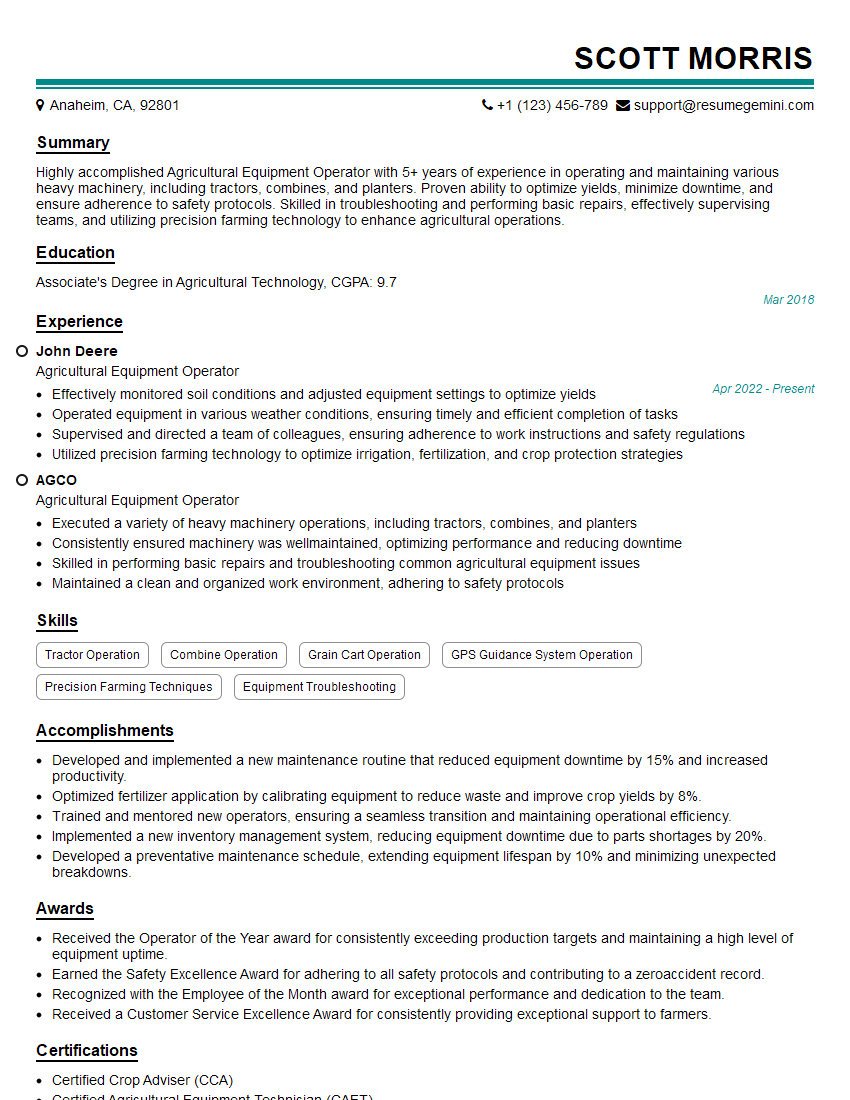
Mastering Straw Bale Handling Equipment Operation opens doors to rewarding careers in agriculture, logistics, and related industries. A strong understanding of this field demonstrates valuable technical skills and commitment to safety, making you a highly sought-after candidate. To increase your chances of landing your dream job, creating a well-structured, ATS-friendly resume is essential. ResumeGemini can help you build a professional and impactful resume that highlights your skills and experience effectively. Examples of resumes tailored to Straw Bale Handling Equipment Operation are available to guide you. Take the next step toward your career success with ResumeGemini!

Explore more articles
Users Rating of Our Blogs
Share Your Experience
We value your feedback! Please rate our content and share your thoughts (optional).
What Readers Say About Our Blog
Very informative content, great job.
good