Unlock your full potential by mastering the most common Strength and Power Development interview questions. This blog offers a deep dive into the critical topics, ensuring you’re not only prepared to answer but to excel. With these insights, you’ll approach your interview with clarity and confidence.
Questions Asked in Strength and Power Development Interview
Q 1. Explain the difference between strength and power.
Strength and power, while related, are distinct concepts in exercise physiology. Strength refers to the maximal force a muscle or muscle group can generate in a single effort. Think of it as the capacity to lift the heaviest weight possible. Power, on the other hand, is the rate at which work is done; it’s the combination of force and speed. It’s about how quickly you can move that heavy weight.
Imagine two weightlifters: one can lift a very heavy weight slowly, demonstrating high strength. Another can lift a lighter weight very quickly, showcasing greater power. A powerlifter focuses on maximal strength, while an Olympic weightlifter prioritizes power to excel in explosive lifts like the clean and jerk.
Q 2. Describe the SAID principle and its application in strength training.
The SAID principle, or Specific Adaptation to Imposed Demands, is a cornerstone of effective training. It states that the body adapts specifically to the type of training it’s subjected to. If you train for endurance, you’ll get better at endurance; if you train for strength, you’ll get stronger. This means that your training program needs to be tailored to your specific goals.
In strength training, this implies that choosing exercises, rep ranges, and training intensities directly impact the adaptations you achieve. For example, if you want to increase your bench press strength, you need to include bench pressing in your program, using progressively heavier weights and focusing on the concentric (lifting) phase. Training with lighter weights and high repetitions would primarily enhance muscular endurance, not strength.
Q 3. What are the different types of muscle contractions and how do they relate to strength and power development?
There are three main types of muscle contractions relevant to strength and power development:
- Isometric: Muscle tension increases, but muscle length remains the same. Think of holding a plank or a static wall sit. While this builds strength, it contributes less to power development due to the lack of movement.
- Concentric: Muscle shortens as it produces force. This is the lifting phase of a weightlifting repetition. Concentric contractions are crucial for both strength and power, contributing significantly to the explosive aspect of power development.
- Eccentric: Muscle lengthens while producing force. This is the lowering phase of a weightlifting repetition. Eccentric training is particularly effective for building strength as it engages a higher number of motor units and contributes to hypertrophy (muscle growth), indirectly enhancing power.
Effective strength and power programs integrate all three types. Eccentric training is often incorporated to enhance strength gains, while concentric training, especially with fast speeds of movement, is crucial for power development.
Q 4. Explain the concept of progressive overload and its importance.
Progressive overload is the gradual increase in the demands placed upon the body during training. This is essential for continued improvement because the body adapts to stress; if the stress remains constant, adaptations plateau. To keep pushing boundaries, you must continuously increase the load (weight), repetitions, sets, or intensity.
Examples of progressive overload include adding weight to the bar, increasing the number of repetitions or sets, reducing rest periods between sets, or incorporating more challenging variations of an exercise. The rate of progressive overload should be carefully managed to avoid overtraining and injury. Listening to your body and adjusting the program accordingly is vital.
Q 5. What are the key adaptations to resistance training?
Resistance training elicits several key adaptations in the body:
- Increased muscle fiber size (hypertrophy): This leads to greater strength and power potential.
- Increased muscle fiber recruitment: The body learns to activate more muscle fibers during contractions, leading to greater force production.
- Enhanced neuromuscular efficiency: Improved coordination between the nervous system and muscles, resulting in more effective force transmission.
- Increased bone density: Weight-bearing exercises strengthen bones, reducing the risk of osteoporosis.
- Increased tendon and ligament strength: This improves joint stability and reduces the risk of injury.
- Metabolic adaptations: Improved glucose metabolism and insulin sensitivity.
These adaptations work synergistically to enhance both strength and power. The extent and nature of these adaptations depend on the training program’s characteristics (e.g., volume, intensity, exercise selection).
Q 6. Discuss the importance of periodization in strength and power programs.
Periodization is a systematic approach to strength and power training that involves manipulating training variables (volume, intensity, frequency) over time to optimize performance and minimize overtraining. It’s akin to building a house – you don’t build the entire structure at once; you work on different phases systematically.
The importance of periodization lies in its ability to strategically schedule periods of high-intensity training with periods of lower intensity, allowing for rest, recovery, and adaptation. This cyclical approach maximizes performance gains by avoiding plateaus and minimizing injury risk. Without periodization, athletes risk overtraining and burnout, negating their training efforts.
Q 7. Outline the phases of a typical strength and power training program.
A typical strength and power program often involves several phases:
- Preparatory Phase (off-season): Focuses on building a base level of fitness through high volume and moderate intensity training. This phase lays the groundwork for the subsequent phases.
- Hypertrophy Phase (pre-season): Emphasizes muscle growth through higher training volume and moderate intensity. This phase aims to increase muscle mass to support strength and power gains.
- Strength Phase (in-season): Prioritizes strength development through lower volume and high-intensity training. Heavier weights and lower repetitions are the focus.
- Power Phase (competition phase): Focuses on developing power by incorporating plyometrics, Olympic lifts, and other explosive exercises. Volume is moderate, and intensity is high.
- Active Recovery Phase (post-season): Low intensity, low volume training to allow for complete recovery and prevent injury.
The specific duration and characteristics of each phase are tailored to the individual’s needs and goals, along with the training cycle (e.g., yearly, quarterly).
Q 8. What are the different methods for assessing strength and power?
Assessing strength and power involves a multifaceted approach, utilizing both direct and indirect methods. Direct methods measure the force produced, while indirect methods assess performance-based outcomes related to strength and power output.
- Direct Methods: These involve using specialized equipment to quantify force production. Examples include:
- 1-Rep Max (1RM): This classic method measures the maximum weight an individual can lift for a single repetition. It’s a gold standard for assessing maximal strength but carries a risk of injury if not performed correctly.
- Isometric Strength Testing: This involves measuring force production while maintaining a static position (e.g., handgrip dynamometry). It’s useful for assessing strength in specific muscle groups without the need for movement.
- Isokinetic Dynamometry: This sophisticated method uses specialized equipment to measure force production at a constant speed of movement, providing detailed information about muscle performance throughout the range of motion.
- Indirect Methods: These assess strength and power through performance-based tests. Examples include:
- Vertical Jump: Measures explosive leg power.
- Broad Jump: Measures explosive leg power and horizontal force production.
- Medicine Ball Throw: Assesses upper body power.
- Sprint Tests (e.g., 40-yard dash): Indicates the ability to rapidly accelerate and produce power over short distances.
The choice of method depends on the specific goals of the assessment, the available equipment, and the characteristics of the individual being tested.
Q 9. Explain the role of plyometrics in power development.
Plyometrics plays a crucial role in power development by focusing on the stretch-shortening cycle (SSC). The SSC is a neuromuscular phenomenon where a pre-stretch of a muscle immediately before a concentric contraction results in a more powerful subsequent contraction. Think of a jump – the initial lowering of the body (eccentric phase) pre-stretches the muscles, storing elastic energy, which is then released during the upward jump (concentric phase).
Plyometric exercises, like box jumps, depth jumps, and medicine ball throws, exploit this SSC to enhance power output. They train the neuromuscular system to recruit more muscle fibers quickly and efficiently, thus improving explosive strength and power. Plyometrics should be incorporated into training programs progressively, starting with low-impact exercises and gradually increasing intensity and complexity to minimize injury risk.
For example, a basketball player might incorporate plyometric exercises like jump squats and lateral bounds to improve their vertical jump and agility on the court. A sprinter could use plyometrics such as bound exercises and hurdle jumps to develop explosive power for acceleration.
Q 10. Describe the biomechanics of the squat, bench press, and deadlift.
Understanding the biomechanics of fundamental lifts is vital for maximizing effectiveness and minimizing injury. Let’s explore the squat, bench press, and deadlift:
- Squat: The squat involves a multi-joint movement primarily targeting the quadriceps, hamstrings, and gluteus maximus. Proper biomechanics include maintaining a neutral spine, keeping the chest up, and squatting to a depth where the hips are below the knees. Excessive forward lean or rounding of the back can lead to injury.
- Bench Press: This exercise focuses on the pectoralis major, triceps brachii, and anterior deltoids. Key biomechanical considerations are maintaining a stable base, keeping the elbows tucked, and lowering the bar to the chest with control. Flared elbows or arching the back can increase the risk of shoulder impingement.
- Deadlift: The deadlift is a full-body movement engaging the posterior chain muscles, including the erector spinae, gluteus maximus, hamstrings, and traps. Correct technique involves maintaining a neutral spine, keeping the weight close to the body, and driving the hips and shoulders up simultaneously. Rounding the back is a significant risk factor for injury.
In each lift, proper form is paramount. An experienced coach or trainer should assess an athlete’s technique and provide individualized instruction to ensure proper movement patterns.
Q 11. How do you design a training program for a specific sport or athlete?
Designing a training program for a specific sport or athlete requires a holistic approach. It’s not a one-size-fits-all solution and should be tailored to the individual’s specific needs, goals, and limitations.
- Needs Analysis: Begin with a thorough needs analysis. This involves identifying the specific physical demands of the sport (e.g., strength, power, speed, agility, endurance). Observe the athlete’s performance during competitions or training, and consider their strengths and weaknesses.
- Goal Setting: Establish clear, measurable, achievable, relevant, and time-bound (SMART) goals. These goals should align with the demands of the sport and the athlete’s capabilities.
- Exercise Selection: Choose exercises that directly address the identified needs. Prioritize compound movements (e.g., squats, deadlifts, bench press) that train multiple muscle groups simultaneously. Incorporate isolation exercises as needed to target specific muscle groups.
- Periodization: Structure the training program using periodization, which involves systematically varying the training variables (e.g., volume, intensity, rest) over time. This cyclical approach helps prevent overtraining and optimize performance. A common periodization model is macrocycles (yearly), mesocycles (monthly), and microcycles (weekly).
- Progressive Overload: Gradually increase the training load (weight, repetitions, sets) over time to stimulate continued adaptation and improvements.
- Monitoring and Evaluation: Continuously monitor the athlete’s progress by tracking training data (e.g., weights lifted, repetitions performed, perceived exertion) and performance outcomes. Adjust the program based on these observations.
For example, a marathon runner’s program will prioritize endurance training, while a weightlifter’s program will focus on strength and power development. Regular adjustments are key to adapt to the athlete’s response and ensure continual progress.
Q 12. What are the common injuries associated with strength training and how can they be prevented?
Strength training, while incredibly beneficial, carries inherent risks. Common injuries include muscle strains, sprains, tendonitis, and fractures. Prevention focuses on proper technique, gradual progression, and attention to detail.
- Muscle Strains: These occur when muscles are overstretched or torn. Prevention involves proper warm-up, controlled movements, and avoiding excessive intensity or volume too quickly.
- Sprains: These involve injuries to ligaments. Proper technique, adequate flexibility, and controlled movements minimize the risk.
- Tendonitis: Inflammation of the tendons. Gradual progression, appropriate rest, and avoidance of repetitive stress are crucial.
- Fractures: These can occur from excessive loads or improper technique. Proper lifting technique and gradual increases in weight are essential.
Prevention Strategies:
- Proper Warm-up: Prepare the body for exercise with dynamic stretching and light cardiovascular activity.
- Correct Technique: Mastering proper lifting technique is paramount. Work with a qualified trainer to ensure correct form.
- Gradual Progression: Avoid increasing the weight or intensity too rapidly. Allow the body time to adapt.
- Adequate Rest and Recovery: Allow sufficient time for muscle repair and recovery. Incorporate rest days into the training schedule.
- Proper Nutrition and Hydration: Ensure adequate intake of nutrients to support muscle growth and recovery.
Q 13. Explain the importance of proper warm-up and cool-down routines.
Proper warm-up and cool-down routines are critical for optimizing performance and reducing injury risk. They prepare the body for exercise and aid in recovery.
- Warm-up: The warm-up should increase blood flow, elevate muscle temperature, and enhance neuromuscular coordination. It typically includes:
- General Warm-up: Light cardio, such as jogging or jumping jacks (5-10 minutes).
- Specific Warm-up: Dynamic stretching, involving movements that mimic the exercise to be performed (e.g., arm circles before bench press, leg swings before squats).
- Cool-down: The cool-down helps to gradually reduce heart rate and muscle temperature, preventing blood pooling and promoting muscle relaxation. It usually involves:
- Light Cardio: Slow jogging or walking (5-10 minutes).
- Static Stretching: Holding stretches for 15-30 seconds, focusing on the muscles worked during the workout.
Think of a warm-up as preparing your car engine before a long drive, and the cool-down as allowing the engine to cool down gradually after the journey. Both are crucial for optimal performance and longevity.
Q 14. How do you address individual differences in training needs and responses?
Individual differences in training needs and responses are significant. Factors such as genetics, training history, age, and overall health influence an individual’s response to training. Therefore, a personalized approach is vital.
Addressing Individual Differences:
- Individualized Needs Assessment: Conduct a thorough assessment to understand the individual’s strengths, weaknesses, goals, and limitations.
- Progressive Overload Tailored to the Individual: Adjust the rate of progressive overload based on the individual’s progress and response. Some individuals may progress more quickly than others.
- Monitoring and Adjustment: Closely monitor the individual’s training progress and adjust the program based on their response. This might involve adjusting the volume, intensity, or exercise selection.
- Consideration of Individual Limitations: Adapt the program to account for any injuries, limitations, or medical conditions.
- Account for Genetic Predispositions: Some individuals may be naturally predisposed to certain strengths or weaknesses. This should be considered in program design.
- Regular Communication and Feedback: Maintain open communication with the individual to address their concerns and provide feedback.
For instance, a beginner might require a slower rate of progression compared to an experienced lifter. Similarly, an athlete recovering from an injury might require a modified program to protect the injured area.
Q 15. Discuss the role of nutrition in strength and power development.
Nutrition plays a foundational role in strength and power development. Think of it as the fuel for your engine – without the right fuel, your performance suffers. It’s not just about eating enough; it’s about eating the right things at the right times.
Macronutrients are key:
- Protein: Essential for muscle repair and growth. Aim for 1.6-2.2 grams of protein per kilogram of body weight daily for strength athletes. Good sources include lean meats, poultry, fish, eggs, and legumes.
- Carbohydrates: Provide the energy for intense training sessions. Prioritize complex carbs like whole grains, fruits, and vegetables for sustained energy release. Consume adequate carbs around workouts.
- Fats: Crucial for hormone production and overall health. Include healthy fats like avocados, nuts, seeds, and olive oil in your diet.
Micronutrients are equally important: Vitamins and minerals support various metabolic processes vital for recovery and performance. A balanced diet typically provides sufficient micronutrients, but supplementation might be considered under specific circumstances and with professional guidance.
Timing is crucial. Consume a protein and carbohydrate-rich meal or snack post-workout to replenish glycogen stores and stimulate muscle protein synthesis. Pre-workout nutrition should focus on easily digestible carbohydrates for immediate energy.
Hydration is critical. Dehydration negatively impacts strength, power, and endurance. Drink plenty of water throughout the day, especially during and after training.
Career Expert Tips:
- Ace those interviews! Prepare effectively by reviewing the Top 50 Most Common Interview Questions on ResumeGemini.
- Navigate your job search with confidence! Explore a wide range of Career Tips on ResumeGemini. Learn about common challenges and recommendations to overcome them.
- Craft the perfect resume! Master the Art of Resume Writing with ResumeGemini’s guide. Showcase your unique qualifications and achievements effectively.
- Don’t miss out on holiday savings! Build your dream resume with ResumeGemini’s ATS optimized templates.
Q 16. What is the importance of recovery in strength training?
Recovery is not just about resting; it’s the period where your body adapts and gets stronger. Without proper recovery, you risk overtraining, injury, and plateaus. It’s the crucial ‘building’ phase after the ‘breaking’ phase of training.
Sleep is paramount – aim for 7-9 hours of quality sleep per night. Sleep deprivation impairs hormone function, muscle protein synthesis, and immune function, all crucial for recovery.
Nutrition plays a vital role, as previously discussed. Consuming sufficient protein, carbohydrates, and micronutrients helps repair muscle damage and replenish energy stores.
Active recovery involves light activities like walking or stretching that promote blood flow and reduce muscle soreness. It helps clear metabolic waste products.
Passive recovery includes techniques like massage, ice baths, or foam rolling, to reduce inflammation and muscle soreness.
Training periodization is essential. Incorporating planned rest days or deloading weeks allows the body to recover adequately before resuming intense training. Ignoring recovery needs frequently leads to injuries and burnout, significantly hindering progress.
Q 17. How do you monitor an athlete’s progress and adjust training accordingly?
Monitoring progress and adjusting training requires a multi-faceted approach. I use a combination of methods:
- Regular testing: This includes assessing 1RM (one-rep maximum) for major lifts, power output measurements (e.g., vertical jump height, power clean), and body composition analysis. Testing frequency depends on the training phase and athlete’s needs.
- Performance tracking: I meticulously track training loads (volume and intensity), perceived exertion, and subjective feedback from the athlete (e.g., soreness, fatigue). This helps identify potential overtraining or undertraining.
- Technical analysis: I closely observe the athlete’s movement patterns during training to identify and correct any technical flaws that might hinder progress or increase injury risk. Video recording and analysis is often incorporated.
- Regular communication: Open communication with the athlete is essential to understand their physical and mental state. This allows me to adapt the training program based on individual needs and feedback.
Adjusting training involves modifying the program based on the collected data. This may include increasing or decreasing training volume or intensity, changing exercise selection, or adjusting the rest periods. I also consider the athlete’s response to previous training cycles and make adjustments accordingly, using a data-driven, iterative approach.
For example, if an athlete consistently fails to meet their training targets, I might reduce the training volume to allow for better recovery or adjust the exercises to target specific muscle groups more effectively. Conversely, if an athlete consistently surpasses their targets, I might gradually increase the training volume or intensity to promote further progress.
Q 18. Explain the role of flexibility and mobility in strength and power development.
Flexibility and mobility are often overlooked but are crucial for optimal strength and power development. Think of it like this: a stiff engine won’t perform as well as a well-oiled, flexible one.
Flexibility refers to the range of motion around a joint. Good flexibility allows for a greater range of motion during exercises, leading to increased muscle activation and power production. Limited flexibility can restrict movement patterns, increasing the risk of injuries.
Mobility refers to the ability to actively control that range of motion. This involves not just reaching a certain position, but also maintaining control and stability throughout the entire range. Mobility is essential for efficient movement and reduces the likelihood of compensations during exercise.
Benefits of incorporating flexibility and mobility training:
- Improved performance: Enhanced range of motion translates to greater power output in movements like squats, jumps, and throws.
- Injury prevention: Increased flexibility and mobility reduce stress on joints and muscles, decreasing the risk of injuries.
- Improved posture and body awareness: Flexibility and mobility training promote proper posture and body mechanics, improving overall function and well-being.
I typically incorporate flexibility and mobility training into a program using methods like dynamic stretching before workouts, static stretching after workouts, and mobility drills focusing on specific joint ranges.
Q 19. Describe different training methodologies (e.g., linear, undulating, block periodization).
Periodization is a systematic approach to training that involves varying training variables (volume, intensity, frequency) over time to optimize performance and prevent overtraining. Here are three common methodologies:
- Linear Periodization: This involves a gradual increase in training volume and intensity over several weeks or months, culminating in a peak performance period. It’s relatively simple to implement but can be less effective for advanced athletes or those prone to overtraining.
- Undulating Periodization: This involves daily or weekly fluctuations in training variables. For instance, one day might focus on high volume, low intensity, while the next might emphasize low volume, high intensity. This approach allows for frequent stimulus changes and can improve adaptation.
- Block Periodization: This involves dividing the training year into distinct blocks of time, each focusing on different training goals (e.g., strength, power, hypertrophy). Each block has specific training characteristics. This can be very effective but requires careful planning and monitoring.
The choice of methodology depends on several factors including the athlete’s experience level, training history, and specific goals. For example, a beginner athlete may benefit from linear periodization, while an experienced athlete may benefit from undulating or block periodization.
Q 20. How do you incorporate different training modalities (e.g., bodyweight, free weights, machines) into a program?
Incorporating different training modalities—bodyweight, free weights, and machines—offers diverse stimuli and caters to various training goals. It’s not about choosing one over the others, but strategically combining them.
Bodyweight exercises are excellent for building foundational strength, improving body awareness, and enhancing mobility. They are accessible and require minimal equipment.
Free weights (barbells, dumbbells) allow for greater freedom of movement and recruit more stabilizer muscles, improving functional strength and power. They offer a more dynamic and challenging stimulus compared to machines.
Machines offer a more controlled and isolated movement, allowing for targeted muscle development and reducing the risk of injury. They are ideal for building muscle mass or rehabilitating injuries.
Example Program Integration: A well-rounded program might start with bodyweight movements to establish foundational strength and mobility, then incorporate free weight exercises for greater strength and power development, and finally, use machines to focus on specific muscle groups or achieve hypertrophy goals. The specific distribution will depend on the athlete’s needs and training goals.
For instance, a program might include bodyweight squats for mobility, followed by barbell back squats for strength, and finally leg press machine for hypertrophy.
Q 21. How would you assess an athlete’s current strength and power levels?
Assessing an athlete’s strength and power levels involves a combination of methods:
- Strength Assessment: This commonly involves testing the 1RM (one-rep max) for major compound lifts like squats, bench press, and deadlifts. This provides a measure of maximal strength.
- Power Assessment: This requires measuring power output. Common tests include vertical jump height, broad jump distance, and medicine ball throws. These assess the athlete’s ability to produce force quickly.
- Submaximal Testing: This involves performing repetitions at submaximal loads to assess strength and endurance characteristics. This approach is safer and less taxing for the athlete.
- Movement Assessment: Observe the athlete’s movement patterns during exercises to identify any technical flaws or limitations that might affect strength and power output.
- Body Composition Analysis: Assessing body fat percentage and lean muscle mass provides additional information about the athlete’s overall physical condition.
The specific tests chosen will depend on the athlete’s sport and training goals. For example, a powerlifter will have a different assessment profile than a sprinter.
It’s crucial to use standardized testing protocols and control for variables (like fatigue, warm-up) to ensure reliable and valid results. Data from multiple assessments will provide a comprehensive understanding of the athlete’s current strength and power levels, guiding the development of a tailored training program.
Q 22. What are the ethical considerations in strength and power training?
Ethical considerations in strength and power training are paramount. They center around the safety and well-being of the athlete, the avoidance of performance-enhancing substances, and maintaining professional integrity.
- Safety First: This involves proper screening for pre-existing conditions, designing programs appropriate for the athlete’s experience level and physical capabilities, and providing adequate supervision and instruction. For example, a novice lifter shouldn’t be immediately thrust into advanced weightlifting techniques without proper guidance. A thorough understanding of anatomy and biomechanics is crucial here.
- Doping Control: The use of performance-enhancing drugs (PEDs) is unethical and often illegal. As a strength and conditioning coach, it’s crucial to maintain a strong stance against their use and educate athletes on the health risks and competitive sanctions associated with them. Regular testing in competitive contexts is essential.
- Athlete Autonomy and Informed Consent: Athletes must understand the training program, its goals, and potential risks. They should be fully involved in the decision-making process and feel comfortable communicating concerns. This includes having access to the detailed program and the rationale behind it. For instance, if an athlete expresses discomfort with a particular exercise, their opinion should be carefully considered.
- Confidentiality: Maintaining the confidentiality of an athlete’s personal information, medical history, and training data is non-negotiable. Respecting their privacy builds trust and enhances the coach-athlete relationship.
In summary, ethical practice involves a commitment to the athlete’s holistic well-being, a firm rejection of PEDs, and a respect for the athlete’s autonomy. It’s a continuous process of learning, adapting, and prioritizing ethical considerations above all else.
Q 23. How do you handle athlete non-compliance with a training program?
Athlete non-compliance is a common challenge. Addressing it requires a multi-faceted approach focusing on communication, understanding the root cause, and adjusting the training plan accordingly.
- Open Communication: I initiate a conversation with the athlete to understand the reasons for non-compliance. Are they experiencing pain, feeling overwhelmed by the program, or facing external pressures? Active listening is key here.
- Identifying the Root Cause: Is the program too demanding, poorly designed, or simply not engaging? Perhaps the athlete lacks understanding of the rationale behind the exercises. Sometimes, it’s about external factors—personal issues or lack of time.
- Collaboration and Adjustment: Based on the reasons identified, I adjust the program collaboratively with the athlete. This might involve modifying the exercises, reducing volume or intensity, or adjusting the training schedule. It’s about finding a balance between achieving the training goals and accommodating the athlete’s needs and circumstances.
- Setting Realistic Goals and Expectations: I ensure that the training goals are realistic and achievable. This prevents frustration and reinforces the athlete’s belief in the process. Progress monitoring and positive reinforcement, along with celebrating milestones, enhances adherence.
- Seeking External Support: If necessary, I involve other professionals, such as sports psychologists or medical personnel, to address underlying issues affecting the athlete’s performance and compliance.
Ultimately, a supportive and collaborative approach, where the athlete feels heard and valued, is essential in overcoming non-compliance.
Q 24. Describe your experience with designing and implementing strength and conditioning programs.
I have extensive experience designing and implementing strength and conditioning programs across various sports and populations. My approach involves a thorough needs analysis, periodization planning, program design, implementation, and regular monitoring and adjustments.
- Needs Analysis: This involves a detailed assessment of the athlete’s sport-specific demands, current fitness levels, training history, and any limitations. It also incorporates injury history and other relevant health factors. For example, a sprinter will require different training than a marathon runner.
- Periodization: I utilize periodized training plans to structure training systematically across different phases (macrocycles, mesocycles, microcycles) gradually increasing the training load and specificity throughout the year. This carefully planned progression aims for peak performance during crucial competitions.
- Program Design: This involves selecting appropriate exercises, sets, repetitions, rest periods, and intensity levels based on the athlete’s needs and goals. The program integrates various training methods, such as strength training, power training, plyometrics, and conditioning, tailored to the specific demands of their sport.
- Implementation: This involves hands-on coaching, providing proper instruction on technique, monitoring progress and providing feedback, and ensuring athlete safety. Regular communication with the athlete is key during implementation.
- Monitoring and Adjustments: The program is continuously monitored for effectiveness and adjustments are made based on performance data, feedback, and any changes in the athlete’s condition. This is an iterative process. For example, if the athlete shows signs of overtraining, the training volume or intensity may be reduced.
Over the years, I have worked with athletes of varying levels—from beginners to elite competitors—achieving consistent improvements in their strength, power, and overall athletic performance. Each program is customized to the individual needs and goals of the athlete.
Q 25. Explain the differences between maximal strength, explosive strength, and power.
Maximal strength, explosive strength, and power are closely related but distinct aspects of strength and conditioning.
- Maximal Strength: This refers to the maximum force a muscle or muscle group can generate in a single maximal voluntary contraction. Think of it as the absolute heaviest weight you can lift once. It’s assessed via 1-repetition maximum (1RM) testing.
- Explosive Strength: This is the ability to exert maximal force in a short period, often characterized by high force production at high velocities. It’s not about how much weight you lift but how quickly. Examples include the power clean or snatch.
- Power: Power is the rate of doing work, combining both force and velocity. It’s defined as the product of force and velocity (Power = Force x Velocity). A higher weight lifted quickly represents higher power than a heavier weight lifted slowly.
Think of it this way: A weightlifter might have high maximal strength (able to lift a heavy weight once), but their explosive strength and power might be relatively lower. Conversely, an athlete specializing in explosive movements like a long jumper might have high explosive strength and power, but a lower maximal strength compared to the weightlifter. All three aspects contribute to overall athletic performance, but their relative importance varies based on the sport or activity.
Q 26. Discuss the role of motor unit recruitment in strength and power development.
Motor unit recruitment plays a crucial role in strength and power development. Motor units are the functional units of muscle contraction, consisting of a motor neuron and all the muscle fibers it innervates. The number of motor units recruited and the rate at which they fire determine the force and speed of muscle contraction.
- Recruitment: During strength and power training, the nervous system learns to recruit more motor units simultaneously. This leads to increased muscle activation and force production. Beginners initially recruit fewer motor units, while experienced athletes can recruit a greater number, leading to greater force production.
- Rate Coding: The nervous system also increases the rate at which motor units fire (rate coding). Higher firing rates result in a stronger and faster muscle contraction, contributing to increased power output. This is particularly important for explosive movements.
- Neuromuscular Adaptations: Strength training leads to significant adaptations in the nervous system, enhancing motor unit recruitment and rate coding. This explains why strength gains can occur initially even before significant muscle hypertrophy (muscle growth) takes place.
Essentially, strength and power training isn’t just about building bigger muscles; it’s also about improving the nervous system’s ability to efficiently recruit and coordinate motor units, leading to greater force and power output. This neural adaptation is a significant factor in early strength gains.
Q 27. How do you adapt training programs for athletes of different ages and experience levels?
Adapting training programs for athletes of different ages and experience levels is crucial for safety and effectiveness. Training needs differ significantly depending on maturity levels, training age, and physical capabilities.
- Age: Young athletes (pre-pubescent) focus on developing fundamental movement skills, coordination, and general fitness. The emphasis is on proper technique and enjoyment, avoiding high-intensity or high-volume training that could risk injury. In contrast, adult athletes can handle more intense and demanding programs. Older athletes might require modifications to accommodate age-related changes in muscle mass, bone density, and recovery capacity.
- Experience Level: Beginners require a progressive overload approach, gradually increasing the intensity and volume of training to prevent injury and promote gradual adaptation. Experienced athletes can handle greater training loads and advanced techniques. They often benefit from more complex training programs with variations and challenging exercises.
- Individual Needs: Beyond age and experience, individual differences must be considered. Factors such as injury history, genetics, and personal goals all influence the design of a safe and effective training program. A detailed needs analysis and ongoing monitoring are essential for individualized programming.
For example, a novice lifter might start with bodyweight exercises before progressing to resistance training with lighter weights and lower repetitions. An experienced lifter, on the other hand, might incorporate advanced lifting techniques, higher training volume, and periodized training approaches.
Q 28. Explain the effects of various training variables (sets, reps, rest periods) on strength and power gains.
Training variables—sets, repetitions, and rest periods—significantly influence strength and power gains. Manipulating these variables allows for targeted adaptation.
- Sets: The number of sets performed for a given exercise affects the total training volume. Higher sets generally lead to greater muscle hypertrophy (muscle growth) and can enhance strength gains. However, excessively high sets can lead to overtraining.
- Repetitions (Reps): The number of repetitions per set determines the training intensity and the type of muscle fiber recruitment. Lower reps (1-5) primarily target maximal strength, while higher reps (15-20) favor muscular endurance. Reps in the 6-12 range are optimal for both strength and hypertrophy.
- Rest Periods: The rest period between sets influences the intensity of subsequent sets. Shorter rest periods (30-60 seconds) increase metabolic stress, favoring muscular endurance and hypertrophy. Longer rest periods (2-5 minutes) are better suited for maximizing strength and power gains, allowing for full recovery before subsequent sets.
To illustrate: A program focused on maximal strength might involve 1-5 reps per set with longer rest periods (3-5 minutes). A program designed for hypertrophy would incorporate more sets (3-4) and higher repetitions (8-12) with shorter rest periods (60-90 seconds). Power training often uses moderate reps (3-5) with moderate rest periods (1-3 minutes) to optimize both force and velocity.
Key Topics to Learn for Strength and Power Development Interview
- Biomechanics of Strength and Power: Understanding force production, levers, and muscle activation patterns. Practical application: Analyzing movement techniques for optimal performance and injury prevention.
- Training Program Design: Principles of periodization, progressive overload, and variation. Practical application: Designing individualized training programs for various populations and goals (e.g., athletes, rehabilitation clients).
- Strength and Power Assessment: Methods for measuring strength and power (e.g., 1RM, jump tests, power output analysis). Practical application: Interpreting assessment data to inform training adjustments and monitor progress.
- Energy Systems and Metabolic Conditioning: Understanding the roles of ATP-PCr, glycolysis, and oxidative metabolism in strength and power performance. Practical application: Designing training programs that effectively target and improve energy system capacity.
- Neuromuscular Adaptations: Exploring the neural mechanisms underlying strength and power gains (e.g., motor unit recruitment, rate coding). Practical application: Optimizing training strategies to maximize neural adaptations.
- Recovery and Regeneration: Strategies for optimizing recovery and minimizing injury risk (e.g., nutrition, sleep, active recovery). Practical application: Integrating recovery strategies into training programs for improved performance and long-term health.
- Exercise Prescription and Programming for Specific Populations: Adapting training programs for individuals with different needs and limitations (e.g., age, injury history, health conditions). Practical application: Demonstrating an understanding of modifying exercises and tailoring programs based on individual assessments.
- Injury Prevention and Rehabilitation: Understanding common injuries related to strength and power training and strategies for prevention and rehabilitation. Practical application: Identifying risk factors, implementing corrective exercises, and designing rehabilitation programs.
Next Steps
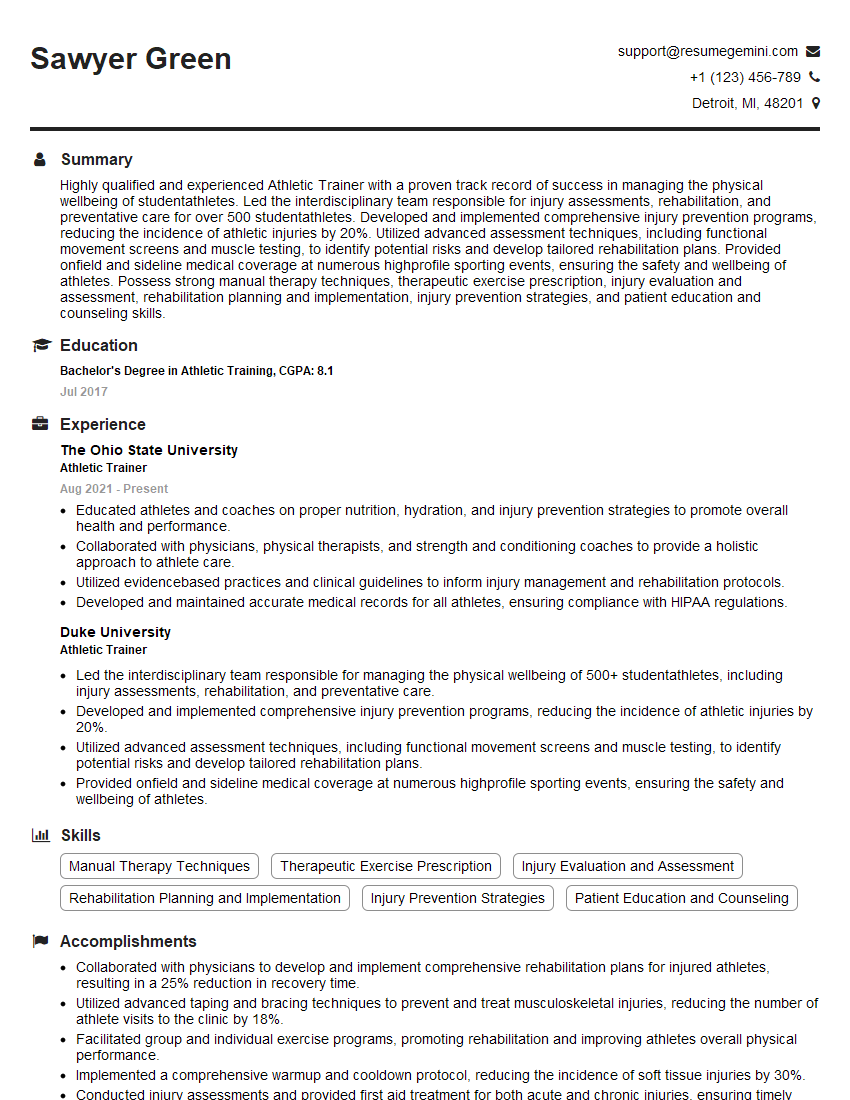
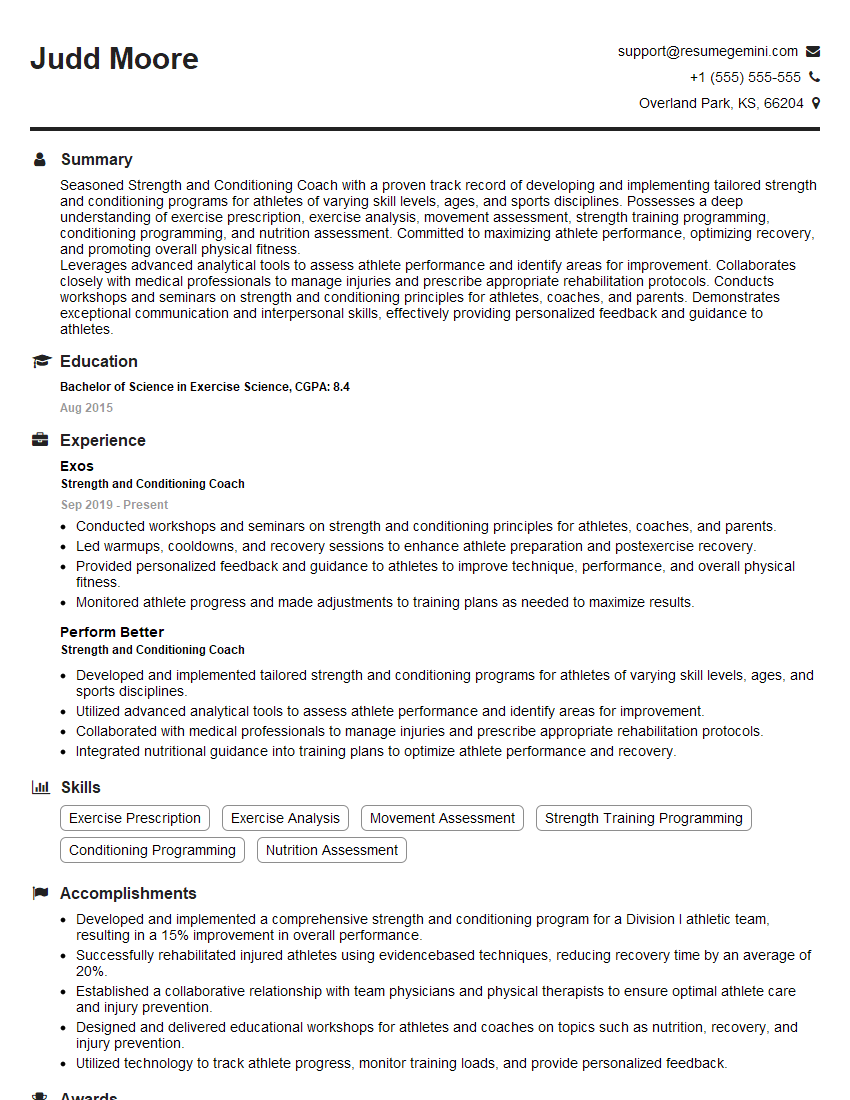
Mastering Strength and Power Development opens doors to exciting career opportunities in fitness, sports science, and rehabilitation. A strong understanding of these concepts is crucial for demonstrating expertise and securing your ideal role. To significantly boost your job prospects, creating an ATS-friendly resume is essential. ResumeGemini is a trusted resource to help you build a professional and impactful resume that highlights your skills and experience effectively. ResumeGemini provides examples of resumes tailored specifically to Strength and Power Development roles, ensuring your application stands out.


Explore more articles
Users Rating of Our Blogs
Share Your Experience
We value your feedback! Please rate our content and share your thoughts (optional).
What Readers Say About Our Blog
Very informative content, great job.
good