Are you ready to stand out in your next interview? Understanding and preparing for Strong understanding of Patent Law and Practice interview questions is a game-changer. In this blog, we’ve compiled key questions and expert advice to help you showcase your skills with confidence and precision. Let’s get started on your journey to acing the interview.
Questions Asked in Strong understanding of Patent Law and Practice Interview
Q 1. Explain the difference between a utility patent, design patent, and plant patent.
The three main types of patents in the US protect different forms of invention. Think of them as protecting different aspects of a product:
- Utility Patents: These are the most common type, protecting the functionality of an invention. This means it protects how something works, its process, or its machine. For example, a utility patent might cover a new type of engine, a software algorithm, or a novel method of manufacturing a product. They have a term of 20 years from the date of application.
- Design Patents: These protect the appearance of a product. Think of the ornamental design – the shape, configuration, or surface decoration – of an article of manufacture. For example, a design patent might cover the unique shape of a chair, the aesthetic design of a smartphone, or the pattern on a fabric. They have a term of 15 years from the date of grant.
- Plant Patents: These are quite specialized, covering the invention or discovery of a distinct and new variety of plant. This includes asexual reproduction, meaning the plant can be reproduced without sexual reproduction (like through cuttings). They also have a term of 20 years from the date of application.
In short: Utility patents are for how something works, design patents are for how something looks, and plant patents are for new plant varieties.
Q 2. Describe the requirements for patentability under 35 U.S.C. §101.
35 U.S.C. §101 sets out the basic requirements for patentability. An invention must be:
- Patentable Subject Matter: This is a broad category encompassing processes, machines, manufactures, and compositions of matter. However, abstract ideas, laws of nature, and natural phenomena are generally not patentable subject matter. The courts have struggled with defining the line between patentable subject matter and abstract ideas, particularly in the software and biotechnology fields. For example, a newly discovered gene itself may not be patentable, but a method of using that gene for medical treatment might be.
- Useful: The invention must have a practical application. It can’t be purely theoretical or without any real-world utility.
- Novel: The invention must be new and not previously known or used by others. It cannot be found in prior art (existing knowledge or inventions).
- Non-obvious: The invention must not be obvious to a person having ordinary skill in the art (PHOSITA) at the time the invention was made. This is often a complex determination and hinges on whether the invention represents a significant leap forward, rather than a simple modification of existing technology.
Meeting all four requirements is crucial for obtaining a patent. Failure to satisfy even one renders the invention unpatentable.
Q 3. What is the difference between prior art and anticipation?
Both prior art and anticipation are used to assess the novelty of an invention, but they differ in their scope and impact:
- Prior Art: This encompasses all information that existed before the filing date of a patent application. It includes patents, publications, prior uses of the invention, and other forms of public knowledge. Prior art is used to determine both novelty and non-obviousness. It’s a broad body of evidence that sets the context for assessing the inventive step.
- Anticipation: This is a more specific form of prior art. An invention is anticipated if a single prior art reference discloses every element of the claimed invention. In essence, it means the invention was already known or publicly available before the applicant’s claimed invention. Anticipation is a complete bar to patentability; if an invention is anticipated, it is not patentable.
Think of it this way: prior art is the entire library of knowledge, and anticipation is finding an exact copy of your book already on the shelf.
Q 4. Explain the concept of obviousness in patent law.
Obviousness, under 35 U.S.C. §103, means that an invention would have been obvious to a person having ordinary skill in the art (PHOSITA) at the time the invention was made. It’s a key hurdle in obtaining a patent. Simply put, if the invention is a simple modification or combination of existing technologies that a skilled person would readily have thought of, then it’s likely obvious and therefore not patentable.
The determination of obviousness involves several factors:
- The scope and content of the prior art: What technologies already existed?
- The differences between the prior art and the claimed invention: What makes the new invention different?
- The level of ordinary skill in the pertinent art: What would a typical expert in the relevant field already know?
Determining obviousness often requires considering the motivation to combine prior art references and the expectation of success in doing so. For example, combining two known technologies to create a novel device might be obvious if there is a clear reason to do so and a high likelihood of success. Conversely, a surprising and unexpected result from the combination may indicate non-obviousness.
Q 5. What are the key elements of a patent claim?
Patent claims are the most important part of a patent. They define the scope of the legal protection afforded by the patent. They are the metric by which infringement is determined. A claim is a numbered paragraph that precisely defines the invention’s boundaries. Key elements of a patent claim include:
- Preamble: This introductory phrase briefly describes the invention’s general purpose or nature. It helps to contextualize the claim but does not limit its scope.
- Transitional Phrase: Words that link the preamble to the body of the claim. Common examples include “comprising,” “consisting of,” and “consisting essentially of.” These phrases impact the claim’s scope.
- Limiting Elements (Body): These are the specific structural and functional features of the invention. Each element must be present for an accused product to infringe. These elements are usually described using technical terms specific to the field of invention.
Think of a claim as a precise legal fence defining your property. Any encroachment within the bounds of that fence constitutes infringement.
Example: A claim might read: “1. A method of making coffee comprising the steps of: (a) grinding coffee beans; (b) adding water to the coffee beans; and (c) brewing said mixture.” Each step is a limiting element.
Q 6. Describe the process of patent prosecution.
Patent prosecution is the process of applying for and obtaining a patent. It involves several key steps:
- Preparation and Filing of the Patent Application: This involves drafting a detailed application including a specification (describing the invention) and claims (defining the invention’s scope). Drawings are also usually included. A patent attorney or agent is typically used in this stage.
- Examination by the Patent Office: The patent office reviews the application to assess patentability (novelty, non-obviousness, subject matter, and utility). They may issue rejections based on prior art or other reasons.
- Response to Office Actions: The applicant responds to any rejections or objections raised by the examiner, often amending the claims or providing arguments to overcome the rejections.
- Allowance or Rejection: If the examiner is satisfied, the application is allowed and the patent is granted. If not, the application may be rejected. The applicant can appeal rejections.
- Issuance of the Patent: Once allowed, the patent is granted and published. It is then protected for a set time.
This process can be complex and lengthy, often taking several years. Strategic decision-making throughout the process, regarding which claims to pursue and how to respond to rejections, is crucial for success.
Q 7. What is a claim construction hearing, and why is it important?
A claim construction hearing is a critical stage in patent litigation. It’s a pre-trial proceeding where the judge determines the meaning and scope of the patent claims at issue. This interpretation guides the rest of the litigation. The parties present arguments and evidence regarding the proper interpretation of the claims, supported by expert testimony, dictionaries, and prior art. The judge’s decision on claim construction—known as the claim construction order—is binding on the jury (if there’s a jury trial).
Why is it so important? Because claim construction directly impacts whether the defendant’s product or process infringes the patent. A narrow claim construction might limit infringement to only very similar products, while a broad construction could cover a wider range of potentially infringing products or processes. Essentially, claim construction determines the “battlefield” on which the infringement issue will be fought.
For example, a claim for “a device for cutting apples” might be narrowly construed to cover only specific apple-cutting devices with certain features, or it might be broadly construed to cover many different apple-cutting devices. The claim construction hearing will determine which interpretation is correct.
Q 8. Explain the doctrine of equivalents.
The doctrine of equivalents is a crucial legal principle in patent law that broadens the scope of patent protection beyond the literal claims of a patent. It prevents others from circumventing a patent by making only insignificant changes to the patented invention. Think of it as a safety net for inventors; it protects the core inventive concept, even if someone tries to slightly modify it.
Essentially, if an accused product or process performs substantially the same function in substantially the same way to achieve substantially the same result as the patented invention, it can be found to infringe, even if it doesn’t literally match the claim language. This is determined through a three-part test, often referred to as the ‘function-way-result’ test.
Example: Imagine a patent for a ‘self-closing door using a spring mechanism.’ A competitor might create a door that uses a different type of spring or a slightly different placement, but still achieves the same self-closing function. Under the doctrine of equivalents, this could still be considered infringement.
However, it’s important to note that the doctrine is not limitless. The differences between the accused product and the patent claims must be insignificant. Courts carefully examine the prosecution history (the record of interactions between the patent applicant and the patent office) to avoid broadening the patent’s scope beyond what was originally intended.
Q 9. What are the different types of patent infringement?
Patent infringement broadly falls into two categories: direct and indirect.
- Direct Infringement: This occurs when someone makes, uses, sells, offers for sale, or imports a patented invention without authorization. It’s the most straightforward type of infringement. For example, manufacturing and selling a product that precisely matches the claims of a patent is direct infringement.
- Indirect Infringement: This involves contributing to the infringement of a patent without directly infringing it. There are two main types of indirect infringement:
- Inducement: Actively encouraging or inducing another to infringe a patent. For example, providing detailed instructions on how to make an infringing product.
- Contributory Infringement: Knowingly supplying a component or material that is specifically designed for use in an infringing invention. This requires the knowledge that the component will be used in an infringing manner and that the component is not suitable for substantial non-infringing use. For example, selling a crucial part that is only useful in the infringing device.
Establishing infringement involves demonstrating that the accused product or process falls within the scope of the patent claims (either literally or under the doctrine of equivalents).
Q 10. How does patent law differ internationally?
Patent law varies significantly across countries. Each country has its own patent office, its own laws, and its own procedures. This can lead to complexities for inventors seeking international protection. Some key differences include:
- Patent Term Length: The duration of patent protection varies across jurisdictions. In the US, it’s typically 20 years from the date of application, while some countries use a different system.
- Subject Matter Eligibility: What is considered patentable subject matter differs. Some countries are more restrictive on patenting software or business methods than others.
- Patentability Requirements: The requirements for novelty, non-obviousness, and utility may have nuances in their application and interpretation across jurisdictions. For example, the ‘inventive step’ in Europe has a different standard than the ‘non-obviousness’ requirement in the US.
- Application Procedures: The application process, including the required documentation and fees, differs from country to country. Some countries have a first-to-file system, while others use a first-to-invent system.
- Enforcement Mechanisms: The legal mechanisms available to enforce a patent vary across countries.
International treaties like the Patent Cooperation Treaty (PCT) aim to simplify the process of obtaining protection in multiple countries, but significant differences in national laws remain.
Q 11. Explain the concept of patent assignment.
Patent assignment is the transfer of ownership of a patent or patent application from one party (the assignor) to another (the assignee). It’s a formal legal process that typically involves a written agreement that clearly specifies the patent being assigned, the terms of the assignment (e.g., the consideration being paid, any exclusive or non-exclusive rights granted), and any other relevant conditions.
Example: A small startup company invents a new technology and secures a patent. They might decide to sell their patent to a larger company for a substantial sum of money. This sale involves a formal patent assignment, transferring all rights and responsibilities associated with the patent from the startup to the larger corporation.
Properly documenting the assignment is crucial. The assignment must be recorded with the relevant patent office to ensure that the transfer of ownership is legally recognized and protects the assignee’s rights. Failure to record the assignment can lead to problems in enforcing the patent.
Q 12. What is a provisional patent application?
A provisional patent application is a type of patent application that establishes an early filing date for a U.S. patent, giving the applicant one year to file a full, non-provisional patent application. It’s a less formal application than a non-provisional application; it doesn’t require claims (the specific description of what is being patented), detailed drawings, and a formal oath or declaration. Think of it as a placeholder that secures your place in line while you continue to develop and refine your invention.
It’s a cost-effective way to secure an early filing date, allowing inventors to test the market, gather more data, and perfect their invention before investing the significant time and expense associated with a full non-provisional application. This is particularly useful for early-stage inventions where the details might still be evolving.
Q 13. Discuss the differences between a non-provisional and a provisional patent application.
The key differences between provisional and non-provisional patent applications lie in their formality, required content, and legal effect:
- Formality: Provisional applications are much less formal. Non-provisional applications are far more rigorous and detailed.
- Content: Provisional applications only require a written description of the invention and drawings, while non-provisional applications require claims, a detailed specification, and an oath or declaration.
- Legal Effect: A provisional application only secures a filing date. It doesn’t grant any patent rights. A non-provisional application, once granted, provides enforceable patent rights.
- Filing Fee: Provisional applications typically have a lower filing fee than non-provisional applications.
- Term: A provisional application has a one-year life, after which a non-provisional application must be filed to maintain protection. A non-provisional application, once granted, has a term of 20 years from the filing date of the application.
Essentially, a provisional application is a stepping stone towards a non-provisional application, providing a safety net and time for further development before the commitment of a full application.
Q 14. What are the advantages and disadvantages of filing a patent application internationally?
Filing a patent application internationally presents both advantages and disadvantages:
- Advantages:
- Broader Protection: Securing patent protection in multiple countries protects your invention in various markets and prevents others from exploiting your innovation in those regions.
- Market Access: International patents are necessary for commercialization in other countries.
- Enhanced Licensing Opportunities: A globally protected invention can lead to more licensing opportunities and increased revenue potential.
- Improved Investment Attraction: Strong international patent portfolios can attract investors who are confident in the invention’s commercial potential.
- Disadvantages:
- High Costs: Filing internationally can be very expensive, particularly in multiple jurisdictions, encompassing filing fees, translation costs, and legal representation.
- Complex Procedures: Navigating the different patent laws and procedures in multiple countries can be extremely complex and time-consuming.
- Varied Legal Systems: The differing legal systems and enforcement mechanisms in different countries make it challenging to uniformly protect one’s intellectual property worldwide.
- Time-Consuming Process: The international patent application process can be significantly longer than a domestic application.
Whether the advantages outweigh the disadvantages depends on factors such as the nature of the invention, the target markets, the resources available, and the business strategy.
Q 15. Describe the role of claim charts in patent litigation.
Claim charts are essential tools in patent litigation, acting as visual aids that simplify complex patent claims and their relationship to the accused infringing product or process. They visually map the elements of each claim to corresponding aspects of the accused technology. This helps attorneys, judges, and juries understand the scope of patent protection and whether infringement exists.
Imagine a patent for a new type of bicycle. The claim might include elements like a ‘frame,’ ‘handlebars,’ ‘wheels,’ and a ‘unique gear system.’ A claim chart would visually show how each element of this claim maps onto the components of a competitor’s bicycle. If the competitor’s bicycle lacks the ‘unique gear system,’ the chart highlights the non-infringement of that specific claim element. This visual representation dramatically aids in understanding intricate legal arguments during trial.
In practice, claim charts are indispensable during discovery, mediation, and trial. They streamline complex technical information, allowing for more efficient communication and a clearer presentation of evidence. Sophisticated claim charts can even incorporate color-coding and hierarchical structures to represent relationships between claims and sub-claims, further enhancing their utility.
Career Expert Tips:
- Ace those interviews! Prepare effectively by reviewing the Top 50 Most Common Interview Questions on ResumeGemini.
- Navigate your job search with confidence! Explore a wide range of Career Tips on ResumeGemini. Learn about common challenges and recommendations to overcome them.
- Craft the perfect resume! Master the Art of Resume Writing with ResumeGemini’s guide. Showcase your unique qualifications and achievements effectively.
- Don’t miss out on holiday savings! Build your dream resume with ResumeGemini’s ATS optimized templates.
Q 16. Explain the concept of ‘best mode’ in patent applications.
The ‘best mode’ requirement in patent applications mandates that the applicant disclose the best way they know to practice their invention at the time of filing. This doesn’t necessarily mean the *absolute* best mode conceivable, but rather the inventor’s preferred embodiment – the method or configuration they believe to be optimal based on their knowledge and experimentation. Failure to disclose the best mode can render a patent invalid.
Think of an inventor who has developed a novel type of adhesive. They may have experimented with various formulations, discovering one that works exceptionally well under specific conditions. This preferred formulation, even if other equally good or slightly inferior ones exist, must be described in the patent application to fulfill the best mode requirement. Omitting details about this preferred formulation – perhaps a specific mixing ratio or curing temperature – could lead to patent invalidity if discovered later.
The best mode requirement aims to ensure that the public gains access to the inventor’s most effective implementation of the invention. It fosters transparency and prevents the inventor from withholding crucial information that would allow others to efficiently utilize the patented technology. The specific details required depend on the complexity of the invention; for a simple invention, a succinct description might suffice while a complex invention necessitates a more thorough explanation.
Q 17. What is the difference between a patent and a trademark?
Patents and trademarks protect different forms of intellectual property. A patent protects inventions – novel, useful, and non-obvious processes, machines, manufactures, compositions of matter, or improvements thereof. A trademark, on the other hand, protects brand identifiers like logos, names, slogans, and even sounds or colors that distinguish goods and services of one party from those of others.
Imagine a new type of smartphone. The innovative technology behind the phone’s battery life might be protected by a patent. Simultaneously, the brand name ‘PhoneX’ and the phone’s distinctive logo are protected as trademarks, preventing others from using similar branding to create customer confusion.
The key differences lie in what they protect (invention vs. brand identity) and how they protect it (exclusive rights to use and sell the invention vs. preventing consumer confusion). Patents offer exclusive rights for a limited time, while trademarks offer indefinite protection as long as they are in use and properly maintained. Furthermore, patents require a rigorous examination process for novelty and non-obviousness, while trademark registration often involves checking for conflicts with existing marks.
Q 18. What is a patent term adjustment?
Patent term adjustment (PTA) is a mechanism that modifies the length of a patent’s term to compensate for delays caused by the United States Patent and Trademark Office (USPTO) during prosecution. These delays can stem from various factors, such as lengthy examination processes, office actions requiring responses from the applicant, and appeals. PTA aims to ensure that the patent holder receives the full statutory term (generally 20 years from the earliest filing date) despite these bureaucratic delays.
For example, if the USPTO takes an unusually long time to examine a patent application, leading to a significant delay in issuance, the patent term might be extended to account for that lost time. The adjustment is calculated based on the specific delays experienced, ensuring fairness for the applicant. This process helps to protect the value of patents, as longer processing times could significantly reduce the effective market life of the invention.
PTA calculations are complex and involve precise accounting of various deadlines and actions taken by both the applicant and the USPTO. It’s a critical aspect of patent prosecution, safeguarding the inventor’s rights and ensuring a consistent term of protection regardless of procedural delays.
Q 19. What is a patent license agreement?
A patent license agreement is a contract granting a licensee the right to use, manufacture, or sell a patented invention, under specified terms and conditions. The agreement defines the scope of the license (exclusive, non-exclusive, etc.), the royalties or fees payable to the patent holder (licensor), and other critical aspects of the relationship between the licensor and licensee.
Imagine a company that owns a patent for a revolutionary engine. They might license the technology to another company, allowing them to manufacture and sell vehicles using the patented engine. The agreement would detail how much the licensee pays per vehicle produced, the geographical territories covered by the license, and any restrictions on how the technology can be used. It might also stipulate confidentiality obligations and limitations on sublicensing.
Patent license agreements are essential for technology transfer and commercialization. They provide a framework for generating revenue from inventions while ensuring that the licensor retains control over their intellectual property. Negotiating and drafting these agreements requires a thorough understanding of patent law, contract law, and business strategy. The agreement should be clear, comprehensive, and robust enough to handle various scenarios that might arise throughout the license’s duration.
Q 20. How do you determine the novelty and non-obviousness of an invention?
Determining novelty and non-obviousness is crucial for obtaining a valid patent. Novelty means the invention hasn’t been previously described or publicly available anywhere in the world before the patent application’s filing date. Non-obviousness (also known as inventiveness) means the invention wouldn’t have been readily apparent to a person of ordinary skill in the art at the time the invention was made. These are assessed using prior art, which encompasses all publicly available information related to the invention.
Let’s say someone invents a new type of self-cleaning coffee cup. To assess novelty, a thorough search is conducted through patent databases, scientific publications, and other sources to determine if a similar self-cleaning coffee cup has been previously described. If a prior art reference describes a nearly identical cup, the invention might lack novelty. Even if the design is slightly different, if the difference is minor and obvious to a person with experience in coffee cup design, the invention might lack non-obviousness.
Determining novelty and non-obviousness requires a deep understanding of the relevant technology and the art of searching for prior art. It’s often a complex and iterative process, involving analyzing numerous prior art documents and interpreting their technical content. Patent examiners at the USPTO and judges in patent litigation frequently grapple with these questions, weighing the evidence and arguments presented by both sides to reach a decision.
Q 21. Describe your experience with conducting patent searches.
My experience with conducting patent searches spans over [Number] years, encompassing a wide range of technologies and jurisdictions. I’m proficient in using various commercial and free databases such as [List Databases e.g., Google Patents, Espacenet, Westlaw, etc.], employing advanced search strategies to efficiently identify relevant prior art. My approach involves a structured methodology including defining search terms, selecting appropriate databases, and iteratively refining the search strategy based on initial results.
A recent project involved searching for prior art related to a novel medical device. This required a multi-faceted approach: initial keyword searches in several databases were followed by classification code searches and a review of cited references. I also utilized Boolean operators and wildcard characters to broaden and refine the search results as needed. The process led to the identification of several relevant patents and publications, which were subsequently analyzed to assess their relevance to the novelty and non-obviousness of the invention. This thorough process greatly aided my clients in preparing a strong patent application.
My training includes [Mention relevant training and certifications]. I am adept at not just finding documents but also critically analyzing them to determine their impact on patentability. I understand the importance of accurately interpreting search results and identifying potentially problematic prior art, ensuring that my clients receive a comprehensive and reliable assessment.
Q 22. How do you evaluate the validity of a patent?
Evaluating the validity of a patent involves a thorough assessment of several key aspects. Think of it like a detective investigating a case; you need to examine all the evidence to reach a conclusion. We primarily look at two core components: novelty and non-obviousness.
- Novelty: This examines whether the invention is new. It hasn’t been previously described or used publicly anywhere in the world before the patent application’s filing date. We meticulously search patent databases and other publications to identify any prior art – existing technologies or knowledge that anticipates the invention. For example, if someone claims a new type of widget, but a similar widget with slightly different features was disclosed in a prior publication, the novelty requirement might not be met.
- Non-Obviousness: This goes beyond novelty and asks whether the invention would have been obvious to a person having ordinary skill in the art (PHOSITA) at the time the invention was made. This is a subjective assessment, considering the differences between the invention and prior art. Suppose a PHOSITA, an expert in widgets, would have easily thought of this new design given what was already available – then it’s likely obvious and therefore not patentable. We often use legal arguments and evidence to demonstrate the unexpected results or unique features of the invention to overcome this hurdle.
- Enablement and Written Description: The patent application must adequately describe the invention and enable a skilled artisan to practice it without undue experimentation. Think of it like a recipe: a patent must be clear enough for someone to follow and recreate the invention.
- Best Mode: The applicant must disclose the best mode of carrying out the invention known to them at the time of filing. This ensures that the patent doesn’t hide the most effective way of practicing the invention.
Ultimately, a patent’s validity hinges on successfully navigating these complex legal requirements. Each case is unique, requiring a careful analysis of the specific claims, the prior art, and the applicable law.
Q 23. What is your experience with patent litigation?
I have extensive experience in patent litigation, having been involved in numerous cases across various technologies. My experience ranges from pre-litigation counseling to discovery, motion practice, and trial. I’ve handled cases involving both patent infringement and validity challenges. In one notable case, involving a dispute over a novel semiconductor design, I was able to successfully utilize expert witness testimony and a thorough analysis of the prior art to demonstrate the validity and infringement of our client’s patent. This resulted in a favorable settlement for our client. This experience has honed my skills in strategic thinking, legal research, and persuasive argumentation – essential for effective patent litigation.
I am also adept at managing the financial and strategic aspects of litigation, including budget management, case assessment, and risk assessment, a critical part of effectively representing clients in patent disputes.
Q 24. Describe your experience in drafting and prosecuting patent applications.
My experience in drafting and prosecuting patent applications spans over [Number] years and encompasses a wide range of technologies, including [List technologies, e.g., software, mechanical engineering, biotechnology]. I’m intimately familiar with the entire process, from initial client consultation and invention disclosure to claim drafting, response to office actions, and appeal.
I’ve successfully secured patents for clients in [Number] jurisdictions, demonstrating my understanding of the nuances of different patent offices’ requirements. A recent example involved securing a patent for a client’s innovative medical device. This required careful claim drafting to distinguish it from existing prior art, along with a detailed response to various objections raised by the patent examiner. We ultimately received a Notice of Allowance, demonstrating the value of my rigorous approach to patent prosecution.
Furthermore, my expertise extends to patent application strategies, helping clients navigate the complexities of global patent filing and prosecution.
Q 25. How do you manage a large patent portfolio?
Managing a large patent portfolio requires a systematic and organized approach. I use a combination of technology and process to ensure efficiency and effectiveness. Think of it like managing a large investment portfolio – you need a strategy to maximize value and minimize risk.
- Database Management: I utilize specialized patent management software to track and organize patents, their status, and associated deadlines. This includes information on licensing, litigation, and maintenance fees.
- Regular Portfolio Reviews: Periodic reviews are crucial to identify patents that are no longer strategically valuable, need renewal, or require additional enforcement. This allows for proactive decision-making to optimize the portfolio’s value.
- Prioritization: Not all patents are created equal. We prioritize those with the greatest commercial value or strategic importance, allocating resources accordingly.
- Licensing and Enforcement: I actively manage licensing agreements to generate revenue and engage in enforcement actions when necessary to protect our clients’ intellectual property.
Effective communication and collaboration with internal and external stakeholders, such as legal counsel, business units, and external licensing agents, are essential for successful portfolio management.
Q 26. Explain your understanding of the America Invents Act (AIA).
The America Invents Act (AIA) fundamentally changed the U.S. patent system, shifting from a “first-to-invent” to a “first-inventor-to-file” system. This means that the first person to file a patent application, not necessarily the first inventor, has priority.
Other key changes under the AIA include:
- Post-Grant Review (PGR): This allows for a challenge to the validity of a patent after it’s been granted.
- Inter Partes Review (IPR): This is a similar but faster process for challenging patent validity.
- Covered Business Method (CBM) patent eligibility: The AIA initially established a special review process for CBM patents, though this path has now largely been replaced by other AIA provisions.
- First-Inventor-to-File System: As mentioned, this changed the way priority was determined in patent applications.
Understanding these changes is crucial for effective patent strategy. For instance, the AIA’s emphasis on filing deadlines necessitates a more proactive approach to patent prosecution and a sharper focus on filing strategies to secure the earliest filing date possible.
Q 27. What are some common pitfalls to avoid when drafting patent applications?
Several common pitfalls can derail a patent application. Avoiding these is critical for maximizing the chances of obtaining a strong, enforceable patent.
- Insufficient Disclosure: Failing to adequately describe the invention or how it’s made prevents a PHOSITA from recreating it. Think of it like a poorly written recipe – the result is unpredictable.
- Overbroad Claims: Claiming too much can make a patent easily invalidated. Claims should be specific and accurately reflect the invention’s scope.
- Inadequate Prior Art Search: A thorough prior art search is essential to ensure novelty and non-obviousness. Overlooking relevant prior art can be fatal.
- Missing Important Information: Failing to include crucial details, such as specific embodiments or experimental data, can weaken the patent.
- Poor Claim Drafting: Ambiguous or poorly written claims can make it difficult for others to understand the invention’s boundaries.
To avoid these pitfalls, I recommend working closely with experienced patent attorneys, conducting thorough prior art searches, and meticulously documenting the invention and its development. A well-planned and thoroughly executed application significantly increases the likelihood of a successful outcome.
Q 28. Describe your experience with managing client expectations related to patent prosecution.
Managing client expectations is paramount in patent prosecution. It involves clear communication, realistic timelines, and consistent updates. I begin by setting clear expectations from the outset, explaining the complexities of the patent process and the potential outcomes. I often use analogies to make the complex legal aspects more understandable.
For example, I might compare the patent application process to building a house: each step is crucial, and unexpected delays might arise. I maintain regular communication with clients, providing timely updates on the progress of their applications. I promptly address their queries and concerns, offering clear and concise explanations of the legal complexities involved.
Transparency is key. I don’t shy away from discussing potential setbacks or challenges. Instead, I proactively strategize with clients to overcome obstacles and work toward the best possible outcome. This approach fosters trust and ensures that clients are fully informed throughout the process, ultimately enhancing satisfaction and optimizing the likelihood of a positive result.
Key Topics to Learn for a Strong Understanding of Patent Law and Practice Interview
- Patent Eligibility: Understand the criteria for patentability (e.g., novelty, non-obviousness, utility) and the different types of patents (utility, design, plant).
- Patent Prosecution: Familiarize yourself with the process of filing a patent application, interacting with patent offices (USPTO, EPO, etc.), responding to office actions, and navigating appeals.
- Patent Claim Drafting: Master the art of writing clear, concise, and enforceable patent claims that effectively protect your invention.
- Patent Searching and Analysis: Develop proficiency in searching patent databases (e.g., Google Patents, Espacenet) and analyzing prior art to assess patentability and infringement.
- Patent Litigation: Gain a foundational understanding of patent infringement litigation, including the process, key players, and common defenses.
- Licensing and Transfer of Patents: Learn about the legal aspects of licensing and transferring patent rights, including negotiation and contract drafting.
- Intellectual Property Strategy: Develop an understanding of how patent law fits into a broader IP strategy for businesses.
- Ethical Considerations in Patent Practice: Understand the ethical responsibilities of patent professionals and how to maintain integrity throughout the patent process.
- Practical Application: Think through scenarios involving patent infringement, claim construction disputes, and licensing negotiations. Practice applying your knowledge to hypothetical situations.
Next Steps
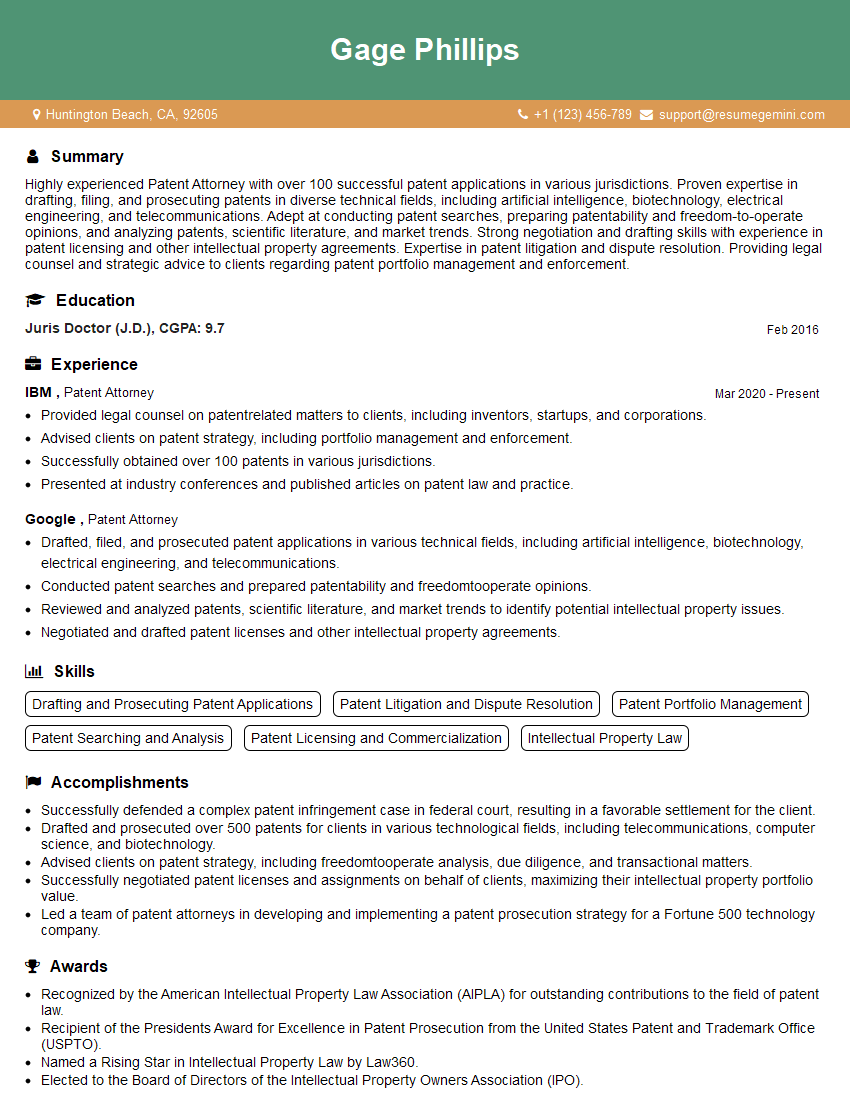
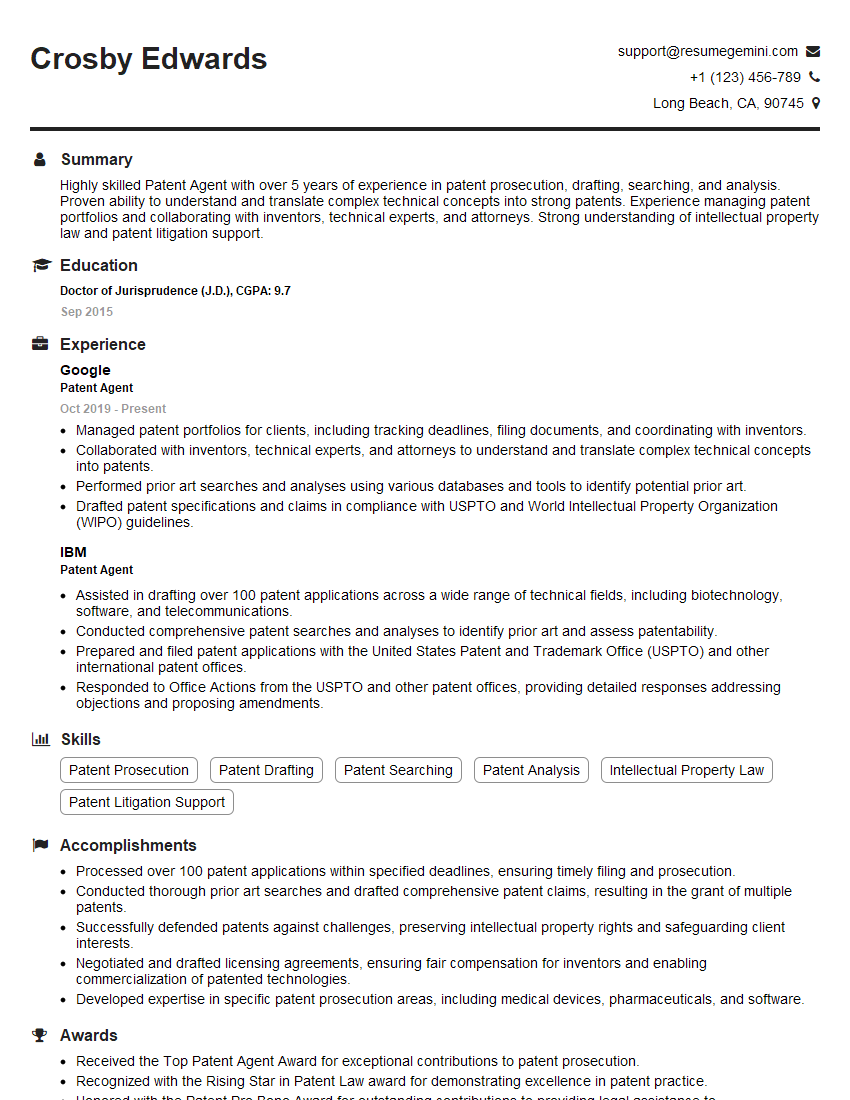
Mastering patent law and practice is crucial for career advancement in this dynamic field. A strong understanding of these concepts will significantly enhance your competitiveness in the job market. To maximize your chances of landing your dream role, it’s vital to present your skills effectively. Create an ATS-friendly resume that showcases your expertise. ResumeGemini is a trusted resource that can help you build a professional and impactful resume tailored to your experience. Examples of resumes tailored to a strong understanding of patent law and practice are available to guide you.
Explore more articles
Users Rating of Our Blogs
Share Your Experience
We value your feedback! Please rate our content and share your thoughts (optional).
What Readers Say About Our Blog
Very informative content, great job.
good