Interviews are opportunities to demonstrate your expertise, and this guide is here to help you shine. Explore the essential Structural Detailing interview questions that employers frequently ask, paired with strategies for crafting responses that set you apart from the competition.
Questions Asked in Structural Detailing Interview
Q 1. Explain the difference between a beam and a girder.
While both beams and girders are horizontal structural members that support loads, there’s a key distinction based on their size and function. Think of it like this: a beam is a smaller, more localized support, whereas a girder is a larger, main beam that often supports smaller beams.
A beam typically spans shorter distances and carries loads directly from the structure above, such as floor joists or roof purlins. For example, a beam might support a section of a floor in a residential building.
A girder, on the other hand, is a larger, stronger member that supports multiple beams or other structural elements over longer spans. Girders are usually found in larger structures, like industrial buildings or high-rise constructions, where heavier loads and longer spans are involved. A girder might support several beams carrying the weight of an entire floor in a multi-story building.
In essence, girders act as primary load-carrying members, distributing the load to columns or other supporting structures, while beams act as secondary members distributing the load to the girder.
Q 2. Describe your experience with different steel connection types.
Throughout my career, I’ve worked extensively with a wide range of steel connections, each chosen based on the specific structural requirements and design considerations of the project. My experience encompasses:
- Welded Connections: These are prevalent due to their strength and efficiency. I’m proficient in detailing various weld types, including fillet welds, groove welds, and butt welds, ensuring proper weld sizes and configurations according to the design specifications and relevant codes.
- Bolted Connections: I’m experienced with different bolt types, such as high-strength bolts (HSB) and ordinary bolts, and connection designs including shear connections, tension connections, and moment connections. Accurate detailing here involves specifying bolt sizes, grades, and patterns to ensure appropriate strength and stiffness.
- Moment Connections: These connections transfer both shear and moment forces, requiring precise detailing to guarantee proper behavior under load. My experience includes detailing both bolted and welded moment connections, paying close attention to the stiffness and strength requirements.
- Base Plates: I have a strong understanding of designing and detailing base plates, ensuring proper bearing and anchorage to the foundation. This involves careful selection of plate size and thickness, as well as consideration of anchor bolt arrangement and embedment depths.
My experience also includes designing and detailing connections that are compliant with seismic design requirements, incorporating features to ensure ductility and energy dissipation.
Q 3. How do you ensure accuracy in your structural detailing work?
Accuracy is paramount in structural detailing, as even small errors can have significant consequences. I employ several strategies to ensure accuracy:
- Thorough Review of Design Drawings: I meticulously review the architectural and structural design drawings to fully understand the project’s requirements and design intent before commencing detailing.
- Utilizing BIM Software: I leverage BIM software like Revit to create 3D models, enabling early clash detection and coordination with other disciplines. This significantly reduces errors during construction.
- Detailed Calculations and Checks: I independently verify member sizes and connection designs using relevant software and manual calculations, often utilizing structural analysis software to confirm the adequacy of design.
- Adherence to Codes and Standards: Strict adherence to relevant codes, standards, and the client’s specifications ensures compliance and structural integrity.
- Quality Control Checklists: Implementing comprehensive checklists helps me systematically review my work, ensuring all aspects of the design are addressed.
- Peer Reviews and Cross-Checking: Seeking peer reviews on my detailing further enhances accuracy by providing an extra layer of oversight and identifying potential mistakes.
This multi-layered approach significantly minimizes errors, ultimately leading to safe, efficient, and cost-effective structures.
Q 4. What are the common codes and standards you follow in structural detailing?
My work consistently adheres to a range of codes and standards, depending on the project’s location and requirements. These frequently include:
- AISC (American Institute of Steel Construction): Specifically, the AISC Steel Construction Manual and the AISC Design Guide series are vital resources for steel structure design and detailing.
- ASCE (American Society of Civil Engineers): ASCE standards influence various aspects of structural design and analysis.
- IBC (International Building Code): The IBC provides overall building codes and regulations impacting structural design.
- Local Building Codes: I always consider and incorporate specific local building codes and regulations, as these can vary significantly based on geographical location and site-specific conditions.
- Eurocodes (EN): When working on projects in Europe or regions adopting Eurocodes, I utilize the relevant parts applicable to steel structures.
Staying updated with the latest revisions and amendments to these codes is crucial for ensuring compliance and maintaining the highest standards of structural safety.
Q 5. Explain your experience with clash detection in BIM software.
My experience with clash detection in BIM software, primarily Revit, is extensive. Clash detection is not just about finding errors; it’s about preventing them from occurring in the first place. I utilize the software’s in-built clash detection tools and regularly perform model coordination with other disciplines.
My process involves:
- Early Coordination: I start by integrating my model with the architectural and MEP models as early as possible in the design process.
- Regular Clash Detection Runs: I conduct clash detection runs on a regular basis, ideally at key milestones throughout the detailing phase.
- Prioritization of Clashes: I prioritize the resolution of clashes based on their severity and potential impact on construction.
- Collaboration and Communication: I work closely with other disciplines (architects, MEP engineers, etc.) to effectively resolve identified clashes.
- Documentation and Tracking: I maintain meticulous records of all detected clashes, the resolutions implemented, and any revisions made to the models.
This proactive approach using BIM software significantly reduces costly rework during construction by identifying and resolving potential conflicts before they become construction issues. For instance, I have prevented conflicts between steel beams and ductwork, as well as clashes between structural elements and fire protection systems.
Q 6. How do you handle revisions and changes during the detailing process?
Revisions and changes are inherent in design processes. I handle them systematically and efficiently:
- Formal Change Management: All changes are formally documented and communicated through designated channels, ensuring all stakeholders are informed.
- Version Control: I maintain strict version control of my drawings and models, ensuring clear tracking of all revisions.
- Impact Assessment: Whenever a change is proposed, I assess its potential impact on the structural integrity and other aspects of the design. This might involve recalculations or modifications to connections.
- Communication and Collaboration: I communicate all changes promptly to the relevant parties to prevent misunderstandings.
- Updating Documentation: All drawings and models are updated to reflect the approved revisions, including detailed revision logs.
By following this structured approach, I ensure all changes are implemented correctly, preserving the structural integrity of the design and minimizing potential delays or errors.
Q 7. Describe your proficiency with AutoCAD or Revit software.
I possess extensive experience with both AutoCAD and Revit, leveraging their strengths based on project needs. AutoCAD remains a valuable tool for 2D drafting and detailing, especially for smaller projects or specific detailing tasks. I’m proficient in creating detailed shop drawings, including section views, plan views, and detail drawings.
However, my primary focus now is on Revit, particularly for larger and more complex projects. Revit’s capabilities for 3D modeling, clash detection, and parametric design significantly improve efficiency and accuracy in my work. I utilize Revit to create detailed 3D models of steel structures, including beams, columns, connections, and base plates. My skills include:
- Family Creation: I can create custom families for frequently used steel elements, optimizing the modeling process.
- Fabrication Modeling: I create models optimized for fabrication, including accurate representation of connection details and bolt patterns.
- Coordination with Other Disciplines: I leverage Revit’s features for coordination with architectural and MEP models.
- Quantity Takeoffs: I use Revit for accurate material quantity takeoffs.
I can seamlessly switch between AutoCAD and Revit, selecting the best tool based on project requirements to produce accurate and high-quality structural detailing.
Q 8. What is your experience with creating shop drawings?
Creating shop drawings is a crucial part of structural detailing. It involves transforming the architect’s design and engineer’s structural calculations into detailed, fabrication-ready drawings for contractors. My experience encompasses a wide range of projects, from small residential additions to large-scale commercial buildings. I’m proficient in creating drawings for various structural elements, including beams, columns, connections, and foundations. For example, on a recent high-rise project, I produced shop drawings for complex steel connections, ensuring precise dimensions and detailing for proper fabrication and erection. This involved not only accurately representing the geometry but also specifying weld sizes, bolt patterns, and other critical details. I understand the importance of clear and concise drawings, including detailed notes, schedules, and material specifications, to avoid ambiguities and prevent errors during construction.
I always strive to coordinate closely with the fabricators and erectors throughout the process, addressing any questions or concerns they might have and ensuring that the drawings accurately reflect the latest design changes and revisions. This collaborative approach minimizes delays and rework on site.
Q 9. How do you manage large and complex structural projects?
Managing large and complex structural projects requires a structured and organized approach. I use Building Information Modeling (BIM) software extensively to manage the vast amount of data involved. This allows for effective coordination between different disciplines and simplifies the process of detecting and resolving conflicts early on. For instance, I’ve used BIM on a recent airport terminal project to coordinate the structural, architectural, and MEP (Mechanical, Electrical, and Plumbing) designs. We could identify clashes between different systems before construction, saving substantial time and money.
Beyond BIM, I employ a rigorous system of document control, utilizing version control software to track changes and ensure everyone works from the most up-to-date drawings. Detailed project schedules, regular progress meetings, and close collaboration with the project team are also integral to my approach. I find breaking down large projects into smaller, manageable tasks helps maintain efficiency and allows for better quality control. Finally, effective communication is key to keeping everyone informed and on track, preventing misinterpretations and delays.
Q 10. Explain your understanding of structural analysis principles.
My understanding of structural analysis principles is fundamental to my work as a structural detailer. I understand the basic concepts of statics, dynamics, and material behavior, and how these principles influence the design of structural elements. This knowledge allows me to interpret engineer’s calculations and ensure that the details I create are structurally sound and compliant with building codes. For example, understanding moment diagrams helps me design and detail beams correctly for bending stresses, while understanding shear diagrams is vital for designing appropriate shear connections.
I’m also familiar with various analysis methods, such as Finite Element Analysis (FEA), and understand how these methods can be used to optimize designs. Although I don’t perform the analysis myself, I can interpret the results and incorporate them into my detailing work. Essentially, I act as a bridge between the structural engineer’s analysis and the physical construction of the structure, ensuring accuracy and safety.
Q 11. What is your experience with detailing different materials (steel, concrete, timber)?
I have extensive experience detailing structures using steel, concrete, and timber. Steel detailing involves working with various sections, connections, and fabrication techniques, including welding and bolting. I’m proficient in creating detailed drawings for steel frames, beams, columns, and bracing systems, paying close attention to connection design, ensuring proper detailing for strength and stability. Concrete detailing involves creating reinforcement drawings showing bar sizes, spacing, and placement, and includes accurate representation of formwork and casting details.
Timber detailing requires specific knowledge of timber species, grades, and connection methods. This involves understanding the unique properties of different timbers, ensuring the design accounts for its natural variability. I’m experienced in detailing various timber structures, including framing systems, glulam beams, and timber-concrete composite structures. In each case, I ensure that my detailing adheres to the relevant codes and standards, prioritizing safety and efficiency.
Q 12. How do you ensure the accuracy of dimensions and tolerances in your drawings?
Ensuring the accuracy of dimensions and tolerances is paramount in structural detailing. I utilize precise measurement techniques within my CAD software and conduct thorough checks at multiple stages of the drawing process. This includes using built-in CAD tools for dimensioning and tolerance verification. I always follow the design specifications and relevant building codes, paying close attention to details like weld sizes, bolt diameters, and concrete cover.
For example, during the detailing of a complex steel connection, I use parametric modeling techniques to ensure all dimensions remain consistent across different views and drawings. This prevents inconsistencies and reduces errors. I also use dimension schemes that are clear, consistent, and easy to understand to avoid ambiguity during fabrication.
Q 13. Describe your process for checking for errors in your detailed drawings.
My error-checking process is multi-layered and includes both automated and manual checks. I leverage the software’s built-in error detection tools to catch any inconsistencies or errors early on. This includes checking for clash detection in BIM software and running automated checks for dimensioning, layering, and other common errors. Beyond automated checks, I conduct meticulous manual reviews, carefully examining each drawing for accuracy and completeness.
This often involves a checklist approach, where I systematically go through each aspect of the drawings, verifying dimensions, material specifications, and connection details. I also frequently conduct peer reviews, where another detailer checks my work for errors. This cross-checking helps identify and correct any issues that might have been missed during my own review. Finally, a crucial part of my process is maintaining clear communication with the engineers and fabricators to address any queries or concerns they might have regarding the drawings.
Q 14. What software do you use for creating detailed drawings?
I am proficient in several software packages commonly used for structural detailing, including AutoCAD, Revit, and Tekla Structures. AutoCAD is a powerful tool for 2D drafting, allowing precise creation and manipulation of drawings. Revit provides the framework for Building Information Modelling (BIM), enabling better coordination and clash detection in complex projects. Tekla Structures is especially valuable for steel detailing, offering advanced tools for modeling and fabrication detailing, significantly reducing errors and enhancing efficiency.
My choice of software often depends on the specific project requirements and client preferences. However, my familiarity with multiple platforms allows me to adapt readily and choose the most suitable tools for the job, ensuring optimal results.
Q 15. How do you handle conflicting information in design documents?
Conflicting information in design documents is unfortunately common. My approach is systematic and prioritizes clear communication. First, I meticulously review all available documents, noting discrepancies. I then create a detailed log of these conflicts, identifying the source document for each conflicting piece of information (e.g., architectural drawings versus structural calculations). Next, I attempt to resolve the conflict using logical reasoning and engineering principles. If the discrepancy involves structural integrity, I always prioritize the more conservative approach to ensure safety. If I cannot resolve the conflict myself, I immediately escalate the issue to the senior engineer or project manager for clarification and guidance. Clear and concise documentation of the conflict, my analysis, and the resolution (or the path to resolution) are crucial.
For example, if architectural drawings show a column in a location where structural calculations indicate insufficient support, I would investigate both to identify the root cause (perhaps a design oversight or a miscommunication). I might propose alternative solutions, such as adjusting the column location or increasing its size, documented with supporting calculations and sketches. This systematic approach prevents errors and ensures that everyone is on the same page.
Career Expert Tips:
- Ace those interviews! Prepare effectively by reviewing the Top 50 Most Common Interview Questions on ResumeGemini.
- Navigate your job search with confidence! Explore a wide range of Career Tips on ResumeGemini. Learn about common challenges and recommendations to overcome them.
- Craft the perfect resume! Master the Art of Resume Writing with ResumeGemini’s guide. Showcase your unique qualifications and achievements effectively.
- Don’t miss out on holiday savings! Build your dream resume with ResumeGemini’s ATS optimized templates.
Q 16. How do you prioritize tasks in a fast-paced environment?
Prioritization in a fast-paced environment is key. I use a combination of techniques, including the Eisenhower Matrix (urgent/important), to effectively manage my workload. I start by identifying the most time-sensitive tasks – those with imminent deadlines or critical dependencies – and assigning them the highest priority. Next, I break down large tasks into smaller, more manageable subtasks, assigning realistic completion times to each. This allows for more effective tracking of progress and facilitates better time management. I also utilize project management software, such as Microsoft Project or similar tools, to visualize the timeline and dependencies between tasks. Regularly reviewing and updating the schedule, coupled with proactive communication with the project team, ensures that unexpected delays are addressed promptly and efficiently.
For instance, on a recent project, we were under a tight deadline for steel detailing. Using the Eisenhower Matrix, I prioritized tasks related to the most critical structural elements first, ensuring those were completed and checked before moving to less critical components. This enabled us to deliver the most essential drawings on time, even if minor delays occurred in less urgent sections. Proactive communication with the fabricator regarding potential delays helped prevent further issues.
Q 17. Describe your experience with working on collaborative projects.
I have extensive experience in collaborative projects. My approach is rooted in clear communication, active listening, and a commitment to teamwork. I believe in proactive sharing of information and regularly update colleagues on my progress, addressing any potential roadblocks proactively. I’m adept at using collaborative platforms for seamless sharing of drawings and models, such as BIM 360 or similar cloud-based solutions. I value diverse perspectives and actively seek input from other team members, understanding that different skills and expertise can lead to better solutions. I am comfortable providing and receiving constructive criticism, viewing it as an opportunity for improvement.
For example, during a recent high-rise project, I worked closely with the architectural, MEP, and civil engineers, using BIM software to coordinate our designs and avoid conflicts. Open communication and regular model reviews helped us to identify and resolve clashes early in the design process, saving time and resources later on. My collaborative skills were critical to the project’s success.
Q 18. Explain your experience using BIM software for coordination.
My experience with BIM software for coordination is significant. I am proficient in various platforms including Revit, Tekla Structures, and AutoCAD. I utilize BIM to improve coordination among various disciplines, create accurate clash detection reports, and generate fabrication drawings efficiently. I’m familiar with the use of different levels of detail (LOD) in BIM modeling, tailoring the level of detail to the specific needs of each stage of the project. This efficient use of LODs helps prevent the creation of unnecessary or overly detailed models. I also leverage BIM for quantity take-offs, material scheduling, and cost estimation.
For example, on a recent hospital project, we used Revit to model the entire structure. The clash detection feature identified numerous conflicts between the structural, MEP, and architectural elements early on, which were then resolved collaboratively. This prevented costly rework during construction. The accurate model also facilitated precise quantity take-offs, leading to accurate material ordering and budget control.
Q 19. How do you interpret and apply structural design specifications?
Interpreting and applying structural design specifications requires a meticulous approach. I begin by thoroughly reviewing the entire specification document, understanding the project’s specific requirements, including material properties, design codes, and loading conditions. I then cross-reference the specifications with the design drawings and calculations to ensure consistency and accuracy. Any ambiguities or uncertainties are clarified with the structural engineer before proceeding with detailing. I always ensure that the detailing adheres to all relevant codes and standards, such as AISC, ACI, or IBC (depending on the project location and applicable building codes).
For instance, if the specifications stipulate the use of a specific grade of steel, I ensure that this is reflected in the fabrication drawings and material take-offs. I also carefully check the specified tolerances and fabrication techniques to guarantee the final product meets the design intent and code requirements.
Q 20. What is your experience with different types of foundations?
I have experience with a variety of foundation types, including shallow foundations (spread footings, strip footings, rafts), deep foundations (piles, caissons, drilled shafts), and retaining walls. My understanding extends to the selection criteria for each type, based on factors like soil conditions, loading, and environmental considerations. I’m adept at reviewing geotechnical reports to determine the appropriate foundation design and ensuring that the detailing accurately reflects the engineer’s specifications. I’m also familiar with the design and detailing of foundation reinforcement, including the placement of bars and ties to meet structural requirements.
For example, on a project with challenging soil conditions, the geotechnical report recommended the use of helical piles. I ensured the detailing accurately reflected the pile type, embedment depth, and reinforcement requirements, ensuring proper connection to the superstructure. This careful attention to detail was crucial for the structural integrity of the building.
Q 21. Explain your experience in preparing fabrication drawings.
Preparing fabrication drawings requires precision and a thorough understanding of fabrication processes. I’m experienced in creating detailed drawings that include dimensions, material specifications, fabrication techniques, and tolerances. My drawings clearly communicate the necessary information to the fabricators, minimizing the possibility of errors and ensuring that the final product meets the design intent. I use industry-standard detailing practices and symbols, ensuring consistency and clarity. I also incorporate appropriate weld symbols, bolt specifications, and surface finishes. Regular review and quality checks are integral parts of my process to ensure accuracy and adherence to standards.
For example, when detailing steel connections, I meticulously specify the type of welds, bolt sizes, and their placement, including tolerances and fit-up requirements. This ensures that the fabricator can accurately create the connection, contributing to the overall strength and stability of the structure. Clear and precise annotations minimize misinterpretations and potential construction errors.
Q 22. How do you communicate effectively with engineers and contractors?
Effective communication is paramount in structural detailing. It’s a collaborative process involving engineers who design the structures, and contractors who build them. My approach focuses on clarity, active listening, and proactive problem-solving. I ensure I understand the engineers’ design intent thoroughly, asking clarifying questions to eliminate ambiguities. For instance, if a detail is unclear, I’ll schedule a quick call to confirm the intended connection type or reinforcement placement. With contractors, I prioritize clear and concise detailing that’s easily interpreted on-site. I use straightforward language in my shop drawings, avoiding technical jargon wherever possible. Visual aids, such as annotated sections and 3D models, help bridge any communication gaps. Regular meetings and progress updates keep everyone informed, allowing for early identification and resolution of potential issues.
For example, on a recent high-rise project, a slight discrepancy arose in the interpretation of a beam connection detail. By proactively initiating a discussion with the engineer and contractor, we quickly clarified the issue through a shared model review session, avoiding costly rework later.
Q 23. Describe your process for generating material takeoffs.
Generating accurate material takeoffs is critical for project budgeting and scheduling. My process is systematic and meticulous, starting with a thorough review of the structural drawings. I utilize specialized detailing software that can automatically extract quantities of various elements like beams, columns, rebar, and concrete. This software cross-references the drawings with the material specifications provided by the engineer. I then double-check the software’s output manually, paying close attention to details such as lap lengths for rebar and adjustments for waste and cut-offs. I maintain a detailed log of all materials, including sizes, grades, and quantities, to ensure consistency and accuracy. This log also incorporates waste factors based on past project experience and specific construction methods employed.
For instance, when estimating rebar, I account for bending allowances, hooks, and potential wastage during cutting and placement. The final material takeoff is meticulously reviewed and verified before being submitted to the relevant parties involved. This ensures we accurately determine the project’s overall material costs and schedule procurement accordingly.
Q 24. What are some common mistakes to avoid in structural detailing?
Several common mistakes can derail even the most well-intentioned detailing projects. One significant error is neglecting proper dimensioning and labeling. Incomplete or inaccurate dimensions can lead to costly errors during construction. Another frequent mistake is overlooking clashes between different structural elements, which may only become apparent during the construction phase. This often involves insufficient coordination between different disciplines. Furthermore, ignoring local building codes and standards is a recipe for disaster. Insufficient reinforcement detail and improper detailing of connections are also major issues leading to structural weakness and potential failure. Lastly, lack of attention to detail in producing clear and unambiguous shop drawings is a significant cause of errors and rework.
To avoid these pitfalls, I employ a robust quality control process including thorough checks of dimensions, clash detection software, and rigorous adherence to building codes. A methodical approach and meticulous attention to detail, combined with regular peer reviews, significantly reduces the risk of these common errors.
Q 25. How do you stay updated on the latest technologies and standards in structural detailing?
Staying abreast of the latest technologies and standards in structural detailing is crucial for remaining competitive and delivering high-quality work. I actively participate in industry conferences and workshops to learn about new software and techniques. I subscribe to relevant professional journals and online publications, and I frequently engage with online forums and communities dedicated to structural engineering and detailing. Continuous learning is a priority, and I regularly undergo training courses to improve my skills in software such as Tekla Structures or Revit Structure. Keeping updated on evolving codes and standards, such as the latest versions of ACI and AISC standards, is equally important. This ensures my work always adheres to the most current best practices and regulatory requirements.
For example, recently I completed a course on the use of Building Information Modeling (BIM) in structural detailing, significantly enhancing my ability to create and manage complex structural models.
Q 26. Describe your experience with quality control procedures.
Quality control is integral to my workflow. My process includes multiple layers of checks and balances to ensure accuracy and completeness. Initially, I perform self-checks of my work, verifying dimensions, reinforcement details, and connection designs against the structural plans. This is followed by a peer review, where another detailer independently verifies my work for any potential errors or omissions. Finally, the drawings undergo a thorough quality check by a senior member of the team before being submitted. We use checklists and standard operating procedures to maintain consistency and identify potential problem areas. We also utilize clash detection software to identify potential conflicts between different structural elements before the drawings are finalized. All these checks are documented and tracked to ensure full accountability and traceability.
On a recent project, the peer review process identified a minor error in the detailing of a column baseplate. This was corrected early in the process, avoiding potential delays and rework on site.
Q 27. How do you handle ambiguous or incomplete design information?
Dealing with ambiguous or incomplete design information is a common challenge in structural detailing. My approach prioritizes proactive communication and thorough investigation. When confronted with unclear details, I immediately contact the structural engineer to clarify the ambiguities. I maintain detailed records of all communications, including emails and meeting notes, to ensure a clear audit trail. I will often prepare alternative detailing solutions based on different interpretations of the ambiguous information, presenting these options to the engineer for review and selection. If information is missing entirely, I highlight this in my drawings and request the missing data from the engineer as soon as possible. This ensures the project progresses efficiently and mitigates risks associated with incorrect interpretations or assumptions.
For example, on a past project, the design documents lacked sufficient detail on the connection between a beam and a column. By proactively engaging with the engineer, we collaboratively developed a suitable design that satisfied both the structural requirements and the construction constraints.
Q 28. Explain your experience with working on projects with tight deadlines.
Working under tight deadlines is a frequent occurrence in the construction industry. My strategy for managing time effectively involves prioritization, efficient workflow management, and a proactive approach. I create detailed schedules and break down large tasks into smaller, more manageable units. I utilize time management techniques like the Pomodoro Technique to maintain focus and avoid burnout. I leverage software tools to enhance efficiency, automating repetitive tasks whenever possible. Effective communication is critical in tight deadline situations – keeping the project team informed of progress and any potential challenges allows for swift problem-solving and prevents delays. This includes open communication with engineers and contractors, ensuring alignment and cooperation throughout the process.
On a previous project with an aggressive timeline, we successfully delivered the detailing on time through careful planning, efficient resource allocation, and robust communication. Regular progress meetings and updates kept all stakeholders informed and ensured everyone was aligned on the project’s schedule and milestones.
Key Topics to Learn for Your Structural Detailing Interview
- Building Codes and Standards: Understanding and applying relevant building codes (e.g., IBC, ASCE) to ensure structural integrity and compliance. This includes familiarity with different code interpretations and their practical implications.
- Structural Analysis Fundamentals: Demonstrating a solid grasp of fundamental structural analysis principles, including load paths, stress/strain relationships, and the behavior of various structural members under different loading conditions. Practical application includes interpreting analysis results from software like ETABS or SAP2000.
- Connection Design: Detailed knowledge of various connection types (e.g., bolted, welded, moment connections) and their design considerations, including capacity calculations, detailing for weld access, and proper bolt placement. Practical examples could involve sketching and describing different connection details.
- Material Properties and Selection: Understanding the properties of various construction materials (steel, concrete, timber) and their influence on structural detailing choices. This includes knowledge of material limitations and appropriate selection for specific applications.
- Detailing Software Proficiency: Showcase your skills in commonly used detailing software (e.g., Tekla Structures, AutoCAD). Be prepared to discuss your experience with modeling, detailing, and generating fabrication drawings. Highlight your proficiency in creating clear, concise, and accurate drawings.
- Shop Drawing Review and Coordination: Discuss your experience in reviewing shop drawings for accuracy and compliance with design intent. Be prepared to explain the importance of coordination between different disciplines involved in construction.
- Problem-Solving and Critical Thinking: Interviewers often assess your ability to identify and solve detailing challenges. Prepare examples from your past experiences where you had to overcome design constraints or resolve discrepancies.
- Construction Practices and Tolerances: Understanding real-world construction practices and fabrication tolerances is crucial. This demonstrates your practical approach and ability to create constructible details.
Next Steps
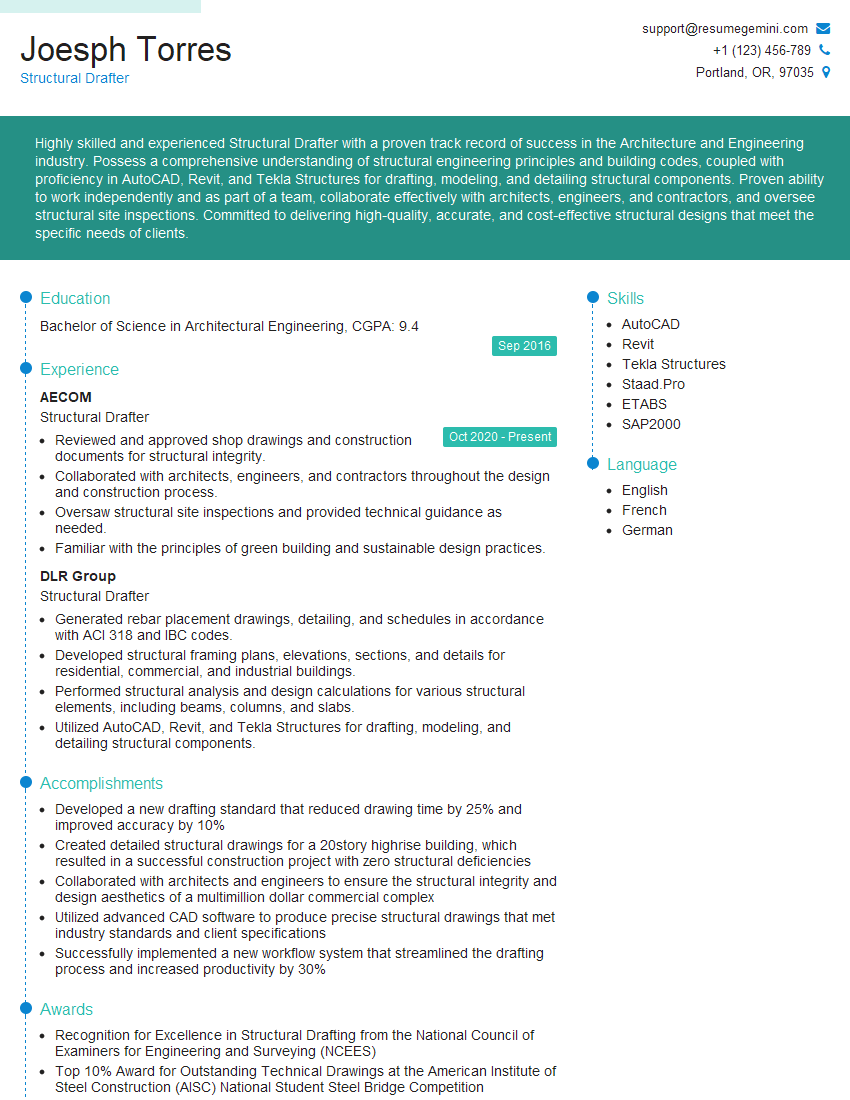
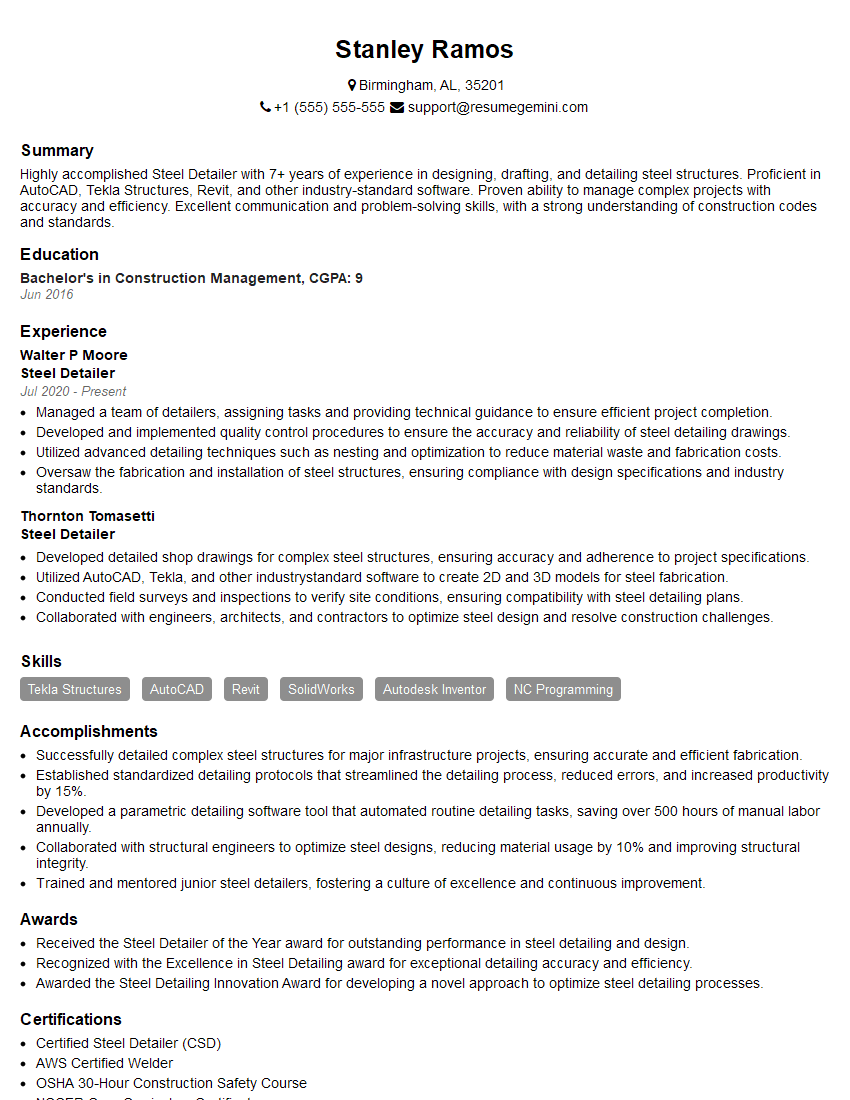
Mastering structural detailing opens doors to exciting career opportunities with significant growth potential. A strong understanding of these concepts translates directly into higher earning potential and more advanced roles within the industry. To make sure you land your dream job, it’s essential to present your skills effectively. Creating an ATS-friendly resume is key to getting noticed by recruiters. We highly recommend using ResumeGemini to build a professional resume that highlights your expertise in Structural Detailing. ResumeGemini provides resources and examples tailored to this field, ensuring your resume stands out from the competition. Examples of resumes tailored specifically to Structural Detailing professionals are available to help you get started.
Explore more articles
Users Rating of Our Blogs
Share Your Experience
We value your feedback! Please rate our content and share your thoughts (optional).
What Readers Say About Our Blog
Very informative content, great job.
good