Cracking a skill-specific interview, like one for Subfloor Preparation, requires understanding the nuances of the role. In this blog, we present the questions you’re most likely to encounter, along with insights into how to answer them effectively. Let’s ensure you’re ready to make a strong impression.
Questions Asked in Subfloor Preparation Interview
Q 1. Describe your experience with different types of subfloor materials (plywood, OSB, concrete).
My experience encompasses a wide range of subfloor materials, each presenting unique challenges and benefits. Plywood, a classic choice, offers strength and stability when properly installed and graded. I’ve worked extensively with various grades, from the more economical and readily available AC plywood to the higher-grade BC and even marine-grade plywood for exceptionally demanding applications like bathrooms or areas prone to moisture. OSB (Oriented Strand Board) is another common material; it’s generally more cost-effective than plywood, but its performance can vary depending on the density and type of adhesive used. I consider factors like moisture resistance, shear strength, and thickness when selecting OSB, often opting for higher-density boards in high-traffic areas. Finally, concrete subfloors are prevalent in many homes and commercial buildings. Working with concrete requires a different approach, focusing on surface preparation, crack repair, and moisture mitigation to ensure a suitable base for the final flooring installation. I’ve handled everything from minor crack repairs to extensive concrete grinding and leveling.
Q 2. Explain the process of assessing subfloor levelness and identifying uneven areas.
Assessing subfloor levelness is crucial for a successful flooring installation. I typically use a long, straight 2-meter level to check for unevenness. I run the level across the entire subfloor in multiple directions, checking for variations in height. For larger areas, I might use a laser level for greater accuracy and efficiency. Uneven areas are marked with chalk or tape. Beyond simple level checks, I also feel the floor for any significant dips or bumps that may be hard to detect visually. This tactile assessment, combined with the visual check from the level, gives me a comprehensive understanding of the subfloor’s condition. If major unevenness is discovered, I can then use a more precise measuring device to quantify the discrepancy – such as a straight edge and feeler gauges to measure the height variation accurately, documenting my findings for planning purposes.
Q 3. How do you determine the appropriate method for leveling a subfloor?
The method for leveling a subfloor depends heavily on the severity of the unevenness, the type of subfloor, and the final flooring choice. For minor imperfections, I might use a self-leveling compound, which is a quick and easy solution for smoothing out minor irregularities. For more significant unevenness in a wood subfloor, I may opt for using shims to raise lower sections and secure them into place properly. With larger discrepancies or extensive damage, I would typically use a combination of methods including strategically placing plywood underlayment, engineered wood planks, or concrete patching where appropriate, before applying a self-leveling compound. For concrete subfloors, grinding or patching might be necessary before self-leveling compound is applied. The choice always involves careful consideration of cost, time constraints, and the final flooring’s structural requirements. In each case, I make sure to account for appropriate expansion and contraction gaps in my preparation.
Q 4. What are the common causes of subfloor moisture problems, and how do you address them?
Subfloor moisture problems are a major concern, often leading to flooring failure. Common causes include leaks from plumbing, inadequate ventilation, rising damp from the ground, or even simply high humidity in the surrounding environment. For example, I once encountered a situation where a seemingly small leak behind a shower had resulted in significant moisture damage to the subfloor underneath the bathroom tiles, leading to serious rot over time. Addressing these issues requires a systematic approach. First, the source of the moisture must be identified and fixed – this could involve plumbing repairs, improved ventilation, or waterproofing measures. Once the source is addressed, I might use moisture meters to assess the remaining moisture content in the subfloor and to ensure that the area is drying properly. Severe cases may require the complete replacement of the damaged subfloor material, ensuring proper ventilation, and potentially using a vapor barrier. If a concrete subfloor is affected, I would apply a proper moisture mitigation system such as a moisture barrier before final floor covering installation.
Q 5. Describe your experience with moisture mitigation techniques for subfloors.
My experience with moisture mitigation techniques is extensive. These techniques vary depending on the subfloor material and the severity of the moisture problem. For wood subfloors, I often use vapor barriers such as polyethylene sheeting to prevent moisture migration. In cases of significant moisture, I may recommend using specialized moisture-resistant underlayment to minimize moisture intrusion. For concrete subfloors, I utilize various methods to address moisture problems, including sealers, vapor retarders, and in severe cases, even specialized moisture-resistant concrete overlays. I might also incorporate drainage solutions or ventilation in these scenarios, ensuring that the foundation is sufficiently protected. The critical element is selecting the appropriate technique based on a proper assessment of the moisture level and its source, using moisture meters and thorough visual inspection to guide my approach.
Q 6. What are the signs of subfloor damage or rot, and how do you repair them?
Signs of subfloor damage or rot include discoloration (darkening or staining), soft or spongy areas underfoot, a musty odor, visible cracks or gaps, and even the presence of insects or fungi. Repairing such damage varies depending on the extent of the problem. Minor damage, such as small cracks in a wood subfloor, can often be patched with epoxy filler or wood putty and re-sanded. More extensive rot necessitates replacing the affected sections. This involves cutting out the damaged area, ensuring removal down to sound material, installing replacement sections of new material of matching thickness and quality, and carefully securing the installation. For concrete subfloors, cracks can be repaired using specialized epoxy mortars and patching compounds. Severe damage might require more extensive repairs such as concrete grinding and overlaying or replacement of affected sections. In all cases, proper drying and the application of appropriate sealants or treatments are crucial to prevent further damage.
Q 7. How do you prepare a concrete subfloor for the installation of flooring?
Preparing a concrete subfloor for flooring installation is a critical step that significantly impacts the final floor’s longevity and appearance. I always begin with a thorough cleaning to remove any dust, debris, or loose material. I then check for cracks and imperfections, which I repair using appropriate patching compounds. Next, I assess the levelness using a long level and address any significant unevenness through grinding or self-leveling compound application. This ensures a flat surface for the new flooring. I then meticulously check for any remaining dust after the leveling process is complete and proceed to prime the surface, ensuring optimal adhesion of the final flooring. Finally, I examine the moisture content of the concrete using a moisture meter, and if any moisture issues are discovered, I would utilize appropriate moisture barriers or other mitigation techniques before commencing with the flooring installation.
Q 8. How do you prepare a wood subfloor for the installation of flooring?
Preparing a wood subfloor for new flooring is crucial for a long-lasting, beautiful finish. It involves a thorough inspection and several key steps to ensure a level, stable, and dry surface. Think of it like preparing a canvas before painting a masterpiece – a poorly prepared surface will ruin the final product.
- Inspection: First, I carefully inspect the entire subfloor for loose boards, squeaks, nail pops, gaps, and significant damage. I check for any signs of moisture damage like discoloration or soft spots. Any issues found are addressed before proceeding.
- Repairing Damage: Loose boards are secured with construction adhesive and screws. Nail pops are countersunk and refastened. Significant damage might require board replacement. Gaps are filled with wood filler.
- Leveling: Unevenness is addressed through sanding, planing, or the application of a self-leveling compound (more on that later). The goal is to achieve a smooth, level surface suitable for the chosen flooring.
- Cleaning: After repairs, the entire subfloor is thoroughly cleaned to remove dust, debris, and any loose particles that could interfere with the adhesive used for the new flooring.
For example, I once worked on a subfloor with several loose boards and significant squeaking. After securing the loose boards, I used a self-leveling compound to correct minor unevenness, resulting in a flawless installation of the engineered hardwood.
Q 9. Explain your experience using self-leveling compounds.
Self-leveling compounds are invaluable for creating a perfectly smooth subfloor. I have extensive experience using them on various projects, ranging from small bathroom renovations to large-scale commercial installations. These compounds are essentially liquid cement that self-levels after application, creating a flawlessly flat surface.
My experience includes working with different brands and formulations, selecting the appropriate type based on the substrate, the amount of leveling required, and the drying time constraints. For example, I’ve used rapid-setting compounds for quick turnarounds in smaller projects and slower-setting compounds for larger areas requiring minimal attention to detail during the drying process. Proper mixing is critical to avoid lumps and ensure even leveling. I also understand the importance of following the manufacturer’s instructions precisely, paying close attention to application thickness and drying times. It’s a bit like baking a cake – the right ingredients and proportions are key.
Proper preparation is paramount before application. This involves thoroughly cleaning the subfloor, priming porous surfaces to prevent excessive compound absorption, and using appropriate edge barriers to contain the compound. A long, straight edge is then used to ensure an even spread. The compound typically requires 24 to 72 hours to fully cure before installation of the final flooring.
Q 10. What safety precautions do you take when working with subfloor materials and tools?
Safety is my top priority. Working with subfloor materials and tools involves several potential hazards. Therefore, I always employ the following safety precautions:
- Personal Protective Equipment (PPE): I consistently wear safety glasses, dust masks, hearing protection, work gloves, and appropriate footwear.
- Tool Safety: Power tools are always used according to the manufacturer’s instructions, and their blades and cutting surfaces are kept sharp and in good condition. I ensure proper ventilation when using materials that emit fumes or dust.
- Material Handling: Heavy materials are handled with care, using appropriate lifting techniques and equipment when necessary. Materials are stored properly to prevent accidents.
- Housekeeping: The work area is kept clean and organized, minimizing the risk of trips and falls. Debris and waste are disposed of properly.
- Moisture Meter Safety: When using a moisture meter (as described below), I always check the calibration and follow the manufacturer’s instructions for proper use and maintenance.
For example, I always use a dust mask when sanding the subfloor to prevent inhaling harmful particles, ensuring a safe and healthy work environment.
Q 11. Describe your experience with using different types of underlayment.
My experience encompasses using a variety of underlayments, each with its own properties and applications. Underlayment is a crucial layer between the subfloor and the final flooring, providing insulation, moisture protection, and sound dampening. Some common types include:
- Foam Underlayment: Offers excellent sound insulation and cushioning. Different thicknesses are available, impacting the level of cushioning.
- Cork Underlayment: A natural and sustainable option that provides good insulation and dampening.
- Fiberboard Underlayment: More rigid than foam, providing a stable base for harder flooring like hardwood.
- LuAn Underlayment: A plywood-based product offering exceptional strength and dimensional stability.
The choice of underlayment depends on the type of flooring, the existing subfloor condition, and the desired properties of the finished floor. For instance, I might use a thicker foam underlayment under laminate flooring in an apartment building to reduce noise transmission. However, with hardwood I might opt for a thinner underlayment to prevent a soft feel. Choosing the right underlayment is about understanding the interaction between layers and creating a robust and well-performing final floor.
Q 12. How do you ensure the subfloor is adequately supported before installing flooring?
Adequate subfloor support is fundamental for preventing future issues. A poorly supported subfloor can lead to squeaks, unevenness, and even structural damage. My approach involves several key steps:
- Inspection of Joists: I carefully inspect the floor joists for signs of rot, damage, or inadequate spacing. Improper spacing can cause deflection and unevenness.
- Addressing Deflection: If deflection is present, sistering joists, adding blocking, or installing engineered wood I-joists can significantly enhance support. This is akin to reinforcing the beams of a house for added stability.
- Checking for Levelness: A long level or a laser level is used to check for significant unevenness in the subfloor. Severe unevenness might require significant leveling measures.
- Addressing Soft Spots: Soft spots in the subfloor indicate potential issues beneath, possibly rot or inadequate support. These require investigation and repair. This might involve replacing damaged joists or sections of subflooring.
For instance, I recently worked on a project where the subfloor exhibited noticeable deflection. By sistering the existing joists, we significantly improved support and prevented potential future problems. This careful attention to structural integrity is a cornerstone of successful subfloor preparation.
Q 13. What tools and equipment are essential for subfloor preparation?
A well-equipped toolbox is essential for efficient subfloor preparation. Key tools include:
- Moisture Meter: To accurately assess moisture content (discussed further below).
- Hammer and Nail Set: For securing loose boards.
- Screwdriver (Drill/Driver): For fastening screws and driving in nails.
- Circular Saw or Reciprocating Saw: For cutting and removing damaged sections of subflooring.
- Hand Plane or Belt Sander: For smoothing uneven surfaces.
- Putty Knife and Wood Filler: For filling gaps and cracks.
- Measuring Tape and Level: For accurate measurements and assessing levelness.
- Safety Glasses, Dust Mask, Hearing Protection, Work Gloves: Essential for personal protection.
- Self-Leveling Compound Trowel and Straight Edge: For creating a level surface with self-leveling compounds.
Beyond these essential tools, additional equipment, such as a jackhammer or pry bar may be necessary depending on the condition of the subfloor. I always make sure to have all necessary tools on hand before starting a project to ensure efficiency and a smooth workflow.
Q 14. Describe your experience with using a moisture meter.
A moisture meter is an indispensable tool for assessing the moisture content of wood subfloors. High moisture content can lead to significant problems, including warping, buckling, and mold growth. This can ultimately damage the installed flooring and lead to costly repairs.
My experience with moisture meters includes using both pin-type and non-invasive (surface) models. Pin-type meters are more accurate but require piercing the wood surface. Non-invasive meters measure the surface moisture content. I select the appropriate meter based on the situation and the type of wood. The readings obtained are crucial in determining the suitability of the subfloor for flooring installation and identifying areas requiring further attention. The readings are generally compared against the manufacturer’s recommendations for the flooring being installed to ensure compatibility.
Before each use, I always calibrate the meter according to the manufacturer’s instructions to ensure accurate readings. I take multiple readings in different locations across the subfloor to obtain a representative average. High moisture readings might require the use of a dehumidifier or other moisture mitigation techniques before installation can proceed. This meticulous approach ensures that the new flooring is installed on a dry and stable surface, promoting longevity and preventing future issues.
Q 15. How do you manage time effectively on a subfloor preparation project?
Effective time management on a subfloor preparation project hinges on meticulous planning and efficient execution. I begin by thoroughly reviewing the blueprints and specifications to understand the scope of work precisely. This includes identifying the subfloor type, its condition, and the required final finish. Next, I create a detailed schedule, breaking down the project into manageable tasks with realistic timelines. This schedule accounts for potential delays and incorporates buffer time. For example, if moisture mitigation is needed, I’ll allocate sufficient time for testing, drying, and potential remediation. Regular progress checks and communication with the team help keep the project on track. I also prioritize tasks based on their dependencies, ensuring that crucial steps are completed before subsequent ones. Finally, I leverage technology – utilizing project management software to track progress, manage resources, and communicate effectively with stakeholders.
Think of it like baking a cake: you wouldn’t start frosting before the cake is baked. Similarly, installing flooring directly onto an improperly prepared subfloor is a recipe for disaster. Careful planning and a step-by-step approach are essential for success.
Career Expert Tips:
- Ace those interviews! Prepare effectively by reviewing the Top 50 Most Common Interview Questions on ResumeGemini.
- Navigate your job search with confidence! Explore a wide range of Career Tips on ResumeGemini. Learn about common challenges and recommendations to overcome them.
- Craft the perfect resume! Master the Art of Resume Writing with ResumeGemini’s guide. Showcase your unique qualifications and achievements effectively.
- Don’t miss out on holiday savings! Build your dream resume with ResumeGemini’s ATS optimized templates.
Q 16. Explain your understanding of building codes and regulations related to subfloors.
My understanding of building codes and regulations related to subfloors is comprehensive. I’m familiar with codes such as the International Building Code (IBC) and local variations. These codes dictate requirements for subfloor materials, installation methods, deflection limits, moisture content, and the overall structural integrity of the subfloor system. For example, the IBC specifies maximum allowable deflection for subfloors under different loads to prevent sagging and ensure the longevity of the floor covering. Similarly, moisture content limits are crucial to prevent problems like mold growth and floor failure. I always cross-reference my project plans with the relevant local building codes and ensure that every aspect of the subfloor preparation adheres to these standards. I also maintain detailed records of all materials used and installation methods for future reference and inspections.
Non-compliance can lead to significant issues, from costly repairs to safety hazards. Therefore, strict adherence to building codes is paramount.
Q 17. How do you handle unexpected problems or challenges during subfloor preparation?
Unexpected problems during subfloor preparation are inevitable. My approach is rooted in proactive problem-solving. First, I carefully assess the situation. Is it a minor issue, such as a localized imperfection in the subfloor, or something more significant like extensive rot or pest infestation? Once the problem is identified, I thoroughly document it, including photos and detailed notes. Then, I develop a solution. This might involve simple repairs, such as patching damaged areas or addressing minor leveling issues. For more complex problems, like extensive moisture damage, I consult with structural engineers or other specialists to determine the appropriate remediation strategy. Open communication with the client is vital to ensure they are informed and involved in the decision-making process. I also meticulously update the project schedule to account for any delays caused by the unexpected challenges.
For instance, discovering rotted joists during a seemingly simple leveling project requires a completely revised approach. This could involve replacing damaged joists, which significantly impacts the timeline and budget. Open communication prevents surprises and ensures the project’s successful completion.
Q 18. Describe your experience with working in a team environment on subfloor projects.
I have extensive experience collaborating effectively within team environments on subfloor projects. Successful subfloor preparation often requires a coordinated effort between different trades. I believe in clear communication, mutual respect, and a collaborative problem-solving approach. I actively participate in pre-project meetings to define roles, responsibilities, and timelines, ensuring everyone is on the same page. I also maintain open lines of communication throughout the project, addressing concerns and challenges promptly. I am adept at delegating tasks appropriately, recognizing team members’ strengths and ensuring the efficient use of resources. Moreover, I contribute to a positive team dynamic, fostering collaboration and mutual support. I believe that a strong team, working cohesively, delivers higher-quality results and completes projects more efficiently.
On a recent project, we encountered a significant delay due to a supplier issue with the subfloor material. By working closely with the project manager and the supplier, we were able to find an alternative solution within a reasonable timeframe, minimizing the disruption to the overall schedule.
Q 19. How do you maintain quality control during subfloor preparation?
Maintaining quality control during subfloor preparation involves a multi-faceted approach. I begin with thorough inspection of the existing subfloor, carefully documenting its condition, including moisture content, levelness, and any structural deficiencies. I use appropriate tools and testing methods like moisture meters and level gauges. During the preparation process, I meticulously adhere to the project specifications and building codes, paying close attention to details such as proper fastener spacing, adhesive application, and the overall levelness of the subfloor. Regular quality checks are performed at various stages of the process, addressing any deviations promptly. Finally, I conduct a thorough final inspection before handing over the project, ensuring the subfloor meets all requirements and is ready for the final flooring installation. This meticulous approach ensures a solid and long-lasting foundation for the final floor covering.
Think of it like building a house – a weak foundation compromises the entire structure. Similarly, neglecting quality control in subfloor preparation can lead to problems down the line, such as squeaky floors, uneven surfaces, and even structural damage.
Q 20. What are the different types of adhesives used for subfloor installation?
Several types of adhesives are used for subfloor installation, each suited to different materials and applications. Common choices include:
- Construction Adhesives: These are often used for plywood or OSB subfloors, providing strong bonding and gap-filling properties. Different formulations cater to various moisture conditions.
- Modified Thin-Set Mortars: These are used for ceramic tile or stone subfloors, providing a strong bond and excellent leveling capabilities.
- Epoxy Adhesives: Used for demanding applications, epoxy adhesives offer superior strength and resistance to moisture and chemicals, ideal for areas prone to high moisture.
- Hybrid Adhesives: Blending the properties of multiple adhesive types.
Q 21. How do you determine the proper spacing for subfloor fasteners?
Determining proper spacing for subfloor fasteners is critical for structural integrity and preventing issues like squeaking or deflection. The spacing is determined by several factors, including:
- Subfloor Material: Plywood, OSB, and concrete all have different fastener requirements.
- Subfloor Thickness: Thicker subfloors generally require less frequent fasteners.
- Span of Joists: Longer joist spans necessitate closer fastener spacing.
- Type of Fastener: Screws or nails have different holding power.
- Manufacturer Specifications: Always refer to the manufacturer’s guidelines for optimal fastener spacing.
Q 22. Explain your understanding of vapor barriers and their importance in subfloor preparation.
Vapor barriers are crucial in subfloor preparation because they prevent moisture from migrating upwards from the ground or crawl space into the living space. Think of them as a raincoat for your floor – protecting it from the elements below. This is especially important in basements or areas prone to high humidity. Without a proper vapor barrier, moisture can lead to mold growth, wood rot, and damage to the flooring materials themselves, ultimately creating expensive problems down the line.
The type of vapor barrier used depends on the climate and subfloor conditions. Common materials include polyethylene sheeting (6-mil or thicker is recommended), building paper, and specialized vapor retarders. The installation is equally important; it must be continuous, sealed at seams with tape, and extend up the walls to a height that depends on the specific situation. Any gaps or tears defeat the purpose.
For example, in a basement renovation, I recently installed a 6-mil polyethylene vapor barrier over the concrete slab before laying down the plywood subfloor. I carefully overlapped the sheets by at least 6 inches and sealed the seams with vapor-barrier tape. This ensured a complete moisture barrier, protecting the new subfloor and the future hardwood flooring from any potential moisture problems.
Q 23. Describe your experience with installing subfloors over radiant heating systems.
Installing subfloors over radiant heating systems requires careful consideration to ensure proper heat transfer and structural integrity. The key is selecting the right type of subflooring material and ensuring it allows for efficient heat distribution. Commonly used materials include cement backerboard, plywood (specific grades are needed for this application) or engineered wood products designed for radiant heating systems. These materials offer good thermal conductivity, meaning heat can transfer efficiently through them to warm the room.
My experience includes projects where I used ½-inch cement backerboard over a radiant heating system. The installation required using a thin-set mortar to bond the cement board to the heating pipes, ensuring proper contact and heat transmission. It’s crucial to follow manufacturer’s recommendations for spacing and fasteners – using too many fasteners can hinder heat flow, and too few can compromise structural support.
Another crucial aspect is ensuring the heating system is properly tested and functioning before installing the subfloor. This avoids problems after installation. Furthermore, you need to consider the thickness of the subfloor materials to avoid compromising the height of your finished floor.
Q 24. How do you deal with incompatible subfloor materials?
Incompatible subfloor materials can lead to structural issues, squeaking, and premature failure of the flooring. For example, combining old, worn-out wood with new plywood is a recipe for disaster. The solution depends on the specific materials and the extent of the incompatibility.
My approach involves assessing the condition of the existing subfloor. If it’s severely damaged or compromised, removal and replacement is often the best course of action. For instance, if I found rotted sections of wood, I would carefully remove those areas and replace them with properly treated lumber. This might necessitate some structural repairs too, like fixing joists.
If the incompatibility is less severe, I might use appropriate adhesives or underlayment to bridge the gap between different materials, ensuring a stable and level base for the new flooring. This would involve careful preparation, ensuring the surfaces are clean and free of debris before applying any adhesives. Using a self-leveling compound to smooth out unevenness can resolve minor discrepancies in height between different materials.
Q 25. What is your experience with using shims for leveling subfloors?
Shims are essential for leveling subfloors, particularly in older homes where the floor joists might have settled unevenly. They provide support and adjust the height of the subfloor, ensuring a perfectly level surface for the final flooring installation. Proper shimming prevents squeaking, uneven wear, and prevents problems with the finished floor.
I use wooden shims, typically made of hardwood, and I always choose shims that are appropriately sized and strong enough to support the load. I also ensure they are snugly fitted against the subfloor and the joists. Incorrectly sized or poorly installed shims can create instability. I always use shims in combination with a level to ensure the subfloor is perfectly level before securing the subfloor panels down. This prevents any long-term issues.
For instance, I recently worked on a project where the subfloor had a significant slope. I carefully used shims to raise the low spots, gradually building up support until the subfloor was perfectly level, creating a uniform surface for the tile installation.
Q 26. How do you handle the disposal of subfloor materials responsibly?
Responsible disposal of subfloor materials is crucial for environmental protection. This involves sorting the materials correctly and adhering to local regulations. Simply dumping materials at the curb isn’t environmentally responsible.
My practice involves separating materials according to their type. Wood scraps, for instance, are often suitable for reuse or recycling as mulch or biomass fuel. Some wood is suitable for recycling and some should be disposed of in designated landfills. Metals like nails and screws are collected separately for recycling. Polyethylene sheeting might require specialized disposal methods depending on local regulations. I always check with local waste management facilities to determine the proper disposal methods for each material before I start a project.
For example, on a recent job, I meticulously separated the old plywood subfloor from any metal components and contacted a local recycling facility to take the plywood away. This ensured responsible disposal and minimized environmental impact.
Q 27. Describe your experience with repairing damaged joists or floor trusses.
Repairing damaged joists or floor trusses is critical for structural integrity and safety. Ignoring damage can lead to sagging floors, instability, and even structural collapse. The repair method depends on the nature and extent of the damage.
My approach involves a thorough inspection to assess the damage. Minor damage, such as small cracks, might be repaired with epoxy. More significant damage, like rot or significant weakening, requires more extensive repairs, potentially involving sistering (adding a new joist alongside the damaged one), or replacing the damaged section altogether. Proper support and bracing are crucial during any repair work.
For instance, I once encountered a joist with significant termite damage. I carefully removed the damaged section, ensuring the integrity of the surrounding structure, and replaced it with a new, properly treated joist, firmly securing it with appropriate fasteners and providing temporary support to prevent sagging until the repair was completed. Safety is paramount, so using proper safety equipment during such repairs is also key.
Q 28. How do you ensure a smooth and even subfloor surface for final flooring installation?
Achieving a smooth and even subfloor surface is paramount for the longevity and aesthetic appeal of the final flooring. Unevenness can lead to issues with the final flooring, like cracking, squeaking and an uneven finish. My approach focuses on meticulous preparation and attention to detail.
This process begins with leveling the subfloor using shims as described earlier. Once the subfloor is level, any gaps or inconsistencies are addressed. If the unevenness is minor, self-leveling compound is an excellent solution, creating a perfectly smooth and even surface. For larger irregularities, additional layers of plywood or other appropriate material might be necessary.
After leveling, the surface needs to be clean and free of any debris or loose particles. This involves thorough sweeping and vacuuming. Once the surface is completely prepared, it ensures the final flooring adheres properly and looks its best. For instance, before installing ceramic tile, I always ensure a smooth and perfectly level surface to guarantee a perfect installation without issues. This will prevent cracking or chipping.
Key Topics to Learn for Subfloor Preparation Interview
- Understanding Subfloor Types: Learn to identify different subfloor materials (concrete, plywood, wood, etc.), their properties, and common issues associated with each.
- Moisture Content Assessment: Master techniques for measuring moisture levels and understanding the implications for subfloor suitability and the selection of appropriate flooring materials. This includes using moisture meters and interpreting results.
- Leveling Techniques: Explore various methods for leveling uneven subfloors, including self-leveling compounds, underlayments, and shimming. Understand the pros and cons of each approach.
- Crack Repair and Remediation: Learn to identify and repair cracks, holes, and other imperfections in subfloors, employing appropriate patching and repair techniques to ensure a stable base.
- Installation of Underlayments: Understand the purpose and application of various underlayments, including their impact on sound insulation, moisture protection, and overall flooring performance.
- Substrate Preparation for Specific Flooring Types: Gain expertise in preparing subfloors for different types of flooring, such as hardwood, tile, laminate, and carpet. This includes understanding specific requirements for each type.
- Troubleshooting Common Subfloor Problems: Develop your problem-solving skills by understanding common issues like squeaking floors, unevenness, and moisture damage, and how to address them effectively.
- Safety Procedures and Regulations: Familiarize yourself with relevant safety regulations and best practices related to subfloor preparation, including proper use of tools and equipment.
- Estimating and Budgeting: Develop your skills in accurately estimating materials and labor costs associated with subfloor preparation projects.
Next Steps
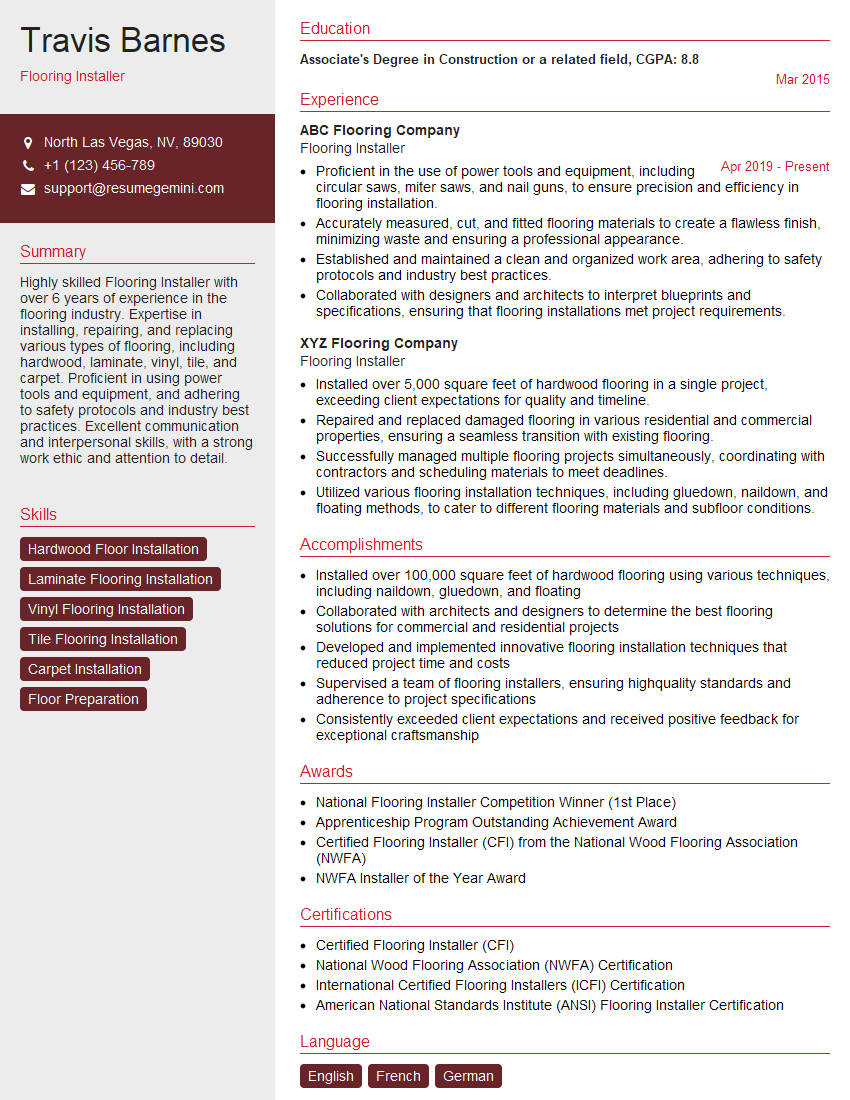
Mastering subfloor preparation is crucial for career advancement in the flooring industry. A strong understanding of these techniques demonstrates your expertise and problem-solving abilities, making you a highly valuable asset to any team. To significantly enhance your job prospects, it’s essential to create a professional, ATS-friendly resume that highlights your skills and experience effectively. ResumeGemini is a trusted resource to help you build a compelling resume that showcases your qualifications. We provide examples of resumes tailored to Subfloor Preparation to help you get started.
Explore more articles
Users Rating of Our Blogs
Share Your Experience
We value your feedback! Please rate our content and share your thoughts (optional).
What Readers Say About Our Blog
Very informative content, great job.
good