Feeling uncertain about what to expect in your upcoming interview? We’ve got you covered! This blog highlights the most important Tattoo Fine Line Designs interview questions and provides actionable advice to help you stand out as the ideal candidate. Let’s pave the way for your success.
Questions Asked in Tattoo Fine Line Designs Interview
Q 1. Describe your experience with fine line tattooing techniques.
My experience with fine line tattooing spans over a decade, encompassing thousands of hours of practice and refinement. I started with a deep appreciation for the intricate detail and delicate nature of the style. I’ve worked extensively with various styles within fine line, from minimalist geometric designs to highly detailed illustrative pieces. My journey included mentorship under renowned fine line artists, continuous self-education through studying anatomy, and relentless practice to achieve the level of precision required. This dedication extends to staying updated on the latest advancements in equipment and techniques to ensure I deliver consistently high-quality work. For example, I’ve recently incorporated the use of rotary tattoo machines with specific needle configurations to optimize for fine line applications, a significant upgrade from the coil machines I began with.
Q 2. What are the key differences between fine line and traditional tattooing?
The key difference between fine line and traditional tattooing lies primarily in the line weight, style, and overall aesthetic. Traditional tattooing typically involves bold, solid lines and blocks of color, often featuring classic American or Japanese designs. The focus is on impactful imagery with strong visual weight. Fine line tattooing, in contrast, emphasizes incredibly thin, precise lines, creating delicate and detailed designs. The style lends itself to more intricate work, such as illustrative pieces, geometric patterns, or minimalist designs. Think of it this way: traditional is like a powerful oil painting, while fine line is a finely detailed pencil sketch. Traditional uses thicker needles and bolder inks, while fine line necessitates specialized needles and inks suited for their delicate nature.
Q 3. Explain your process for creating a fine line tattoo design.
My process for creating a fine line tattoo design begins with a thorough consultation with the client to understand their vision and preferences. We then collaborate to develop a concept, sketching and refining the design until we achieve a final piece that accurately represents their ideas. This often includes multiple design revisions. Once the design is finalized, I transfer the artwork onto the client’s skin using a stencil. This is crucial for precise placement. I always use high-quality stencil paper and transfer methods. I then carefully begin the tattooing process using the chosen needles and inks, paying meticulous attention to line weight consistency and accuracy. After the tattoo is completed, I provide aftercare instructions to ensure proper healing and longevity of the design. The entire process prioritizes collaboration, precision, and client satisfaction.
Q 4. How do you ensure precision and accuracy in your fine line work?
Precision and accuracy in fine line work demand a high level of skill and the right tools. I use a combination of techniques to ensure impeccable results. This includes using high-quality rotary tattoo machines with a light touch, precise needle configurations, and appropriate ink consistency. Maintaining proper hygiene and sanitation throughout the process is paramount. Proper stretching of the skin during the tattooing process is also vital for achieving straight, clean lines. Regularly cleaning and adjusting the needle is essential to prevent ink blowouts and maintain a sharp line. Finally, years of experience have enabled me to develop a steady hand and the ability to anticipate and correct minor inconsistencies in real-time.
Q 5. What types of needles and inks do you prefer for fine line tattoos?
For fine line tattoos, I prefer using high-quality rotary tattoo machines equipped with extremely fine needles, typically ranging from 1RL to 7RL (Round Liner needles) depending on the line weight required. The smaller the number, the finer the line. I use only professional-grade tattoo inks known for their vibrancy, longevity, and suitability for fine line work. Certain inks are formulated specifically for precision, allowing for sharper lines and better color saturation. I prioritize inks with low levels of pigment to avoid blowouts and maintain the crispness of the lines. Regular maintenance and replacement of my needles and equipment is non-negotiable to ensure optimal performance and safety.
Q 6. How do you handle difficult skin types or placement areas for fine line tattoos?
Dealing with challenging skin types or placement areas requires adaptability and expertise. For example, very thin or sensitive skin requires a lighter hand and potentially different needle configurations. Bony areas or areas with excessive movement may necessitate adjusting the stencil placement or using techniques to minimize distortion during application. Before starting any tattoo, I carefully assess the client’s skin to determine the best approach. This may involve using techniques like multiple passes with minimal ink or adjusting the needle depth and angle. Experience and ongoing training are vital to handling these situations effectively and ensuring a high-quality result, regardless of the challenges presented. I always prioritize client comfort and safety.
Q 7. What is your approach to client consultations for fine line tattoo designs?
My approach to client consultations for fine line tattoo designs is collaborative and thorough. The initial consultation involves a detailed discussion about the client’s desired design, including inspiration, style preferences, size, and placement. We delve into the client’s lifestyle and skin type to assess suitability and potential challenges. I review portfolios of my previous work to showcase my capabilities and style. I then create custom sketches, incorporating the client’s feedback, until we achieve a design we both love. I’m transparent about expectations, the healing process, and any potential complications. The goal is to create a design that aligns perfectly with the client’s vision and will age gracefully.
Q 8. Describe your stenciling and transfer methods for fine line tattoos.
Stenciling and transfer are critical for precision in fine line tattoos. I utilize high-quality stencil paper and thermal transfer paper for optimal results. First, the design is meticulously created digitally, ensuring perfect scaling for the client’s chosen area. Then, I print the design onto stencil paper using a high-resolution printer. I carefully apply the stencil to the client’s skin, ensuring it’s smooth and wrinkle-free, using a transfer solution to help it adhere. This solution helps prevent smudging during the tattooing process. After ensuring the stencil is correctly positioned, I use a transfer machine (for thermal paper) or a stencil applicator (for stencil paper) to transfer the design onto the skin. The stencil is then carefully removed, leaving a precise outline ready for tattooing.
For particularly intricate designs, I might use a combination of freehand sketching and stenciling, adding details freehand directly onto the skin after initial transfer, guided by the underlying stencil lines as a frame of reference.
Q 9. How do you manage client expectations regarding healing and aftercare for fine line tattoos?
Managing client expectations is paramount. Before any tattooing begins, I have a detailed consultation where I discuss the healing process, providing realistic expectations, not just idealized images. Fine line tattoos, while delicate, still require proper aftercare to heal cleanly. I explain that slight scabbing or flaking is normal, but picking at it can cause scarring or color loss. I emphasize the importance of keeping the area clean and moisturized using fragrance-free, unscented lotions I recommend. Following up with clients post-tattoo via text or email is also a part of my process. This helps address any concerns and reassures them that the healing is progressing as expected. Providing high-quality aftercare instructions, both verbal and written, is essential for positive outcomes and happy clients.
Q 10. What are some common mistakes to avoid when applying fine line tattoos?
Several common mistakes can ruin a fine line tattoo. Overworking the skin is a major one – repeatedly going over the same line can lead to blowouts (ink bleeding under the skin) and blurriness, especially with fine lines. Using dull needles is another; sharp needles are crucial for clean, crisp lines. Improper stencil placement can also create problems; this leads to asymmetry or misaligned elements in the design. Inconsistent pressure during the tattoo process can cause some parts of the line to appear fainter than others, detracting from the overall aesthetic. Finally, ignoring skin conditions like sunburns or existing skin issues can impact healing and tattoo quality. Addressing these issues upfront is critical to avoid mistakes and achieve optimal results.
Q 11. How do you maintain the sterility and hygiene standards during fine line tattoo application?
Sterility and hygiene are non-negotiable. I meticulously follow strict protocols, beginning with autoclaving all equipment that comes into contact with the skin, including needles, grips, and tubes. I use single-use disposable items where possible. The tattoo area is thoroughly cleaned and disinfected before, during, and after the procedure. I use fresh gloves throughout the entire process, changing them frequently to maintain a sterile environment. The work area is sanitized before each client, and all surfaces are wiped down with a medical-grade disinfectant. A barrier film is applied to protect both the client and the work surface, maintaining a sterile field. My adherence to these strict practices ensures a safe and hygienic environment for both myself and the client.
Q 12. What are your strategies for managing challenging or complex fine line designs?
Complex designs require a strategic approach. I begin by carefully analyzing the design, breaking it down into smaller, manageable sections. I might create a layered stencil approach for complex designs, tattooing each layer sequentially to ensure precision. For intricate details, I might use magnification tools to maintain accuracy. I also take frequent breaks during the tattooing process to avoid fatigue, as this can significantly impact precision. Communicating with the client throughout the process is key to managing their expectations and ensuring they’re comfortable. Flexibility is important, as adjustments may need to be made on the fly to address any challenges that arise.
Q 13. Describe your experience with various fine line tattoo styles (e.g., geometric, minimalist).
My experience spans various fine line styles. Geometric designs offer a beautiful challenge, requiring exceptional precision and clean lines. Minimalist tattoos are a perfect example of ‘less is more,’ where the focus lies on simplicity and impactful composition using just a few well-placed lines. Botanical fine line work allows me to showcase detail and shading subtlety. I’ve also worked with illustrative styles, incorporating delicate details and shading, resulting in very detailed tattoo work. Adapting my technique to the specific style is important for achieving the desired aesthetic; each style has its unique nuances requiring precision and careful consideration of line weight, shading, and composition.
Q 14. How do you adapt your technique for different skin tones and types?
Skin tone and type significantly influence the tattooing process. For example, darker skin tones may require adjustments in needle depth and ink saturation to ensure the lines appear sharp and don’t get lost against the skin’s pigment. I might choose inks that are specifically formulated for darker skin, ensuring maximum color vibrancy. Thicker skin might require slightly more pressure, but it is always done carefully to avoid blowouts. For sensitive skin, I might opt for a different type of needle or reduce the intensity and frequency of passes, ensuring both comfort and the best possible results. This adaptation process is a vital part of delivering the best quality tattoo possible, irrespective of the client’s individual characteristics.
Q 15. How do you price your fine line tattoo services?
Pricing my fine line tattoo services involves a multifaceted approach. I don’t use a simple per-hour rate because fine line work, while seemingly simple, demands precision and time. Instead, I assess the design complexity, size, and detail. Smaller, simpler designs will have a lower base price, while intricate pieces with extensive detail and shading will cost more. I also factor in the client’s skin tone and placement—some areas are more challenging than others. For example, a delicate floral design on the inner wrist will be priced differently than a large, detailed piece on the back. I always provide a detailed quote upfront, including any potential additional costs, ensuring complete transparency.
Think of it like this: a simple, single-line bracelet is less expensive than an elaborate landscape. Both require skill, but the time and effort differ significantly.
Career Expert Tips:
- Ace those interviews! Prepare effectively by reviewing the Top 50 Most Common Interview Questions on ResumeGemini.
- Navigate your job search with confidence! Explore a wide range of Career Tips on ResumeGemini. Learn about common challenges and recommendations to overcome them.
- Craft the perfect resume! Master the Art of Resume Writing with ResumeGemini’s guide. Showcase your unique qualifications and achievements effectively.
- Don’t miss out on holiday savings! Build your dream resume with ResumeGemini’s ATS optimized templates.
Q 16. How do you market your fine line tattooing skills?
Marketing my fine line tattooing skills focuses on showcasing my unique style and artistry. I utilize a multi-platform approach. My Instagram is crucial, featuring high-quality photos and videos of my work, highlighting the detail and precision. Client testimonials and reviews are also vital. I participate in local tattoo conventions and collaborate with other artists, photographers, and models for portfolio expansion and networking. I also actively engage with potential clients through direct messaging, offering consultations and answering questions. Word-of-mouth referrals are incredibly powerful and contribute significantly to my client base.
A strong online presence paired with real-world engagement is key. I strive to create a unique brand identity that reflects the quality and artistry of my work.
Q 17. What is your experience with tattoo machine maintenance and setup?
Maintaining and setting up my tattoo machine is paramount for delivering consistent, high-quality results. Before each session, I thoroughly inspect my machine, checking for any damage, loose parts, or issues with the power supply. I meticulously clean and sterilize all components, including the grips and tubes. Proper lubrication is essential to prevent wear and tear. I regularly replace needles, ensuring they’re sharp and function optimally. Setting up involves precisely adjusting the needle depth and voltage to achieve the desired line weight and saturation. I also prioritize using high-quality inks and power supplies to ensure consistent performance.
Think of a chef preparing his tools before cooking; it’s a critical aspect of achieving the desired outcome.
Q 18. Explain your understanding of proper needle depth and angle for fine line work.
Needle depth and angle are critical for fine line work. The ideal needle depth is shallow, typically between 0.25mm and 0.5mm. Going too deep can result in bleeding, blowouts, and scarring, while too shallow may lead to faint lines and poor ink retention. The angle should be consistent and as close to 30-45 degrees as possible, keeping the needle parallel to the skin. Maintaining a consistent angle and depth throughout the entire tattoo is challenging but crucial for even and precise lines. Practice and experience are key to mastering this technique.
Imagine drawing with a fine pen; a slight change in angle or pressure dramatically alters the line’s appearance.
Q 19. How do you address skin reactions or complications after fine line tattoo applications?
Addressing skin reactions or complications after fine line tattoos involves immediate action and client communication. I provide detailed aftercare instructions, emphasizing proper cleaning and moisturizing. Minor reactions, such as redness or mild swelling, are common and typically resolve within a few days. However, more severe reactions like excessive swelling, significant pain, or infection require immediate attention. I advise clients to contact me immediately if they experience any concerns. If necessary, I refer them to a dermatologist or medical professional for evaluation and treatment. Documentation of the tattoo session and aftercare advice is crucial for liability and client safety. Open communication is essential in managing any post-tattoo complications.
Proactive communication and proper aftercare minimize risks but having a plan for handling complications is crucial.
Q 20. How do you handle client requests for designs outside your expertise?
Handling client requests outside my expertise is about professionalism and honesty. If a client requests a design style or technique I’m not confident in executing to a high standard, I’ll openly discuss my limitations. I’ll explain why I may not be the best fit for their specific request and suggest alternative options or refer them to a more suitable artist. This preserves my reputation and ensures the client receives the best possible result. It’s about setting realistic expectations and prioritizing the client’s satisfaction.
It’s better to refer a client to someone else than to create subpar work that could damage my professional reputation.
Q 21. Describe your knowledge of tattoo aftercare instructions and products.
My aftercare instructions are comprehensive and emphasize hygiene. I recommend using unscented, fragrance-free soap to gently clean the tattooed area twice daily. A thin layer of a fragrance-free, unscented moisturizer should be applied several times daily to keep the skin hydrated. Direct sunlight, excessive sweating, and soaking in water should be avoided for the first few weeks. Clients should avoid picking, scratching, or rubbing the tattoo. I provide them with a detailed aftercare sheet and a sample of the moisturizer I recommend. Regular follow-up communication ensures clients are healing correctly and addresses any questions or concerns. I recommend using only products specifically formulated for tattoo aftercare, avoiding potentially harmful chemicals and fragrances.
Providing clear and concise aftercare instructions and maintaining client communication is key to achieving optimal healing.
Q 22. How do you stay updated with the latest trends and techniques in fine line tattooing?
Staying current in the dynamic world of fine line tattooing requires a multi-pronged approach. It’s not just about following fleeting trends, but understanding the underlying artistic and technical advancements.
- Consistent Online Research: I regularly browse reputable tattooing websites, blogs, and forums. I look for articles on new techniques, equipment reviews, and discussions among master artists. This helps me identify emerging styles and innovative approaches.
- Following Leading Artists on Social Media: Instagram and other platforms are invaluable for discovering new talent and observing the work of established fine line artists. I pay close attention to their style, techniques, and the tools they use.
- Attending Conventions and Workshops: Participating in tattoo conventions and specialized workshops allows for direct interaction with leading artists, access to demonstrations, and the opportunity to learn from experts. It’s a great way to network and see new techniques in person.
- Continuous Experimentation: I dedicate time to experimenting with new techniques and materials in a safe and controlled environment. This constant exploration allows me to refine my skills and discover what works best for me.
Essentially, staying updated is an ongoing process that requires dedication and a genuine passion for continuous improvement.
Q 23. What is your process for creating custom fine line tattoo designs from client references?
Transforming client references into bespoke fine line tattoo designs is a collaborative process that requires careful listening, skilled interpretation, and artistic vision. My process unfolds in several stages:
- Initial Consultation: I begin with a thorough consultation to understand the client’s vision, preferences, and any existing reference images (photos, sketches, etc.). Open communication is crucial here.
- Concept Sketching: Based on the consultation, I create several initial sketches, exploring various compositional approaches and stylistic interpretations of the reference material. I present these sketches to the client, ensuring they understand the design elements and potential limitations.
- Refinement and Feedback: This is an iterative process. The client provides feedback on the sketches, suggesting modifications or adjustments. I use this input to refine the design, ensuring it accurately reflects their vision.
- Digitalization and Finalization: Once the design is finalized, I often create a high-resolution digital version. This allows for adjustments to detail and provides the client with a clearer picture of the finished tattoo. We confirm all elements before proceeding.
- Stencil Creation: Finally, I create a stencil of the approved design, ready for the tattooing process.
Throughout the entire process, transparency and open communication are paramount, ensuring a truly personalized and satisfying result for the client.
Q 24. How do you incorporate client feedback into the design process?
Client feedback is the cornerstone of a successful fine line tattoo. It’s not merely an afterthought; it’s integral to the entire design process. I incorporate feedback at every stage, ensuring the final design meets and exceeds client expectations.
- Active Listening: I encourage clients to express their preferences openly and honestly. I actively listen to understand their vision and identify areas where the design might require adjustments.
- Iterative Design: I present sketches or digital mockups at multiple stages, allowing clients to provide feedback and shape the design iteratively. This collaborative approach avoids major revisions later on.
- Visual Aids: I use visual aids like sketches, digital renderings, and examples of similar work to help clients visualize the final product and understand stylistic choices.
- Addressing Concerns: I take the time to address any concerns or questions the client may have, patiently explaining design choices and addressing potential challenges.
- Open Communication: Maintaining open communication ensures a shared understanding and prevents misunderstandings, resulting in a design that fully satisfies the client.
Ultimately, client feedback is not about changing the design to match every whim, but about creating a tattoo that genuinely reflects their individuality and artistic vision.
Q 25. Describe your experience working with different types of tattooing equipment.
My experience spans a range of tattoo equipment, each with its strengths and weaknesses in the context of fine line work. The choice of equipment is highly dependent on the specific design and client needs.
- Rotary Machines: Rotary machines are my preferred choice for fine line work due to their smooth and consistent operation. They offer greater control over needle depth and speed, resulting in cleaner lines and precise detail. I’ve worked with various brands, each providing a slightly different feel and performance.
- Coil Machines: While less commonly used for fine line work, coil machines can be effective in the hands of experienced artists. Their higher power output can be advantageous for certain applications, but they require more skill to control.
- Needles: The selection of needles is critical. I typically use single-needle liners for most fine line tattoos and may opt for 3RL or 5RL needles depending on line weight and style.
- Power Supplies: A reliable power supply is essential for consistent performance. I prefer adjustable power supplies that allow precise control over voltage and speed.
Ultimately, my expertise lies in adapting my technique and equipment choice to suit the specific demands of each fine line design.
Q 26. How do you address the challenges of creating small, intricate details in fine line tattoos?
Creating small, intricate details in fine line tattoos presents unique challenges that demand meticulous technique and a steady hand. Several strategies are essential for success:
- Proper Setup and Technique: Using a high-quality rotary machine with a sharp needle, maintaining consistent speed and pressure, and employing proper stretching techniques on the skin are crucial for clean lines and minimal trauma.
- Needle Depth and Angle: Precise control over needle depth and angle is paramount. Too shallow, and the lines may be faint; too deep, and they may be too thick or blotchy. Practice and experience are key to mastering this aspect.
- Multiple Passes: For very fine lines, multiple light passes may be necessary to achieve the desired saturation without causing blowouts. This method minimizes the risk of damaging the skin.
- Stencil Accuracy: A precise stencil is crucial. Any inaccuracies in the stencil will directly translate to the tattoo. I ensure my stencils are perfectly aligned and sharply defined.
- Patience and Precision: Fine line tattooing is a slow and meticulous process. Rushing can result in mistakes, so patience and a steady hand are vital for achieving excellent results.
Overcoming these challenges requires not only technical skill but also the discipline and patience to approach each element with precision and care.
Q 27. Explain your knowledge of health and safety regulations in tattooing.
Adherence to health and safety regulations is non-negotiable in tattooing. My practice prioritizes the well-being of my clients and myself, strictly adhering to all relevant guidelines.
- Sterilization: All equipment, including needles, tubes, and grips, is meticulously sterilized using an autoclave. I follow strict protocols to ensure complete sterilization and prevent cross-contamination.
- Hygiene: I maintain a clean and sanitary workspace, regularly disinfecting surfaces and using disposable gloves and barriers. Hand washing is consistently practiced.
- Needle Disposal: Used needles are disposed of safely in sharps containers, in accordance with local regulations.
- Bloodborne Pathogens Training: I have completed comprehensive training on bloodborne pathogens and universal precautions, understanding the risks associated with tattooing and how to mitigate them.
- Client Consultation and Aftercare: I conduct thorough consultations to screen clients for any health concerns and provide detailed aftercare instructions to promote proper healing and minimize infection risk.
- Compliance with Local Regulations: I maintain up-to-date knowledge and strict adherence to all local and state health and safety regulations pertaining to tattooing.
Safe practices are not merely regulations, but essential components of ethical and responsible tattooing.
Q 28. How do you maintain your professional development in fine line tattooing?
Maintaining professional development in fine line tattooing is an ongoing commitment that requires dedication and a proactive approach.
- Continuing Education: I regularly participate in advanced workshops, seminars, and masterclasses focusing on fine line techniques, shading, color theory, and new equipment advancements.
- Mentorship and Collaboration: Connecting with and learning from other skilled fine line tattoo artists is invaluable. This can involve attending conventions, collaborating on projects, or seeking guidance from established professionals.
- Portfolio Review and Self-Criticism: Regularly reviewing my work, identifying areas for improvement, and seeking constructive feedback from trusted colleagues enhances my skills and artistic vision. I am always open to constructive criticism.
- Staying Updated on Industry Best Practices: This involves researching new materials, studying advancements in equipment, and following reputable sources for the latest safety protocols and health regulations.
- Practice and Refinement: Dedicated practice is crucial. Even seasoned artists must regularly hone their skills to maintain precision and efficiency in fine line tattooing.
Professional development is not just about acquiring new techniques, but also refining existing ones, understanding new trends, and constantly striving for excellence.
Key Topics to Learn for Tattoo Fine Line Designs Interview
- Understanding Fine Line Aesthetics: Explore the principles of fine line tattooing, including line weight consistency, precision, and delicate shading techniques. Consider the differences between fine line and other tattoo styles.
- Design & Composition: Practice composing intricate designs suitable for fine line work. Analyze how to effectively utilize negative space and create visually appealing, balanced compositions within the limitations of fine lines.
- Technical Skill & Equipment: Demonstrate knowledge of appropriate needles, inks, and machines for fine line tattooing. Understand the importance of sterile techniques and skin preparation for optimal results.
- Client Consultation & Design Transfer: Explain your approach to consulting with clients, understanding their vision, and transferring designs accurately onto the skin. Highlight your ability to manage client expectations and offer professional advice.
- Aftercare & Healing Process: Detail your knowledge of proper aftercare instructions and the typical healing process for fine line tattoos. Understand how to identify and address potential complications.
- Style & Inspiration: Showcase your understanding of different fine line styles (e.g., geometric, botanical, illustrative) and your ability to draw inspiration from various artistic sources.
- Troubleshooting & Problem Solving: Discuss strategies for addressing common challenges in fine line tattooing, such as line blow-out, uneven ink saturation, and client sensitivities.
Next Steps
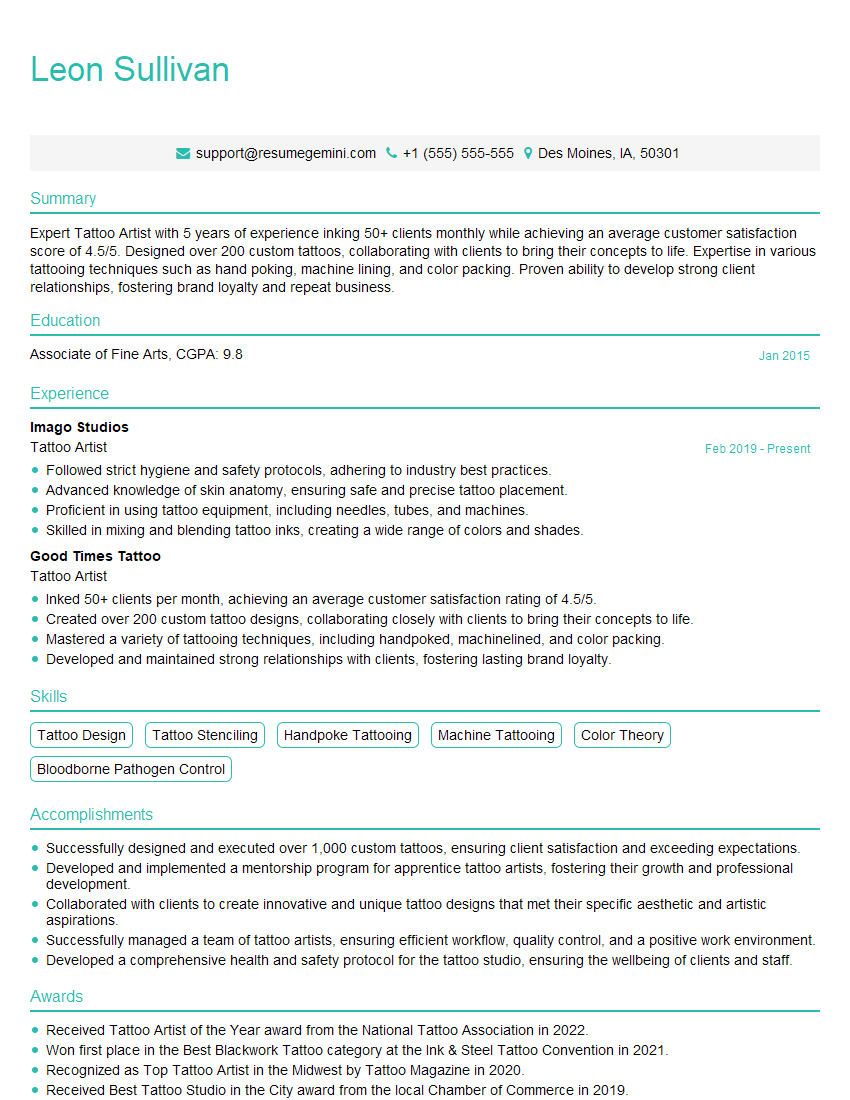
Mastering Tattoo Fine Line Designs opens doors to a rewarding career with high earning potential and creative freedom. A strong portfolio is crucial, but a well-crafted resume is your first impression. An ATS-friendly resume is essential for getting your application noticed by recruiters. To maximize your job prospects, leverage the power of ResumeGemini to create a professional and impactful resume. ResumeGemini offers valuable tools and resources, including examples of resumes tailored to the Tattoo Fine Line Designs field, to help you stand out from the competition.
Explore more articles
Users Rating of Our Blogs
Share Your Experience
We value your feedback! Please rate our content and share your thoughts (optional).
What Readers Say About Our Blog
Very informative content, great job.
good