The thought of an interview can be nerve-wracking, but the right preparation can make all the difference. Explore this comprehensive guide to Telemetry Interpretation interview questions and gain the confidence you need to showcase your abilities and secure the role.
Questions Asked in Telemetry Interpretation Interview
Q 1. Explain the principles of electrocardiography (ECG).
Electrocardiography (ECG or EKG) is a non-invasive diagnostic procedure that measures the electrical activity of the heart over time. It works on the principle that the heart’s electrical impulses cause the muscles to contract, and these electrical signals can be detected on the body’s surface. These signals are amplified and displayed as waveforms on an ECG tracing. The tracing shows the various phases of the cardiac cycle, allowing clinicians to assess the heart’s rhythm, rate, and overall electrical conduction. Think of it like a map of the heart’s electrical highway – showing if traffic (electrical impulses) is flowing smoothly or encountering delays or blockages.
The ECG provides invaluable information about the heart’s health, helping diagnose conditions like arrhythmias (irregular heartbeats), ischemia (reduced blood flow), myocardial infarction (heart attack), and electrolyte imbalances. By analyzing the waves (P, QRS, T), intervals (PR, QRS, QT), and segments (ST), healthcare professionals can pinpoint the location and nature of cardiac abnormalities.
Q 2. Describe the different ECG leads and their placement.
Standard ECGs utilize 12 leads, each providing a different perspective of the heart’s electrical activity. These leads are categorized into limb leads and precordial leads. The limb leads (I, II, III, aVR, aVL, aVF) use electrodes placed on the limbs to detect electrical signals from different angles. The precordial leads (V1-V6) use electrodes placed on the chest wall, providing a more detailed view of the heart’s anterior and lateral surfaces.
- Limb Leads: I: Right arm (-) to left arm (+); II: Right arm (-) to left leg (+); III: Left arm (-) to left leg (+); aVR, aVL, aVF are augmented leads, providing views from different perspectives.
- Precordial Leads: V1: 4th intercostal space, right sternal border; V2: 4th intercostal space, left sternal border; V3: Midway between V2 and V4; V4: 5th intercostal space, mid-clavicular line; V5: 5th intercostal space, anterior axillary line; V6: 5th intercostal space, mid-axillary line.
Precise electrode placement is crucial for accurate ECG interpretation. Improper placement can lead to misinterpretations of the tracing.
Q 3. Interpret a normal sinus rhythm ECG tracing.
A normal sinus rhythm (NSR) is characterized by a regular rhythm originating from the sinoatrial (SA) node, the heart’s natural pacemaker. The ECG tracing shows:
- Rate: 60-100 beats per minute (bpm)
- Rhythm: Regular
- P waves: Upright, consistent in shape and morphology, and one P wave preceding each QRS complex. This indicates normal atrial depolarization.
- PR interval: 0.12-0.20 seconds (3-5 small boxes), representing the time it takes for the electrical impulse to travel from the SA node to the ventricles.
- QRS complex: Narrow (less than 0.12 seconds), indicating normal ventricular depolarization.
- QT interval: Variable, but generally within normal limits.
Imagine a well-orchestrated symphony; each instrument (atria and ventricles) plays its part at the right time and in the right order, creating a harmonious rhythm.
Q 4. Interpret a sinus tachycardia ECG tracing.
Sinus tachycardia is a rapid heart rhythm originating from the SA node. The ECG will show:
- Rate: Greater than 100 bpm
- Rhythm: Usually regular
- P waves: Upright, consistent, and one P wave preceding each QRS complex
- PR interval: Normal (0.12-0.20 seconds)
- QRS complex: Normal (less than 0.12 seconds)
This can be caused by various factors, including exercise, stress, fever, dehydration, and certain medical conditions. Think of it as the heart ‘speeding up’ – perhaps from a demanding physical activity or an anxious situation.
Q 5. Interpret a sinus bradycardia ECG tracing.
Sinus bradycardia is a slow heart rhythm originating from the SA node. The ECG tracing exhibits:
- Rate: Less than 60 bpm
- Rhythm: Usually regular
- P waves: Upright, consistent, and one P wave preceding each QRS complex
- PR interval: Normal (0.12-0.20 seconds)
- QRS complex: Normal (less than 0.12 seconds)
While sometimes normal in athletes or during sleep, it can indicate underlying issues if symptomatic. Imagine the heart beating more slowly than usual; if this rhythm becomes too slow, it may not effectively circulate blood throughout the body.
Q 6. Interpret an atrial fibrillation ECG tracing.
Atrial fibrillation (AFib) is a common arrhythmia characterized by chaotic and irregular atrial activity. The ECG shows:
- Rate: Irregularly irregular ventricular rate
- Rhythm: Irregularly irregular
- P waves: Absent; instead, there are fibrillatory waves (f waves) which are small, erratic, and irregular waves.
- PR interval: Not measurable due to absent P waves.
- QRS complex: Usually normal, unless there are underlying conduction abnormalities.
The heart’s upper chambers (atria) quiver instead of beating in a coordinated fashion. This can lead to blood clots and an increased risk of stroke.
Q 7. Interpret an atrial flutter ECG tracing.
Atrial flutter is an arrhythmia with a rapid, regular atrial rhythm. The ECG demonstrates:
- Rate: Atrial rate is usually between 250-350 bpm; ventricular rate is variable and depends on the AV node conduction.
- Rhythm: Regularly irregular (atrial rhythm is regular but ventricular rhythm is irregular because of AV node block).
- P waves: Absent; instead, there are characteristic “sawtooth” flutter waves (F waves).
- PR interval: Not measurable due to absent distinct P waves.
- QRS complex: Usually normal unless there is a conduction abnormality.
Imagine a rapid, rhythmic fluttering of the atria, causing an irregular heartbeat. This often requires medical intervention.
Q 8. Interpret a ventricular tachycardia ECG tracing.
Ventricular tachycardia (VT) is a rapid heart rhythm originating from the ventricles. On an ECG, it’s characterized by three or more consecutive premature ventricular complexes (PVCs) with a rate typically exceeding 100 beats per minute. The QRS complexes are wide (>0.12 seconds) and bizarre in morphology, meaning they look different from the normal heartbeats. The P waves are often absent or dissociated from the QRS complexes, meaning they don’t have a clear relationship to the ventricular contractions. This means the atria and ventricles are beating independently.
Imagine a drummer playing a frantic, irregular beat—that’s similar to the erratic rhythm of VT on an ECG. The wide, distorted QRS complexes represent the ventricles struggling to pump blood efficiently. This can be life-threatening because the heart isn’t pumping blood effectively to the body. Treatment involves immediate intervention, often with cardioversion (a shock to reset the heart rhythm) or medication to slow the heart rate.
Example: A tracing showing QRS complexes consistently wider than 0.12 seconds, occurring at a rate of 150 bpm, with no discernible P waves would be indicative of ventricular tachycardia.
Q 9. Interpret a ventricular fibrillation ECG tracing.
Ventricular fibrillation (VF) is a chaotic, disorganized electrical activity in the ventricles. It’s a life-threatening arrhythmia because the ventricles are not contracting effectively, preventing any meaningful blood flow to the body. The ECG shows a completely irregular pattern, with no discernible P waves, QRS complexes, or T waves. It’s characterized by a coarse or fine wavy baseline, lacking any organized rhythm.
Think of it like a tangled ball of yarn – the electrical signals are all over the place, not coordinating effectively. The heart is quivering instead of pumping. The patient will be unresponsive and pulseless. Immediate defibrillation is critical to restore a normal heart rhythm; CPR is also essential.
Example: An ECG tracing exhibiting an irregular, wavy baseline with complete absence of identifiable P waves, QRS complexes, and T waves clearly depicts ventricular fibrillation.
Q 10. Interpret a premature ventricular contraction (PVC) ECG tracing.
A premature ventricular contraction (PVC) is an extra heartbeat originating from the ventricles before the next expected beat from the sinoatrial (SA) node – the heart’s natural pacemaker. On the ECG, a PVC appears as a wide (usually >0.12 seconds) and bizarre QRS complex that is premature; it interrupts the normal rhythm. The P wave may be absent or buried within the QRS complex. Following a PVC, there is often a compensatory pause, meaning the heart pauses slightly before resuming its normal rhythm.
Imagine a car that unexpectedly sputters and jolts before smoothly continuing its journey; this is similar to the interruption of the heart’s normal rhythm by a PVC. In healthy individuals, occasional PVCs are usually benign. However, frequent PVCs can indicate underlying heart conditions.
Example: A normal sinus rhythm with a sudden wide, bizarre QRS complex followed by a pause is a classic example of a PVC.
Q 11. Interpret a premature atrial contraction (PAC) ECG tracing.
A premature atrial contraction (PAC) is an extra heartbeat that originates in the atria before the next expected beat from the SA node. On an ECG, a PAC is characterized by a premature P wave that has a different morphology from the normal P waves. The P wave is followed by a QRS complex which might be normal or slightly abnormal depending on the pathway the impulse takes through the heart. There is often a short compensatory pause after the PAC.
Think of it as an early bird chirping before the usual sunrise chorus – it’s an extra beat that disrupts the regular pattern, but usually not significant. Most healthy individuals experience occasional PACs. Frequent PACs can sometimes indicate underlying heart conditions, although it is often benign.
Example: A regular sinus rhythm with a sudden premature P wave that looks different from the normal P waves and is followed by a QRS complex depicts a PAC.
Q 12. Differentiate between ST-segment elevation and depression.
The ST segment is the isoelectric line on an ECG that connects the end of the QRS complex (ventricular depolarization) to the beginning of the T wave (ventricular repolarization). ST-segment elevation signifies that the segment is elevated above the isoelectric line, while ST-segment depression signifies that it’s depressed below it.
Imagine a flat road; elevation represents a rise above the road level, while depression means a dip below it. These changes can indicate significant cardiac events.
Q 13. Explain the significance of ST-segment changes.
ST-segment changes are crucial indicators of myocardial ischemia (reduced blood flow to the heart muscle) or injury. ST-segment elevation is often associated with acute myocardial infarction (heart attack), where there’s a complete blockage of a coronary artery. ST-segment depression can suggest myocardial ischemia, often caused by reduced blood flow, possibly due to coronary artery disease. The magnitude and location of the ST-segment changes help pinpoint the affected area of the heart.
The significance lies in their indication of potential life-threatening situations demanding immediate medical attention. The location of the ST-segment changes helps to localize the affected area of the heart, assisting in the diagnosis and management of the problem.
Q 14. Describe the characteristics of a myocardial infarction (MI) on an ECG.
An ECG showing myocardial infarction (MI) typically presents with ST-segment elevation in the leads corresponding to the affected area of the heart. This elevation is usually significant, typically >1mm in at least two contiguous leads. The QRS complexes might show pathological Q waves (abnormally deep Q waves), indicative of necrosis (death of heart muscle tissue) and appearing after the acute phase. Inverted T waves and abnormal Q waves (significant in size) are also often present. The appearance of these changes varies depending on the size, location, and time elapsed since the MI occurred.
The changes reflect the electrical abnormalities caused by the death of heart muscle cells due to lack of oxygen supply. Immediate medical intervention is required to restore blood flow, thereby limiting the damage to the heart muscle and preventing complications.
Example: ST-segment elevation of 2mm in leads II, III, and aVF, with reciprocal ST depression in leads I and aVL, may suggest an inferior wall MI. The presence of pathological Q waves in those leads further supports the diagnosis post-acute phase.
Q 15. Explain the use of telemetry in the detection and management of cardiac arrhythmias.
Telemetry, the remote monitoring of patients’ vital signs, plays a crucial role in detecting and managing cardiac arrhythmias. It allows continuous observation of the heart’s electrical activity, enabling early identification of potentially life-threatening irregularities. For example, a patient recovering from a heart attack might be placed on telemetry to monitor for dangerous arrhythmias like ventricular tachycardia or fibrillation. The continuous ECG data provides immediate alerts to healthcare professionals, allowing for swift intervention. This is particularly important because many arrhythmias, if left untreated, can lead to stroke, heart failure, or sudden cardiac death.
Telemetry systems detect arrhythmias by analyzing the ECG waveform, looking for deviations from normal sinus rhythm. Specific arrhythmias have characteristic patterns. For instance, atrial fibrillation shows a chaotic, irregular rhythm, while ventricular tachycardia presents as a rapid, regular rhythm originating from the ventricles. Once an arrhythmia is detected, the system alerts the staff, allowing for prompt treatment with medication, cardioversion, or other interventions. The continuous data also helps assess the efficacy of treatment and adjust the management plan as needed. Imagine it as a silent guardian constantly watching for any irregularities in the heart’s rhythm.
Career Expert Tips:
- Ace those interviews! Prepare effectively by reviewing the Top 50 Most Common Interview Questions on ResumeGemini.
- Navigate your job search with confidence! Explore a wide range of Career Tips on ResumeGemini. Learn about common challenges and recommendations to overcome them.
- Craft the perfect resume! Master the Art of Resume Writing with ResumeGemini’s guide. Showcase your unique qualifications and achievements effectively.
- Don’t miss out on holiday savings! Build your dream resume with ResumeGemini’s ATS optimized templates.
Q 16. What are the common artifacts seen on an ECG and how are they identified?
Artifacts on an ECG are distortions or abnormalities in the waveform that aren’t related to the heart’s electrical activity. These can significantly impede accurate interpretation. They can be caused by various factors, including patient movement, electrode placement issues, electrical interference, and equipment malfunctions.
- Patient Movement: Muscle tremors, shifting, or even breathing can create wandering baseline, irregular waveforms, or extra deflections.
- Electrode Placement: Poor skin preparation or loose electrodes cause wandering baseline and attenuated waveforms.
- Electrical Interference: Nearby electrical equipment (like cell phones or machines) can introduce noise, creating erratic spikes or oscillations.
- Electrode Gel: Insufficient or drying gel may cause high-frequency noise.
Identifying artifacts requires careful observation of the ECG tracing. Artifacts often have a characteristic appearance, distinguishing them from actual cardiac rhythms. For instance, muscle tremors often produce irregular, high-frequency waves, while electrical interference typically presents as regular, uniform spikes. Careful review of the entire tracing and considering the patient’s condition and environment are crucial in differentiating artifacts from true cardiac events.
Q 17. How do you troubleshoot issues with ECG equipment?
Troubleshooting ECG equipment involves a systematic approach. The first step is to verify that the device is properly connected and powered on. This includes checking the leads, electrodes, and connections to the monitoring system. Then, we assess the quality of the ECG signal on the monitor. Is the signal clear and steady, or are there artifacts?
- Check Connections: Examine all leads, electrodes, and cables for any loose connections or damage. Ensure proper skin preparation and electrode placement.
- Inspect Electrodes: Replace any damaged or loose electrodes and ensure sufficient gel. Consider using different types of electrodes if necessary.
- Assess the Signal: Look for artifacts like muscle tremor or electrical interference. Try moving the patient away from potential sources of interference. Consider changing the electrode placement.
- Evaluate Equipment: Check for any error messages or indicators on the monitor itself. If problems persist, it might be necessary to check the ECG machine calibration or contact the biomedical engineering department for a service call.
For example, if I encounter a wandering baseline, I would first check the electrode connections and skin preparation. If the problem persists, I would investigate for possible sources of electrical interference. If the problem continues after all these troubleshooting steps, I will contact the biomedical engineering department to assess the machine itself.
Q 18. Explain the process of escalating critical ECG findings to the appropriate medical personnel.
Escalating critical ECG findings is a crucial aspect of patient safety. The process involves immediate notification of the appropriate healthcare personnel – typically the attending physician or a designated rapid response team. The urgency depends entirely on the severity of the arrhythmia.
For immediately life-threatening rhythms such as ventricular fibrillation or pulseless ventricular tachycardia, immediate cardiopulmonary resuscitation (CPR) is initiated, and the code team is called immediately. For other critical but less immediately life-threatening arrhythmias, such as sustained ventricular tachycardia, the attending physician is alerted immediately. A clear and concise report is essential, including the patient’s name, room number, the observed rhythm, and the patient’s current status. I would use standardized communication, like SBAR (Situation, Background, Assessment, Recommendation) to ensure clear and efficient communication. For instance, I might say: “This is the telemetry technician. I am reporting a patient in Room 302 showing sustained ventricular tachycardia. The patient is conscious but hypotensive. I recommend immediate physician assessment and possible cardioversion.”
Q 19. Describe your experience with different types of telemetry systems.
Throughout my career, I have extensive experience with various telemetry systems, including bedside monitors, central monitoring stations, and wireless telemetry systems. Bedside monitors offer continuous ECG monitoring for individual patients, providing real-time data at the patient’s bedside. Central monitoring stations allow a single nurse to monitor multiple patients simultaneously, improving efficiency and providing a centralized overview of the unit’s cardiac status. Wireless telemetry systems provide the advantage of mobility, allowing patients more freedom while still maintaining continuous cardiac monitoring. I’ve worked with both traditional wired systems and modern wireless solutions from various manufacturers, gaining proficiency in their specific functionalities and troubleshooting techniques. My experience extends to both traditional 5-lead systems, often used in hospitals and cardiac units, and more advanced 12-lead systems that are especially useful for comprehensive ECG analysis.
Q 20. Discuss your understanding of heart rate variability (HRV).
Heart rate variability (HRV) refers to the variations in the time intervals between successive heartbeats. It reflects the balance between the sympathetic (fight-or-flight) and parasympathetic (rest-and-digest) branches of the autonomic nervous system. A healthy autonomic nervous system demonstrates significant HRV, indicating adaptability and resilience. Low HRV, however, is often associated with increased risk of cardiovascular events, and is an indicator of impaired autonomic function. HRV analysis involves examining the patterns of these variations, typically using techniques like spectral analysis to quantify high-frequency, low-frequency, and very-low-frequency components of the heart rate.
For example, a high-frequency component of HRV indicates greater parasympathetic activity, which is associated with a more relaxed state. Conversely, a low-frequency component usually reflects sympathetic activity and is often higher in individuals experiencing stress or anxiety. Clinically, HRV measurements can help assess risk stratification for various cardiovascular diseases and serve as a potential marker for monitoring the effectiveness of treatments.
Q 21. Explain your knowledge of Holter monitoring and event recorders.
Holter monitoring and event recorders are ambulatory ECG monitoring techniques used for detecting intermittent cardiac arrhythmias or ischemic episodes that might be missed during a routine ECG. A Holter monitor continuously records the ECG for 24-48 hours, allowing for the detection of arrhythmias that occur sporadically. The patient keeps a diary documenting symptoms and activities, which is then correlated with the ECG recording.
Event recorders, on the other hand, are smaller and more patient-friendly devices. They record ECG data only when triggered by the patient, upon the occurrence of symptoms. Some advanced event recorders even automatically detect potentially significant arrhythmias. The information is stored in the device and can be downloaded later for analysis. Both Holter monitoring and event recorders are valuable tools in diagnosing a wide range of cardiac conditions. The choice between the two depends on the specific clinical question and the patient’s symptoms.
Q 22. How do you handle a situation where there is a discrepancy between the telemetry monitor and the patient’s clinical presentation?
Discrepancies between telemetry readings and a patient’s clinical presentation are a critical concern requiring immediate attention. It’s like having two pieces of a puzzle that don’t quite fit. The first step is to meticulously re-evaluate the telemetry data: check lead placement, ensure proper signal quality, and verify the calibration of the equipment. Then, we must reassess the patient’s clinical picture—vital signs, level of consciousness, skin color, and any subjective complaints. For example, a patient might report chest pain, but their ECG might show only sinus rhythm. This could indicate the pain is non-cardiac in origin, such as musculoskeletal pain, or that the cardiac event is subtle and requires further investigation (e.g., enzymatic studies, echocardiogram). If the discrepancy persists after this reassessment, I would immediately consult with the attending physician or a senior colleague. This collaborative approach is essential to ensure the patient receives the correct diagnosis and treatment. We may also need to consider additional testing, such as a 12-lead ECG or continuous cardiac monitoring with advanced features like ST-segment analysis to resolve the inconsistency.
Q 23. Explain the importance of documentation in telemetry interpretation.
Thorough documentation in telemetry interpretation is paramount for ensuring patient safety, facilitating effective communication among the healthcare team, and providing a comprehensive record for legal and quality assurance purposes. Every observation, analysis, and clinical action related to the telemetry data must be documented accurately and precisely. This includes noting the time, specific ECG findings (e.g., arrhythmias, ST-segment changes), patient’s clinical status, interventions implemented (e.g., medication administration, notification of the physician), and the physician’s response. For instance, meticulously documenting an episode of atrial fibrillation, including its duration, rate, and patient response, enables a clear understanding of the event’s significance and its impact on the patient. This comprehensive documentation not only safeguards the patient but also protects the healthcare professionals involved by providing a clear and accountable record of the care provided.
Q 24. What are some safety considerations in telemetry monitoring?
Patient safety is the top priority in telemetry monitoring. Key safety considerations include:
- Proper lead placement and skin preparation: Incorrect lead placement can lead to inaccurate readings and misinterpretations. Proper skin preparation minimizes artifact and ensures good signal quality.
- Regular monitoring of signal quality: Frequent checks for signal artifacts, such as muscle tremor or electrical interference, are crucial to ensure reliable data.
- Prompt recognition and response to critical events: Immediate identification of significant arrhythmias, ST-segment elevation, or other critical changes in the ECG tracing is vital, triggering timely interventions and physician notification.
- Effective alarm management: Proper alarm settings and response protocols are essential to prevent alarm fatigue and ensure timely intervention. Regular review and adjustment of alarm parameters are vital.
- Patient education and reassurance: Explaining the purpose of the monitoring process and addressing patient concerns can help reduce anxiety and improve compliance.
- Infection control measures: Following proper hygiene protocols during lead placement and removal helps prevent infections.
Adherence to these safety guidelines ensures accurate interpretation and appropriate responses to evolving patient conditions.
Q 25. Describe your experience working in a high-pressure environment.
In my previous role at a busy urban hospital, I frequently worked in a high-pressure environment with multiple simultaneous critical patients. During a particularly hectic night, we had a surge of patients arriving with cardiac events. I maintained focus by prioritizing critical patients based on their ECG findings and clinical presentation, effectively communicating with the nursing staff and promptly escalating critical findings to physicians. Utilizing established protocols, I streamlined my workflow, prioritizing tasks, and delegating appropriately to other team members while maintaining an organized and efficient approach. This situation tested my ability to manage multiple tasks, handle pressure, and make quick decisions under stress, highlighting the importance of clear communication and efficient workflow in a demanding environment. I thrived in this fast-paced setting and consistently delivered accurate interpretations, leading to appropriate and timely clinical interventions.
Q 26. Describe your ability to work independently and as part of a team.
I am equally comfortable working independently and collaboratively as part of a team. Independent work requires meticulous attention to detail and self-motivation. I can effectively manage my workload, prioritize tasks, and meet deadlines autonomously. However, I also understand the value of teamwork. I actively contribute to team discussions, offering my expertise and perspectives while actively listening to and learning from colleagues. A recent example involved a complex case of a patient with an unusual arrhythmia. Working independently, I analyzed the telemetry data and narrowed down the possibilities. Then, I collaborated with a cardiologist and other nurses, sharing my findings and incorporating their insights to reach a definitive diagnosis. This synergy led to a more accurate interpretation and effective patient care, demonstrating my ability to both contribute independently and thrive within a collaborative team environment.
Q 27. How do you stay updated on the latest advancements in telemetry technology and interpretation?
Staying updated in the rapidly evolving field of telemetry technology and interpretation requires a multifaceted approach. I regularly attend professional conferences and webinars focused on cardiology and critical care. I am a member of professional organizations such as the American Heart Association (AHA), which offers continuous education resources and publications on the latest advancements. I also actively pursue continuing medical education (CME) credits to stay abreast of the latest diagnostic techniques and clinical guidelines. Additionally, I regularly review relevant medical journals and online resources, focusing on peer-reviewed articles and updates from leading experts. Keeping my knowledge current is crucial, not only for maintaining a high level of clinical competence but also for ensuring patient safety and providing the best possible care.
Q 28. Describe a challenging case you faced in telemetry interpretation and how you resolved it.
One challenging case involved a patient presenting with recurrent episodes of syncope (fainting). Their telemetry showed occasional premature ventricular contractions (PVCs), but these didn’t seem sufficient to explain the syncope. The initial interpretation was inconclusive. To resolve this, I systematically reviewed the telemetry recordings, paying close attention to the timing of the PVCs relative to the syncopal episodes. I noticed a pattern: the syncope occurred only during episodes of prolonged runs of PVCs, leading to a significant drop in blood pressure. I also reviewed the patient’s medical history, discovering a family history of long QT syndrome (LQTS), a condition known to cause syncope and potentially life-threatening arrhythmias. This suspicion was confirmed with further testing, such as ECG analysis for QT interval prolongation. This case demonstrated the importance of detailed analysis of telemetry data in conjunction with a comprehensive review of the patient’s clinical history and family history. The appropriate diagnosis and subsequent management of LQTS prevented potentially fatal outcomes and highlighted the importance of systematic investigation and careful consideration of multiple factors in complex cases.
Key Topics to Learn for Telemetry Interpretation Interview
- ECG Rhythm Recognition: Mastering the identification of normal sinus rhythm, atrial fibrillation, atrial flutter, ventricular tachycardia, and other common arrhythmias. Practice interpreting different leads and recognizing subtle variations.
- Electrocardiogram (ECG) Waveform Analysis: Understand the P wave, QRS complex, T wave, and ST segment. Learn to analyze their morphology and relationship to identify ischemia, infarction, and electrolyte imbalances.
- Hemodynamic Monitoring: Familiarize yourself with the interpretation of arterial blood pressure, central venous pressure, pulmonary artery pressure, and cardiac output. Understand the physiological implications of these measurements.
- Cardiac Output and Indices: Understand how to calculate and interpret cardiac index, stroke volume, and systemic vascular resistance. Know how these values relate to overall cardiovascular function.
- Interpretation of Artifact: Learn to identify and differentiate between various artifacts (e.g., muscle tremor, electrical interference) that can affect ECG readings. Know how to mitigate their impact on interpretation.
- Clinical Correlation: Practice applying your knowledge of ECG interpretation to real-world clinical scenarios. Understand how ECG findings correlate with patient symptoms and other diagnostic information.
- Troubleshooting and Problem-Solving: Develop your skills in identifying inconsistencies and potential errors in ECG tracings. Be prepared to explain your reasoning and justify your interpretations.
- Advanced ECG Concepts (Optional): Depending on the seniority of the role, you may want to explore topics such as bundle branch blocks, Wolff-Parkinson-White syndrome, and other complex arrhythmias.
Next Steps
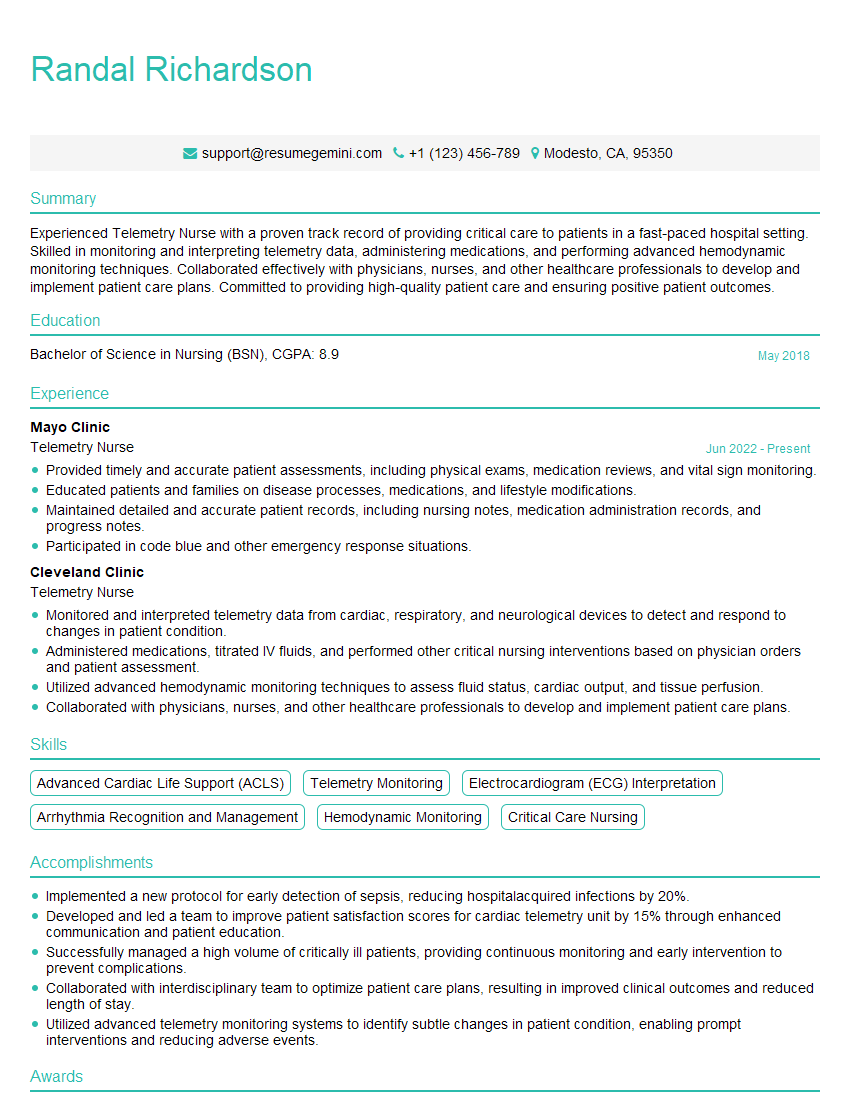
Mastering Telemetry Interpretation is crucial for career advancement in healthcare, opening doors to specialized roles and increased responsibility. A strong understanding of this skill demonstrates a commitment to patient care and technical expertise. To significantly boost your job prospects, focus on creating an ATS-friendly resume that highlights your abilities. ResumeGemini is a trusted resource to help you craft a professional and impactful resume. They offer examples of resumes tailored to Telemetry Interpretation to guide you, ensuring your application stands out.
Explore more articles
Users Rating of Our Blogs
Share Your Experience
We value your feedback! Please rate our content and share your thoughts (optional).
What Readers Say About Our Blog
Very informative content, great job.
good