Interviews are opportunities to demonstrate your expertise, and this guide is here to help you shine. Explore the essential Test Case Management and Execution interview questions that employers frequently ask, paired with strategies for crafting responses that set you apart from the competition.
Questions Asked in Test Case Management and Execution Interview
Q 1. Explain the difference between Test Cases and Test Scripts.
While the terms ‘test case’ and ‘test script’ are often used interchangeably, there’s a crucial distinction. A test case is a documented set of steps that detail how to test a specific aspect of a software application. It outlines the preconditions, test steps, expected results, and postconditions. Think of it as a recipe for testing. A test script, on the other hand, is an automated version of a test case. It’s a program (often written in languages like Python, Java, or JavaScript) that executes the steps defined in a test case automatically. Essentially, a test script is the automated execution of a test case.
Example: Let’s say we’re testing a login feature. A test case might describe steps like: 1. Enter a valid username, 2. Enter a valid password, 3. Click the login button, 4. Expect to be redirected to the user’s homepage. A test script would automate these steps using a programming language, potentially verifying the expected outcome through code.
Q 2. Describe your experience with different test case design techniques (e.g., equivalence partitioning, boundary value analysis).
I’ve extensively used various test case design techniques throughout my career. Equivalence Partitioning helps me divide input data into groups (partitions) that are expected to be treated similarly by the system. For example, testing a field accepting ages would involve partitions for valid ages (0-120), negative ages, and non-numeric inputs. I then select representative values from each partition for testing. Boundary Value Analysis focuses on testing values at the edges of each partition. In the age example, I’d test 0, 1, 119, 120, -1, and a non-numeric value, as these are more likely to reveal defects. I also utilize Decision Table Testing, particularly useful when dealing with complex logic involving multiple conditions and their resulting actions, and State Transition Testing for systems that transition between different states. The choice of technique depends greatly on the context and complexity of the application under test.
Q 3. How do you prioritize test cases for execution?
Test case prioritization is critical for maximizing the value of testing within time constraints. My approach involves a multi-faceted strategy. First, I identify critical functionalities – those directly impacting core user workflows or the system’s stability. Test cases covering these features are prioritized highly. Next, I consider risk. Features with higher chances of failure or with significant business impact receive higher priority. I also assess business value – features providing major value to the user or business get top priority. Finally, I use a combination of risk-based and business value-based prioritization to create a ranked list of test cases. Tools like Jira and TestRail greatly aid in this process, letting me assign priorities (high, medium, low) and track progress.
Q 4. Explain your approach to managing test data.
Managing test data is paramount for reliable testing. My approach starts with understanding the data requirements of each test case. I create a test data management plan that outlines the sources, types, and volume of data needed. Then I either use existing data (carefully sanitized to protect sensitive information) or create synthetic data that mimics real-world scenarios but avoids sensitive information. For managing large datasets, I utilize database tools to create and manage test data efficiently. I also ensure data isolation; test data should not affect production data, and vice-versa. Data masking techniques are employed to protect sensitive data elements while maintaining data integrity for testing purposes. The goal is to have clean, consistent, and readily available test data that accurately represents real-world usage patterns.
Q 5. How do you handle defects found during testing?
When a defect is found, my process begins with clear and concise documentation. I use a defect tracking system (like Jira) to log the defect, providing detailed steps to reproduce, actual results versus expected results, severity (critical, major, minor), and priority. I include relevant screenshots or logs to aid in understanding the issue. Once reported, I verify the defect with a second test to ensure it’s not a one-off occurrence. I then monitor the defect’s status through its lifecycle (assigned, fixed, retested, closed) and communicate with the development team for updates and clarifications. A crucial aspect is ensuring the defect is properly fixed; I retest the bug after the fix to verify it has been resolved effectively. I also track the resolution times and analyze them to identify trends or areas for process improvement.
Q 6. Describe your experience with test management tools (e.g., Jira, TestRail, ALM).
I have extensive experience with various test management tools, including Jira, TestRail, and HP ALM (now Micro Focus ALM). Jira is excellent for managing both requirements and defects within an agile environment; its flexibility allows for seamless integration with development workflows. TestRail excels specifically in test case management; its user-friendly interface and reporting capabilities are valuable for tracking test execution progress and generating comprehensive test reports. ALM provides a more comprehensive solution, managing the entire software development lifecycle, including requirements management, test planning, execution, and defect tracking. My choice of tool depends on the project’s size, methodology, and overall organizational structure. I’m proficient in using these tools to create test plans, manage test cases, track execution, and generate reports.
Q 7. How do you ensure test coverage?
Ensuring adequate test coverage is crucial for releasing high-quality software. My approach uses multiple strategies. First, I start with requirements analysis; each requirement needs corresponding test cases to verify its fulfillment. This ensures requirements traceability. Then, I use risk analysis to identify high-risk areas and allocate more test cases there. I also utilize test coverage metrics; these could be functional coverage (percentage of requirements tested) or code coverage (percentage of code executed during testing), allowing me to measure the effectiveness of our testing efforts. Reviewing test cases among team members is critical for ensuring all scenarios have been considered and for identifying blind spots. Continuous monitoring and improvement of our test coverage strategy is key; we regularly analyze results to improve future testing cycles.
Q 8. How do you measure the effectiveness of your testing efforts?
Measuring the effectiveness of testing efforts goes beyond simply finding bugs. It’s about understanding the overall impact on software quality and project success. I use a multi-faceted approach, focusing on key metrics.
- Defect Density: This measures the number of defects found per lines of code or function points. A lower defect density indicates better quality. For example, a project with 50 defects per 1000 lines of code has a higher defect density than one with 10 defects per 1000 lines of code, suggesting the latter had more effective testing.
- Defect Severity: Categorizing defects by severity (critical, major, minor) helps prioritize fixes and understand the impact of undetected defects. A high proportion of critical defects points to weaknesses in testing strategies.
- Test Coverage: This metric assesses the percentage of code or requirements covered by test cases. High test coverage, ideally approaching 100%, provides confidence that the software has been thoroughly tested, though it doesn’t guarantee the absence of defects.
- Test Execution Efficiency: I track the time taken to execute test cases and identify areas for improvement in test automation or test case design. This helps optimize testing processes and increase efficiency.
- Customer Satisfaction: Post-release feedback from users helps determine the effectiveness of testing in preventing production issues. A low number of reported bugs after release is a strong indicator of successful testing.
By regularly monitoring these metrics, I can identify trends, pinpoint areas needing improvement, and demonstrate the value of testing throughout the software development lifecycle. For instance, if defect density consistently increases in a specific module, it might indicate a need for more thorough testing or improved coding practices in that area.
Q 9. What are some common challenges you face in test case management?
Test case management, while crucial, faces several challenges. These challenges often interrelate and require careful management.
- Maintaining Up-to-Date Test Cases: As software evolves, test cases need regular updates to reflect changes in functionality and requirements. This can be time-consuming and requires careful version control. For example, a minor change in the UI might necessitate updates across multiple test cases.
- Test Data Management: Creating and managing realistic and consistent test data can be a significant overhead, especially for complex systems. Managing sensitive data requires careful consideration of security and compliance regulations.
- Collaboration and Communication: Effective test case management relies on strong communication between developers, testers, and other stakeholders. Difficulties in sharing information and coordinating testing efforts can lead to delays and errors.
- Tool Selection and Integration: Choosing and implementing the right test case management tool can be challenging. Integrating the tool with other development tools and systems is crucial for streamlined workflow.
- Tracking and Reporting: Effectively tracking test execution, defect reporting, and generating meaningful reports to demonstrate testing progress and effectiveness can be a complex task requiring the use of appropriate reporting tools.
Addressing these challenges involves adopting best practices, using appropriate tools, and fostering a collaborative environment within the testing team. For example, using a robust test management system with version control and clear communication channels significantly mitigates these challenges.
Q 10. Explain your experience with different testing methodologies (e.g., Agile, Waterfall).
I have extensive experience with both Agile and Waterfall methodologies, understanding their strengths and weaknesses in relation to testing.
Waterfall: In Waterfall, testing is typically a distinct phase that occurs after development is complete. This allows for thorough testing but can lead to late defect discovery and costly rework. I’ve managed testing in Waterfall projects by meticulously planning test cases based on detailed requirements specifications and using robust test documentation.
Agile: Agile embraces iterative development and continuous testing. Testing is integrated throughout the development process, often involving short sprints with frequent feedback loops. My Agile experience includes implementing test-driven development (TDD) and using practices like Behavior-Driven Development (BDD) to ensure alignment between development and testing efforts. This approach promotes early defect detection and reduces the risk of significant issues emerging later in the development cycle. I’ve successfully utilized tools like Jira and TestRail for managing test cases and tracking progress in Agile environments.
Regardless of the methodology, my focus is on adapting the testing approach to meet the specific needs and challenges of the project, ensuring that testing contributes effectively to delivering high-quality software.
Q 11. How do you handle conflicting priorities in testing?
Conflicting priorities in testing are a common occurrence. Effective prioritization is key to maximizing the value of testing efforts. I use a risk-based approach.
- Risk Assessment: I identify potential risks associated with each testing area. This considers factors like the impact of a failure, the likelihood of a failure, and the cost of fixing it.
- Prioritization Matrix: I use a matrix (e.g., a simple Risk x Impact matrix) to rank testing areas based on their risk profile. High-risk areas receive priority over lower-risk areas.
- Negotiation and Communication: I clearly communicate the risks and implications of neglecting certain testing areas to stakeholders. This often involves negotiating priorities based on available resources and project deadlines.
- Continuous Monitoring and Adjustment: I regularly monitor the progress of testing and make adjustments as needed. This might involve re-prioritizing testing efforts based on newly discovered risks or changing project circumstances.
For example, if a critical security vulnerability is discovered, I would prioritize security testing even if it means delaying other aspects of testing. This proactive approach ensures that the most important aspects of the software are adequately tested, even with resource constraints.
Q 12. Describe your experience with automated testing.
I have significant experience with automated testing, using it to improve efficiency and consistency. Automation is not a replacement for manual testing, but rather a powerful complement.
- Test Automation Frameworks: I am proficient in using various test automation frameworks such as Selenium (for web applications), Appium (for mobile applications), and JUnit/TestNG (for unit testing). I choose the appropriate framework based on the project’s needs.
- Test Automation Strategy: I develop a comprehensive test automation strategy, identifying which test cases are suitable for automation (those that are repetitive, time-consuming, and prone to human error) and which should remain manual (e.g., exploratory testing, usability testing).
- Continuous Integration/Continuous Delivery (CI/CD): I integrate automated tests into CI/CD pipelines to ensure continuous feedback and early detection of regressions. This helps maintain high software quality throughout the development process.
- Test Data Management: I employ techniques for managing test data effectively, including using test data generators and ensuring that test data is appropriately isolated and managed.
For instance, in a recent project, automating regression tests saved significant time and resources, allowing the team to focus on other testing activities. Automation also improved consistency and accuracy, reducing the number of human errors.
Q 13. How do you integrate testing into the development lifecycle?
Integrating testing into the development lifecycle is essential for delivering high-quality software. I advocate for a shift-left approach.
- Early Involvement: I actively participate in requirements gathering and design reviews, ensuring testability is considered from the outset. This includes reviewing requirements for clarity, completeness, and testability.
- Test-Driven Development (TDD): Where appropriate, I employ TDD, writing tests before writing code. This ensures that the code meets the specified requirements and promotes a strong focus on testing from the beginning.
- Continuous Integration (CI): I integrate automated tests into the CI pipeline, allowing for continuous feedback and early detection of regressions. This provides immediate feedback to developers and prevents bugs from propagating to later stages of development.
- Collaboration: I foster close collaboration between developers and testers, promoting a shared understanding of quality goals and fostering a collaborative debugging environment.
- Feedback Loops: I ensure that regular feedback loops are established to address identified issues and make necessary improvements to the software and testing process. This involves using appropriate tools to track defects and provide reports to stakeholders.
By embedding testing throughout the development lifecycle, rather than treating it as a separate phase, I significantly reduce the risk of defects and improve the overall quality of the software.
Q 14. Explain your experience with performance testing.
Performance testing is crucial for ensuring that software meets performance expectations under various load conditions. My experience encompasses different types of performance testing.
- Load Testing: I use load testing tools to simulate the expected user load on the application, identifying performance bottlenecks and potential points of failure under normal operating conditions. This helps determine the application’s capacity and stability.
- Stress Testing: I go beyond normal load to identify the breaking point of the application, determining its resilience under extreme conditions. This reveals the application’s behavior when pushed beyond its expected limits.
- Endurance Testing: I evaluate the application’s performance over extended periods to identify memory leaks or other degradation issues. This helps assess the long-term stability of the system under continuous load.
- Spike Testing: This involves simulating sudden, large increases in user load to observe the application’s responsiveness. This is particularly important for applications that experience unpredictable traffic spikes.
I use tools like JMeter and LoadRunner to conduct performance testing and analyze the results. I present findings clearly to stakeholders, including performance metrics, bottlenecks identified, and recommendations for improvement. For example, in a recent project, performance testing identified a database query that was causing significant slowdowns. By optimizing this query, we significantly improved the overall application performance.
Q 15. How do you create effective test reports?
Creating effective test reports is crucial for communicating the testing process’s health and results to stakeholders. A good report should be concise, informative, and easy to understand, even for those without a technical background. It needs to clearly present the status of testing, highlight key findings, and offer actionable insights.
My approach involves a structured format including:
- Executive Summary: A brief overview of the testing scope, objectives, and overall results (pass/fail rates, critical defects found).
- Test Coverage: Details on the extent of testing performed, including the number of test cases executed, requirements covered, and areas not tested (and why).
- Defect Analysis: A summary of detected defects, categorized by severity and priority, including their status (open, closed, fixed). I often use charts and graphs to visualize defect trends.
- Test Environment: Clear description of the hardware and software used for testing to ensure reproducibility.
- Metrics: Quantitative data like defect density, test execution time, and pass/fail ratios, providing objective measures of testing effectiveness.
- Recommendations: Suggestions for improvement, based on the testing findings, such as retesting areas with high defect concentration or prioritizing the fixing of critical bugs.
For example, in a recent project testing a new e-commerce platform, my report highlighted a critical defect causing payment processing failures. This report, with clear visuals and prioritized recommendations, ensured immediate action from the development team, avoiding a potential major launch issue.
Career Expert Tips:
- Ace those interviews! Prepare effectively by reviewing the Top 50 Most Common Interview Questions on ResumeGemini.
- Navigate your job search with confidence! Explore a wide range of Career Tips on ResumeGemini. Learn about common challenges and recommendations to overcome them.
- Craft the perfect resume! Master the Art of Resume Writing with ResumeGemini’s guide. Showcase your unique qualifications and achievements effectively.
- Don’t miss out on holiday savings! Build your dream resume with ResumeGemini’s ATS optimized templates.
Q 16. How do you ensure the quality of your test cases?
Ensuring high-quality test cases is vital for effective testing. This involves a systematic approach that goes beyond simply writing test steps. It’s about designing tests that are clear, concise, comprehensive, and maintainable.
My quality assurance process includes:
- Clear and Concise Test Cases: Each test case should have a unique ID, a clear objective, preconditions, steps, expected results, and postconditions. I avoid ambiguity and use simple, unambiguous language.
- Requirement Traceability: Every test case should be linked directly to a specific requirement, ensuring complete test coverage. This is often managed using a requirements traceability matrix.
- Peer Reviews: I always conduct peer reviews of test cases to identify potential gaps, inconsistencies, or areas for improvement. A fresh pair of eyes often catches details that I might miss.
- Test Case Reusability: I design test cases to be reusable across multiple testing cycles and platforms. This reduces redundancy and improves efficiency.
- Regular Updates: Test cases need to be updated as requirements change. I maintain a version control system to track changes and ensure everyone is using the most up-to-date version.
Think of it like baking a cake – you wouldn’t start baking without a well-tested recipe. Similarly, well-defined test cases are the recipe for a successful testing process.
Q 17. What are some metrics you use to track testing progress?
Tracking testing progress requires a combination of quantitative and qualitative metrics. These metrics give insight into the effectiveness and efficiency of the testing process and help in identifying potential problems early on.
Some key metrics I use include:
- Test Case Execution Rate: The percentage of test cases executed compared to the total number of test cases.
- Defect Density: The number of defects found per lines of code or per module. This helps in assessing the quality of the software.
- Defect Severity and Priority: Categorizing defects based on their impact and urgency helps prioritize fixing efforts.
- Test Coverage: The percentage of requirements or code covered by test cases.
- Test Execution Time: The total time taken to execute all test cases, which can indicate potential bottlenecks.
- Pass/Fail Ratio: The percentage of test cases that passed versus the percentage that failed.
I regularly report on these metrics using dashboards and charts, allowing stakeholders to easily understand the testing progress and identify potential risks.
Q 18. How do you handle changes in requirements during testing?
Changes in requirements during testing are inevitable and need to be managed effectively to prevent delays and ensure the quality of the final product. My approach involves:
- Impact Assessment: Carefully analyze the impact of each requirement change on existing test cases. This involves identifying which test cases need to be updated, added, or removed.
- Prioritization: Prioritize the changes based on their impact and urgency. Critical changes must be addressed immediately, while less critical changes might be handled later.
- Test Case Updates: Update the affected test cases to reflect the changes in requirements. This includes modifying existing test steps, adding new test cases, or removing obsolete ones.
- Regression Testing: Perform regression testing after incorporating the changes to ensure that the changes haven’t introduced new defects or broken existing functionality.
- Communication: Keep stakeholders informed of the changes and their impact on the testing timeline and budget. Transparent communication is crucial in managing expectations.
Imagine building a house – if the blueprint changes midway, adjustments are needed. Similarly, agile handling of requirement changes during testing is crucial for a successful project.
Q 19. How do you ensure traceability between requirements, test cases, and defects?
Ensuring traceability between requirements, test cases, and defects is essential for demonstrating that all requirements are tested and that identified defects are linked back to their root causes. This creates a clear audit trail and improves accountability.
I use several techniques to ensure this traceability:
- Requirements Traceability Matrix (RTM): This matrix provides a clear mapping between requirements, test cases, and defects. Each requirement is linked to the test cases that verify it, and each defect is linked to the test case that revealed it.
- Unique Identifiers: Assigning unique identifiers to requirements, test cases, and defects helps maintain a clear link between them throughout the testing process.
- Test Management Tools: Using test management tools such as Jira or TestRail helps automate the tracking of this information. These tools often have built-in features to facilitate traceability.
- Documentation: Maintaining clear and comprehensive documentation is crucial for preserving traceability information.
By implementing these methods, I can easily trace a defect back to the requirement it violated and the test case that uncovered it, making it easier to fix the problem and prevent similar issues from arising in the future.
Q 20. Describe your experience with risk-based testing.
Risk-based testing focuses on testing the most critical areas of the software first, prioritizing areas with the highest potential for risk and impact. This efficient approach helps optimize testing efforts and reduces the chances of critical defects making it to production.
My experience with risk-based testing involves:
- Risk Identification: Identifying potential risks associated with the software, such as functionality, security vulnerabilities, and performance issues.
- Risk Assessment: Assessing the likelihood and potential impact of each identified risk. This involves evaluating the severity and probability of failure.
- Risk Prioritization: Prioritizing testing efforts based on the risk assessment, focusing on high-risk areas first.
- Test Case Design: Designing test cases specifically targeting the high-risk areas, ensuring thorough testing of critical functionalities.
- Risk Mitigation: Implementing strategies to mitigate the identified risks, such as developing contingency plans or increasing testing coverage in high-risk areas.
In a recent project involving a banking application, risk-based testing allowed us to focus on security features and transaction processing, reducing the risk of critical financial losses and ensuring a secure launch. We prioritized testing these areas early and mitigated the risks significantly.
Q 21. How do you manage test environments?
Managing test environments is crucial for ensuring consistent and reliable testing. A well-managed test environment mirrors the production environment as closely as possible, minimizing the risk of discrepancies between testing and deployment.
My approach to managing test environments includes:
- Environment Setup: Setting up dedicated test environments that replicate the production environment’s hardware and software configurations.
- Configuration Management: Using configuration management tools to track and manage the software and hardware configurations of the test environments.
- Data Management: Creating and managing test data that accurately reflects real-world scenarios. This might include synthetic data or anonymized production data.
- Environment Provisioning: Using virtualization or cloud-based solutions to quickly and easily provision and manage test environments. This helps in reducing setup time and costs.
- Environment Monitoring: Regularly monitoring the health and performance of the test environments to ensure they are stable and reliable.
Consistent and stable test environments are the bedrock of reliable testing. Without them, test results could be misleading, potentially causing problems after the software is deployed.
Q 22. How do you collaborate with developers and other stakeholders?
Collaboration is the cornerstone of successful software testing. I foster strong working relationships with developers, product owners, and other stakeholders through proactive communication and a collaborative approach. This involves:
- Regular meetings: Daily stand-ups, sprint planning sessions, and retrospectives are crucial for keeping everyone informed and aligned on progress, roadblocks, and priorities. For example, in a recent project, daily stand-ups allowed us to quickly address a critical bug found during testing, preventing it from impacting the release.
- Defect tracking and management systems: Using tools like Jira or Azure DevOps, I meticulously document defects, assigning them to developers, and tracking their resolution. Clear and concise defect reports, accompanied by detailed steps to reproduce the issue and screenshots or videos, ensure smooth communication and rapid resolution.
- Open communication channels: I maintain open communication through various channels – email, instant messaging, and collaborative platforms – to address questions, provide updates, and facilitate discussions promptly. For example, using a shared document for test results allowed the entire team to quickly understand the testing progress and identify potential risks.
- Test strategy discussions: I actively participate in discussions around the testing strategy, ensuring that the testing scope, approach, and timeline align with project goals. This is where proactive collaboration with developers can help to identify potential risks early on and mitigate them.
By actively engaging with all stakeholders, I ensure transparency, avoid misunderstandings, and contribute to a collaborative environment where everyone works together to deliver high-quality software.
Q 23. What is your approach to regression testing?
Regression testing is crucial for ensuring that new code changes haven’t introduced new bugs or broken existing functionality. My approach is multifaceted and focuses on efficiency and effectiveness:
- Prioritization: I prioritize regression tests based on risk assessment. Critical functionalities and frequently used features receive more attention. For example, in an e-commerce application, the checkout process would be a top priority for regression testing.
- Test automation: I extensively use automation tools (Selenium, Cypress, etc.) to automate repetitive regression tests, saving time and resources. Automated tests run swiftly and consistently, ensuring thorough coverage.
- Test suite optimization: Regularly reviewing and updating the regression test suite is essential. We remove obsolete tests and add new ones as features evolve. This keeps the suite lean and focused, improving efficiency.
- Selective regression testing: Based on the nature of code changes, we may opt for partial regression testing, focusing only on areas likely to be impacted. This smart approach reduces test execution time without compromising quality.
- Smoke testing: Before a major regression run, a quick smoke test is performed to verify the core functionality and prevent wasting time on a severely broken build.
This approach ensures that regression testing remains efficient and effective, contributing to the rapid release of high-quality software.
Q 24. Describe your experience with different types of testing (e.g., unit, integration, system, acceptance).
My experience spans various levels of testing, including:
- Unit Testing: I’ve worked with developers to understand their unit tests, reviewing their effectiveness and suggesting improvements. I’ve also performed unit testing for smaller, independent components, ensuring they function correctly in isolation.
- Integration Testing: I’ve extensively tested the interaction between different modules and components, identifying issues in their integration. This often involves creating test data and using mock objects to simulate dependencies.
- System Testing: I have considerable experience in end-to-end system testing, verifying the entire system’s functionality and performance against specified requirements. This involved testing various scenarios and boundary conditions to ensure the robustness of the system.
- Acceptance Testing (UAT): I’ve collaborated with stakeholders to design and execute acceptance tests, validating the system against their needs and expectations. This includes facilitating UAT sessions and addressing user feedback.
My understanding of these different testing levels allows me to approach testing holistically, identifying and addressing issues across the entire software development lifecycle.
Q 25. How do you estimate the time required for testing?
Estimating testing time requires a combination of experience, data analysis, and communication. My approach is based on a thorough understanding of the project scope, complexity, and available resources.
- Requirements analysis: I carefully review the requirements document, identifying the functionalities, features, and complexity of the system under test. This helps determine the scope of testing.
- Test case design: After designing test cases, I estimate the time required for each test case based on its complexity and execution time. For example, automated tests are usually faster than manual tests.
- Risk assessment: Identifying high-risk areas helps prioritize testing efforts. This helps allocate more time to critical functionalities.
- Resource availability: Considering the number of testers, their skills, and the availability of test environments significantly impacts the overall testing time.
- Historical data: Using data from past projects, I can create baseline estimates and refine them based on the current project’s specifics.
- Contingency planning: Always include a buffer in the estimate to account for unforeseen issues and delays.
By using a combination of these techniques, I provide realistic and accurate test time estimates, allowing for better project planning and management.
Q 26. What is your experience with test case review and approval processes?
Test case review and approval are critical for ensuring quality and consistency. I’ve been involved in various review processes, including formal and informal reviews.
- Formal reviews: These involve structured walkthroughs or inspections, where a team of peers reviews test cases for completeness, accuracy, and clarity. This helps identify potential gaps and improve the overall quality of test cases.
- Informal reviews: Less formal reviews, like pair programming for test case creation, offer quick feedback and ensure early identification of errors. This helps maintain a continuous review process, improving the accuracy of test cases.
- Peer reviews: I use checklists to ensure all necessary elements are present in a test case (description, steps, expected results, etc.). This makes the review process more standardized and effective.
- Approval process: I’m familiar with different approval workflows, including simple sign-offs and more complex approval chains based on roles and responsibilities. I ensure that all stakeholders relevant to the testing process approve the test cases.
- Version control: Utilizing version control systems (e.g., Git) for test cases allows for tracking changes, resolving conflicts and maintaining a history of all revisions.
By applying these methods, we ensure that our test cases are accurate, complete, and ready for execution, leading to better test coverage and higher quality software.
Q 27. Explain your experience with using a test case repository.
Test case repositories are essential for managing and organizing test cases. I have extensive experience using various repositories, including:
- Dedicated Test Management Tools: Tools like TestRail, Zephyr, and Xray provide centralized repositories for managing test cases, test runs, and defect tracking. They offer features for version control, reporting, and collaboration, improving team efficiency.
- Version Control Systems: Using Git or similar systems allows for managing test cases as code, facilitating collaboration, version history, and branching for different versions of software. This approach is beneficial for larger projects.
- Spreadsheet Software: In smaller projects, spreadsheets can be a suitable option for managing test cases. However, this approach has limitations in scalability and functionality compared to dedicated test management tools.
My experience with these repositories allows me to select the most appropriate tool for the project’s needs, ensuring efficient management and accessibility of test cases. For example, in a recent project with a large number of test cases and an agile development process, we opted for TestRail due to its features like version control and integration with our defect tracking system.
Q 28. How do you handle test case maintenance and updates?
Test case maintenance is an ongoing process that ensures the relevance and accuracy of test cases over time. My approach is proactive and involves:
- Regular review: I regularly review test cases, comparing them against the latest requirements and software functionality. Obsolete test cases are identified and removed. This ensures test cases always reflect current specifications.
- Updating test cases: Whenever there are changes in the software requirements or functionality, I update the corresponding test cases to reflect the changes. This keeps the tests relevant and ensures that the entire range of software functionality is thoroughly tested.
- Version control: I maintain version control for test cases, allowing me to track changes and revert to previous versions if needed. This provides flexibility and ensures that updates can be tracked.
- Automation: Automating test cases where possible reduces the effort required for maintenance and ensures consistency. Updates to automated tests are typically more manageable than manual updates.
- Defect tracking integration: Linking test cases with defects found during execution helps track the impact of bugs and ensures that updated tests address identified issues. This provides greater traceability.
A well-maintained test case repository is vital for efficient testing and reducing the risk of regression bugs. Proactive maintenance reduces long-term effort and increases confidence in the software’s quality.
Key Topics to Learn for Test Case Management and Execution Interview
- Test Case Design Techniques: Understanding different approaches like equivalence partitioning, boundary value analysis, decision tables, and state transition testing. Be prepared to discuss their strengths and weaknesses and when to apply each.
- Test Case Management Tools: Familiarity with popular tools like Jira, TestRail, Zephyr, or ALM. Practice navigating their features and explaining how you’d use them to manage a testing project from planning to reporting.
- Test Data Management: Discuss strategies for creating and managing test data, including techniques for data masking and generating realistic test scenarios. Highlight your understanding of the importance of data integrity and security.
- Test Execution and Reporting: Explain your approach to executing test cases efficiently, logging defects accurately, and creating comprehensive test reports that clearly communicate results to stakeholders.
- Defect Tracking and Management: Describe your experience with the defect lifecycle, from identification and reporting to resolution and verification. Showcase your understanding of defect prioritization and severity assessment.
- Test Metrics and Analysis: Discuss key metrics like defect density, test coverage, and execution efficiency. Explain how you’d use these metrics to assess the quality of testing and identify areas for improvement.
- Agile Testing Methodologies: Demonstrate your understanding of how test case management and execution integrate within Agile frameworks like Scrum or Kanban. Be ready to discuss sprint planning, daily stand-ups, and sprint retrospectives.
- Automation Testing Integration: Discuss how automated tests fit into your overall test strategy and how you would manage and integrate automated tests alongside manual testing efforts.
Next Steps
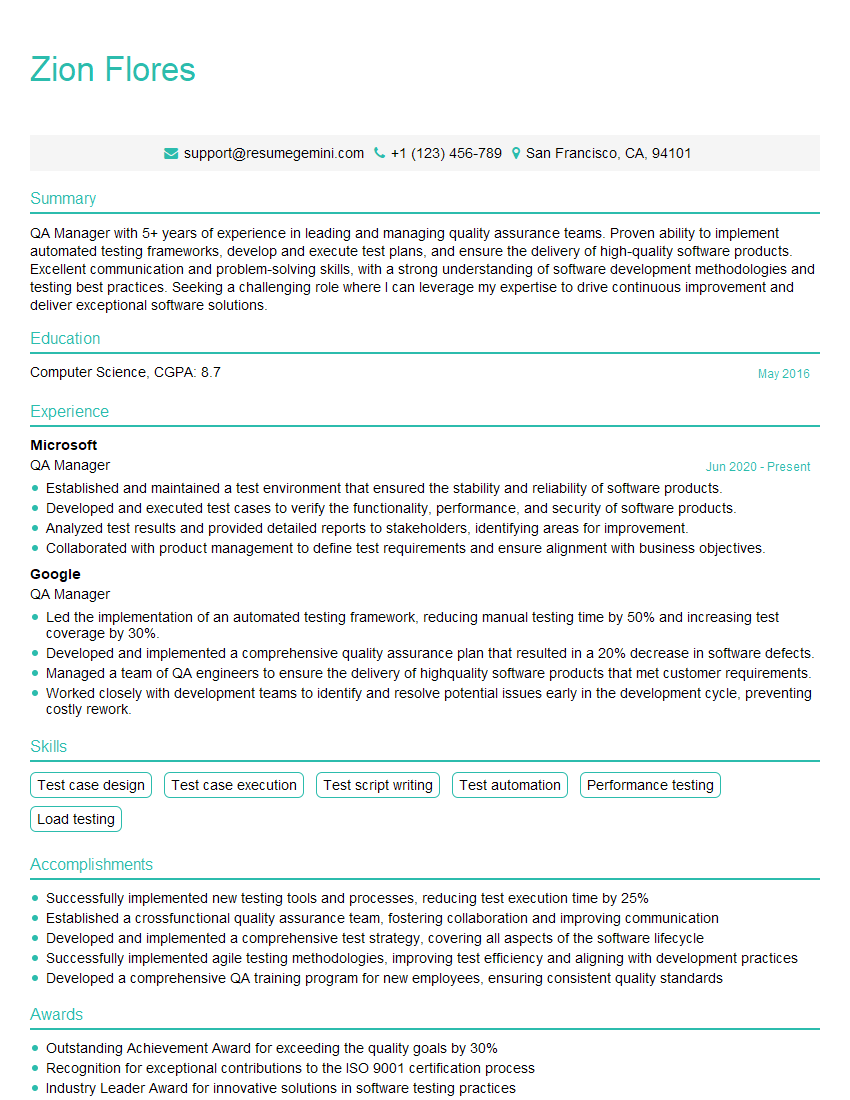
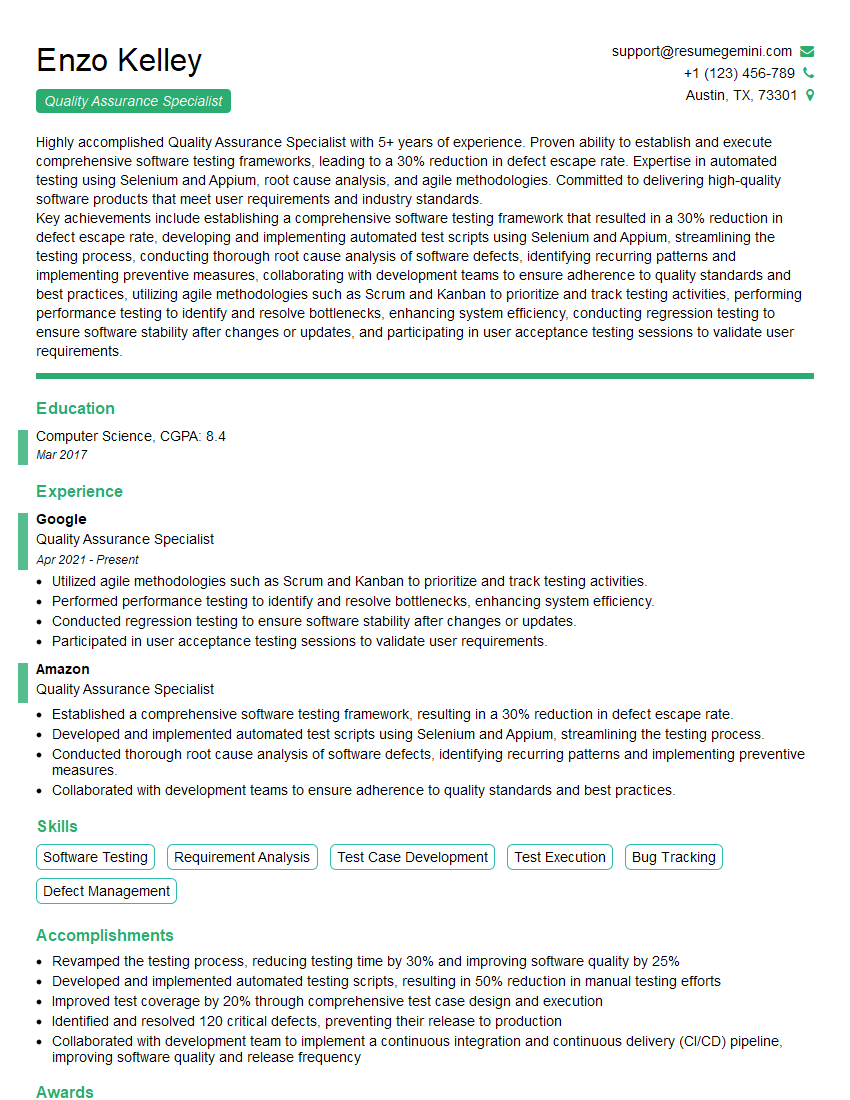
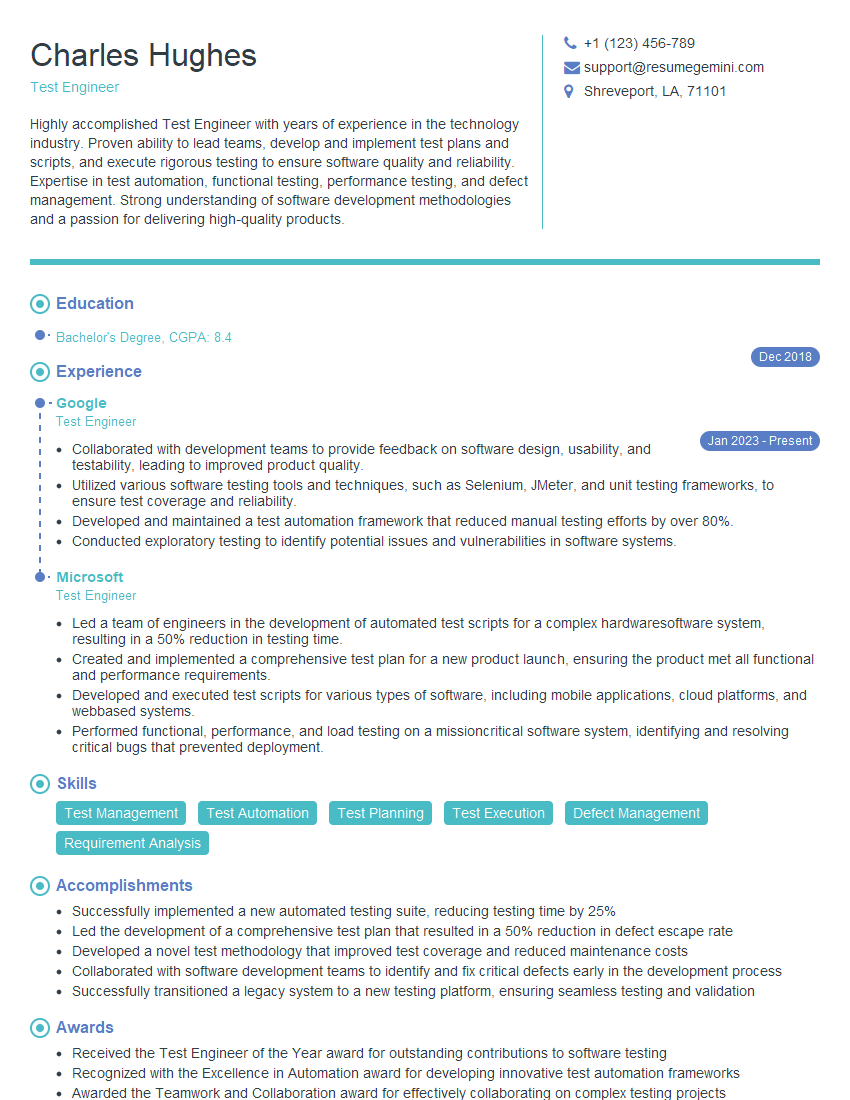
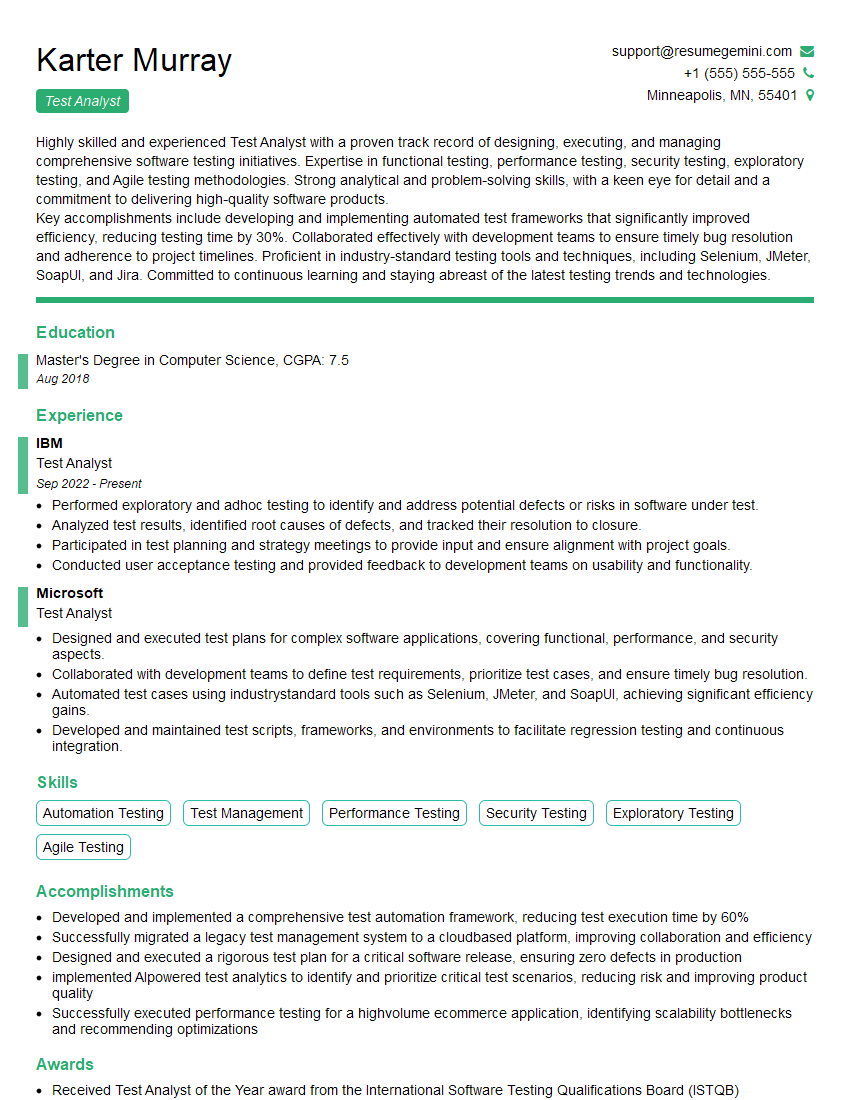
Mastering Test Case Management and Execution is crucial for career advancement in the software industry, opening doors to senior roles and specialized testing expertise. An ATS-friendly resume is your key to unlocking these opportunities. Make sure your resume clearly highlights your skills and experience in these areas. ResumeGemini is a valuable resource to help you craft a professional and impactful resume that catches the recruiter’s eye. We provide examples of resumes tailored to Test Case Management and Execution to guide you. Take the time to refine your resume and showcase your expertise – your dream job awaits!
Explore more articles
Users Rating of Our Blogs
Share Your Experience
We value your feedback! Please rate our content and share your thoughts (optional).
What Readers Say About Our Blog
Very informative content, great job.
good