Interviews are more than just a Q&A session—they’re a chance to prove your worth. This blog dives into essential Texturing Workflow interview questions and expert tips to help you align your answers with what hiring managers are looking for. Start preparing to shine!
Questions Asked in Texturing Workflow Interview
Q 1. Explain your preferred texturing workflow from concept to final asset.
My preferred texturing workflow is a highly iterative process, focusing on strong concept art and efficient material creation. It begins with a clear understanding of the asset’s purpose and the desired visual style. I start with concept art or reference images to define the look and feel. Then I move to modeling (if I’m involved in that stage), followed by UV unwrapping, optimized for texture tiling and minimal distortion. Next, I jump into Substance Designer or a similar tool to create procedural textures, allowing for efficient iterations and variations. This is where I build the base materials – diffuse, normal, specular, roughness, and potentially others like ambient occlusion and displacement. I constantly render test in my game engine of choice to check how the materials are looking and to make adjustments as necessary. Finally, I refine the textures in Photoshop or similar software, hand-painting details or making final tweaks to ensure the look is perfect and optimized for real-time rendering. This entire process often involves several passes and refinements; I usually focus on one material type or aspect at a time before combining them for final integration.
Q 2. Describe your experience with Substance Designer or similar texturing software.
I have extensive experience with Substance Designer, using it as my primary texturing tool for over five years. I’m proficient in creating both hand-painted and procedural textures within the software. I’m comfortable using its node-based system to create complex and efficient material workflows. For instance, I’ve built extensive libraries of custom nodes and materials that I reuse across projects, significantly speeding up my workflow. I frequently leverage Substance Designer’s features for creating realistic wear and tear, generating variations in surface detail, and creating seamless tiling textures. My proficiency extends to exporting textures in various formats and resolutions, optimized for different platforms and renderers. I’m equally familiar with utilizing Substance Painter for the hand-painting and final refinement of textures.
Q 3. How do you optimize textures for real-time rendering?
Optimizing textures for real-time rendering requires a multi-pronged approach. Firstly, I focus on resolution: using the smallest texture size that still delivers acceptable visual quality. Often, this means using power-of-two dimensions (e.g., 256×256, 512×512, 1024×1024). Secondly, I carefully consider compression. I utilize formats like BC7 (for DirectX) or ASTC (for OpenGL) which offer a good balance between quality and file size. Thirdly, I minimize the number of textures used per object, combining maps where possible. For instance, I might combine specular and glossiness into a single map if the added visual fidelity doesn’t significantly outweigh the benefit of reducing texture draw calls. Finally, I employ mipmapping, generating a series of smaller copies of the texture for different levels of detail, preventing blurry artifacts and improving performance at various distances. This is often handled automatically by the engine, but it’s crucial to ensure it’s set up correctly. For example, I’ve optimized textures for mobile games where texture memory and processing power are limited, resulting in a smaller game size and improved performance.
Q 4. What are the differences between diffuse, normal, specular, and roughness maps?
These maps represent different aspects of a material’s appearance in a 3D engine:
- Diffuse Map (Albedo): Defines the base color of the surface. Think of it as the inherent color you see when the surface is lit evenly.
- Normal Map: Simulates surface detail and bumps without requiring high-poly models. It affects how light reflects off the surface, creating the illusion of depth and texture.
- Specular Map: Controls the reflectivity of the surface. Brighter areas reflect more light, creating highlights. This often dictates shininess.
- Roughness Map: Dictates how rough or smooth a surface is. Rough surfaces scatter light more diffusely, while smooth surfaces create sharp reflections. This map complements the specular map, often controlling the size and sharpness of specular highlights.
Q 5. Explain the importance of UV unwrapping in texturing.
UV unwrapping is the process of projecting a 3D model’s surface onto a 2D plane. This 2D representation is crucial for applying textures because it allows us to map our 2D texture images onto the 3D model’s surface. Without proper UV unwrapping, the texture would be stretched, distorted, or repeated in undesirable ways. A well-unwrapped model will have a consistent texture scale across the entire surface, minimizing distortion and ensuring that textures appear correctly. For example, a poorly unwrapped character model might have a face that is stretched and distorted while the hands are highly compressed. Proper UV unwrapping ensures consistent texture resolution across the entire model which is vital to maintain the visual quality.
Q 6. How do you handle tiling textures to avoid repetition?
Avoiding repetition in tiling textures is crucial for realism. I employ several techniques:
- Offsetting Tiles: Slightly shifting the position of each tile reduces obvious repetition. This can be done manually in image editing software or procedurally in Substance Designer.
- Blending Tiles: Using a blend mode (like overlay or soft light) can seamlessly blend the edges of tiles, masking the repetition. This approach works particularly well for textures like grass or rock.
- Using Procedural Techniques: Procedural generation techniques in Substance Designer allow for the creation of textures with inherent variation, thus significantly reducing or eliminating the need for tiling.
- World-space noise: Combining noise textures to alter the colour or even the normal map adds a great level of variation that would be difficult to achieve by hand. This approach is particularly useful when adding more natural looking details.
Q 7. What techniques do you use to create realistic material variations?
Creating realistic material variations relies on several techniques:
- Using variations of base textures: I often create several versions of the base textures with slight variations in color, pattern, and detail. This allows the engine to randomly select between those textures to add variation to the same material, leading to a more natural and less uniform look. Imagine painting variations of a brick wall texture in photoshop to create a range of different brick wall assets in game.
- Combining multiple textures: Combining textures of different resolutions and variations can add subtle details and inconsistencies, breaking up repetitive patterns.
- Adding procedural noise: Applying subtle noise to textures can create variations in color, shading, and pattern. In Substance Designer you can blend this in seamlessly.
- Using masks: Masks allow selective application of details, creating variations in wear and tear or discoloration within a material. This approach is very useful for simulating things like dirt, weathering, and scratches.
Q 8. Describe your experience with different texture formats (e.g., DDS, PNG, JPG).
My experience with texture formats spans across various types, each with its own strengths and weaknesses. Let’s take a look at three common ones: DDS, PNG, and JPG.
- DDS (DirectDraw Surface): This is a Microsoft-developed format specifically optimized for real-time rendering in games and other applications. It supports various compression schemes, including DXT (S3TC), which allows for efficient storage of high-quality textures while maintaining acceptable memory usage. Its key advantage lies in its hardware acceleration support, leading to faster rendering. I often use DDS for game projects due to its performance benefits.
- PNG (Portable Network Graphics): PNG is a lossless format, meaning it preserves all image data without any compression artifacts. This makes it excellent for textures requiring high fidelity, such as those with sharp edges or intricate details. However, it typically results in larger file sizes compared to compressed formats. I use PNGs for concept art, textures that need to be edited repeatedly without loss of quality, and when visual fidelity is paramount, even if it comes at a slight performance cost.
- JPG (JPEG): JPEG is a lossy compression format, meaning it discards some image data during compression to reduce file size. This is advantageous for large images where file size is a major concern. However, this compression can introduce artifacts, especially noticeable in areas with fine details or sharp color transitions. I use JPGs sparingly, often for low-resolution textures or preview images, not for the main game assets, due to the potential loss of quality.
Choosing the right format depends heavily on the project’s specific needs. Factors to consider include texture resolution, required detail level, memory constraints, and target platform.
Q 9. How do you manage and organize your texture files in a project?
Texture organization is paramount for efficient workflow and project maintainability. My approach involves a hierarchical folder structure, mirroring the project’s structure itself. This makes finding specific textures a breeze, regardless of project size.
For example, a typical structure might look like this: ProjectRoot/Textures/Characters/Hero/Diffuse, Normal, Specular/Environment/Skybox/Props/Weapons/. Each folder contains textures of a specific type (diffuse, normal, specular, etc.) related to that game element. Within these folders, I often employ a naming convention, for example, Hero_Diffuse_4k.dds, clearly indicating the asset, type, and resolution.
Further organization may involve using version control (like Git) to manage changes to textures over time. This is crucial for collaboration and allows for easy rollback if necessary. Finally, using a digital asset management (DAM) system can significantly enhance organization, especially for large-scale projects.
Q 10. Explain your understanding of procedural texturing.
Procedural texturing is the generation of textures using algorithms rather than hand-painting or photographic sources. It’s like having a recipe that creates unique textures based on mathematical functions and parameters. This offers a level of flexibility and control unmatched by traditional methods.
Think of it this way: instead of creating a wood texture by meticulously painting each grain, you create an algorithm that simulates the wood grain’s appearance based on inputs like wood type, age, and wear. You can then easily adjust parameters to produce variations without manually creating new textures.
The benefits are immense: reduced storage space (since you’re storing algorithms rather than images), endless variability, and the ability to create highly complex and detailed textures that would be impossible to create manually in a reasonable timeframe. I often utilize procedural texturing for generating seamless textures, creating realistic variations of materials like stone or wood, and for things like noise patterns.
Q 11. How do you troubleshoot texture issues in a game engine?
Troubleshooting texture issues in a game engine is a common task. My approach is systematic and involves a series of checks:
- Verify File Paths and Names: The simplest issue is often a wrong path or a typo in the texture filename. Double-check that the engine is correctly accessing the texture file.
- Check Texture Format and Compression: Ensure the game engine supports the texture format used. If using compressed formats like DDS, make sure the compression settings are compatible.
- Inspect Texture Properties: In the engine, verify that the texture’s settings (wrap mode, filtering, etc.) are correctly configured. Incorrect settings can lead to artifacts or unexpected behavior.
- Examine Material Settings: The problem might lie not in the texture itself but in how it is applied to the material. Verify shader properties, texture coordinates (UVs), and other material parameters.
- Look for Engine Logs: Game engines usually generate log files that can provide valuable information about errors or warnings related to texture loading or rendering.
- Simplify the Scene: To isolate the problem, temporarily disable or remove other scene elements to see if the texture issue persists. This can help pinpoint if the issue is linked to the texture or a problem in interaction with other elements.
If the problem persists after these checks, it might indicate a more complex issue such as a bug in the engine or a problem with the texture file itself. Then I would use a debugger to pinpoint the exact location of the error.
Q 12. Describe your experience with baking normal maps and other maps from high-poly models.
Baking normal maps and other maps from high-poly models is a crucial step in optimizing game assets. It’s like creating a detailed blueprint from a complex 3D model and then using that blueprint on a simplified version.
The process involves taking a high-polygon model with fine details (the source) and generating lower-resolution maps (like normal maps, ambient occlusion maps, and curvature maps) that contain information about the high-poly model’s geometry, surface details, and lighting. These maps are then applied to a low-poly model (the target) for use in the game, preserving the visual detail without the performance cost of rendering the high-poly model directly. I typically use tools like Substance Painter, Marmoset Toolbag, or xNormal for baking.
I pay close attention to the parameters during baking. Things like bake resolution, cage settings, and normal map space are crucial in generating high-quality maps without artifacts. The specific parameters vary depending on the tools being used and the desired level of detail.
Q 13. How do you create seamless textures?
Creating seamless textures is essential for preventing noticeable repetition or visual glitches when applied to 3D models, especially for tiled surfaces. There are several techniques:
- Using tiling textures: This requires careful planning during texture creation, ensuring that the edges seamlessly match. This typically involves painting or creating images with matching patterns or gradual fades at the edges.
- Procedural generation: Using algorithms to generate textures that inherently repeat without seams. This offers the greatest control and allows for infinitely large textures.
- Using texture software: Most texture editing software packages offer features to create seamless textures, such as tiling and mirroring options or using various filters to blend edges smoothly. I frequently use these features along with careful manual editing of the edges.
- UV unwrapping techniques: Seamless texture creation is often highly influenced by how the UV map is created for the 3D model. Careful planning during UV unwrapping, including the use of techniques like planar mapping or cylindrical mapping can significantly reduce the risk of seams.
Careful planning and using appropriate techniques ensure that textures blend seamlessly together, resulting in visually realistic and artifact-free surfaces in the final game.
Q 14. What is your experience with PBR (Physically Based Rendering)?
Physically Based Rendering (PBR) is a rendering technique that aims to simulate how light interacts with materials in the real world. Instead of relying on arbitrary parameters, PBR uses physically accurate models of reflection, refraction, and scattering of light. This leads to more realistic and consistent lighting and material appearance across different scenes and lighting conditions.
My experience with PBR involves creating and utilizing PBR material workflows. This includes creating and utilizing the standard PBR textures: albedo (diffuse), normal, metallic, roughness, and ambient occlusion maps. Understanding how these maps interact with the PBR shader is critical for achieving realistic results. I’ve worked with various PBR rendering pipelines and workflows in different game engines (Unity, Unreal Engine), adapting my texture creation process accordingly. I’m proficient in using tools like Substance Painter and other texture creation software to create textures optimized for PBR workflows.
Q 15. How do you work with artists from other disciplines (e.g., modelers, riggers)?
Collaboration is key in a successful texturing workflow. I thrive in multidisciplinary teams. My process starts with clear communication; I attend pre-production meetings with modelers and riggers to understand the model’s intended use, polygon count, UV mapping strategy, and any specific requirements for the textures. For example, if a character model is intended for a close-up shot, we’ll need higher resolution textures. Conversely, environment textures viewed from afar can utilize lower resolutions. I provide regular updates on my progress, sharing texture previews and seeking feedback early and often. This iterative approach ensures that the textures seamlessly integrate with the rest of the project’s assets.
I often use cloud-based file sharing services like Dropbox or Google Drive to easily share high-resolution textures and receive feedback, even when working remotely. This facilitates a smooth and transparent workflow where everyone is on the same page regarding texture progress and any necessary adjustments.
- Early Communication: Attending planning meetings to discuss model specifics and texture requirements.
- Regular Feedback Loops: Sharing work-in-progress previews for review and adjustment.
- Efficient File Sharing: Utilizing cloud services for seamless collaboration.
Career Expert Tips:
- Ace those interviews! Prepare effectively by reviewing the Top 50 Most Common Interview Questions on ResumeGemini.
- Navigate your job search with confidence! Explore a wide range of Career Tips on ResumeGemini. Learn about common challenges and recommendations to overcome them.
- Craft the perfect resume! Master the Art of Resume Writing with ResumeGemini’s guide. Showcase your unique qualifications and achievements effectively.
- Don’t miss out on holiday savings! Build your dream resume with ResumeGemini’s ATS optimized templates.
Q 16. Explain your process for creating photorealistic textures.
Creating photorealistic textures is an iterative process that leverages both technical skill and artistic judgment. It begins with gathering reference images of high quality and variety. These images are carefully analyzed to understand the subtle nuances of light, shadow, and material properties. I then use dedicated photo editing software, like Photoshop, to process and manipulate these references. This might involve things like color correction, layer blending, and the creation of normal, roughness, and specular maps. I use various techniques like smart filters, digital painting, and even procedural generation to craft detailed textures.
For example, creating a photorealistic brick wall texture involves carefully combining images of real brick walls, applying adjustments to accurately represent the variation in color and brick shapes, and then crafting a normal map to convey the three-dimensional surface detail. The process culminates in testing and refinement within the game engine or rendering software to achieve the desired level of realism and visual fidelity.
The end goal is to seamlessly blend textures with lighting and shaders to create a realistic appearance; this involves careful consideration of how the lighting interacts with the surface. For example, subsurface scattering may be necessary to represent materials like skin or marble. I always compare my work to real-world photographs to ensure accuracy.
Q 17. How do you optimize texture memory usage?
Optimizing texture memory is crucial for performance, especially in real-time applications like games or virtual reality experiences. The first step is to understand the limitations of the target platform and its memory constraints. I use appropriate resolutions and texture formats that are both visually effective and memory-efficient. For example, I utilize normal maps and other maps that store detail efficiently rather than using extremely high-resolution diffuse maps.
Techniques like mipmapping (creating smaller versions of the texture for distant viewing), atlasing (combining multiple textures into a single one), and using compressed texture formats such as DXT, BC7, or ASTC are crucial. I also leverage procedural techniques whenever possible, generating textures on-demand instead of storing large static textures. Careful UV layout can also minimize texture memory consumption. Prioritizing visual impact and strategic implementation of efficient techniques avoids unnecessary memory usage without sacrificing quality.
For instance, if I’m texturing a large environment, I might use a lower resolution texture for distant elements and a higher resolution texture only for close-up areas. This method is known as level of detail (LOD) texturing. It greatly improves performance without a noticeable drop in visual quality.
Q 18. Describe your experience with texture compression techniques.
My experience with texture compression techniques is extensive. I’m proficient in various formats, including DXT (DirectX Texture Compression), BC7 (Block Compression 7), and ASTC (Adaptive Scalable Texture Compression). The choice of compression format depends heavily on the target platform and desired balance between visual quality and compression ratio. For example, ASTC offers a high degree of control and good compression, making it suitable for mobile platforms and VR. BC7 offers superior quality at higher compression ratios. DXT, while older, is still widely supported.
I use specialized tools within software packages like Photoshop, Substance Painter, and various game engines to compress textures, often experimenting with different settings to find the optimal balance between visual fidelity and file size. Understanding the limitations and strengths of each format is crucial to optimizing for memory and performance.
I often need to evaluate the compressed texture within the target game engine or application to ensure that the quality isn’t overly degraded; this final visual review is critical to validate the choice of compression and settings used.
Q 19. What is your experience with different types of shaders?
My experience spans various shader types, including diffuse, normal, specular, roughness, metallic, ambient occlusion, and subsurface scattering shaders. I understand how these shaders interact with each other and the lighting model to achieve different visual effects. I’m comfortable working with both physically based rendering (PBR) and older, less physically accurate shading models.
PBR workflows require a good understanding of material properties, such as albedo, roughness, metallic, and normal. I use these maps as inputs for my shaders and integrate them seamlessly with lighting and shadows. I’m familiar with shader authoring in languages like HLSL (High-Level Shading Language) and GLSL (OpenGL Shading Language), allowing me to customize shaders to specific needs. For example, I may write a custom shader to accurately simulate the scattering of light through translucent materials.
Understanding the shader’s role in how the texture is displayed is essential. Knowing which shader works best for which material, and how to adjust those shaders to match is critical for high-quality results.
Q 20. How do you manage large texture sets efficiently?
Managing large texture sets efficiently is critical for project organization and performance. I utilize a hierarchical file structure, organizing textures by category (e.g., characters, environments, props), and further subdividing based on resolution or type. This approach makes it easy to locate and manage individual textures and allows for faster loading times.
I also use texture atlasing and batch processing where appropriate to reduce the number of individual files. Texture atlasing involves combining multiple textures into a single larger texture, while batch processing streamlines tasks like compression or format conversion. Furthermore, employing cloud-based storage solutions ensures accessibility and collaboration without the burden of local storage limitations. Using a well-defined naming convention for textures – descriptive and consistent – greatly aids organization and search functionality.
For example, a project may contain several thousand textures. Organizing them by character, then clothing, then individual elements of the clothing greatly reduces search time and avoids confusion. This allows easy access to specific textures, streamlining the workflow and reducing potential errors.
Q 21. Describe your experience with version control systems for textures (e.g., Perforce, Git).
I have extensive experience with Perforce and Git for version control of textures. Perforce is ideal for large teams and binary assets, like high-resolution textures, due to its efficient handling of large files and branching capabilities. Git, while not traditionally preferred for large binary files, can be very useful for smaller projects, text files, and metadata associated with the textures. I often use Git for managing shader code and texture metadata, ensuring all project elements are tracked effectively.
My workflow involves regularly committing changes to the version control system, including detailed commit messages describing the changes made. This allows for easy rollback to previous versions if necessary and maintains a clear history of modifications. I frequently compare different versions of the textures to ensure consistency and quality.
For example, using Perforce allows multiple artists to work on the same project simultaneously without overwriting each other’s work. The branching capabilities facilitate exploration of different texture variations without compromising the main branch. This ensures a smooth, collaborative workflow and safeguards the integrity of the textures across the entire project lifespan.
Q 22. How do you handle feedback from clients or supervisors on your textures?
Handling feedback is crucial for creating high-quality textures. I approach it as a collaborative process, not a critique. First, I actively listen to understand the client’s or supervisor’s perspective and concerns. Then, I analyze the feedback, separating subjective opinions from objective observations regarding technical aspects like tiling, seams, or color accuracy.
For subjective feedback (e.g., “The wood doesn’t look realistic enough”), I ask clarifying questions: What specifically feels unrealistic? Is it the grain pattern, color variation, or the overall impression? This helps me target specific adjustments. For objective feedback (e.g., “There are noticeable seams near the corner”), I directly address the technical issue. I might refine the UV mapping, use a different projection method, or adjust the texture blending to resolve the problem. I always document all changes and share updated versions with clear explanations of the adjustments made.
Finally, I consider the feedback’s context within the project’s scope and timeline. Sometimes, significant revisions may necessitate adjustments to the overall schedule. Open communication is key to ensuring everyone is on the same page and the final product meets expectations.
Q 23. What are your favorite resources or techniques for learning new texturing methods?
My learning process involves a multi-faceted approach. I regularly explore online resources like ArtStation, which showcases high-quality work from professional artists, inspiring me with new techniques and approaches. I also follow prominent texturing artists on platforms such as YouTube and Instagram, learning from their tutorials and insights.
Beyond online resources, I find hands-on experimentation crucial. I challenge myself with complex texturing projects, pushing my limits and exploring different tools and workflows. For example, recently I tried recreating a highly detailed stone texture using Substance Designer’s procedural capabilities, leading me to develop a new understanding of noise functions and their interaction with various filters.
Books are another valuable source. Textbooks on digital painting, 3D modeling, and material science provide a deeper theoretical understanding, enriching my practical skills.
Q 24. How do you stay up-to-date with the latest trends in texturing and rendering?
Staying current in this rapidly evolving field necessitates a proactive approach. I regularly attend industry conferences and workshops (both online and in-person) to engage directly with leading experts and learn about the latest software and techniques. I actively participate in online communities and forums, engaging in discussions and sharing knowledge with fellow artists. This provides valuable insights into emerging trends and best practices.
I subscribe to industry-related newsletters and follow key influencers on social media platforms. I also routinely review articles and tutorials on websites specializing in game development and visual effects. Tracking software updates from companies like Substance 3D, Marmoset Toolbag, and Unreal Engine is critical to leveraging new features. This ensures that I am constantly aware of new developments and tools that can enhance my workflow and the quality of my textures.
Q 25. Describe a situation where you had to solve a complex texturing problem. What was your approach?
I once faced a challenging project requiring the texturing of a highly detailed, realistically weathered wooden ship hull. The problem stemmed from the complex interplay of wood grain, multiple layers of paint (with wear and tear), barnacles, and rust. A straightforward approach wouldn’t capture the subtlety and realism required.
My approach involved a layered texturing technique. I started with a high-resolution base texture showcasing the underlying wood grain, created procedurally in Substance Designer. Then, in Photoshop, I meticulously painted layers representing different paint coats, incorporating varying levels of wear and weathering. Each paint layer had its own unique texture properties, including color variation, roughness, and normal maps. I then added textures for barnacles and rust, carefully blending them to create a believable sense of depth and age. For realistic water staining, I used custom brushes to simulate its flow and absorption into the wood.
Finally, I employed several rendering techniques to enhance realism, including subsurface scattering for the wood, and ambient occlusion to emphasize the depth and crevices. The result was a highly detailed and realistic texture that exceeded the client’s expectations. This experience reinforced the importance of layered texturing and the power of combining procedural and hand-painted techniques for achieving realistic results.
Q 26. Explain your understanding of different texture mapping techniques (e.g., planar, cylindrical, spherical).
Texture mapping involves projecting a 2D image onto a 3D model’s surface. Different techniques offer varying degrees of realism and efficiency, depending on the model’s geometry.
- Planar Mapping: This method projects the texture onto the model’s surface as if it were a flat plane. It’s simple and efficient but suffers from distortions when applied to complex curved surfaces. Imagine projecting a picture onto a curved wall – the image gets distorted.
- Cylindrical Mapping: This technique wraps the texture around a cylinder. It’s better suited for objects with cylindrical shapes, such as pipes or columns. The distortions are minimized compared to planar mapping for these types of objects.
- Spherical Mapping: This method projects the texture onto a sphere, useful for objects with spherical or roughly spherical shapes. It also reduces distortion compared to planar mapping for spherical objects, but can still lead to distortions on highly irregular surfaces. Think of wrapping a globe with a map—some areas will be stretched or compressed.
The choice of method depends heavily on the model’s shape and the desired level of realism. Often, a combination of techniques might be used or more advanced mapping methods like UV unwrapping are employed for greater control and better results. UV unwrapping involves carefully unfolding the 3D model’s surface into a 2D plane for texture application, minimizing distortion.
Q 27. What is your experience with creating and using custom shaders?
I have extensive experience creating and using custom shaders, primarily using Shader Graph in Unity and HLSL in Unreal Engine. Custom shaders provide unparalleled control over the appearance of materials, allowing for effects not easily achievable with pre-built shaders.
For instance, I’ve created custom shaders to simulate realistic subsurface scattering in skin and organic materials, achieving a more lifelike appearance. I’ve also developed shaders to create stylized effects, such as cel-shading or hand-painted looks. In one project, I created a custom shader to simulate the effect of light scattering through frosted glass, requiring careful manipulation of light vectors and transparency parameters. //Example HLSL snippet for basic diffuse shading: float4 PS(float4 pos : SV_POSITION) : SV_TARGET { return float4(0.5, 0.5, 0.5, 1.0); }
My understanding of shader programming extends beyond simply applying pre-made code. I understand the underlying mathematical principles governing lighting, shading, and texturing, allowing me to troubleshoot problems, optimize performance, and create highly customized and optimized shader solutions tailored to specific artistic needs.
Q 28. Describe your experience with using a non-destructive workflow in texturing.
A non-destructive workflow in texturing emphasizes preserving the original data and applying changes in a way that can easily be undone or modified. This is crucial for flexibility and iterative refinement. Instead of directly painting on textures or permanently modifying images, I prefer using layer-based applications like Photoshop and procedural generation tools like Substance Designer.
In Photoshop, I use adjustment layers, layer masks, and non-destructive filters to modify textures. This allows me to experiment with different parameters without altering the underlying base texture. In Substance Designer, the entire process is inherently non-destructive; nodes can be added, removed, or modified at any point in the process without permanently affecting earlier stages. This makes it easy to explore various iterations and refine textures iteratively. This approach is very useful in collaborative projects, allowing various team members to experiment with the texture without the fear of corrupting it.
This approach increases efficiency by making it easy to experiment with different artistic directions and quickly revert to previous versions if needed. It reduces the risk of errors and allows for easy updates if requirements change during the project lifecycle. This approach fosters better collaboration and reduces time wasted on tedious undo/redo operations.
Key Topics to Learn for Texturing Workflow Interview
- Understanding Different Texture Maps: Learn the nuances of diffuse, normal, specular, roughness, and ambient occlusion maps; their purpose and how they interact.
- Workflow Optimization: Explore efficient techniques for creating and applying textures, including using texture atlases, tiling, and optimizing polygon counts for performance.
- Software Proficiency: Demonstrate expertise in industry-standard software such as Substance Painter, Mari, Photoshop, or similar texturing applications. Practice showcasing your skills in a portfolio.
- UV Unwrapping Techniques: Master various UV unwrapping methods (planar, cylindrical, spherical, etc.) and understand their impact on texture quality and efficiency.
- Texture Baking and its Applications: Understand the process of baking different texture maps from high-poly models to low-poly models for efficient rendering.
- Material Creation and Shader Interaction: Learn how to create realistic materials by combining different texture maps and understanding how they interact within a shader network.
- Problem-Solving and Troubleshooting: Practice identifying and resolving common texturing issues such as texture stretching, seams, and artifacts. Be prepared to discuss your problem-solving approach.
- PBR (Physically Based Rendering) Principles: Demonstrate a strong understanding of PBR workflows and its implications for realistic material representation.
- Version Control and Collaboration: Discuss your experience with version control systems (e.g., Perforce, Git) within a collaborative texturing pipeline.
- Real-time vs. Offline Rendering Considerations: Understand the differences and optimization techniques required for each rendering approach.
Next Steps
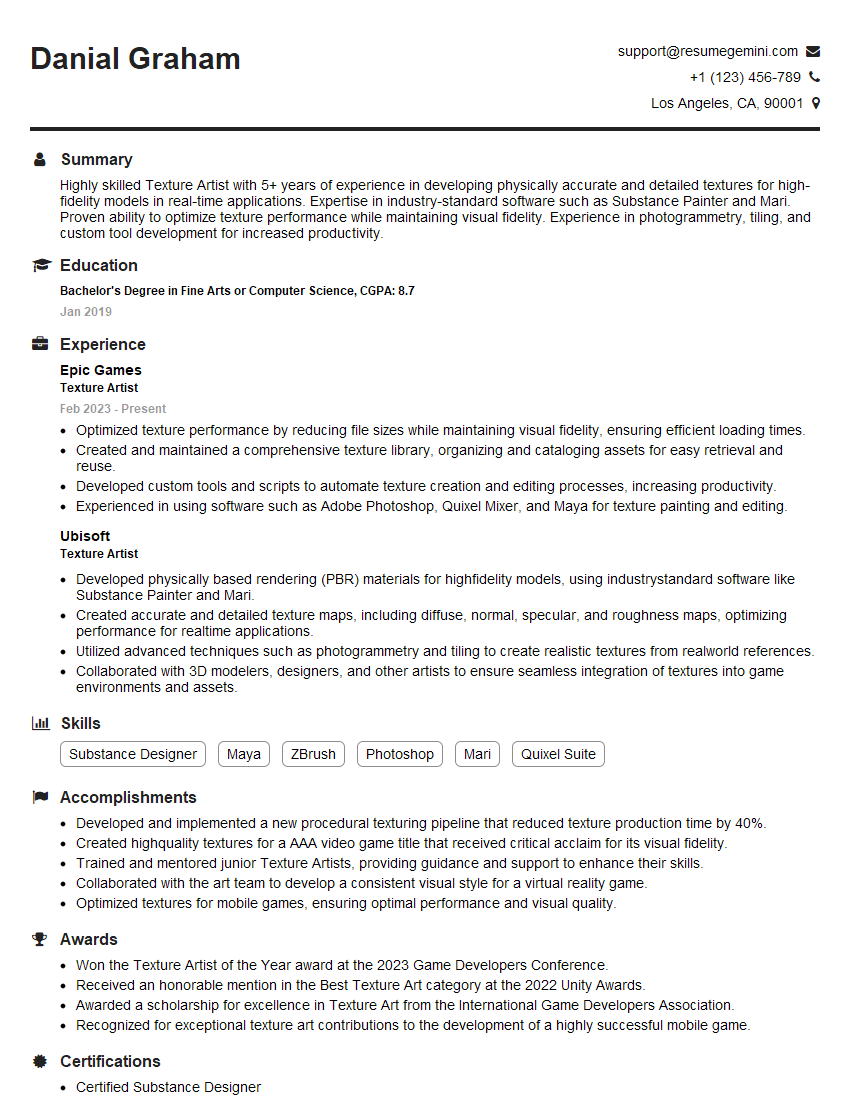
Mastering a robust texturing workflow is crucial for career advancement in the games, film, and VFX industries. A strong understanding of these principles allows you to create high-quality assets efficiently and collaborate effectively within a team. To significantly boost your job prospects, focus on crafting an ATS-friendly resume that highlights your skills and experience effectively. ResumeGemini is a trusted resource to help you build a professional and impactful resume. They provide examples of resumes tailored to Texturing Workflow to help guide you. Take advantage of these resources to present yourself as the ideal candidate.
Explore more articles
Users Rating of Our Blogs
Share Your Experience
We value your feedback! Please rate our content and share your thoughts (optional).
What Readers Say About Our Blog
Hello,
we currently offer a complimentary backlink and URL indexing test for search engine optimization professionals.
You can get complimentary indexing credits to test how link discovery works in practice.
No credit card is required and there is no recurring fee.
You can find details here:
https://wikipedia-backlinks.com/indexing/
Regards
NICE RESPONSE TO Q & A
hi
The aim of this message is regarding an unclaimed deposit of a deceased nationale that bears the same name as you. You are not relate to him as there are millions of people answering the names across around the world. But i will use my position to influence the release of the deposit to you for our mutual benefit.
Respond for full details and how to claim the deposit. This is 100% risk free. Send hello to my email id: [email protected]
Luka Chachibaialuka
Hey interviewgemini.com, just wanted to follow up on my last email.
We just launched Call the Monster, an parenting app that lets you summon friendly ‘monsters’ kids actually listen to.
We’re also running a giveaway for everyone who downloads the app. Since it’s brand new, there aren’t many users yet, which means you’ve got a much better chance of winning some great prizes.
You can check it out here: https://bit.ly/callamonsterapp
Or follow us on Instagram: https://www.instagram.com/callamonsterapp
Thanks,
Ryan
CEO – Call the Monster App
Hey interviewgemini.com, I saw your website and love your approach.
I just want this to look like spam email, but want to share something important to you. We just launched Call the Monster, a parenting app that lets you summon friendly ‘monsters’ kids actually listen to.
Parents are loving it for calming chaos before bedtime. Thought you might want to try it: https://bit.ly/callamonsterapp or just follow our fun monster lore on Instagram: https://www.instagram.com/callamonsterapp
Thanks,
Ryan
CEO – Call A Monster APP
To the interviewgemini.com Owner.
Dear interviewgemini.com Webmaster!
Hi interviewgemini.com Webmaster!
Dear interviewgemini.com Webmaster!
excellent
Hello,
We found issues with your domain’s email setup that may be sending your messages to spam or blocking them completely. InboxShield Mini shows you how to fix it in minutes — no tech skills required.
Scan your domain now for details: https://inboxshield-mini.com/
— Adam @ InboxShield Mini
Reply STOP to unsubscribe
Hi, are you owner of interviewgemini.com? What if I told you I could help you find extra time in your schedule, reconnect with leads you didn’t even realize you missed, and bring in more “I want to work with you” conversations, without increasing your ad spend or hiring a full-time employee?
All with a flexible, budget-friendly service that could easily pay for itself. Sounds good?
Would it be nice to jump on a quick 10-minute call so I can show you exactly how we make this work?
Best,
Hapei
Marketing Director
Hey, I know you’re the owner of interviewgemini.com. I’ll be quick.
Fundraising for your business is tough and time-consuming. We make it easier by guaranteeing two private investor meetings each month, for six months. No demos, no pitch events – just direct introductions to active investors matched to your startup.
If youR17;re raising, this could help you build real momentum. Want me to send more info?
Hi, I represent an SEO company that specialises in getting you AI citations and higher rankings on Google. I’d like to offer you a 100% free SEO audit for your website. Would you be interested?
Hi, I represent an SEO company that specialises in getting you AI citations and higher rankings on Google. I’d like to offer you a 100% free SEO audit for your website. Would you be interested?
good