Cracking a skill-specific interview, like one for Title V Operating Permits, requires understanding the nuances of the role. In this blog, we present the questions you’re most likely to encounter, along with insights into how to answer them effectively. Let’s ensure you’re ready to make a strong impression.
Questions Asked in Title V Operating Permits Interview
Q 1. What are the key components of a Title V operating permit?
A Title V operating permit is a comprehensive document issued by the Environmental Protection Agency (EPA) or a state agency that details the environmental operating conditions for a major source of air pollution. Think of it as a legally binding contract between the facility and the regulatory agency. It’s not just a list of rules; it’s a roadmap for environmentally responsible operations.
- Facility Information: Detailed description of the facility, its location, and the processes that emit air pollutants.
- Emission Limits: Specific limits on the amount of each regulated pollutant the facility can release into the atmosphere. These are often expressed in pounds per hour or tons per year.
- Monitoring Requirements: Specifications on how the facility must monitor its emissions, including the type of equipment to use, frequency of testing, and data reporting procedures. This is crucial for ensuring compliance.
- Recordkeeping Requirements: Specifies what records the facility must maintain, such as emission data, maintenance logs, and training records. This provides a clear audit trail.
- Compliance Certification: Annual certifications from responsible officials confirming that the facility has met all the permit conditions. This demonstrates accountability.
- Other Conditions: Depending on the specifics of the facility and its operations, other conditions might include requirements for specific control technologies, pollution prevention plans, or employee training programs. These address unique environmental challenges.
For example, a cement plant’s Title V permit might specify limits on particulate matter, nitrogen oxides, and sulfur dioxide emissions, along with requirements for continuous emissions monitoring systems and regular stack testing.
Q 2. Explain the difference between a Title V permit and a minor NSR permit.
The key difference lies in the size and impact of the source. A Title V permit applies to major sources of air pollution, those that meet certain emission thresholds established by the EPA. These sources have a significantly greater potential to impact air quality. A minor NSR (New Source Review) permit, on the other hand, is for minor sources. These sources have less impact and are subject to a simpler permitting process with less stringent requirements.
Think of it like this: a major source is like a large factory, while a minor source might be a small business with limited emissions. A Title V permit is like a comprehensive building code for a skyscraper, requiring extensive documentation and oversight, while a minor NSR permit is like a simplified checklist for a small residential building.
The emission thresholds that distinguish major from minor sources vary by pollutant and can be quite complex to determine, often requiring specialized engineering expertise.
Q 3. Describe the process for obtaining a Title V permit.
Obtaining a Title V permit is a multi-step process that can take several months or even longer. It requires thorough planning, detailed documentation, and close collaboration with the regulatory agency.
- Application Preparation: The facility owner or operator prepares a comprehensive permit application, providing detailed information on their operations, emissions, and proposed control measures. This is often a lengthy and complex process.
- Agency Review: The regulatory agency thoroughly reviews the application, including conducting modeling to assess potential air quality impacts. They may request additional information or revisions.
- Public Comment Period: The application is typically subject to a public comment period, allowing the public to provide input and express concerns. This ensures transparency and community involvement.
- Permit Issuance or Denial: Based on the review and public comment, the agency issues the permit or denies the application. If issued, the permit specifies the facility’s operating conditions.
- Compliance Monitoring and Reporting: Once the permit is issued, the facility is responsible for complying with all its conditions and submitting regular monitoring and compliance reports.
The complexity of this process often requires the assistance of environmental consultants with expertise in air permitting.
Q 4. What are the requirements for renewing a Title V permit?
Renewing a Title V permit is similar to the initial application process, but often less extensive. It typically involves submitting an updated application demonstrating continued compliance with existing conditions and any changes in operations. The application needs to verify that the facility’s emissions remain within the permit limits and that monitoring and reporting are ongoing.
The renewal process helps ensure that the permit continues to accurately reflect the facility’s operations and its impact on air quality. It’s important to submit the renewal application well in advance of the permit’s expiration date to avoid potential delays or penalties.
A key aspect of renewal is demonstrating consistent compliance with the existing permit conditions throughout its lifetime.
Q 5. What are the consequences of non-compliance with Title V permit conditions?
Non-compliance with Title V permit conditions can result in serious consequences, ranging from administrative penalties to criminal charges. The severity of the penalties depends on factors such as the nature and duration of the violation, the potential environmental impact, and the facility’s history of compliance.
- Administrative Penalties: These can include substantial fines, suspension or revocation of the permit, and requirements for corrective action.
- Civil Penalties: More severe violations can lead to civil lawsuits, with potentially higher fines and other legal remedies.
- Criminal Penalties: In cases of intentional or reckless disregard for permit conditions, criminal charges can result in significant fines and even imprisonment.
- Citizen Suits: Environmental groups or individuals may file citizen suits against non-compliant facilities, leading to legal action and potential penalties.
Maintaining compliance is critical not only for avoiding penalties but also for protecting public health and the environment. Proactive monitoring, regular maintenance, and employee training are vital for preventing violations.
Q 6. How are emissions limits determined in a Title V permit?
Emission limits in a Title V permit are determined through a combination of factors, aiming to balance environmental protection with economic feasibility. The process is often complex and requires technical expertise.
- Applicable Regulations: The limits are based on the applicable federal and state air quality regulations, considering the specific pollutants emitted by the facility.
- Best Available Control Technology (BACT): For new or modified sources, emission limits are often based on BACT, representing the most effective and feasible technology for controlling emissions. This ensures that the facility uses the best available technology to minimize its environmental footprint.
- State Implementation Plans (SIPs): State-specific regulations and implementation plans also play a role in determining emission limits. States may impose more stringent requirements than the federal level.
- Air Quality Modeling: Air quality modeling is used to predict the impacts of the facility’s emissions on ambient air quality. This helps ensure that the emission limits are sufficient to prevent exceedances of national or state ambient air quality standards.
- Negotiation and Consultation: There’s often a process of negotiation and consultation between the facility and the regulatory agency to reach an agreement on the emission limits. This incorporates technical expertise and considers economic aspects.
Determining emission limits is a rigorous process, requiring a deep understanding of air pollution control technologies, regulatory requirements, and air quality modeling.
Q 7. Explain the role of monitoring and reporting in Title V compliance.
Monitoring and reporting are the cornerstones of Title V compliance. They provide the means to verify whether the facility is adhering to its permit conditions and to identify and address any potential issues. Regular monitoring allows for early detection of problems, preventing larger violations and associated penalties.
- Continuous Emissions Monitoring Systems (CEMS): Many Title V facilities are required to use CEMS to continuously measure and record their emissions. This provides real-time data on emissions, which is crucial for immediate responses to potential exceedances.
- Periodic Testing: In addition to CEMS data, periodic testing such as stack tests are often required to verify the accuracy of CEMS data and measure emissions of pollutants not continuously monitored.
- Recordkeeping: Facilities must maintain detailed records of all monitoring data, maintenance activities, and other relevant information. This provides a transparent record of compliance.
- Reporting: Regular reports, typically annually, are submitted to the regulatory agency summarizing monitoring data and demonstrating compliance with permit conditions.
Effective monitoring and reporting help not only to ensure compliance but also to provide valuable data for evaluating the effectiveness of emission control technologies and overall environmental performance. This is a critical aspect of environmental stewardship and regulatory accountability.
Q 8. What are the different types of monitoring methods used for Title V permits?
Title V permits require comprehensive monitoring to ensure compliance with emission limits. The specific methods depend on the pollutant and source, but common approaches include:
- Continuous Emission Monitoring Systems (CEMS): These systems provide real-time data on emissions, offering immediate feedback and allowing for prompt adjustments. For example, a CEMS might continuously monitor sulfur dioxide (SO2) emissions from a power plant.
- Periodic Testing: This involves regular, scheduled measurements of emissions, often using methods like Method 25A (for particulate matter) or various EPA-approved methods for specific pollutants. A company might need to conduct quarterly stack testing for volatile organic compounds (VOCs).
- Flow Rate Monitoring: This measures the volume of gas emitted from a stack, crucial for calculating emission rates. An example is using a flow meter to determine the exhaust gas volume from a cement kiln.
- Manual Methods: These less frequent methods can include visual inspections, leak detection and repair (LDAR) programs, and opacity readings. A visual inspection might check for visible emissions from a process vent.
- Data Logging and Reporting Systems: These systems automatically collect, process, and report monitoring data to regulatory agencies. Such systems are indispensable for effective compliance.
The choice of method is determined by factors like the type of pollutant, emission rate, and regulatory requirements. The permitting authority specifies the appropriate methods in the permit.
Q 9. How are deviations from permit limits addressed?
Deviations from permit limits are taken very seriously. The first step is immediate corrective action to bring the emissions back into compliance. This might involve adjusting process parameters, repairing equipment, or implementing temporary emission controls. A detailed investigation must then be conducted to determine the root cause of the deviation. This investigation often involves reviewing operational data, maintenance records, and conducting process audits.
Following the investigation, a written report is usually required, detailing the deviation, the corrective actions taken, and the root cause analysis. This report is submitted to the permitting authority. Depending on the severity and frequency of deviations, penalties can range from administrative actions like warning letters to significant fines and even permit revocation. A significant deviation might trigger a more extensive compliance evaluation by the permitting authority, possibly involving additional monitoring or inspections.
Q 10. What is the role of the permitting authority in Title V compliance?
The permitting authority, which can be either a state or federal agency depending on the facility’s location and emissions, plays a critical role in Title V compliance. Their responsibilities include:
- Permit Issuance and Review: They evaluate permit applications, ensuring they meet all applicable requirements and contain accurate emissions information.
- Compliance Monitoring and Enforcement: They conduct inspections, review monitoring data, and enforce compliance through inspections and penalties. They may audit the facility’s compliance programs to ensure effectiveness.
- Data Management and Tracking: They collect and maintain records of permits, monitoring data, and compliance reports.
- Public Access to Information: They often make permit information and compliance data publicly accessible to promote transparency and community involvement.
- Technical Assistance: They may offer guidance and assistance to facilities in navigating complex compliance requirements.
Essentially, the permitting authority acts as the watchdog, ensuring facilities operate within the established environmental regulations. This involves a balance of oversight, cooperation, and enforcement.
Q 11. Explain the concept of ‘significant emissions’ in the context of Title V.
Under Title V, ‘significant emissions’ are defined as emissions that exceed certain thresholds specified in the regulations. These thresholds vary depending on the pollutant and the source category. For example, a specific quantity of a hazardous air pollutant (HAP) or a certain amount of a criteria pollutant like particulate matter (PM) from a specific source category may trigger the ‘significant’ designation.
The significance of this designation is that it triggers more stringent requirements for facilities. Facilities with significant emissions must obtain a Title V permit, which involves a more extensive application process and stricter monitoring and reporting requirements compared to facilities with less substantial emissions. Determining whether emissions are significant requires a careful review of emission rates and comparison against the applicable thresholds detailed in the regulations and guidance documents.
Q 12. Describe your experience with conducting compliance audits for Title V permits.
Throughout my career, I’ve conducted numerous compliance audits for Title V facilities. These audits typically involve a thorough review of the facility’s operations, monitoring data, and compliance programs. I follow a structured approach, starting with reviewing permit conditions and applicable regulations. Then, I perform onsite inspections, reviewing equipment, examining records, and interviewing personnel. My focus is on verifying accurate reporting, identifying any deviations from permit limits, and assessing the effectiveness of the facility’s environmental management systems.
For instance, during an audit of a chemical manufacturing plant, I discovered inconsistencies in their emission monitoring data. This discrepancy led to further investigation which uncovered a malfunctioning CEMS and an inadequate maintenance program. We helped them rectify the situation and update their maintenance procedures. Documentation is crucial, and all findings are documented thoroughly, including any corrective actions recommended to the facility.
Q 13. How do you ensure accurate and timely reporting under Title V regulations?
Accurate and timely reporting is paramount under Title V. We utilize several strategies to ensure this:
- Automated Data Collection Systems: These systems minimize manual data entry errors and streamline the reporting process. Integrating CEMS directly into the reporting system is an effective strategy.
- Data Validation and Quality Control Checks: We implement rigorous checks to identify and correct inconsistencies or errors in the data before submission.
- Regular Data Reviews: We conduct regular reviews of collected data to ensure accuracy and identify any trends that warrant investigation. This helps in identifying potential compliance issues before they escalate.
- Internal Audits: Regular internal audits help verify the accuracy of the data and the effectiveness of the reporting system.
- Training of Personnel: Properly trained personnel are crucial in ensuring accurate data collection and reporting. Regular training keeps everyone updated with the latest regulations and best practices.
This multi-faceted approach minimizes the risk of non-compliance and maintains transparency with the regulatory agencies.
Q 14. What are the key differences between federal and state Title V requirements?
While both federal and state Title V programs aim for consistent air quality standards, there are key differences:
- Program Administration: The federal EPA establishes the core framework, while states often receive delegated authority to administer their own programs. This means that permitting requirements and enforcement procedures can vary from state to state.
- Permitting Requirements: Though largely similar, states can incorporate their specific regulations and requirements into their permits. This might involve additional reporting or monitoring requirements tailored to state-specific concerns.
- Enforcement Mechanisms: Enforcement approaches can differ, although both federal and state agencies strive for consistent compliance. Penalties and corrective actions may vary slightly between state and federal programs.
- Specific Pollutants: States may regulate certain pollutants or source categories beyond federal requirements, reflecting regional environmental concerns. This is particularly true for pollutants of local or regional importance.
Understanding the nuances of both federal and state regulations is crucial for effective Title V compliance.
Q 15. How do you handle changes in emission sources or operating conditions?
Changes in emission sources or operating conditions under Title V require a systematic approach. Think of your Title V permit as a contract outlining your facility’s emissions. Any significant change – meaning something that could affect your emissions – needs to be addressed. This isn’t just about adding new equipment; it includes modifications to existing equipment, changes in raw materials, increases in production rates, or even changes in operating hours.
Step 1: Assessment: First, we determine if the change is significant enough to trigger a permit modification. This often involves calculating the potential impact on emissions using engineering calculations and comparing it to the thresholds defined in the permit or applicable regulations. For example, a minor adjustment to a process variable that leads to a negligible increase in emissions might not need a permit change, but a major equipment upgrade certainly would.
Step 2: Notification: If the change is significant, we notify the permitting authority. This usually involves submitting a formal notification and providing detailed information about the proposed change, its potential impact on emissions, and proposed mitigation measures. We might need to provide updated emission calculations, process flow diagrams, or other supporting documentation.
Step 3: Permit Modification: The permitting authority reviews the notification. They may request additional information or require an updated permit. This process can involve public notice and comment periods. Obtaining approval for the permit modification is crucial before implementing the change. Ignoring this process can lead to significant penalties.
Example: Imagine a manufacturing plant upgrading its boiler system. The new boiler might have different emission characteristics. We’d need to assess this, calculate the potential emissions change, notify the authority, and likely request a permit modification to reflect the new boiler and its associated emissions.
Career Expert Tips:
- Ace those interviews! Prepare effectively by reviewing the Top 50 Most Common Interview Questions on ResumeGemini.
- Navigate your job search with confidence! Explore a wide range of Career Tips on ResumeGemini. Learn about common challenges and recommendations to overcome them.
- Craft the perfect resume! Master the Art of Resume Writing with ResumeGemini’s guide. Showcase your unique qualifications and achievements effectively.
- Don’t miss out on holiday savings! Build your dream resume with ResumeGemini’s ATS optimized templates.
Q 16. Explain your understanding of the Prevention of Significant Deterioration (PSD) program.
The Prevention of Significant Deterioration (PSD) program is a crucial part of the Clean Air Act aimed at protecting air quality in areas already meeting national ambient air quality standards (NAAQS). It prevents further deterioration of air quality in these areas. Think of it as a safeguard to maintain the good air quality that has already been achieved.
PSD applies to new or modified major sources of air pollution. ‘Major’ means exceeding certain emission thresholds for specific pollutants. Before such a source can operate, it must obtain a PSD permit. This permit requires a rigorous review process, including an analysis of the project’s impact on air quality, the evaluation of available control technologies to minimize emissions, and often the use of air dispersion modeling to predict the impact of emissions on downwind areas. The permitting authority must determine that the project will not significantly worsen air quality.
Key Elements of PSD:
- Best Available Control Technology (BACT): Applicants must demonstrate the use of BACT to reduce emissions to the lowest achievable emission rate. This is determined on a case-by-case basis, considering factors like the technology’s availability, feasibility, and cost.
- Air Quality Modeling: Modeling is used to predict the impact of the emissions on ambient air quality. This helps to ensure that the project will not violate the NAAQS or lead to significant deterioration of air quality.
- Analysis of Impacts: A comprehensive impact analysis considering air quality, visibility, and other environmental factors is often necessary.
In essence, PSD ensures that economic growth doesn’t come at the expense of clean air in already clean areas.
Q 17. What is your experience with emission inventory development and reporting?
Emission inventory development and reporting are critical aspects of Title V compliance. An emission inventory is a comprehensive list of all the pollutants a facility emits, along with the quantities emitted. It’s a snapshot of your facility’s environmental footprint. We use several methods to develop emission inventories, including:
- Engineering Calculations: Using process data, emission factors, and engineering principles to calculate emission rates from various sources.
- Test Data: Conducting stack tests to directly measure emissions from specific equipment.
- Emission Factors: Using EPA-approved emission factors for various processes and equipment to estimate emissions.
The development of an accurate emission inventory is crucial for several reasons:
- Permitting: It’s a key component of the Title V permit application and subsequent reporting.
- Compliance Monitoring: It serves as a baseline to compare against actual emissions, aiding in compliance monitoring and identifying potential problems.
- Reporting: Data from the emission inventory is used in annual reports to the permitting authority.
Example: For a power plant, we would calculate emissions from the boilers using heat input and emission factors for the fuel used. We’d then validate these calculations by conducting periodic stack tests to ensure accuracy. The results would be compiled into an annual emission inventory report.
Q 18. How familiar are you with the Clean Air Act regulations related to Title V?
My familiarity with the Clean Air Act regulations related to Title V is extensive. Title V establishes a permitting program for major sources of air pollution. It requires facilities to obtain and maintain a Title V operating permit, which outlines emission limits, monitoring requirements, and record-keeping obligations. I understand the intricacies of the permitting process, including the requirements for permit applications, modifications, renewals, and compliance monitoring.
I’m well-versed in the various sections of the Clean Air Act that pertain to Title V, such as requirements for:
- Permitting Thresholds: Knowing what constitutes a major source and the associated thresholds for different pollutants.
- Emission Limits: Understanding the different types of emission limits (e.g., concentration limits, mass emission rates).
- Monitoring Requirements: Being aware of the different monitoring methods and frequencies required for various pollutants.
- Recordkeeping: Understanding the detailed recordkeeping requirements, ensuring data is properly maintained and readily available for audits.
- Enforcement: Familiar with the potential consequences of non-compliance, including penalties and enforcement actions.
This knowledge is essential for ensuring accurate permit applications, effective compliance monitoring, and proactive identification of potential compliance issues. A deep understanding of the legal framework underpinning Title V is crucial for successful environmental compliance.
Q 19. Describe your experience with using emission modeling software.
I have significant experience using emission modeling software, primarily AERMOD and CALPUFF. These models are used to predict the dispersion of pollutants released into the atmosphere. The results are critical for evaluating the potential impact of emissions on ambient air quality, especially for PSD permitting and compliance demonstrations.
My experience includes:
- Model Setup and Input Data Preparation: This involves gathering the necessary meteorological data, source emission characteristics, and terrain data to create accurate model inputs. Accuracy here is paramount to reliable output.
- Model Execution and Output Interpretation: Running the models and interpreting the results, understanding the model limitations, and properly assessing the predictions of air concentrations.
- Sensitivity Analysis: Performing sensitivity analyses to determine the impact of uncertainties in input data on model predictions. Understanding the potential errors is crucial for a robust assessment.
- Model Comparison and Validation: Comparing the results from different models or comparing model predictions with monitoring data to validate the model’s performance.
Example: In a recent project, we used AERMOD to model the dispersion of sulfur dioxide emissions from a power plant to assess its impact on nearby air quality monitoring stations. The modeling results helped demonstrate compliance with PSD requirements and showed the effectiveness of emission control technologies.
Q 20. How do you identify potential environmental compliance issues related to Title V?
Identifying potential environmental compliance issues related to Title V involves a proactive and systematic approach. We utilize a risk-based methodology to pinpoint areas that need closer attention. The process involves:
- Regular Compliance Audits: Conducting regular internal audits to review permits, emissions data, monitoring records, and operational practices to identify any deviations from permit conditions.
- Data Analysis: Analyzing emissions data to identify trends, unusual patterns, or exceedances of emission limits. Statistical process control charts can be invaluable here.
- Review of Operational Practices: Examining operational procedures to ensure they align with the permit conditions and best practices.
- Regulatory Updates: Staying informed on changes in regulations and ensuring that our practices remain compliant with the latest requirements.
- Communication and Training: Promoting open communication among employees to encourage prompt reporting of potential problems and providing regular training on environmental compliance procedures.
Example: During a compliance audit, we might notice a consistent upward trend in NOx emissions from a specific piece of equipment. This could signal a problem with the equipment, a process change, or an issue with the monitoring system. Further investigation would be needed to identify the root cause and address the issue.
Q 21. What is your experience with environmental compliance software and databases?
My experience with environmental compliance software and databases is substantial. I’m proficient in using various software tools for data management, reporting, and compliance tracking. Examples include EPA’s AirData, various emissions tracking databases, and specialized software for compliance reporting. These tools are critical for managing the large volumes of data involved in Title V compliance.
My experience encompasses:
- Data Entry and Management: Accurately entering and managing emissions data, operational data, and other compliance-related information into these systems.
- Report Generation: Using software to generate reports for regulatory compliance, including annual emission inventories and compliance certifications.
- Data Analysis and Visualization: Using the data within these systems to identify trends, outliers, and potential compliance issues. Visualizations such as charts and graphs help illustrate these issues clearly.
- Database Maintenance: Ensuring the accuracy, integrity, and security of compliance data within the chosen database systems.
Example: We utilize a compliance software platform to manage all aspects of our Title V compliance program, including emissions monitoring data, permit information, and compliance reports. This centralized system helps ensure we stay organized and proactive in our compliance efforts.
Q 22. Explain your understanding of the permitting process for modifications to Title V facilities.
Modifying a Title V facility requires a thorough understanding of the permitting process. It’s not simply about submitting a form; it’s a multi-step procedure designed to ensure continued environmental compliance. The process typically begins with an internal assessment to determine if the proposed modification constitutes a ‘major’ or ‘minor’ change. This is crucial because major modifications trigger a more extensive review process, potentially requiring a complete permit revision. Minor modifications, conversely, often involve a simpler notification or amendment process.
Steps typically involved:
- Internal Assessment: Evaluating the change against the existing permit conditions and applicable regulations.
- Notification/Application Submission: Submitting the appropriate notification or application to the regulatory agency, including a detailed description of the modification, its potential environmental impacts, and proposed control measures.
- Agency Review: The regulatory agency reviews the submission, often requesting additional information or clarifications. This may involve public comment periods for major modifications.
- Permit Modification: Upon approval, the permit is officially amended to reflect the modifications. New or revised permit conditions may be included.
- Implementation and Monitoring: Implementing the approved modifications and ensuring ongoing compliance through rigorous monitoring and record-keeping.
Example: A manufacturing plant intending to install a new piece of equipment that might increase emissions would need to evaluate if this change qualifies as a major or minor modification based on emission thresholds defined in their permit and relevant regulations. A major modification would necessitate a far more rigorous review and likely involve significant cost and time investment.
Q 23. Describe your experience with negotiating permit conditions with regulatory agencies.
Negotiating permit conditions is a key aspect of my work. It’s a collaborative process requiring a deep understanding of both the regulatory requirements and the operational realities of the facility. My approach involves a strong emphasis on building a positive and productive relationship with the regulatory agency. This includes clear and open communication, proactively addressing potential concerns, and presenting well-supported arguments for modifications to proposed conditions. I often bring in scientific data, engineering calculations, and best available technologies (BAT) information to support our proposed operating scenarios and justify our position.
Example: In one case, the agency initially proposed very stringent monitoring requirements for a new emission control system. Through detailed analysis and presentation of data demonstrating the reliability and accuracy of our internal monitoring program, we successfully negotiated a less burdensome monitoring plan while still ensuring compliance.
Q 24. What are the common challenges faced in Title V compliance?
Title V compliance presents several challenges. One of the most significant is the ever-evolving nature of regulations. Staying current with updates and interpretations is critical. Another challenge is maintaining accurate and complete records. This includes emission monitoring data, maintenance logs, and training records. Data management can be extremely complex, especially for larger facilities. Furthermore, ensuring employee understanding and adherence to compliance procedures requires robust training programs and a culture of compliance within the organization. Unexpected equipment malfunctions or process upsets can also lead to challenges, necessitating immediate corrective actions and prompt reporting to the regulatory agency.
Examples: Keeping up with changes in EPA guidance documents, ensuring accurate calibration of monitoring equipment, and dealing with unexpected spikes in emissions are all common challenges. Maintaining an effective environmental management system (EMS) is key to addressing these issues.
Q 25. How do you stay updated on changes in Title V regulations and guidance?
Staying updated on Title V regulations is crucial. I accomplish this through a multi-pronged approach: I actively subscribe to relevant newsletters and publications from the EPA and other environmental organizations. I regularly attend industry conferences and workshops to learn about best practices and regulatory changes. Additionally, I monitor the EPA’s website for updates and guidance documents and use specialized environmental compliance databases and software to stay informed of the latest regulatory developments and case law. Maintaining professional contacts within regulatory agencies also provides valuable insights.
Q 26. Explain your experience with working with regulatory agencies on Title V issues.
My experience working with regulatory agencies on Title V issues has been largely positive and collaborative. Open communication is key. I’ve found that proactive engagement—anticipating potential issues and addressing them head-on—is much more effective than reacting to problems. I’ve developed strong working relationships with agency personnel based on mutual respect and a shared goal of environmental protection. Regular communication, transparent data sharing, and a willingness to work together to find solutions have consistently yielded positive results.
Example: I’ve successfully collaborated with agencies on developing innovative compliance strategies that are both environmentally sound and economically feasible for the facilities I represent.
Q 27. Describe your approach to problem-solving in complex environmental compliance scenarios.
My approach to problem-solving in complex environmental compliance scenarios is systematic and data-driven. I begin by clearly defining the problem and gathering all relevant information, including permit conditions, emissions data, and operational parameters. I then analyze the information to identify the root cause of the issue. This may involve utilizing specialized software, conducting site inspections, or consulting with technical experts. Once the root cause is understood, I develop and evaluate potential solutions, considering both technical feasibility and regulatory compliance. This often involves cost-benefit analysis and risk assessment. Finally, I implement the chosen solution, monitoring its effectiveness and making adjustments as needed. Documentation is crucial throughout the process.
Q 28. How would you handle a situation where a deviation from permit limits occurs?
A deviation from permit limits is a serious matter requiring immediate action. My first step would be to investigate the cause of the deviation, documenting everything thoroughly. This includes reviewing operating logs, maintenance records, and meteorological data. Once the cause is identified, I would implement corrective actions to bring the facility back into compliance. This could involve repairing equipment, adjusting operating parameters, or implementing additional control measures. It is essential to report the deviation to the regulatory agency promptly and transparently, providing a detailed explanation of the event, the corrective actions taken, and any plans to prevent future occurrences. Depending on the severity and frequency of deviations, further actions may be required, such as developing a corrective action plan and undergoing an agency inspection.
Example: If a sudden increase in emissions is detected, we would immediately investigate potential causes like equipment malfunction, process upsets or changes in feedstock. We’d then take corrective actions, document the event in detail, and report it to the agency. A comprehensive Corrective Action Plan (CAP) would be developed and implemented to prevent reoccurrence.
Key Topics to Learn for Title V Operating Permits Interview
- Permit Application Process: Understand the complete lifecycle, from initial application to renewal, including required documentation and compliance deadlines.
- Regulatory Compliance: Master the intricacies of relevant environmental regulations and their practical application in maintaining permit compliance. This includes understanding emission limits, monitoring requirements, and record-keeping protocols.
- Emission Inventories and Calculations: Gain proficiency in accurately calculating emissions, understanding different methodologies, and applying this knowledge to real-world scenarios.
- Compliance Monitoring and Reporting: Learn about various monitoring techniques, data analysis, and report generation procedures for demonstrating ongoing compliance.
- Enforcement and Penalties: Understand potential violations, enforcement actions, and the implications of non-compliance for both the permit holder and the environment.
- Permit Modification and Renewals: Know the process for modifying existing permits and navigating the renewal process to ensure continuous operational legality.
- Risk Management and Prevention: Demonstrate an understanding of proactive strategies for minimizing environmental risks and preventing permit violations.
- Air Quality Modeling and Dispersion: Familiarity with air quality modeling techniques and the interpretation of dispersion modeling results is beneficial.
- Best Available Control Technologies (BACT): Understand the selection and application of BACT to minimize emissions and meet regulatory requirements.
- Environmental Management Systems (EMS): Knowledge of integrating an EMS into daily operations to further enhance compliance and environmental stewardship.
Next Steps
Mastering Title V Operating Permits significantly enhances your career prospects in environmental compliance and opens doors to leadership roles within regulated industries. A strong resume is crucial for showcasing your expertise. To maximize your chances of landing your dream job, create an ATS-friendly resume that highlights your skills and experience effectively. ResumeGemini is a trusted resource to help you build a professional and impactful resume. They offer examples of resumes tailored to Title V Operating Permits to guide you in crafting a compelling application that stands out from the competition.

Compliance Director Resume Sample
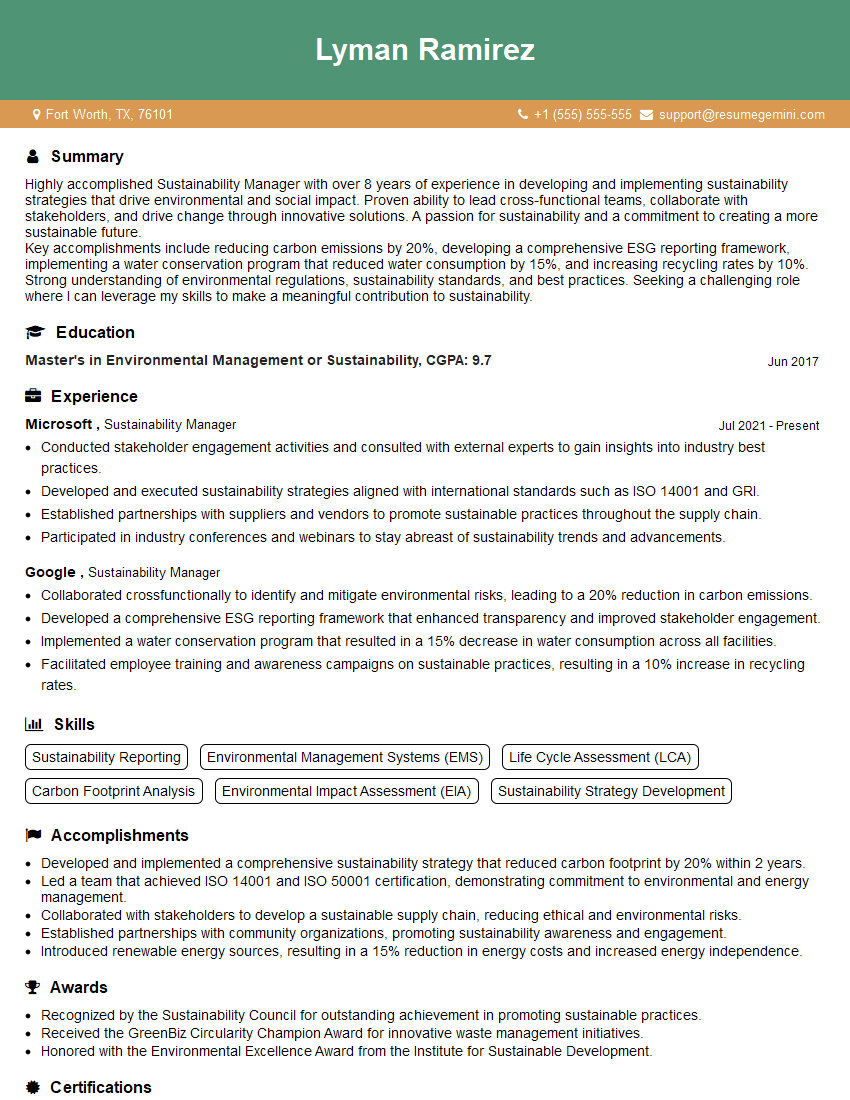
Sustainability Manager Resume Sample
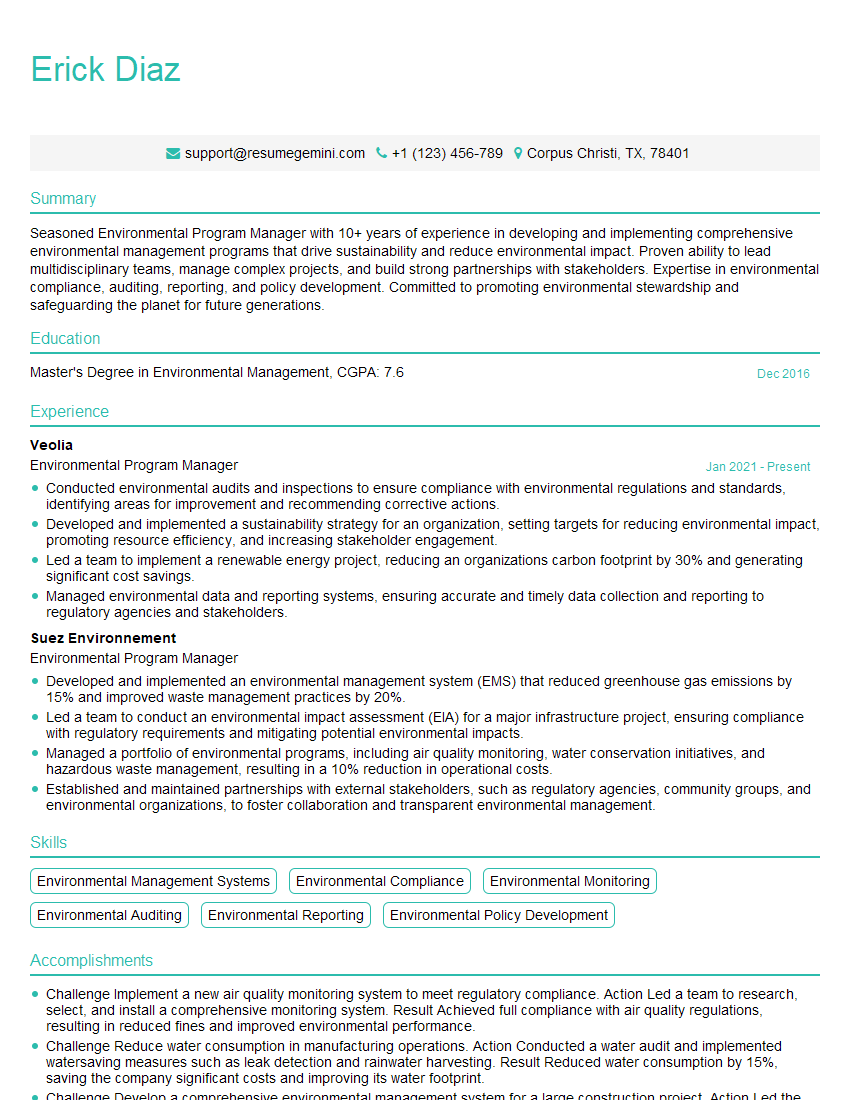
Environmental Program Manager Resume Sample
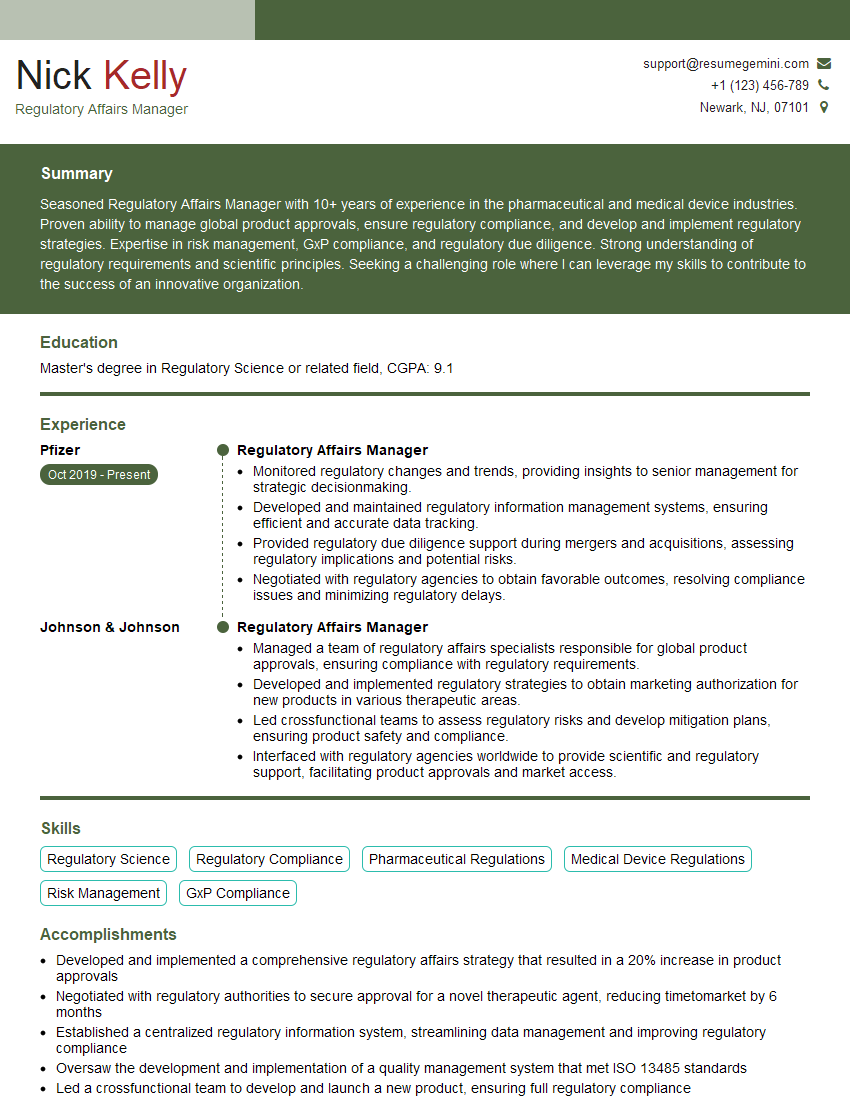
Regulatory Affairs Manager Resume Sample
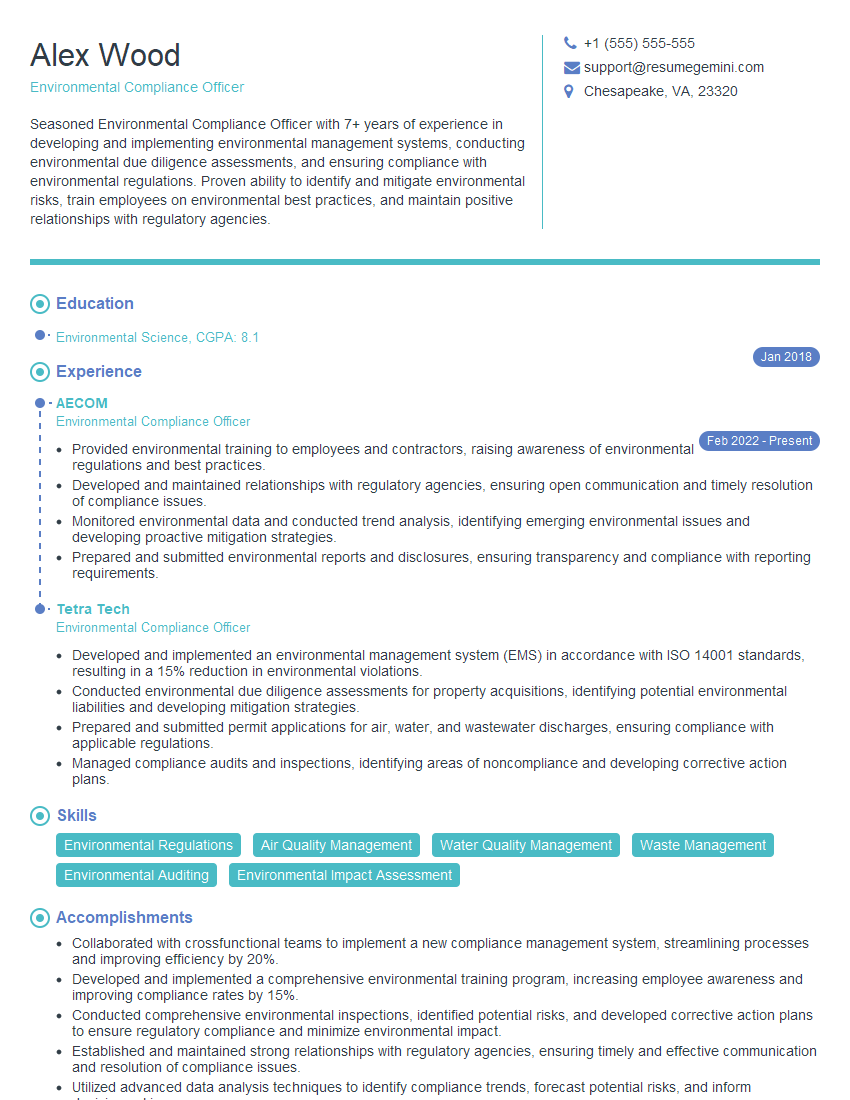
Environmental Compliance Officer Resume Sample
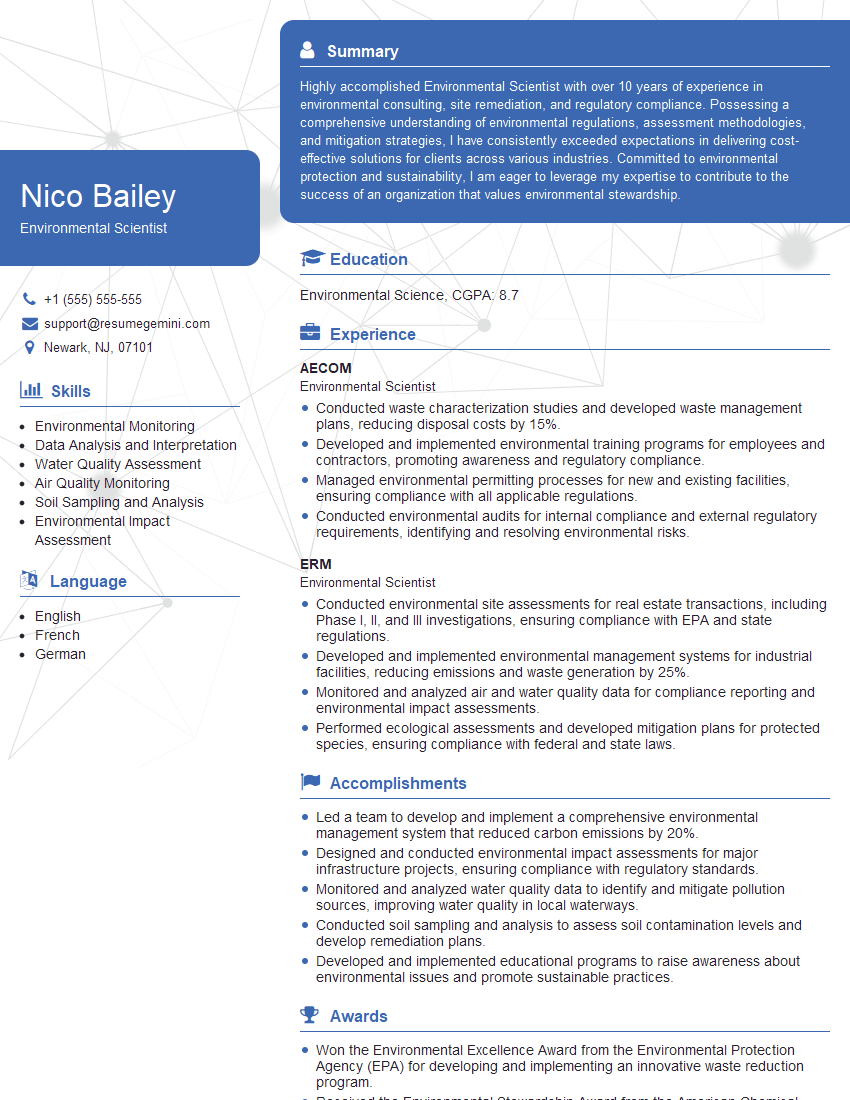
Environmental Scientist Resume Sample
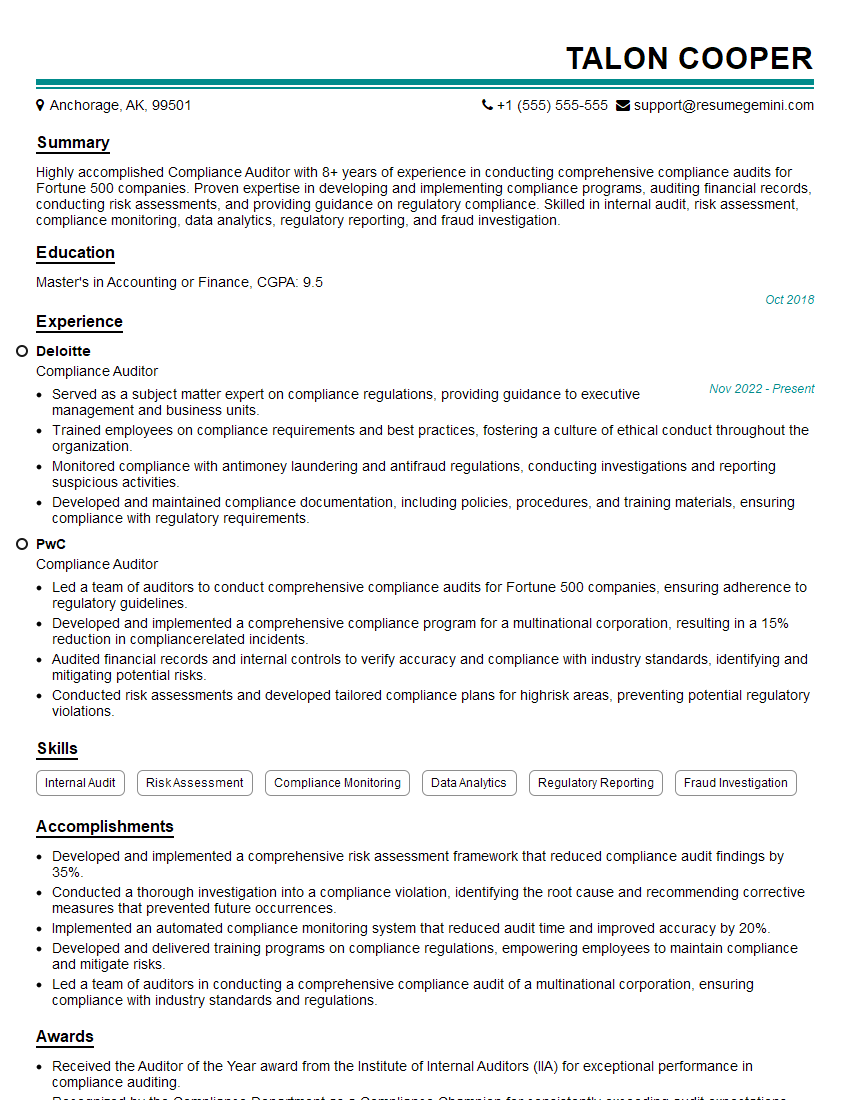
Compliance Auditor Resume Sample
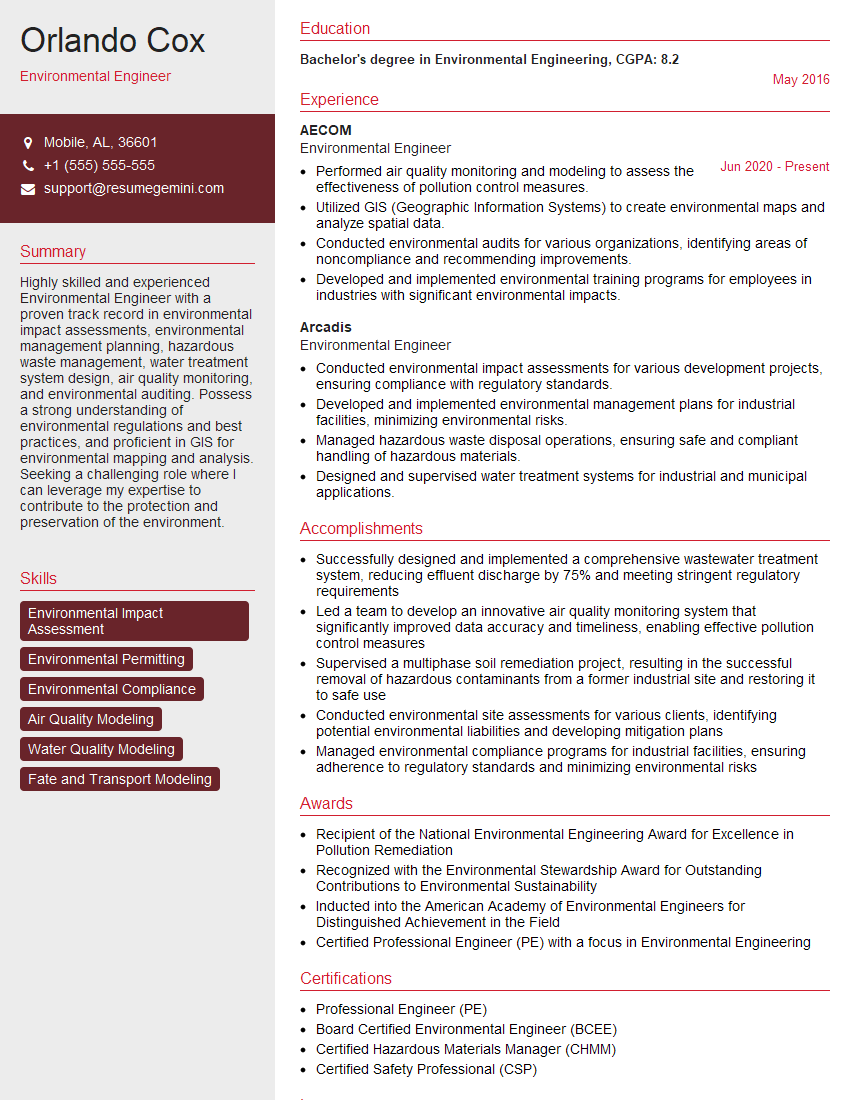
Environmental Engineer Resume Sample
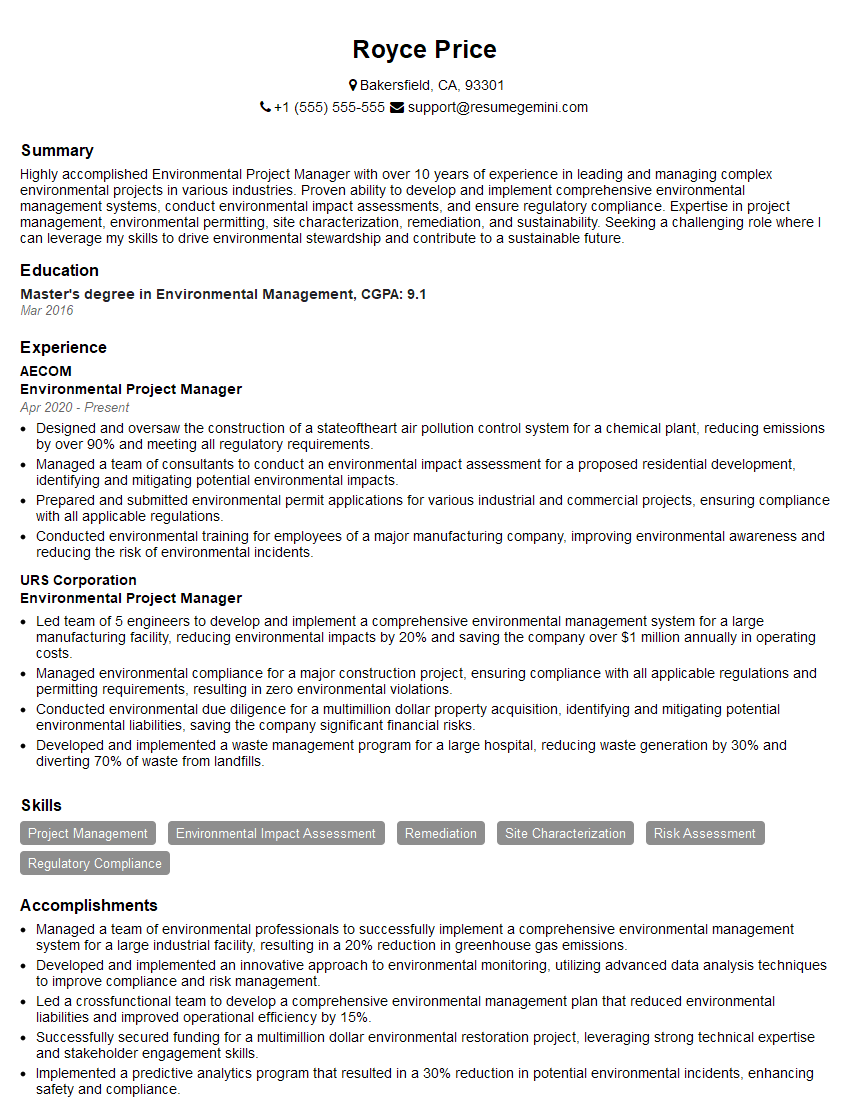
Environmental Project Manager Resume Sample
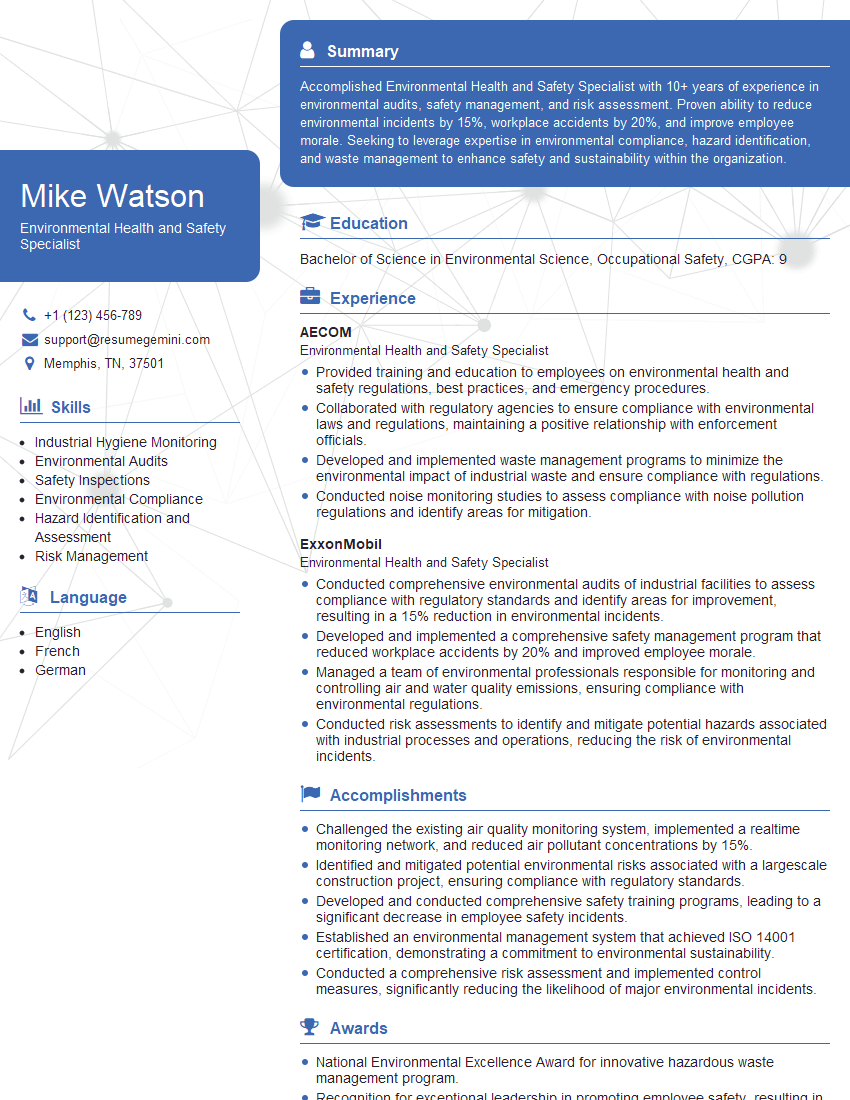
Environmental Health and Safety Specialist Resume Sample
Explore more articles
Users Rating of Our Blogs
Share Your Experience
We value your feedback! Please rate our content and share your thoughts (optional).
What Readers Say About Our Blog
Very informative content, great job.
good