Preparation is the key to success in any interview. In this post, we’ll explore crucial Transmission and Distribution (T&D) Engineering interview questions and equip you with strategies to craft impactful answers. Whether you’re a beginner or a pro, these tips will elevate your preparation.
Questions Asked in Transmission and Distribution (T&D) Engineering Interview
Q 1. Explain the difference between transmission and distribution systems.
Transmission and distribution systems are both crucial parts of the power grid, but they differ significantly in voltage levels, distances covered, and the types of equipment used. Think of it like this: transmission is the highway, carrying massive amounts of power long distances, while distribution is the network of smaller roads that deliver power to individual homes and businesses.
Transmission systems operate at high voltages (typically 110 kV and above), transporting bulk power generated at power plants over long distances to substations. These systems are designed for efficiency and minimal power loss over extensive distances. They use large transmission towers, high-capacity conductors, and sophisticated protection systems.
Distribution systems operate at lower voltages (typically below 69 kV), distributing power from substations to end-users. These systems prioritize reliability and safety, with smaller conductors, shorter distances, and protective equipment designed to handle local faults effectively. Think of distribution lines as the smaller branches reaching every house from the main highway.
Q 2. Describe the various types of transmission lines and their applications.
Several types of transmission lines cater to different needs and conditions. The choice depends on factors like voltage level, power transfer capacity, terrain, and cost.
- Overhead Lines: These are the most common type, consisting of conductors suspended from towers. They are economical for long distances but susceptible to weather conditions and environmental impacts. There are various conductor types used, including ACSR (Aluminum Conductor Steel Reinforced) and bundled conductors to reduce losses and increase capacity.
- Underground Cables: These lines are buried underground and offer better aesthetics, reduced environmental impact, and enhanced protection from severe weather. However, they are more expensive to install and maintain, and have higher capacitance which leads to increased charging current.
- High-Voltage Direct Current (HVDC) Lines: These lines transmit power using direct current, offering advantages in long-distance transmission and improved stability. They are particularly useful for connecting asynchronous grids or transmitting large amounts of power across long submarine cables. This technology is more expensive but solves issues of long transmission distance and stability.
Q 3. What are the advantages and disadvantages of different grounding techniques?
Grounding techniques are essential for safety and system stability. Different methods offer various advantages and disadvantages:
- Solid Grounding: This provides a low-impedance path for fault currents, quickly clearing faults and protecting equipment. However, it can lead to higher fault currents and may require larger equipment.
- Resistance Grounding: This method limits fault currents by inserting a resistor in the ground path. It offers a balance between fault protection and reducing equipment stress. However, finding the optimal resistance value is crucial and requires careful calculation.
- Reactance Grounding: Similar to resistance grounding, but using a reactor to limit fault current. This method is often preferred for higher voltage systems.
- Ungrounded (Isolated) System: This method isolates the system from ground and relies on protective relays to detect faults. It is less prone to ground faults but requires more sensitive protection schemes.
The best grounding technique depends on the system’s specific requirements, voltage level, and fault current considerations. For instance, a solid grounding system is commonly used in low-voltage distribution systems, while resistance or reactance grounding might be preferred for high-voltage transmission systems. The choice will heavily depend on the risk assessment of the site.
Q 4. Explain the principles of power system protection and relaying.
Power system protection aims to detect and isolate faults quickly, minimizing damage and ensuring system stability. Relays are the core components, acting as the ‘nervous system’ of the grid.
The principles involve:
- Fault Detection: Relays continuously monitor system parameters like current, voltage, and impedance. When a fault occurs, these parameters deviate significantly from normal operating conditions, triggering the relay.
- Fault Isolation: Once a fault is detected, the relay activates circuit breakers to isolate the faulty section from the rest of the system. This prevents the fault from spreading and causing widespread outages.
- Protection Coordination: Relays are coordinated to ensure that the correct protection devices operate in the right sequence and only isolate the affected section, preventing unnecessary tripping.
Different types of relays exist, including overcurrent, distance, differential, and directional relays, each designed to protect against specific types of faults. For example, an overcurrent relay will trip when the current exceeds a preset threshold, while a distance relay measures the impedance to detect faults within a specific zone.
Q 5. How do you perform fault analysis on a power system?
Fault analysis determines the possible faults in a power system and their impact. Several methods are used:
- Symmetrical Component Analysis: This method decomposes unbalanced fault currents into symmetrical components (positive, negative, and zero sequence). This helps to understand the contribution of different sequences in causing the fault and facilitates relay coordination.
- Z-bus (impedance) matrix method: This method uses network topology and component impedances to calculate fault currents at various busbars. It is commonly used for larger power systems. For example, to calculate the fault current at any given bus, a specific equation based on the Z-bus matrix is utilized.
- Fault Location Algorithms: These algorithms use measurements from various locations on the power system to pinpoint the location of faults in transmission lines. This is crucial for quick repairs.
Software packages are used extensively for simulating faults and analyzing results. The choice of analysis method depends on the system’s complexity and the level of detail required.
Q 6. Describe the function of a substation and its key components.
Substations are critical switching centers in T&D systems, transforming voltage levels and routing power. They act like major traffic interchanges, managing power flow efficiently.
Key components include:
- Transformers: These step up or step down voltage levels, matching the requirements of transmission and distribution networks.
- Circuit Breakers: These act as switches to isolate faulty sections of the system, ensuring safety and preventing cascading failures. They are vital for fault isolation.
- Buses: These are conducting bars that serve as connection points for various equipment.
- Protective Relays: These detect faults and initiate circuit breaker operations.
- Switchgear: This includes disconnecting switches, isolators, and other switching devices to control and isolate equipment.
- Measurements: Substations have instruments that measure voltage, current, power, frequency, and other key parameters for system monitoring and control.
Q 7. What are the different types of transformers used in T&D systems?
Various types of transformers are employed in T&D systems, each suited for specific applications:
- Power Transformers: These are large transformers used in substations to step up voltage for transmission and step down voltage for distribution. They handle large power flows.
- Distribution Transformers: Smaller transformers located near consumers, stepping down voltage to the utilization levels (e.g., 120/240V for residential use).
- Autotransformers: These transformers have a single winding, tapped at various points. They are used for voltage regulation and smaller voltage transformations.
- Instrument Transformers: These are used for measurement and protection purposes, stepping down voltage (potential transformers) and current (current transformers) to safer levels for monitoring and relaying.
The choice of transformer type is governed by voltage levels, power rating, efficiency requirements, and cost considerations.
Q 8. Explain the concept of power flow studies and their importance.
Power flow studies are analyses that determine the steady-state operating conditions of a power system. Think of it like mapping the flow of electricity through the entire network – from power generation plants to individual homes and businesses. These studies calculate various parameters at each point in the system, including voltage magnitudes and angles, real and reactive power flows, and current magnitudes. This information is crucial for system planning, operation, and control.
Their importance stems from several factors:
- Planning and Design: Power flow studies help engineers determine the optimal sizing and placement of new transmission lines, transformers, and generators, ensuring the system can reliably handle future load demands.
- Operation and Control: They help operators monitor the system’s performance in real-time, identifying potential overloads or voltage violations that could lead to outages. This allows for proactive interventions to maintain system stability.
- Fault Analysis: By understanding normal operating conditions, power flow studies form a baseline for analyzing the system’s response to faults, such as short circuits. This is critical for protection system design.
- Economic Dispatch: Power flow studies can aid in optimizing the generation dispatch (i.e., determining how much power each generator should produce) to minimize the overall cost of electricity while meeting demand.
For instance, imagine designing a new solar farm connection. Power flow studies would determine the necessary transformer capacity and the impact on the existing grid, preventing potential overloads or voltage sags.
Q 9. How is voltage regulation maintained in a distribution system?
Voltage regulation in a distribution system is the process of maintaining the voltage levels within acceptable limits (typically ±5%). Consistent voltage is essential for the proper operation of electrical equipment.
Several methods are used:
- Tap-Changing Transformers: These transformers can adjust their turns ratio, effectively changing the voltage level. They are commonly used at substations to regulate the voltage supplied to the distribution network. Think of it like a gear shifter in a car, adjusting the voltage to match the load demands.
- Voltage Regulators (Step Voltage Regulators): These devices are installed along distribution lines to automatically regulate voltage in specific sections of the network. They can raise or lower voltage in discrete steps based on load fluctuations.
- Capacitor Banks: Reactive power compensation is crucial. Capacitor banks are connected to the distribution system to improve power factor and reduce voltage drop. This is like adding extra ‘oomph’ to the electrical system to maintain voltage.
- Distributed Generation (DG): Integrating renewable energy sources like solar and wind power can provide voltage support locally, reducing the reliance on centralized voltage regulation.
- Advanced Control Systems: Modern distribution systems utilize advanced control systems (often involving SCADA, described later) that coordinate voltage regulation across the entire network in a more efficient and responsive manner.
For example, during peak demand hours, a tap-changing transformer might boost the voltage to compensate for increased line losses and maintain voltage at customer locations.
Q 10. Describe different methods for improving power system stability.
Power system stability refers to the ability of the system to maintain synchronism between generators following a disturbance. Loss of synchronism leads to cascading outages.
Methods for improving stability include:
- Fast Acting Protective Relays: Quickly isolating faults minimizes the impact on the system and prevents widespread instability.
- Power System Stabilizers (PSS): These devices enhance the generator’s ability to remain in synchronism during disturbances by adjusting its excitation system.
- Flexible AC Transmission Systems (FACTS): FACTS devices, such as Static Synchronous Compensators (STATCOMs) and Static Synchronous Series Compensators (SSSC), provide fast and flexible control of voltage and reactive power flow, improving system stability.
- Improved Grid Infrastructure: Upgrading transmission lines and transformers, along with implementing appropriate protection schemes, makes the system more robust.
- Energy Storage Systems (ESS): Batteries and other energy storage technologies can provide fast-responding power during transient events, supporting system stability.
For instance, a PSS on a generator might quickly increase its output power to counter a sudden drop in frequency, preventing the generator from falling out of synchronism.
Q 11. What are the challenges associated with integrating renewable energy sources into the grid?
Integrating renewable energy sources like solar and wind presents several challenges:
- Intermittency: The output of renewable sources fluctuates depending on weather conditions. This unpredictability requires sophisticated forecasting and grid management techniques.
- Variability: The intermittent nature causes rapid changes in power generation, potentially leading to frequency and voltage instability if not properly managed.
- Location: Renewable resources are often located far from load centers, requiring new transmission infrastructure to deliver power efficiently.
- Reverse Power Flow: When generation exceeds demand, power can flow back towards the source, requiring appropriate protection and control measures.
- Grid Integration Costs: Significant investments are needed to upgrade the grid to accommodate the intermittent nature and variable output of renewables.
For example, a sudden drop in solar generation due to cloud cover can lead to frequency deviations if not compensated by other generators or energy storage.
Q 12. Explain the role of SCADA in T&D systems.
Supervisory Control and Data Acquisition (SCADA) systems are crucial for monitoring and controlling T&D systems. Think of it as the nervous system of the power grid.
SCADA’s role includes:
- Real-time Monitoring: SCADA systems continuously monitor key parameters such as voltage, current, power flow, and equipment status across the entire network.
- Remote Control: Operators can remotely control various equipment, such as circuit breakers, transformers, and capacitor banks, from a central control room.
- Alarm Management: The system generates alerts when abnormal conditions occur, enabling timely intervention to prevent outages or equipment damage.
- Data Logging and Analysis: SCADA collects vast amounts of data, which can be used for performance analysis, fault diagnosis, and system optimization.
For instance, if a fault is detected on a transmission line, SCADA can automatically isolate the faulty section, minimizing the impact on the rest of the system.
Q 13. Describe your experience with power system simulation software.
Throughout my career, I have extensively used various power system simulation software packages, including ETAP, PSS/E, and PowerWorld Simulator. I’m proficient in building detailed models of power systems, running power flow, fault analysis, and stability studies. My experience extends to using these tools for both planning and operational studies. For instance, in a recent project involving the integration of a large wind farm, I used PSS/E to model the system, conduct stability studies, and determine the appropriate control strategies to ensure reliable operation.
I’m familiar with the capabilities and limitations of each software package and can select the most appropriate tool for a given task. Beyond the technical aspects, I have a strong understanding of how to interpret the results and translate the simulations into actionable insights for system design and operation. This includes understanding the assumptions and limitations inherent in the models used.
Q 14. How do you ensure the reliability of a T&D system?
Ensuring the reliability of a T&D system involves a multi-faceted approach:
- Preventive Maintenance: Regular inspections, testing, and refurbishment of equipment are essential to prevent failures. This is proactive and avoids costly and disruptive outages.
- Redundancy and Protection: Designing the system with backup equipment and protection schemes prevents cascading failures. Multiple paths for power flow are crucial.
- Advanced Control Systems: Implementing sophisticated control systems, such as SCADA and advanced state estimation, allows for proactive management and rapid response to disturbances.
- System Monitoring and Analysis: Continuous monitoring and analysis of system performance identifies potential weaknesses and areas for improvement before they lead to failures.
- Emergency Response Planning: Having well-defined procedures and trained personnel for responding to outages ensures quick restoration of service.
A good example of this is the use of smart grid technologies which enhance real-time monitoring and control, enabling faster responses to disturbances and minimizing the impact of outages. My approach always prioritizes a balanced blend of proactive preventative measures and reactive corrective actions.
Q 15. Explain the importance of power quality in T&D systems.
Power quality in Transmission and Distribution (T&D) systems refers to the consistency and stability of the electrical power delivered to consumers. Maintaining high power quality is crucial because even minor deviations can have significant impacts on equipment and operations.
Think of it like this: your home appliances work best with a stable water pressure. Similarly, consistent voltage, frequency, and waveform are essential for the proper functioning of electrical equipment. Poor power quality can lead to malfunctions, reduced efficiency, premature equipment failure, and even safety hazards.
Key aspects of power quality include:
- Voltage Stability: Maintaining voltage within acceptable limits (+/- 5% is common).
- Frequency Stability: Keeping the frequency close to the nominal value (50Hz or 60Hz).
- Waveform Distortion: Minimizing harmonics and other distortions in the sinusoidal waveform.
- Transient Events: Mitigating voltage sags, swells, and interruptions.
Ensuring good power quality requires careful planning, design, operation, and maintenance of the entire T&D system. This involves using appropriate equipment, implementing effective protection schemes, and regularly monitoring system performance.
Career Expert Tips:
- Ace those interviews! Prepare effectively by reviewing the Top 50 Most Common Interview Questions on ResumeGemini.
- Navigate your job search with confidence! Explore a wide range of Career Tips on ResumeGemini. Learn about common challenges and recommendations to overcome them.
- Craft the perfect resume! Master the Art of Resume Writing with ResumeGemini’s guide. Showcase your unique qualifications and achievements effectively.
- Don’t miss out on holiday savings! Build your dream resume with ResumeGemini’s ATS optimized templates.
Q 16. What are the different types of insulators used in transmission lines?
Insulators in transmission lines are critical components responsible for preventing current leakage to the ground. They need to withstand high voltages and harsh environmental conditions. Several types are commonly used:
- Porcelain Insulators: These are the most common type, known for their high mechanical strength, good dielectric properties, and resistance to environmental degradation. They’re typically used in lower voltage applications. They are also relatively inexpensive.
- Glass Insulators: Offer excellent dielectric strength and are less susceptible to flashover due to surface contamination compared to porcelain. However, they are more fragile.
- Polymer Insulators (Composite Insulators): These are increasingly popular due to their high strength-to-weight ratio, resistance to pollution, and relatively low cost. They typically consist of a fiberglass core surrounded by a weather-resistant polymer housing.
- Long Rod Insulators: These are used where space is limited, offering a compact design. These are a type of polymer insulator.
The choice of insulator depends on various factors such as voltage level, environmental conditions (pollution, temperature, humidity), and cost considerations. For instance, in heavily polluted areas, polymer insulators might be preferred due to their superior pollution performance.
Q 17. Explain the concept of impedance and its role in power systems.
Impedance is a measure of the opposition to the flow of current in an AC circuit. It’s a complex quantity comprising resistance (R) and reactance (X), represented as Z = R + jX, where ‘j’ is the imaginary unit.
Resistance represents the energy dissipated as heat, while reactance represents the energy stored in the electric and magnetic fields. Reactance further divides into inductive reactance (XL) due to inductors and capacitive reactance (XC) due to capacitors.
Impedance plays a crucial role in power systems by determining:
- Voltage drop across transmission lines: Higher impedance leads to larger voltage drops, affecting the voltage profile at the load end.
- Power flow distribution: Impedance influences the distribution of power throughout the system.
- Stability analysis: Impedance plays a critical role in determining the stability of the power system. High impedances can contribute to system instability, including voltage collapse.
- Fault current calculation: Impedance is used to calculate fault currents during short circuits, influencing the design of protection relays.
For example, a high impedance in a transmission line will cause a larger voltage drop, requiring voltage regulation measures such as tap-changing transformers. Understanding impedance is fundamental to designing and operating efficient and reliable power systems.
Q 18. Describe your experience with protective relay coordination studies.
I have extensive experience in protective relay coordination studies. These studies are crucial for ensuring that protective relays operate correctly during faults, isolating the faulty section and minimizing service interruptions while preventing cascading failures. My experience encompasses various stages, from data gathering to report generation.
My typical workflow involves:
- Gathering System Data: This includes relay settings, transformer ratings, line impedances, and protection schemes.
- Developing a One-Line Diagram: Creating a simplified representation of the power system to be analyzed.
- Using Specialized Software: Employing software packages like ETAP, EasyPower, or ASPEN to simulate fault conditions and analyze relay operation times.
- Coordination Studies: Ensuring that the protective relays operate in the correct sequence and with appropriate time delays to isolate the fault effectively.
- Report Generation and Recommendations: Documenting the findings and providing recommendations for relay setting adjustments, if necessary.
One project involved coordinating the protection scheme for a large industrial facility with multiple transformers and generators. By carefully coordinating relay settings, we ensured that the system would quickly isolate faults without causing unnecessary tripping of healthy sections. This resulted in improved system reliability and reduced downtime.
Q 19. How do you handle voltage sags and swells in a distribution system?
Voltage sags and swells are common power quality issues in distribution systems, often caused by faults, switching operations, or large load variations. Handling these requires a multi-pronged approach:
- Mitigation at the Source: Implementing measures to reduce the occurrence of sags and swells. This might include improving system grounding, upgrading equipment, or using power factor correction techniques.
- Using Voltage Regulators: Installing voltage regulators, such as tap-changing transformers or dynamic voltage restorers (DVRs), to maintain voltage within acceptable limits.
- Employing Surge Protection Devices (SPDs): SPDs, such as surge arresters, protect equipment from voltage surges and transients.
- Utilizing Uninterruptible Power Supplies (UPS): For critical loads, UPS systems can provide a clean and uninterrupted power supply during sags, swells, and interruptions.
- Load Management Strategies: Implementing load management techniques to reduce the impact of voltage fluctuations on sensitive loads.
For example, a significant voltage sag at a hospital could lead to the failure of critical medical equipment. To prevent this, a UPS system would be a crucial protective measure for these loads.
Q 20. Explain the concept of reactive power compensation.
Reactive power compensation involves adding devices to the power system to improve the power factor. This is important because inductive loads (like motors) draw reactive power, which doesn’t contribute to useful work but causes higher currents and voltage drops.
The goal of reactive power compensation is to reduce the reactive power demand by supplying reactive power locally to the load, thus improving the power factor closer to unity (1). This can be achieved through several methods:
- Shunt Capacitors: These are the most common method, providing capacitive reactive power to counteract the inductive reactive power. They are often installed at substations or distribution points near large inductive loads.
- Synchronous Condensers: These are synchronous motors running without a mechanical load, providing controllable reactive power compensation. They offer more flexibility than shunt capacitors, especially for dynamic load variations.
- Static Synchronous Compensators (STATCOM): These are advanced power electronic devices that provide fast and precise reactive power compensation.
By improving the power factor, reactive power compensation reduces current flow, minimizes voltage drops, enhances system efficiency, and reduces transmission and distribution losses. This ultimately leads to cost savings and improved system performance. Think of it like clearing a clogged pipe; reactive power compensation removes the ‘blockage’ (reactive power) allowing the useful power to flow more efficiently.
Q 21. What are the different types of cables used in underground distribution?
Underground distribution cables are crucial for reliable power delivery in densely populated areas and environmentally sensitive locations. Several types are used, each with its own advantages and disadvantages:
- Solid Dielectric Cables: These use paper or polymeric materials as insulation. Paper-insulated lead-sheathed (PILC) cables were common historically but are now largely replaced by modern polymeric materials. These are less expensive but tend to be larger and heavier.
- Cross-linked Polyethylene (XLPE) Insulated Cables: XLPE cables offer superior dielectric strength, improved resistance to moisture, and longer life compared to PILC cables. They are commonly used in high-voltage underground distribution.
- High-Pressure Fluid-Filled (HPFF) Cables: These cables use oil under high pressure to improve insulation performance and heat dissipation. They are often preferred for very high voltage applications.
- Gas-Filled Cables: Use pressurized gas as insulation; commonly used for high-voltage applications where space is limited.
The selection of the cable type depends on factors such as voltage level, current carrying capacity, environmental conditions, cost, and installation constraints. For instance, in areas with limited space, gas-filled or XLPE cables might be preferred due to their smaller size and weight compared to PILC cables.
Q 22. Describe your experience with GIS software for T&D system analysis.
My experience with GIS software in T&D system analysis is extensive. I’ve utilized various GIS platforms, including ArcGIS and OpenGIS, for tasks ranging from network modeling and asset management to fault location analysis and outage management. For example, in a recent project involving the expansion of a 230kV substation, I used ArcGIS to create a detailed geographic model of the existing and proposed transmission lines, substations, and other assets. This allowed for efficient spatial analysis, identifying potential conflicts with existing infrastructure and optimizing the placement of new equipment. Beyond simply mapping, I’ve leveraged the analytical capabilities of GIS to perform complex tasks such as shortest path analysis to optimize feeder routes and load flow simulations to identify potential voltage violations within the network. This integrated approach of combining geographic data with network analysis has proven crucial in enhancing project planning, operational efficiency, and overall system reliability.
Furthermore, I’m proficient in using GIS to integrate data from various sources, such as SCADA systems and asset databases, creating a comprehensive and dynamic representation of the T&D network. This integrated view allows for better decision-making in areas like maintenance scheduling, resource allocation, and emergency response.
Q 23. How do you ensure compliance with safety regulations in T&D projects?
Ensuring compliance with safety regulations in T&D projects is paramount. My approach is multi-faceted and begins with a thorough understanding of all applicable regulations, including OSHA, NEC, and relevant industry standards. This involves staying updated on the latest code revisions and best practices. I implement a robust safety program on every project, starting with a comprehensive risk assessment identifying potential hazards during each phase of the project, from design to construction and operation. This assessment leads to the development of detailed safety plans with specific control measures to mitigate identified risks. Examples of these measures include using proper lockout/tagout procedures for equipment maintenance, employing personal protective equipment (PPE) appropriate for the task, and implementing rigorous training programs for all personnel involved.
Beyond documentation, I actively oversee the implementation of these safety measures, performing regular site inspections and safety audits. I also foster a strong safety culture by empowering workers to report hazards and participate in safety discussions. Proactive communication and collaboration with contractors and regulatory bodies are essential to maintain compliance throughout the project lifecycle. In case of any non-compliance, we implement corrective actions immediately and conduct thorough root cause analyses to prevent future occurrences. A culture of safety, emphasized through education and accountability, is the most effective way to mitigate risks and ensure safe project completion.
Q 24. What are the latest trends in T&D technology?
The T&D industry is experiencing rapid technological advancements. Some of the most significant trends include:
- Smart Grid Technologies: This encompasses the integration of advanced sensors, communication networks, and data analytics to improve grid efficiency, reliability, and resilience. Examples include advanced metering infrastructure (AMI), distribution automation systems (DAS), and phasor measurement units (PMUs).
- Renewable Energy Integration: The increasing penetration of renewable energy sources like solar and wind power requires sophisticated grid management techniques to handle their intermittent nature. This includes advancements in energy storage technologies and power electronics.
- Advanced Analytics and AI: Machine learning and artificial intelligence are being used for predictive maintenance, fault detection, and load forecasting, leading to optimized operations and reduced downtime.
- Digital Twins: Creating virtual representations of the T&D system allows for simulation and analysis of various scenarios, helping to optimize design, operation, and planning.
- High-Voltage Direct Current (HVDC) Transmission: HVDC technology is becoming increasingly important for long-distance transmission and integration of renewable energy sources.
These trends collectively contribute to a more resilient, efficient, and sustainable power grid capable of meeting future energy demands.
Q 25. Describe your experience with project management in T&D projects.
My experience in project management within T&D projects is extensive, encompassing all phases – from conceptualization and design to construction, commissioning, and handover. I’ve successfully led and managed numerous projects, adhering to strict budgets and timelines, often under challenging conditions. My approach incorporates proven methodologies, such as Agile and PRINCE2, adapting them to the specifics of each project. For instance, in one project involving the upgrade of a major substation, I implemented an Agile approach, breaking down the project into smaller, manageable sprints, allowing for flexibility and responsiveness to changing requirements. This iterative approach facilitated effective stakeholder communication and minimized potential delays.
Key aspects of my project management include meticulous planning, risk management, resource allocation, and communication. I utilize project management software like MS Project to track progress, manage resources, and identify potential risks proactively. Regular stakeholder meetings ensure transparency and collaboration, facilitating prompt resolution of any arising issues. Effective documentation throughout all project phases is crucial for ensuring compliance and successful handovers. My focus is always on delivering projects on time, within budget, and to the highest safety standards.
Q 26. How do you handle emergencies and outages in a T&D system?
Handling emergencies and outages in a T&D system requires a rapid and coordinated response. My experience includes leading teams during such events, utilizing a structured approach. This typically begins with immediate fault location identification, often utilizing SCADA systems and outage management systems (OMS). Once the location is confirmed, the next step involves isolating the affected section of the network to prevent further damage and ensure the safety of personnel. This may involve remotely switching equipment or dispatching field crews to manually isolate the fault.
Simultaneously, communication is critical. I ensure effective communication with control centers, field crews, and affected customers, providing regular updates and coordinating restoration efforts. Once the fault is isolated, the next phase focuses on repair and restoration. This often involves assessing the damage, ordering necessary parts, and coordinating repair activities. Post-outage, a thorough root cause analysis is conducted to determine the cause of the outage and implement corrective measures to prevent future occurrences. This analysis often involves reviewing data logs from SCADA and protection relays to identify contributing factors. Continual improvement is crucial, and I utilize lessons learned from each event to enhance the system’s reliability and emergency response capabilities.
Q 27. Explain your understanding of smart grid technologies and their applications.
Smart grid technologies are transforming the T&D landscape, enhancing efficiency, reliability, and sustainability. My understanding encompasses various aspects, including:
- Advanced Metering Infrastructure (AMI): AMI enables real-time monitoring of energy consumption, facilitating demand-side management and improved load forecasting.
- Distribution Automation Systems (DAS): DAS enables remote control and automation of grid operations, enhancing reliability and reducing outage durations.
- Phasor Measurement Units (PMUs): PMUs provide high-resolution data on voltage and current phasors, crucial for improved grid stability and protection.
- Energy Storage Systems (ESS): ESS, such as battery storage, help integrate intermittent renewable energy sources and enhance grid stability.
- Wide-Area Monitoring Systems (WAMS): WAMS provide a comprehensive view of the entire grid, allowing for early detection of potential problems and improved situational awareness.
Applications of these technologies range from enhancing grid resilience to optimizing renewable energy integration, improving energy efficiency, and enabling better customer engagement. For example, in a project I worked on, we implemented an AMI system that significantly reduced energy theft and improved customer service by providing real-time energy consumption data. The integration of smart grid technologies is crucial for building a modern, robust, and sustainable power grid.
Q 28. Describe your experience with the design and implementation of protection schemes.
My experience in the design and implementation of protection schemes is grounded in a deep understanding of relay principles, system protection philosophies, and industry standards. I’ve worked on various protection schemes, from simple overcurrent protection to complex schemes involving distance protection, differential protection, and busbar protection. The design process begins with a thorough understanding of the system’s characteristics, including its topology, fault levels, and operating conditions. This allows me to select appropriate protection equipment and settings to effectively protect the system from various faults.
For instance, in a recent project involving a new transmission line, I designed a protection scheme incorporating distance relays for line protection, current transformers (CTs) and voltage transformers (VTs) for measurement, and protective relays for coordination. The coordination of these relays was crucial to ensure that the protection system operates correctly during faults, minimizing the extent of the outage and protecting equipment. Simulation software, such as PSS/E and ETAP, were employed to test and validate the scheme’s performance under various fault conditions. Rigorous testing is crucial before implementation, and this includes both offline simulations and on-site testing to verify the effectiveness and proper operation of the implemented protection scheme. Documentation is also crucial for future maintenance and troubleshooting.
Key Topics to Learn for Transmission and Distribution (T&D) Engineering Interview
- Power System Analysis: Understanding load flow studies, fault analysis, and stability analysis is crucial. This theoretical knowledge translates directly into practical application in system planning and operation.
- Protection and Relaying: Master the principles of protective relaying schemes, including distance protection, differential protection, and overcurrent protection. Be prepared to discuss practical applications in preventing equipment damage and maintaining grid reliability.
- High Voltage Engineering: A strong grasp of high voltage phenomena, insulation coordination, and surge protection is essential for ensuring the safe and efficient operation of transmission lines.
- Substation Design and Operation: Familiarize yourself with the design, operation, and maintenance of substations, including busbar configurations, circuit breakers, and transformers. Understand the practical challenges and solutions involved in substation design.
- Power System Control and Automation: Explore the role of SCADA systems and advanced control strategies in managing and optimizing the T&D network. Be prepared to discuss real-world applications and the benefits of automation.
- Renewable Energy Integration: Understand the challenges and opportunities associated with integrating renewable energy sources, such as solar and wind power, into the existing T&D infrastructure. This includes grid stability issues and power quality considerations.
- Transmission Line Design and Construction: Gain a thorough understanding of the design principles and construction methods for transmission lines, including conductor selection, tower design, and right-of-way considerations.
- Distribution System Planning and Optimization: Learn about the principles of distribution system planning, including load forecasting, feeder design, and voltage regulation. Be ready to discuss practical approaches to optimizing distribution system performance.
Next Steps
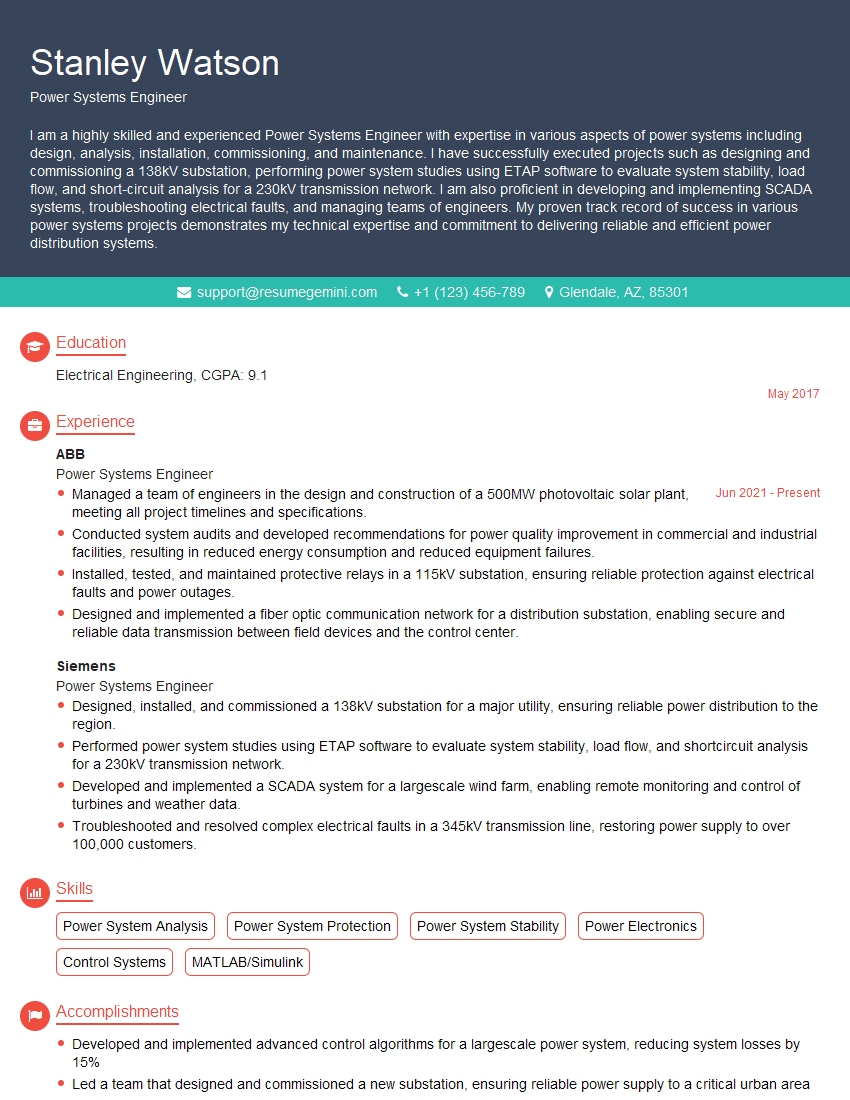
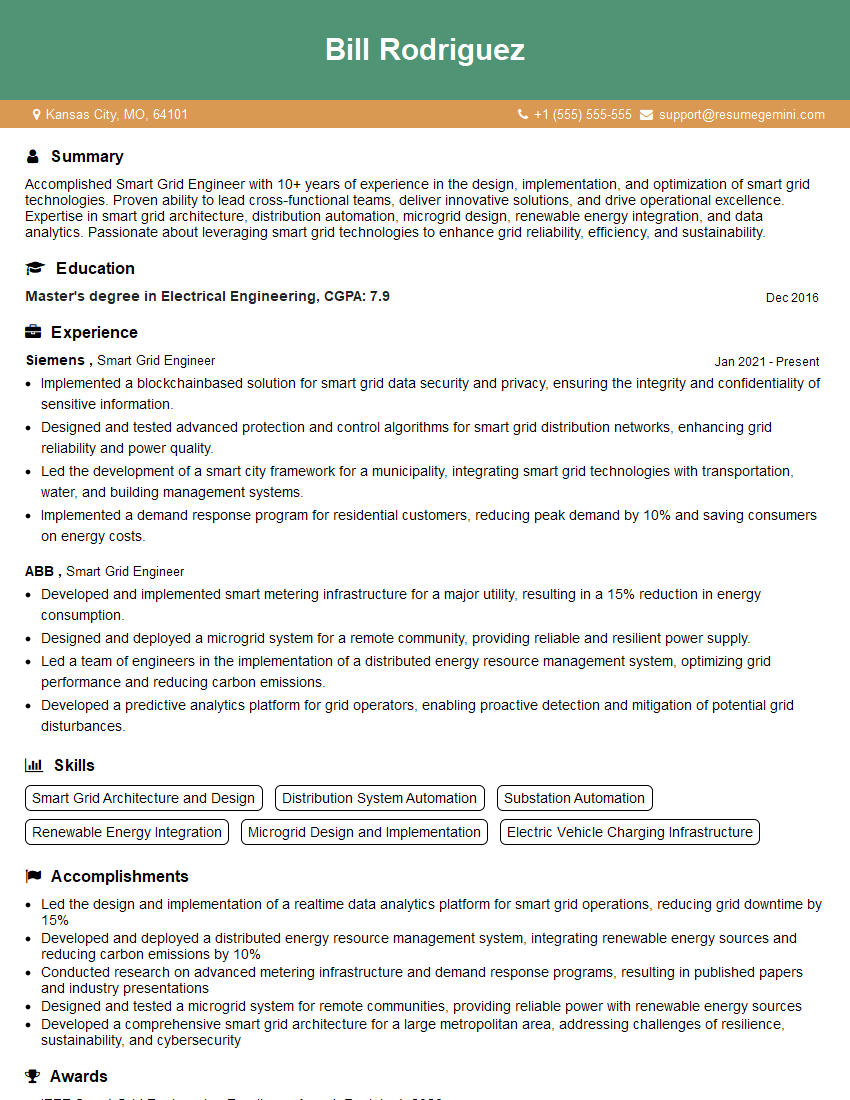
Mastering Transmission and Distribution (T&D) Engineering opens doors to a rewarding and impactful career, offering opportunities for innovation and problem-solving within a vital global industry. To maximize your job prospects, create an ATS-friendly resume that highlights your skills and experience effectively. ResumeGemini is a trusted resource that can help you build a professional and impactful resume. We provide examples of resumes tailored to Transmission and Distribution (T&D) Engineering to guide you through the process, ensuring your application stands out from the competition. Invest the time to craft a strong resume—it’s your first impression and a key to unlocking your career potential.
Explore more articles
Users Rating of Our Blogs
Share Your Experience
We value your feedback! Please rate our content and share your thoughts (optional).
What Readers Say About Our Blog
Very informative content, great job.
good