The right preparation can turn an interview into an opportunity to showcase your expertise. This guide to Transmission interview questions is your ultimate resource, providing key insights and tips to help you ace your responses and stand out as a top candidate.
Questions Asked in Transmission Interview
Q 1. Explain the difference between AC and DC transmission systems.
The fundamental difference between AC and DC transmission lies in the nature of the current flow. AC (Alternating Current) transmission uses electricity that periodically reverses direction, while DC (Direct Current) transmission uses electricity flowing in one consistent direction. Think of it like a swinging pendulum (AC) versus a steadily flowing river (DC).
AC transmission has historically been the dominant method due to its ease of voltage transformation using transformers. This allows for efficient long-distance transmission at high voltages and then stepping down the voltage for safer and more usable levels at the consumer end. DC transmission, while simpler in terms of current flow, traditionally lacked the ability for easy voltage changes. However, advancements in power electronics have made High Voltage Direct Current (HVDC) transmission increasingly competitive, particularly for long distances and underwater cables where its lower losses and reduced reactive power issues are advantageous.
For example, AC is commonly used for grid systems spanning across countries, while HVDC is often preferred for long undersea cables connecting islands or countries separated by large bodies of water, because it minimizes losses and the effects of capacitive reactance.
Q 2. Describe the various types of transmission lines and their applications.
Transmission lines are categorized based on their voltage level and construction. Common types include:
- Overhead Transmission Lines: These are the most prevalent type, consisting of conductors suspended on towers. They are cost-effective for long distances but susceptible to weather and environmental impacts. They are typically used for high-voltage bulk power transmission.
- Underground Transmission Lines: These lines are buried beneath the ground, offering better aesthetics and protection from weather but at a significantly higher cost. They are used in densely populated areas or where visual impact is a major concern, or for applications requiring high reliability.
- Submarine Cables: These are specialized cables designed for underwater applications, often used to connect islands or countries across bodies of water. They’re designed for high pressure and water resistance.
- Gas-Insulated Transmission Lines (GIL): These lines use pressurized gas as insulation instead of air or soil, offering compact design and high reliability but are expensive.
The choice of transmission line depends on factors like distance, cost, environmental considerations, reliability requirements, and the voltage level.
Q 3. What are the advantages and disadvantages of overhead and underground transmission?
Overhead Transmission:
- Advantages: Relatively inexpensive to construct and maintain, easy to inspect and repair, lower losses due to less resistance.
- Disadvantages: Vulnerable to weather events (lightning strikes, wind, ice), visual impact on the landscape, potential safety hazards.
Underground Transmission:
- Advantages: Improved aesthetics, enhanced safety, less susceptible to weather events, less land acquisition required.
- Disadvantages: Significantly higher construction and maintenance costs, difficult to inspect and repair, higher losses due to higher resistance in cables, greater heat dissipation issues
The decision of whether to use overhead or underground transmission involves a careful cost-benefit analysis considering the specific circumstances of the project.
Q 4. Explain the concept of transmission line parameters (resistance, inductance, capacitance).
Transmission line parameters represent the electrical characteristics that affect the flow of power along the line. They are:
- Resistance (R): This opposes the flow of current, causing power loss as heat (I²R losses). It’s primarily determined by the conductor material, size, and temperature.
- Inductance (L): This is the property of a conductor to oppose changes in current flow. It is associated with the magnetic field created around the conductor. Inductance causes voltage drop and power factor issues.
- Capacitance (C): This is the ability of the line to store electrical energy in the electric field between conductors. It exists between conductors and to ground. Capacitance affects line charging currents and can influence voltage levels.
These parameters are distributed along the transmission line and are considered per unit length (e.g., ohms/km, henries/km, farads/km). They influence the performance and efficiency of the transmission system.
Q 5. How do you calculate the voltage drop in a transmission line?
Voltage drop calculation in a transmission line depends on the type of line (short, medium, or long) and the desired accuracy. For a simplified approach, we can use the following formula for a short line:
Voltage Drop = (I * R * L) + (I * X * L)Where:
- I = Line current
- R = Resistance of the line
- X = Reactance of the line (inductive reactance)
- L = Length of the line
For medium and long lines, more complex calculations using ABCD parameters or equivalent pi/T models are necessary to account for distributed parameters and line constants. Specialized software tools are often employed for accurate calculations in these cases. The choice of method depends on the accuracy requirements and the characteristics of the line.
Q 6. Describe the different types of insulators used in transmission lines.
Insulators are crucial for safely supporting overhead transmission lines and preventing current leakage to ground. Several types are used:
- Pin-type insulators: Simple and inexpensive, suitable for low-voltage lines. They consist of a single porcelain or glass insulator fixed to a cross-arm on the transmission tower.
- Suspension insulators: Used for high-voltage lines. These consist of several disc-shaped insulators connected in series to increase the overall voltage withstand capability. This design provides flexibility to handle voltage variations and reduces the stress on each insulator.
- Strain insulators: Used at the ends of spans or at locations where the line experiences high tension. They’re designed to withstand significant mechanical stress.
The material choice is primarily porcelain or glass due to their high dielectric strength, good insulation properties, and ability to withstand harsh weather conditions. Polymeric insulators are also gaining popularity due to their lighter weight and improved hydrophobic properties.
Q 7. Explain the importance of transmission line protection and its different methods.
Transmission line protection is critical to ensure the reliability and safety of the power system. Faults, such as short circuits, can cause significant damage and widespread outages if not quickly cleared. Protection methods include:
- Relays: These are sensing devices that detect abnormal conditions like overcurrent, ground faults, and distance protection. They initiate tripping signals to circuit breakers.
- Circuit Breakers: These are switching devices that interrupt the flow of current, isolating the faulty section of the line.
- Protective Relays: These work in coordination to identify the location and type of fault rapidly, isolating the faulty section to minimize the impact.
- Distance Protection: This relay method measures the impedance to the fault location, determining if a fault is within the protected zone.
- Differential Protection: This compares the current entering and leaving a protected zone, detecting internal faults based on current imbalances.
Modern protection schemes employ advanced digital relays with communication capabilities, allowing for faster fault detection, isolation, and coordination. The choice of protection methods depends on factors like voltage level, line configuration, and system requirements.
Q 8. What are the different types of transmission line faults?
Transmission line faults are undesirable events that disrupt the normal flow of power. They can be broadly classified into three main types:
- Phase-to-ground faults (Single Line-to-Ground): This is the most common type, where one phase comes into contact with the ground. Imagine a tree branch falling on a power line – that’s a single line-to-ground fault. The current flows to ground through the fault point.
- Phase-to-phase faults (Line-to-Line): This occurs when two phases make contact with each other, creating a short circuit between them. Picture two wires accidentally touching during a storm.
- Three-phase faults (Three-phase short circuit): This is the most severe type, involving all three phases simultaneously short-circuiting. This is like a direct short across all three lines, resulting in a massive surge of current.
- Double Line-to-Ground Faults: Two phases come into contact with the ground simultaneously. This is less common than single line-to-ground faults, but still significant.
Understanding these fault types is crucial for designing protective relay systems to isolate faulty sections quickly, minimizing damage and downtime.
Q 9. How do you analyze and locate transmission line faults?
Fault analysis and location on transmission lines involves a combination of techniques, primarily relying on protective relaying and advanced measurement systems.
Protective Relays: These devices constantly monitor the line’s current and voltage. When a fault occurs, the relays detect abnormal conditions (e.g., excessive current, unusual voltage imbalance) and trigger circuit breakers to isolate the faulty section. The specific relay tripping sequence provides some indication of the fault’s location.
Distance Protection Relays: These sophisticated relays measure the impedance along the transmission line. By calculating the impedance to the fault, they can pinpoint its location quite accurately, even on long lines.
Fault Location Algorithms: Advanced algorithms utilizing data from multiple points along the line (e.g., distributed sensors, phasor measurement units – PMUs) can analyze wave propagation patterns to precisely locate faults. These algorithms consider factors like line parameters and wave travel times.
Traditional Methods: Older methods include using line impedance measurements and comparing readings at different substation points. This was more time-consuming and less accurate.
In practice, a combination of these methods is used for efficient and reliable fault location. Modern digital protection schemes coupled with sophisticated algorithms are increasingly preferred for their accuracy and speed.
Q 10. Explain the concept of power system stability and its importance in transmission systems.
Power system stability refers to the ability of a power system to maintain synchronism between generators after being subjected to a disturbance. Think of it like a group of dancers: if one dancer stumbles, the others need to quickly adjust to maintain the overall harmony and continue the dance.
Importance in Transmission Systems: Maintaining stability is paramount for reliable power delivery. Loss of stability can lead to cascading outages, where one fault triggers others, causing widespread blackouts. It’s crucial for maintaining grid integrity, preventing equipment damage, and ensuring the continuous supply of electricity to consumers.
Several types of stability exist, including:
- Rotor Angle Stability: This concerns the ability of synchronous generators to remain in synchronism with each other after a disturbance.
- Frequency Stability: This relates to the system’s ability to maintain its frequency within acceptable limits after a disturbance.
- Voltage Stability: This involves maintaining voltage levels within acceptable ranges.
Analyzing and ensuring stability involves sophisticated simulation tools and a deep understanding of power system dynamics.
Q 11. What are the different methods for improving power system stability?
Improving power system stability involves various strategies aimed at strengthening the grid’s ability to withstand disturbances:
- Increased Transmission Capacity: Upgrading transmission lines and substations to handle higher power flows makes the system more robust.
- Improved Generator Controls: Advanced excitation systems and governors help generators respond more effectively to disturbances, stabilizing the system.
- Power System Stabilizers (PSS): These devices enhance generator response and damping of oscillations, particularly rotor angle oscillations. They’re like shock absorbers for the power system.
- Flexible AC Transmission Systems (FACTS): These devices (discussed in more detail below) provide real-time control over voltage and power flow, greatly enhancing stability.
- Improved Protection Schemes: Fast-acting protection systems help isolate faults quickly, preventing cascading outages.
- Optimal Power Flow (OPF): Techniques that find the best operating point for the system, considering factors like stability margins.
- Dynamic Load Management: Methods of reducing or shifting load demands during emergencies to help ease stress on the system.
The specific methods used depend on the nature of the system and the types of disturbances it’s expected to face.
Q 12. Describe the role of FACTS devices in enhancing transmission system performance.
Flexible AC Transmission Systems (FACTS) devices are power electronic-based controllers that enhance the controllability and stability of AC transmission systems. They act like adjustable valves and resistors within the transmission network, dynamically adapting to changing conditions.
Role in Enhancing Performance: FACTS devices achieve this through:
- Improved Voltage Control: They can compensate for voltage drops along transmission lines, ensuring reliable voltage levels across the system.
- Enhanced Power Flow Control: They can steer power flow along desired paths, optimizing utilization and improving system security.
- Increased Transmission Capacity: By improving voltage profiles and controlling power flow, they allow for the efficient use of existing transmission lines, effectively increasing capacity without physical upgrades.
- Improved Stability: They enhance system damping, reducing oscillations and improving dynamic stability. They act like shock absorbers preventing large swings in power.
Examples of FACTS devices include:
- Static Synchronous Compensators (STATCOM): Provide reactive power compensation.
- Static Synchronous Series Compensators (SSSC): Provide series compensation for power flow control.
- Thyristor Controlled Series Compensators (TCSC): Similar to SSSC but using thyristors instead.
FACTS devices represent a crucial technology for modern power systems, enabling the efficient and reliable integration of renewable energy sources and overall enhancement of grid stability and control.
Q 13. Explain the concept of reactive power compensation in transmission systems.
Reactive power compensation is a technique used to control and improve voltage profiles and power factor in transmission systems. Reactive power is essential for maintaining voltage levels, but an imbalance can cause voltage fluctuations and losses.
Concept: Inductive loads (like motors) consume reactive power, causing voltage drops. Capacitive loads, conversely, generate reactive power, improving voltage levels. Reactive power compensation aims to balance the reactive power demand and supply, ensuring efficient voltage regulation and minimizing transmission losses.
Methods:
- Capacitor Banks: These are the most common method. Banks of capacitors are strategically placed along the transmission lines to generate reactive power, compensating for the reactive power consumed by inductive loads.
- Synchronous Condensers: These are synchronous motors running without mechanical load, providing controllable reactive power compensation. They offer more flexible control than capacitor banks.
- STATCOMs (Static Synchronous Compensators): These are advanced FACTS devices that provide fast and precise reactive power compensation.
By effectively compensating for reactive power, we reduce transmission losses, improve voltage regulation, enhance system stability, and increase the power transfer capability of the transmission lines.
Q 14. What are the different types of transformers used in transmission substations?
Transmission substations employ various types of transformers, each playing a specific role in stepping up or down voltage levels to efficiently transmit and distribute power:
- Power Transformers: These are the workhorses of transmission substations. They step up the voltage from generating stations to high transmission voltages (e.g., 230 kV, 500 kV) for efficient long-distance transmission, minimizing losses. They then step it down at substations closer to the load centers for distribution at lower voltages (e.g., 132kV, 33kV).
- Autotransformers: These transformers have a single winding with a tap for voltage adjustment. They’re often used for small voltage changes, such as regulating voltages within a substation or for boosting voltage on long lines.
- Instrument Transformers: These are smaller transformers used for measuring voltage and current in high-voltage circuits. Current transformers (CTs) step down high currents, and voltage transformers (PTs) step down high voltages to safe levels for metering and protection equipment. They are crucial for monitoring the system and enabling protection schemes.
- Shunt Reactors: These are transformers that mostly act as inductive elements that are used to compensate for excessive capacitive reactance in long transmission lines, aiding voltage regulation.
The selection of transformer type and rating depends on several factors, including voltage levels, power capacity requirements, and specific system needs.
Q 15. Explain the principle of operation of a power transformer.
A power transformer operates on the principle of electromagnetic induction. It uses two or more coils of wire, known as windings, wound around a common ferromagnetic core. When an alternating current (AC) flows through the primary winding, it creates a changing magnetic flux in the core. This changing flux, in turn, induces a voltage in the secondary winding. The ratio of the number of turns in the primary and secondary windings determines the voltage transformation ratio. If the secondary winding has more turns than the primary, the transformer steps up the voltage; if it has fewer turns, it steps down the voltage.
Think of it like a lever: a small force applied to one end can lift a much heavier weight at the other end. Similarly, a relatively low voltage in the primary can be transformed into a much higher voltage in the secondary, or vice-versa, all while maintaining (ideally) the same power.
For example, a step-down transformer at a substation might take high-voltage electricity from the transmission lines (e.g., 230 kV) and convert it to a lower voltage (e.g., 11 kV) suitable for local distribution. The core material is carefully chosen to minimize energy losses (like hysteresis and eddy currents) during the transformation process.
Career Expert Tips:
- Ace those interviews! Prepare effectively by reviewing the Top 50 Most Common Interview Questions on ResumeGemini.
- Navigate your job search with confidence! Explore a wide range of Career Tips on ResumeGemini. Learn about common challenges and recommendations to overcome them.
- Craft the perfect resume! Master the Art of Resume Writing with ResumeGemini’s guide. Showcase your unique qualifications and achievements effectively.
- Don’t miss out on holiday savings! Build your dream resume with ResumeGemini’s ATS optimized templates.
Q 16. How do you perform load flow analysis on a transmission system?
Load flow analysis is a crucial process in power system engineering to determine the steady-state operating conditions of a transmission system. It calculates the voltage magnitude and phase angle at each bus (node) in the system, along with the real and reactive power flow in each transmission line. This information is vital for planning, operation, and control of the system.
The process usually involves solving a set of non-linear algebraic equations, typically using iterative numerical methods like the Gauss-Seidel or Newton-Raphson methods. These equations represent the power balance at each bus, considering the generation, load, and line impedances. Software packages like PSS/E or PowerWorld Simulator are commonly used for this complex task. Input data includes system topology (lines, transformers, buses), generator parameters (voltage, reactive power limits), and load demands.
For instance, load flow analysis helps predict voltage drops along transmission lines, ensuring voltage levels remain within acceptable limits. It also helps in determining the optimal placement and sizing of new transmission lines or reactive power compensation devices to maintain system stability and efficiency. This is critical to avoid voltage collapses or overloading lines.
Q 17. What are the different types of circuit breakers used in transmission systems?
Transmission systems use several types of circuit breakers depending on voltage level, fault current, and application requirements. Common types include:
- Air Circuit Breakers (ACB): These are relatively simpler and widely used in lower voltage applications. They use compressed air to extinguish the arc formed during fault interruption.
- Oil Circuit Breakers (OCB): Historically common, but their use is declining due to environmental concerns. They utilize oil to quench the arc, offering good arc-extinguishing capabilities, particularly for high currents.
- Vacuum Circuit Breakers (VCB): These are preferred for medium voltage applications because they are compact, require minimal maintenance, and have a long service life. The arc is extinguished in a vacuum.
- Sulfur Hexafluoride (SF6) Circuit Breakers: SF6 gas is an excellent dielectric and arc-quenching medium. SF6 circuit breakers are commonly used in high-voltage transmission systems because of their superior performance, smaller size, and ability to interrupt high fault currents.
The choice depends on factors such as cost, operating voltage, interrupting capacity, environmental regulations, and maintenance requirements. High-voltage transmission systems usually employ SF6 circuit breakers due to their superior performance and reliability.
Q 18. Explain the working principle of a circuit breaker.
A circuit breaker is a crucial safety device designed to automatically interrupt the flow of electric current under fault conditions. It protects equipment and personnel from damage and injury. The working principle revolves around rapidly opening contacts to interrupt the current, thereby creating an arc. The key is then to effectively extinguish this arc before it re-ignites, thus maintaining the interruption.
Different circuit breaker types use various arc-quenching techniques: in oil circuit breakers, the oil cools and insulates the arc; in vacuum circuit breakers, the vacuum prevents re-ignition; in SF6 circuit breakers, the gas rapidly cools and insulates the arc. The opening of the contacts is often initiated by a tripping mechanism that’s activated by protective relays detecting a fault.
For example, if a short circuit occurs on a transmission line, the protective relays detect the fault condition. They signal the circuit breaker to open, disconnecting the faulty section from the rest of the system and preventing further damage or cascading failures. The entire process happens in milliseconds to ensure quick response.
Q 19. What are the different types of relays used for transmission line protection?
Several types of relays are used for transmission line protection, each designed to respond to specific fault conditions. Common types include:
- Overcurrent Relays: These detect excessive current flow, indicating a potential short circuit or overload. They are relatively simple and inexpensive, but can be susceptible to false tripping.
- Distance Relays: These measure the impedance to the fault location. They are highly selective and widely used for transmission line protection (explained further in the next answer).
- Differential Relays: These compare the currents entering and leaving a protected zone. Any significant difference indicates an internal fault within that zone.
- Pilot Relays: These use communication channels between the ends of a transmission line to coordinate tripping actions, enhancing selectivity and speed.
- Underfrequency Relays: These detect system-wide frequency drops, indicating potential instability or widespread outages.
The specific relay type and its settings depend on the characteristics of the transmission line, the level of protection required, and coordination with other protection devices in the system. Modern systems often use sophisticated microprocessor-based relays that offer greater flexibility and advanced functionality.
Q 20. Explain the concept of distance protection and its application in transmission systems.
Distance protection is a highly selective and sensitive method used to protect transmission lines. It determines the distance to a fault along the protected line by measuring the impedance between the relay location and the fault point. This impedance is calculated from voltage and current measurements at the relay location.
The principle is based on the fact that the impedance seen by the relay is proportional to the distance to the fault. The relay is set with zones of protection, each corresponding to a certain impedance range. If the measured impedance falls within a zone, the relay initiates tripping of the circuit breaker. The use of multiple zones (typically three zones with progressively increasing reach) provides a hierarchical protection scheme, ensuring backup protection.
The advantages of distance protection are its high speed and selectivity. It can accurately locate the fault, leading to faster clearing times and minimizing the extent of disruption. This is particularly critical for long transmission lines where overcurrent protection alone may be less effective due to delays and potential for false tripping.
For instance, if a fault occurs close to one end of a transmission line, the distance relay at that end will quickly detect it and trip the breaker, isolating the fault before it can propagate to other parts of the system. This significantly reduces the impact of the fault on system stability.
Q 21. Describe the role of SCADA systems in transmission system monitoring and control.
Supervisory Control and Data Acquisition (SCADA) systems play a vital role in monitoring and controlling transmission systems. They provide a centralized platform to collect real-time data from various points in the system, such as voltage, current, power, and status of circuit breakers and other equipment.
SCADA systems use communication networks (like microwave links or fiber optics) to gather data from remote terminal units (RTUs) and intelligent electronic devices (IEDs) located throughout the transmission network. This data is then processed, analyzed, and displayed on operator consoles at control centers, allowing operators to monitor the system’s health and performance.
Beyond monitoring, SCADA systems also facilitate remote control of various equipment, including circuit breakers, transformers, and reactive power compensation devices. Operators can remotely switch equipment on or off, change settings, and respond to system disturbances efficiently. This improves system reliability, reduces response times, and enhances operational efficiency.
For example, if a transmission line fault occurs, the SCADA system automatically detects it, displays the fault location, and enables operators to quickly initiate corrective actions, such as isolating the faulty section and rerouting power flow. This prevents cascading failures and minimizes the duration of outages, ensuring the continued supply of electricity to consumers.
Q 22. What are the challenges associated with integrating renewable energy sources into transmission systems?
Integrating renewable energy sources like solar and wind power into existing transmission systems presents several unique challenges. The intermittent nature of these resources is a primary concern. Unlike traditional power plants, solar and wind generation fluctuates significantly depending on weather conditions. This variability necessitates sophisticated forecasting and grid management techniques to maintain grid stability and reliability.
Another challenge lies in the geographical distribution of renewable energy resources. Often, these resources are located in remote areas far from load centers, requiring extensive new transmission infrastructure to transport the generated power. This can be costly and may face permitting and environmental hurdles.
Furthermore, the integration of renewable energy sources often involves dealing with different voltage levels and power quality issues. Many renewable energy generators are connected to the grid at medium or low voltage levels, requiring careful voltage regulation and power flow management to avoid instability. The inherently fluctuating nature of renewables can also introduce harmonics and other power quality disturbances. Finally, the decentralized nature of many renewable energy projects requires advanced monitoring and control systems to efficiently manage the distributed generation and ensure grid stability.
For example, imagine a large solar farm built in a desert region. While providing substantial clean energy, it needs high-voltage transmission lines to connect it to urban areas hundreds of miles away. The cost of building and maintaining these lines, combined with the need for advanced grid control systems to handle the intermittent nature of solar power, presents significant engineering and economic challenges.
Q 23. How do you ensure the reliability and security of a transmission system?
Ensuring the reliability and security of a transmission system is paramount for maintaining a stable and robust power grid. This involves a multi-faceted approach that encompasses various strategies and technologies.
- Redundancy and Protection: Implementing redundant transmission lines and protective relay systems is crucial. If one line fails, the others can carry the load, preventing widespread outages. Protective relays rapidly isolate faulty sections of the grid, preventing cascading failures.
- Advanced Monitoring and Control: Sophisticated SCADA (Supervisory Control and Data Acquisition) systems constantly monitor the system’s health, providing real-time data on voltage, current, and other parameters. These systems enable proactive maintenance and quick responses to potential problems. State Estimation algorithms use this data to create an accurate picture of the grid’s state, enabling effective control and optimization.
- Cybersecurity: Protecting the transmission system from cyberattacks is critical. This includes implementing robust cybersecurity measures such as firewalls, intrusion detection systems, and regular security audits to safeguard control systems and prevent disruptions.
- Predictive Maintenance: Using advanced analytics and machine learning techniques, we can predict equipment failures before they occur, allowing for proactive maintenance and minimizing downtime.
- Emergency Response Planning: Having well-defined emergency response plans is essential. These plans outline procedures for handling various contingencies, including natural disasters and cyberattacks, ensuring swift and coordinated action during emergencies.
For instance, during a severe storm, a transmission line might be damaged. Redundant lines and protective relays work together to reroute power around the damaged section, minimizing the impact on consumers. Simultaneously, the SCADA system alerts operators, allowing for timely repairs.
Q 24. Explain the impact of harmonics on transmission systems and mitigation techniques.
Harmonics are non-sinusoidal currents or voltages at multiples of the fundamental power frequency (typically 50 or 60 Hz). They are generated by non-linear loads such as rectifiers, variable speed drives, and switching power supplies, which draw current in short pulses rather than smoothly.
The presence of harmonics in a transmission system can lead to several problems:
- Overheating of transformers and cables: Harmonics contribute to additional losses and increased heating in equipment, potentially reducing their lifespan and causing premature failure.
- Resonance: Harmonics can interact with the system’s natural frequencies, leading to resonance, which causes excessive voltage and current magnitudes, damaging equipment.
- Malfunction of sensitive equipment: Harmonics can interfere with the operation of electronic devices and protective relays, leading to malfunctions and inaccurate measurements.
- Increased power losses: Harmonics increase the power losses in the transmission system, reducing efficiency and increasing operating costs.
Mitigation techniques include:
- Filtering: Installing harmonic filters (passive or active) to absorb or compensate for harmonic currents.
- Transformer design: Using specially designed transformers that minimize harmonic generation and distortion.
- Load management: Optimizing the operation and distribution of non-linear loads to reduce their impact.
- Harmonics mitigation devices: Active power filters actively generate harmonic currents to counteract those produced by non-linear loads.
An example of a real-world application is the use of active power filters in industrial facilities with large numbers of variable speed drives. These filters actively compensate for the harmonic currents generated by the drives, ensuring a cleaner power supply for sensitive equipment and minimizing losses in the power system.
Q 25. Describe your experience with transmission line design software.
I have extensive experience using several transmission line design software packages, including PSLF (Power System Load Flow), ETAP (Electrical Transient Analyzer Program), and CYME. These tools are invaluable for modeling, analyzing, and designing transmission lines. I’m proficient in using them to perform load flow studies, short circuit calculations, and transient stability analysis, assisting in optimal design decisions.
For example, using PSLF, I recently modeled a new 500 kV transmission line for a major utility company. The software allowed for the precise calculation of line parameters, voltage drops, and power flow under various operating conditions. This ensured the design met the required specifications while minimizing losses and maximizing efficiency. I also used CYME’s electromagnetic transient simulation capabilities to analyze the impact of lightning strikes on the proposed line design, informing the selection of appropriate surge arresters and insulation levels. This detail is critical for ensuring operational security.
Q 26. Explain your experience troubleshooting transmission system problems.
Troubleshooting transmission system problems requires a systematic approach, combining theoretical knowledge with practical experience. My experience includes investigating issues ranging from equipment failures to power quality disturbances.
One example involved a recurring fault on a 230 kV transmission line. After performing detailed analysis of SCADA data, relay settings, and site inspections, I identified a recurring problem caused by insulator flashover during periods of heavy fog. This led to the implementation of a preventative maintenance program focusing on insulator cleaning and the installation of advanced insulation systems. This solved the issue and prevented future outages.
Another instance involved a large-scale power outage caused by a sudden drop in voltage. By systematically analyzing the network’s behavior using load flow analysis software and fault location algorithms, I pinpointed the fault to a transformer winding failure. Rapid response, based on the analysis, minimized downtime.
My approach is always methodical, beginning with data collection, moving to analysis using appropriate software and simulations, and concluding with practical solutions. This includes considering the safety implications of every action taken during the troubleshooting and repair process.
Q 27. Discuss your knowledge of relevant transmission standards and codes.
My knowledge of relevant transmission standards and codes is comprehensive and up-to-date. I am familiar with IEEE, IEC, and ANSI standards related to transmission line design, protection, and operation. This includes standards relating to:
- IEEE Std 738: Power System Stability
- IEEE Std 399: Power System Relaying
- IEC 60079: Explosive atmospheres
- ANSI C84.1: American National Standard for Electrical Power Systems and Equipment – Voltage Ratings
I understand the importance of adhering to these standards to ensure the safety, reliability, and compliance of transmission systems. My experience includes adapting designs and implementing solutions to satisfy specific regional regulations and codes as well. Understanding these standards and codes isn’t just about compliance; it’s fundamental to building a safe and efficient power grid.
Q 28. Describe your experience with transmission system maintenance and testing.
Transmission system maintenance and testing is crucial for ensuring long-term reliability and preventing costly outages. My experience encompasses various aspects of this process.
This includes:
- Preventive Maintenance: Regular inspections of equipment such as transformers, insulators, and circuit breakers, including cleaning, tightening, and lubrication, to prevent failures and extend equipment lifespan. I have experience developing and implementing preventive maintenance schedules based on equipment condition and operational history.
- Condition-Based Maintenance: Utilizing advanced diagnostic tools and techniques such as partial discharge testing, oil analysis, and infrared thermography, to assess equipment health and prioritize maintenance activities.
- Testing and Commissioning: Conducting various tests on new and existing equipment, including insulation resistance tests, impedance measurements, and relay testing, to ensure proper functionality and compliance with standards. I’ve overseen numerous commissioning projects, guaranteeing seamless integration of new infrastructure into existing networks.
- Emergency Repairs: Responding promptly to equipment failures and implementing effective repairs to restore power supply as quickly and safely as possible.
For example, I recently led a project to upgrade the protection system on a critical 500 kV transmission line. This involved replacing outdated relays with advanced digital protection equipment, performing rigorous testing and commissioning, and providing comprehensive training to operations personnel. This project significantly improved the reliability and security of the line.
Key Topics to Learn for Transmission Interview
- Transmission Protocols: Understand the intricacies of various transmission protocols (e.g., TCP/IP, UDP) and their applications in different network scenarios. Consider the trade-offs between reliability and speed.
- Network Topologies and Routing: Familiarize yourself with common network topologies (e.g., star, bus, mesh) and routing protocols (e.g., BGP, OSPF). Be prepared to discuss how these impact data transmission efficiency and reliability.
- Error Detection and Correction: Learn about different error detection and correction techniques used in data transmission. Understand their strengths and weaknesses and how they contribute to data integrity.
- Data Compression and Encoding: Explore various data compression and encoding methods and their impact on bandwidth utilization and transmission speed. Discuss practical examples of their usage.
- Security in Data Transmission: Study different security mechanisms used to protect data during transmission, including encryption, authentication, and access control. Be ready to discuss relevant security protocols and best practices.
- Performance Optimization: Learn about techniques to optimize data transmission performance, including bandwidth management, queuing mechanisms, and congestion control. Be prepared to discuss real-world scenarios requiring optimization.
- Troubleshooting and Debugging: Develop your skills in troubleshooting and debugging network transmission issues. Practice identifying and resolving common problems related to connectivity, performance, and security.
Next Steps
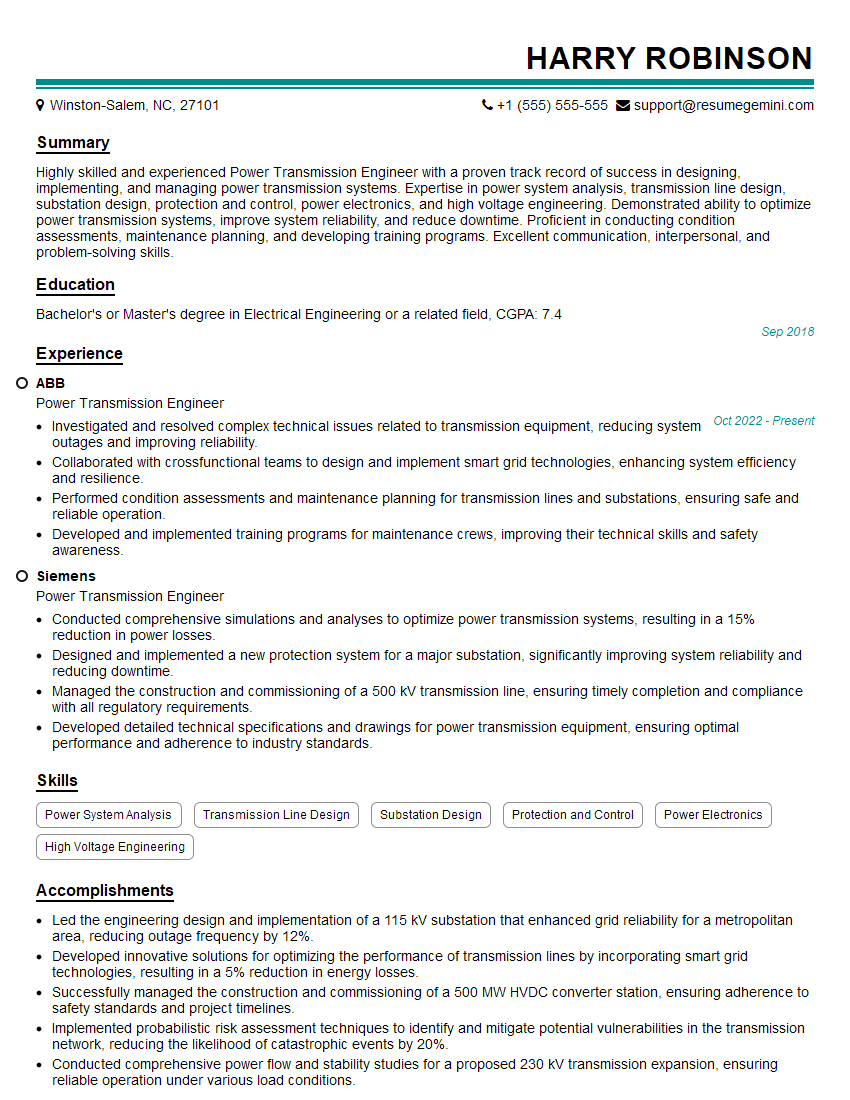
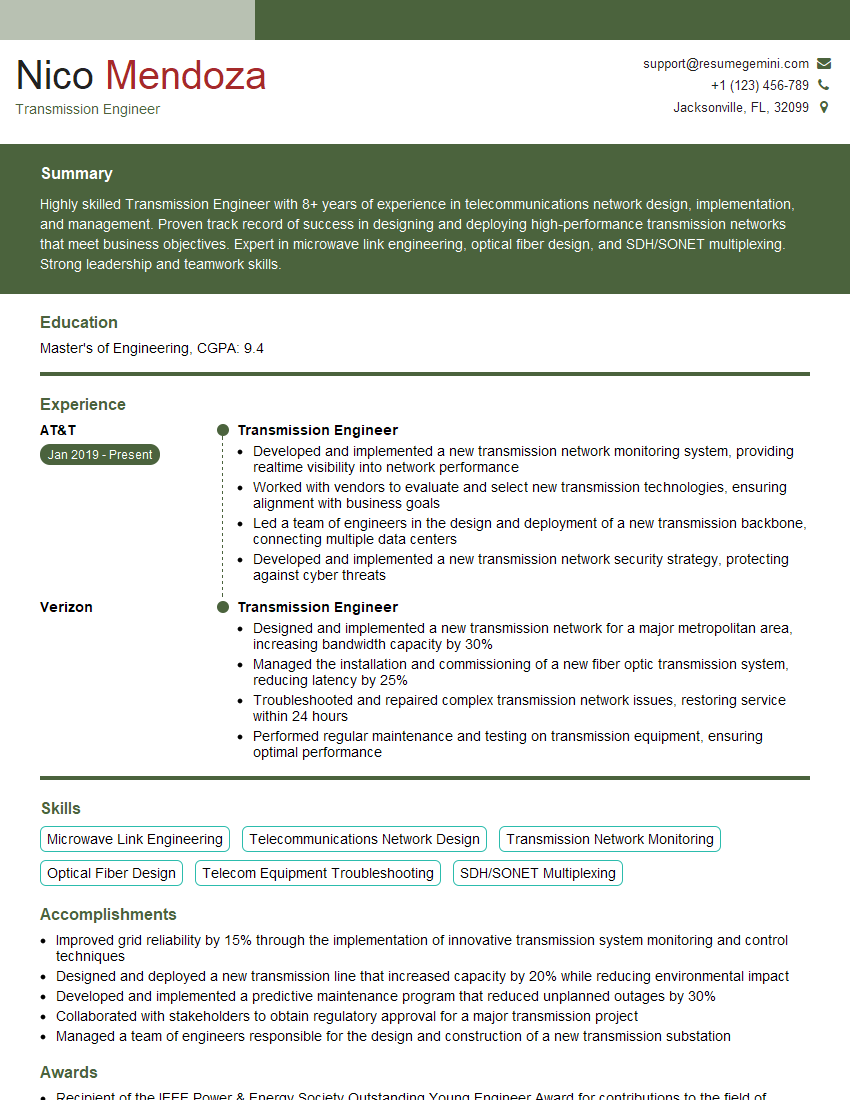
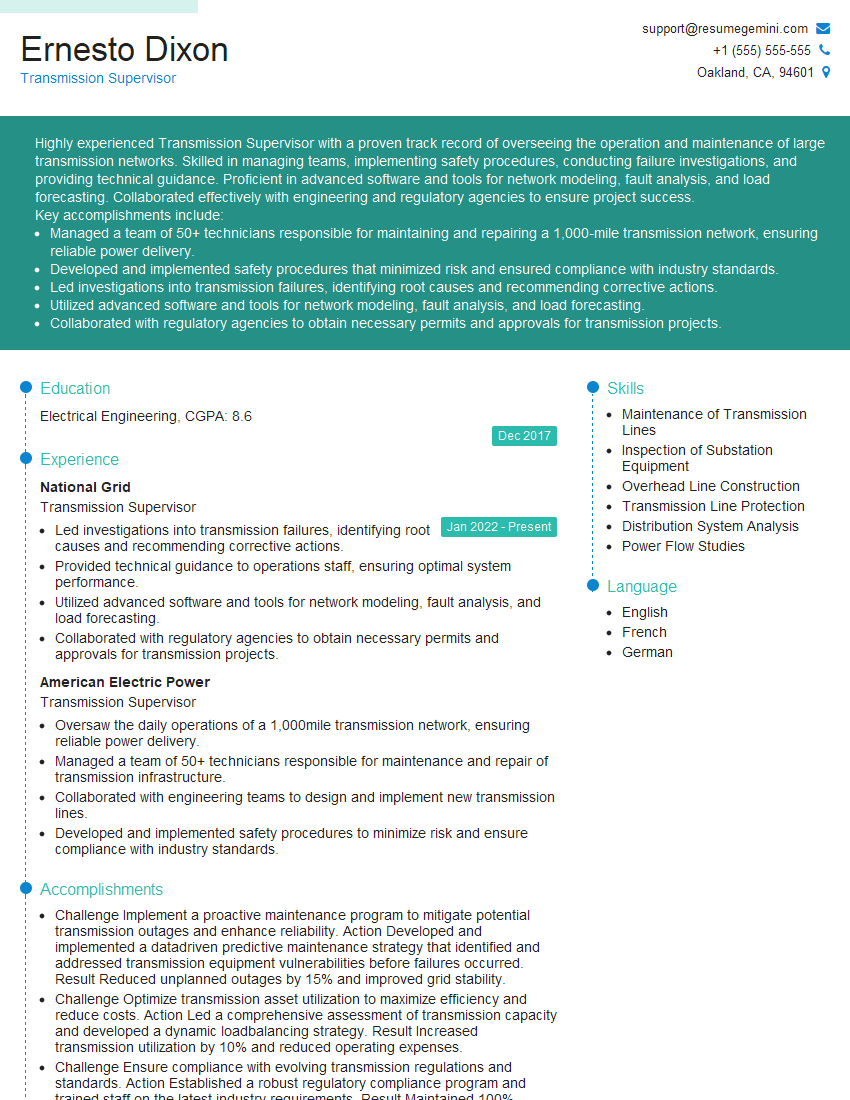
Mastering Transmission principles is crucial for career advancement in networking and related fields, opening doors to exciting opportunities and higher earning potential. To significantly improve your job prospects, invest time in creating a professional and ATS-friendly resume that highlights your skills and experience effectively. ResumeGemini is a trusted resource that can help you build a compelling resume tailored to the Transmission domain. Examples of resumes optimized for Transmission roles are available to guide you. Take the next step toward your dream career today!
Explore more articles
Users Rating of Our Blogs
Share Your Experience
We value your feedback! Please rate our content and share your thoughts (optional).
What Readers Say About Our Blog
Very informative content, great job.
good